My daughter walked into the house in tears and whispered, “Uncle Brad hit me just because I got an A and his son didn’t.”
I looked at the mark on her cheek and felt my whole body go cold, but I did not yell. I did not make a scene. I stayed calm, took a photo, and made one quiet decision that was going to change the balance of my family before anyone understood what was coming.
I can still see that afternoon as clearly as if it were preserved behind glass. It was a Thursday in early fall, one of those Ohio evenings when the light turns thin too fast and the air outside starts carrying the first real edge of cold.
The school buses had already gone through the neighborhood, and I was in the kitchen rinsing strawberries and half listening to the dryer thump in the laundry room when I heard the front door open and then close too softly.
Ava usually came in like she had been fired out of a cannon. Her shoes would hit the mat, her backpack would land somewhere it did not belong, and within ten seconds she would be in the kitchen asking what there was to eat. That day she moved like she was trying not to take up any space at all. Her backpack was hanging off one shoulder, one shoelace untied, her hair slightly stuck to one side of her face, and even from the doorway I could tell something was wrong.
At first I thought maybe she had gotten sick at school. Kids can look strange when they are trying not to throw up, or when they have cried so hard in the bathroom they think no one will notice. But this was different. The red on her face was uneven, concentrated on one side, and when she turned just enough for me to see her profile, I caught the shape of it. Not a scrape. Not a fall. Not the flat flush of embarrassment. A hand had been there.
My mind did what minds do when the truth shows up too quickly. It tried to outrun it. Maybe she had tripped near the curb. Maybe another kid had hit her with a ball on the playground. Maybe she had bumped into the side of a car getting out. I went through those explanations in the space of a breath, offering them to myself before she said a word, because once she said it, whatever life had been a second before would be over.
She did not come to me. She walked past me into the living room, set her backpack down by the couch, and sat with that careful, stiff little posture children have when they are trying to stay in control. Then, like this was any other afternoon in our ordinary little subdivision outside Dayton, she unzipped her bag and started pulling out a math folder.
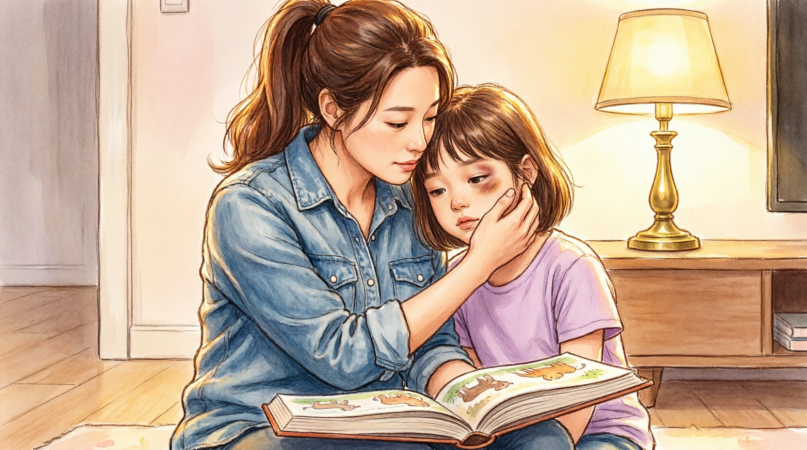
I dried my hands and sat beside her.
She kept her eyes on the folder for a long moment. I could hear the hum of the refrigerator from the kitchen, the dryer stopping in the other room, a lawn mower somewhere down the street, and over all of it that silence that comes before a truth nobody wants. Then she said, very quietly, “Uncle Brad hit me.”
There are sentences that split your life in two. You do not always recognize them when they arrive. Sometimes they sound dramatic. Sometimes they come dressed in ordinary words. This one came in a child’s voice barely above a whisper.
I did not interrupt her. I did not ask, “What?” the way part of me wanted to. I knew if I jumped too fast, she might retreat. So I sat still and let the room stay open around her. After a second she swallowed and added, “Because I got an A on my math test and Jordan didn’t. He said I was showing off.”
Everything inside me went silent. Not empty, not numb, just silent in the way a church can be silent after the doors close. My thoughts stopped moving in full sentences. One thing remained: Brad put his hands on my child.
Brad. Megan’s husband. My brother-in-law by law alone, never by affection. A man I had tolerated for years because families, especially American families in small suburban neighborhoods like ours, become experts at decorating their discomfort. You tell yourself he is blunt. Competitive. Old-school.
Stressed from work. You say he has a rough personality, that he does not mean anything by it, that maybe some men are just bad at warmth. Then Thanksgiving comes, and Christmas comes, and cookouts, Little League games, birthday parties at trampoline parks, and everyone keeps eating potato salad under strings of backyard lights while the one person making the air harder to breathe goes right on being included.
Brad was the kind of man who always needed the room arranged around him. He never raised his voice first. That was part of what made him so slippery. Men who shout from the beginning are easier to identify. Brad preferred the slow method. He corrected people mid-story. He laughed in a way that made the person next to him feel smaller. He had a habit of talking to children like they were tiny employees whose performance he was evaluating.
I had seen him roll his eyes when Ava got excited about books. I had heard him ask Jordan, right in front of her, whether boys in his class found girls who always had the right answer annoying. Once, at a family barbecue, Ava had been explaining a science project she was proud of, and Brad had smiled that dry smile of his and said, “Careful, sweetheart. Nobody likes a know-it-all.”
Everyone laughed, because that is what families do when they do not want to stop the evening. Ava laughed too, but she got quieter after that. I noticed. I always noticed. I just had not yet understood the size of what I was looking at.
Now I did.
I asked her, as evenly as I could, to tell me exactly what happened. She did. Not in a dramatic flood. Not with the exaggeration adults are always accusing children of. She gave it to me plainly, which somehow made it worse. She said she had shown Megan her graded math test because she was happy about it. Jordan had seen it.
Brad had looked at Jordan’s paper, looked at Ava’s, and started making jokes about how some kids liked to rub their success in other people’s faces. Ava said she told him she was not rubbing anything in, that she had only shown Aunt Megan because Megan asked how school was. Then Brad stepped closer, told her not to get smart with him, and hit her across the face.
She said the room went quiet after that. Megan had been in the laundry room. Jordan had stared at the floor. Brad told Ava if she wanted people to like her, she should learn some humility.
I listened without moving. Inside, something ancient and animal was rising through me, but I held it down because she needed me clear. Children can read panic even when you think you are hiding it. I would not make her responsible for managing mine.
I asked whether he had grabbed her anywhere else. She hesitated, then lifted one shoulder. “He pulled me back when I tried to leave,” she said. “Right here.”
I took out my phone.
Some people imagine that when something like this happens, you erupt. You call screaming. You drive across town in a rage. You pound on doors. There is a place for anger. I felt enough of it to power a city block. But anger can burn away the very evidence you need. The moment I saw that mark on Ava’s face, some colder part of me stepped forward. Maybe it was instinct. Maybe it was every article I had ever read, every story I had ever heard about women and children not being believed until it was too late. Whatever it was, it kept my hands steady.
I photographed her cheek in the living room light, then near the window where the angle was clearer. I took one of her jawline when the red began to deepen and one under her chin where I could see another shadow of bruising forming. Then I asked her to show me her shoulder. There it was, faint but coming on fast, the sort of bruise that would look like nothing to someone determined not to see and like exactly what it was to anyone honest.
I documented everything.
Then I told her to put her homework back in her bag because we were going out.
“Am I in trouble?” she asked.
That question nearly undid me. Children ask it far too often after something terrible is done to them, as if the pain itself must have been permission for blame.
“No,” I said. “Absolutely not. You are not in trouble. Not now. Not at all.”
I grabbed my keys, my wallet, and a zip-up hoodie for her because the air had cooled off. We left the house without calling anyone. I did not text Megan. I did not warn Brad. I did not pause to think through whether my sister would feel blindsided. When someone puts hands on your child, their spouse’s feelings become background noise.
The urgent care sat in one of those suburban medical plazas near the highway, beside a chain pharmacy and a frozen yogurt shop that had closed for the season. Inside it smelled like sanitizer and weak coffee. The television in the waiting room was playing a local weather report with the sound off. An older man in a work uniform was holding his wrist. A toddler in pink rain boots was asleep across two chairs. The whole room had that ordinary Thursday feeling that made our presence there feel both surreal and brutally real.
The woman at the front desk took one look at Ava’s face and her expression changed. Not wildly. Just enough. She lowered her voice and said, “Can you tell me what happened?”
I said, “An adult hit her.”
She did not ask whether I was sure. She did not try to soften it. She handed me a clipboard and quietly told us they would get us back as soon as possible.
The nurse who took us in had kind eyes and no unnecessary chatter. She checked Ava’s blood pressure, asked a few gentle questions, and gave me one of those looks women give each other in bad rooms, the kind that says I understand more than I can say right now. The doctor came in a few minutes later, examined Ava carefully, and began using words I was grateful to hear because they were the right words, the words that enter records and stay there.
Suspected abuse.
Minor child.
Non-parental adult.
Visible contusion.
Tenderness.
She asked Ava whether she was comfortable telling her what happened. Ava nodded and repeated the story almost exactly the same way she had told me. No embellishment. No confusion. She even remembered the wording Brad had used about humility. The doctor wrote it down. When she finished, she told me they were required reporters. I said, “Good.”
That seemed to surprise her for half a second, and then it did not. She understood what kind of mother she was looking at.
On the way out, after the paperwork was printed and the instructions were tucked into the folder, Ava asked me again whether Aunt Megan was going to be mad at her. I was standing beside the automatic doors with the cold evening air just beyond the glass, and for one weak second I wanted to lie. I wanted to tell her no, of course not, that all the adults would instantly line up on the side of truth and safety. But I had lived inside my family long enough to know better.
“I don’t know,” I said carefully. “But none of this is your fault.”
We got into the car and I did not head home right away. I drove without really seeing the roads, through the shopping center, past the gas station, past the little public library branch, through the Kroger parking lot where carts rolled loose in the wind. Finally I parked in a far corner near the garden center and turned off the engine.
Then I made three phone calls.
The first was to county child protective services. My voice sounded strange to me, almost too measured, as if I were reciting directions. I gave them Brad’s full name, Megan’s address, my daughter’s statement, the urgent care visit, the doctor’s report. The person on the other end asked questions in a practiced tone, and I answered every one of them. Before we hung up, she said someone would follow up quickly.
The second call was to a lawyer I had met the year before through a friend at church, a woman who handled family law and had the kind of reputation that made people sit straighter when her name came up. I had once watched her across a folding table at a fundraiser, and she carried herself like someone who had no interest in being liked when being effective would do. She listened, asked where I was, and told me she could come by the house the next morning.
The third call was to an old neighbor, a retired Marine turned law enforcement officer who had moved out of our cul-de-sac a year earlier. I had not spoken to him in months, and I did not ask him for anything improper. I simply told him what happened and asked what steps I needed to take to keep this from becoming one more family matter that got talked down until it disappeared. He told me to keep every record, save every text, write down the timeline while it was fresh, and do not let anyone persuade me that quiet would be kinder.
“Predators count on people protecting the family image,” he said. “Do not do his work for him.”
I wrote that down on the back of a grocery receipt.
When we finally went home, the house felt altered. The same lamp was on in the living room. The same dish towel was hanging by the sink. The same mail sat unopened on the counter. Yet everything in it had shifted because I had crossed an invisible line from suspicion into action, and once you cross that line, there is no walking back into the life you had before.
That night Ava asked if she could sleep with me.
She was too old to ask in the way little kids do, casually, like it is all comfort and no shame. She asked with the awkwardness of a child trying to be brave, which broke my heart in a new place. I told her yes before she finished the sentence. She brought her blanket and her stuffed dog from when she was smaller, the one with one stitched eye slightly higher than the other, and climbed into bed holding herself with a tension that said she had been holding herself that way since it happened.
She fell asleep with one hand wrapped around my wrist.
I did not sleep at all. I lay there in the dark staring at the ceiling fan, replaying years of little moments I had brushed aside. Brad teasing. Brad watching. Brad choosing Ava for the sharp joke because she was bright enough to react and young enough to doubt herself. I remembered a Fourth of July cookout when he had told Jordan, in front of everyone, that losing was what happened when boys acted soft. I remembered Megan laughing too quickly afterward, the kind of laugh women use when they are trying to patch a rip in the room before anyone sees it.
I also remembered the ways my sister had changed after marrying him. Smaller clothes, quieter opinions, a habit of checking his face before finishing a sentence. If you had asked me back then whether I thought he was hurting her, I might have said no. If you had asked whether I thought he was controlling, I would have said probably. I knew enough to distrust him. I had not known enough to call it what it was.
By morning I had a notebook on the kitchen table with times, dates, exact phrases, names, and every step I had taken so far. The lawyer arrived with a leather tote and a face that told me she had already decided how serious this was. She did not waste my time with soothing language. She went through the photos, the urgent care paperwork, the CPS call, and Ava’s account. Then she looked at me and said, “You did the right things in the right order.”
It should not have mattered as much as it did, but it did. When you are moving through something like this, you are aware of how easily people can make you feel irrational. Hysterical mother. Family grudge. Overreaction. Hearing a professional say otherwise steadied me.
She explained what was likely to happen next. Interviews. Home visit. Possible law enforcement involvement. Temporary orders if the evidence supported it. She also warned me, with the bluntness I appreciated, that the family would probably become its own secondary problem.
“They always do,” she said. “People will tell you not to ruin everyone’s lives. Nobody says that to the person who caused the damage.”
She was right.
Over the next two days I did not speak to Megan. She texted asking whether Ava was coming over that weekend because she and Jordan had planned a movie night. I left it unanswered. She called once. I let it ring. I was not interested in giving anyone a chance to shape the story before the official record did its work.
On the third day I got a call from child services telling me Ava had already been interviewed at school by a caseworker in a private office with the counselor present. They said a home visit had been scheduled for Megan and Brad’s house that afternoon. The woman on the line was careful with what she shared, but I did not need details. I knew enough.
Late that day I heard raised voices outside and went to the front window. From there I could see the edge of my sister’s front lawn across the street. Brad was outside in pajama pants and a T-shirt, barefoot on the grass, and he was crying.
Not angry-crying. Not performative outrage. Real, messy, panicked crying, down on his knees like the world had suddenly turned into a place where other people made the rules. Megan was behind him on the porch, pacing and shaking, her phone in one hand. For a second I wondered whether she was calling me or calling him a lawyer or calling nobody because she did not know which direction her life was falling.
I stepped onto my own porch and stood there.
Brad looked up and saw me. Whatever he said then got lost in the distance and the wind, but I could tell the shape of it. Pleading. Explaining. Bargaining. Men like him always believe there is a version of the story that will put them back at the center. I did not wave. I did not react. I simply stood there and let him understand, maybe for the first time in his life, that I was not going to help him.
That, I would later realize, was the first crack in his confidence.
The next morning Megan came to my door.
No text. No warning. Just a knock.
When I opened it, she looked like she had been pulled through the night backward. No makeup, swollen eyes, old gray hoodie, hair shoved into a loose ponytail. She stepped inside as if the air outside was too thin to stand in and stopped in the middle of my living room.
I did not ask if she wanted coffee. I did not ask her to sit. The house was quiet except for the dishwasher running in the kitchen and the low hum of the heater kicking on.
She looked at me and said, “Is it true?”
I knew exactly what she meant, but I made her say it.
“Did Ava really say that?” she asked. “Did Brad really hit her?”
“Yes,” I said.
Then I told her precisely what Ava had told me. I did not add emotion for emphasis. I did not take anything out to protect her. I gave her the facts in a voice so flat it sounded almost cold, and maybe that was mercy, because if I had let any more feeling into it, we would have crossed into a different kind of conversation.
She stood there blinking at me as if comprehension were arriving in pieces. Then the excuses came, the way they always do when a woman is trying to buy time for the version of her life she thought she was living.
“Maybe she misunderstood.”
No.
“Maybe Brad was being stupid and it looked worse than it was.”
No.
“He jokes sometimes and—”
“No,” I said again, and that time I let the word stay in the room.
I went to the drawer where I had put the printed photographs and handed them to her in an envelope. She took them with fingers that already seemed to know what they were about to touch. She looked at the first image, then the second, then the one of Ava’s shoulder.
She did not sit down. She just stood there under the living room lamp flipping through proof of her own marriage.
When she finally spoke, it was so quiet I almost did not catch it.
“I don’t even know who he is anymore.”
I did not comfort her. I know that sounds cruel. But there are moments when comfort functions like anesthesia, and I was not going to numb this for her. She needed to feel every sharp edge of it.
After a long silence she looked up and said, “Why didn’t you come to me first?”
There it was. Not whether Ava was okay. Not whether I needed anything. Not how quickly it had happened. Why I had bypassed the private family route and gone straight to records, reporting, and law.
Because I knew how families work.
Because I knew that by the time one sister finishes asking another sister what really happened, ten emotions have already stepped in front of the truth.
Because I knew a man like Brad would use every minute of delay to rearrange the room.
But what I said was, “I needed to protect my daughter, not Brad’s reputation.”
She flinched. Good.
“I didn’t have the luxury of waiting to decide whether it was true,” I told her. “It was true. I had proof.”
She left without saying goodbye.
That afternoon I got a call from a detective. Child services had forwarded the medical notes, the photos, and Ava’s statement. They were moving forward. He asked whether I still had the clothes Ava wore that day. I did. He asked me not to wash them. I found the outfit in the hamper, sealed it in a large plastic bag, and put it in the hall closet like evidence from a television crime show, except this was my actual life and my daughter’s actual skin.
By Friday, Brad had a lawyer. I was not surprised. He was exactly the kind of man who believes charm is strategy and strategy is innocence. I could already imagine the picture he would paint. Ava was sensitive. I was dramatic. There had been tension between us for years. He had been trying to discipline a difficult child. He had been misunderstood. Men like Brad do not see truth as fixed. They see it as a contest of who can sound calmest while the other person looks emotional.
By Sunday the whispers started moving through the family like smoke under a door.
My aunt called first. She did not come right out and say she doubted me. She did something subtler and, in some ways, uglier. She used the voice people use when they would like you to help them pretend something is still manageable.
“I heard something happened with Ava and Brad,” she said. “And maybe CPS got involved?”
She paused there, offering me the opening to soften it.
I did not take it.
“Yes,” I said.
Another pause. Then, “Well, I’m sure there are two sides.”
I looked out the kitchen window at the maple in my backyard, already starting to turn, and felt a clarity settle over me that would stay for the rest of this ordeal. There are people who want truth, and there are people who want comfort. In family crises, those are rarely the same people.
“Don’t call me again unless it’s about Ava,” I said, and hung up.
Then came the texts. One cousin said she hoped I was not blowing things out of proportion because this could ruin lives. Another wanted to know whether maybe Ava had misunderstood Brad’s meaning. She even wrote, “Kids exaggerate. Sometimes discipline gets taken out of context.”
I stared at that message for a long time. Discipline. That clean little word people use when they want to put a ribbon around harm. I did not answer either of them.
Instead I focused on Ava.
She was quieter than usual, but not in a broken way. It was the kind of quiet that comes when a child’s trust has been rearranged and she is trying to understand which parts of her world are still stable. She asked practical questions. Would she have to go back to Megan’s house? Did Jordan know what happened? Could she tell him she was sorry his dad got in trouble?
That last question told me everything about who she was and why men like Brad target children like her. She was still trying to carry everyone else’s weight.
“You do not owe anyone an apology,” I told her. “Not Jordan. Not Aunt Megan. Not anybody.”
School made things worse before it got better.
Jordan told a couple of kids that Ava lied about his dad. One of them repeated it near the monkey bars at recess. A teacher overheard enough to step in, and later that afternoon Ava told me about it in the car with the same tiredness she had been carrying since Thursday. She did not cry. That almost made it harder.
The next morning I drove to the school myself.
The building was one of those low brick suburban schools with paper pumpkins taped in the front office windows and a faded sign by the curb reminding parents not to idle in the pickup lane. I sat across from the principal in a chair too small for adult anger and explained exactly what had happened, where the case stood, and what kind of protection Ava needed from rumor and retaliation.
The principal said all the right things. They would monitor. They would support her. They would speak to Jordan in an age-appropriate way. They would make sure teachers were aware.
I appreciated it. I also knew small American schools in small American communities have their own currents. Stories stick to children before facts do. Adults say they do not gossip, then repeat half a sentence in a parking lot by the baseball fields and call it concern. I was not going to let my daughter become easier to manage than the truth.
When I walked back out to the parking lot, I sat in my car for a minute with both hands on the steering wheel. The sky had gone hard and bright. Somewhere beyond the football field a lawn crew was blowing leaves against a chain-link fence. Normal life was moving along, exactly as it always does when someone else’s world has cracked open.
That was when I understood something that would matter later. I had not just reported one slap. I had declared war on every quiet bargain my family had ever made with bad behavior. People were going to resent that more than they resented what Brad had done.
They were also going to learn I did not care.
If anything, I was just getting started.
Three days after the home visit, and the sight of Brad on his lawn crying like a man who had finally run out of tricks, Megan texted me out of nowhere.
Can we talk? Just us.
I stared at the message longer than I wanted to admit. By then I had developed a reflexive tension every time her name lit up my screen. I expected denial. Bargaining. Some soft, desperate version of don’t do this, not because she believed he was innocent, but because a whole life can be built around pretending a certain truth is too expensive to face.
Still, something about the wording felt different. There was no defense in it, no explanation, no “you know Brad.” Just a request, stripped down and uneasy, like someone standing at the edge of a room she no longer recognized.
I told her we could meet.
I picked a diner halfway between our houses, one of those old roadside places that had survived two remodels and somehow still looked like every Midwestern diner I had ever known. Cracked red booths, pie case by the register, coffee that tasted burned no matter how fresh it was, a waitress who called everybody honey and never wrote anything down. It was public enough that nobody could stage a scene, private enough that two sisters could sit under weak yellow lights and let a marriage die in plain sight.
Megan was already there when I walked in. She had chosen the booth in the back corner near the window, where the blinds were half open and the late afternoon light laid thin stripes across the table. Her coffee sat untouched. She looked like she had been up for days, and maybe she had. Her eyes were swollen, the skin under them bruised with exhaustion. She had pulled her hair back, but strands had already come loose around her face.
I slid into the seat across from her and set my purse beside me. For a second neither of us spoke. The waitress came by, filled my cup, asked if we needed a minute, and moved on without that extra little linger some people do when they sense grief and want to see more of it.
Then Megan said, without preamble, “I asked Brad to leave.”
I did not react right away. Not because I wanted to punish her with silence, though maybe part of me did, but because I had expected resistance and she had shown up with something much more dangerous. The truth.
She kept talking, as if she had rehearsed it in the car and knew if she stopped, she might lose nerve.
“I couldn’t stop seeing the photos,” she said. “I couldn’t stop hearing what you said. I went home that night and waited until he fell asleep. Then I took his phone.”
That made me sit back.
She told me she had opened it because she needed one last chance to prove to herself that this had somehow been a misunderstanding. That maybe Ava had exaggerated, or maybe I had filled in the worst version because I never liked him. She needed, in her own words, something that would let her stay married to the story she had been telling herself.
Instead she found text messages.
Screenshots of Jordan’s report card. Complaints to a coworker. Little mean jokes that stopped feeling little once they were laid out in sequence. Brad had written that Ava was “going to ruin that boy’s confidence” if someone did not do something about her. In another message he had called her “that smug little genius.” Then there was the line that made Megan go cold: She’s got that slapworthy kind of face.
She said when she read it, she sat on the bathroom floor with the phone in her hand for almost an hour. Not crying. Not thinking clearly. Just sitting there while the whole architecture of her marriage shifted around her.
Across the table from me, she rubbed her thumb over the rim of the coffee cup and stared down into it. “For the first time,” she said, “I was actually scared of him.”
The diner was filling up around us by then. A father in a Browns jacket was cutting pancakes for a little girl in the next section. An older couple near the register was splitting a slice of coconut cream pie. The waitress turned the volume up on the television over the pie case because the local news was starting. It struck me then how ordinary everything looked, how American and familiar and safe it all was, while my sister sat there admitting she had built a home with a man she now feared.
I asked, “Was this the first time?”
She shook her head, but not in answer to the question I had asked. More like she was already arguing with herself.
“No,” she said finally. “No. Not really.”
Then the rest of it came out.
She told me Brad had hit Jordan twice that she knew of. Once after Jordan spilled cereal across Brad’s laptop before school. Another time after a Little League game where Jordan struck out twice and the team lost. Brad had called him weak, shoved him hard enough that he hit the wall, and then told him that if he cried, he could forget baseball altogether.
She had seen the bruise on Jordan’s side that night. She had asked where it came from. Jordan said he had bumped into the hallway table. She let herself believe it because the alternative would have required action, and action would have blown up everything.
“I told myself it wasn’t that bad,” she said. “I told myself he was stressed. I told myself I was protecting Jordan by keeping things calm.”
She laughed once then, sharp and empty. “I wasn’t protecting anyone.”
I looked at my sister and saw, maybe for the first time in years, the woman she had been before Brad. Not because she had become herself again overnight. That is not how it works. But because the performance was gone. The smoothing-over. The automatic defense. She looked wrecked, yes, but she also looked briefly honest in a way I had not seen from her since before the wedding.
“Why didn’t you say something?” I asked.
She did not flinch from it. “Because I thought people would think I was overreacting,” she said. “Because every time I almost did, he’d act normal for a week and I’d tell myself I imagined the worst of it. Because I thought if I left, I’d lose Jordan half the time. Because I thought if I kept the peace, I could manage him.”
She paused and swallowed.
“And because somewhere along the way, I got used to living around his moods and started calling that love.”
That sentence stayed with me.
I asked if she would testify.
She said yes immediately.
Not maybe. Not if she had to. Yes.
The next day she called the detective and gave a full statement. She told them about the messages on the phone, the incidents with Jordan, the way Brad talked about Ava like she was some kind of rival instead of a child, the atmosphere inside the house that I had sensed for years but never had words for. She did not trim it down. She did not protect herself by making it smaller. She gave them everything.
That changed the case overnight.
The detective called me that afternoon and asked if Ava could come in for a forensic interview with a specialist trained to talk to children about trauma and abuse. I explained it to Ava as gently as I could. She listened, thought for a second, and then nodded. “Okay,” she said. “I can do that.”
The interview took place in a child advocacy center painted in colors meant to calm people. There were toys in one corner, low bookshelves, a basket of stuffed animals, and murals on the walls of birds and trees and smiling suns, as if softness could offset what children were brought there to describe. The woman who interviewed Ava had a voice so steady it seemed to lower the temperature in the room. I waited on the other side of a closed door, staring at a fish tank and trying not to imagine too much.
When it was over, the interviewer came out and told me Ava had done very well. It was a strange phrase for a child recounting fear, but I knew what she meant. Ava had been clear. Consistent. Brave.
Later, when the detective summarized part of the interview for me, I learned more than I had known.
Ava told them Brad had a habit of separating her from Jordan during visits, especially when she was doing well in school and Jordan was struggling. She said he joked that smart girls grew up to be lonely women nobody wanted around. She told them about one evening the previous winter when he locked her outside in the cold for answering a math question faster than Jordan during dinner. Only for a few minutes, he had called it. Just long enough to “cool off.”
She told them he had once grabbed her wrist so hard she dropped her fork. After that she did not want to eat. She told them she had tried to avoid being alone in a room with him when she was at Megan’s house, but she did not want to tell me because she thought it would make family gatherings harder.
I sat in my car after hearing all that and put my forehead against the steering wheel.
That is one of the cruelest things about abuse involving children and family. They start trying to manage the adults around them. They make themselves smaller. They absorb discomfort so the room can keep functioning. Then adults call them resilient, when really they are just carrying more than they ever should have had to.
Within a day, a no-contact order was issued. Brad was barred from contacting or being around Ava or Jordan. Megan filed for emergency custody. When he was served, he showed up at the house in some great final display of wounded authority, tried to force his way inside to “talk,” and a neighbor called the police before Megan even reached the door. They removed him from the property and made it clear there would not be much patience left if he tried that again.
He was losing control, and men like Brad do not experience that as a correction. They experience it as an attack.
While all of that was happening, I was building in the background.
I was not waiting to see whether the state would move quickly enough or thoroughly enough. I was on the phone with my lawyer almost every day. We started discussing a civil case in case the criminal one stalled or got pleaded down into something insulting. We built timelines. We organized documents. Megan, once she crossed into honesty, became almost frighteningly useful. She gave me passwords, screenshots, copies of email threads, even a voice memo she had recorded months earlier during an argument when she thought she might need proof of the way he talked to her.
In that recording, Brad was calm. That was the thing about him. He was rarely the screaming type in ways outsiders could hear. He sounded composed, almost bored, while he told her no court would believe her over him. He told her she was emotional, unstable, too dependent to leave. He told her that by the time anybody listened, he would already have the story told.
Listening to it made me understand how women end up doubting reality while standing fully inside it.
Jordan changed too, once the distance from Brad widened enough for his nervous system to notice. The school counselor called Megan after he blurted out that he did not want to go back to his father’s house. He said he had nightmares. He said he could not sleep unless his bedroom door was locked. He said sometimes when he heard footsteps in the hallway, his whole body tensed before he even woke all the way up.
That was when the language from investigators shifted. The phone calls stopped sounding preliminary. The words alleged and misunderstanding began disappearing from emails. It was no longer being treated like one ugly moment. It was what it actually was: a pattern.
Brad, meanwhile, still believed he could control the narrative.
Through my lawyer I learned that he had filed paperwork claiming I was manipulating Ava. According to him, I had exaggerated her injuries, coached her statements, and used the situation to settle a personal grudge because I had never liked him. He also implied that Megan was emotionally unstable and being influenced by me. Reading those pages felt like looking at a cartoon version of a woman he hoped a judge would find easier to distrust than himself.
I will give him this: he understood the old playbook. Cast the mother as hysterical. Cast the sister as confused. Cast the child as suggestible. Reframe violence as parenting. Suggest the truth is messy enough that everyone should back away and let the respectable man continue speaking.
But by then, too many people had seen too much.
Megan forwarded his filing to the detective without comment except for one line: I’m ready to add to my statement.
The next turn came from a place neither of us expected.
Late one night an old friend of Megan’s reached out. They had not talked in years. She had seen some vague mention online that Megan was going through something and needed support, and Brad’s name alone had set off something in her memory. Not because of a recent rumor. Because years earlier Brad had dated her younger sister, back before Megan ever met him.
At first the sister did not want to talk. She said she had put that chapter away. She had built a life, gotten married, moved to Indiana, and did not want to dig up an old version of herself she barely recognized. But once she heard Ava’s name and Jordan’s, the old fear came back with a sharpness she could not ignore.
When she finally spoke to us over the phone, I understood immediately that Brad had been practicing this pattern for a very long time.
She said he used to mock her intelligence in public and then tell her she was lucky he put up with her. He would isolate her from friends under the guise of helping her avoid “bad influences.” During arguments he would stand too close, talk softly, and say things designed to make her sound crazy even to herself. Once he shoved her into a doorframe and then insisted she had lunged at him first. Another time he took her car keys because she was “too emotional to drive” and then laughed when she cried.
Most important, she still had a notebook from that time. Actual pages in her own handwriting, dated, describing incidents that sounded sickeningly familiar. The humiliation. The control. The tiny punishments. The conviction that other people existed only as surfaces on which he could restore his own ego.
Our lawyer moved fast. She prepared a sworn statement and submitted it as evidence of prior behavior, not to try him for old acts that were never reported, but to show pattern and intent. Brad’s world had depended on every previous woman choosing survival over exposure. He had mistaken that for immunity.
Then he made his worst mistake.
Ava came into my room one night holding her tablet like it was something contaminated.
“Somebody called me,” she said.
I took the device. The number was unfamiliar. She said she had answered because she thought it was a friend from robotics club using a parent’s phone. It was Brad.
Even now I hate imagining his voice entering my house through that screen.
Ava said he told her adults were confused. He said if she would just tell them she had made a mistake, everything could go back to normal. He said he was sorry if she got scared. He said he missed her. That last part chilled me in a way I still cannot fully explain. Not because it suggested affection. Because it revealed the depth of his entitlement. Even then, with the walls closing in, he still believed he had a right to reach into my child’s mind and arrange her reality for his benefit.
She hung up on him. Then she started shaking so hard I could hear her teeth click.
I called the detective immediately.
The number was traced to a prepaid phone bought with cash two days earlier. That detail mattered. It showed planning. Secrecy. Conscious violation. The judge did not need much more than that. Brad was arrested the following afternoon for violating the no-contact order and attempting to influence a minor witness.
Megan called me afterward.
Her voice sounded scraped raw. She said he had been crying in the driveway while they put him in the police car, begging her to tell them it was a misunderstanding. Begging her to say he had only been trying to apologize. Begging like men beg when the consequences finally become public and they realize tears are the last currency they still possess.
“I didn’t go outside,” she said.
“Good,” I told her.
That arrest cracked the whole case open.
The prosecutor amended the charges. Child abuse. Witness tampering. Aggravated intimidation. Violation of a protective order. Suddenly the conversation was no longer about anger management classes or supervised parenting time or family counseling. It was about sentencing exposure. It was about prison.
The first time someone mentioned ten years, I sat very still.
Not because it felt excessive. Because it felt real.
I had spent the first stretch of this ordeal moving with the kind of focus that leaves no room for emotional forecasting. Do the next right thing. Protect the child. Preserve the record. Manage the family fallout. It was only when prison became part of the conversation that I understood how far this had moved beyond the private, manipulative territory Brad preferred. The state was now speaking to him in the only language men like him ever truly fear: loss of power.
The arraignment was held in a county courtroom so cold I wished I had worn thicker tights. Megan and I sat on one of the hard benches behind the prosecution table. The fluorescent lights made everyone look tired. The walls were that pale institutional beige that seems designed to strip all personality out of a room. Brad came in wearing a dark suit, freshly shaved, like he was attending a business meeting where professionalism alone might save him.
He did not look furious. He looked patient, which somehow made him appear more dangerous. As if part of him still believed the adults would eventually clear the children from the room and let him explain.
He pled not guilty.
His attorney, a smooth man with silver hair and an expensive tie, stood up and delivered a speech so practiced it might as well have come off a template. Family tensions. Emotional misunderstandings. Different households, different parenting styles. A bright child perhaps confused by adult discipline. A mother perhaps overreacting under the strain of existing family dynamics.
Listening to him was like listening to someone use polished silverware to carve up the truth.
The prosecutor did not rise to the performance. She simply stood and started laying out the record.
Not everything. Not yet. Just enough to let the judge see what this was.
They entered still photographs from the urgent care visit. The timestamps matched the day of the incident. The doctor’s report was entered. Then came security camera footage from a neighbor’s house showing Ava leaving Megan’s home that day, walking down the driveway with one hand against her face, shoulders hunched, movement wrong in the unmistakable way of a child trying not to fall apart before she reaches safety.
Then they brought up the phone call. The burner. The violation of the no-contact order. The attempt to get Ava to “help” him.
The judge asked whether the call was made after the order had been served. The detective confirmed it was.
That was the first visible shift in the room.
Brad’s attorney adjusted his tie. The clerk stopped typing for a second. Brad himself did not turn around, but the angle of his shoulders changed. It was slight. Still, I saw it. That was the moment the story he had built for himself stopped feeling solid.
Then the prosecution introduced the sworn testimony from the woman he had dated years before Megan. Her statement described the same pattern now emerging from every direction: the belittling, the isolation, the controlled voice, the private punishments, the insistence that everyone else was unstable and he alone was reasonable.
One line from her testimony lodged itself inside me and never left: He never yells. He just breaks you down slowly until you forget who you were before you met him.
When Megan took the stand, I felt my lungs tighten.
I did not know what version of herself she would bring into that courtroom. The sister trying to repair her own conscience. The mother trying to save her son. The wife still half loyal to the ruins of her marriage. Maybe all of them.
But what sat in that witness chair was a woman who had finally gotten too tired to lie.
She admitted she had ignored things she should not have ignored. She admitted she had believed Brad when part of her knew something was wrong. She described the messages on his phone, the bruise on Jordan, the night he screamed at their son after a baseball loss, the way he talked about Ava like intelligence in a girl was some kind of insult to his household.
She did not spare herself. That mattered more than I can explain. Courts hear polished outrage all the time. What they trust more is the shape of remorse when it is honest.
Then she said, in a voice that shook only once, “I thought I could protect my son better by staying. I was wrong.”
After that, the room belonged to the truth.
The prosecutor rested. Brad’s side asked for time. We left the courthouse into a hard gray afternoon with dead leaves skittering across the parking lot, and for the first time since this started, I believed he might actually lose in a way he could not negotiate around.
We waited three more days.
Those three days felt longer than the previous three weeks. Every phone buzz made my body tighten. Every time an unknown number appeared, my pulse jumped. I kept expecting some technicality, some procedural delay, some ugly compromise that would allow him to call himself punished while staying dangerously close to the edges of our lives.
Then the offer came.
Ten years on the table. Felony child abuse. Witness tampering. Intimidation. Violation of a protective order. Brad’s attorney pushed for less. Five years. Parole eligibility sooner. Counseling. Structured conditions. The familiar softening language men like Brad hope will translate private cruelty into treatable stress.
The prosecutor did not move.
Ten years or trial.
And Brad took the deal.
No trial. No dramatic testimony under cross-examination for Ava. No chance for him to keep dragging us through months of hearings hoping someone would break. Ten years, with parole eligibility after eight. Permanent protection orders for Ava and Jordan. Loss of custody. No contact. No loopholes.
When my lawyer called to tell me, I was parked outside Ava’s school in the same pickup line lane where I had spent so many ordinary afternoons before any of this. Kids were spilling out of the building with backpacks and instrument cases and soccer cleats. Somewhere inside, Ava was at robotics club, probably hunched over some little wheeled machine with three other kids, thinking about sensors and teamwork and maybe what she wanted for dinner.
I sat there with the phone pressed to my ear and stared through the windshield while the enormity of it settled over me.
Not victory. I hate that word in stories like this. There is no victory in discovering what a man was willing to do to children under the shelter of family. There is only interruption. Exposure. Prevention. Relief.
Still, when I hung up, I cried.
Not loudly. Not dramatically. Just enough to feel the pressure inside me begin to loosen. Just enough to let my body understand what my mind had been refusing to trust: he was not coming back into our orbit.
That night, after Ava came out of school with her backpack bouncing against her coat and climbed into the passenger seat, I told her.
I kept it simple because children deserve simple truths when the world has already asked too much of them.
“He’s not coming back,” I said. “You’re safe. You do not ever have to see him again.”
She sat quietly for a moment with both hands in her lap. Traffic from the pickup line inched forward. A crossing guard in a neon vest raised one hand for a row of kids on scooters. Somewhere behind us somebody tapped their horn too impatiently. Life, as always, kept behaving like life.
Then Ava asked, “Can we get pizza?”
I laughed, and it came out sounding more fragile than I intended. “Yes,” I said. “We can absolutely get pizza.”
We went to the little local place in the strip mall near the hardware store, the one with the red vinyl booths and the framed black-and-white photos of old Dayton on the walls. Ava ordered pepperoni, garlic knots, and a slice of chocolate cake she was too full to finish but insisted on getting anyway because, in her words, “It feels like cake kind of news.”
I let her have all of it.
There is something holy about ordinary appetite returning after fear. The sight of her reaching for a garlic knot, complaining that the cheese on one slice had slid too far to one side, telling me about a girl in robotics club who always wanted to be team leader even when she had no plan, did more for my nervous system than a thousand reassuring speeches ever could. Trauma narrows the world. It makes every room feel like a waiting room. That night, in a pizza place with sticky menus and too many neon beer signs, the world widened by one inch.
The next day Megan sent me a photo.
Jordan was standing in the backyard holding a baseball bat almost as tall as he was, wearing a new team jersey and smiling in that shy, uncertain way of a child not yet convinced he is allowed to be happy in public. Megan wrote, He asked if he could try out again now that things feel quieter.
I stared at the picture for a long time.
Quiet is an underrated miracle. People talk about healing as if it arrives in big cinematic breakthroughs. It does not, not usually. It arrives in the absence of slamming doors. In a child sleeping with the bedroom door cracked open instead of locked. In homework done at the kitchen table without someone breathing criticism across from you. In a baseball glove left by the back door because the kid who owns it believes there will, in fact, be another game.
The rest of the family went mostly silent after the plea.
A few people texted apologies. My aunt sent one of those vague messages people write when they want forgiveness without the humiliation of naming what they did. A cousin said she had not understood the whole situation and hoped we could move forward.
Another one wrote that she had been “praying for all involved,” which sounded to me like the coward’s version of accountability, but by then I did not have much interest in grading anyone’s effort. Silence was fine. Distance was fine. I had discovered, in a very practical way, that family can be both blood and weather. Sometimes it shelters. Sometimes it only teaches you how to close your windows.
In the weeks that followed, the neighborhood settled around the new reality the way neighborhoods do. The mail still came. The school bus still stopped at the same corner. Leaves gave way to the first hard frosts, then to Christmas lights clipped onto gutters all down the street. Brad’s house, or what had once been Brad’s house, looked different almost immediately. Not because the siding changed or the porch got repainted. Because menace leaves a shape in a home, and once it is gone, even grief looks lighter.
Ava laughed again.
Not all at once. At first it came in careful bursts, a little snort at something on television, a genuine grin when the dog from next door chased a squirrel into a hedge, the quick bright smile she gave me when she solved something faster than I did. Then one evening while I was making spaghetti, she came into the kitchen and said she thought she wanted to join Mathletes.
For a second I just stood there with a wooden spoon in my hand.
She had spent weeks trying not to appear too smart. I saw it even before she said it. She second-guessed answers she knew. Shrugged off compliments from teachers. Lowered her voice when she talked about school. She was not only recovering from fear. She was trying to renegotiate the very trait that had made Brad target her in the first place.
So when she said, almost casually, “I think maybe I want to do Mathletes if sign-ups are still open,” I had to blink fast.
“Then you should do Mathletes,” I said.
She leaned against the counter and picked at the label on an apple. “Do you think Jordan could come watch one sometime?” she asked.
Only Ava would make it this far and still be thinking about the boy who had lived under the same roof as the man who hurt her. That was another thing about children. They can keep tenderness alive in places adults would salt over.
“I think he’d like that,” I said.
Megan and I did not speak much in the first two weeks after sentencing. Not because there was conflict. We were just exhausted in a way that had nothing to do with sleep and everything to do with the body finally understanding it is no longer allowed to run on pure alarm. When we did see each other again, it was at her kitchen table on a gray Saturday morning with coffee steaming between us and a silence that no longer felt hostile.
There was no dramatic reunion. No tears. No speech about sisters finding their way back. She simply slid a mug toward me and asked if I wanted to help her go through some of Brad’s boxes in the garage.
“Yes,” I said.
The garage smelled like cardboard, motor oil, and old winter coats. Brad had been the kind of man who saved paperwork in labeled folders as if administrative neatness could substitute for moral order. We found bank statements, printouts of emails, old warranties, tax documents, even Little League schedules he had highlighted and annotated. Under one stack of utility bills Megan found a folder containing Jordan’s report cards from the previous two years.
At first glance they looked like any parent’s records. Then we saw the notes.
Brad had circled grades in red pen. Beside a B-minus he wrote, Lazy. Beside a missed assignment, Embarrassing. Next to a teacher comment about Jordan being distracted in class, he had written, Needs consequences. There were pages where he had actually listed punishments the way some parents list groceries: no TV, no baseball, cold shower, write apology, no dessert all week. The handwriting was neat. That might have been the worst part. Cruelty always looks one way from the outside and another when you find the paperwork.
Megan stood there with the folder open in her hands and did not speak for a long time.
Finally she said, “He organized it.”
“Yes,” I said.
She nodded once, slowly, like the last fragment of denial had just dissolved. “Keep all of it,” she said. “In case we ever need it.”
I took the box home and put it in the hall closet with the other records. Not because I wanted the evidence near us. Because there is a strange comfort in having the truth properly stored when you have spent weeks watching other people try to blur it.
Jordan changed in small, astonishing ways.
Megan told me he stopped grinding his teeth in his sleep. He started leaving his bedroom door open. He asked if they could get cereal he actually liked instead of the high-protein kind Brad insisted on. He laughed harder at movies.
He put his cleats by the door without being told. Once, when I dropped Ava off for an afternoon so the kids could work on a school project together, I watched through the kitchen doorway as Jordan missed an easy shot during a driveway basketball game and then froze, instinctively bracing for something. Nothing came. Just Ava tossing the ball back and telling him to try again. The look on his face after that nearly broke me.
A child should not have to learn, by comparison, what ordinary safety feels like.
Ava had one more formal conversation to get through, this time with a victim advocate working on the final renewal language for the protective order. It was not court, thank God. No bench, no public gallery, no lawyer trying to reshape her words. Just a woman in a small office with soft lamp light and a legal pad, making sure every detail was in order so nobody could later claim confusion.
Ava handled it with a steadiness that was hard to witness and impossible not to admire. She answered questions clearly. She corrected one small timeline point herself. She did not fidget. She did not look to me to rescue her. That pride you feel in a child in moments like that is always cut with grief. You are proud, yes, but you also know strength arrived because it was demanded.
Afterward I took her for milkshakes.
She ordered chocolate with rainbow sprinkles and said, after the first sip, “This is the best one I’ve ever had.”
I do not think it was about the milkshake.
Around that time my father called.
We had not spoken much through the worst of it. He belongs to that generation of men who think family trouble should be approached with lowered voices and limited eye contact, as if naming a thing gives it more power than it already has. During the early days he had mostly remained silent, not openly siding with anyone, which in practice means letting the loudest version of events run unchecked.
When I saw his number on my phone, I almost let it go to voicemail. Then I answered.
He did not waste words. He said, “You did the right thing.”
I leaned against the kitchen counter and said nothing.
Then he added, “You didn’t let it slide. I’m proud of you.”
It was not everything. It did not erase his earlier silence or the years of family culture that had helped produce it. But it was something. In families like ours, sometimes something is the first honest thing anyone has offered in a generation.
As for Brad, he went to prison.
I do not know much about his daily life there, and I have no wish to know. I heard through legal channels that he was adjusting poorly. That did not surprise me. Men who rely on control tend to fare badly in environments where control is assigned by other men with no interest in their self-image. His whole identity had been built around setting the emotional temperature of every room he entered. Now he was just another body in a system that did not care whether he felt respected.
He had plenty of time to think.
I did not.
That is another thing nobody says enough about surviving a family rupture. Once the immediate danger ends, real life begins demanding attention again with almost insulting speed. Bills still need paying. Groceries still run out. Forms still need signing.
Children still need rides to clubs and practices and dentist appointments. There is laundry, dinner, half-finished science projects, spirit week at school, a permission slip under a pile of mail. At first I resented that. How dare ordinary life resume after what we had lived through? But gradually I understood the mercy in it. Routine is not denial. Sometimes it is repair.
By January the world had gone white and gray in that particular Ohio way, where the sky looks like unprimed canvas and every parking lot carries a ridge of black slush along the edges. Ava left for school in a puffer coat, knit hat, and boots too small by a half size because she had grown again when I was not looking. One afternoon I went into her room to put away folded laundry and noticed something new pinned beside her spelling bee ribbon and a certificate from robotics.
A yellow sticky note.
In her handwriting it said, I’m not scared anymore.
I stood there for a long time holding a stack of socks.
She had not pointed it out to me. She had not made a speech. She had simply written it and placed it among the other proof of who she was. Not as a dramatic declaration. As a fact.
That might have been the moment I cried hardest out of the whole ordeal.
Not in front of her. In the hallway, quiet, hand over my mouth, because relief can be just as overwhelming as fear when it finally has somewhere to go.
Spring came slowly. It always does here. First the mud, then the rain, then those stubborn patches of green that begin showing up along curbs and fence lines. With the warmer weather came the ordinary markers of suburban American life that had once seemed so impossible to imagine returning: practice schedules on the fridge, cleats by the back door, field-day forms in backpacks, end-of-year assemblies, mosquito bites, the smell of cut grass drifting through screens.
Jordan made his new team.
He was not the strongest player, but he showed up, which in my mind counted for more. Megan sent videos sometimes. Him taking batting practice. Him laughing in the dugout. Him striking out once and then not collapsing into shame afterward. There is a whole category of healing that looks unimpressive from the bleachers and miraculous from inside the family.
Ava joined Mathletes and loved it.
The first meet was held in a middle school cafeteria one district over. Folding chairs, dry cookies, parents clutching coffee from gas station cups, teams of children wearing school T-shirts and trying very hard to look casual about being good at math. Ava sat with her team under fluorescent lights and answered questions with that quick, bright concentration that has always lived in her face. When they announced individual scores, she looked toward the audience exactly once. I lifted my hand. She smiled and turned back.
Jordan came to watch the second meet.
He sat beside Megan in a baseball hoodie and cheered at all the wrong moments because he did not understand the format, which made Ava laugh so hard afterward she nearly dropped her medal. On the drive home she said, “It felt normal.”
That word again.
Normal.
People misunderstand it. They think it means forgetting. It does not. It means fear is no longer the organizing principle of your day.
Megan and I never went back to being the kind of sisters we had been before Brad. That version of us belonged to a world where some truths had not yet been spoken aloud. But we built something different, maybe better. More honest. Less sentimental. We texted about school schedules and court mail and whether Jordan needed a new glove. Sometimes we talked about what happened. More often we talked about dinner, weather, teacher conferences, the price of eggs. There was love in that too. A quieter kind.
One afternoon in late spring we sat on her back porch while the kids drew chalk mazes on the patio and she said, “I keep thinking about all the times I knew something was off and called myself dramatic.”
I looked out at Ava, who was arguing with Jordan about the shape of a turn in the maze, and said, “You were trained to.”
She nodded slowly.
“That’s what scares me,” she said. “How easy it became to explain him.”
I understood exactly what she meant. Every family has a dialect for denial. Some call it loyalty. Some call it privacy. Some call it being reasonable. It always sounds kinder than it is.
The protection orders were renewed without issue. Brad remained where he was supposed to remain: far away.
Every now and then somebody from the extended family would reappear with a holiday text or a polite inquiry about how the kids were doing, as if enough time had passed for us all to speak in weather updates again. I responded when it served the children. Otherwise I let distance do what distance does.
I also learned the practical side of boundaries.
Boundaries are not dramatic declarations delivered in perfect wording while everyone nods and grows as people. More often they are missed calls. Unanswered texts. Choosing not to explain yourself for the fifteenth time to someone committed to misunderstanding you. They are changing pickup arrangements, blocking numbers, keeping screenshots, saying no without adding a paragraph to soften it. They are less cinematic than people imagine and more exhausting. They are also the reason some children grow up safe.
By summer, the neighborhood had fully moved on in the outward way neighborhoods do. New mulch appeared in flower beds. Flags went up for Memorial Day and then the Fourth. Somebody a few houses down repainted their shutters blue. Kids rode bikes in the cul-de-sac after dinner while parents stood in driveways holding paper plates. If you had driven through on a warm evening, you might have thought nothing extraordinary had ever happened there.
But peace, I learned, is not the same thing as ignorance.
Peace is earned. Peace is maintained. Peace knows exactly what almost happened and keeps watch anyway.
Sometimes, late at night, when the house is quiet and the dishwasher is humming and Ava is asleep down the hall under that sticky note on her wall, I think about how close families can come to protecting the wrong person simply because he knows how to wear normal like a costume. I think about how many women have stood in kitchens, parking lots, urgent care waiting rooms, school offices, and county courtrooms trying to make reality legible before it gets swallowed again. I think about how often children tell the truth in plain voices and adults look for reasons it would be easier not to hear them.
I also think about that first night, when Ava held my wrist in her sleep like she was making sure I would still be there in the morning.
I was.
I am.
And if that sounds simple, it isn’t. Staying can be the hardest thing in the world when staying means becoming the person who breaks the family script. But I would break it again. Every time. For her. For Jordan. For any child standing in a room where an adult has mistaken access for permission.
We all came out of this changed.
Bruised in places that would never show up in medical photographs. Wiser in ways none of us asked for. Less interested in keeping peace for people who build their comfort out of somebody else’s fear. There are losses that still ache. The sister I thought Megan was before all this. The easy holidays. The illusion that blood automatically makes people brave. But there are gains too, and I hold onto those harder.
Ava’s laughter from the next room.
Jordan sleeping with his door open.
Megan reaching for truth before denial.
My father, however late, saying he was proud.
The fact that one man’s certainty about his own untouchability was finally proven wrong.
And the quiet. Real quiet. Not the suffocating silence of secrets. The lived-in quiet of safety. The kind that settles over a house after the last lock is checked and no one is afraid of footsteps in the hall. The kind that lets a child pin a sticky note to her wall and mean every word.
Sometimes I wonder what Brad tells himself now. Maybe he still thinks he was misunderstood. Maybe he still imagines himself the victim of a conspiracy built by emotional women and suggestible children. Men like him are often better at defending themselves from reality than from consequences. But it no longer matters what story he tells in his own head.
What matters is that Ava can raise her hand in class without fear.
What matters is that Jordan can lose a game and still come home to peace.
What matters is that my front door opens every afternoon and my child walks through it carrying only the ordinary weight a child should carry: homework, opinions, hunger, plans.
How many families would still look whole from the outside if just one person finally refused to keep the secret that held them together?
If you’re still here, thank you. That means more than you know.