My Husband Hit Me At Dinner. His Mother Looked At Me And Said, “I Stayed. Don’t Make The Same Mistake.” The Slap Came Out Of Nowhere. One Second I Was Laughing At Something My Brother-In-Law Said About His New Boat. The Next, My Head Snapped Sideways And The Entire Table Went Silent.
Part 1
The slap came so fast my brain refused to label it at first.
One second I was laughing at something Liam said about the marina fees on his new boat, the ridiculous way he described fuel costs like they were a humanitarian crisis. The next second my head snapped to the side so hard I tasted metal. My wineglass slipped out of my hand and shattered against the marble floor. Red wine sprayed across the hem of my cream dress like something alive.
The room went silent in the strange, expensive way only rich people can make silence happen. No gasping. No scraping chairs. No shocked, ordinary words like “Jesus” or “What the hell.” Just the faint hiss of candles and the little ringing sound crystal makes when it breaks.
My cheek burned. Not hot exactly. Hot comes later. This was sharp and white, like a stove burner touched by accident.
Derek sat back in his chair and adjusted his napkin on his lap.
That was the part I remember most clearly. Not the impact. Not the pain. The napkin. He smoothed it once with his fingertips, the way he did before carving steak, and picked up his fork again.
My father-in-law, Richard, cleared his throat and asked one of the servers to pass the bread basket.
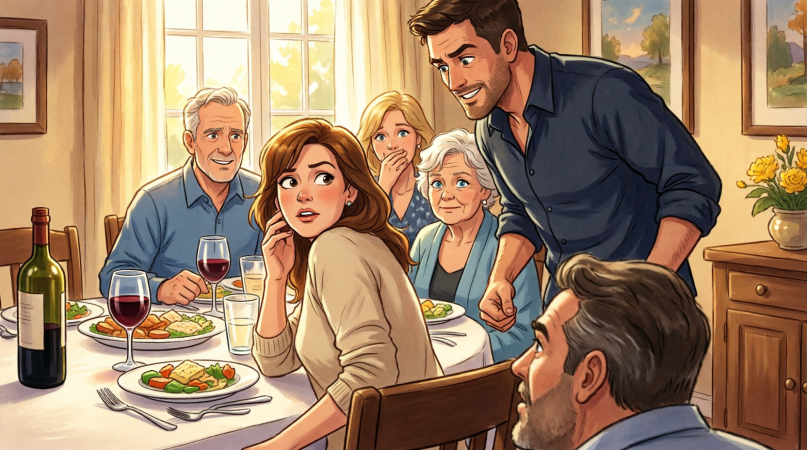
Chloe looked down at her plate so hard I thought she might drill through the porcelain with her eyes. Liam took a sip of Cabernet. Patricia, my mother-in-law, lifted her Chardonnay and watched the candlelight through it as if she were checking the color.
I sat there with one palm flat on the table and the other hanging uselessly by my chair, tiny shards of crystal glittering beside my shoe. My face throbbed in pulses. Nobody said my name.
Then, slowly, like a machine restarting after a power blink, the conversation resumed.
Richard asked Liam about the outboard motor warranty. Chloe mentioned a villa in Saint-Tropez one of her friends had rented for next summer. Derek cut into his duck with steady, elegant movements. The server knelt beside my chair and swept up the broken glass without meeting my eyes.
I remember thinking, absurdly, that I should apologize to the staff. That was how thoroughly the room had trained me in less than two years—my husband hit me, and I worried about making extra work for someone else.
“I need the restroom,” I said.
My voice sounded normal. That frightened me more than the slap.
I walked out on legs that felt borrowed, crossed the hall lined with oil paintings of dead Whitmans, and shut myself in the powder room off the library. It smelled like rose soap and lemon polish. I gripped the edge of the sink so hard my knuckles went pale under the gold light.
The mark on my cheek was already rising.
Five distinct fingerprints spread across my skin in a red bloom, ugly and undeniable. My eyes looked too bright. My lipstick had smudged at one corner. I looked like a woman in a movie right before she makes a terrible choice.
The door opened without a knock.
Patricia stepped inside, closed it behind her, and leaned back against the door with one manicured hand still on the brass handle. She wore navy silk and her usual pearls, the size of small grapes, and she looked exactly as she always did—composed, expensive, impossible to read.
She studied my reflection in the mirror.
“You embarrassed him,” she said. “You laughed too loudly.”
I turned and stared at her. “He hit me.”
“Yes,” she said. “He did.”
The air in the room seemed to thin out. I could hear the soft buzz of the sconces and, far away, the muffled rise of laughter from the dining room. Someone had told another joke. Someone was enjoying dessert wine while my face swelled.
“You’re not even—” My voice cracked. “You’re not even surprised.”
Patricia’s mouth tightened, not with sympathy but with something older and harder. “Derek does not like to be interrupted. His father didn’t either.”
The way she said father landed in my stomach like a dropped coin.
I looked at her more closely then. Past the blowout, the pearls, the perfect lipstick. There were lines around her mouth I had never really seen before, not because they weren’t there, but because I had mistaken polish for peace.
“You should put cold water on it,” she said. “Warm first, then cold. Warm will calm the shock. Cold will keep the swelling down.”
I laughed once, a disbelieving little sound that hurt my face. “That’s your advice?”
Her eyes met mine in the mirror.
“I stayed forty-two years,” she said quietly. “Three broken ribs, I told the doctor, came from a fall on the back stairs. A fractured wrist, I blamed on tennis. Two teeth, I said I cracked on a serving platter.”
For a second the room went absolutely still inside me.
I had known Richard was controlling. Everybody knew that in the acceptable, cocktail-party way people know ugly truths about wealthy men and call them old-fashioned. But I had never seen Patricia as anything except a queen in her own house. The idea of her young and cornered, making excuses through split lips, did not fit in my mind.
She opened her quilted Chanel bag and reached inside. Her fingers moved past lipstick, compact, reading glasses. She brought out a small brass key and pressed it into my palm.
The metal was cold enough to sting.
On the round head of the key, a number was stamped: 74.
“What is this?” I whispered.
For the first time since I had known her, Patricia’s expression broke. Not fully. Just enough. Enough for me to see the exhaustion underneath the lacquer.
“I stayed,” she said, and her voice was so low I barely heard it. “Don’t make the same mistake.”
Then she turned on the gold faucet and held a thick paper towel under warm water. By the time she handed it to me, her face had reset.
“Press this gently against your cheek,” she said in her normal luncheon voice. “Use the green corrector in my bag before foundation. There’s La Mer in the side pocket. It will cover the redness for now.”
I could only stare at her.
“We are having roast duck,” she added. “Derek hates it when meat gets cold.”
Then she left.
I stood there alone in the powder room, the paper towel steaming faintly in my hand, the brass key digging into my lifeline. In the mirror I looked like a woman who had just stepped into her real life and wished she hadn’t.
I covered the mark the best I could. The green cream made me look sickly before the foundation softened it. I smoothed my hair, straightened my shoulders, and went back into the dining room.
The broken glass was gone. A fresh crystal goblet sat by my plate.
Derek glanced up as I took my seat. His eyes flicked to my cheek, to the makeup, to the fact that I had returned and restored the scene. He gave me a small smile.
“That’s better,” he murmured. “Feeling more in control, darling?”
“Yes,” I said.
The rest of dinner tasted like warm paper.
On the drive home, rain struck the windshield in hard silver lines. Derek drove with both hands at ten and two, jaw tight, radio off. The inside of the Range Rover smelled like leather, cedar cologne, and the faint iron scent of my own skin.
“You push me,” he said at last, staring straight ahead. “You know that, right?”
I looked at the blur of streetlights through water. “I know.”
“I hate public disrespect.”
“I know.”
He sighed like I was disappointing but manageable. “I love you, Elena. That’s why this is so frustrating. You can be so good when you choose to be.”
At the house he leaned over before getting out and kissed my forehead.
“Do better,” he said softly. “I don’t want a repeat of tonight.”
Later, in bed, I lay stiff beside him and listened to his breathing even out. The bruise on my cheek pulsed with every heartbeat. In the dark, I slipped my hand under the nightstand drawer, touched the brass key where I had hidden it inside my jewelry box, and felt something inside me shift from shock into shape.
I didn’t know what the key opened. I didn’t know if Patricia was saving me or using me. I only knew one thing with terrible clarity.
If I stayed until I understood, I might not get another chance to leave.
Part 2
The bruise looked worse in daylight.
Morning light in our bathroom was merciless. It came through the frosted window over the tub in a pale strip and showed everything—the yellowing edge of the handprint beneath the concealer, the burst capillaries near my jaw, the swollen place high on my cheekbone where Derek’s ring had caught me.
I stood there in one of my silk robes, cotton pad in hand, and remembered all the smaller things I had explained away before this.
The wrist he squeezed under the table at a fundraiser when I corrected the year of some senator’s divorce. The hand on the back of my neck guiding me—not roughly, exactly, but firmly enough to remind me whose direction counted. The way he once shut a car door so hard beside my face the whole frame shook because I had taken a call from my sister while we were on the way to dinner.
There had always been a line of heat running beneath him. I had spent two years learning where not to step.
At seven, he came into the kitchen in navy slacks and a white shirt, kissed the air beside my temple, and drank his coffee standing up.
He never sat on weekday mornings. He prowled them.
“You should rest today,” he said. “Your face still looks a little… mottled.”
“I’ll work from home.”
He buttered toast with precise, clean movements. “That’s not necessary. Just answer emails for the foundation and try not to overthink last night.”
I looked at his cuff links, silver and black onyx, a gift from Richard on his fortieth birthday. His hands were beautiful. That sounds stupid, but it’s true. Long fingers. Trim nails. Skin that always smelled faintly of bergamot soap. They looked like a surgeon’s hands or a pianist’s hands. Not the hands that had made my teeth clack together over roast duck.
When he bent to pick up his briefcase, he paused.
“Did my mother say anything to you in the bathroom?”
My pulse kicked once, hard.
“No,” I said, keeping my voice bored. “She gave me concealer.”
He huffed a small laugh. “That sounds like her.”
At the door he turned back. “Dinner at my parents’ again Friday. Anniversary. Wear something blue.”
Then he left.
I waited at the front window, just enough off to the side that he couldn’t see me if he glanced back, and watched his taillights curve down the private road until the gates opened and swallowed him.
Only then did I breathe fully.
I did not use my car. That felt obvious in a way it had never felt before. Instead I walked three blocks to the main road, hood up, cheek hidden behind oversized sunglasses, and called an Uber from a convenience store parking lot that smelled like gasoline and burnt coffee.
I gave the driver an address downtown I’d never noticed before though I had probably passed it a hundred times: a glass-fronted building with no bank logo, no brass lettering, no welcoming potted trees. Just black windows, a discreet buzzer, and a broad-shouldered guard inside wearing an earpiece.
The lobby was cool enough to raise goosebumps on my arms. Everything was gray stone and brushed steel. Sound died quickly in there. Even the clerk’s voice came out flat and muffled, like money was too serious for echo.
I laid the brass key on the counter.
He looked at it, then at me. “Vault number?”
I swallowed. “Seventy-four.”
He checked a screen. “Box seven-zero-four. Name on the account?”
My mind went blank for half a second.
Patricia had never said. Of course she hadn’t. Maybe on purpose. Maybe because she hadn’t had time. Maybe because she didn’t trust me enough to finish the sentence.
Then I remembered one of those family-tree conversations she’d once had after too much Sancerre, talking about old Virginia names and war widows and “our Vance side.”
“Eleanor Vance,” I said.
The clerk nodded.
My knees nearly buckled with relief.
He led me down a narrow corridor lined with matte-black doors and keypads. The air smelled faintly metallic, like cold coins and machine oil. In a private room he placed a long steel box on the table and left me alone.
For a moment I just stared at it.
Then I slid in the key.
The lock turned with a solid, old-fashioned click.
Inside were stacks of cash bound in plain rubber bands. Hundreds. Neat columns of them, so dense and ordinary-looking they didn’t feel real. Beside the money lay two USB drives, a leather journal worn soft at the corners, a sealed envelope, and a navy passport.
My fingers shook when I picked it up.
Inside was my face.
Not a perfect photo, but close enough—cropped from somewhere official, probably my driver’s license or passport application. Under the photo was a different name.
Clara Hughes.
I sat down.
The chair was hard metal. The kind that doesn’t care whether you’re comfortable. I put the passport on the table and opened the envelope.
There was one sheet of cream stationery in Patricia’s elegant slanted hand.
If you are reading this, he has crossed the line in a way you can no longer deny.
Take the cash. Use the passport only if you must.
The journal explains enough. The drives prove the rest.
I began collecting when Richard broke my wrist and bought me sapphires the next day. I kept collecting when Derek was sixteen and learned how power changes shape but not purpose. By the time I understood what I had built around me, I no longer had the courage to use it.
I am giving it to you because your wings are not broken yet.
Burn them down before they move the money.
I opened the journal.
It was not a diary. It was a ledger of sins.
Dates. Account numbers. Property acquisitions routed through shell companies in Delaware and the Caymans. Notes about judges who had been paid through “consulting fees.” Loans gutted and flipped. Pension funds stripped. Families pushed into foreclosure under predatory terms while Richard toasted philanthropy at children’s hospital galas. Derek’s name began appearing in the entries twelve years ago, first alongside his father’s, then on his own.
Every so often, between the numbers and corporate names, Patricia had written a line that cut cleaner than the rest.
April 7: Richard hit the wall beside my head after dessert. Derek watched.
September 19: Derek shoved a valet at the club. Richard called it backbone.
January 14: I told myself Elena is smart enough to see what I could not fix.
I stopped on that line.
My own name sat there in her careful handwriting like a stain.
On the second-to-last page, a note was clipped over a list of offshore routing instructions.
The master authentication key for the new Swiss structure is on Derek’s key ring. Black titanium fob. He never willingly parts with it. Without that key, the final transfers cannot be opened or traced in time.
I leaned back and covered my mouth.
This was not just escape money. It was ammunition.
For a wild minute I wondered if it was all a setup. If Derek knew. If Patricia was testing me. If the second I walked out with any of this, someone would be waiting at home with polite questions and a locked study door.
But then I looked again at the passport with my face and another woman’s name, at the stacks of money Patricia had hidden from a husband who counted everything, at the sentence your wings are not broken yet, and the truth landed where fear had been.
She had prepared for my leaving before I had.
I took one bundle of cash, the USB drives, the passport, and photographed twenty pages of the journal with the burner-free phone I didn’t yet own but wished I did. Then I stopped myself. No phone. No trail. I put the journal back, locked the box, and slid it across the table.
When I stepped back outside, the city air felt different—colder, sharper, more specific. A bus exhaled at the curb. Somewhere nearby, onions hit a hot griddle and sent up that sweet browned smell from a deli vent. The world kept going with its ordinary noises, as if I hadn’t just opened the inside of the Whitman family and found rot all the way down.
In my tote bag, the cash and passport pressed against my hip.
For the first time since Derek’s hand hit my face, I wasn’t thinking about how to survive the next hour. I was thinking about timing, leverage, and where exactly to cut.
Then I remembered the final line in Patricia’s note, and the cold came back full force.
Burn them down before they move the money.
Part 3
Running would have been the simpler story.
People always imagine escape as a doorway. Coat on, suitcase in hand, one brave sprint into rain. Maybe a bus station. Maybe a motel with floral bedspreads and a tired woman at the front desk who doesn’t ask questions.
Real escape, when the man you’re leaving is rich, connected, and patient enough to smile while he ruins you, is logistics.
Derek controlled more of my life than I had ever admitted out loud. The house was in a trust he managed. My main checking account was technically joint, but his assistant monitored large withdrawals for “fraud prevention.” He knew every board I sat on, every lunch I attended, every yoga class I claimed to enjoy. He liked to frame it as concern. He liked words like protected, handled, efficient.
That afternoon, I made a list on the back page of an old recipe notebook because I didn’t trust my laptop.
Cash.
Documents.
Private email.
Phone not tied to me.
Proof copied in more than one place.
A lawyer before he realizes I need one.
I tucked the notebook into the bottom of a basket of dish towels and went out to the garage under the pretense of getting mineral water from the spare fridge.
I don’t know exactly why I looked. Maybe paranoia had finally matured into instinct. Maybe Patricia’s key had changed the lighting on everything. But I knelt beside my car and felt under the rear bumper, then in the wheel well, then under the lip of the trunk liner.
Nothing.
I opened the trunk anyway.
Under the spare tire cover, taped neatly near the jack compartment, was a small black tracker.
It was so clean and deliberate I almost laughed.
For a minute I just crouched there in the smell of rubber and old cardboard, holding the tracker between finger and thumb. My wedding set flashed in the garage light. The house was silent behind me, all white oak and curated art and hidden rot.
Derek hadn’t started controlling me after the slap.
He had simply stopped pretending he wasn’t.
I didn’t break the tracker. Breaking it would tell him I had found it. Instead I drove—carefully, normally—to a grocery store twenty minutes away, walked inside, bought a lemon and a magazine, then came back out and slipped the tracker into the side pocket of a landscaper’s trailer parked near the loading dock.
Let him follow mulch to the county line.
From there I took a cab to the public library downtown.
I had not been in a public library in months, maybe longer. The Whitmans donated to museums, private schools, hospital wings, not places with sticky keyboards and children’s drawings taped to walls. The library smelled like paper, dust, hand sanitizer, and old upholstery. I almost cried from relief the second I walked in.
At a computer on the second floor, I opened a private browser and searched domestic violence safety planning.
The words themselves felt both dramatic and embarrassingly accurate.
I read everything. Clear browser history. Use a device he cannot access. Change passwords from a safe location. Pack medications. Tell one trusted person. Be careful with shared phone plans, shared cloud accounts, smart home devices, vehicle trackers.
Every sentence tightened the story around my life until there was no room left for denial.
I created a new encrypted email using the name Clara Hughes and wrote down the password in code inside the recipe notebook. I searched women’s legal services, forensic accountants, federal whistleblower procedures. I learned there were channels for people who exposed financial crimes, and for one dizzy second I thought about the absurdity of it—my mother-in-law had handed me enough evidence to destroy half the city council and I was reading about it under a mural of cartoon owls.
Before I left, I called a hotline from a pay phone in the lobby because I did not trust any number tied to my name.
The woman who answered sounded like she had seen everything and was not surprised by any of it.
When I said, “He only hit me once,” she did not let me get away with the word only.
She asked if there were guns in the house. No. If he controlled my money. Yes. If I had somewhere safe to go. Not yet. If anyone else knew. I hesitated and said, “His mother.”
There was a pause.
“Is she safe?” the woman asked.
“I don’t know.”
“That matters,” she said. “So does this: if you think he’ll escalate when he loses control, do not warn him by half-leaving. Make one plan and execute it.”
One plan.
The phrase stayed with me all the way home.
That evening Derek brought flowers.
White roses. My least favorite. He knew that, too.
He set them on the kitchen island and kissed my cheek—the good one. “How was your day?”
“Quiet.”
He loosened his tie. “Good. I got us reservations at Laurent’s next week. You deserve something nice.”
The diamond tennis bracelet appeared after dinner in a black velvet box. Eight carats, maybe more. Cold fire in a perfect curve.
“A peace offering,” he said.
“For what?”
His smile did not reach his eyes. “For yesterday being unpleasant.”
I let him fasten it around my wrist.
The diamonds sat on the same arm he had grabbed hard enough last month to leave faint finger marks before a fundraiser. I remembered covering those with foundation too. Luxury was just another language for hush.
On Thursday, at Patricia’s charity luncheon, she sat three seats away from me under a tent full of orchids and women in expensive linen. Silverware clicked against china. Waiters moved between tables with chilled cucumber soup and salmon tartare. The room smelled like perfume, lemon slices, and money.
We did not look at each other directly.
“He’s moving the funds by month’s end,” she said while smiling at the woman on her left. “Switzerland. Once they clear, retrieval becomes much harder.”
I stirred my soup. “I need the key.”
“Thursday nights he plays squash with Liam.”
My spoon paused.
“At the club?” I asked.
She dabbed her mouth with a napkin. “Men’s locker room. He leaves his key ring in the gym bag while he showers. The locker is usually padlocked.”
Usually.
I could feel the heat under my collar even in the air-conditioned tent. “Why are you helping me now?”
Patricia finally turned her head the smallest amount. Her lipstick was flawless. Her eyes were not.
“Because last time, when I was twenty-four and thought about leaving, no one handed me a key.”
Then Chloe began talking loudly about Cabo and the conversation rolled over us again.
That night I ordered a lockpick set and a hardware token cloner using cash-loaded gift cards from three different stores. I had never done anything like that in my life. My hands trembled as I opened the packages over a towel in the guest bathroom, as if the objects themselves made me criminal.
Maybe they did.
But when I pictured Derek’s hand coming toward my face again, the fear sorted itself into something steadier.
By Sunday I could open a cheap padlock in under ninety seconds.
By Tuesday I had timed Derek’s squash game twice and mapped the back hallway to the men’s locker room in my head.
By Thursday afternoon, the cloned future of my life fit inside a small pouch in my handbag.
And still, as I parked near the club and checked the time with a dry mouth and numb fingers, one question kept scraping under everything else.
What if Patricia wasn’t saving me at all?
Part 4
The country club always smelled faintly of chlorine and old money.
Even in the athletic wing, where the floors were rubberized and the walls held framed black-and-white photographs of men holding silver cups from decades nobody alive cared about, there was still that same polished scent—cedar lockers, expensive soap, crisp towels laundered within an inch of their lives.
I had been there a hundred times before. Charity auctions. Summer luncheons. One humiliating couple’s tennis lesson Derek insisted we take because apparently my backhand reflected poorly on him.
I had never once gone near the men’s locker room.
That helped.
At 7:12 p.m., Derek and Liam were on Court Three. I knew because I’d watched them through the glass for thirty full seconds from the upstairs hallway, pretending to text. Derek wore navy shorts and a white polo, and from a distance he looked like a catalog ad for control. Liam, broader and louder in every movement, had already thrown his racket once at a bad call.
Their game would run at least forty minutes, maybe fifty if Derek felt like proving something.
I waited another five just in case.
Then I took the service corridor behind the spa.
The lights back there were harsher, fluorescent instead of flattering. I could hear the hum of an ice machine and the soft rattle of dishes from the kitchen below. A cart of fresh towels stood unattended beside a door marked MEMBERS ONLY. My palms were slick. I wiped them on my slacks and walked through.
The locker room was empty.
Rows of dark wood lockers stretched under brass number plates. The air was warm and damp, carrying cedar, eucalyptus, and the lingering bite of male cologne. Somewhere deep in the showers, water dripped in a slow regular tick.
I found Derek’s locker on the far wall. I knew his number because I had once listened, smiling, while he complained about another member taking “his” preferred locker and making a whole adult issue out of it.
The padlock was matte silver, newer than the practice one I’d bought.
I dropped to one knee with my body angled so anyone glancing in might think I was tying a shoe. The metal of the lock felt cool and stubborn in my hand. I slid in the tension wrench, then the pick. Tiny clicks. Nothing. My pulse beat in my ears so hard it blurred the room.
Come on.
I adjusted the pressure. Felt for the pins. One set. Two. Three.
The shackle popped open.
I almost laughed from the shock of it.
Inside hung Derek’s suit jacket, his gym bag, and a dry-cleaned shirt in plastic. I went straight for the bag. Shoes. A change of clothes. Toiletries in a leather case monogrammed D.W. And there, in the side pocket, the heavy silver key ring.
The black titanium fob was smaller than I expected. Sleek. Dense. Expensive-looking in that minimalist way rich men love, like the absence of ornament proves seriousness.
I pulled the cloning device from my handbag, plugged in the fob, and set it on the bench.
A small blue screen lit up.
Reading token.
My mouth went dry.
The progress bar began to crawl.
10%.
17%.
22%.
I could smell my own sweat now, sharp under my blouse. Somewhere outside the locker room a door opened and closed. I froze, then forced myself not to snatch the device too soon. Half-copied was useless.
34%.
41%.
I glanced toward the entrance. Empty.
52%.
Then footsteps echoed in the tiled hallway outside. Two male voices. A burst of laughter. Closer than I expected, far earlier than I needed.
My hands went cold.
“—told you your follow-through was trash,” Liam said.
Derek answered, breathless with exertion. “You don’t have a follow-through. You have a tantrum.”
They were almost at the door.
78%.
Come on.
I could hear the metal crash bar on the outer entrance push inward.
91%.
99%.
Done.
I yanked the fob free, shoved it back onto the key ring, stuffed the keys into the exact side pocket, zipped the gym bag, dropped it back into place, snapped the padlock shut, and lunged for the nearest hiding spot—the towel closet beside the steam room.
I slipped inside and pulled the door almost closed just as Derek and Liam walked in.
Darkness swallowed me.
It smelled like bleach, hot cotton, and those eucalyptus tablets they use in steam rooms. Shelves of folded white towels pressed against my shoulder. Somewhere a ventilation fan whirred with a tired, grinding sound.
I held my breath.
“You left your keys in the bag again,” Liam said.
“So?”
“So one day some idiot will steal the Bentley.”
“Nobody here steals.”
“Everyone steals. They just call it bonus structure when they wear loafers.”
The locker door opened. I heard hangers scrape.
If Derek noticed anything out of place, this was where I died.
A zipper. A thud. Shoes hitting the floor. Then silence long enough to become dangerous.
“You moving the Zurich structure tomorrow or Monday?” Liam asked.
“Tomorrow night,” Derek said. “After dinner.”
My heart slammed once against the shelf behind me.
“Dad nervous?”
“Dad is eighty percent cholesterol and ego. He’ll be fine once the money clears.”
Liam gave a low whistle. “And your wife?”
I went rigid.
A pause. Then Derek laughed, soft and ugly.
“She’ll sign what I put in front of her. If she doesn’t, I’ll manage it. She’s been much more cooperative since last month.”
Liam made a sound halfway between a laugh and a grunt. “Good. Because if you put her name on that charitable shell and she gets skittish, it gets messy.”
I closed my eyes.
My name.
On what shell?
Derek’s voice sharpened. “She doesn’t know what’s in her own handbag half the time. Don’t overestimate her.”
The darkness inside the closet changed shape.
This was not just about the Swiss transfer. They had already woven me into something. Not because they trusted me. Because they expected to use me.
Showers came on. Lockers opened and closed farther down. Another member entered, humming tunelessly. The ordinary sounds were almost worse than the conversation.
I stayed in that closet for twelve more minutes, legs cramping, fingers dug into a stack of towels, while Derek and Liam showered and talked about a charity golf event as if they had not just discussed using my name in a crime.
When they finally left, the room went quiet again.
I stepped out on shaking knees and crossed to the exit without looking back.
Outside, the night air hit my face cold and clean. Somewhere on the far lawn sprinklers clicked on in soft rotating arcs. A bartender was dragging in patio cushions. Cars purred through the circular drive under little islands of yellow light.
In my bag, the cloned fob felt like a coin heated by skin.
Tomorrow night. My name on a shell. A signature waiting somewhere for me to become the scapegoat.
I had come for a key. I left with a deadline.
Part 5
I barely made it home before Derek did.
That was the first problem.
The second was that my hands would not stop shaking.
I stood at the kitchen sink rinsing an already clean wineglass when I heard the garage door rumble open beneath the house. The sound traveled through the floor, low and mechanical, and every muscle in my back locked.
I counted to five, set the glass down, and turned just as he came in.
He looked showered and freshly shaved, his hair still damp at the temples. There was a faint red mark on one knee where the squash court had caught him. For some reason that tiny ordinary abrasion made him seem more dangerous, not less. Men like Derek always looked most vicious when they also looked handsome.
“Hi,” I said.
He kissed my forehead, then stepped back and studied my face in that assessing way he had. “You okay? You look pale.”
“Headache.”
“Take something.”
He loosened his tie and went to the fridge. “Funny thing happened at the club. I could’ve sworn my lock felt odd.”
I did not move.
He glanced over his shoulder. “Probably nothing.”
Probably nothing.
I slept beside that sentence like it was a live wire.
At 1:43 a.m., Derek’s breathing deepened into the heavier rhythm bourbon usually gave him. I had waited for it before, on ordinary nights, only for smaller reasons—to escape to the bathroom without a conversation, to cry quietly, to stand in the dark kitchen and remember I was a person with thoughts he could not hear. That night I waited for it as if my life depended on timing.
Maybe it did.
I slid out of bed in socks and a black camisole, took the cloned fob, the USB drives, and the burner laptop I had bought with cash that afternoon, and padded down the hallway to Derek’s office.
The room was locked.
For a second I thought my whole body might simply shut down.
Then I remembered the house had smart locks tied to his phone. I went to the kitchen, pulled a magnet off the side of the fridge, and used it to trigger the old mechanical release tucked beneath the trim of the office door—a feature he’d once bragged about to a contractor while redesigning the house, because Derek loved systems more when they had backups.
The door clicked open.
Inside, the office smelled like leather, cedar, and printer toner. Moonlight from the terrace doors laid silver bars across the rug. Derek’s desk sat in the middle like a command station—two monitors, framed degree, a bronze horse head somebody had given him, and the little dish where he tossed cuff links at night.
I woke the laptop.
Password prompt.
I plugged in the cloned fob.
For one terrible second nothing happened.
Then the screen blinked, accepted the token, and opened.
I exhaled so hard my knees weakened.
The desktop was arranged with military neatness. Folders by client name. Calendar. Secure finance tools. An innocuous folder titled Household. Another titled Foundation. And one called Alpine Restructure.
I clicked it.
What opened was a map of shell companies nested inside shell companies, spreadsheets of transfers, memo drafts, appointment letters, tax strategies, all couched in the language of legal respectability. Advisory routing. Temporary nominee structure. Transitional governance appointment.
My eyes caught on a PDF.
Waverly Charitable Holdings—Board Resolution.
I opened it.
There was my name.
Elena Whitman, appointed interim director.
A scanned signature beneath it that looked enough like mine to fool anyone who didn’t know how carefully Derek had practiced mimicking other people. There were three more like it. Meeting minutes placing operational authority on me. A memo describing my “ongoing involvement” in grant disbursement timing that was, in plain English, money laundering dressed in philanthropy.
I sat down very slowly.
They had built an exit ramp out of my life.
If the Swiss transfer went through and anyone came looking, there I would be in the paperwork—gracious wife, charity face, soft target with no hard power of her own. Easy to blame. Easy to paint as confused, overspending, emotional, maybe vindictive if the marriage happened to fracture.
The room tilted.
Then anger cut through the dizziness so cleanly it steadied me.
I inserted Patricia’s first USB drive and started copying files. Journal scans. Offshore account maps. Emails. Wire transfer receipts. Photos of handwritten ledgers. On Derek’s machine I found live banking access logs, scheduled transfer windows, and a current routing sheet for the Zurich move set for 8:30 p.m. Friday—half an hour into Richard and Patricia’s anniversary dinner.
He really had planned to move millions while raising a glass to family.
I built the dossier carefully. Folder by folder. Crimes, corroboration, timelines, shell structures, my forged documents, Patricia’s notes, active transfer schedule. On the burner laptop I drafted an encrypted package and addressed it to the SEC whistleblower office, the local FBI field office, IRS Criminal Investigation, and two financial reporters whose names I found in old articles about municipal fraud.
I scheduled the send for 8:00 p.m. Friday.
Then, because one plan was not enough unless it had a second spine, I uploaded a duplicate archive to a cloud account under Clara Hughes with timed release links.
If one failed, another would open.
At 2:51 a.m., I heard floorboards creak in the hallway.
I froze.
Another creak. Closer.
I ejected the drive, closed the windows, cleared recent files, shut the laptop, pocketed the cloned fob, and moved to the office door just as the knob turned.
Locked.
I had relocked it from inside without thinking.
My blood went to ice.
The knob rattled once, softly. Derek’s voice came through the wood, thick with sleep.
“Elena?”
I could smell my own fear, sour and immediate.
I crossed the room, unlocked the door, and opened it halfway. “You scared me.”
He stood there in boxers, bare-chested, eyes narrowed against the hall light. “What are you doing?”
“Couldn’t sleep. I came down for Tylenol and thought I heard something in here.”
He leaned one shoulder against the frame. “At three in the morning?”
“I was nervous,” I said, and let my voice wobble. That part wasn’t hard.
His gaze traveled past me, into the dark office, across the desk. My skin felt too small for my body.
Then he lifted one hand and touched the side of my throat, light as a lover.
“You’ve seemed nervous a lot lately,” he said.
I said nothing.
His thumb rested over my pulse. “Were you in my office?”
The house was silent around us. Upstairs, our bed was turned down. In my camisole pocket sat the fob that could break him. Behind my ribs, my heart slammed hard enough that he must have felt it under his thumb.
If I answered wrong, I had no idea whether Friday would come at all.
Part 6
I let my eyes fill.
It was not difficult. Fear has a way of sitting close to tears, and Derek had always preferred my fear if it looked soft and feminine. Rage he considered vulgar. Grief he could work with.
“I was looking for you,” I said. “I woke up and you weren’t there.”
His hand stayed on my throat another second, maybe two. Then he smiled the way men smile when they decide you are still containable.
“I’m right here.”
He kissed my forehead and guided me back toward the bedroom with that same hand, light enough to pass for affection. When we lay down again, he pulled me against his chest. I could feel the damp warmth of his skin, smell bourbon and mint on his breath, hear the calm certainty in the way he drifted back to sleep.
I did not sleep at all.
The next day passed in sharp little fragments.
I moved a go-bag into the trunk of a rideshare parked three blocks away by paying the driver cash to hold luggage for “a surprise weekend.” Passport, cash, burner laptop, medication, an extra phone charger, jeans, sneakers, the recipe notebook. I left the diamond bracelet in my jewelry drawer. Leaving it felt better than stealing it.
At noon Derek sent flowers to the house again. Blue hydrangeas this time. The card said, Wear the navy silk tonight. The one with the open back.
At three he texted, Don’t be late. Mom hates delays.
At five I stood in our dressing room looking at the navy silk dress hanging from its padded hanger. It was elegant, expensive, cut to show the graceful line of my shoulders while keeping everything else controlled. Derek liked dresses that made me look like an heirloom he had acquired.
I covered the last faint shadow of the bruise with concealer and fastened pearl drops in my ears. Not because I wanted to resemble Patricia. Because in that family pearls had become a kind of armor. Gloss over damage. Soft luster over grit.
When Derek came home and saw me, satisfaction settled over his face.
“There she is,” he said.
I smiled.
In the car, he talked about investor confidence, a charity chairmanship, and an upcoming trip to Zurich that he framed as a romantic getaway. His hand rested on my knee at every stoplight, possessive and warm. The city slid past in dusky gold—restaurants filling up, buses sighing at curbs, joggers with bright shoes flashing under streetlamps. I wondered how many of those people were on their way to normal evenings, and whether they knew what a gift that was.
The Whitman estate was lit like a hotel for a wedding. Valets moved under the porte cochere. Through tall windows I could see chandeliers blazing and servers in white jackets crossing the dining room with silver trays. The house smelled like beeswax, polished wood, and roasted meat the moment we stepped inside.
Patricia met us in emerald silk. Her pearls rested at the base of her throat, immaculate as ever.
“You’re late,” Richard said from the staircase landing, though we were three minutes early.
“Traffic,” Derek said.
Patricia’s eyes passed over me once. Not warm. Not cold. Just present. If she noticed the way I held my handbag tighter than usual, she did not show it.
Dinner unfolded in courses.
Caviar with buckwheat blini. Then a delicate soup poured tableside from silver pots. Then quail with wild mushrooms and a cherry reduction so dark it looked almost black against the bone china.
I could not taste any of it.
The dining room glowed. The chandelier threw warm light over silverware and crystal. Somewhere behind us a server opened a bottle of Bordeaux with a soft cork sigh. Richard held court at one end of the long mahogany table, flushed with power and anniversary nostalgia. Liam interrupted too much. Chloe drank too quickly and watched everybody from behind her smile. Patricia sat like a queen in a portrait. Derek kept one hand on my thigh under the table and squeezed whenever he wanted to remind me of it.
At 7:54 I checked the slim watch face hidden by my sleeve.
Six minutes.
Richard rose with his glass. “To forty-three years,” he announced. “To legacy. To family that knows how to remain strong.”
Crystal rang as everyone lifted their glasses.
I did too.
My fingers were steady.
At 7:57 Liam launched into another story about his boat, all diesel bills and marina politics and the kind of problems men invent when they have never had real ones. A month earlier I had laughed too loudly and Derek had hit me.
This time I waited.
At 7:59 Liam said, “You two should come out next weekend. Weather’s supposed to be perfect.”
“Elena gets seasick,” Derek said before I could speak.
He hadn’t even looked at me.
I set down my glass.
“Actually,” I said, clear and calm, “I don’t get seasick.”
Every fork at the table went still.
Derek turned his head slowly.
I could see the exact moment the rage lit behind his eyes. It always came in silence first. A shutter dropping.
“I’d love to go,” I added.
Richard’s mouth flattened. “Derek.”
Under the table, Derek’s hand left my thigh. His shoulder shifted. That tiny lowering movement I now knew too well—the body readying itself for impact.
I felt the room hold its breath for him.
Then phones began to ring.
Not one. All of them.
Richard’s on the sideboard. Liam’s on the tablecloth. Derek’s vibrating hard against his jacket. Even Patricia’s, though hers only flashed once and went still.
Derek snatched up his phone with irritation already on his face. It changed before he finished reading.
The color drained out of him so fast it looked poured.
“What?” Richard barked.
Derek stood so abruptly his chair scraped the floor. “No.”
Richard had his own phone to his ear now, red flooding his neck. “What do you mean frozen? Who authorized—”
Liam stared at his screen. “Dad.”
Chloe whispered, “Oh my God.”
Derek looked around the room like an animal catching scent of fire. “Somebody got in,” he said. “Someone got into the Zurich structure.”
I sat very still.
The dining room doors opened.
Six federal agents in dark jackets stepped in with local officers behind them. The yellow FBI letters across their backs were so stark against all that polished wealth they looked almost theatrical, except no one in the room was acting anymore.
“Richard Whitman. Derek Whitman,” the lead agent said. “You are under arrest for securities fraud, wire fraud, money laundering, and conspiracy.”
Everything after that happened in fragments.
Chloe shrieked. Liam shoved back from the table and got pinned against the wall before he reached the service entrance. Richard started shouting for his attorney, then clutched his chest and collapsed back into his chair, face mottled purple with rage and panic. Silverware hit the floor. A server dropped a tray and crystal exploded across the marble again.
Derek turned to me.
Not to the agents. Not to his father. To me.
The realization came into his face slowly, then all at once.
“You,” he said.
His voice was almost soft with disbelief.
Then he lunged.
He came over the corner of the table hard enough to knock over his own glass, hand already lifted. I didn’t flinch. I didn’t even stand. One of the agents tackled him before he reached me, driving him face-first into the mahogany with a crack that sent red wine streaming across the linen.
His shout turned into a grunt as they pinned his arms and cuffed him.
All around the room, the Whitman world came apart in expensive pieces.
And through it all, Patricia remained seated.
She looked at me once. Then, very slowly, she reached up and unclasped her pearl necklace. The pearls slid into her hand with a soft dry sound like rain against silk. She set them on the table beside her untouched dessert plate.
Derek twisted against the agents and found enough breath to snarl one sentence at me.
“This isn’t over.”
Part 7
The FBI field office smelled like stale coffee, copier heat, and wet wool.
By the time they brought me into an interview room, the adrenaline had drained out of my body and left me cold. Someone had thrown a blanket over my shoulders in the car. It was gray, rough, and smelled faintly of disinfectant. I kept it around me because it gave my hands something to hold.
Across from me sat Special Agent Monica Ruiz, who looked like the sort of woman no liar enjoyed meeting twice. Dark suit, hair pulled back, eyes that missed nothing and seemed offended by excuses on principle. She offered me water in a paper cup, then waited until I had taken three full sips before asking my name for the record.
“My husband was going to blame me,” I said before she finished her first question.
Her pen paused.
I swallowed and tried again, this time in order. The dinner. The slap. Patricia in the powder room. The key. The vault. The journal. The forged board resolutions with my signature. The cloned fob. The scheduled email. The Swiss transfer. Derek and Liam in the locker room. My name on the shell. One by one, I laid the pieces out on the metal table.
Ruiz did not interrupt often. When she did, it was to pin down a date, a file name, an exact phrase. At some point another agent came in carrying the evidence bags I had handed over from my purse and the spare materials I’d had moved from the trunk drop. The burner laptop. The passport. The USB drives. The recipe notebook with three pages torn out.
When I got to the fake signature page, my voice broke.
Not from emotion, exactly. From fury finally hitting air.
“He was going to use me as cover,” I said. “If anything went wrong.”
Ruiz nodded once. “That’s what it looks like.”
A woman from victim services photographed the fading bruise on my cheek under a harsh white lamp. The camera flash made spots bloom in my vision. I held still and stared at the cinderblock wall.
Afterward Ruiz folded her hands and said, “Because you came in with evidence before the transfers cleared and before charges were filed, your cooperation matters. A lot. You need a lawyer, a secure place to stay, and no direct contact with any Whitman unless we approve it.”
“Any Whitman?”
Her expression didn’t change. “That includes Patricia until we understand exactly where she stands.”
I almost laughed.
“Join the club,” I said.
Near dawn they moved me to a downtown hotel under a different name. Not witness protection. Not yet. Just temporary containment with two plainclothes officers in the lobby and instructions not to post, call, or return anywhere predictable.
The room was generic in the most comforting way. Beige carpet. Heavy curtains. A landscape print over the bed with no personality at all. The minibar hummed. Ice clicked somewhere in the wall. I stood in the bathroom and scrubbed off my makeup with hotel soap until the last ghost of the bruise showed through again, and for the first time in twenty-four hours I let myself cry.
Not because I missed Derek.
Because the danger had changed shape and I didn’t know the new rules yet.
By noon the story had broken.
Whitman Capital Partners raided in federal fraud investigation.
Local titan Richard Whitman and son arrested at private family dinner.
Anonymous source alleged years of financial misconduct.
The hotel television ran footage of agents carrying boxes out of the downtown office building. The crawl at the bottom mentioned frozen assets, investor panic, and “possible links to municipal bribery.” No names of cooperating witnesses yet. No mention of me.
That didn’t calm me.
Derek’s lawyers would know exactly where the holes in the case had come from. If not today, then soon.
At 2:13 p.m., my burner phone lit with a text from an unknown number.
It’s Chloe. Liam threw a lamp at the wall after they released me. I left. Do you know a lawyer?
I stared at the message.
Then I copied the number Ruiz had given me for a domestic violence attorney who worked with federal cases and sent it back with one line.
Don’t tell anyone where you are.
The reply came almost immediately.
I should have believed you were in danger too.
I set the phone down on the hotel desk and stared at the cheap wood veneer until the grain blurred. In that family, belief had always arrived late and at someone else’s expense.
At 4:40 p.m., Ruiz knocked and came in with coffee, a folder, and the look of someone bringing more bad news in manageable portions.
“They’re already trying to shift blame,” she said. “Richard’s attorney is floating the idea that clerical irregularities came through charitable entities with your name attached.”
I let out a hard little laugh. “Of course he is.”
“We’ll counter it. Patricia’s journals help. So do the timestamps on your upload and the forged signatures. But listen carefully: this will get uglier before it gets better.”
I believed her.
She slid a second sheet across the table. It was a summary of my immediate protective steps. Separate counsel. Freeze shared access. Document prior incidents. No meetings without a witness. She also mentioned, in that careful bureaucratic tone that means this may matter later, that whistleblower statutes could apply if the financial recovery was substantial.
Money. Safety. Consequence. The three things Derek had always treated as interchangeable.
After she left, I ate two crackers from room service because the thought of real food turned my stomach. Then I opened the blackout curtains a fraction and looked down at the street six floors below. People hurried past with grocery bags, umbrellas, headphones. The ordinary city beat on.
At 7:08 p.m., the front desk called.
“There’s an envelope here for Ms. Hughes,” the clerk said. “No sender listed.”
My whole body went cold.
Two officers checked it before bringing it up. Plain cream paper. My alias handwritten in elegant slanted script I recognized instantly.
Inside was an old Polaroid.
Patricia, maybe twenty-six, standing beside a station wagon in a wool coat, one side of her face turned slightly away from the camera. Even in the faded photo, I could see the swelling at her jaw. She looked so young it hurt.
Tucked behind it was a note.
You should know what I did before you decide what I deserve.
Meet me tomorrow at Saint Andrew’s, noon, if Agent Ruiz permits it. If she does not, tell her to ask about storage unit B9.
I read the line twice.
Then a third time.
The key had opened one box. Apparently Patricia had spent forty-two years building more than one exit, and I still had no idea whether that made her brave, monstrous, or both.
Part 8
Saint Andrew’s sat between a parking garage and a bakery that sold cardamom buns big as fists.
I arrived five minutes early with Agent Ruiz in the back pew pretending not to watch us. The church was cool and dim and smelled like old wood, candle wax, and the faint mineral dampness old stone buildings always hold in their corners. Colored light from the stained-glass windows striped the aisle in red and blue.
Patricia was already there.
No pearls.
That was the first thing I noticed, absurdly enough. Her throat looked bare without them, almost vulnerable. She wore a camel coat and cream gloves folded in her lap. Without the usual armor, she seemed smaller, though maybe it was only that I had finally stopped seeing her from below.
For a moment neither of us spoke.
I slid into the pew beside her, leaving half a body’s width between us.
“You look tired,” she said.
I almost laughed. “That’s generous.”
She looked ahead at the altar. “Agent Ruiz asked about storage unit B9.”
“And?”
“And she’ll be opening it after this.” Patricia clasped her hands. “Original contracts, board minutes, and taped dictation Richard made when he thought bragging into a recorder was safer than keeping assistants around. Enough to hurt the remaining partners who will try to survive by sacrificing everyone else.”
I studied her profile. “Why didn’t you give it all to the FBI at dinner?”
“Because if they had searched me before they searched the house, Richard’s attorney would argue contamination, concealment, chain of custody, twenty other things men like him use to turn truth into paperwork.” Her mouth tightened. “And because after forty-two years of fear, I no longer trust myself to do anything the simple way.”
That, at least, sounded honest.
A janitor’s cart squeaked faintly somewhere near the vestibule. Someone lit a candle two rows ahead and left without glancing at us.
I took the Polaroid from my bag and laid it between us. “What did you do?”
Patricia looked down at the photo. When she spoke again, her voice lost its society crispness and turned quieter, older.
“I married Richard at twenty-one. My father was dying, my mother was in debt, and Richard looked like rescue. Three months after the wedding, he broke a crystal ashtray against the wall six inches from my head because I mispronounced the name of a client’s wife. The first time he hit me, he sent flowers to the hospital room where I was having my wrist set.”
I said nothing.
“I told myself all the things women tell themselves when leaving feels larger than dying in pieces. He didn’t mean it. He was under pressure. It won’t happen again. And later, when Derek was born, I told myself I had to stay for the boys.” She let out a thin, humorless breath. “As if boys raised in a house full of fear become gentle.”
The church felt suddenly smaller.
“Did you know what Derek was before he married me?”
That landed between us hard.
Patricia closed her eyes once. “Yes.”
There it was. Not the answer I wanted. The answer I had known was waiting.
“How much?”
“Enough.”
My hands went cold.
She kept her gaze on the altar as she spoke, maybe because she couldn’t bear to look at me. “I knew he was controlling. I knew he had frightened women before you. I knew he had a temper that matched his father’s too closely. I also knew he had learned to hide it better, and I told myself that mattered.” Her voice roughened. “When he started bringing you around, I had someone look into your background.”
I stared at her.
She nodded once, a movement almost too small to register. “You were intelligent. No powerful family. Financial experience from your bank compliance work. Clean reputation. Gracious under pressure. I thought you might either soften him or survive him.”
A hot, bright disgust moved through me so fast it almost felt clean.
“You approved me,” I said.
The words sounded ugly in the church.
“Yes.”
“As what? A wife? A shield? A useful signature?”
Patricia flinched like I had touched a bruise.
“I told myself I was choosing someone strong.”
“No,” I said, my voice shaking now. “You were choosing someone expendable.”
The silence after that had weight.
Somewhere behind us, Ruiz shifted in the pew. She did not interrupt.
Patricia’s hands tightened around her gloves. “You may hate me for the rest of your life. That would be reasonable.”
“I don’t know if hate is the word.”
“What is the word?”
I looked at her. Really looked. At the careful makeup that couldn’t hide the age in her skin. At the small scar near her hairline I had once assumed came from childhood. At the bare throat where the pearls used to sit like a warning disguised as elegance.
“Late,” I said.
Her face changed.
Not dramatically. Patricia was not a dramatic woman. But the truth of that word found her.
“Your help came late. Your courage came late. Your conscience came late. It may save me, and I’m grateful for that. But it came after you watched this family pull women apart and chose table settings over truth.”
A muscle jumped once in her jaw.
“Yes,” she said.
We sat with that.
After a while she opened her handbag and slid a small envelope toward me. Inside was a notarized affidavit—her statement detailing decades of abuse, fraud, bribery, Derek’s violent behavior, and the forged use of my name. Her signature at the bottom looked firm.
“I’ll testify,” she said. “Publicly.”
“Why now?”
She gave the smallest shrug. “Because my husband is in federal custody. My sons can’t reach me before the law can. And because watching Derek lift his hand at you across that dinner table made me understand something I should have understood thirty years ago.”
“What?”
“That silence is not neutral. It belongs to the man using it.”
I thought about that while sunlight shifted across the aisle in colored squares.
At the bakery next door, someone opened the oven and the smell of sugar and spice drifted faintly through the old church door. Life, ordinary and warm, just twenty feet away.
I stood.
“Thank you for the key,” I said. “For the evidence. For testifying.”
Patricia looked up at me.
“But don’t mistake that for absolution.”
She nodded as if she had expected nothing else.
When I reached the aisle, she spoke once more.
“I had a second passport made for you six months ago,” she said.
I turned.
“Why?”
“Because the first time I saw the bruise on your wrist,” she said, “I knew exactly what shape your marriage had started to take.”
I wanted to ask why she had waited from that bruise to the slap. Why she had watched, measured, prepared escape documents, and still seated me at holiday tables like any of this was normal. But there are some questions that don’t produce better answers. They just deepen the wound.
Outside, the sky was pale and hard with winter light. Agent Ruiz fell into step beside me as we crossed the sidewalk.
“Useful?” she asked.
“Yes,” I said.
She glanced at my face. “You don’t look relieved.”
I looked back at the church door, at the old stone holding its cool silence, at the woman inside who had finally chosen a side and still could not undo the years she spent feeding the machine.
“I’m not,” I said.
Then my burner phone buzzed with a new message from my lawyer.
Derek wants a meeting. Claims he has information that could ‘clear this up’ if you stop cooperating.
Part 9
My divorce attorney’s office overlooked a parking lot and a Dunkin’ drive-thru, which I found deeply comforting.
After years of Whitman views—riverfront glass, curated gardens, membership-only terraces—there was something honest about watching minivans loop around for coffee while a woman in sensible heels explained how to prevent my husband from liquidating joint assets before the restraining orders fully locked down.
Her name was Tessa Markham. She had a blunt bob, excellent posture, and the calm of a person who had seen every flavor of male panic money could finance.
“Do not meet him alone,” she said for the third time, tapping the request letter Derek’s lawyer had sent over. “If you meet him at all, it will be in federal detention, recorded, with counsel aware, and only because there is some legal advantage to hearing him speak.”
“What if he has something real?”
Tessa gave me a look over the top of her glasses. “Men like your husband think information is only real if they are holding it. That doesn’t mean it is useful. It means he misses leverage.”
I sat back in the vinyl chair and looked out at the parking lot. A little girl in a puffy pink coat was trying to carry two donut boxes bigger than her torso. Her father took one before she dropped it. The ordinariness of the scene made something in my chest ache.
I had moved into a furnished apartment over a bakery three days earlier under a short-term lease Ruiz approved. It had squeaky floors, radiators that hissed at night, and a kitchen so small the oven door brushed the opposite cabinet when it opened. I loved it with an intensity that embarrassed me. Every mug in the cabinet was mismatched. Every plate had probably seen years of other people’s dinners. Nothing in it had been chosen by Derek, approved by Patricia, or polished by staff.
I bought my own dish soap.
I cried over that too.
The legal war moved faster than my body could catch up.
Richard’s firm issued statements about isolated misconduct and rogue accounting anomalies. Derek’s counsel suggested I had accessed materials unlawfully out of marital resentment. One local paper ran a photo of me from a museum gala—hair glossy, hand on Derek’s arm—under the headline Society Wife at Center of Whitman Collapse. As if I were a decorative object discovered hiding explosives.
Then the victims started appearing on television.
A retired school principal who lost half her pension when one of Richard’s “restructured” funds collapsed. A couple from Queens whose apartment building had been bought, stripped, and foreclosed through one of the shell companies Patricia documented. A city parks contractor who described paying “consulting fees” to stay on approved lists.
It stopped feeling like revenge. It started feeling like excavation.
On Wednesday I met with prosecutors again. The conference room was cold enough to keep everyone awake. Files spread across the table. Charts. Timelines. Names I had only seen in spreadsheets now attached to real men with club memberships and charitable foundations.
Ruiz pointed to one branch of the chart. “This is the entity where they forged your directorship. We can prove the signature discrepancy, but your testimony on household access and coercive control helps establish why they chose you.”
A younger prosecutor added, “Patricia’s affidavit will help too, if she holds on the stand.”
If.
Nothing in this process stayed solid for long.
Afterward, in the hallway outside, Chloe texted again.
Left Liam for good. Found out I’m pregnant. Haven’t told him. Please don’t tell anyone.
I stopped walking.
Pregnant.
The word opened a whole second layer of dread. Another woman in that family, one more generation with Whitman blood and Whitman danger already claiming space before birth.
I typed back carefully.
I won’t tell anyone. Call Tessa’s office. Say I sent you. They can help with custody and protection planning.
Three dots appeared, vanished, appeared again.
Thank you.
That was all.
The same afternoon, Tessa forwarded me Derek’s letter.
Not an email. A physical letter on cream paper, as if he were still writing donor notes after a gala.
Elena,
You are making choices based on incomplete information and my mother’s bitterness. I can still protect you from the consequences of what she has dragged you into. We can correct the record. We can present a united front and contain the damage, but not if you continue behaving emotionally.
You know me. You know what we are together. Don’t let temporary chaos define the rest of your life.
Come see me.
D.
I read it twice and felt nothing at first.
Then I noticed the phrasing: protect you from the consequences of what she has dragged you into.
Not what you did. Not what happened. What she dragged you into.
He was already revising authorship. Already building the next structure. Patricia as unstable older woman. Me as confused wife. Himself as rational center, magnanimous even now. It would have worked on me once. Maybe not fully, but enough to make me question my own sharpest instincts.
Not anymore.
Still, I brought the letter to Ruiz.
She read it in silence and said, “I think you should see him.”
I blinked. “You just told me not to.”
“I said not alone. That’s different.” She tapped the page. “He believes he still has influence over you. People like that talk when they think they’re reasserting control. Sometimes they hand you exactly what you need because they can’t resist hearing themselves explain it.”
Tessa nodded reluctantly from the speakerphone. “If you go, do not argue. Do not seek closure. Let him perform.”
That night, back at the apartment, I sat cross-legged on the borrowed couch with a paper bag from the bakery open beside me. The kitchen smelled like butter and cinnamon from downstairs. Traffic hissed past on the wet street. I read Derek’s letter again under the yellow lamp and imagined him writing it—measured, offended, still assuming his version of reality should be the most elegant one in the room.
Outside, someone laughed on the sidewalk.
Inside, my phone buzzed with the detention center approval notice.
Visit authorized. Friday. Thirty minutes.
I folded the letter once, very neatly, and set it on the coffee table.
If Derek wanted an audience, I would give him one.
I just had to remember that men like him mistake listening for surrender.
Part 10
Federal detention had the color palette of old teeth.
The visitation room was all off-white walls, bolted chairs, and thick glass that flattened everyone into a poorer version of themselves. Even the light seemed tired. A guard led me to a booth and pointed at the phone.
I sat down, palms cold against the molded plastic ledge, and waited.
When Derek came in on the other side, I almost didn’t recognize him for half a second.
Not because jail had transformed him. Because it hadn’t.
He still looked groomed. Controlled. His hair was shorter. His jaw showed the faint shadow of an overdue shave. He wore a beige detention uniform instead of custom wool, but he carried himself the same way he always had—like the room owed him discretion.
Then he saw me and smiled.
My body remembered before my mind did. A small tightening in the lungs. A reflexive catalog of exits.
He picked up the phone. I did the same.
“Elena.”
“Derek.”
For a second he just looked at me, his eyes traveling over my face as if confirming what was still his to assess. He noticed the absence of my wedding ring. His mouth thinned.
“You look tired,” he said.
“I sleep better now.”
That made something flicker behind his eyes.
He leaned closer to the glass. “You shouldn’t be in that apartment.”
“How do you know where I am?”
He smiled again, patient and unpleasant. “Please. I know things.”
Maybe he did. Maybe he was bluffing. The old me would have spent a week unraveling which possibility was worse. The new me just filed it for Tessa and kept going.
“You asked to see me,” I said.
“Yes.” He sat back. “Because this circus has gone far enough.”
I almost laughed.
He continued as if we were discussing a messy renovation. “My mother is unstable. You know that now. She’s spent years hoarding information she barely understands and feeding it to people who want our name in headlines. Richard’s health is compromised. Liam is an idiot. I’m the only person in this family still thinking clearly.”
Of course he was.
“You forged my name.”
He gave the smallest shrug. “Administrative necessity. Temporary.”
“You hit me.”
“That,” he said, with actual annoyance, “was one moment taken grotesquely out of scale.”
I stared at him.
He lowered his voice. “You embarrassed me. In front of them. You know how my father is.”
It was almost impressive, the precision of the deflection. Even now. Even here.
“Why did you ask me to come?”
He leaned in. “Because I can still help you. If you correct your statement. If you say my mother manipulated you, planted documents, exploited marital tension. You were emotional. Overwhelmed. You accessed files you didn’t understand. We can make this survivable.”
For whom, I almost asked. But Tessa’s voice came back to me: let him perform.
Instead I said, “And if I don’t?”
His expression changed.
Not into rage. Rage would have been honest. It changed into something colder—the face he wore when firing staff or gutting someone in a boardroom while sounding civil.
“Then you become part of this,” he said. “Forever. Every article. Every deposition. Every whisper in every room you enter. You think people will see a victim. They’ll see a woman who married into wealth, enjoyed it, then flipped when the tide turned.”
He was not entirely wrong, which was the genius of people like Derek. Their threats often wore the clothes of truth.
He went on, softer now. “Come back to me, Elena. Tell them you panicked. We can rebuild from this. You know I loved you.”
Loved.
Such a small word for such a big lie.
I looked at the glass between us. At his reflection overlapping mine. At the mouth that had spoken kindly to waiters in public and cruelly to me in kitchens, hallways, parked cars. At the hands resting calm on the ledge, hands I could still feel on my throat, my wrist, my face.
“No,” I said.
For the first time since I had sat down, he looked uncertain.
“No?” he repeated.
“No, Derek. You don’t get to keep the house, the money, the story, and me. Pick three.”
Something snapped then. Not loud. Not dramatic. His face lost its smoothness and showed the machinery underneath.
“You think you won because you got lucky,” he said. “Because my mother finally grew a spine in a church pew and some federal agents wanted a headline. You have no idea what people are capable of when they lose everything.”
I held his gaze. “I know exactly what you’re capable of.”
The guard looked over. Derek leaned back and smiled again, but it sat wrong on him now, all teeth and fracture.
“Then you know this isn’t finished.”
He was wrong, but not in the way he thought.
The trial began six weeks later.
Richard had taken a partial plea on a few counts, trying to save the rest of his life in exchange for selective cooperation, which only made everybody hate him more. Liam followed his usual instinct and tried to cut a deal late. Derek went all the way to trial, because men built like Derek often mistake stubbornness for innocence.
The courtroom smelled like old paper, wool coats, and burnt coffee from the vending machine in the hall. Reporters filled the benches behind the rail. I could feel their pens before I saw them.
When I took the stand, Derek watched me with the same expression he used to wear at galas when he wanted me to say the exact right thing. Half expectation. Half threat.
I told the truth anyway.
Not beautifully. Not with television eloquence. Just exactly. The dinner. The slap. The bathroom. The key. The vault. The forged signatures. The office. The Swiss transfer. The way a wealthy family can turn violence into etiquette if everyone at the table benefits.
The defense attorney tried to peel me open.
Why did you stay after the first controlling incidents?
You enjoyed the Whitman lifestyle, correct?
You never reported prior abuse, did you?
You had access to charitable accounts, yes?
Wasn’t your marriage already under strain for other reasons?
Each question carried the same implication: if a woman stays, she consents to the story being told about her.
I answered each one.
Yes, I stayed until I understood the danger clearly enough to leave alive.
Yes, I lived in the house my husband provided. That did not make his crimes mine.
No, I didn’t report the first incidents because shame is efficient.
Yes, I had access to charitable work. No, I did not authorize shell companies in my name.
No, there was no affair. No, there was no breakdown except the one he created with his hand across my face.
When Patricia testified, the room changed.
She walked in wearing a dark suit and no pearls. The absence was almost louder than an admission. She described Richard’s violence with the exact same precision she once used to discuss table linens. Dates. Injuries. Cover stories. Then she described Derek learning what power looked like at his father’s elbow and refining it into something more polished, not less brutal.
Derek went pale.
At one point, while Patricia explained the passport she had prepared for me months before the final dinner, he laughed out loud—one sharp barking sound of disbelief. The judge shut him down. The jury watched him the way people watch a dog that has just shown teeth.
By closing arguments, the room felt tight as a drum.
The jury went out on a Thursday afternoon.
By Friday at noon they still hadn’t returned.
At 2:17 p.m., the clerk announced movement.
I looked at Derek as the jurors filed back in. He sat perfectly straight, face composed, as if discipline itself could bend reality.
Then the foreperson stood, unfolded the paper, and I knew from the way Derek’s hand tightened once on the table that whatever he had told himself during those long hours was finally slipping.
Part 11
Guilty on the major counts.
Wire fraud. Securities fraud. Money laundering. Conspiracy.
Not every count. Trials are never as total as the damage they describe. But enough. More than enough.
Richard received seven years, though everybody in the courtroom could see his body had been failing long before the government reached him. Liam cooperated his way into less time and more shame. Derek got eighteen years in federal prison, plus forfeitures big enough to strip the Whitman name off several buildings by the end of the year.
At sentencing, he wore a dark suit and a face he had practiced for months in reflective surfaces.
Remorseful enough for optics. Dignified enough for pride.
His lawyer spoke about family legacy, market complexity, stress, the regrettable influence of an overbearing father. The usual architecture men build when they want the court to confuse biography with excuse.
Then the judge asked if anyone wished to speak.
I stood.
The courtroom was quieter than any room in the Whitman house had ever been. Real quiet. Not forced. Not curated. Just the plain kind that comes when people are waiting for something true.
I looked at the judge first, because I had learned not to offer Derek my face unless I chose to.
“My husband liked to say I made him do things,” I said. “That I pushed him. Embarrassed him. Confused him. Men like him are always borrowing authorship. They want their violence to sound like your mistake.”
Nobody moved.
“The night he hit me at dinner, everyone at that table knew exactly what had happened. Most of them also knew it was not the first kind of violence in that family. What nearly destroyed me was not just his hand. It was the silence after. The smooth continuation. The insistence that if enough crystal glitters on enough polished floors, the truth becomes impolite.”
I heard a reporter’s pen stop.
“I am not asking for mercy. I am not offering forgiveness. I am asking the court to see clearly what this was: a man who believed money could buy silence, and silence could erase harm.”
Only then did I turn to Derek.
He was already looking at me, jaw locked, eyes bright with the old furious disbelief that I had stopped behaving properly.
“I don’t forgive you,” I said. “Not for the slap. Not for the lies. Not for trying to build a criminal exit ramp out of my name. Whatever love you claimed was just ownership in nicer clothes.”
Something in his face buckled then, not into shame, but into the naked recognition that he could no longer reach me.
The judge imposed the sentence.
Derek did not look back as the marshals took him away.
Afterward, outside the courthouse, cameras flashed in the hard fall light. My lawyer steered me toward a side exit. Reporters shouted questions—about Patricia, about the money, about whether I had known more than I admitted, about whether I felt vindicated.
Vindicated was not the word.
Free was closer. Exhausted closer still.
Three months later the Whitman estate sold quietly through a court-approved process. The foundation boards dropped the family name like it had gone moldy. The museum where Patricia once chaired the spring gala removed her portrait from the donor wall, then later put it back in a smaller room under a different description after her testimony became public. Society has strange standards for redemption. It likes confession best when it comes with tasteful lighting.
Chloe had a daughter in June. Liam did not get to attend the birth. She sent me one photo and no commentary: a red-faced baby wrapped in hospital stripes, furious to be here. I loved her instantly for that.
Patricia moved into a small condominium on the Upper West Side and sent me two letters.
The first contained no request, just information: names of women’s shelters she had anonymously funded now that the government had unfrozen her separate assets, a note that storage unit B9 had proved as useful as Ruiz hoped, and one line in the middle of the page that read, I am learning how little dignity silence ever gave me.
The second contained the pearl necklace.
No note. Just the pearls in a velvet box.
I mailed them back the next morning.
Not cruelly. Not dramatically. Just with a short card.
Thank you for the key. Keep the rest.
She never sent them again.
A year after the raid, the SEC approved a whistleblower award tied to the recovered funds. My share was more money than the twenty-six-year-old version of me, the one who worked compliance at a regional bank and ate yogurt at her desk, would have known what to do with.
So I did the only thing that felt remotely clean.
I used part of it to buy the bakery building where I had rented that tiny apartment. The upstairs became offices. The downstairs still sold cardamom buns and sourdough. On the second floor, with the help of lawyers, advocates, and one very patient contractor, I started the Brass Key Fund—small emergency grants for women leaving dangerous homes when “just go” was not a realistic sentence.
Locks changed. Retainers paid. Motel rooms. Burner phones. Train tickets. First week groceries. The unglamorous things freedom actually costs.
On my desk, in a shallow ceramic dish, I keep the original brass key Patricia pressed into my palm that night in the bathroom.
Sometimes women notice it and ask what it opens.
I tell them the truth.
“Not one thing,” I say. “A whole chain of things.”
I still startle at sharp sounds.
I still check mirrors more often than I used to. I still sleep with my phone charging beside the bed and a baseball bat in the closet, though Tessa says that habit can probably retire. Healing, it turns out, is less like a sunrise and more like winter giving up inch by inch.
As for love, I stopped chasing answers there. There is a man who owns the hardware store two blocks over who brings over extra tulip bulbs in spring and never steps across a threshold without being invited. He has kind hands and asks, every time, “Is now a good time?” That matters. I notice it. I am not building my life around it.
I am building my life around quieter things.
The click of my own deadbolt at night.
Coffee in a chipped mug no one selected for status.
Paperwork that bears only my real signature.
Women leaving my office with grocery cards and burner phones tucked into their bags, shoulders still tense but pointed toward doors that are finally theirs to walk through.
On the anniversary of the trial verdict, I took the diamond tennis bracelet Derek gave me after the first slap to a jeweler and sold it.
With the money, we covered fourteen emergency hotel stays.
That felt like the only appropriate setting for those stones.
Some nights, when the office is empty and the bakery below has gone quiet except for the low hum of refrigeration, I hold the brass key and think of Patricia in the powder room, face composed, voice low, finally telling the truth too late to save herself but just in time to save me.
I can be grateful for the warning and still refuse the woman who gave it.
That is another thing nobody teaches women early enough: gratitude is not forgiveness. Survival is not reconciliation. And leaving does not require you to turn your scars into mercy for the people who put them there.
I lock the office, walk down the narrow stairs, and step out into the evening air smelling of bread and rain and city heat lifting off pavement.
Then I go home to the apartment upstairs, turn my own key in my own door, and listen to the clean little click.
I didn’t stay.
THE END!
Disclaimer: Our stories are inspired by real-life events but are carefully rewritten for entertainment. Any resemblance to actual people or situations is purely coincidental.