At My 5-Year-Old Son’s Birthday Party, He Suddenly Collapsed. Foam Poured From His Mouth And His Body Convulsed. I Rushed Him To The Hospital, Where The Doctor Looked At Me With A Grave Expression. “This Isn’t Food Poisoning.” When The Doctor Showed Me The Test Results, My Body Froze. When I Returned Home With The Police, One Person Started Trembling…
Part 1
The morning my son turned five, the house smelled like vanilla candles, bacon, and the plastic sweetness of balloons fresh out of a bag.
I woke Ethan before the sun had fully climbed over the maple tree outside his window. He was sprawled across his dinosaur sheets with one sock on and one leg kicked free, his hair flattened on one side and sticking straight up on the other. When I brushed my fingers over his forehead, he blinked twice and then smiled so fast it felt like someone had switched on a lamp inside him.
“Happy birthday, baby.”
“I’m five,” he whispered, like it was a secret too big to say in a normal voice.
“You are.”
He sat straight up. “Is Aunt Jennifer coming?”
That question should have annoyed me a little, maybe. I had been up since five making deviled eggs, fruit skewers, and the little turkey-and-cheese pinwheels he liked. I had wrapped presents, tied ribbons, cleaned frosting smudges off the counter. But that was Ethan. He loved with his whole body. There was no ranking system in his heart. People who were kind to him got all of him.
“Yes,” I said, smiling as I tucked the blanket away from his feet. “She’s coming. She wouldn’t miss it.”
He grinned and launched himself at me hard enough to push me backward. “Best day ever.”
I held him, breathing in the warm, sleepy smell of his skin and shampoo, and for one small second I just stayed there. He was getting long in the legs. His pajamas ended above his ankles now. The baby roundness in his cheeks was thinning. Mothers notice these things the way nurses notice pulse changes. Quietly, immediately, with a strange ache.
By ten, our house looked like a party store had exploded. Blue and yellow streamers draped from the ceiling fan. Ethan’s plastic dinosaur tablecloth was already wrinkled at one corner because he’d pulled it to peek at the paper plates underneath. A speaker in the kitchen played a kid-friendly playlist that kept bouncing from Disney songs to old pop hits my husband David swore he hated and somehow knew all the words to.
I moved through the rooms checking details the way I always did—juice boxes chilled, allergy-safe snacks on a separate tray, EpiPen in Ethan’s backpack upstairs, extra wipes in the hall closet, candles by the cake stand.
Habit, training, motherhood. Before Ethan was born, I spent ten years as an ER nurse. Even after leaving the hospital, the part of my brain that ran emergency scenarios never really shut off.
Ethan’s peanut allergy had taught me that lesson even harder.
David came up behind me while I was lining tiny plastic forks in straight rows and put his hands on my shoulders. “You’re doing the nurse thing again.”
“I’m doing the mom thing.”
“You checked the EpiPen three times already.”
“Twice.”
He laughed softly. “That’s still too many.”
“Too many is when I laminate the emergency plan and tape it to the wall.”
He looked at me. “Did you?”
I didn’t answer, which was answer enough.
By two o’clock the house was loud in the specific way children make noise—high, bright, chaotic, but somehow still joyful. Ten of Ethan’s friends were tearing through the living room in socks, sliding on hardwood, arguing about who got the green dinosaur hat.
My parents had arrived early and were stationed near the food like they didn’t trust anyone else to watch it. David’s parents sat on the couch with the stiff, careful posture of people who loved family gatherings in theory and found real ones exhausting.
Then Jennifer came.
Ethan heard her car door slam before I did. He shouted, “Aunt Jenny!” and bolted down the hall so fast one of his socks spun off behind him.
Jennifer stood at the front door holding a giant silver gift box with a blue ribbon. She looked polished the way she always did—camel coat, soft cream sweater, gold hoops, lipstick that somehow survived everything. Ethan hit her around the waist like a tiny missile and she bent down laughing, hugging him with both arms.
“There’s my birthday boy.”
“You came!”
“I said I would.”
She handed him the box, and his whole face lit up. Jennifer always brought extravagant gifts: the expensive building sets, the giant stuffed animals, the robot dinosaur David and I had spent three weeks debating and finally decided was too much. Part of me appreciated her generosity. Another part of me had always found it a little strange, the intensity of it. As if every gift was trying to say something bigger than “happy birthday.”
When she stood up, her eyes met mine.
“Rachel,” she said. “You look tired.”
“Good to see you too.”
She smiled, but something about it snagged in me. Jennifer had always smiled with her whole face. Today it stopped at her mouth. The skin around her eyes stayed still.
Maybe I imagined it. Parties did that to me—turned me into a scanner, reading tones and angles and pauses that probably meant nothing.
Jennifer squeezed my arm. “You handle the guests. I’ll pick up the cake.”
“You don’t have to.”
“I know. I want to.”
I hesitated. The cake had been ordered from Sweet Dreams Bakery with specific allergy instructions. No peanuts in the kitchen area, no cross-contact, boxed separately, manager notified. I had called twice to confirm. Still, my instinct was to go myself.
Jennifer saw the hesitation and smiled again, that same careful smile. “Rachel. It’s fine. I’m just grabbing it.”
David called from the kitchen, “Let her help, babe.”
I let out a breath. “Okay. It’s paid for. They know the order.”
Jennifer lifted her keys. “I’ll be back before the kids mutiny.”
From the front window, I watched her cross the driveway. The sky was pale and clear. Sunlight flashed across the windshield of her white sedan as she drove off. I don’t know why I stood there an extra second after she was gone. Maybe because the room behind me was loud and the driveway was quiet. Maybe because something in me had tightened without permission.
At three-thirty Jennifer came back carrying the bakery box like it held something sacred. The chocolate smell escaped before she even set it down. Rich, dark, sweet. Ethan bounced beside the dining table so hard I worried he’d crack his chin on the edge.
“Can we do candles now?”
“We can do candles now,” I said.
We gathered around the table. Kids climbed over one another for better spots. The adults drew closer. Jennifer opened the box, and there it was: glossy chocolate frosting, Ethan’s name piped in blue, five little sugar dinosaurs marching around the border. Perfect.
“Looks amazing,” David said.
Jennifer took the knife from the stack of serving utensils and placed it beside the cake. “Only the best for Ethan.”
We sang. Ethan laughed through most of it, then shut his eyes hard to make his wish. He blew all five candles out in one breath and looked so proud of himself I thought my chest might split open.
“Can I eat cake first?” he asked me.
“You’re the birthday boy.”
Jennifer cut the first slice. A big one, corner piece, extra frosting. She slid it onto a dinosaur plate and crouched to hand it to him.
“For my favorite little man,” she said.
Ethan took a giant bite. Chocolate frosting smeared across his upper lip. The kids laughed. He laughed too.
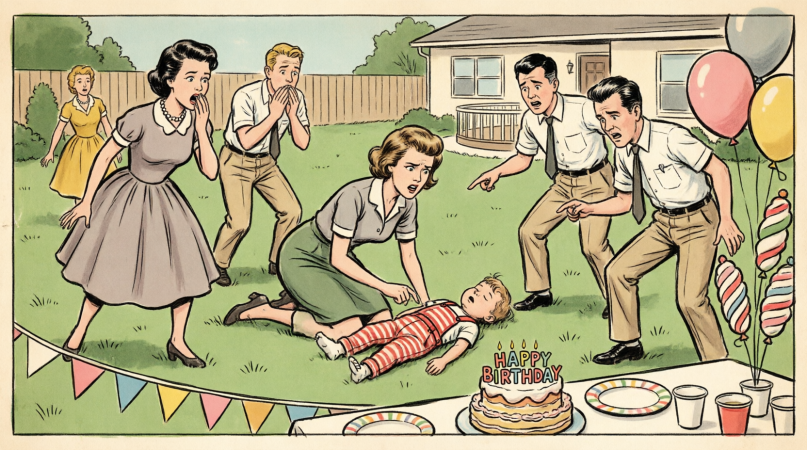
Three minutes later, he touched his throat.
At first it looked small. Just a distracted motion, fingers brushing the skin at the base of his neck. Then he coughed. Once. Twice. His face changed color so quickly it didn’t even feel real. Pink to red to something blotchy and wrong.
I was already moving when he looked at me with wide, frightened eyes.
“Mom,” he said, his voice thin and rough. “It hurts.”
My stomach dropped so fast it felt like missing a step in the dark. I snatched him up, and as I reached for him, I saw Jennifer standing on the other side of the table with the knife still in her hand, watching.
Then Ethan clawed at his throat and whispered, “I can’t breathe,” and suddenly every sound in the room turned sharp enough to cut. What I grabbed next should have saved my son—but the second my hand closed around it, I knew something was terribly wrong.
Part 2
The EpiPen should have felt familiar in my hand.
It always had. I had practiced with trainer devices on my own thigh, on David’s thigh, on an orange, on a rolled towel when Ethan was first diagnosed. I knew the weight of it. The balance. The exact snap of the safety cap, the resistance before the spring fired.
This one felt off.
Not enough for someone else to notice. Enough for me.
“David!” I shouted. “Call 911!”
Ethan was wheezing now, a terrible wet, narrowing sound. His little body bucked against me as I shoved the EpiPen into his outer thigh through his jeans and held it there.
One, two, three.
Nothing.
No click. No recoil. No release of medication. Just dead plastic in my hand.
For one stupid frozen second my brain refused to process it. Devices fail sometimes, a tiny calm clinical voice in me said. Manufacturing defect. Misfire.
Then Ethan’s knees gave way.
He hit the hardwood and started convulsing.
Foam bubbled at the corner of his mouth. One of the children screamed. Someone knocked over a cup and red punch spread across the floorboards like blood in a movie, too bright to look real. My mother started praying out loud. David was on the phone yelling our address. My father lunged to gather the other kids and herd them into the den.
I grabbed Ethan’s face between my hands. “Stay with me. Stay with me, baby. Look at me.”
His eyes were open but wrong—rolling, unfocused, glossy with panic.
Jennifer was standing near the wall, her phone in one hand. She looked pale, but not panicked. Not the way a person looks when a child they love is dying in front of them. Her shoulders were stiff. Her breathing was too controlled. And when David barked, “Move!” at her so he could kneel beside us, she jerked like she had been caught thinking about something else.
“Come on, come on,” David said, hands shaking as he put the dispatcher on speaker. “He’s five. Severe allergy. EpiPen didn’t work.”
“Lay him flat,” the dispatcher said. “Keep his airway clear. Paramedics are en route.”
I was already doing that. Years of ER muscle memory took over even while the mother in me was breaking apart. I turned Ethan, kept his airway open, counted breaths that were getting farther apart, rubbed his sternum, called his name until my voice shredded.
The seven minutes before the ambulance arrived felt longer than labor.
The siren finally cut through the street outside, and then our house filled with people in navy uniforms, plastic equipment cases, the clean chemical smell of antiseptic and cold air following them in. They moved with brisk purpose. Oxygen mask. Adrenaline. Monitors. Questions. Age, weight, medical history, allergen exposure, EpiPen dose, time of onset.
I answered automatically, holding Ethan’s hand while a paramedic started a line in the crook of his tiny arm.
Another paramedic took the EpiPen from me. “Did this discharge?”
“No,” I said.
He frowned. “You sure?”
I looked at him so hard he immediately regretted the question. “I know what a discharged EpiPen feels like.”
He nodded once. “Got it.”
They got Ethan breathing again in the ambulance, but it was ragged and shallow. I rode with him, sitting on the bench seat with one hand braced against the metal cabinet and the other wrapped around his cold fingers. The oxygen hissed. The monitor beeped too fast, then too slow, then too fast again. Every bump in the road jolted through my spine.
I kept staring at his eyelashes.
It was the stupidest detail to focus on, but I couldn’t stop. They were damp and stuck together at the tips. I had kissed those lashes goodnight the night before. I had kissed them that morning. I couldn’t make my mind accept that a child could eat birthday cake in one moment and hover at the edge of death in the next.
At the hospital, they wheeled him away under bright fluorescent lights that made everything look washed out and unreal. The automatic doors to the treatment area swung shut in front of me with a rubber-sealed thud that I felt in my teeth.
Then I was in the hallway.
There are hospital hallways that smell like coffee and hand sanitizer and old papers, and there are emergency hallways that smell like adrenaline even though adrenaline doesn’t have a smell. This one was the second kind.
I sat on a molded plastic chair and stared at the floor. My hands were sticky with frosting and dried punch and maybe my son’s spit. My knees bounced. My chest hurt. David came in twenty minutes later, breathless, tie half-undone, face gray.
“How is he?”
“I don’t know.”
He sat beside me hard enough to rattle the connected chairs. For a minute neither of us spoke. Then Jennifer appeared at the end of the hall.
She was crying now. Or at least her eyes were wet.
“Rachel,” she said softly. “I’m so sorry.”
I looked at her and heard myself ask the question before I had decided to. “Why didn’t the EpiPen work?”
She blinked. “What?”
“The EpiPen,” I repeated. “Why didn’t it work?”
Her gaze dropped for half a second. “Maybe it was expired.”
“No.” My voice came out flat. “I replaced it last month.”
Jennifer swallowed. “Then maybe it was defective.”
Maybe. It was possible. Rare, but possible.
Still, something in me twisted harder.
An hour later a doctor came through the swinging doors. Mid-forties, short dark hair tucked behind one ear, calm face with the careful softness doctors wear when they have to say things that crack lives open.
“Mrs. Martinez?”
I stood so fast the chair legs squealed against the floor.
“I’m Dr. Sarah Kim. Your son is stable. He’s sedated, but he’s breathing on his own.”
Stable.
The word hit me so hard I nearly cried from relief. Then I saw that Dr. Kim hadn’t relaxed. Not really.
“There’s more,” she said.
We followed her into a consultation room that smelled faintly of copier toner and stale coffee. She shut the door and laid two reports on the desk between us.
“The bloodwork confirms a severe peanut reaction,” she said. “But the concentration of peanut protein markers in his system was unusually high.”
I stared at the paper. Numbers. Lab values. Notes.
“How high?”
“Far beyond incidental cross-contact. This was a substantial exposure.”
I heard David say, “What does that mean?”
Dr. Kim looked at me first, maybe because she could tell from the way I read the report that I understood medicine.
“It means this was not likely to be a trace contamination. It suggests intentional introduction of peanut oil or peanut product.”
For a second I thought I had misheard her.
“Intentional?” I said.
She slid the second report forward. “We also examined the EpiPen device brought in by EMS.”
My mouth went dry.
“The cartridge did not contain epinephrine,” she said. “It contained saline.”
David actually laughed once, a sharp unbelieving sound. “That’s not possible.”
Dr. Kim didn’t look away. “I’m sorry. It is.”
The room went cold around the edges.
No—worse than cold. Hollow.
I put a hand on the desk because I suddenly wasn’t sure where my body ended and the room began. Saline. Not expired. Not defective. Replaced.
Tampered with.
Someone had fed my son peanut oil. Someone had switched life-saving medication for saltwater.
Someone had tried to kill him.
The door opened again twenty minutes later, and a detective stepped in carrying a notebook and a tired face. He introduced himself as Marcus Chun. Homicide had not been called because my son was alive, but attempted murder had.
He asked me to start from the beginning.
I told him about the party, the guests, the cake, the timing. I told him Jennifer had picked up the cake. I told him the EpiPen was normally stored in Ethan’s backpack upstairs. Detective Chun wrote in neat, small letters and occasionally looked up in a way that made me feel he was arranging every word into a pattern.
“Who had access to the backpack in the last week?” he asked.
“Family,” I said. “Anyone close. My parents. David’s parents. Jennifer.”
He tapped his pen once. “Anyone else in the house recently?”
I opened my mouth to say no, and then stopped.
Yesterday.
Jennifer had come by with a present while I was cooking. I remembered hearing her footsteps on the stairs. I remembered calling up, “Second door on the left!” I remembered how long it took her to come back down.
Too long.
“She was upstairs alone yesterday,” I said slowly. “In Ethan’s room. For maybe thirty minutes.”
Detective Chun’s pen stopped moving.
Thirty minutes is a long time when all you’re supposed to be doing is setting down a gift. Suddenly I could see Jennifer in that hallway so clearly it made me nauseous—her hand on the doorknob, her soft voice calling out that she’d “just be a minute,” my own distracted answer from the kitchen.
The detective closed his notebook.
“Mrs. Martinez,” he said, “I need you to think very carefully. When we go back to your house tonight, I want to know exactly who looks afraid.”
And standing there under the fluorescent lights, with the taste of panic still metallic in my mouth, I realized I already had one name in my head. The problem was, I didn’t know yet whether I was remembering the truth—or just the person I would most hate to be right about.
Part 3
Hospitals at night have two personalities.
The first is the one families see during visiting hours—busy, bright, full of coffee cups and elevator dings and rushed footsteps. The second starts after midnight, when the lights are dimmed in the hall and every sound gets louder because there are fewer of them. Sneaker soles squeak. A monitor alarms three doors down. Someone coughs behind a curtain. Someone cries in a vending machine alcove because they think no one can hear.
I sat beside Ethan’s bed and watched his chest rise and fall.
His room smelled like warmed plastic, sanitizer, and the weirdly sweet scent of pediatric medicine. A stuffed triceratops one of the nurses had found for him was tucked under his arm. Tape held the IV line in place against his skin. His lashes lay dark against cheeks still puffy from the reaction.
Stable, Dr. Kim had said.
Stable was not the same as okay. Stable was a rope bridge over a canyon. Stable was a promise for right now, not forever.
David dozed in the vinyl chair in the corner around two in the morning, chin dropped to his chest, one hand still wrapped around his phone. He had spent the evening making calls to relatives, answering police questions, managing practical things. Men like David did that when they were scared—grabbed logistics with both hands so they didn’t have to touch the terror directly.
I used to think that made him less emotional than me. Marriage had taught me it just made him emotional in a different direction.
My phone buzzed around three-thirty. A message from Jennifer.
How is he?
I stared at the screen until it dimmed.
Then another.
Please answer.
Then another, three minutes later.
I’m so sorry.
I set the phone face down on my lap.
Sorry for what?
For being there?
For picking up the cake?
For suggesting the EpiPen might be expired?
For standing still while my son convulsed on the floor?
I hated myself a little for thinking it. Jennifer had loved Ethan. Or seemed to. She had taken him to the zoo, bought him ridiculous remote-control cars, let him smear glitter all over her apartment one Christmas because he had been making “magic snow.” She cried at his preschool graduation video like he was her own child.
But love that is real does not stand with empty hands while a child dies.
At some point near dawn, I gave up pretending I could sit still. I slipped into the hallway with my phone and searched the one thing I had been pushing away for hours.
Jennifer Thompson infertility.
The first result was an old feature on a support site. Five years old. Her picture was smaller and grainier there, but it was unmistakably her—same chin, same set to the mouth, same effortful elegance.
I read the article standing under a vending machine light.
Ten years of fertility treatment.
Seven failed cycles.
A marriage that ended while she was still trying to convince herself effort could beat biology.
A line from Jennifer that made my stomach tighten:
Every baby shower felt like being invited to watch everyone else live in the country I’d been deported from.
I read that sentence twice.
Pain radiated off the page. Not performative pain. Not dramatic pain. The flat, exhausted kind that comes after years of private loss.
Then I remembered a family dinner two months earlier.
Jennifer had been sitting across from me at David’s parents’ house, turning her wineglass slowly by the stem while everyone talked over one another about school districts and mortgage rates and whether my mother-in-law had over-salted the potatoes. I had just told them I was pregnant again. Early, but we had decided to share.
Everyone had congratulated me. David had kissed the side of my head. My father-in-law had actually laughed, delighted, and said, “Another grandchild. That’s what matters.”
At the time I had only felt embarrassed by how blunt he was.
Now, in the hospital hallway, another memory unlocked behind it.
Jennifer had smiled at me and said, “You really are lucky, Rachel.”
Lucky.
Not happy for you. Not wonderful news. Lucky.
I kept scrolling. Another article mentioned advocacy work. Another mentioned grief support. No scandal. No arrests. No public breakdown. Just a woman with a long, documented history of infertility.
That alone did not make her dangerous.
I knew that. God, I knew that. Suffering does not equal violence. Pain does not equal cruelty.
But pain can warp. And jealousy, fed in the dark long enough, can turn intelligent people into strangers.
When I went back into Ethan’s room, dawn had started bleaching the window sky. David was awake now, rubbing his eyes.
“You should go home for a few hours,” he said. “Shower. Change clothes. Bring Ethan’s dinosaur blanket. He’ll want it when he wakes up.”
“I don’t want to leave.”
“I know. But you’re running on fumes.”
He was right. And there was one more truth under his suggestion: the house had become a crime scene in my head. I needed to look at it with my own eyes.
At nine-thirty, after Dr. Kim assured me Ethan was improving, I drove home alone.
The party was still there, only dead now.
Blue balloons sagged near the ceiling. One of the paper banners had peeled off the wall on one side and drooped like a snapped smile. A half-melted bowl of ice floated grapes in pink water. Someone had kicked a party hat under the dining table. The room smelled faintly of chocolate, juice, and stale air.
I stood in the foyer and had to lock my knees to stay upright.
Then I went upstairs.
Ethan’s room looked normal until it didn’t.
Most crime scenes in real life don’t look dramatic. Nothing glows. Nothing is outlined. You just notice what doesn’t belong if you know a space intimately enough. I knew Ethan’s room down to the angle of the toy basket.
His backpack sat beside the bed where I always kept it on high-risk days. I picked it up and opened the front pocket.
The zipper was half an inch farther right than where I always left it.
Such a tiny thing. So ridiculous that anyone else would laugh if I pointed it out. But people who care for children with life-threatening allergies become ritualistic. I always zipped that pocket closed with the pull tab facing left because that was the fastest angle for my hand.
Someone had opened it. Someone had closed it differently.
I crouched and looked under the bed because instinct told me to look low. Dust. A runaway sock. A green crayon with teeth marks. And there, near the back leg of the frame, a small clear plastic cap.
I reached for it carefully.
Syringe cap.
Medical-grade. Clean. Not from our house. We didn’t use injectable meds. We didn’t keep loose syringes in Ethan’s room. I slid it into a sandwich bag from the bathroom cabinet with fingers that had started to shake in earnest.
Jennifer had been up here yesterday for thirty minutes.
I sat back on my heels and looked around the room: dinosaur lamp, tiny sneakers under the dresser, the framed finger painting Ethan had made for me in preschool. The normalness of it made the hidden violence feel even dirtier.
Then I went into David’s study.
I wasn’t proud of that part. But fear makes you ruthless, and I had begun to understand that if someone inside our family had done this, politeness was a luxury for safer people.
David kept financial papers and legal documents in a locking file cabinet that was currently unlocked. Inside a brown envelope marked ESTATE sat a copy of my father-in-law’s will.
I told myself I was only looking for motive. I told myself a lot of things.
The language was legal and dry until it wasn’t.
To my son David, I leave the family investment account, valued at approximately five million dollars, in recognition of his position as the father of my grandson, Ethan, who continues the family line.
To my daughter Jennifer, I leave five hundred thousand dollars.
That was bad enough.
Then came the sentence that made me grip the edge of the desk so hard my nails hurt.
Because she has no children and therefore no direct heir, this distribution reflects the practical needs of the family legacy.
Practical needs.
I read it again because I wanted to be sure I wasn’t making it uglier in my head.
No. It was exactly that ugly.
Jennifer hadn’t just suffered privately. She had been measured publicly, legally, by the one thing she could not give. And now I was pregnant with a second child.
I sat in David’s desk chair, hearing the faint hum of the air vent, the distant bark of a dog outside, and my own pulse knocking hard in my ears.
Maybe Jennifer wasn’t the only person with reason to be angry. David hated that will. He had argued with his father about it more than once. My father-in-law was cruel in polished, respectable ways and called it realism. My mother-in-law defended him because she’d had practice.
But only one person had been alone in Ethan’s room. Only one person had handled the cake. Only one person had seemed to freeze instead of move.
I stared at the will until the words blurred.
Then I folded it back into the envelope and went downstairs with the syringe cap in my bag and one thought hardening into decision.
If Jennifer had touched that cake after leaving the bakery, there would be a camera somewhere that had seen it. And if I was right, I was about to watch my son’s birthday split open on a screen.
Part 4
Sweet Dreams Bakery was one of those places that looked innocent enough to be used in a commercial.
White awning. Pink script on the window. Glass case full of cupcakes with buttercream swirls so precise they looked machine-made. The air inside smelled like sugar, coffee, and warm flour. Mothers with strollers came here after preschool pickup. Brides-to-be sampled cake fillings here on Saturdays. I had always liked that about it. It felt safe.
Now even the bell over the door sounded suspicious.
The manager remembered me immediately. Word travels fast when police start asking questions.
“Mrs. Martinez,” she said, coming out from behind the counter, hands clasped tight. “I’m so sorry about your son.”
I swallowed. “I need to see the footage.”
She glanced around the shop. “The detective already requested a copy.”
“I know. I still need to see it.”
Something in my face must have convinced her, because she nodded and led me through a door marked STAFF ONLY into a cramped office with a desk fan, a mini fridge, and a wall monitor connected to the exterior camera system.
She pulled up the timestamp from the day before.
There was Jennifer at 2:35 p.m., smiling at the cashier, signing the receipt, carrying the white cake box out with both hands. The angle from inside only showed her leaving.
Then the exterior parking lot camera caught her crossing to her car.
I leaned closer.
Jennifer opened the driver’s side door and set the cake box on the passenger seat. Instead of getting in and leaving, she sat there with the door shut and didn’t start the engine. The lot was bright with afternoon sun. The windshield reflected half the sky, but from the side camera we could still see movement inside the car.
Her shoulders bent forward.
Her right hand moved to her bag.
She took something out. Small. Bottle-shaped.
Then something long and narrow.
My skin went cold.
The manager paused the footage and looked at me. “Do you want me to zoom?”
“Yes.”
The resolution got grainier, but clearer in the ways that mattered. Jennifer held a syringe.
I actually heard myself inhale.
She drew liquid from the bottle. Opened the cake box. Looked around the lot once, quickly. Then she pushed the syringe down into the top of the cake in several slow, deliberate motions. Not random. Not messy. Careful. Controlled.
The manager made a broken sound beside me. “Oh my God.”
Jennifer closed the box, wiped the syringe with something—maybe a tissue, maybe a wipe—put both items back in her bag, and sat still for another few seconds before starting the car.
The timestamp clicked forward. She drove away.
I had imagined a hundred possible explanations in the car on the way over. Bakery mix-up. Cross-contamination. A stupid catastrophic accident. Maybe even Jennifer doing something misguided, like adding decorative syrup she thought was harmless.
But people do not inject secret ingredients into birthday cakes in parking lots because they are harmless.
My hands were trembling so hard I tucked them under my arms.
“Can I get a copy?” I asked.
The manager nodded at once. “Yes. Absolutely.”
While she copied the footage to a flash drive, I sat in a metal folding chair and stared at a box of printer paper. My mind moved too fast and too slowly at the same time. Jennifer had done something to the cake. That much was visible. But the bottle label was not readable from the camera angle. I needed more than suspicion. I needed the object itself.
When the manager handed me the flash drive, our fingers brushed and she whispered, “I hope your little boy is okay.”
I nodded because speech had abandoned me.
Outside, the sun was too bright. The asphalt shimmered. I sat in my car with both hands on the steering wheel and forced myself to think.
Where would Jennifer have put the syringe and bottle?
She had gone straight from the bakery to my house. Then to the hospital. Then eventually home. If she had any sense, she would have thrown the evidence away.
If.
Jennifer had always been composed, but panic makes fools of careful people. And people who believe their plan succeeded sometimes get sloppy before they realize it didn’t.
I drove to her apartment complex.
Her white sedan was parked in the back corner under a scraggly ornamental pear tree, dusted with yellow pollen. I cut my engine and sat there a moment, listening. A distant leaf blower. A dog barking behind another building. My own breathing.
This was a terrible idea. Possibly illegal. Definitely stupid.
I got out anyway.
The lot was nearly empty. I checked once more to make sure no one was watching and reached for the driver’s side handle.
It opened.
My heart kicked hard.
The car smelled like vanilla car freshener and old takeout. There were receipts in the cup holder, a cardigan tossed over the passenger seat, two lipsticks rolling in the center console. Nothing incriminating in plain sight.
I opened the glove compartment.
Inside, under a stack of registration papers and a pack of gum, lay a zip-top cosmetic pouch.
I pulled it out and unzipped it.
Disposable gloves.
An empty syringe.
A small glass bottle.
My fingers went numb.
The bottle label was turned half away, but I didn’t need the whole thing. I could read enough.
Peanut oil.
For a second the parking lot blurred. I had to brace myself against the open car door because a wave of heat passed through me so violently it felt like fever. Peanut oil. The same thing Dr. Kim had found in Ethan’s blood. The same thing that would send my child into anaphylaxis so fast he never even got to open the giant robot dinosaur Jennifer had brought him.
I took pictures. Bottle. Syringe. Gloves. Car interior. Time stamp on my phone visible in one frame because former nurse brain had quietly become evidence brain overnight.
Then I called Detective Chun.
He answered on the second ring. “Chun.”
“It’s Rachel Martinez,” I said, and my voice did not sound like mine. “I found the evidence.”
He was silent for half a beat. “Where are you?”
I told him.
Then: “Mrs. Martinez, did you enter her vehicle?”
“Yes.”
Another silence, sharper this time. “Do not touch anything else.”
“I already photographed it.”
“Step away from the car. Stay there. I’m sending a team.”
I did as I was told, mostly because my legs had started shaking too much to trust. I stood under the pear tree, staring at Jennifer’s windshield, at the dried arc left by wiper blades, at my own reflection floating faintly over the glass.
When Detective Chun arrived forty minutes later with two officers, he looked exactly the way I expected a detective to look when a terrified mother did half his job for him: annoyed, impressed, and worried all at once.
He gloved up, examined the pouch, bagged everything, and took the flash drive from me. Then he asked the question I had been dreading because it made this real in a way the objects hadn’t.
“Do you want to be there when we confront her?”
I looked at the evidence bags in his hand. The bottle caught the light, amber and innocent-looking.
“Yes,” I said.
He nodded. “Then go home. Don’t say a word to anyone. We’ll meet you there this evening.”
By six o’clock the whole family would be in my living room, and one of them would know the police were not coming for questions. They were coming for an arrest. I had spent years reading panic in emergency rooms, and suddenly I knew exactly what I was waiting to see: the moment guilt learned it had run out of time.
Part 5
Our living room had never held so much silence.
Everyone was there by six, called under the excuse that Detective Chun needed follow-up statements from the family. My parents sat together on the loveseat, my mother clutching a wad of tissues she had not yet used, my father with his jaw set so tightly a muscle kept jumping in his cheek. David stood near the fireplace, one hand braced on the mantel as if the room were moving under him. His parents sat side by side on the couch, his father restless, his mother pale and pinched.
Jennifer was by the front window.
She had changed clothes since the hospital. Gray sweater, dark jeans, hair brushed back. She looked composed from a distance, but up close there was strain around her mouth and a bright, feverish shine in her eyes. She kept rubbing her thumb against the side of her index finger. Again and again. Small repetitive movement. Self-soothing. Or fear.
Detective Chun entered behind me with two uniformed officers. No one missed the change in the room when they stepped inside. It was like a pressure drop before a storm.
David looked from the detective to me. “Rachel? What is this?”
I set my purse down on the entry table very carefully. “Ethan is stable,” I said. “But this wasn’t an accident.”
My mother inhaled sharply. My father swore under his breath. David’s face drained.
Detective Chun spoke with the measured neutrality of someone who knew families could crack in unpredictable directions. “We have reason to believe the allergic exposure and the failure of the EpiPen were intentional.”
Nobody moved.
Then Jennifer said, too quickly, “Intentional by who?”
I turned to look at her fully.
Her voice had trembled on the last word.
“I’d like to ask you something first,” I said.
Jennifer folded her arms. “Rachel, I’ve been sick with worry all day. If this is some kind of accusation—”
“Yesterday,” I cut in, “when you came over before the party, what were you doing upstairs in Ethan’s room for thirty minutes?”
The room tightened around us.
Jennifer blinked. “I told you. I was putting his gift on the bed.”
“For thirty minutes?”
She let out a thin laugh that sounded wrong. “I don’t know, maybe I got distracted.”
“With what?”
Her gaze flicked to David and back. “I was looking at his room. Talking to him. I don’t remember.”
“He wasn’t upstairs.”
Jennifer’s lips parted. Just slightly.
No one else in the room would have noticed the shift. I did.
I reached into my purse and took out the sandwich bag with the syringe cap. The plastic crackled in the silence.
“I found this under Ethan’s bed this morning.”
Jennifer stared at it and actually took a step back.
“That’s not mine,” she said.
Detective Chun stepped closer, but I wasn’t done.
“Then maybe this is.”
I pulled out my phone and opened the bakery footage. My hands were steady now. Anger had done for me what sleep couldn’t.
I turned the screen so everyone could see.
Jennifer walking to her car.
Jennifer taking a bottle from her bag.
Jennifer loading a syringe.
Jennifer opening the cake box.
Jennifer pushing the syringe into the cake.
No one spoke until the video ended.
David made a sound like the air had been punched out of him. “Jennifer,” he said, not loudly. “What the hell is that?”
Jennifer was shaking her head before he finished. “No. No, it’s not what it looks like.”
I almost laughed. The sentence was so absurd it seemed borrowed from a bad television script.
“Then what is it?” I asked.
She looked at me with eyes that had suddenly become wild. “It was flavoring. I was adding flavoring. Ethan likes—”
“Peanut oil?” I said.
That landed.
Her entire body went still for a fraction of a second, the way animals go still when they hear a branch snap.
Then I showed them the pictures from her car. The bottle label. The syringe. The gloves.
My mother-in-law made a choking sound and put a hand to her mouth. My father-in-law stood up so fast his knee hit the coffee table. David just stared at the phone screen as if his mind had detached from his body and was refusing to come back.
“No,” Jennifer whispered.
Detective Chun nodded to the officers.
One of them stepped forward. “Jennifer Thompson—”
She folded in on herself before he even reached her. Dropped to her knees. Hands on the carpet. A terrible, animal kind of crying burst out of her, the kind that sounds dragged from someplace so deep it doesn’t even seem voluntary.
David moved first. “Why?” he shouted. “Why, Jennifer? He’s a child.”
She looked up at him through tears, mascara streaking down her face. “Because I can’t have one!”
The words hit the room like broken glass.
Nobody spoke. Jennifer’s shoulders shook violently. I had never seen a person look both so undone and so dangerous.
“Every time I looked at Ethan,” she said, “I saw everything I never got. Every birthday. Every school photo. Every sticky little hand around my neck. All of it. Rachel gets one child and then another, and I got nothing. Nothing.”
My father-in-law took a step toward her. “Jennifer—”
She rounded on him with a ferocity that made him stop. “Don’t,” she snapped. “Not you.”
Her face twisted. “You wrote me out like I was defective inventory. Five hundred thousand dollars because I have no heir? Because I failed the family?”
He actually had the nerve to look offended.
My voice came out colder than I expected. “So you tried to kill my son.”
Jennifer looked at me then, and something in her expression changed. The hysteria slid back just enough for something rawer to show through.
“I wanted you to understand,” she said. “Just once. I wanted you to know what it feels like to lose a child.”
My knees nearly gave out.
This was not an accident. Not jealousy in some loose emotional sense. Not a meltdown. She had wanted to hand me grief on purpose, carefully packaged, on my son’s birthday, under balloons and candles and children’s songs.
I stepped toward her. The officers moved with me, uncertain whether they were protecting her or me.
“You do not get to use your pain as a knife,” I said. “You do not get to carve a child open with it.”
Jennifer covered her face and sobbed harder.
Detective Chun gave the officer a small nod.
Metal cuffs clicked around Jennifer’s wrists.
When they lifted her to her feet, her whole body was trembling so badly she could barely stand. That was the moment the title of the day burned itself into me—not the collapse, not the ambulance, not the doctor. It was this: the police in my house, my family frozen in place, and the woman I had trusted most shaking because the truth had finally touched her skin.
As they led her to the door, she turned her head toward me. “Rachel,” she whispered.
I didn’t answer.
I watched her go all the way out into the fading evening light, and even then one thought kept knocking against the inside of my skull. Jennifer had not looked surprised to be caught. She had looked ruined. Like someone who had been carrying a script for months and had just reached the final page.
Which meant somewhere, before the cake and before the party and before Ethan hit the floor, the plan had started. And I needed to know how long she had been smiling at us with murder already tucked behind her teeth.
Part 6
The next day Detective Chun called just after noon.
His voice was calm, but there was an edge under it now, the kind that told me the case had shifted from shocking to ugly.
“We searched Jennifer’s apartment,” he said. “There’s something you should see.”
I asked if Ethan was allowed to have visitors yet before I even answered the detective. That was my life now—grief, fear, logistics, all braided together. Ethan had woken up that morning groggy and clingy, his throat sore, his voice small. He remembered the cake. He remembered not being able to breathe. He did not remember the convulsions, thank God.
I kissed his forehead, promised I’d be back by dinner, and drove to the station with my palms sweating against the steering wheel.
The interrogation room they put me in was colder than it needed to be. Gray walls, bolted metal table, two plastic chairs. There was a faint smell of coffee gone stale in a paper cup and the lemony cleaner janitors use in public buildings because it’s cheap and strong. Detective Chun entered carrying a clear evidence bag.
Inside was a black leather journal.
Jennifer’s diary.
Even in the bag it looked used hard—creased spine, softened corners, a ribbon marker frayed at the end. The kind of object that had been opened hundreds of times with tired hands.
“We found it in her bedroom,” he said. “Bedside table.”
I stared at it and hated myself a little for the rush of anticipation that moved through me. Diaries are private. Violated privacy should bother me. Under normal circumstances, it would have.
These were not normal circumstances.
Detective Chun sat down across from me and opened a photocopied set of selected pages. “You don’t have to read them,” he said.
“Yes, I do.”
He slid the first page over.
Three months earlier.
Today Rachel announced she’s pregnant again. Everyone smiled and clapped like life is so easy for people like her. I smiled too. I even hugged her. I could feel the heat of her happiness through her sweater and wanted to claw it off her skin.
I pressed my lips together.
The next entry was from one month later.
I asked Rachel to show me the EpiPen. She was so eager to explain it, sweet and efficient, like she always is when she gets to be competent and needed. Blue first, then orange. Hold in place. Replace monthly. She has no idea how easy she makes everything look.
A cold line of sweat slid down my back.
Detective Chun turned another page.
I have a plan for Ethan’s birthday. Peanut oil is simple. People hear “allergy” and stop asking questions. The EpiPen will be the important part. If that fails, there will be no time to save him. Rachel will know what it is to hold a dying child and understand that pain is not an abstract thing women like her get to pity from a safe distance.
The room around me flattened.
It is one thing to know a person has tried to kill your child. It is another to watch their intent unfold in their own handwriting, deliberate and clear, without the cushioning blur of panic.
This was not a burst of jealous rage. Not a breakdown. Not one terrible impulsive act.
This was method.
Planning.
Timing.
Study.
Performance.
Jennifer had practiced compassion on the outside while engineering death underneath.
“Premeditated,” I said.
Detective Chun nodded. “Very.”
He slid me another page.
This one was older. Four years old.
David’s ex is pregnant. Three months and already glowing. How cruel that happiness has a look. I smiled at her at brunch and offered more tea. Women like her never even know when they’re standing inside another woman’s grave.
I looked up. “David’s ex?”
He shook his head. “Not your husband. Her ex-husband. Same first name.”
I let out a breath I hadn’t realized I’d trapped.
He continued, “Her ex-husband remarried three years ago. His new wife became pregnant shortly after. She miscarried at eleven weeks.”
I felt the blood drain from my face.
“Are you saying Jennifer—”
“I’m saying the timing is troubling, and some of the diary language is suggestive. We do not have enough evidence to charge anything related to that incident. But we are investigating.”
He slid the next page over.
I read it once. Then again, slower.
She took my place and got the child that should have been mine. Sometimes God is lazy, so women have to do things themselves.
I pushed the papers away.
For the first time since Ethan collapsed, fear changed shape inside me. Up to then it had been acute, immediate, bright. Save him. Find proof. Catch her.
Now it became something older and darker.
Who had Jennifer been while we were all calling her kind? How long had her grief been mutating in private? How many times had I hugged her in my kitchen while she stood there cataloging what she wanted to destroy?
Detective Chun let the silence sit for a minute.
“We’re also processing the EpiPen for prints and residue,” he said. “But the diary alone is powerful.”
I nodded, though the movement felt disconnected from thought.
He hesitated. “She asked if you would visit.”
My head snapped up. “What?”
“At arraignment she asked if you knew why she did it. Then she asked if you would come.”
I almost laughed. The audacity of that. As if there were a version of events where I owed her the gift of being witnessed.
“No,” I said automatically.
But even as the word left my mouth, another part of me stirred. The part that used to sit with intoxicated patients, psych patients, grieving families, violent men in restraints and teenage girls after overdoses. The part that knew answers sometimes lived in rooms you never wanted to enter.
I looked down at Jennifer’s diary again.
She had written about me like I was a symbol, a category, a woman-shaped insult from the universe. Not Rachel with flour on her shirt and dark circles under her eyes. Not the former nurse who forgot dentist appointments and reheated the same coffee three times every morning. Not the mother who had sat on the floor of the laundry room and cried after Ethan’s diagnosis because she was afraid one mistake would bury her child.
Just Rachel the fertile. Rachel the lucky. Rachel the woman with everything.
That kind of distortion does not happen overnight.
“Set it up,” I said.
Detective Chun watched me closely. “You don’t have to do this.”
“I know.”
When I stood to leave, he gathered the photocopies and slipped the diary back into the evidence bag. The plastic crackled softly. It sounded too ordinary for what it held.
I drove back to the hospital in silence, but the words kept replaying in my head.
If that fails, there will be no time to save him.
Jennifer had not wanted Ethan merely frightened. She had wanted him dead before help could arrive. She had wanted me kneeling on the floor of my own living room with empty hands.
And now she wanted to see me.
By the time I reached Ethan’s room, my son was awake and coloring a triceratops with markers the nurse had brought him. He looked up, smiled weakly, and said, “Mom, did I miss my presents?”
I crossed the room and wrapped myself around him so fast I startled him. He smelled like hospital soap and little-boy sweat and the faint medicinal tang of adhesive tape.
“No, baby,” I whispered into his hair. “You didn’t miss anything.”
But as I held him, another question pressed up under my ribs, one I couldn’t stop asking.
If Jennifer had spent months preparing to make me lose my child, what exactly did she think she wanted from me now—confession, absolution, or the one thing I already knew she would never get?
Part 7
The detention center visiting room was colder than the police station and somehow more airless.
There was thick glass between the seats, a metal shelf under each window, and phones chained to the wall with coiled cords that had gone sticky with years of disinfectant. The overhead fluorescent lights flattened everyone’s faces into a sickly, exhausted version of themselves. Somewhere down the hall, a door buzzed open and slammed shut. Again and again. It sounded like finality with bad acoustics.
I had told David not to come.
He argued, of course. Said there was no reason I had to do this alone. Said Jennifer didn’t deserve another minute of my time. Said maybe seeing her again so soon would make things worse.
All true.
I came anyway.
When the door on her side opened, Jennifer stepped in wearing county orange and no makeup. For a second I did not recognize her. Not because prison had transformed her that fast, but because I had never seen her without all the careful scaffolding. Her hair was pulled back badly, revealing how thin her face had gotten. There were bruised shadows under her eyes. She moved like someone who had not slept in days and no longer trusted her legs completely.
She sat.
For a moment neither of us touched the phones.
Then she lifted hers. I lifted mine.
“You came,” she said.
Her voice sounded rough, worn down to its grain.
“I almost didn’t.”
She gave a tiny nod like she had expected that. “That would have been fair.”
I didn’t answer. I looked at her hands instead. No rings. No polished nails. Just the dry, bitten cuticles of a woman who had been unraveling for longer than anyone understood.
Finally I said, “Why did you want to see me?”
Jennifer’s eyes filled, but I had already learned tears didn’t mean innocence. Or regret. Sometimes they just meant self-pity had found water.
“Because the story sounds simpler from everyone else,” she said. “They say jealous aunt. Monster. Crazy woman.”
“You poisoned my child and replaced his medication with saline.”
“I know what I did.”
“Do you?” I leaned closer. “Because the version in your diary sounds very neat. Almost elegant. The version in my house involved my son foaming at the mouth on the floor while children screamed.”
Her mouth trembled. “I know.”
“No. You know the idea of it. You know the symbolic version. You wanted me to suffer, Jennifer. You wanted to create grief in me like that would balance some cosmic scale. But Ethan is not an idea. He is a real boy. He likes dinosaur bandages and refuses to eat crusts and laughs in his sleep. You picked him because he was mine, and you made him into a weapon.”
She closed her eyes.
For one full breath, two full breaths, she just sat there. Then she said, “I used to think pain made people deep. More human. More compassionate. But after enough of it, if you don’t do something with it, it just hollows you out and fills the space with poison.”
“That sounds almost insightful,” I said. “Where was that insight before you tried to murder a five-year-old?”
She flinched.
Good.
I hadn’t come for cruelty, exactly. But I also had not come to hand her comfort.
“I need the truth,” I said. “All of it. Not the polished version you tell yourself. Start with the EpiPen.”
Jennifer stared past my shoulder at the blank cinderblock wall behind me. “The day before the party,” she said quietly, “I came over with the present. You were making those little sandwiches Ethan likes. I could smell the mustard from the kitchen.”
I remembered. The house warm. My hands wet from rinsing grapes. Her heels on the stairs.
“I went into his room,” she continued. “And for a second I almost left. It looked so… ordinary. His tiny socks. The bookshelf. A half-built Lego thing on the rug. It made me sick how much life there was in that room.”
I gripped the phone harder.
“I had the syringe already prepared,” she said. “I took the EpiPen cartridge apart and replaced the medication. I’d watched videos. I practiced on another injector first.”
The steadiness in her voice on that part was what made me cold, not her crying.
“You planned it for weeks.”
“Yes.”
“You asked me to teach you how to use it.”
“Yes.”
“So you could sabotage it.”
She nodded once.
I let silence press on her.
“Did you mean to kill him,” I asked, “or did you tell yourself you only meant to scare me?”
That finally made her look at me. Fully. Directly.
“I meant to kill him,” she said.
There it was.
No evasions. No language about accidents. No vague talk of losing control. A plain sentence. Hideous and complete.
My heart beat so hard it hurt.
“You could have stopped,” I said. “Any time. In the parking lot. On the drive over. When he hugged you at the door. When he smiled at the cake. You could have stopped.”
“I know.”
“Then why didn’t you?”
Jennifer laughed once, softly, with no humor in it. “Because by then I had already spent so long building the moment in my head that stopping felt impossible. I wanted your life to break the way mine had broken.”
I closed my eyes for a second.
Then I asked the question that had followed me here like a shadow. “What about your ex-husband’s wife?”
Her face changed.
Not much. Just enough. A tiny tightening around the mouth. A delay.
“There’s no charge for that,” she said.
“That’s not an answer.”
She looked down at the metal shelf. “I’m not confessing to anything else.”
“Did you hurt her?”
Jennifer said nothing.
“Did you?”
Her eyes lifted. Empty and shiny at once.
“If I had,” she said slowly, “it would only mean I was already gone long before Ethan.”
My skin prickled.
That wasn’t a confession. It also wasn’t denial.
I could hear a guard talking at the far end of the hall. Keys clinked. A vending machine thumped when someone hit it too hard. Everything ordinary sounded obscene next to this conversation.
“Listen to me carefully,” I said. “I can understand infertility grief. I can understand rage. Shame. Jealousy. Humiliation. I can understand all of it. But understanding is not forgiveness.”
Jennifer’s lips parted.
“I will never forgive you,” I said.
The sentence came out cleaner than I expected. No tremor. No performance. Just truth.
Her face crumpled, but I kept going.
“You do not get to turn your wound into my burden. You do not get redemption from me. You will not have a role in our healing. Ethan will grow up without you. My daughter will grow up without you. And if you spend the next twenty years learning the exact shape of what you destroyed, that still will not purchase forgiveness.”
Tears ran down her face. She didn’t wipe them.
“I know,” she whispered. “I don’t deserve it.”
“No. You don’t.”
For a moment I thought that was the end.
Then Jennifer leaned forward and gripped her phone tighter. “Rachel,” she said, voice dropping, “I need you to know one thing.”
Every nerve in me sharpened.
“When Ethan collapsed… I thought I would feel relief. Justice. Something clean.” Her mouth twisted. “But when he looked at you and said he couldn’t breathe, I felt afraid. Not for him. For me. For what I had become.”
I stared at her.
Maybe she meant it. Maybe she was still centering herself in the only way she knew how. At that point I no longer cared which.
I set the phone back in its cradle and stood.
Jennifer’s eyes widened. “Rachel—”
I walked to the door without turning around.
The guard buzzed me out. The hall air hit my face like freezer burn. I kept walking until I was outside in the parking lot with the late afternoon sun stabbing off windshields and my own breath coming too fast.
I had come wanting the whole truth. I left with enough.
Jennifer meant to kill my son.
She had practiced.
She had planned.
And if the detective was right, Ethan might not even have been the first life she tried to bend to fit her pain.
When I got into my car, my phone lit up with a message from Detective Chun.
Trial date set.
I stared at those three words, my fingers suddenly cold on the steering wheel. Jennifer had given me her confession. The court would give it a sentence. But punishment was one thing. Living after this was another.
And for the first time since Ethan’s birthday, I understood that catching the person who did it was only the first ending. The harder story was the one that came after.
Part 8
The trial started three months later on a Monday morning that smelled like rain.
Courthouses always smell faintly the same to me—wet wool, old paper, floor polish, and stale air from vents that never seem to fully work. People speak too quietly in them at first and too loudly later. Shoes echo. Clerks move with the irritated efficiency of people who have seen every kind of human disaster and no longer find any of it cinematic.
I sat in the second row behind the prosecution table with David beside me. His knee bounced constantly. Mine stayed very still. That was the difference between us when we were under pressure: he shook movement into the world; I turned to stone.
Jennifer sat at the defense table in a plain navy blouse, hair tucked behind her ears, looking smaller than I had ever seen her. Not harmless. Small. There’s a difference.
She never looked at me while jury selection happened. She looked at the wood grain on the table, the legal pad in front of her, the judge, once at the ceiling. But not me.
Good.
The state built the case the way good prosecutors do—without drama, because facts performed well enough on their own.
Dr. Kim testified first. She explained Ethan’s reaction in precise medical language, then translated it for the jury: the dose of allergen was large, the onset was rapid, and the failed EpiPen turned a treatable emergency into a near-fatal event. She described finding saline in the injector cartridge. I watched two jurors physically recoil when she said that.
Then the bakery manager took the stand.
The courtroom lights dimmed slightly as the parking lot footage played on a screen. There was Jennifer on video, clear enough now after enhancement to show the sequence in terrible detail: syringe, bottle, cake, injections. Slow and careful. Not frantic. Not confused.
The prosecutor paused the footage at the moment the syringe pierced the frosting.
“Did the defendant have authorization from the bakery to modify the cake in any way?”
“No.”
“Did she tell any employee she intended to add an ingredient?”
“No.”
“Had the cake been prepared according to allergy precautions requested by the customer?”
“Yes.”
Simple questions. Final answers.
Detective Chun testified next about the search of Jennifer’s car, the recovery of the peanut oil bottle and syringe, the evidence chain, the fingerprint match, the diary. When he read excerpts aloud, the room changed. You could feel it happen. Jurors who had been attentive became tense. One woman in the box pressed her lips together so hard they disappeared.
I didn’t cry during the testimony.
Neither did David.
I think we had both spent too much of ourselves already in the private rooms where fear lives. Court demanded another kind of endurance—public, vertical, controlled.
The defense tried what I expected: long-term infertility trauma, severe depression, diminished judgment, disordered thinking, a life bent by grief and family humiliation. None of that was untrue. I hated how much that complicated me. I hated that Jennifer’s suffering was real enough to make the courtroom story human while never once excusing what she did.
That was the trap, maybe. People want clean monsters because then the world feels organized. Jennifer wasn’t clean. She was wounded, intelligent, resentful, cruel, and calculating. She had become dangerous through choices, not just pain. That complexity mattered. It also changed nothing essential.
When I testified, the courtroom looked both huge and oddly close. Faces blurred except for the prosecutor and the jurors.
I told them about the party. The balloons. Ethan’s excitement. Jennifer offering to get the cake. The first bite. The hand at his throat. The EpiPen that didn’t fire. My training. My certainty that it had been tampered with. The sandwich bag and syringe cap. The bakery video. The pouch in Jennifer’s car.
The prosecutor asked, “Mrs. Martinez, did the defendant have permission to alter your child’s medication?”
“No.”
“Did she have permission to add peanut oil to the cake?”
“No.”
“After learning what she had done, how did you understand her actions?”
The defense objected. Sustained. Rephrased.
“How did you understand the risk created by those actions?”
I looked at the jury and said, “I understood that she intended for my son to die before anyone could save him.”
That sat in the room for a long time.
The defense attorney was careful with me on cross-examination, but not kind. He asked whether Jennifer had ever previously harmed Ethan. No. Whether she had shown affection toward him. Yes. Whether I knew the extent of her emotional suffering. Not fully. Whether I had compassion for infertility grief. Yes.
He thought that answer would soften the edges.
It didn’t.
I said, “Compassion for grief does not include permission to murder.”
There was a tiny shift in the jury box at that. Not dramatic. Enough.
The verdict came on the fourth day.
Guilty on attempted murder.
Guilty on aggravated assault of a child.
Guilty on tampering with a medical device.
Guilty on poisoning.
Jennifer stood very straight while the foreperson read it. Only her hands gave her away. Even from where I sat, I could see them trembling against the table.
At sentencing two weeks later, the judge was blunt.
“This was not a spontaneous act,” he said. “It was a deliberate attempt to engineer the death of a vulnerable child while ensuring rescue would fail. The court also notes the calculated breach of familial trust involved.”
He sentenced her to twenty-five years without parole eligibility for the attempted murder count, concurrent lesser terms on the remaining counts, mandatory psychiatric treatment, and a permanent restraining order from our family.
Jennifer closed her eyes when he said twenty-five years.
Then she opened them and looked at me for the first time all day.
People expect fireworks in moments like that. A speech. A collapse. A curse. There was none.
Just one long look across polished wood and institutional lighting.
There were tears in her eyes.
There was nothing in mine.
Afterward, outside the courthouse, microphones waited by the steps because local news loves any story that can be reduced to a sentence with the word “birthday” and the word “murder.” We ignored them. Rain had started, fine and cold. David held an umbrella over both of us while we crossed to the parking garage.
Halfway there, he said, “It’s over.”
I thought about Ethan sleeping with the hallway light on now.
About how he refused chocolate cake.
About how I still checked ingredient labels even on things I had bought a hundred times before because certainty no longer felt real.
“No,” I said quietly. “The trial is over.”
David looked at me. Rain tapped steadily on the umbrella overhead, a soft plastic drumming.
He understood.
That night, after Ethan finally fell asleep, I sat at the kitchen table with my laptop open and an untouched mug of tea going cold beside me. I wasn’t looking at court updates or legal summaries or victim resources. I was searching fertility grief counseling, infertility trauma groups, community mental health referrals.
Jennifer had chosen hatred. I could not change that. But the support forums I found were full of women writing in the dark to strangers: I’m ashamed of my jealousy. I don’t recognize myself anymore. I feel erased. I feel broken. I’m scared of the thoughts I’m having.
I read until two in the morning.
And somewhere between one testimonial and another, with rain ticking softly at the windows and my son breathing down the hall, a new idea formed in me—not forgiveness, not absolution, but refusal. Refusal to let Jennifer’s story be the only version of pain I knew.
If suffering could be turned into something this ugly, then maybe it had to be intercepted sooner. Named sooner. Held sooner. And as I stared at the blank document on my screen, I realized the life after the trial had already begun asking something of me.
Part 9
The first support meeting happened in the basement of a community church that smelled like lemon cleaner, stale coffee, and folding chairs.
I almost canceled it three times.
Not because I doubted the need. By then I had already spent weeks speaking with therapists, reading medical literature, contacting nonprofit consultants, and leaning hard on every practical skill my nursing years had given me. I knew the need was real. I had seen it in late-night forum posts and voice messages from women who found my preliminary website through some weird internet chain I still didn’t fully understand.
No, what I doubted was myself.
Who was I to stand in front of women living the exact kind of pain Jennifer had twisted into violence? Who was I to say I understood anything when I was still waking up at three in the morning to check that Ethan was breathing?
But maybe that was the point. I did not understand infertility from the inside. I understood what untreated rage could become when shame and isolation fed it. I understood medical systems, family cruelty, grief language, and what silence does to people. That had to be worth something.
I named the organization Hope Beyond Pain, and the name embarrassed me a little at first because it sounded too earnest. Then women started writing to say the words themselves made them cry, and I stopped apologizing for it.
The first meeting had twelve people.
One came straight from work in scrubs. One wore a wedding ring but no makeup and stared at the floor for twenty straight minutes before speaking. One arrived late, sat near the door, and kept her coat on the entire time like she might bolt.
I brought tea bags, cheap cookies, tissues, a list of therapy referrals, and a simple rule sheet printed in large font:
No judgment.
No comparing wounds.
No weaponizing someone else’s joy.
No one leaves more alone than she arrived.
We sat in a circle under buzzing fluorescent lights while the church refrigerator hummed in the adjoining kitchenette. Rain tapped at the basement windows set high in the wall. I introduced myself by first name only.
Then I said, “This room exists because pain gets dangerous when it only has one place to go.”
That was the truth stripped of ornament.
The woman in scrubs was first to talk. “I had my fourth failed transfer last month,” she said, rubbing both hands over her knees. “And I smiled through my sister’s baby shower last weekend. I smiled the whole time. Then I sat in my car after and screamed until I threw up.”
No one looked shocked. That was the first miracle.
Another woman, older, with sharp cheekbones and watery eyes, said, “My husband keeps saying we can just adopt like that solves the fact that I feel like my body betrayed me.”
Then the woman by the door spoke without lifting her head. “Sometimes I hate pregnant women on sight.”
Silence.
Then she said, voice shaking, “I don’t want to. I know that sounds ugly. But it happens before I can stop it.”
I leaned forward. “Jealousy is not the same thing as cruelty,” I said. “But jealousy buried in shame can rot into cruelty if you never drag it into daylight.”
Her eyes finally lifted to mine.
I did not tell Jennifer’s story that first night in full. Only enough.
“I know a woman,” I said, “who let her untreated pain become hatred. She hurt a child because she wanted someone else to feel what she felt. That path does exist. That’s why this room exists too.”
No one spoke for a while after that.
Then the woman in scrubs reached across and touched the door-sitter’s wrist. “I’m glad you said it out loud,” she whispered.
By the end of the meeting, coats had come off. Two women were exchanging numbers. Someone actually laughed, tired but real, about how unfair it was that every fertility clinic waiting room had terrible wall art. We stacked chairs together at the end because that’s what women do even after crying in public—they restore the room before they leave it.
When I got home, David was washing dishes with one hand while bouncing Emily against his shoulder with the other. She was three months old by then and had perfected the art of looking furious that life involved waiting even thirty seconds for anything.
“How did it go?” he asked.
I kissed Emily’s soft head and inhaled that milky baby smell that still felt half holy to me.
“It mattered,” I said. “I think it mattered.”
David smiled. “You look different.”
“Tired?”
“Useful.”
That word stayed with me.
Weeks turned into months. The group grew. We added virtual sessions, therapist partnerships, informational workshops on infertility and depression, and one brutal but necessary seminar called Jealousy Without Shame. Women came in brittle and careful and left with shoulders lowered an inch. Not healed. Just less alone.
I told Jennifer’s story publicly for the first time at a larger event in October.
Two hundred people in a hotel conference room.
Muted carpet patterned like spilled ink.
Pitcher water sweating on white tablecloths.
Too much air-conditioning, as always.
When I stood behind the podium, my notes trembled only a little.
“A year ago,” I said, “my son almost died. The person who did it was someone our family trusted. She had suffered from infertility for many years, and instead of getting help for the rage and shame that pain created in her, she fed it. She chose hatred. I will never excuse what she did. I will never forgive it. But I refuse to let her be the only story told about women in pain.”
The room was very still.
I talked about isolation. Medical trauma. Cultural cruelty. Family systems that reduce women to reproduction. The way secret jealousy mutates when paired with humiliation. The need for support that is honest enough to say the ugly parts out loud before those parts start asking for blood.
Afterward, women lined up to talk to me.
One hugged me so hard my shoulder ached.
One cried without speaking.
One said, “I thought I was becoming a monster because of the thoughts I had. You made me feel like I could choose differently.”
That sentence alone would have been enough reason to keep going.
But life at home did not transform into a neat healing montage.
Ethan still startled at coughing fits.
He still asked me to check labels twice.
He did not want store-bought cake.
He did not want Aunt Jennifer’s name said casually, like it belonged in normal conversation.
One night, a week before his sixth birthday, I tucked him in and found him awake longer than usual, staring at the glow-in-the-dark stars on his ceiling.
“Mom?”
“Yeah, baby?”
He twisted the edge of his blanket between his fingers. “Is it bad that I still think about Aunt Jennifer?”
The question hit me harder than any courtroom sentence had.
“No,” I said softly. “It’s not bad.”
He swallowed. “Sometimes I’m scared. But sometimes I feel sad.”
I sat on the edge of his bed, the mattress dipping under my weight. The room smelled faintly of laundry soap and crayons.
“Sad because she hurt me,” he said. “But also sad because… I think something was wrong in her heart.”
I looked at my son—this little boy with his new front tooth growing in crooked, this child who had almost died and somehow still had room in him for sorrow bigger than himself—and my own throat tightened.
He turned to face me fully. “Is that wrong?”
I brushed the hair off his forehead. “No,” I said. “That’s compassion.”
He let that sit between us a moment.
Then he asked the question I hadn’t prepared for and maybe never could have.
“If someone is hurting that much, how do you stop them before they do something terrible?”
And in the dim dinosaur-lamp light, with my son watching me as if I might actually know, I felt the whole story shift again. Because court had answered what happened. My work had begun answering what comes after. But now Ethan was asking the deepest question of all—how a person is reached before the damage is done.
Part 10
On the morning of Ethan’s sixth birthday, I baked the cake myself.
Not because I suddenly trusted myself more than professionals in some rational way. Rational had left the building a year earlier. I baked it because healing sometimes needs something embarrassingly literal. Flour on your hands. Eggs cracking under your thumbs. Vanilla blooming in warm batter. Control measured in cups and teaspoons and oven timers.
Ethan stood on a kitchen chair beside me wearing dinosaur pajamas and solemnly reading ingredients out loud from the labels as I handed them to him.
“Cocoa powder. Sugar. Baking powder. Salt.”
“And?” I prompted.
He squinted. “Manufactured in a peanut-free facility.”
I smiled. “Good catch.”
Sunlight slanted across the counter. Emily banged a spoon against her high chair tray like a tiny, furious drummer. David made coffee and pretended not to steal frosting from the bowl with his finger. The house smelled warm and sweet and normal, which was all I had wanted for a year.
The party was small this time. No crowd. No swarm of classmates. Just grandparents, my parents, Ethan’s two closest friends, and the kind of cautious joy people carry after they have learned how quickly a room can change.
David’s parents arrived early and quiet. Jennifer’s absence lived in every line of their faces now. My mother-in-law had aged two years in one. My father-in-law had become softer in ways I’m not sure were noble so much as inevitable. Consequences had entered his home too, and men like him often only develop humility when it finally sits at their own table.
He offered to carry in a cooler from the car. I let him.
That was as close to grace as I had for him.
The homemade cake sat in the center of the dining table on Ethan’s favorite green stand. Chocolate again, because I refused to let fear own an ingredient category. Blue frosting letters, a little crooked this time. Six tiny sugar dinosaurs I placed myself.
Ethan stared at it for a long moment.
“Mama?”
“Yeah?”
“This one is safe?”
I knelt so we were eye level. “Yes. I made it. I checked everything twice.”
He studied my face the way children do when they are deciding whether an adult is really telling the truth or just trying to make them feel better.
“There’s no peanuts?”
“I promise.”
He nodded once, satisfied, and the tension left his shoulders.
That tiny release almost undid me.
We sang. He laughed. Emily clapped because everyone else was clapping. Frosting ended up on three cheeks and one elbow. Someone spilled lemonade. One of Ethan’s friends tried to hide a whole extra slice of cake under a napkin. Life, messy and alive and gloriously unimpressed by symbolism, kept happening.
Later that night, after the last guest left and the wrapping paper had been stuffed into trash bags and the dishwasher was humming, a corrections envelope waited in the mailbox.
Return address: state women’s prison.
Jennifer.
I stood under the porch light with the letter in my hand while moths battered themselves against the bulb. For a second I just looked at the familiar slope of her handwriting. I had seen it on birthday cards, recipe notes, gift tags tied around Ethan’s presents.
David opened the front door behind me. “What is it?”
I turned the envelope over.
He saw the return address and went still. “You don’t have to open it.”
I knew that.
I also knew what was likely inside. Apology. Explanation. A request. Prison strips people of almost everything except time, and people with too much time start reaching backward with words.
I took the letter to the kitchen table and opened it anyway.
The paper smelled faintly institutional, dry and flat. Her handwriting was smaller than usual.
Rachel,
There is no version of this letter that can make me worthy of being heard, but I am writing because silence feels like another form of cowardice. I think every day about Ethan on the floor and about your face when you realized what I had done. I know you said you would never forgive me, and you were right to say it. I am not asking for that. I am writing only to say that you were right about something else too: I had choices before hatred became the loudest voice in me, and I refused them.
I stopped there.
Not because the words were especially moving. Not because I felt myself softening. The opposite, actually. I felt something settle.
All year people had confused understanding with obligation. If I understood Jennifer’s pain, didn’t that make forgiveness more virtuous? If I built an organization around preventing women from reaching her level of destruction, didn’t that mean I had, in some moral sense, transcended anger?
No.
Helping others is not the same as erasing what was done to your child.
Building meaning is not the same as granting access.
Compassion for suffering does not require reopening the door to the person who chose cruelty.
I folded the letter once, twice, and slid it back into the envelope.
“What did she say?” David asked.
“The truth,” I said. “Too late.”
He waited.
Then I tore the letter cleanly down the middle. Then again. Then once more, until her words were confetti in my hands. I dropped them into the trash and did not feel guilty.
“No reply?” he asked gently.
“No reply.”
And that was that.
Before bed I went to check on the kids. Emily was asleep on her stomach, diapered bottom in the air, one fist still curled around nothing. Ethan was awake, moonlight washing one side of his face silver.
“Good birthday?” I whispered.
“The best,” he said.
I sat beside him for a minute. The house had gone quiet except for the refrigerator’s hum and the far-off bark of a dog down the street.
“Mom?”
“Yeah?”
“When people come to your meetings, do they get better?”
I thought about the church basement. The conference room. The emails. The women who still cried in parking lots but no longer did it alone.
“Sometimes not all at once,” I said. “But they get less lost.”
He considered that. “That’s good.”
Then he yawned and reached for my hand. I held it until his breathing deepened.
In the hallway I stood between my children’s rooms and listened to the ordinary music of my home—the soft rush of the vent, the click of settling pipes, David moving around downstairs, alive and near. A year ago I thought our family might never feel safe again. The truth was more complicated. Safety had not returned as innocence. It had returned as practice. As vigilance without panic. As joy that knew exactly what it had survived.
Jennifer would spend twenty-five years behind concrete and steel. I would spend those same years doing something else entirely: raising my children, loving my husband, helping women name their pain before it became a weapon, and protecting the life we had almost lost.
I did not forgive her.
I would not.
Some doors stay closed because that is the healthiest thing love can do.
At dawn the next morning, I stood at the kitchen window with my coffee and watched the first light spread over the backyard. The grass shone wet. A robin landed by the fence, cocked its head, and hopped once through the pale gold.
Behind me, I heard Ethan’s feet slap the hallway and Emily let out her demanding little morning cry. David laughed at something I couldn’t hear.
I turned from the window and went toward them.
That, in the end, was the whole answer. Not revenge. Not forgetting. Not forgiveness.
Forward.
THE END!
Disclaimer: Our stories are inspired by real-life events but are carefully rewritten for entertainment. Any resemblance to actual people or situations is purely coincidental.