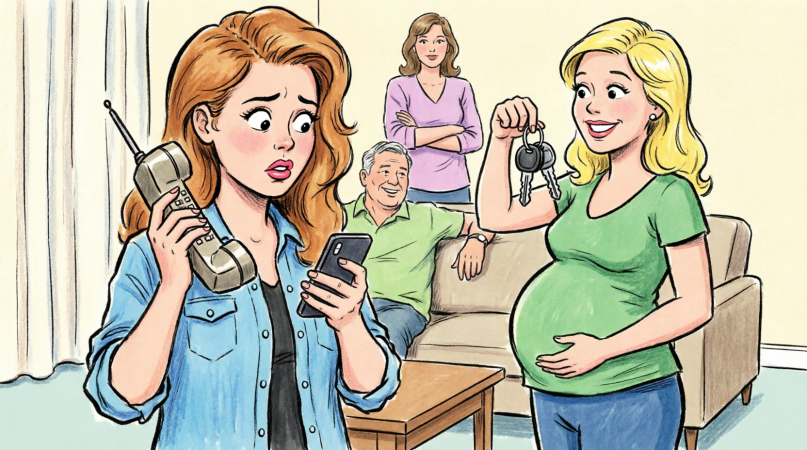
I returned home to an empty driveway two weeks after paying off my 2024 BMW. When I called my dad in a panic, he laughed and said, “We gave it to your sister.” You’re unmarried, and she’s expecting a child. She lacks a license. Instead of arguing, I filed a police report.

Two weeks after I made the final payment on my 2024 BMW, I came home to an empty driveway.

For five years, that car had been my private finish line. I’d run toward it in small, unglamorous strides: overtime shifts in the cardiac unit, skipping weekend trips, packing lunches that smelled like microwaved broccoli, picking up extra holidays because the differential pay stacked up faster than any “treat yourself” moment ever could. I wasn’t rich. I wasn’t married.

I wasn’t the kind of woman my family bragged about at church. But I had a goal, and at thirty-one, I’d hit it with my own two hands.

The night everything cracked open started like any other Tuesday.

I left Providence General with the fluorescent hum still buzzing behind my eyes and my shoulders carrying the leftover weight of other people’s fear. I changed out of scrubs in the locker room, tied my hair into a knot, and walked into the parking garage with my tote bag digging into my elbow.

My phone lit up with a text from Brittany.

Drinks?

I stared at it for a second, thumb hovering, then typed, Can’t. Dead on my feet.

Traffic downtown was lighter than usual. Portland in late fall always felt like it was holding its breath between rainstorms, the air crisp and sharp enough to make you feel awake even when your body begged for sleep.

I stopped at my favorite Thai place and grabbed pad see ew, extra broccoli. The smell filled my car as soon as I set the bag on the passenger seat, soy and garlic and something sweet that made me feel, for a moment, like I was taking care of myself.

My apartment complex had assigned parking. My spot was always the same, right near the entrance where the light didn’t flicker and the security camera aimed just enough to make you feel safer than you probably should.

I turned into the lot, half on autopilot, and my brain didn’t register the problem until my tires rolled past the space where my BMW was supposed to be.

There was nothing there.

Just asphalt and a faded white line.

I slowed, blinked hard, and told myself I’d parked somewhere else that morning. It happened sometimes after a double shift. The mind does weird things when it’s running on caffeine and obligation.

I drove through the lot once. Then again. Then I circled the outer row, heart tapping faster, pad see ew cooling in my lap like it knew dinner wasn’t going to happen the way I’d planned.

The third time I passed my empty spot, denial finally let go.

My car was gone.

My stomach dropped so hard I thought I might actually throw up. My hands started shaking as I pulled my phone out, and my thumb hovered over 911 like it didn’t want to be the one to confirm this was real.

The dispatcher answered with calm professionalism, and I forced myself to speak clearly.

“My car’s been stolen,” I said. “I just got home. It’s not here. I live at—”

She asked for my address, make and model, license plate, the last time I’d seen it. I answered like I was giving a report at work, like it was someone else’s crisis. She told me an officer would arrive within the hour to take a statement.

When I hung up, I stood in the cooling air beside my empty parking spot, clutching a bag of takeout like it was the last normal thing I had left. It wasn’t just the financial hit, though that alone made my throat tighten. It was the violation. The feeling that someone had reached into my life and plucked out something I’d earned.

Then, because my brain was scrambling for footing, I thought of my dad.

Lawrence had helped me research security features when I bought the BMW. He’d sounded proud back then, even if my mother had pursed her lips and asked whether I really needed something so expensive. Ashley, my younger sister, had rolled her eyes when I sent photos and made a comment about sports sedans being impractical.

But Dad had said, That’s my girl.

So I called him, because that’s what you do when the world tips sideways. You call the person who’s supposed to steady it.

He answered on the third ring. I could hear the TV blaring in the background, crowd noise and a commentator’s voice. Football, probably.

“Hey, sweetheart,” he said, like nothing in the world was wrong.

“Dad,” I said, and my voice cracked in a way that made me hate myself. “Someone stole my car. I just got home and it’s gone. I called the police, but I don’t know what to do.”

There was a pause, just long enough for my hope to lean forward.

Then he laughed.

Actually laughed, loud and easy, like I’d told him something cute.

“Nobody stole your car, honey,” he said. “We gave it to Ashley.”

For a few seconds, the words didn’t connect. They floated in the air like puzzle pieces from a different box.

“What do you mean you gave it to Ashley?” I said.

“Your mother and I talked about it,” he said, his tone shifting into that confident, final voice he used when he wanted the conversation to end. “Ashley’s got the baby coming, and she needs reliable transportation. You’re single. You live close to the hospital. You could walk if you had to.”

My mouth went dry. “Dad, that’s my car. I paid for it. I paid it off two weeks ago.”

“Don’t be dramatic,” he said.

In the background, I heard my mother’s voice, muffled but sharp, like she was punctuating his words with her agreement.

“We’re a family,” Dad continued. “Family helps each other. Ashley and Brett can’t afford a new car right now. They need something safe.”

“Ashley doesn’t even have a license,” I said, the sentence tasting like something poisonous.

“She’s been sober for eighteen months,” my father shot back, like sobriety erased the fact that she’d lost her license after her second DUI. “And Brett can drive it. They’ve got responsibilities now.”

I stared at the empty space, my mind catching up in jagged leaps. “How did you even get my car?”

“Your mother has your spare key, remember?” he said. “From that medical conference last year. You gave it to her in case someone needed to move it for street cleaning.”

I did. I had. In good faith. Like an idiot who thought her parents wouldn’t weaponize trust.

“That doesn’t give you the right to take my property,” I said, forcing my voice to level out. “Tell Ashley to bring it back. Right now.”

Dad’s tone hardened. “Listen. Your sister is about to be a mother. You spend all your money on yourself anyway. Fancy apartment, expensive car. It won’t hurt you to make this sacrifice.”

“I worked for five years for that car,” I said, my throat burning. “Every payment came from my paychecks.”

“And your mother and I paid for your college,” he snapped. “Or did you forget? We never asked for a dime back. The least you can do is help your sister.”

The logic was so twisted my brain almost stalled. A gift turned into a debt. My success turned into a resource they could redistribute.

Ashley’s pregnancy turned into a permission slip.

“You stole my car,” I said quietly.

“We didn’t steal anything,” he said, and I could hear the smile in his voice. “We’re reallocating family resources. Ashley needs it more than you do. End of discussion.”

He hung up.

I stood there with my phone pressed to my ear, pad see ew cooling into sadness, and I realized something with a clarity so sharp it felt like pain.

This wasn’t a misunderstanding.
This was who they were when they thought they could get away with it.
his was who they were when they thought they could get away with it.
The blue lights flashed against the brick wall of my apartment building a few minutes later. Officer Martinez stepped out of the cruiser, notebook in hand, looking tired but alert. I showed him my ID, the registration, and the proof of insurance. All in my name. All current.
“Did you give anyone permission to take the vehicle?” he asked.
“No,” I said. My voice was steady now. The shock had calcified into something solid. “My father admitted over the phone that he took it without my consent. He gave it to my sister.”
“Did he say where the vehicle is located?”
“Yes.” I gave him Ashley’s address. It was only twenty minutes away, in a subdivision my parents had helped them buy.
Martinez nodded. “Technically, if there’s a dispute over ownership, we usually classify this as civil. But since the title is in your name, you’re the registered owner, and you’re reporting it stolen, we can respond to recover the property. If they refuse to hand it over, that becomes a different problem for them.”
He asked if I wanted to accompany him. I did. I needed to see it. I needed to see the look on their faces when the fantasy collapsed.
I followed the cruiser in my old Honda Civic—the beater I’d kept running just in case—and watched the neighborhood blur past. My phone buzzed repeatedly. Texts from my mom. Stop making a scene. Think about your sister. You’re embarrassing us.
I didn’t read them all. I put the phone in the glove box.
Ashley’s house was a colonial with a two-car garage. The BMW was parked in the driveway, gleaming under the porch light like a trophy. My dad’s truck was there too. He was standing on the lawn, arms crossed, wearing the same flannel shirt he’d worn in the photo he sent me last Christmas where he claimed he was “too busy to visit.”
When he saw the police car, his posture shifted. The confidence leaked out of him, replaced by a stiff, defensive rigidity. Ashley came out onto the porch, one hand on her baby bump, looking confused and irritated.
Officer Martinez killed the lights and stepped out. I parked behind him and walked up the driveway. My heels clicked on the concrete, a sharp rhythm in the quiet street.
“Mr. Lawrence?” Martinez asked.
“My daughter is making a mistake,” my dad said, pointing at me. “This is a family matter. She’s being selfish.”
“Sir,” Martinez said calmly. “The vehicle is registered to Ms. Hayes. She has filed a stolen vehicle report. She states she did not give permission for the transfer. Do you have documentation showing she gifted the vehicle to your other daughter?”
My dad opened his mouth, then closed it. There was no documentation. There was no bill of sale. There was only entitlement.
“It’s a loan,” my dad said weakly.
“Without the owner’s consent?” Martinez asked. “That’s unauthorized use. I need the keys. Now.”
Ashley stepped forward, her face flushing red. “You’re calling the cops on Dad? Over a car?”
“It’s not over a car,” I said. I looked at her, really looked at her. She looked tired, too. But her eyes were hard. “It’s about consent. You knew I didn’t agree to this. You knew I paid for it.”
“Mom said you wouldn’t mind,” Ashley muttered.
“Mom lied,” I said. “And you believed her because it was easier.”
Martinez held out his hand. “Keys, please.”
My dad reached into his pocket and pulled out the fob. He slammed it into Martinez’s palm. “You want it? Take it. But don’t come crying to us when you need help next time.”
“I won’t,” I said.
The officer handed the keys to me. The metal was warm from my dad’s pocket. I gripped it tight.
“Is there anything else in the vehicle?” Martinez asked.
“No,” I said. “I cleared it before I went to work.”
“Okay. I’m filing this as recovered. If there are further disputes, you’ll need to handle them through civil court. But for now, the property is being returned to the registered owner.”
He walked back to his cruiser. He didn’t wait to see if they would try something. He knew the look of a family that had pushed too far.
I walked to the BMW. I unlocked the door and sat in the driver’s seat. The leather smelled like newness and soy sauce. I started the engine. It purred, quiet and strong.
I rolled down the window. My dad was still standing on the lawn, looking smaller than he ever had in my life. My mom had come out of the house now, standing behind him, her arms wrapped around herself like she was cold.
“You’re cutting us off,” my dad said. It wasn’t a question.
“I’m protecting myself,” I replied. “There’s a difference.”
“After everything we did for you,” my mom cried out. “We raised you!”
“You raised me to believe that love was transactional,” I said. “That if I worked hard enough, I could buy your approval. But the price kept going up. Today, it was my car. Next time, it would be my savings. Then my home.”
I put the car in drive. “I’m not paying anymore.”
“Maya, wait!” Ashley called out. “Don’t do this. I need this car.”
“Get a license,” I said. “Then buy your own.”
I drove away. I didn’t look in the rearview mirror. I didn’t want to see them standing there, watching their leverage disappear into the night.
I drove straight to a locksmith. I had every lock on the car changed. I had the key fob reprogrammed so the old ones wouldn’t work. Then I drove to my apartment and changed the deadbolt. I took the spare key my mom had and melted it with a lighter over the sink until it was a useless lump of metal.
That night, I sat on my couch with the pad see ew, now cold and congealed. I ate it anyway. It tasted like victory.
My phone buzzed again. A voicemail from my dad. I listened to it. He was yelling now, calling me ungrateful, saying I’d regret this when I needed them.
I deleted it.
Then I blocked the number. I blocked my mom. I blocked Ashley.
It was quiet. The kind of quiet that scares you at first because you’re used to the noise of other people’s demands. But after an hour, the quiet changed. It became peaceful. It became mine.
Two weeks later, I got a letter from a lawyer. My parents were threatening to sue for “emotional distress.” My own lawyer, a sharp woman named Sarah who I hired with the money I’d saved for a vacation I never took, sent a letter back. She cited harassment. She cited the police report. She mentioned that if they continued, she would countersue for legal fees.
The letter stopped coming.
Six months later, I heard through a cousin that Ashley had bought a used Honda. She’d gotten her license reinstated. It wasn’t a BMW. It wasn’t new. But it was hers.
I hoped she liked it. I hoped she learned what I had learned: that there is no dignity in receiving what was stolen from someone else.
I kept the BMW. I drove it to work every day. I parked it in my spot. I locked the doors.
Sometimes, when I was sitting in the cardiac unit on break, scrolling through my phone, I’d think about them. I’d wonder if they missed me, or if they just missed what I provided. I decided it didn’t matter.
Grief is the price you pay for boundaries. I was willing to pay it.
One evening, I was washing the car. The sun was setting, casting long orange shadows across the hood. A neighbor walked by, an older woman who often waved from her porch.
“Beautiful car,” she said.
“Thank you,” I replied.
“Yours?”
“Yes,” I said. “All mine.”
She smiled. “Good for you.”
She kept walking. I dried the last spot on the hood. I put the rag away. I got in the driver’s seat and started the engine.
I wasn’t just driving a car. I was driving away from the version of myself that thought she had to earn the right to exist. I was driving toward a life where my “no” was a complete sentence.
I pulled out of the lot. The road ahead was clear. No obstacles. No expectations. Just asphalt and freedom.
And for the first time in thirty-one years, I didn’t check the rearview mirror to see who was watching. I just kept my eyes on the road.

Leave a Reply

Your email address will not be published. Required fields are marked *