.And I don’t want the Nissan either,” Isabella said, her voice barely rising above the hum of the air conditioning.
She uncapped the cheap plastic pen. The sound was sharp in the quiet room, like a twig snapping in a forest. Diego watched her hand, a smirk playing on his lips. He expected her to hesitate. He expected her to beg. He expected her to cry. Instead, she placed the tip of the pen on the dotted line next to her name.
She signed. Isabella Mendoza.
She didn’t use her married name. She hadn’t used it in months, not really. But seeing her maiden name on the document seemed to trigger something in Diego. He laughed again, a short, barking sound.
“Mendoza?” Diego shook his head. “Right. Back to nothing. Just a name on a mailbox in a neighborhood where the streets don’t even have names.”
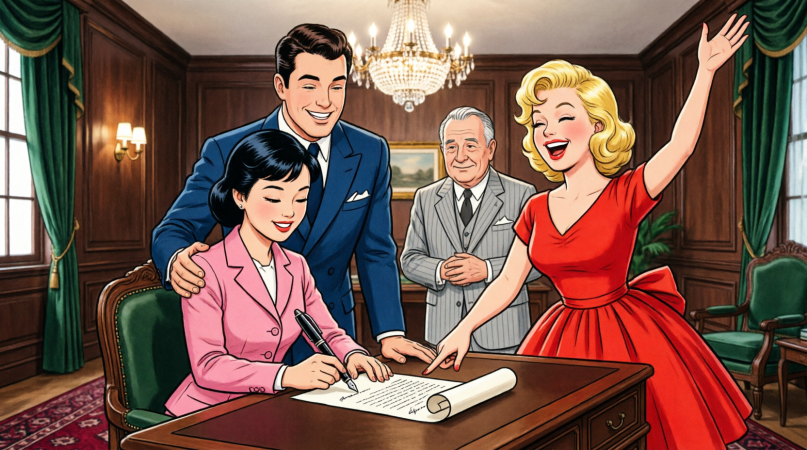
Camila giggled from the windowsill. She finally looked up from her phone, scrolling over to join them at the table. She picked up the black Amex card Isabella had pushed away, inspecting it as if it were a trophy.
“Smart move,” Camila said, sliding the card into her own pocket. “Honestly, Diego, I don’t know why you even bothered giving it to her. She wouldn’t know how to use a card like this. She’d probably try to buy groceries with it.”
Diego leaned forward, resting his elbows on the mahogany. “Consider it a lesson, Isabella. The world isn’t fair. You had your chance. You chose to be… modest. You chose to stay in the background. Now you get to live in the background.”
He stood up, buttoning his suit jacket. He looked at his watch. “Robles, finalize the filing. I have to be at Pujol in forty minutes. The investors from New York are landing tonight, and I need to look like a man with no baggage.”
Licenciado Robles, the sweaty lawyer, began shuffling the papers nervously. He didn’t look at Isabella. He kept his eyes down, stacking the documents with trembling hands. There was something about the atmosphere in the room that had shifted. The air felt heavier, charged with static, like the moment before a thunderstorm breaks.
Isabella didn’t move. She capped the pen and placed it neatly beside the signed papers. She folded her hands in her lap again. She wasn’t looking at Diego. She was looking past him, toward the back of the room, toward the shadows near the door where the man in the charcoal suit sat.
Diego followed her gaze. He turned slightly, annoyed. “Is there someone else waiting? Robles, I told you I wanted this private.”
The man in the charcoal suit stood up.
He didn’t move quickly. He moved with the deliberate, unhurried grace of someone who knows that time belongs to him. He was older, perhaps sixty, with silver hair combed back and eyes that had seen decades of deals, betrayals, and empires rise and fall. He adjusted his cufflinks—simple platinum, understated but expensive.
When he walked forward, his shoes made no sound on the carpet. He stopped behind Isabella’s chair. He placed a hand on her shoulder. It was a gentle touch, but it carried the weight of a mountain.
Diego frowned. “Who are you? This is a private legal proceeding.”
The man didn’t answer immediately. He looked at Diego, then at Camila, and finally at Licenciado Robles. When his eyes landed on the lawyer, Robles turned the color of old ash. The lawyer’s pen slipped from his fingers and rolled across the table, stopping at Diego’s elbow.
“Señor Mendoza,” Robles whispered. His voice cracked. “I… I didn’t know you were… I wasn’t informed…”
Diego’s smile faltered. “Mendoza? You know him, Robles?”
Alejandro Mendoza finally spoke. His voice was low, calm, and resonant. It filled the room without effort.
“Licenciado Robles knows me,” Alejandro said. “He handles the estate planning for the Mendoza Group. He knows that I own the building we are sitting in. He knows that I own the law firm that employs him. And he knows…” Alejandro paused, letting the silence stretch until it was uncomfortable. “…that he is currently witnessing a very grave mistake.”
Diego straightened his tie, trying to regain his composure. He didn’t recognize the name. Mendoza was common. There were Mendozas everywhere. But the lawyer’s reaction was unsettling.
“Look, Señor… Mendoza,” Diego said, his tone dismissive but edged with uncertainty. “I don’t know who you think you are. This is a family matter. A divorce. Unless you’re her lawyer, you have no standing here. And if you’re some distant uncle hoping for a cut of the settlement, you’re out of luck. She signed. It’s over.”
Alejandro smiled. It wasn’t a warm smile. It was the smile of a shark smelling blood in the water.
“Her lawyer?” Alejandro repeated softly. He looked down at Isabella. “Do you need a lawyer, mi hija?”
Isabella looked up at him. For the first time since the meeting started, she smiled. It was a genuine smile, bright and relieved. “No, Papá. I think I’m done here.”
Diego froze. The word hung in the air. Papá.
The color drained from Diego’s face so fast it looked like a physical illness. He looked from Isabella to Alejandro, his brain scrambling to connect the dots. Mendoza. The Mendoza Group. The conglomerate that owned half of Paseo de la Reforma. The silent partner in half the tech ventures in Latin America. The man whose face was on the cover of Forbes Mexico last year.
“You…” Diego stammered. “You’re… Alejandro Mendoza?”
“I am,” Alejandro said. He walked around the table and stood next to Diego. He was taller than he looked sitting down. He loomed over the younger man. “And you are Diego Ramírez. CEO of NovaLink. Or at least, you were until five minutes ago.”
Diego laughed nervously. “That’s… that’s not funny. My company is independent. We have investors from Silicon Valley. We’re going public next month. You can’t just…”
“Can’t I?” Alejandro interrupted. He reached into his jacket pocket and pulled out a folded sheet of paper. He didn’t hand it to Diego. He placed it on the table, on top of the divorce papers Isabella had just signed.
“NovaLink operates out of floors 35 through 37 of this building,” Alejandro said calmly. “The lease is held by a subsidiary of the Mendoza Group. Clause 14, Section B states that any conduct deemed detrimental to the reputation or interests of the building ownership constitutes grounds for immediate eviction. Publicly humiliating the daughter of the building’s owner in a boardroom owned by her father… I think that qualifies.”
Camila dropped her phone. It hit the table with a clatter. “Wait… Isabella… you’re…?”
Isabella stood up. She smoothed her cream-colored cardigan. “I told you I didn’t fit into your world, Camila. You just assumed it was because I was too poor. It was actually because I was too rich for people like you.”
Diego grabbed the paper Alejandro had put on the table. His hands were shaking so badly the paper rustled violently. He scanned the letterhead. Mendoza Property Holdings. Notice of Lease Termination. Effective immediately.
“You can’t do this,” Diego hissed. “You’ll destroy the IPO. You’ll ruin hundreds of jobs. My investors…”
“Your investors,” Alejandro said, “were vetted by my team. Did you think you got that kind of capital based on your pitch deck alone? You thought you were a genius, Diego. But you were just a placeholder. We invested in the technology, not the man. And now that the man has shown his true character… the investment is being recalled.”
Diego looked like he was going to be sick. He gripped the edge of the table to steady himself. “Recalled? You can’t recall Series C funding!”
“We can when the fraud clause is triggered,” Alejandro said. “Misrepresentation of assets. Misrepresentation of marital status affecting public perception. And… let’s not forget the embezzlement.”
Diego’s head snapped up. “What embezzlement?”
Isabella spoke this time. Her voice was cold, clear. “The office rent, Diego. The first year. You told the investors you used your seed capital. But you used my savings. The ‘inheritance’ I told you about. I have the bank transfers. I have the emails where you asked me to ‘hold onto the receipts’ so the auditors wouldn’t ask questions.”
Diego stared at her. “You… you recorded that?”
“I documented everything,” Isabella said. “My mother taught me that. Paper is proof. People rewrite history. Documents don’t.”
Camila backed away from the table. She was heading for the door, trying to make herself small. “Diego, I… I didn’t know. I thought she was… she wore those cheap clothes…”
“Security will escort you out,” Alejandro said to Camila without looking at her. “You are no longer employed by NovaLink. And I suggest you return that credit card before you leave the building. It belongs to the company, which is currently being frozen.”
Camila fumbled the black Amex out of her pocket and dropped it on the table. She didn’t look at Isabella. She hurried out of the room, her heels clicking frantically on the tile.
Diego was alone. Well, not alone. He was with the lawyer, who was packing his briefcase as fast as humanly possible, trying to distance himself from the sinking ship.
“Please,” Diego said. His voice was small now. The arrogance was gone, replaced by the panic of a child who realizes the adults are no longer playing along. “Isabella… please. We can fix this. I… I loved you. In the beginning.”
Isabella picked up her bag. She slung it over her shoulder. She looked at her husband—the man she had cooked stew for, the man she had scheduled meetings for, the man she had believed in.
“You didn’t love me, Diego,” she said. “You loved the idea of having someone who needed you. You loved the power. But you never saw me. You saw a waitress. You saw a project. You never saw the woman who built your schedule, who paid your rent, who believed in your dream when no one else did.”
She walked toward the door. Alejandro followed her. He held the door open, a gesture of respect that made Diego flinch.
“Wait!” Diego called out. He took a step toward them. “Isabella! You can’t just leave me with nothing! I’m your husband!”
She stopped. She didn’t turn around. “Not anymore.”
“And the company!” Diego shouted, desperation cracking his voice. “I built that company!”
Isabella turned her head slightly. “No, Diego. You occupied it. There’s a difference.”
She walked out into the hallway.
The elevator ride down was silent. The doors were polished steel, reflecting their faces. Isabella looked at her reflection. She looked the same as she had when she walked in. Same cardigan. Same hair. But she felt different. Lighter. The weight of the secret was gone. The weight of the lie was gone.
Alejandro stood beside her. He didn’t speak until the elevator reached the lobby.
“Are you okay?” he asked.
Isabella nodded. “I am now.”
“He hurt you,” Alejandro said. His voice was dark. “I should have stepped in sooner. I wanted to… but you asked me to wait. You wanted to see if he would choose you.”
“He chose himself,” Isabella said. “He always would have.”
The elevator doors opened. The lobby of the building was grand, with marble floors and a high ceiling. Rain lashed against the glass doors outside. A doorman held an umbrella ready.
“What happens to him?” Isabella asked as they walked toward the exit.
“The lawyers will handle the eviction,” Alejandro said. “The investors will handle the audit. He won’t go to prison, probably. But he won’t have a company. He won’t have a reputation. In Mexico City, reputation is everything. He is finished.”
Isabella stopped under the awning. She watched the rain falling on Paseo de la Reforma. The traffic was heavy, headlights blurring in the gray afternoon.
“I don’t want him to suffer,” she said. “I just… I wanted him to know the truth. I wanted him to know that I wasn’t nothing.”
Alejandro put his arm around her shoulders. “You were never nothing, Isabella. You were just hiding your light to let him shine. But the sun doesn’t need permission to rise.”
A black car pulled up to the curb. It wasn’t a taxi. It was a chauffeur-driven sedan, sleek and quiet. The driver got out and opened the back door.
“Where are we going?” Isabella asked.
“Home,” Alejandro said. “Your mother made mole. She’s been waiting.”
Isabella smiled. “She knows?”
“Everyone knows,” Alejandro said. “We just waited for you to be ready.”
Isabella got into the car. The leather seats were soft. The interior smelled of clean linen and rain. As the car pulled away from the curb, she looked back at the building. The 38th floor was hidden by the clouds, but she knew what was happening up there. Diego was probably still standing in that room, staring at the divorce papers, realizing that the signature on the bottom wasn’t just a name. It was a verdict.
Six Months Later
The rain had stopped. The sky over Mexico City was a clear, brilliant blue.
Isabella sat on the terrace of a café in Roma Norte. She was wearing a dress now—simple, elegant, linen. She had a laptop open in front of her. She wasn’t checking emails from investors. She was reviewing blueprints.
She had started her own firm. Mendoza Architecture & Design. It wasn’t relying on her father’s money. She had taken the settlement from the divorce—a sum Diego had fought tooth and nail to reduce, only to lose anyway when the forensic accountants found the embezzlement—and used it as seed capital.
She had hired ten employees. All women. All from backgrounds similar to hers. Women who had been overlooked. Women who had been told they were “too much” or “not enough.”
A waiter brought her a coffee. “Señora Mendoza?”
“Señorita,” she corrected gently. “And just Isabella is fine.”
“Okay, Isabella.” He set the cup down. “There’s someone here to see you. He says he’s an old friend.”
Isabella frowned. She didn’t have many old friends from that life. She looked toward the entrance of the café.
Diego stood there.
He looked different. The custom Italian suit was gone. He was wearing a off-the-rack blazer that didn’t fit quite right. The Rolex was missing. He looked tired. The arrogance was gone, replaced by a hollowed-out exhaustion. He held a folder in his hand.
Isabella didn’t stand up. She didn’t smile. She just watched him approach.
“Can I sit?” Diego asked. His voice was rough.
“This is a public café,” Isabella said. “You can sit wherever you want.”
Diego pulled out a chair and sat opposite her. He placed the folder on the table. He didn’t open it.
“I heard you’re doing well,” he said. “New firm. Big contracts. The new museum in Polanco… that’s yours?”
“It’s my team’s,” Isabella said. “I’m just the lead.”
Diego nodded. He looked at his hands. “NovaLink filed for bankruptcy last week.”
Isabella took a sip of her coffee. “I saw the news.”
“They’re suing me,” Diego said. “The investors. They say I misrepresented the financials. They say I… well, they say what you said. About the rent. About the savings.”
“And?”
“And I lost the house. The penthouse. Camila left… actually, she left two months ago. Turns out she was seeing someone else. Someone with a newer car.” Diego let out a dry laugh. It sounded painful. “I guess I wasn’t as rescuing as I thought.”
Isabella didn’t feel satisfaction. She didn’t feel joy. She just felt… neutral. The anger was gone. It had burned itself out in that boardroom six months ago.
“Why are you here, Diego?” she asked.
He opened the folder. Inside were papers. Job applications. References.
“I need a reference,” he said. “I’m applying for a position. Junior project manager. At a construction firm. They… they want to call my previous employer. They want to talk to you.”
Isabella looked at the papers. Then she looked at him.
“You want me to give you a reference?”
“I know I don’t deserve it,” Diego said quickly. “I know what I did. But… I have to start somewhere. I have to pay back the debts. I have to… fix something.”
Isabella leaned back in her chair. She watched a waiter carry a tray of pastries to another table. She watched the people walking by on the street. Normal people. Living normal lives. Not worrying about IPOs or stock prices or inheritance.
“I won’t lie for you, Diego,” she said.
Diego nodded. “I know.”
“But I won’t block you either,” she said. “If they call, I’ll tell them the truth. I’ll tell them you’re talented. I’ll tell you you’re hardworking. And I’ll tell them you made mistakes. Terrible mistakes. But I’ll tell them you’re trying to pay them back.”
Diego looked up. His eyes were wet. “Thank you.”
“Don’t thank me,” Isabella said. “Do the work. Pay the debts. Be better. Not for me. For you.”
Diego stood up. He picked up the folder. He hesitated, like he wanted to say something else. An apology, maybe. But he seemed to realize that some things couldn’t be fixed with words.
“Good luck, Isabella,” he said.
“Good luck, Diego.”
He walked away. He disappeared into the crowd on the street.
Isabella watched him go until she couldn’t see him anymore. Then she turned back to her laptop. She opened the blueprint for the museum. There was a line that wasn’t quite right. A curve in the roof that needed adjustment.
She picked up her stylus and began to draw.
Her phone buzzed. A message from her father. Dinner tonight? Your mother made flan.
Isabella smiled. Yes. I’ll be there.
She put the phone down. She took another sip of coffee. It was hot. It was bitter. It was real.
She looked around the café. She saw a young woman at the next table, typing furiously on a laptop, looking stressed. She looked like she was trying to prove something to someone.
Isabella wanted to tell her that she didn’t have to. That she was enough. But she didn’t. Some lessons you have to learn on your own. Some mountains you have to climb yourself.
She went back to work.
Epilogue: One Year Later
The museum opened on a Tuesday. It was a modern structure, glass and steel, but with curves that softened the edges. It looked like it belonged in the city, but also like it was rising above it.
Isabella stood at the entrance, greeting guests. She wasn’t wearing a cardigan. She was wearing a suit of her own design.
Alejandro and her mother stood nearby. They weren’t hovering. They were just… present. Proud.
A reporter approached her with a microphone. “Señorita Mendoza. This building is being called a masterpiece. Critics say it redefines the skyline. How does it feel to be the architect of the year?”
Isabella looked at the building. She thought about the boardroom on the 38th floor. She thought about the rain. She thought about the signature on the divorce papers.
“It doesn’t feel like I’m the architect,” Isabella said.
The reporter frowned. “What do you mean?”
“I mean,” Isabella said, turning to look at the camera. “That I didn’t build this to prove something to someone else. I built it because it needed to exist. Success isn’t about who watches you win. It’s about knowing you can stand on your own when everyone leaves.”
She smiled. It was the same smile she had given her father in the elevator. Quiet. Certain.
“And besides,” she added. “The best views aren’t from the top. They’re from the ground, looking up at what you created.”
The reporter nodded, seemingly confused but impressed. “Thank you, Isabella.”
She walked away from the microphones. She walked over to her parents. Her mother hugged her. Her father kissed her forehead.
“You did it,” Alejandro said.
“No,” Isabella said. “We did it.”
They stood together, watching the sun set over Mexico City. The lights of the buildings began to turn on, one by one. Thousands of windows. Thousands of stories.
Somewhere in one of those buildings, Diego was working a late shift at a construction firm. He was reviewing plans. He was checking numbers. He was paying off a debt.
Somewhere in another, Camila was scrolling through social media, looking for the next big thing.
And here, on the ground, Isabella Mendoza was exactly where she wanted to be.
She took her father’s hand. She took her mother’s hand.
“Let’s go home,” she said.
They walked away from the museum, into the night. The city hummed around them, alive and busy. But Isabella didn’t hear the noise anymore. She only heard the silence. The good kind. The kind that means you’re finally at peace.
The divorce papers were filed away in a box in her father’s office. A relic. A reminder.
She didn’t need them anymore. She had the building. She had her family. She had herself.
And that was enough.
The Letter
Later that night, Isabella found an envelope on her desk at home. It hadn’t been there when she left this morning. It had no stamp. No return address. Just her name.
She opened it. Inside was a single sheet of paper. Handwritten.
Isabella,
I saw the museum on the news. It’s beautiful. I drove by it today. I didn’t go in. I didn’t think I had the right.
I wanted to tell you that I paid the first installment to the investors yesterday. It took everything I had. But I did it.
I know sorry doesn’t fix anything. So I won’t say it. I’ll just say thank you. For not blocking me. For letting me try to be better.
I hope you’re happy.
Diego.
Isabella read the letter twice. She didn’t cry. She didn’t smile. She walked to the kitchen where the stove was lit. She held the paper over the flame.
It caught fire quickly. The edges curled black. The words disappeared into ash.
She watched it burn until it was gone. Then she dropped the ash into the sink and turned on the tap. The water washed it away.
She dried her hands. She turned off the light.
Tomorrow was a new day. And for the first time in her life, it was entirely hers