While I was away on a business trip over Easter, I left my six-year-old son with my mother and sister, trusting he’d be safe. That night, as they were preparing their holiday dinner, the hospital called: “Your son is in critical condition.” Shaking, I called my mother—she laughed. “You shouldn’t have left him with me.” My sister added coldly, “He got what he deserved.” But the next morning, when they walked into his hospital room, both of them started screaming, “No… this can’t be happening!”
The digital clock on the bedside table read 12:45 AM. I sat rigidly on the edge of the mattress, my hands shaking so viole//ntly I nearly dropped my phone. My mother had just hung up on me.
Ten minutes prior, I had been fast asleep in a Denver hotel after a grueling workday. Then, a call from an unknown number shattered my world. A nurse from St. Vincent’s Hospital in Chicago informed me that my six-year-old son, Eli, was in the Pediatric Intensive Care Unit in critical condition.
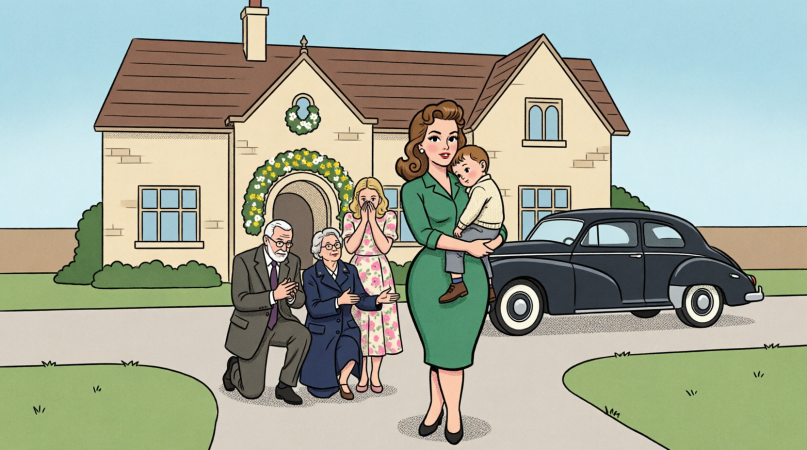
When I called my mother—the woman who was supposed to be guarding him—she didn’t sound frantic. She sounded annoyed. “For heaven’s sake, Natalie, calm down,” she sighed. “He had a little accident. He was being difficult tonight, refusing to eat, and he ran outside and tripped over some garden tools. The neighbor overreacted and called an ambulance.”
But then, my sister Vanessa’s voice cut through the background, dripping with malice: “He never listens, Natalie. He got exactly what he deserved for being a brat.”
“Deserved”? My sweet, gentle boy who loved drawing dinosaurs “deserved” to be in the ICU? The blo0d turned to ice in my veins. I abandoned my luggage and sprinted for the earliest flight back to Chicago, trapped in a claustrophobic purgatory for six agonizing hours.
At 6:00 AM, I reached the hospital. Standing outside the ICU were two men: a surgeon in green scrubs and a detective with a gold shield clipped to his belt. Dr. Aris looked at me with a mixture of profound pity and a barely contained, white-hot rage.
“Ms. Mercer,” the doctor said softly, intercepting me at the double doors. “Eli is alive, but his in//juries… we need to prepare you. Detective Miller needs to speak with you immediately regarding the adults you left in charge of your son.”
My knees buckled. Detective Miller caught my arm to keep me upright.
“What do you mean? My mother said he just tripped in the garden…”
Dr. Aris’s jaw clenched so tightly a muscle jumped in his cheek. He guided me toward the large observation window of Room 4. “I need you to look through the glass first, Natalie,” he said, his voice trembling with unspoken horror.
I forced my eyes upward, and the breath died in my throat at the scene playing out inside…
PART 2
I pressed my hands against the cold glass.
My son. My beautiful, sweet, innocent boy.
He looked impossibly small, completely swallowed by the massive, sterile hospital bed. A terrifying web of translucent tubes and wires kept him tethered to life, connecting him to monitors that beeped with a steady, rhythmic mechanical pulse.
His entire left arm, from the shoulder down to the fingers, was encased in a thick, white plaster cast. But it was his face that shattered me.
The entire right side of his face was swollen to twice its normal size, a horrific landscape of deep, mottled purple, black, and yellow bruising.
His right eye was swollen completely shut. A thick, white bandage covered a laceration on his forehead.
I let out a guttural, animalistic sob, clapping my hands over my mouth to muffle the sound.
PART 3
I didn’t wait for permission. I pushed past the doors, past the rules, past the nurse calling my name. Nothing mattered except reaching Eli. The machines kept him alive, but something inside me was breaking with every step closer to that bed. I whispered his name, afraid the sound alone might hurt him. Then I saw it—faint, trembling fingerprints bruised into his arm, too deliberate, too cruel to be an accident. That’s when the truth stopped being a suspicion and became something far darker.
Detective Miller didn’t need to say much after that. My silence said everything. My mother’s story unraveled in seconds under real light. Garden tools don’t leave marks like that. Falls don’t explain the fear frozen into a child’s face even while unconscious. “We have reason to believe this was intentional,” he said quietly. Intentional. The word echoed like a gunshot in my chest. My own family. The people I trusted. The ones who laughed.
I made the call. My voice didn’t shake this time. “Come to the hospital,” I told them. “If you care at all.” They arrived an hour later, still wearing yesterday’s indifference like perfume. But the moment they stepped into Eli’s room, everything changed. My mother’s face drained of color. Vanessa stumbled backward, her voice cracking into a scream. “No… this can’t be happening!” they cried—but not for him. I saw it clearly. They were afraid.
Because Eli wasn’t alone anymore.
Two officers stood behind them. Silent. Watching. Waiting.
“What did you do to him?” I asked, my voice low, steady—unrecognizable even to myself. For once, they had no sharp replies, no cruel jokes. Just silence. Then excuses. Then panic. It spilled out of them in fragments—anger, frustration, punishment that “went too far.” Words that tried to shrink what they had done. But there was no shrinking this. Not anymore.
Eli’s fingers twitched.
It was small. So small I almost missed it. But I saw it. I grabbed his hand gently, careful of the wires, the bruises, everything. “I’m here,” I whispered, tears falling freely now. “I’m here, baby.” The monitor shifted—just slightly—but enough. Enough for the doctor to rush in. Enough for hope to crack through the horror.
Behind me, I heard handcuffs click.
And for the first time since that phone call, I didn’t feel powerless.
I felt something else.
Justice.
I knew something was wrong before anyone said a word. It wasn’t what I saw. It was what I didn’t hear. The room had gone completely silent. 0002
For a moment, I couldn’t hear anything.
Not the hum of the machine.
Not the quiet ticking of the clock on the wall.
Just the sound of my own pulse—loud, uneven, impossible to ignore.
“That’s not possible,” I repeated, but the words felt weaker the second time. Hollow. Like they didn’t belong to me anymore.
Dr. Bennett didn’t argue.
She didn’t try to convince me.
She simply turned the screen back toward herself and opened another file.
“This clinic,” she said carefully, “partners with several fertility research programs. Experimental ones.”
The word experimental landed wrong.
Sharp.
Unstable.
“I didn’t sign anything,” I said. “I would remember that.”
“I know,” she replied quietly.
That was the second warning.
Because she didn’t say maybe.
She didn’t say let’s double-check.
She said I know.
My fingers curled tightly against the edge of the chair.
“Then how—?”
“Your husband,” she said, her voice lower now, more controlled, “is listed as the primary authorizing party.”
The room tilted.
Not physically.
But something inside me shifted just enough to make everything feel… off.
“That doesn’t make sense,” I said quickly. “That’s not how this works. He can’t just—authorize something like that without me.”
Dr. Bennett held my gaze.
“He can,” she said, “if the paperwork was structured to make it appear routine.”
Routine.
That word again.
The same word that had wrapped itself around every appointment, every test, every reassuring smile I had trusted without question.
I shook my head slowly.
“No… no, we conceived naturally,” I said. “There were no treatments. No procedures. Nothing.”
She didn’t interrupt.
Didn’t correct me.
She just reached for another document and turned it toward me.
“Do you remember a blood test at around six weeks?” she asked.
I frowned.
“Yes… they said it was standard.”
“It was labeled that way,” she said.
My stomach dropped.
“What are you saying?”
“That sample,” she continued, “was used for more than routine screening.”
The pieces didn’t fall together all at once.
They resisted.
Clashed.
Refused to make sense.
Until they didn’t.
Until they started aligning in ways I couldn’t ignore.
The extra appointment Javier had insisted I keep.
The forms he had said he’d “already taken care of.”
The way he had always been just a little too… involved.
Not supportive.
Not attentive.
In control.
My throat tightened.
“Why?” I asked.
It came out almost as a whisper.
Not angry.
Not yet.
Just… searching.
Dr. Bennett hesitated.
And that hesitation told me there was more.
Much more.
“I don’t have full access to the program details,” she said carefully. “But based on what I can see… this wasn’t about helping you conceive.”
A pause.
“It was about creating something specific.”
The words echoed.
Cold.
Precise.
Deliberate.
“Specific how?” I asked.
She exhaled slowly.
“As far as I can tell… genetic modification was involved.”
Everything inside me went still.
Not confused.
Not panicked.
Still.
Like my body had shut something down just to survive the moment.
“That’s not legal,” I said.
“It’s not,” she agreed.
“Then how is this happening?”
Her eyes didn’t leave mine.
“Because programs like this don’t operate in ways that are easy to trace.”
Silence filled the room again.
But now—
it wasn’t just heavy.
It was dangerous.
My hand moved instinctively to my stomach.
To the small, steady presence that had been my anchor for months.
My baby.
My child.
“What does this mean for him?” I asked.
My voice broke slightly on the last word.
Not from weakness.
From fear.
Real fear.
Dr. Bennett softened—just slightly.
“Right now,” she said, “his vitals are stable. Growth is within range.”
Relief flickered.
Brief.
Fragile.
“But—” she added.
Of course there was a but.
“There are anomalies,” she said.
My chest tightened.
“What kind of anomalies?”
She turned the screen back toward me, highlighting areas I hadn’t understood before.
Subtle differences.
Small.
Precise.
Unnatural.
“Nothing immediately life-threatening,” she said, “but enough to confirm this wasn’t a standard development.”
I swallowed hard.
My mind tried to push away from it.
To reject it.
But the evidence was right there.
Clear.
Unavoidable.
“This is why you told me to leave,” I said slowly.
It wasn’t a question.
She nodded.
“If your husband is involved in authorizing something like this,” she said, “then whatever he told you about this pregnancy… isn’t the full truth.”
That was the third warning.
And the most important one.
Because this wasn’t just about what had been done.
It was about what was still being hidden.
“What aren’t you telling me?” I asked.
Her expression tightened again.
“There are identifiers in that scan,” she said. “Tracking markers. That means someone is monitoring this.”
A chill moved through me.
“Monitoring?” I repeated.
“Yes.”
The word echoed louder than it should have.
“Which means,” she continued carefully, “if this is part of a larger program… they may expect continued access.”
Access.
To me.
To my baby.
To something I didn’t even understand yet.
My grip tightened against my stomach.
Protective.
Instinctive.
Immediate.
“No,” I said.
Not loud.
Not emotional.
Certain.
“No one is getting access to him.”
Dr. Bennett nodded once.
“That’s why you need to leave,” she said. “Quietly. Quickly. Without telling your husband.”
My mind raced now.
Not in panic.
In calculation.
Because suddenly—
everything mattered.
Every decision.
Every second.
“If I leave,” I said slowly, “they’ll know.”
“Yes,” she said.
“Then how is that safer?”
“Because right now,” she replied, “you’re exactly where they expect you to be.”
That landed.
Hard.
Predictable.
Accessible.
Controlled.
“But if you disappear,” she added, “you take that control away.”
Silence again.
But different now.
Focused.
Sharp.
Because this wasn’t confusion anymore.
It was a choice.
Stay—
and risk whatever this really was.
Or leave—
and face something unknown.
My hand pressed more firmly against my stomach.
And for the first time since this started—
the fear shifted.
Not toward what had been done.
But toward what might happen next.
“When do I go?” I asked.
Dr. Bennett didn’t hesitate.
“Today.”
Of course.
There was no version of this where I had time.
No version where I could go home and pretend everything was normal.
No version where I could look at Javier and not see a stranger.
I nodded slowly.
Because deep down—
I already knew.
Whatever this was…
it had already gone too far to ignore.
And if I stayed—
I might lose more than just the truth.
I might lose the chance to protect what mattered most.
I stood up, my legs unsteady but my mind clearer than it had been all day.
“Tell me what I need to do,” I said.
And as Dr. Bennett reached for a notepad—
as she began writing things down with quick, deliberate movements—
I realized something that settled deep in my chest.
This wasn’t just a medical emergency.
It wasn’t just a betrayal.
It was something planned.
Something controlled.
Something that had been happening around me—
without me ever seeing it.
Until now.
And now that I did—
there was no going back.