When I pulled again, whatever lived in Elias’s ear came free with a wet snap and landed on the cloth in my hand. Under the lamplight it looked half insect, half nightmare: a pale gray larva still writhing, tangled around a plug of blackened beeswax and a cedar sliver no longer than my thumbnail. The smell that rose off it was rotten and sweet.
I almost dropped the forceps.
Elias shoved back from the table so hard his chair skidded across the floor. For one second I thought he was about to faint. Instead he leaned over, eyes locked not on the creature but on the cedar sliver stuck inside the old wax.
Then he made a sound.
Not a full word. Not even close. Just a raw, scraped-out noise from somewhere deep in his chest.
He snatched the notebook, missed it, cursed silently, then grabbed it with both hands and wrote one name so hard the pencil tore through the page.
Harlan Pike.
Then another line beneath it.
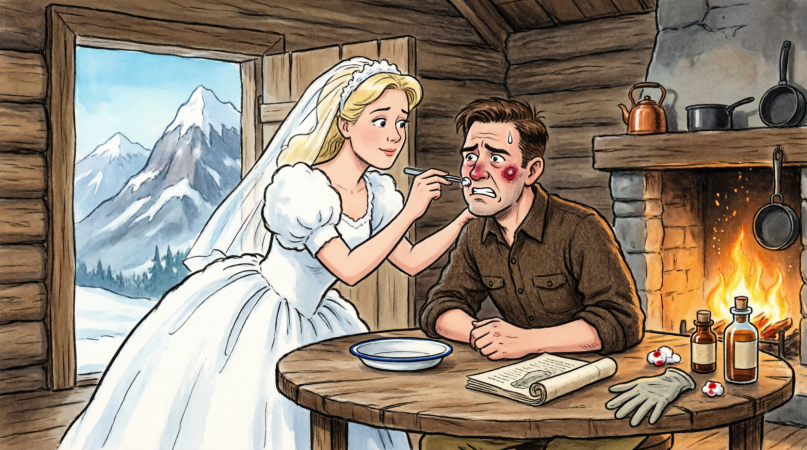
He carved every cedar peg like that.
Harlan Pike was president of the First Mountain Bank, the man who had taken my father’s debt and turned it into a joke, and years before that he had been Elias’s stepfather. I did not know that yet. All I knew was that the silent man everyone in town avoided was staring at a sliver of cedar like it had climbed out of a grave.
I sealed the larva, wax, and wood inside a Mason jar with whiskey because I could not think what else to do. Then I cleaned the blood from his ear while his hands shook. By the time I finished, the hard line of pain around his mouth had loosened. He touched the side of his head, blinked, and looked toward the stove with a baffled expression.
Later he would tell me the first thing he noticed was the faint hiss of sap in the burning logs.
That night, he heard something on his right side for the first time in nearly thirty years.
I sat with him until almost dawn, the jar between us on the table like a tiny, ugly witness. Snow kept falling against the windows. The lamp burned low. And page by page, Elias Barron handed me the buried half of his life.
At nine years old, he had heard perfectly well.
His father died in an avalanche above Lake Fork Pass, leaving Elias and his mother, Annie, with the ranch and too many men offering help that came dressed as control. Two winters later Annie married Harlan Pike because widows in those mountains were expected to choose between loneliness and dependence, and Harlan knew exactly how to present himself as rescue.
In public he was patient, churchgoing, respectable. He tipped his hat to women and talked about prudence and hard work. In private, Elias wrote, he counted everything. Beef heads. Fence wire. Annie’s breaths. He hated any fact that did not end with his name on it.
The ranch, however, belonged to Elias in trust.
Annie had protected it that way before she remarried. If anything happened to her, the land would pass to her son when he came of age. Harlan could work it. He could profit from it. He could not own it.
One night when Elias was nine, he woke to raised voices and came downstairs barefoot. From the hall outside the smokehouse door, he heard Annie say she would never sign the papers Harlan had brought from town. He heard Harlan answer that she would sign, one way or another. He heard her say that if she ever turned up dead, the whole county would know who to look at.
He made the mistake children make when they think the truth itself can protect them.
He stepped into the doorway and said he had heard everything.
Harlan turned.
That was the night the world went quiet.
Elias did not give me every detail. He did not have to. Some pain arrives in the shape of fragments and that is enough. Harlan dragged him into the smokehouse, struck the side of his head, and when the ear bled he packed it with hot beeswax to stop it. Then, whether from panic or calculation, he rammed a cedar sliver in behind it to wedge it deep.
He told Annie the boy had fallen. He told the town doctor a fever had burst something inside the child’s head. He told everyone hearing loss was God’s mysterious will.
After the infection, Elias could still hear a little on the left, almost nothing on the right, and the words he had once spoken easily turned stiff and humiliating in his mouth. People stopped waiting for him. They answered for him. They talked around him. Over time he stopped trying.
Annie lasted less than a year after that.
According to town gossip, she slipped on the cellar steps and broke her neck.
According to Elias’s notebook, he had heard another argument that afternoon, seen the bruising on her wrist, and watched Harlan walk out of the cellar with dirt on his boots before the shouting for help even began. But a frightened, half-deaf boy is an easy witness to dismiss. And Harlan Pike had already taught the county how to look through him.
When Elias turned twenty-one, the ranch finally transferred to him. Harlan could not stop that. What he could do was leave behind gutted accounts, missing cattle, and a reputation so carefully managed that any accusation from Elias sounded like bitterness rather than truth. By then the old doctor was dead, Annie was buried, and the cedar plug was hidden so deep in Elias’s ear that no one ever thought to look for it again.
Until me.
I remember staring at the jar on the table and feeling my own anger change shape.
Not disappear.
Change.
For weeks I had believed Elias married me because he pitied me, or because a group of men laughed and he decided not to lose face. I had built my hurt around that story because it was the simplest one. Men had been deciding things about my body for years. Why would this be any different?
So I turned the next page of his notebook toward me and wrote the question that had been sitting under everything from the day I put on my mother’s dress.
Then why did you marry me?
He did not answer quickly.
Outside, the wind drove snow against the house with a dry scraping sound. Inside, Elias stared at the fire, then at his hands, then finally began to write in the slow, blunt way of a man forcing himself into a place he had avoided for years.
Because Pike chose your name.
Because I knew what it meant when he smiled.
Because I thought his bargain was a trap, and I could pull you out of it faster than I could explain.
I read the lines once, then again. My throat tightened, but not enough to soften me.
You could have asked me, I wrote back.
He nodded at once.
Yes.
You didn’t.
Another nod.
I was angry enough to feel it in my teeth. Saving a woman without asking her can still be another way of taking her choice. I wrote that too. He read it, closed his eyes, and pressed the heel of his hand to his forehead as if the truth of it hurt in a new place.
Then he stood, crossed to the shelf beside the stove, and brought back an envelope I had never seen. Inside was cash, a deed to a small parcel near Gunnison, and a single note in his careful hand.
If you wanted to leave in spring, everything here was meant to be yours.
That broke something open in me.
Not because it erased what had happened. It did not. Not because it made the marriage romantic by magic. It was not. But because I understood, all at once, that Elias had never thought of me as a burden he had been forced to keep. He had thought of me as someone cornered by the same man who had cornered him, and he had done the only clumsy, lonely thing he knew to do.
It was not perfect.
It was not noble enough to excuse everything.
But it was not cruelty.
By morning, I had made two decisions. The first was that Elias was going to see a real doctor, not another man in town who already knew what he wanted to believe. The second was that Harlan Pike was not going to outlive the truth in peace.
The ride to Gunnison took most of the next day, the jar wrapped in towels between us, the road crusted hard with old snow. Dr. Miriam Hale saw us in a brick office that smelled of carbolic soap and coal heat. She was brisk, sharp-eyed, and too young to have been compromised by the mountain habit of shrugging at what powerful men did to women and children when no one else was looking.
She studied the jar for a long time.
Then she studied Elias.
The examination was awful. He gripped the arms of the chair until his knuckles blanched. I stood beside him and let him crush my hand because I wanted him to know I was there when the pain came back out into the light. Dr. Hale removed more old debris, cleaned a pocket of infection that had likely sat inflamed for years, and finally leaned back with the grave expression of someone trying not to sound furious.
The wax and wood were not accidental, she said. The scarring in his right ear suggested deliberate obstruction and long untreated damage. The larva was recent, likely drawn to an old infected cavity, which explained why the pain had worsened so badly in the past months. Without treatment, the infection might have traveled deeper.
Might he hear again, I asked.
Some, she said. Perhaps not everything. Not quickly. But more than he had.
She wrote a formal statement on her letterhead and signed it in a hard, decisive hand. Then she prescribed treatment, taught me how to flush the ear safely, and looked directly at Elias when she said something I will never forget.
What was done to you was done by a person, not by God.
On the ride home, Elias sat very still beside me. At one point a wagon hit a rut and somewhere to our left a dog barked from behind a fence. Elias turned so fast his hat nearly slipped off.
He had heard it.
Only faintly. Only enough to startle him. But he had heard it.
He looked at me then with such naked, bewildered grief that I had to look away for a second to keep from crying right there on the road.
News moves fast in a small town even when no one understands it. By the time we got back, people had already begun whispering that Dr. Hale found something strange in Elias Barron’s ear. Harlan Pike, who had built his entire life on control, did what men like him always do when the ground shifts.
He tried to stamp the movement flat.
Three days later, the bank announced an emergency review of old land notes, including my father’s. Harlan claimed there had been an accounting mistake and the marriage arrangement did not erase all accrued interest. It was a lie, and a sloppy one, but it served its purpose. It forced people to the bank on a Saturday morning, gave him a room full of witnesses, and put my father back in front of the same humiliation he had been trying to outrun by offering me up in the first place.
Howard Vance looked twenty years older when I saw him on the bank steps. He would not quite meet my eyes. For the first time in my life, that did not make me feel small. It made him look small.
Harlan stood behind the teller counter in a black coat, silver watch chain across his vest, calm as a man who thinks the truth belongs to whoever speaks first. He saw me come in with Elias beside me and his mouth barely moved.
That smile.
The one Elias had recognized before I did.
Every chair in the lobby was full. Ranchers. Wives. Two men from the county office. The sheriff leaning by the stove. My father near the wall like a guilty child in an old man’s body. Harlan tapped a paper and began talking about contractual misunderstandings, financial necessity, and the importance of order.
Then I stepped forward and set the Mason jar on his counter.
The room went silent.
Inside, suspended in whiskey, floated the gray larva, the blackened lump of wax, and the little cedar sliver with its crescent notch.
Harlan’s face did not fall apart all at once. Men like him are too practiced for that. It tightened in stages. Mouth first. Then eyes.
What is this supposed to be, he asked.
He said it lightly, but his left hand had already closed over the watch chain at his vest.
I laid Dr. Hale’s signed statement beside the jar.
Then I said, clearly enough for everyone in that bank to hear, that the deafness people had mocked in Elias Barron since childhood was the result of a foreign object forced into his ear, left there to scar and rot, and that the cedar plug bore the same private notch Harlan Pike had carved for years into his fence pegs, tool handles, and account markers.
Somebody behind me whispered my God.
Harlan laughed.
A brittle sound. Too quick.
You expect me to believe a woman with kitchen tools and a doctor from Gunnison can rewrite thirty years of fact?
I would have answered, but Elias moved before I did.
He stepped up to the counter, close enough that Harlan had to tilt his head back a fraction to keep eye contact. The whole room leaned forward. People in Lake City had seen Elias write. They had seen him glare. They had seen him turn his back.
They had not heard him.
His voice, when it came, was rough as split cedar and so low that the first two words barely sounded human from disuse.
You lied.
No one breathed.
Harlan stared at him like a man watching a grave open.
Maybe that was what finally shook him. Not the jar. Not the doctor. Not me. The fact that the child he had silenced was standing in front of him speaking anyway.
He recovered badly.
You should have stayed grateful, he snapped. I kept you fed. I kept that ranch alive. All I did was pack the ear so you wouldn’t bleed out, and the fever ruined the rest—
He stopped.
Too late.
Because the whole bank had heard it.
The sheriff straightened from the stove. One of the county men dropped his pen. My father made a sound like something inside him had collapsed.
Harlan realized what he had said and lunged for the jar, maybe to smash it, maybe to destroy the only physical thing in the room that still held his past. Elias caught his wrist before it landed. The movement was so fast it barely registered. The jar rocked once and settled.
Then the sheriff came around the counter.
What followed was not neat. Truth rarely is. Harlan shouted that his words were being twisted. He called Elias ungrateful, called Dr. Hale a meddler, called me hysterical. My father started crying in that ugly, humiliating way of men who discover grief only after cowardice costs someone else enough. He told the sheriff the bargain should never have happened, that Pike pressured him, that he knew the note had been altered after the wedding but was afraid to say so.
I listened without rescuing him.
That was important.
Because pity is often how women get dragged back into the machinery that crushed them the first time.
The sheriff took Harlan in for assault and fraud pending a fuller investigation. Whether the county could ever prove what happened to Annie Barron all those years ago was another matter. But the bank removed him that afternoon. Men who had laughed in feed stores and nodded at his opinions for two decades suddenly found moral clarity once the room changed direction. That part did not impress me.
What stayed with me was smaller.
As the sheriff led Harlan out, he tried once more to look at me as if I were still the girl in the yellow dress, the girl traded for fifty dollars and silence. But I was standing beside the man he had failed to erase, with a jar of his cruelty on the counter and a whole lobby staring at him.
For the first time, Harlan Pike looked afraid.
After the bank emptied, my father asked if he could speak to me outside. The wind had sharpened by then. Snowmelt dripped from the eaves in slow, clear drops. He kept his hat in both hands and looked everywhere except my face.
He said he had been desperate. Said he thought Elias was the safest choice among dangerous men. Said he had told himself I might at least have a roof and food and a husband who would not beat me drunk.
I let him talk.
Then I told him something I should have said years earlier.
A safe cage is still a cage.
He cried harder at that, which may sound cruel of me, but by then I had learned something essential: another person’s regret is not the same thing as your obligation to soothe it.
I did not go home with him.
I went back to the ranch with Elias.
The next weeks were quiet in a different way. Dr. Hale’s medicine worked slowly. Some mornings Elias could hear only a dull wash of sound. Some afternoons he would turn because he caught the clink of a spoon or the hinge of the back door. Once he heard the kettle begin to sing and stood in the kitchen laughing without sound, shoulders shaking, eyes bright with disbelief.
We learned each other again after that.
Or maybe for the first time.
I learned that he liked coffee stronger than sense and hated being watched while he chopped onions because they made his eyes water. He learned that I sang under my breath when I kneaded bread and slammed cabinet doors when I was angry. He learned that my silences were not all the same. I learned that his were not either.
There was one night in March when he set the envelope back on the table between us — the cash, the deed, the promise of spring freedom — and tapped it once.
Choice, he said.
One word. It came out broken, but clear.
I sat there for a long moment looking at him, at the scar near his ear, at the hand that had once shaken when I held forceps over lamplight, at the man who had made a wrong choice for what he believed was a right reason and then, when the truth cost him, did not hide from it.
I pushed the envelope back.
Then I took the notebook and wrote what I wanted him to understand before anything else.
I am not staying because I owe you for saving me.
He read that, jaw tight.
I wrote the next line slowly.
I am staying because now you are asking.
He looked at me a long time after that. Then he reached across the table and covered my hand with his. No performance. No preacher. No witnesses. Just warmth where there had once been fear.
Spring came late to the San Juans that year. Snow clung to the north faces of the ridges even as the meadow thawed. Mud took over the yard. Calves were born. The creek turned loud with meltwater. The world sounded fuller, and little by little Elias met it.
Not all at once.
That is the part people who have not lived through damage rarely understand. Healing is not a door you walk through. It is a field you cross in weather.
Some days his hearing frightened him. Too much clatter. Too many sharp sounds arriving from nowhere. Some days he grew frustrated when speech lagged behind thought and the old notebook still felt easier. So we used both. Words when they came. Writing when they did not. Hands always.
By May, the town had stopped calling me the fat girl to my face. That change, I noticed, had very little to do with morality and a lot to do with spectacle. I had become interesting to them in a new way. Useful. Worth a story. For a while that almost tricked me into gratitude.
Then I understood something better.
I had not become worthy because I saved a man.
I had been worthy when they laughed at me in my father’s kitchen.
Worthy when they bartered my future.
Worthy in the yellow dress.
Worthy in the cold wagon.
Worthy before anyone in town found a reason to be impressed.
Knowing that changed my life more deeply than their changed opinion ever could.
The moment I remember most happened in early June.
I was in the pasture line hanging wet shirts to dry. The afternoon smelled like sun-warmed pine, clean water, and last winter finally giving up. Elias came up from the barn carrying a broken bridle he meant to mend. I had my back to him. I was pinning one of his work shirts when I heard it.
Clara.
My name.
Rough. Low. Uneven.
Beautiful.
I turned so fast I nearly dropped the laundry basket.
He stood there looking half startled at himself, as if the word had climbed out before he could stop it. Then he tried again, stronger this time.
Clara.
I do not know whether he heard his own voice clearly in that moment. I only know I heard it, and the mountains behind him heard it, and the whole wide sky above our ranch seemed to pause long enough to let the sound settle.
I crossed the yard and kissed him before either of us could think too hard about dignity.
Later, when the shirts were dry and the light had gone honey-gold over the fence line, I asked him what the first sound he truly loved hearing had been.
He thought for a while.
Then he touched the side of his head, smiled with that rare, quiet softness that always felt earned, and answered in the way that suited him best. He picked up the notebook, wrote two words, and turned the page toward me.
Your laugh.
That was the thing no one in town saw coming.
Not the jar.
Not the confession.
Not the bank scandal.
Not even the hearing.
The real shock was simpler.
A woman they had treated like a transaction became the witness who changed a man’s life.
And a man the town had mistaken for empty silence turned out to be full of words, once pain stopped standing on his throat.