I grabbed Lily before Daniel could touch her again.
She slammed into my chest, damp and shaking, and buried her face under my chin. Up close, I could smell the chemical on her skin. Not soap. Not shampoo. Something sharp and bitter.
‘It burns,’ she whispered.
Daniel stood up so fast the brush clattered into the tub. ‘You’re blowing this out of proportion,’ he said. ‘I was helping her.’
Then Mara hit the top stair.
My sister took one look at Lily’s shoulder, then at the open bottle on the floor, and her whole face changed. She didn’t yell. Mara never yelled in a crisis. She stepped between me and Daniel, held out her hand, and said, ‘Back away.’
He laughed once. Dry. ‘It’s developer. Women use this stuff all the time.’
‘Not on a child’s skin,’ Mara said.
I already had 911 on speaker by then. Daniel heard the dispatcher and reached for my phone. Mara shoved his wrist aside before he got close. He stumbled into the sink hard enough to rattle the mirror, and that was the first time he looked scared.
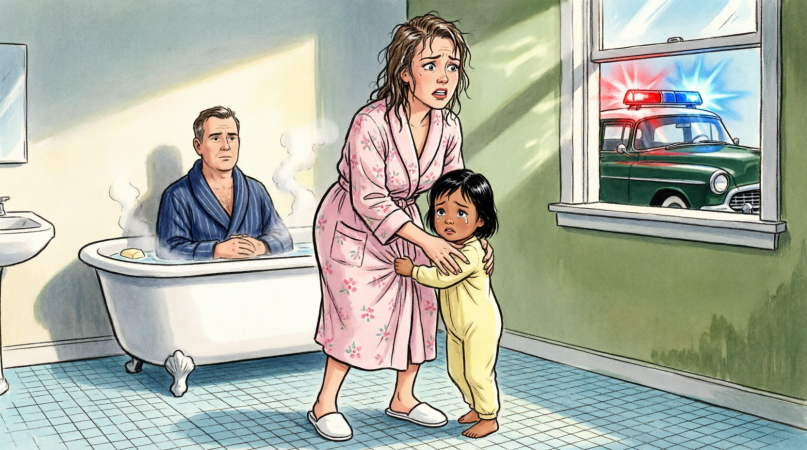
The paramedics arrived with two officers less than ten minutes later. It felt longer. Everything did.
Lily rode to the ER on my lap, wrapped in warmed blankets, while Mara followed behind us with the bottle and brush sealed in a plastic bag. She’d grabbed them before the police even asked. That was Mara. Always two steps ahead when everyone else was still trying to name the disaster.
At the hospital, the doctor cleaned Lily’s shoulder and said the irritation wasn’t from one night. The skin had been repeatedly abraded, then exposed to chemicals. Some spots were shallow burns. Others were older healing areas reopened again.
Repeatedly.
That word nearly broke me.
A child-life specialist sat with Lily and let her squeeze a foam star while the doctor worked. When the room finally quieted, Lily asked the question that still wakes me up sometimes.
‘Does this mean my mark gets to stay?’
I think every adult in that room stopped breathing.
Her birthmark sat on the top of her shoulder, a strawberry-shaped patch she’d had since birth. It had never bothered her until Daniel decided it should. I told her yes, it got to stay. It was hers. No one was allowed to hurt her for it again.
She nodded like she’d been waiting a long time to hear those exact words.
The detective on the case interviewed me that night in a room that smelled like stale coffee and hand sanitizer. I told him everything I could remember. The long baths. The locked door. The way Lily had started hiding her shoulder under towels and T-shirts. The clean game. The secrets.
Every time I said one piece out loud, another piece clicked into place behind it.
That was the part I wasn’t ready for. Not the shock. The shame.
I met Daniel when Lily was eighteen months old. By then, her biological father, Owen, was gone from our lives for good. He had signed away his rights after a brutal custody fight and moved out of state. Daniel stepped into that silence so gently that I mistook gentleness for safety.
He learned how to buckle car seats without pinching little legs. He sat through cartoon movies he hated. He made pancakes in silly shapes and cut crusts off sandwiches because Lily once said the corners were too pointy. For years, he looked like the answer to every prayer I was too embarrassed to say out loud.
That history is exactly why I ignored what should have stopped me cold.
The first time Lily came out of the bathroom blotchy, Daniel said she’d splashed lavender soap in the wrong place. The second time, he said she’d scratched herself. The third time, he smiled and told me I worried too much.
I let him turn my instincts into something embarrassing.
The detective asked whether Daniel had ever said anything about the birthmark before. I almost said no.
Then I remembered little comments I had dismissed because they were always dressed up like jokes. ‘We should ask a dermatologist to clean that up before kindergarten.’ ‘That thing is the first thing people notice in pictures.’ ‘A girl should get to start fresh.’
I had heard those words. I had just refused to hear the meaning.
Daniel was brought to the station that same night. He wasn’t arrested in front of me, but one of the officers later told me he kept insisting this was a misunderstanding. He said he was trying to help Lily before other kids made fun of her. He said I was emotional. He said people were acting like he had beaten her.
Then the police searched his phone.
Two days later, the detective called and asked me to come in.
They had found weeks of searches: remove birthmark at home, will peroxide lighten skin, how long to leave developer on skin, does abrasion help fade pigment. They also found photos. Not of Lily’s face. Just her shoulder, taken in our bathroom mirror every few days like he was tracking a project.
That made me sick in a way I still can’t describe.
But the worst thing wasn’t the searches.
It was the messages.
Daniel had been texting his older brother late at night, complaining that Lily’s birthmark looked exactly like Owen’s. I didn’t even know what he meant until I dug out an old baby album and found one picture from years ago, Owen at the beach, turned sideways, the same patch high on his left shoulder.
Same place. Same strange shape.
Daniel wrote, ‘Every time I see it, it’s like that man is still in my house.’
In another message he said, ‘She’ll thank me later when it’s gone.’
There it was. Not kindness. Not panic about bullies. Ownership. Erasure. He didn’t want Lily protected. He wanted every visible trace of another man removed from the child he had decided should belong to him completely.
When I read those messages, something inside me went cold and steady.
I had spent so much energy trying to decide whether Daniel was cruel or just damaged, dangerous or just insecure, sick or just controlling. The messages ended that debate for me. Intent mattered. So did obsession. So did a grown man teaching a five-year-old to keep pain secret from her mother.
Still, people tried to make the story softer than it was.
Daniel’s mother called three times in one day. On the third call, I picked up because I wanted to hear how she planned to explain this away.
She cried before she finished my name.
She told me Daniel had been bullied for a facial scar when he was a kid. She said he had begged for surgeries and hated mirrors for years. She said maybe, in his twisted way, he thought he was sparing Lily from that kind of pain.
I listened.
Then I told her this: children are not raw material for adults to remake.
She went quiet after that.
There is a version of this story where people keep reaching for his wound because his wound feels easier to discuss than Lily’s. I understand the instinct. It is more comfortable to diagnose a man than to admit a child was hurt in a house that looked normal from the street.
But explanation isn’t the same as excuse.
The child abuse investigator filed for an emergency protective order. Daniel was barred from the house that week. The district attorney later charged him with child endangerment and felony abuse. His lawyer pushed for language about misguided cosmetic treatment, as if a better phrase could change what he did with his hands.
It couldn’t.
Lily slept with me for almost a month after that. Some nights she woke up sobbing because she thought I had left her in the bathroom again. Some nights she asked if marks could hear you talking about them. Once she asked if being pretty enough now would make Daniel come back.
That question shattered something in me.
I told her no one who hurts her gets to come back just because they want to. I told her her shoulder was not a problem to solve. I told her the only body she had to live in was hers, and that made it hers all the way down.
Mara came over every evening that first week.
She changed Lily’s dressings with a gentleness that made me cry in the kitchen afterward. She brought kid-safe bandages with tiny suns on them and taught Lily how to say, ‘Too much,’ when something hurt.
She also did the practical things I would never have remembered on my own. She wrote down badge numbers. She made me photograph every healing stage. She found a child therapist who specialized in coercion and secret-keeping language.
I don’t know how people survive without one person who stays clear when everything gets foggy.
Therapy was its own kind of reckoning.
Lily’s therapist used puppets and toy houses, because five-year-olds don’t sit across from strangers and deliver clean testimony. They show you what happened sideways. One week Lily made a doll stand in a bathtub and scrub a painted wooden block over and over.
The next week the doll hid the block under a pillow and whispered, ‘Don’t tell, or Mommy will be sad.’
That was when I had to leave the room and stand in the hallway until I could breathe again.
My guilt lived in small places.
In the exact rhythm of Daniel’s old line, ‘We’re almost done.’
In the memory of me hearing the latch click and choosing not to push harder.
In every towel I had wrapped around Lily without asking why she held it so high.
People love saying, ‘You couldn’t have known.’
What they mean is, ‘I don’t want to imagine missing it either.’
The truth is harder. I did know something was wrong. I just didn’t know how wrong, and I let my need for certainty outrank my duty to interrupt it. That is the part I have had to face in therapy myself.
Not because the blame belongs to me. It doesn’t. But because honesty is the only thing that has made me a safer mother after the fact.Mara told me that on the first night, when I couldn’t stop shaking.
She sat on my kitchen floor with paper cups of vending-machine coffee and said, ‘Bad men count on hesitation. Good mothers still get to learn after the first lie. You stopped it when you saw it.’
I have repeated that sentence to myself more times than I can count.
By the time the preliminary hearing came around, Lily’s shoulder had healed into a deeper pink version of the mark she was born with. It didn’t disappear. It probably never will. Some of the texture changed where the skin had been burned, and maybe one day she’ll ask why that part feels different under her fingertips.
When she does, I’ll tell her the truth in age-appropriate pieces. Not a sugar-coated version. The truth.
That someone tried to make her smaller to fit inside their fear.
That it didn’t work.
The hearing was the first time I saw Daniel after the night in the bathroom. He looked ordinary. Button-down shirt. Clean shave. The kind of face people trust at a school fundraiser. He did not look at Lily because the judge had ordered that he stay away from her completely, but he looked at me once.
There was still annoyance in his eyes.
Not remorse. Annoyance.
Like this had all been inconvenient.
That look helped me more than any apology would have. It killed the last soft lie I had left.
After court, we went to a diner across the street because Mara said no one should leave family court on an empty stomach. Lily ate half a grilled cheese and asked if she could wear a tank top when summer came.
I told her yes.
She touched the bandage edge and asked, ‘Even if people see it?’
I said, ‘Especially then.’
She smiled. Small, but real.
We still have hard days. She hates the smell of peroxide now. She won’t close a bathroom door all the way unless I promise to stay on the other side. I sit on the floor and talk to her about ordinary things while she washes her hands or brushes her teeth. Grocery lists. Cartoons. The neighbor’s loud dog. Boring things. Safe things.
Little by little, ordinary is becoming ours again.
The case isn’t over. There will be more hearings, more paperwork, more days where I have to explain to strangers why a man who looked helpful was dangerous in private.
I’ll do it every time.
Last week, Lily came out of her room wearing a sleeveless yellow dress she hadn’t touched in months. Her birthmark showed. The healed skin showed too. She stood in front of me with her chin lifted and asked, ‘Do I look okay?’
I told her she looked exactly like herself.
Next month, she starts swim lessons, and this time nobody is teaching her to hide.