I found out about the family reunion through Facebook.
Not from my mother. Not from my younger sister, Paige. Not from any aunt, cousin, or family group chat I had apparently been removed from months earlier. Just a cheerful photo of my mother standing in front of a rented lakeside lodge in northern Michigan, captioned: Can’t wait for the whole family to be together this weekend!
The whole family.
I sat in my apartment in Grand Rapids staring at the post for a long time, my coffee going cold in my hand. Then I did what I always did when my family made their point without saying it outright: I stopped expecting dignity from them and started thinking practically.
The reunion was happening near Blackwater Lake, where cottages lined the shore in a patchwork of old money, inherited grudges, and carefully maintained summer politeness. My grandfather used to take us fishing there before he died. After he passed, my mother, Linda Mercer, treated memory like property—something she could assign, ration, and give to whichever child pleased her most. That child was always Paige.
Paige was two years younger, louder, softer when observed, crueler when believed, and gifted at collapsing into tears whenever consequences approached. My mother called her “sensitive.” I called her dangerous in cashmere.
So when I saw the reunion post and realized I had been deliberately excluded again, I didn’t call. I didn’t argue. I didn’t ask for an invitation.
I called a realtor.
By Thursday afternoon, I had signed the closing papers on a small cedar-shingled cottage less than half a mile from the reunion lodge. It wasn’t grand, but it had lake access, a wraparound porch, a clean title, and—most importantly—it was mine. I bought it through a holding company my accountant had helped me establish years earlier after my divorce, mostly for privacy and asset separation. The deed was recorded that same day.
On Friday night, I arrived with my dog, an overnight bag, groceries, and the steady calm that comes from finally refusing to audition for love that has already chosen someone else.
The first two days were peaceful.
I kayaked at sunrise. Read on the dock. Watched my relatives’ SUVs come and go from the lodge up the hill. A few cousins texted when they spotted my car. My replies were brief and polite. My mother didn’t contact me at all.
Which told me she was planning something.
She arrived Sunday at 10:12 a.m.
Not alone.
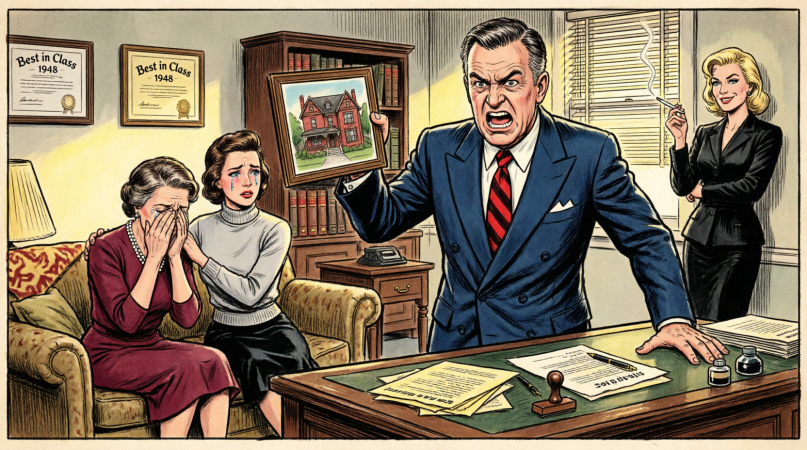
Her silver SUV pulled into my gravel driveway, followed by a county-marked sedan and a tan pickup I didn’t recognize. From the porch, I watched my mother step out in white capris and a blue linen blouse, already wearing the expression she used when she expected to get her way through sheer momentum. Paige stepped out beside her in oversized sunglasses, the kind worn by women trying to appear either glamorous or fragile. From the county car came a man with a clipboard and assessor’s badge. And from the pickup stepped a broad-shouldered deputy in uniform.
Interesting, I thought.
They believed they were arriving as authority.
What they didn’t know was that my attorney had already warned me this might happen after my cousin Evan casually mentioned the night before that my mother had been telling people there had been “a mistake” with the cottage title and that Paige was “supposed to have that one.”
They also didn’t know the porch cameras were recording from three angles.
And they definitely didn’t know my lawyer—and the deputy on my side—were already inside.
My mother climbed the steps smiling like a woman delivering good news to someone unreasonable.
“Honey,” she said, “we need to straighten out a property misunderstanding.”
I leaned against the porch rail and smiled back.
“No,” I said. “You need to leave.”
Her smile disappeared.
And that was when the real reunion finally began.
My mother had always confused confidence with proof.
She stepped onto the porch like she owned not just the cottage, but the air around it. Paige followed a few steps behind, already arranging her face into wounded innocence, while the assessor lingered near the walkway with the uneasy look of a man beginning to suspect he had been dragged into a family conflict under false pretenses.
“Don’t be difficult, Claire,” my mother said. “This property was intended for your sister.”
I almost laughed. Intended by whom? The market? The seller? The county clerk? Because none of them had consulted Linda Mercer’s preferences before processing my wire transfer.
“I purchased this cottage legally,” I said. “The deed is recorded. You can leave now.”
Paige crossed her arms. “You knew I wanted one near the lodge.”
“That sounds like a personal disappointment,” I replied. “Not a title issue.”
The assessor cleared his throat. “Ma’am, I was told there might be a parcel boundary or ownership discrepancy that required review.”
“Were you also told,” I asked, “that the deed holder invited you?”
His eyes shifted toward my mother.
That was the first crack.
My mother pivoted quickly. “Claire, we are trying to avoid embarrassment. If you cooperate, we can handle a transfer quietly. Paige has children. You’re here alone.”
There it was. Not legal reasoning—moral pressure disguised as practicality.
I let the silence stretch just long enough to make Paige fidget.
Then I said, “You brought a government employee and a deputy to pressure me into surrendering private property to my sister because she has children?”
Paige removed her sunglasses. “Why are you making this ugly? Mom said you wouldn’t fight.”
That line hung in the air like smoke.
The assessor now looked openly alarmed.
And right on cue, my attorney stepped out through the screen door behind me.
Her name was Dana Sheffield, and she had the rare ability to sound most dangerous when she spoke softly. She wore a gray blazer despite the heat, carried a slim folder, and looked at my mother with the expression reserved for a stain that had spread too far.
“I’m glad you said that in front of witnesses,” Dana said.
My mother actually took a step back.
“You brought a lawyer?” she asked.
“I brought the owner’s counsel,” Dana replied. “Which is appropriate, since you appear to have arrived under false pretenses with a county official and an armed deputy to coerce a private transfer.”
The deputy shifted, finally realizing this might become reportable.
“No one is coercing anyone,” my mother said.
Dana opened her folder. “Wonderful. Then you won’t mind if I summarize. The property at 18 North Shore Drive was purchased on Thursday by Mercer Lake Holdings LLC, wholly owned by my client, Claire Mercer. Title is clean. Deed recorded. Taxes current. There is no dispute, no probate attachment, and no legal claim by Ms. Paige Mercer or any other family member.”
Paige’s face tightened. “That’s not fair.”
Dana didn’t even look at her. “The law often disappoints people who confuse wanting something with owning it.”
The deputy coughed, covering what might have been a laugh.
My mother tried one last turn toward drama. “Claire, after everything this family has done for you—”
I cut her off.
“No. Don’t do that on my porch.”
She stopped.
All my life, Linda Mercer had survived by forcing every disagreement into an emotional script where she played the wounded mother, Paige played the overlooked daughter, and I was cast as the cold, difficult one for refusing to give away whatever they had already claimed in their minds—money, time, labor, forgiveness.
Not this time.
I looked at the deputy. “Would you like to know why I requested a standby officer this morning?”
My mother’s head snapped toward me. Paige went pale.
The deputy frowned. “You requested?”
“Yes,” I said. “After my attorney warned me there was a strong chance family members would arrive and attempt to create a false ownership claim. I also have exterior video and texts from yesterday indicating my mother planned to ‘bring county people and fix it.’”
The deputy turned slowly toward Linda Mercer.
The balance of power shifted immediately.
She felt it.
So did Paige.
And for the first time since I saw that reunion post, I watched them realize they hadn’t come here to take control.
They had walked into a record.
What followed wasn’t loud.
That was the part I appreciated most.
People like my mother and sister rely on noise—tears, interruptions, confusion, a raised voice at just the right moment to blur what should be obvious. But once they realized there were documents, cameras, and a deputy taking notes, they had to abandon performance and deal with facts. Facts were never their strength.
The assessor spoke first.
“I need to clarify,” he said, now addressing my mother, “I was told I was coming to observe a possible parcel misidentification related to a recently recorded deed. If that is not the case, I should not be here.”
“There isn’t,” Dana said. “And we’d appreciate written confirmation if needed.”
He nodded stiffly. “Understood.”
Then the deputy asked the question that ended any chance of reframing the situation.
“Mrs. Mercer, did you present this as an official property dispute?”
My mother tried for composure. “I may have described it as a family misunderstanding with title implications.”
“That is not what I asked,” he said.
Paige stepped in too quickly. “This is ridiculous. We thought Claire would just do the right thing.”
The deputy glanced at her. “Ma’am, the right thing is not determined by family preference.”
That landed hard.
My mother’s expression hardened. “Claire, if you go through with this, don’t expect this family to forget it.”
I looked at her across the porch I had paid for, the hydrangeas blooming beside the steps, the lake shining behind her, the entire absurd Sunday morning arranged like a courtroom shaped by memory and weather.
“I’m counting on that,” I said.
Dana handed the deputy copies of the deed, property map, and a prepared statement. Efficient as always. The deputy reviewed them, then informed my mother and sister they needed to leave immediately and that any further attempt to enter, intimidate, or misrepresent ownership could lead to a trespass complaint and additional legal consequences.
Paige looked genuinely stunned.
“Over a cottage?” she said.
I shook my head. “No. Over the pattern.”
That was the truth.
It had never been about one house.
It was about every birthday where Paige’s cruelty became “sensitivity.” Every holiday where my mother treated my success like shared property. Every quiet surrender she expected because I was the older daughter, the reasonable one, the one who could “understand.” People like them build entire systems on the patience of others. The first boundary they hit always feels unfair.
My mother left without another word. Paige got into the SUV crying—which, for once, didn’t help her case. The assessor drove away separately, likely rethinking several life decisions. The deputy stayed long enough to ask if I wanted an official incident report filed.
“Yes,” I said. “Please.”
After they were gone, the lake returned to silence so quickly it almost felt staged. Wind moved through the birch trees. My dog came out from under the kitchen table and settled beside me on the porch. Dana closed her folder and looked at me.
“You okay?”
I considered it honestly.
“Yes,” I said. “Actually, better than okay.”
She smiled. “That’s usually what happens when boundaries finally become paperwork.”
She left an hour later. I spent the afternoon on the dock with a paperback and a glass of iced tea, while across the water I could hear the reunion continuing without me—or maybe because of me. Families like mine always need a villain when the script breaks.
Near sunset, my cousin Evan texted.
What happened? Aunt Linda came back furious. Says you humiliated her in front of the county.
I looked out at the cottage—my cottage—the cedar siding glowing warm in the evening light, every inch of it paid for, protected, and finally beyond their reach.
Then I replied:
No. She did that herself. I just had witnesses.
He sent back one stunned emoji and nothing else.
That was fine.
By then, I had everything I wanted: a locked gate, a clean deed, a quiet porch, and the kind of peace that only arrives when people stop mistaking your silence for permission.
They thought I was alone.
That was their favorite mistake.
Now it was on camera.
Part 3 : the paper trail
The dust from their tires settled slowly on the gravel driveway, swirling in the late morning heat before disappearing into the grass. I watched the silver suv shrink until it turned the corner onto the main road, followed by the county sedan and the deputy’s pickup. The silence that rushed back into the space they had occupied was heavy, almost physical. It wasn’t just the absence of noise; it was the absence of pressure. For the first time in an hour, my shoulders dropped away from my ears.
Dana sheffield stood beside me on the porch, her gray blazer untouched by the humidity. She was making notes on a legal pad, the scratch of her pen the only sound besides the lap of water against the dock below.
“deputy miller stayed behind to file the report,” she said, not looking up. “he seemed… eager, actually. I think he was tired of being used as a prop for family disputes too. He mentioned this isn’t the first time linda mercer has tried to use county resources for personal leverage.”
“that doesn’t surprise me,” i said. My voice sounded rough, unused. I cleared my throat. “will they come back?”
“legally? No. Not after the trespass warning miller issued. If they set foot on this property without your written invitation, they can be arrested. Civilly? They could try to file a suit, but based on the texts evan sent you and the video footage we have, any judge would see it as harassment. I’ll send a cease-and-desist letter to your mother tomorrow. Formal notice. It usually stops the noise.”
I nodded, gripping the porch rail. The wood was warm under my palm. “what about the assessor? He looked… shaken.”
“he realized he was being used,” dana said, finally closing her folder. “i spoke to him briefly while you were talking to your mother. He’s going to file an internal memo noting that he was brought to the site under false pretenses. That creates a paper trail that protects you if they try to claim there was ever a genuine zoning issue. You’re covered, claire. From every angle.”
I looked at her. “thank you, dana. I know this wasn’t standard retainer work.”
She smiled, a rare, sharp expression. “consider it an investment in my own peace of mind. I hate seeing bullies win. Besides,” she glanced toward the lake, “this is a nice property. I might want to buy something near here someday. I’d hate to see it turn into a battlefield.”
She left twenty minutes later, her car kicking up a small cloud of dust as she drove away. I was alone. Truly alone. No lawyer, no deputy, no family. Just me, my dog barnaby, and the deed to a house that was mine.
I went inside and locked the door. I engaged the deadbolt, then the chain, then the secondary lock i’d had installed the day after closing. I walked through the rooms, touching the walls. The living room smelled of cedar and old dust. The kitchen had linoleum floors that needed scrubbing. The bedroom window looked out over the water.
It wasn’t perfect. It needed work. The faucet in the bathroom dripped. The paint in the hallway was peeling. But it was mine.
I sat on the floor of the living room, barnaby resting his head on my knee, and i let myself shake. The adrenaline was fading, leaving behind a tremor in my hands that i couldn’t control. I hadn’t cried during the confrontation. I hadn’t cried when i saw the facebook post. But now, in the safety of my own locked house, the grief hit me.
I wasn’t crying for the cottage. I was crying for the mother i wished i had. The one who would have seen the post and called to say, we missed you. Come join us. The one who would have been proud of my independence instead of threatened by it.
I cried until my throat was raw. Then i wiped my face, stood up, and went to the kitchen to make tea.
That afternoon, the phone started buzzing.
It wasn’t my mother. She had gone silent, likely strategizing. It was the cousins. The aunts. The peripheral family members who had been at the lodge.
Did you really call the cops on your mom? Paige is hysterical. Your mother says you threatened them with a lawyer. Is it true you bought the house just to spite them?
I looked at the notifications stacking up on the screen. In the past, i would have felt compelled to answer. To explain. To justify. To smooth things over.
This time, i put the phone in a drawer.
I spent the rest of the day cleaning. I scrubbed the floors. I washed the windows. I cleared out the old closets, finding boxes of fishing lures and rusted tools left by the previous owner. I kept the lures. I threw away the rust.
By evening, the sun was setting over blackwater lake, painting the water in shades of violet and gold. I sat on the dock with a glass of wine, barnaby at my feet. The lodge up the hill was lit up, music drifting down on the wind. They were having dinner. They were telling stories. They were likely telling the story of the crazy sister who called the police.
Let them.
I took a sip of wine. The air was cool. The water was still. I was safe.
Part 4: the winter of silence
The summer ended, as summers do. The tourists left. The boats were pulled from the water. The lake turned gray and choppy under november skies.
I didn’t go back to grand rapids immediately. I had negotiated a remote work arrangement with my firm, citing “family reasons.” they didn’t ask for details. I stayed at the cottage, working from the small desk i’d set up in the second bedroom.
The cease-and-desist letter arrived via certified mail in early september. I signed for it, took a photo of the receipt, and emailed it to dana. She confirmed receipt and filed it. My mother did not respond.
The silence from the family was absolute. No birthday calls. No holiday cards. No texts asking for recipes or advice. I was erased.
It hurt, initially. There were moments, standing in the grocery store aisle looking at a box of stuffing mix, where the habit of buying enough for everyone kicked in. I would reach for the large box, then remember. There was no everyone. There was just me. I put the large box back and picked up the small one.
I started seeing a therapist in the nearby town of petoskey. Dr. Aris was a woman in her sixties with kind eyes and a no-nonsense approach.
“you’re grieving,” she told me during our fourth session. “you’re grieving the loss of a family you never really had. That’s a complex grief. It’s confusing because they’re still alive. But the relationship is dead.”
“i keep waiting for them to realize,” i said. “to wake up and see what they lost.”
“they won’t,” dr. Aris said gently. “people like your mother don’t operate on loss. They operate on control. You taking control away from them feels like loss to them, but they won’t interpret it as their fault. They’ll interpret it as your betrayal. If you wait for their realization, you’ll be waiting forever.”
“so what do i do?”
“you build a life where their realization doesn’t matter,” she said.
So i did.
I joined a local book club. I volunteered at the animal shelter in town, which is where i found barnaby. He was a mixed breed, scruffy and timid, hiding in the back of his kennel. I recognized the look in his eyes. It was the look of something that had been kicked too many times and was waiting for the next blow.
We healed each other. He learned to trust hands. I learned to trust silence.
I started renovating the cottage. I wasn’t handy, but i was willing to learn. I watched youtube videos on how to fix the dripping faucet. I hired a local carpenter to fix the porch steps. I painted the hallway a soft blue, the color of the lake on a clear day.
Every nail i hammered, every brushstroke of paint, was a declaration of ownership. Not just of the house, but of myself.
In december, snow fell heavy and deep. The lake froze over. The lodge up the hill went dark for the season. I was alone for christmas.
I ordered a small tree. I bought ornaments that meant something to me, not ones that matched a color scheme. I cooked a roast chicken. I opened a bottle of wine. I called my friend sarah in grand rapids, who i had reconnected with after cutting off the family.
“merry christmas, claire,” she said. “how’s the exile?”
“it’s not exile,” i said, looking at the fire in the fireplace. “it’s sovereignty.”
We talked for an hour. When i hung up, the house was quiet again. But it wasn’t lonely. It was peaceful.
I received one package in the mail a week later. No return address. Inside was a framed photo of the family reunion. Everyone was smiling. Everyone was there. Except me. There was a gap in the front row where i would have stood. It had been photoshopped out, but the space was still visible if you looked closely. A void where a person should be.
There was no note. Just the photo.
I looked at it for a long time. Then i took it to the woodstove and threw it in. The glass cracked in the heat. The faces curled and blackened. The gap disappeared into the flames.
Part 5: the spring rumors
Spring came late to blackwater lake. The ice broke up in march, sending thick sheets crashing against the shore with the sound of gunshots.
With the thaw came the return of the locals. And with the locals came the news.
I ran into evan at the hardware store. He was buying paint for his own cabin, which was two towns over. He looked uncomfortable when he saw me.
“hey, claire,” he said. “didn’t know you were still up here.”
“i live here now,” i said.
“right. The cottage.” he lowered his voice. “look, i… i heard some stuff. About mom and paige.”
I picked up a bag of soil. “oh?”
“paige’s husband,” evan said. “mark. I heard they’re having money trouble. Serious trouble. Something about bad investments. And mom… she’s been asking around about loans. Trying to get cousins to chip in for… i don’t know, something.”
“let me guess,” i said. “she’s telling them i have money now. That i bought the cottage cash and must have millions hidden away.”
Evan winced. “something like that. She says you hoarded grandpa’s inheritance. That you stole paige’s share.”
“grandpa left everything to charity, evan. You know that. The house was sold years ago.”
“i know,” he said. “but facts don’t matter when she’s telling the story. She’s… she’s desperate, claire. Paige is talking about divorce. Mark’s looking at foreclosure.”
I put the soil in my cart. “that’s unfortunate.”
“aren’t you… i don’t know, worried? If they come back?”
“let them come,” i said. “i have the deed. I have the law. And i have the distance.”
“okay,” evan said. He looked at me with a new kind of respect. “just… be careful. Desperation makes people do stupid things.”
“thanks, evan.”
I paid for my soil and walked out to my truck. The sun was shining, but the air was still cold. I thought about what evan said. Desperation.
For years, i had been the safety net. When paige needed tuition, i paid. When mom needed a new roof, i contributed. When the family needed a venue for thanksgiving, i hosted. I was the resource they drew upon when their own planning failed.
Now the resource was cut off. And they were drowning.
Part of me felt a twinge of pity. They were my blood, after all. But then i remembered the assessor’s clipboard. I remembered the deputy’s hand on his holster. I remembered the look in paige’s eyes when she said, mom said you wouldn’t fight.
They hadn’t come to me for help. They had come to take.
I drove back to the cottage. I unloaded the soil. I planted marigolds along the front walk. Bright, hardy flowers that could withstand the wind.
Let them drown. I had built a boat.
Part 6: the final visit
It happened in july, one year after the confrontation.
I was on the dock, reading, when i heard a car engine on the gravel drive. Not the smooth hum of a delivery truck. The rough idle of an older sedan.
I stood up. Barnaby growled low in his throat. I put a hand on his head. “it’s okay.”
I walked up the path to the house. A blue sedan was parked where my mother’s suv had been a year ago. It was dented. Dirty.
My mother was standing on the porch. She wasn’t wearing white capris this time. She was wearing a worn sweater and jeans that were too big for her. She looked smaller. Frailer. The armor of entitlement had cracked, revealing the fragile woman underneath.
She turned when she heard me approach.
“claire,” she said. Her voice lacked its usual command. It was thin.
“mother,” i said. I didn’t invite her inside. I stayed on the path, ten feet away. “you’re trespassing.”
“i know,” she said. She didn’t move to leave. “i needed to see you.”
“why?”
“paige,” she said. “she’s… she’s leaving mark. She has nowhere to go. She has the boys. They need a place to stay.”
I looked at her. “you want them to live here?”
“just for a little while,” she said. “until she gets on her feet. You have all this space. You’re alone. It’s wasteful.”
There it was. The same argument. You’re alone. It’s wasteful. As if my solitude was a resource to be consumed by their chaos.
“no,” i said.
“claire, please,” she said, and for the first time, i heard something that sounded like genuine fear. “she’s my daughter. She’s your sister. Where else will they go?”
“not here,” i said. “there are shelters. There are programs. There are solutions that don’t involve invading my home.”
“we’re family,” she whispered.
“family doesn’t bring assessors to take your house,” i said. “family doesn’t exclude you from reunions. Family doesn’t treat you like an atm that stops working.”
“we made mistakes,” she said. “we were wrong.”
“you were wrong,” i corrected. “paige was complicit. And you’re only here because you have no other options. If paige had money, you wouldn’t be standing on my porch.”
She flinched. The truth landed hard.
“i can’t help them,” i said. “not like this. If i let them in, nothing will change. They’ll take what they need and leave me with the bill. Again.”
“so you’re just going to let us suffer?”
“i’m letting you face the consequences of your choices,” i said. “just like i had to.”
She looked at me for a long moment. I saw the calculation behind her eyes. She was testing me. Looking for a weak spot. A crack in the armor.
She found none.
“you’re cold,” she said finally. “just like your father said you would be.”
“my father died knowing i loved him,” i said. “you’re the one who’s alone, mother. Not me.”
She turned away. She walked down the steps, her movements stiff. She got into the blue sedan. She didn’t look back as she started the engine.
I watched her drive away. I watched the dust settle.
Barnaby nudged my hand. I scratched behind his ears.
“ready to go inside?” i asked.
He wagged his tail.
We went inside. I locked the door.
Part 7: the legacy
Five years later.
The cottage is no longer just a cottage. It’s a home. The porch has been expanded. The garden is full of perennials that come back every year without needing to be replanted. The faucet doesn’t drip. The paint doesn’t peel.
I still work remotely. I still see dr. Aris, though now it’s only once a month, mostly to check in. I still volunteer at the shelter. Barnaby is old now, his muzzle gray, but he still sleeps at the foot of my bed.
I heard through evan that paige got a job in retail. She keeps the house. It’s small. She’s happy, apparently. Or at least, she’s stable. My mother moved into a senior community in florida. She calls sometimes. I answer sometimes. The conversations are short. Polite. Distant.
She never apologized again. I never asked her to.
I learned that forgiveness isn’t always reconciliation. Sometimes forgiveness is just letting go of the hope that they will change. I forgave them for being who they are. And i chose to be who i am.
Last summer, i hosted a reunion of my own. Not a family reunion. A friends reunion. Sarah came. Dana came. Evan came. Some of the neighbors from the lake. We sat on the expanded porch. We ate grilled fish. We drank wine. We told stories.
No one was excluded. No one was competing. No one was keeping score.
At sunset, i walked down to the dock. The water was calm. The sky was purple. I looked up at the house. It glowed warm in the twilight.
I thought about the woman i was five years ago. The one who stood on the driveway shaking while her mother tried to take her home. She feels like a stranger now.
She thought she needed their approval to be whole. She thought she needed their love to be safe.
She was wrong.
I needed my own approval. I needed my own safety.
I walked back up the path. The lights were on inside. My friends were laughing. The dog was barking.
I opened the door. I walked in. I locked it behind me.
I am claire mercer. I am a homeowner. I am a friend. I am a survivor.
And i am finally, completely, free.
Epilogue: the deed
There is a safe in my office. Inside are important documents. Passports. Birth certificates. Insurance policies.
And there is a folder labeled 18 north shore drive.
Inside is the deed. The closing statement. The survey. And the incident report from deputy miller.
I look at them sometimes. Not to dwell on the pain. But to remember the cost.
Peace isn’t free. It costs money. It costs effort. It costs the courage to stand alone when everyone else wants you to fall.
I paid the price.
And i own the property.
The end.