People like to imagine family betrayals happen in whispers, behind half-closed doors, with enough shame to keep everybody’s voices low.
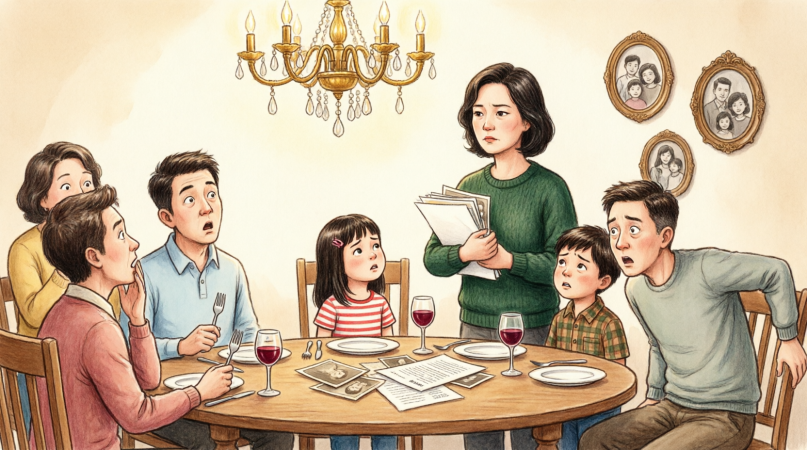
Mine happened under a chandelier, over baked ziti and roast chicken, with twenty relatives gathered around my parents’ dining table and my children close enough to hear my mother offer them a bed in the garage.
My father had always loved the theater of authority.
For thirty years he had been a high school principal, the kind who believed volume was the same thing as leadership and certainty was the same thing as wisdom.
He liked being the final word in a room.
He liked when people paused before speaking to him.
He liked family gatherings because they gave him a stage.
My sister Bethany had always been the person he defended most fiercely.
She was the oldest, the prettiest, the messiest, and somehow the most protected.
If Bethany forgot a bill, somebody else covered it.
If Bethany quit a job, somebody else said she was underappreciated.
If Bethany made a selfish choice, my mother would smooth it over by saying she had a lot on her plate.
Bethany had three children with her husband, Derek, and in my parents’ eyes that one fact erased every bad decision she ever made.
I had two children of my own, Emma and Joshua.
But I was the dependable one, which in my family was just another word for the one who could be asked to absorb more pain.
I worked as a charge nurse at a rehabilitation hospital.
I picked up overtime when I had to.
I budgeted carefully.
I kept routines.
I showed up.
My divorce had been final for four years, and while it had not been easy, I had built a stable life for my kids.
Stability, however, had never impressed my parents as much as neediness did.
The house at the center of the fight had belonged to my grandmother Ruth.
It was a modest three-bedroom brick house with a wraparound porch, a vegetable garden she loved, and creaky hardwood floors that announced every footstep after dark.
It was not huge, but it was warm, solid, and paid off.
More than that, it was home.
When Ruth got sick, most of the family visited in bursts.
I was the one who went every Sunday without fail.
When chemo made her too tired to cook, I brought soup.
When she could not keep up with laundry, I folded it on her couch.
When she was embarrassed and weak and needed help no one likes admitting they need, I was the one who stayed gentle.
When she died, she left the house to me.
That decision had not come from nowhere.
My grandmother believed in effort.
She noticed who came when there was no audience.
She also noticed who treated her like a wallet with a pulse.
Bethany never forgave her for leaving the house to me, and my parents never really accepted it.
They acted polite about it in public, but every now and then one of them would say something that let the truth slip through.
Your sister could have used the space more.
It would have made more sense to keep it in the main branch of the family.
Grandma was confused at the end.
They said
those things as if my children and I were temporary people living in a temporary life.
My SUV was mine for the same reason the house was mine: I had worked for it.
It was a 2022 Honda Pilot, bought after three years of overtime, extra weekend shifts, and an envelope system so strict my kids joked I ran the kitchen like a small government.
It was not flashy.
It was reliable.
It got us to school, soccer practice, work, doctor appointments, and grocery runs.
It was the vehicle that made our whole life possible.
Bethany, meanwhile, had spent years treating every possession like something that existed to rescue her from the consequences of herself.
She and Derek always had a reason they were behind.
Rent went up.
The school needed fees.
Derek’s hours were cut.
The kids needed a bigger place.
There was always a reason, and there was always someone expected to step in.
Usually my parents volunteered first.
When they started running short on money, they turned to guilt.
The first crack in Bethany’s story came from my neighbor, Mrs.
Patterson, who volunteered with a local emergency response team.
One afternoon, months before the dinner, she mentioned seeing Bethany’s name on a report from a wreck on Highway 47.
She said, carefully, that the version floating around the family did not match what responders had whispered at the scene.
Bethany had told everyone she had hit black ice while swerving to avoid a deer.
Mrs.
Patterson said the responders had been talking about alcohol and unrestrained children.
I could not shake it.
So I started looking.
The police report was public record.
So were the court filings related to the charge.
I still remember the feeling in my stomach when I sat at my dining room table and read the first page.
Blood alcohol level: 0.16.
Child endangerment: three counts.
The accident happened at 2:07 a.m.
Tyler, her oldest, had a concussion.
Madison had a broken arm.
Connor had bruising and severe distress.
Bethany had not swerved to miss a deer.
She had driven drunk with her children in the car.
I kept digging, because once you discover a lie that large, you start wondering what else it is attached to.
I found the insurance denial that came after the toxicology report.
I found the notice of license suspension.
I found the diversion agreement requiring alcohol counseling and parenting classes.
Then I found out something worse: my parents did not know the full truth.
Bethany had told them there had been a misunderstanding.
Derek backed her up.
They had swallowed the version that made her the victim again.
At around the same time, Uncle Ron called me about probate paperwork.
Ron was my grandmother Ruth’s younger brother and co-executor of her estate.
He had always been blunt, but unlike most of the family, he was fair.
During that call, he asked whether Bethany had ever spoken to me about the house.
When I said yes, constantly, he went quiet.
Then he told me that before Ruth died, there had been concerns about unauthorized spending on her accounts.
He sent me copies through the attorney.
There were debit card charges from a salon, a boutique hotel, two upscale restaurants, and a home décor store Bethany loved.
There were
cash withdrawals my grandmother could not possibly have made herself.
There was a note in Ruth’s unsteady handwriting that made my throat tighten the first time I read it: Bethany keeps asking me to sign papers.
Do not let her back in here alone.
There was also a letter from Ruth’s attorney explaining, in plain language, why the house had been deeded to me and why the will included a no-contest clause.
Ruth had not been confused.
Ruth had been careful.
Then my father called and said the family needed to have an important discussion on Sunday night.
His tone was too polished, too formal.
Bethany had been hinting for weeks that she needed a bigger place and a better car.
I knew what the dinner was going to be before I even hung up.
I spent that afternoon making copies of every document and sliding them into a manila folder.
I brought my kids because I had no sitter and because, honestly, a part of me did not believe my parents would humiliate me in front of them.
That was my mistake.
Dinner had barely reached the point where plates were being cleared when my father stood up.
He placed both hands on the table, scanned the room, and said, “It’s decided, and if someone disagrees, there’s the door.
Your sister gets your SUV and your house.
She has kids.”
There are moments when the body responds before the mind does.
I felt my hand close around Emma’s beneath the table.
I heard Joshua stop shifting in his seat and go very still.
My face grew hot, then cold.
The room seemed to sharpen around the edges.
I remember the chandelier light on the silverware.
I remember the smell of red sauce and garlic bread.
I remember Bethany already smiling before I had even spoken.
I asked, “What about my kids? Are they not family? And if you give everything away, where will I go?”
My mother came around the table and slapped me.
The sound cracked through the room.
Then she said, “How dare you talk back to your father? If you’re that worried, we’ll just throw a bed in the garage.
You three can sleep on it.”
Everyone laughed.
I do not think I will ever forget that part.
Not the slap.
Not even the words.
The laughter.
The easy, delighted laughter at the idea of my children being displaced for Bethany’s convenience.
Bethany leaned back in her chair and said, “Finally, I won’t have to do a thing anymore.”
That was when something inside me changed from hurt to clarity.
I reached for the messenger bag beside my chair, stood up, and pulled out the folder.
“Funny you should mention kids,” I said.
“Here’s what she did with her last car.”
I laid down the crash photos first.
Bethany’s silver Camry looked like a crushed soda can wrapped around a utility pole.
Uncle Ron leaned forward and asked when it happened.
I told him the date and pushed the police report toward the center of the table.
My father snatched it up.
He got halfway down the page before the color left his face.
My mother read over his shoulder and covered her mouth.
Derek pushed back his chair hard enough to make everyone jump.
Bethany
went white, then angry.
“Where did you get that?” she snapped.
“The court clerk,” I said.
“The DMV.
The insurance records.
Public filings.
Pick one.”
Then I laid out the second stack: the insurance denial, the diversion agreement, the license suspension notice, the required counseling schedule.
I said, “You told everyone there was black ice and a deer.
There wasn’t.
You were drunk.
Your kids were in the car.
And unless I missed something, you still were not supposed to be driving tonight.”
Every head in the room turned toward the keys near Bethany’s plate.
Uncle Ron’s expression changed first.
“I lent you four thousand dollars after that accident,” he said slowly.
“You said a drunk driver hit you.”
Bethany started crying on cue.
She was good at that.
Her tears came fast and glossy, arriving exactly when facts started cornering her.
“It was one mistake,” she said.
“One mistake and she’s acting like I’m a monster.”
“A mistake is missing an exit,” I said.
“Driving drunk with your children in the car is a decision.”
Derek barked at me to shut up.
My father told him to sit down.
My mother started saying none of this changed the fact that Bethany needed help.
That was when I opened the folder again and said, “Then let’s talk about the house.”
I put down the bank statements from my grandmother’s account.
Then the note in Ruth’s handwriting.
Then the letter from her attorney.
The room had gone so quiet I could hear someone in the den changing the cartoon channel.
I told them Bethany had used Grandma Ruth’s debit card for personal spending.
I told them Ruth had written down her fear that Bethany was trying to pressure her into signing papers.
I told them the attorney had documented concerns and changed the estate planning accordingly.
Then I slid the letter to Uncle Ron.
He unfolded it, read the first paragraph silently, and then looked straight at my father.
“Harold,” he said, “the house was left to her on purpose.
Ruth specifically documented why.
And if Bethany contests it, she loses what little she was left.”
My father looked stunned, but not because he felt sorry.
He looked stunned because he was losing control of the narrative.
He said, “That’s all legal language.
We’re talking about what’s right for the family.”
I reached into my purse and set my deed copy and my SUV title on the table next to the rest of the paperwork.
“What’s right,” I said, “is that you don’t get to give away things that do not belong to you.
Not my house.
Not my car.
Not my children’s security.”
Bethany shot out of her chair and tried to grab the folder.
Uncle Ron stood up so fast his chair tipped backward and blocked her with one arm.
“Sit down,” he said, in a voice I had never heard him use before.
“You have lied to everybody in this room.”
Then he looked at Derek and asked, “Who drove here?”
Derek said Bethany had.
Bethany said Derek had.
The contradiction landed like another slap.
My cousin Melissa, who had not been drinking, quietly volunteered to drive Bethany’s children home.
For once, nobody argued with the practical solution.
The atmosphere had shifted too much.
Bethany was no longer
the poor overwhelmed mother.
She was a woman with a suspended license, a DUI report, and evidence of stealing from a dying grandmother.
My father tried one last time to make me the problem.
He said I had humiliated the family.
I looked him in the eye and said, “No.
You humiliated yourself when you offered my kids a bed in the garage.”
Then I took Emma and Joshua, left our untouched dessert on the table, and walked out.
That should have been the end of it.
It was not.
By the time I got home, my phone was full.
A few relatives sent private apologies.
Most sent versions of the same message: You could have handled that differently.
In families like mine, truth is never the first offense.
Exposing it is.
Bethany left me three voicemails in a row, all crying at first and then furious by the end.
Derek sent one text calling me pathetic.
My mother texted that I had broken my father’s heart.
My father texted only one line: We will discuss this like adults tomorrow.
I did not respond to any of them.
Instead, I forwarded every message to the attorney who had helped me organize the estate documents.
She told me I had already done the smart thing by bringing copies and witnesses.
Then she drafted a formal letter stating that any further harassment regarding my house, vehicle, or property would be documented and addressed accordingly.
Two days later, Bethany and my mother showed up at my front door.
I did not let them in.
Bethany looked terrible without the performance lighting of a family dinner.
Her mascara was smudged.
My mother looked furious in the way only embarrassed people can look.
Bethany started with tears, saying she had nowhere to go, that I was punishing innocent children, that sisters were supposed to help each other.
I said, “Help is not the same thing as surrender.”
My mother tried to step past me into the house, and I blocked her.
I told them both that if they came onto my property again to pressure me, I would treat it as trespassing.
Bethany started shouting that Grandma had promised her that house.
I told her that was interesting, because Ruth’s signed attorney letter said the opposite.
They left, but not because they understood.
They left because there was no room left for their version of reality to stand.
The consequences unfolded slowly after that.
Bethany and Derek did not move into my house.
They moved into my parents’ basement.
That alone changed the family atmosphere more than any argument ever had.
Neediness is charming from a distance.
It gets less romantic when it is eating your groceries, running your electric bill up, and treating your spare rooms like a hotel.
Within a month, my mother was calling Aunt Linda to complain that Bethany never cleaned up after the kids and Derek spent half his time on the couch talking about business ideas he never started.
My father began missing golf because he was babysitting.
The same people who laughed at the garage line now had front-row seats to the life they had tried to hand me.
Uncle Ron, meanwhile, did what no one expected: he stopped smoothing things over.
He worked with the probate attorney
to formally document the unauthorized charges from Ruth’s accounts.
He did not drag Bethany to court, mostly because he did not want the children caught in another storm, but he made it clear that any future lies about the estate would be met with paperwork, not family sentiment.
For a while, my parents still doubled down.
Pride can survive facts longer than you would think.
But it started cracking when Bethany “borrowed” my mother’s car and brought it back with a dent in the rear bumper and an empty tank.
It cracked again when Derek used my father’s credit card for a home improvement store run he never repaid.
It split wide open when Bethany told three different relatives three different stories about why she could not move out.
About six months after that dinner, my father came to my porch alone.
He looked older.
Smaller, somehow.
He stood with his hands in his coat pockets and did not ask to come inside.
For a moment I saw not the man who had stood at the head of the table declaring judgment, but a tired old man who had built his whole identity around being right and was now forced to look at what that had cost him.
He said, “I should not have said what I said.”
I waited.
Then he said the part that told the truth.
“I thought you were strong enough to recover.”
That was what I had always been in that family.
The one sturdy enough to survive whatever they took.
I told him, “My strength was never permission.”
He nodded once.
He cried a little, though quietly.
He apologized for the slap too, on my mother’s behalf and then, after I looked at him for a long time, in a way that suggested he understood he had no right to do that.
He asked if things could ever be normal again.
I told him no.
Not because I wanted revenge.
Because normal had been the problem.
I did not reconcile with my parents after that.
I did not cut them off with drama either.
I chose distance.
Controlled contact.
Boundaries that did not bend just because someone showed up looking sorry.
Bethany remained the center of their household chaos, and I remained outside it.
The first holiday I hosted after everything happened was Thanksgiving.
I set the table in my grandmother Ruth’s dining room, the one with the window facing the garden.
Emma helped mash potatoes.
Joshua carried in extra chairs.
Uncle Ron brought pie and stood in the kitchen pretending not to cry when he looked around and said the house smelled like Ruth’s old Thanksgivings again.
A few relatives came who had apologized sincerely and proven over time that they understood what had happened.
My parents were not invited.
Bethany was not invited.
It was a smaller table, but a kinder one.
At one point that evening, after the dishes were stacked and the sky outside had gone dark, Emma climbed into my lap and asked in a small voice, “No one can take our house away, right?”
I held her close and said, “No one.”
And for the first time since that awful dinner, I felt the truth of it all the way down.
The house was still ours.
was still in the driveway.
My son no longer flinched when family was mentioned.
My daughter slept without asking whether we were going to move.
The people who had laughed at our fear no longer had access to create it.
I had not saved the family.
I had saved my children from it.
That was the real ending.
Not a dramatic reconciliation.
Not a perfect apology that stitched everything back together.
Just a warm house, a locked front door, a table filled with the right people, and the quiet relief of knowing my grandmother had been right about me all along.
For the first time in a very long time, this home felt exactly the way she intended it to feel: safe.