My Parents Texted: “Party’s Canceled, Don’t Come.” I Was Already At The Door. They Were Toasting: “So Much Better Without Her.” I Raised My Hand To Knock… Then A Voice Behind Me Whispered: “Don’t. Wait. You’ll Want To See What Happens Next.”
Part 1
The text came in at 8:14 on a gray December morning while I was standing in my kitchen with melted butter on my fingers and a sheet pan of candied pecans cooling by the window.
From Mom: Christmas party is canceled. Don’t come. Money’s tight and your father isn’t up for company. We’ll do something small after New Year’s.
I read it twice. Then I looked at the six wrapped boxes lined up on my counter, the bottle of pinot I’d tied with velvet ribbon, the ridiculous hand-painted ornament I’d bought because my sister Dana once said my taste ran “aggressively tasteful” and I wanted to make her laugh.
There was cinnamon in the air, and brown sugar, and the faint static hiss of the old radio I always kept on for company. Outside, the neighborhood looked rubbed pale by cold. A man across the street was dragging a blow-up Santa upright after the wind had folded it in half overnight.
My mother did not cancel Christmas anything.
She hosted like it was a competitive sport. There were always too many candles, too much food, too many little silver bowls of spiced nuts set out like she expected a magazine photographer. If money was tight, she’d cut back on shrimp or switch to cheaper wine. She would not cancel. And if my father was sick, she would have texted me six dramatic updates before breakfast, each one more detailed than the last.
I stood there long enough for the butter on my knuckles to go tacky, then I typed back: Understood.
That should have been the end of it. Instead, I wrapped the gifts anyway.
Maybe because habit is stronger than pride. Maybe because I’d spent thirty-two years learning that if my family shifted the ground under me, I was supposed to adjust my footing and smile. Maybe because part of me still believed there had to be an explanation that would make the whole thing less ugly.
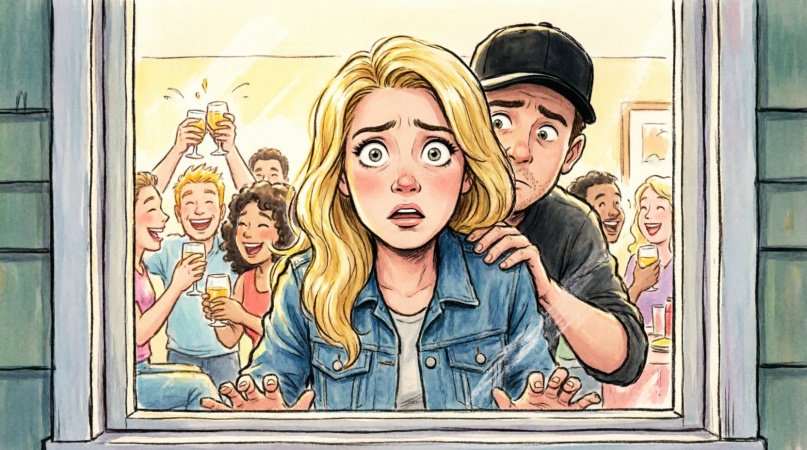
By four-thirty, it was dark. The sky had that bruised winter look, purple at the edges. I loaded the gifts into the passenger seat of my SUV and told myself I was just dropping them off. No knocking. No scene. I’d leave everything on the porch, maybe text from the car, and drive home before the fudge in the back seat picked up the smell of the pine-scented trash bags rolling around near the hatch.
Theo called while I was at a red light near the highway exit.
“You still going?” he asked.
His voice was calm in the way it always was, but I knew him well enough to hear the thought underneath it. Theo never liked my mother’s vague texts. He said vague people treated confusion like a tool.
“Just dropping things off,” I said. “Five minutes.”
A beat. “Call me if something feels off.”
I laughed once, a small dry sound. “Something already feels off.”
“I know,” he said. “That’s why I’m saying it.”
The house I grew up in sat at the end of a cul-de-sac lined with bare maples and those expensive mailbox posts people buy when they want a street to look established faster than it actually is. When I turned onto my parents’ road, my chest tightened before my mind had fully caught up. Cars were already there. Not a full driveway, but enough. My uncle’s dark Lexus. Dana’s white Audi with the dent in the rear bumper she kept promising to fix. My cousin Brent’s pickup crooked near the curb like he had parked in a hurry.
The house itself glowed.
Every downstairs window was lit. Warm yellow squares on the lawn. The front room chandelier was on, and the tree in the bay window threw off that soft, expensive kind of sparkle that comes from glass ornaments, not plastic ones. Even through the windshield I could hear music when I cut the engine. Nat King Cole, low and smooth, the kind of soundtrack my mother preferred when she wanted a night to feel important.
I sat there for three full seconds, my hands still on the steering wheel.
Then I got out.
The cold hit the back of my throat. I could smell wood smoke from somewhere nearby and rosemary from the wreath hanging on the front door. Under my boots, the stone path held a sheen of damp that made it glint under the porch light. I picked up the gift bags, balancing the wine under one arm, and went up the steps as quietly as I could, though I wasn’t exactly sure why I was trying to be quiet. The front door was cracked open a finger’s width. Enough to let laughter slip through.
Dana’s laugh came first—high, bright, always half a note too loud when she was pleased with herself.
Then my mother’s voice, warm in that public way she did so well. “I’m telling you, this was the only way to manage it.”
Someone clinked a glass.
My uncle said something I couldn’t make out, and then Dana answered, “Honestly? It’s better without Miriam here. She notices everything.”
I stopped moving.
There are moments when your body understands before your pride does. My fingers went numb around the ribbon handles. My mouth tasted metallic, like I’d put a coin on my tongue.
My mother laughed softly. “Well, yes. And we needed one evening without questions.”
“By Monday it won’t matter anyway,” Dana said. “Once the wire clears, the pressure’s off.”
I don’t remember deciding to move closer. I only know I was suddenly near enough to see the edge of the foyer through the gap: candlelight on the mirror, my mother in a green silk blouse, Dana in cream cashmere holding a coupe glass by the stem like she’d been born doing it.
My father stood with his back half turned, carving board on the entry table behind him because he never could keep appetizers in the kitchen where they belonged. The smell of glazed ham drifted out, sweet and clove-heavy, so normal it made something inside me lurch.
Questions stacked up so fast in my head they jammed each other. What wire? Why lie? Why tell everyone else to come? Why was my father “not up for company” while he was apparently passing crab puffs to half the county?
I reached for the door.
A hand closed around my elbow from behind, firm enough to stop me without hurting.
I spun so fast the wine bottle nearly slipped. Theo stood in the porch shadows, coat collar turned up against the cold, breath fogging white between us. He must have come up the side path because I hadn’t heard him at all.
“What are you doing here?” I whispered.
“I followed you.”
“Why?”
“Because I had a bad feeling,” he said, and there was none of his usual teasing in it. “And because I found something this afternoon that I needed to show you before you walked into that house.”
Inside, Dana laughed again. My mother said, “Just keep her calm until after the holidays.”
Theo gently took the gift bags from my hands and set them down beside the porch swing. Then he looked at me with that steady, almost painfully controlled expression he wore in real emergencies—the expression I had seen once in an ICU waiting room and once in a deposition where a man lied badly and ruined his own life in under six minutes.
“Not here,” he said quietly. “Come with me.”
I should have yanked the door open anyway. Part of me wanted to. Part of me wanted to step into that bright room with my hair full of cold air and say surprise, I got your text. But the part of me that had built two clinics from a borrowed office and a secondhand exam table knew the difference between fury and leverage. Fury feels better for five seconds. Leverage lasts.
Theo led me back down the walk to his car, parked under the dead branches of the maple across the street. The heater was already running. The windshield ticked softly as it defrosted. He opened a leather folder on the center console and slid one printed page toward me.
At the top was an invoice from a vendor I had never heard of: Meadowfield Biomedical Supply.
At the bottom was my father’s signature.
And in the middle, in a neat little line of numbers that made my stomach drop clear to the floor mat, was the exact amount of Dana’s overdue condo payment from last month.
I looked up at Theo, my pulse roaring in my ears.
He drew in one slow breath and said, “Miriam, I think your parents have been taking money from your clinics.”
Part 2
For a few seconds, I honestly thought he was wrong.
Not because the paper in my hand made sense—it didn’t. Not because my father’s signature looked forged—it didn’t. It looked exactly like his, that square impatient G and the long flat tail on the d like he was underlining his own importance. I thought Theo was wrong because the alternative required me to rearrange half my life in one motion, and the mind will stall for time when the truth is expensive.
“No,” I said automatically. “No, there has to be—”
“A bookkeeping explanation?” Theo finished, not unkindly.
The heater pushed out air that smelled faintly dusty, like the first hot breath from an old radiator. Across the street, through my parents’ front windows, I could see movement and gold light and the ghostly blink of the tree.
I pictured my mother passing plates, my father telling one of his stories about the clinic, Dana tilting her face toward a compliment like a flower toward sun. I had spent years teaching myself not to be surprised by the ways they used me. But this was a different category. This had numbers. This had intent.
Theo flipped to the next page. Then the next.
Meadowfield Biomedical. Crestline Facility Services. Hollow Creek Imaging Logistics.
All of them billed in small enough amounts to slip past a casual glance. Six thousand here. Forty-two hundred there. Nine thousand split over two dates. Nothing so outrageous it would trip an obvious alarm. But there were dozens of them. Maybe more.
And I knew my own business well enough to feel how wrong the names were. We didn’t lease imaging units from outside vendors. We didn’t outsource sterilization. We didn’t even use half the equipment listed on one of the invoices. The language was just plausible enough to sound boring, and boring is where theft likes to hide.
“When did you find this?” I asked.
“I started noticing irregularities three weeks ago,” he said. “You asked me to look over the year-end compliance packet before it went to the board. The revenue dip didn’t match patient volume. Claims were steady. Payroll was normal. Supply costs were inflated in very specific places.”
“Why didn’t you tell me?”
“I wanted to be sure before I blew up your Christmas.”
I let out a laugh that came out closer to a choke. “That ship feels sailed.”
Theo’s hand rested on the folder, long fingers, wedding band catching the dash light. He worked in healthcare compliance law, which meant he had a professional allergy to sloppy records and a personal dislike of people who used complexity as camouflage. When he said he had found something, he didn’t mean a hunch. He meant structure.
“You let your parents handle day-to-day operations eighteen months ago,” he said. “That’s when the pattern starts.”
I stared at the pages. Eighteen months. That tracked. I had been opening our second location then, spending four days a week in zoning meetings, lender calls, fundraising dinners, staff recruiting, the thousand stupidly exhausting details that sit between an idea and a building with your name on the lease. My father had offered to help with vendor oversight because he said I looked tired. My mother had offered to manage vendor relations and community outreach because, in her words, ‘It’s family, Miri. Let us finally do something for you.’
I had cried when they said it.
That memory sat in my chest now like a shard of glass.
“Could it be Dad covering something?” I asked. “Taxes? A settlement? Some issue he was embarrassed about?”
“It could be several things,” Theo said. He chose his words carefully, which made me more afraid, not less. “But you need to know this too.”
He took out his phone, unlocked it, and turned the screen toward me. A county records page. A P.O. box registration. The listed contact person was S. Vale.
Sandra Vale had been my mother’s maiden name.
The inside of my mouth went dry.
“No,” I said again, softer now.
Theo nodded once, like he had expected that exact tone. “I know.”
I looked back toward the house. My mother passed the window with a platter of something golden and steaming. She was smiling at whoever was in the room with her. She looked happy. Not stressed. Not broke. Not like a woman who had just canceled Christmas because money was tight.
And then, because once the mind opens one door it starts kicking the others in too, I thought of Dana.
Dana was thirty-five and beautiful in the high-maintenance, camera-aware way some women make look effortless and some women wear like armor. She had also been drowning financially for two straight years. First the boutique she swore would “curate elevated basics” ate through a small-business loan, then her divorce turned ugly, then the condo, then the cards, then the lawsuit from a supplier she claimed was fake until the court papers showed up at my office by mistake.
She never ran out of crises. She only ran out of people.
Theo must have seen it hit my face because he said, “I don’t know where the money ended up yet.”
But he said yet.
I closed the folder and opened it again. My hands needed something to do. “Show me everything.”
He did.
We sat there for forty minutes with the engine idling. He walked me through payment logs, vendor approvals, authorization chains. My father had approved nearly all the suspect invoices. My mother had handled communication on half of them. A couple had been processed under my own admin credentials, which made my stomach turn in a whole new direction. Theo explained how saved permissions could be abused, how old passwords linger, how people trust the familiar shape of their own system until it becomes the easiest place to be robbed.
Every now and then laughter burst from the house. Every now and then a car door slammed. My life, apparently, had split into two rooms: the warm one where my family toasted themselves, and the cold one where my husband showed me the scaffolding inside their lie.
“What do we do?” I asked when there were no more pages left to flip.
“For tonight?” he said. “Nothing visible.”
“My whole family is in there.”
“I know.”
“They lied to keep me out.”
“I know.”
“And they’re talking about some wire clearing on Monday.”
He looked at me then, not as my husband, not even as a lawyer, but as the one person in the world who had no use for any version of me except the real one. “You can walk in there and let them spend the night making you look hysterical,” he said. “Or you can give me twenty-four hours and let me help you know exactly what they did.”
The cold had worked its way through my coat. My toes were numb. My cheeks burned. Across the windshield, my childhood house shimmered in the dark as if warmth itself had chosen a side.
“Twenty-four hours,” I said.
Theo nodded. “Good.”
When I reached for the folder again, one loose page slid out and landed face-up across my knee. It was a login record from the clinic management system. Date, time, IP address, user authorization. I almost missed the line that mattered because I was still looking at vendor codes.
Then I saw the username at the top.
miriam.holt_admin
Mine.
And beside it, in a note field added by our IT consultant after a system update six months earlier, were four words that made the hair lift at the back of my neck.
Password reset by request.
I never requested it.
Part 3
The next morning smelled like burnt coffee, printer toner, and panic.
Theo had converted our dining room into a temporary war room before sunrise. My laptop sat open at one end of the table beside his legal pad. My clinic tablet was charging against the wall. He had printed spreadsheets in neat stacks and clipped them with color-coded tabs because he understood, better than anyone, that when my emotions got messy, clean paper helped. Outside, sleet tapped at the windows with that soft, persistent sound that makes the whole world feel like it’s being sanded down.
I barely tasted breakfast. Renata came over at seven carrying a cardboard tray of coffees and a bag of sesame bagels, her dark curls damp from the weather and her expression already sharpened into business. She had been my best friend since nursing school and my operations director since the year I opened Cedar Ridge Women’s Health in a converted dental office with peeling wallpaper and one exam room that smelled faintly like old cloves no matter what we did to it. If I trusted anyone besides Theo with the inside of my work life, it was her.
I opened the door, and she took one look at my face and said, “How bad?”
Theo answered for me. “Potential embezzlement. We’re confirming scope.”
Renata set the coffees down slowly. “By who?”
I didn’t say my parents right away. I watched her understand it from my silence.
“Oh,” she said. Then, quieter, “Oh, honey.”
That was all. No pity voice. No overreaction. Just enough softness to remind me I was not crazy and not alone.
By eight, we had pulled every payment record from the last twenty-two months. Theo cross-referenced vendor approvals against shipping logs and service schedules. Renata checked inventory movement and facility maintenance requests. I handled the part that felt most obscene: combing through my own permissions history to see how often my name had been used as a key.
The answer was often.
Not daily. Not enough to be obvious. Just enough to bridge a gap here, approve an exception there, make a transfer look routine. Whoever had done it understood the rhythm of the business well enough to hide theft inside normal motion. That hurt almost as much as the theft itself. It meant attention. Planning. The kind of patience people only use when they feel entitled.
Around ten, I drove to Cedar Ridge because I needed to see the place with my own eyes. I told Theo I was just checking on a vaccine delivery. He didn’t believe me, but he let me go with instructions to call if my father was there.
The clinic lobby smelled like peppermint hand soap and the citrus cleaner our evening crew used on the counters. The Christmas tree by reception was lopsided because one of the medical assistants had let her toddler decorate the bottom third with felt gingerbread men and paper snowflakes with glitter coming loose at the folds. A patient in a camel coat flipped through a magazine under the muted TV. Someone laughed down the hall. Everything looked normal, which made the wrongness underneath it feel even more grotesque.
My father’s office door was open.
He sat behind the desk I’d bought from an estate sale, reading glasses low on his nose, one hand around a ceramic mug from the hospital auxiliary gift shop. He looked up and smiled, quick and easy.
“There she is,” he said. “Thought you were taking the week light.”
I stood in the doorway and took him in. The tie. The polished shoes. The expensive pen he liked to leave uncapped until it stained everything. My father always looked most like himself in rooms that belonged to me.
“Needed to check the inventory discrepancy on the prenatal supplements,” I said.
He made a face like bureaucracy bored him. “Your mother said you were upset about the party.”
“She said you weren’t feeling well.”
He waved a hand. “Just tired. Better not to make a fuss.”
There it was. A lie delivered without heat, as if the facts themselves were a little embarrassing for not keeping up with him.
I wanted to step forward and ask him if he could smell the cleaner, if he could hear the printer in the back office, if he understood what it meant to steal from a place where women came in scared and left feeling steadier. I wanted to ask whether he’d always planned to take from me or whether the first time had been accidental and greed had just liked the way it felt. Instead, I said, “Did IT reset my admin password in June?”
His eyes flicked once, fast, toward the desktop monitor.
Maybe nobody else would have noticed. I noticed.
“System update,” he said. “We all had access issues for a week.”
“That’s not what I asked.”
He smiled again, thinner this time. “Miriam, I’m in the middle of payroll. Is there something you actually need?”
I looked at his hands. My father had nice hands for a liar—trim nails, careful knuckles, a wedding band he polished more often than he admitted. On the desk beside him sat a stack of vendor files. The one on top had a green tab. Crestline.
My pulse kicked once, hard.
“I’ll circle back,” I said.
On my way out, I stopped in the back office and asked Sheila, our part-time bookkeeper, whether she remembered the June reset. Sheila frowned over her bifocals, one hand still on the adding machine tape.
“That week Mr. Holt asked me for blank vendor templates?” she said. “I remember it because he swore the formatting was wrong and then the IT fellow came in twice.”
“Blank vendor templates?”
“So he could draft cleaner versions for the board packet, he said.”
I smiled like it meant nothing. My skin felt cold from the inside.
Back at home, the pieces clicked faster. Theo dug up the IT ticket. There had been no global reset. Only one admin credential had been changed: mine. Submitted by phone. Approved manually because the caller answered security questions correctly.
Who knew those answers?
Anyone in my family.
By noon, Renata had mapped service dates against suspect invoices. Meadowfield billed us for exam light replacements on a wing that hadn’t been renovated yet. Crestline charged monthly maintenance on an ultrasound unit we sold the year before. Hollow Creek Imaging invoiced us for transport services between facilities that shared a parking lot.
“Whoever created these knows enough to sound legit to non-medical people,” she said, tapping one line with a capped pen. “But not enough to fool staff.”
“Because staff wasn’t meant to see the pattern,” Theo said. “Only the summary.”
He printed bank routing records obtained through our accounting portal. The transfers stepped through three small business accounts before landing in something called Riverside Recovery Trust.
The beneficiary name on the final account was blurred in the initial export.
Theo widened the image.
Dana Mercer.
Not Dana Holt—she’d kept her married name after the divorce because, as she once explained over martinis I paid for, it sounded “like someone with generational money.”
A buzzing started behind my eyes. I had expected to feel rage when proof arrived. What I felt first was something thinner and more humiliating: recognition. Of course it was Dana. Of course there was a rescue operation. Of course my parents had wrapped theft in family and called it love.
Then Renata found the spreadsheet.
It was tucked inside a misnamed archive folder, a clumsy mistake in an otherwise careful setup. holiday_menu_final.xlsx
When she opened it, there were no recipes inside. Just columns. Dates. Debts. Minimums. Shortfalls. A note field beside each line.
Condo association
AmEx settlement
Attorney retainer
Holiday rescue
And on the last row, highlighted in pale red like it had mattered most, six words from my mother in a cell comment attached to the payment schedule:
Need this covered before Christmas dinner.
I stared at the screen until the letters blurred.
Last night, while I stood on the porch holding gifts, they had been celebrating because the rescue was nearly complete.
And I had paid for the champagne.
Part 4
Three hours after we found the spreadsheet, my mother called as if nothing at all had happened.
I was in the laundry room folding towels I had no intention of using just because I needed something square and simple in my hands. The washer hummed. Somewhere in the house, Theo was on speaker with one of his associates, using his clipped work voice. Rain had replaced sleet, and the downspout outside knocked every time the gutter overflowed.
I looked at my mother’s name on the screen until it almost rang out. Then I answered.
“Miri,” she said, smooth as cream. “Your father and I need to discuss a business matter with you. Nothing dramatic. We thought perhaps lunch tomorrow at Bellamy’s?”
Bellamy’s was the kind of restaurant people chose when they wanted discretion upholstered in leather. Dark wood, good bourbon, waiters who could pretend not to hear a nervous breakdown two tables over if it came with a decent tip.
“Tomorrow?” I asked.
“If possible. We really should align before year-end.”
Align.
My mother loved corporate words when she wanted to sound above reproach.
“Sure,” I said. “What business matter?”
“Oh, better in person,” she said. Then, after the tiniest pause, “And perhaps dress nicely. We may stop by the hotel after.”
“The hotel?”
“For the foundation dinner planning. You’ve been so busy, sweetheart. Someone has to keep the holiday wheels turning.”
I said yes, because saying no would have wasted an opportunity.
Bellamy’s smelled like leather booths, onion soup, and expensive cologne trying too hard not to be noticed. I arrived early and chose a corner table where I could see both the entrance and the mirrored wall behind the bar. Theo wanted to sit nearby. I told him absolutely not, then compromised by letting him and Renata take the coffee shop across the street where I could call if things went sideways.
At twelve-oh-six, my parents came in together.
My father’s overcoat looked new. Camel hair, tailored shoulders, one of those quiet status pieces he never bought unless he wanted to be read a certain way. My mother wore winter white and red lipstick and the pearl earrings my grandmother Evelyn had left her, though Mom always claimed they were “too sentimental” for daily use. I noticed these things because I always noticed these things. Dana’s line from the porch came back to me—It’s better without Miriam here. She notices everything—and I almost laughed at how much they hated the one trait that kept their lies from settling comfortably.
My mother kissed my cheek. My father squeezed my shoulder. Both of them smelled like polished cold air and hotel-lobby perfume.
We ordered coffee. No one touched the menus.
My father got right to it. “There’s an opportunity we think you’re in a position to move on before the new year.”
I folded my napkin into quarters. “What kind of opportunity?”
“A private healthcare investment group,” he said. “Early-stage outpatient acquisition strategy. There’s a chance to reposition some funds from Cedar Ridge and Lakeview through a holding company before Q1. It protects the clinics, gives us agility, and frankly, opens a lane for family wealth we’ve been stupid not to take.”
Family wealth.
He said it like we’d been building it together all along, not like I’d spent a decade working twelve-hour days while he dropped in for ribbon cuttings and mothered the donors whenever it suited him.
“Who’s us?” I asked.
My mother smiled. “Darling.”
No answer. Just that one word and the smile. My childhood in miniature.
I let the silence stretch.
My father took a folded paper from inside his jacket and slid it across the table. It wasn’t a contract. It was a handwritten number. Clean, precise, not especially round. The exact kind of figure people use when they want a demand to feel calculated rather than greedy.
I recognized it immediately from the spreadsheet.
Dana’s largest outstanding debt.
I looked at the paper, then at him. “What am I looking at?”
“A short-term family need,” my mother said. “And a way to stabilize things before the year closes.”
“There it is,” I said before I could stop myself.
My father’s jaw shifted. “There what is?”
“The truth peeking through the strategy language.”
My mother’s smile cooled by two degrees. “Miriam, there is no need to be dramatic.”
I thought of the forged password reset. The vendor templates. The comment in the spreadsheet. I kept my voice level because anger is a gift to people who want you discredited.
“Tell me about Meadowfield Biomedical,” I said.
My father blinked once.
“Excuse me?” my mother said.
“Or Crestline Facility Services.” I took a sip of coffee. It had gone bitter already. “Actually, tell me why Cedar Ridge has been paying monthly maintenance on an ultrasound unit we sold in May of last year.”
For a second, all three of us sat inside the same silence, but only I knew what it contained.
My father recovered first. “You’re reading documents without context.”
“Great,” I said. “Give me context.”
“There are contract structures you don’t understand,” he said.
I almost smiled. “I own the clinics.”
“And we have been keeping them running while you play visionary,” my mother cut in, sharp now. “You would do well to remember that before you start throwing accusations around like an adolescent.”
There she was.
Not the gracious hostess. Not the wounded parent. The real Sandra Vale Holt—elegant, efficient, and mean in ways that left no fingerprints.
“So there’s no holding company?” I asked.
“There is,” my father said. “And if you were wise, you would let me finish.”
“For what? So I can sign something before year-end?”
Neither of them answered.
The waiter appeared with soup for a nearby table, and the smell of thyme and stock drifted between us. My mother smoothed her napkin. My father stared at me like he could will me back into the version of myself they preferred—useful, grateful, manageable.
Then my sister arrived.
She swept in fifteen minutes late wearing a cream coat with a fur collar I knew she couldn’t afford and sunglasses she left on until she reached the table, because Dana never met a room she didn’t think deserved an entrance. She looked from my face to our parents’ and instantly understood the air.
“Oh,” she said lightly, sliding into the booth beside my mother. “Are we doing this now?”
That one sentence did more for clarity than any spreadsheet.
“You knew,” I said.
Dana gave a small shrug. “About the restructuring? Obviously.”
“No,” I said. “About the theft.”
Her expression changed—not to guilt, exactly, but to irritation that the script had moved ahead without her approval. “That’s not what this is.”
“Then what is it?”
“Family handling family.”
I stared at her. The little gold cross at her throat. The fresh manicure. The expensive coat. The tiny dry crack near the corner of her mouth where she’d probably been chewing her lip at night from stress. For one flicker of a second, I almost pitied her. Then I remembered the porch.
It’s better without Miriam here.
I pushed my chair back.
“Miriam,” my mother snapped.
I stood. “No. You don’t get to do this from across a lunch table and call it sophistication.”
My father lowered his voice, the way men do when they want anger to masquerade as control. “Sit down.”
“No.”
“You are making a mistake.”
“Maybe,” I said. “But at least it’ll be mine.”
I picked up my coat. My heartbeat felt like a fist in my throat. The whole restaurant looked absurdly polished, every glass catching light, every fork aligned, every conversation around us continuing as if the center of my life weren’t cracking open three feet from the bread basket.
By the time I reached the door, my phone was already vibrating.
Mom.
I let it ring once, twice, then answered from the sidewalk where the cold slapped some steadiness back into me.
Her voice had changed completely. Sweet again. Honey over blade.
“You’ve always been emotional before holidays,” she said. “Let’s not ruin a beautiful season over misunderstandings. Wear silver to the foundation dinner on Friday. Invite us properly, and your father will stand beside you when you make the announcement.”
I stared at traffic crawling through wet December light. “What announcement?”
“The check, darling,” she said. “If we’re doing this, we should at least do it with dignity.”
Then she hung up.
I stood there under the awning with rain needling the street and one thought rising hard and clean through all the others.
They weren’t scared.
They thought I was still the daughter they could move with tone.
And that meant Friday was going to teach them otherwise.
Part 5
Planning your own family’s public ruin is a strangely administrative experience.
There should have been thunder with it. Music. A camera zoom. Instead it was spreadsheets, timing, liability questions, and a heated argument about whether the ballroom projector could handle a secure local file without touching hotel Wi-Fi. By Thursday afternoon, my kitchen island looked like a campaign office run by people with very personal motives. Laptops open. Chargers everywhere. Yellow legal pads. Half-drunk coffees leaving rings on the quartz. Renata had commandeered one stool and a bowl of clementines. Theo had turned one end of the counter into a neat pile of exhibits, each clipped and labeled.
Outside, a wet snow started falling, soft and fat and indecisive.
Inside, I was learning the difference between revenge and documentation.
“I still think we keep the first ten minutes clean,” Theo said. “Warm opening, donor thanks, year-end metrics, then transition to governance and accountability.”
Renata snorted. “You say ‘clean’ like we’re not about to blow up Christmas for three narcissists in formalwear.”
“We are,” Theo said. “I’d still prefer the technology to behave.”
I should have laughed. Instead I rubbed my thumb over the rim of my mug and stared at the projection notes. The foundation dinner had been on the calendar for months. Every December, Cedar Ridge and Lakeview hosted a year-end event for donors, community partners, physicians, senior staff, and a handful of local board members. Good food, nice speeches, tax-deductible generosity dressed up in satin. This year it would also include an evidence deck and my parents’ final lesson in what happens when they mistake access for ownership.
The problem wasn’t whether they deserved it. The problem was collateral damage.
“If this gets messy,” I said, “staff will panic. Patients will hear some version of it. Donors could pull.”
Theo nodded. “That’s why the framing matters. You’re not announcing chaos. You’re announcing a breach identified, documented, and contained.”
“Assuming we contain it.”
His gaze met mine. “We will.”
Confidence sounds different when it comes from someone who has actually thought through outcomes. Theo never used certainty as comfort food. If he said we would, he meant there was a path.
The bigger shock came that evening from a place I had almost forgotten could still hurt me.
Our family phone plan used to be a single giant mess that nobody had ever properly untangled. Two years ago Theo and I had moved our lines out, but my old iPad—the one I used for donor events and travel—still occasionally synced strange leftovers from the family cloud because I had never bothered to scrub every shared setting. Usually it was harmless. Mom’s photos of floral centerpieces. Dana’s screenshots of handbags she couldn’t afford. My father’s accidental voice-to-text notes full of punctuation errors and weather complaints.
At six-thirteen, a new audio file appeared.
Untitled memo. Eleven minutes, thirty-two seconds.
I almost ignored it. Then I saw the timestamp: Wednesday night. My parents’ house.
Renata leaned over my shoulder as I hit play.
At first there was only room sound—glasses clinking, a TV murmuring somewhere far off, the hollow acoustics of my mother’s kitchen after dinner when everyone had moved into the den except the people still picking over dessert. Then my mother’s voice, close to the microphone and slightly distorted.
“She was already suspicious at lunch.”
Dana answered, “Of what, exactly?”
A chair scraped. Ice knocked against glass.
“Don’t be stupid,” my father said. “Of the transfers.”
My spine went rigid.
Dana let out a sharp breath through her nose. “Then why are we still doing Friday?”
“Because,” my mother said, in the patient tone she used with children and fools, “Miriam has a crippling need to look reasonable. If she invites us publicly, she’s still hoping for a version of this that doesn’t humiliate her.”
I couldn’t feel my hands anymore.
“She’ll sign if we frame it as legacy,” my father said. “She always caves when it sounds noble.”
Dana laughed, low and mean. “That’s because she likes thinking she built something pure.”
Then came the line that split something open behind my ribs.
“She still thinks the clinics were her idea,” my mother said.
My father laughed.
Not loudly. Not theatrically. Just one short, knowing laugh from a man completely at ease inside his own entitlement.
I stopped the recording because if I heard one more second, I was going to throw the iPad through the back window.
Renata said nothing. Theo took the device from my hand and locked the screen.
“What did she mean?” I asked, though part of me already knew.
For years, my parents had told the story of Cedar Ridge as a family effort. Yes, I had the medical background and the vision, but my father’s “financial wisdom” and my mother’s “community instincts” had made it possible. They had “sacrificed” to help me get started. They had “taken risks” on me. Those words had been repeated so often at dinners, fundraisers, anniversaries, and church events that they had started to calcify into communal memory. I’d always hated the phrasing, but not enough. Not enough to blow up the story. Not enough to go back and check who had actually put in what.
Theo disappeared into the study for half an hour with the original formation documents for Cedar Ridge, the old loan files, and a banker’s box from our basement I had not opened in years.
When he came back, he was holding a photocopy of the initial down payment transfer.
The funds had not come from my parents.
They had come from the Evelyn Vale Living Trust.
My grandmother.
I sat down very slowly.
My grandmother Evelyn had died eight years earlier with sharp blue eyes, a collection of brooches that snagged knitwear, and a habit of slipping me twenties in birthday cards long after I was old enough to be embarrassed by it. She had adored me quietly, which in my family counted as an exotic form of loyalty. I knew she’d helped “the family” at different points. I did not know she had funded the start of my clinic.
My mother had let me thank her and my father for it. Repeatedly.
Renata let out one long whistle under her breath. “So they stole from you,” she said, “and before that they stole the origin story.”
That landed harder than the money.
Because money can be counted. A story gets under your skin. It tells you what you owe and to whom. It teaches you to feel grateful for the chains.
Friday stopped being about exposure in that moment. It became about authorship. About naming a theft that had been happening in broad daylight for years.
Theo touched my shoulder. “We have enough,” he said.
I looked at the snow feathering against the dark window. I thought of my mother selecting silver as if even my humiliation required good lighting. I thought of my father laughing at the idea that I believed in the purity of my own work. I thought of Dana sipping champagne on my porchless Christmas and calling me observant like it was a defect.
“No,” I said. “I want them there.”
Theo studied my face for a second, then nodded.
So I called my mother.
I apologized for lunch. I told her I had overreacted. I said the holidays had me raw and that I wanted to handle everything with grace. I invited her, my father, and Dana as my guests of honor for Friday’s foundation dinner. I told her there would be a private envelope prepared.
Her voice turned honey-soft immediately.
“I always say you come back to sense,” she said.
When I hung up, my phone reflected my face back at me in the black screen—tired eyes, flat mouth, a woman I recognized and didn’t. The house smelled like coffee gone cold and orange peel and paper. Somewhere behind me, Theo’s printer started up again with that mechanical chattering sound like teeth.
Then his own phone buzzed.
He glanced down, and something in his expression sharpened.
“What?” I asked.
He held up the screen. It was a new bank alert from Cedar Ridge.
Another authorization request had just been initiated for Friday afternoon.
Same user family. Same timing pattern.
They were still taking money.
And now I knew exactly what they planned to celebrate.
Part 6
The ballroom at the Ormond Hotel always smelled faintly of pine, linen starch, and expensive white wine.
By six-thirty on Friday, every table was set with winter greenery, taper candles in smoked glass, and place cards printed in a dark green script my mother would have approved of if she hadn’t been the reason I could barely breathe in the room. A jazz trio tuned near the bar. Waitstaff floated through the crowd with trays of crab cakes and sparkling water. People who had known me for years came up smiling with cheeks pink from the cold and said things like “Beautiful event,” and “You must finally be able to exhale,” and “Your parents must be so proud.”
I smiled back. My face felt stiff and weirdly separate from me.
Theo adjusted his cuff beside me near the stage steps. He looked devastatingly composed in a dark suit, which I found mildly insulting under the circumstances because I had spent forty minutes changing earrings and still felt like a woman being zip-tied into a performance. He leaned close enough for only me to hear.
“Board chair is here. Bank rep is here. Counsel has the packet. Security knows to wait for my signal.”
I nodded.
“You okay?”
“No,” I said honestly.
He squeezed my fingers once and let go.
Renata intercepted me before I could be swallowed by another donor. She wore black velvet and practical shoes under the hem because she believed in survival over aesthetics and had earned the right to be smug about it. “Your mother’s here,” she murmured. “And she’s already working table twelve like she’s chaired the foundation for ten years.”
Of course she was.
I turned and saw them near the center of the room.
My mother in silver-gray silk, exactly the shade she’d once told me looked too severe on me and “better on women with softer coloring.” My father in a tuxedo he had no business wearing with that much confidence tonight. Dana in a deep red dress with a slit up one side, laughing at something a cardiologist from Lakeview had just said. They looked expensive, pleased, and perfectly at home. My father had one hand settled lightly at my mother’s back. My mother’s chin was lifted in the angle she used when she wanted a room to read her as indispensable. Dana held a champagne flute and a tiny crystal purse as if she were auditioning for rich innocence.
For one crazy second I wondered if I had made it all up. If evidence could be real and still somehow not mean what it meant. Then my father caught sight of me and raised his glass a fraction, like we were co-conspirators in elegance.
Something inside me went very still.
Dinner moved in courses I barely tasted. Beet salad. Short rib. A too-perfect potato gratin. I stood, sat, thanked, nodded, smiled. My mother worked the room. My father introduced himself to two donors as “Miriam’s operational backbone,” and one of the physicians repeated it back to me later with no idea he was handing me acid. Dana took selfies in front of the sponsor wall. At one point I watched her angle her phone so the foundation logo framed her shoulder, and I understood with humiliating clarity that some people could stand inside a collapse and still look for good light.
After dessert, the lights dimmed slightly.
The room shifted toward the stage.
I stepped behind the podium with my note cards in one hand and a pulse so loud I thought surely the microphone would catch it. The spotlight was warmer than I expected. Beyond it, faces floated out of darkness in soft-edged circles—staff, donors, administrators, community partners. Theo stood near the AV table. Renata was by the side aisle with her arms folded. My parents sat together at the front-right table. Dana crossed one long leg over the other and smiled at me like she’d already spent the money.
I started exactly as planned.
Thank you for being here. Thank you for believing in local care. Thank you for helping us expand access for women who deserve dignity and competence in the same room.
I spoke about our second location, our patient numbers, our scholarship fund, the nurse training program we had launched in October. I could feel people relaxing into the expected rhythm of it. Warmth. Gratitude. Mild applause. The script of public good.
Then I set the cards down.
“When I opened Cedar Ridge,” I said, “I believed something simple. I believed that if you built carefully, if you worked honestly, and if you trusted the people closest to you, the work would hold.”
The room quieted.
“Tonight I need to talk about what happens when trust is used as a tool.”
My mother’s smile froze.
I looked directly at my family and said, “Would my parents and my sister please join me on stage?”
A murmur went through the room—pleased, sentimental, unsuspecting. My mother rose first, of course. My father followed with one button of his jacket closed, Dana a half-step behind, all three of them polished and gracious in the low light. They climbed the steps and stood beside me in a little crescent of family branding.
I could smell my mother’s perfume now. White flowers and money.
“I invited them here,” I said into the microphone, “because I wanted the people who helped build these clinics to hear the truth at the same time.”
Then I nodded to Theo.
The screen behind us lit up.
First slide: Cedar Ridge and Lakeview vendor payment summary.
Second slide: Meadowfield Biomedical invoices.
Third slide: service records showing the equipment did not exist.
By the fourth slide, the room had gone so quiet I could hear the faint electrical buzz from one of the chandeliers.
My father moved first. “Turn this off.”
Theo did not move.
I kept speaking. Not loudly. Not theatrically. Just clearly. Dates. Amounts. Routing chains. Password reset records. My admin credentials used without authorization. Hollow vendors. Real money. Final beneficiaries.
When Dana’s name appeared on the transfer summary, somebody in the back gasped. It was such a human sound—sharp, involuntary, impossible to choreograph—that it cut deeper than any dramatic outburst could have.
“No,” Dana said, too quickly. “No, that’s not—”
My mother grabbed my wrist hard enough to hurt. “Miriam,” she hissed through smiling teeth, “you stop this right now.”
I looked down at her hand on me, then back at the room.
“This money,” I said, “was taken from operational funds and routed through fabricated vendors over the course of eighteen months. The people responsible are standing beside me.”
My father stepped toward the microphone. Security shifted. Theo lifted one hand, subtle, practiced, enough.
“What you are seeing,” my father said, voice booming now because performance had replaced strategy, “is a gross misunderstanding by a daughter under stress.”
A few people looked uncomfortable. A few looked furious. Renata didn’t blink.
Then Theo advanced to the final slide.
The Evelyn Vale Living Trust. Original down payment source. Supporting documents.
The room changed.
I can’t explain it better than that. There was a physical feeling to it, like pressure dropping. My parents’ old story—the one where they had built me, funded me, made me—could not survive the paper behind me. For the first time in my life, they were out of language.
My mother’s face drained. My father’s mouth opened, closed. Dana backed away two steps, eyes darting toward the side exit.
And then, just when I thought the worst of the night had landed, Theo’s phone buzzed.
He looked at it once, and all the color left his face.
I knew that face by now.
I turned toward him. “What?”
He was already moving to me, voice low enough that only I could hear it over the stunned silence in the room.
“Another transfer,” he said. “Forty-three minutes ago.”
I felt the floor tilt.
“From where?”
He held up the screen.
Not Dana’s account this time. Not Riverside Recovery. Not any vendor name I recognized.
The destination account was under my dead grandmother’s trust.
And someone had just tried to use it to secure a loan against the clinic building itself.
Part 7
The next morning began with my father’s fists on my front door.
Not knocking. Not ringing. Pounding. The kind of sound that turns wood into a warning.
It was 6:41 a.m. The sky outside was still that dull pre-dawn blue that makes every object look colder than it is. I was in Theo’s T-shirt in the kitchen, hands wrapped around a mug I hadn’t actually drunk from, when the first hit landed. Then another. Then my mother’s voice, high and furious, carrying even through the insulated glass.
“Miriam! Open this door right now!”
Theo was already up, already in jeans, already reaching for his phone. He moved with the same clipped speed he used when something had tipped from personal crisis into active containment.
“Don’t go near it,” he said.
On the security monitor by the mudroom, my parents looked almost unreal in the porch camera distortion. My father had no coat on over his sweater despite the cold, like rage had made him skip practical steps. My mother stood behind him in camel wool and red lipstick, one hand gripping the strap of her bag so tightly I could see the knuckles go pale even on the small screen. Both of them had the frayed, overnight look of people who had not slept and had no plan left except force.
Then Dana appeared behind them, getting out of a rideshare with sunglasses on at dawn.
Of course she did.
“Call your associate,” I said.
“Already texting him.”
The pounding got louder. My father shouted my name again, then Theo’s, then something about defamation and humiliation and family. My mother switched tactics midstream and started crying loudly enough to make sure the neighbors two houses over could hear the outline of her pain, if not the cause.
I stood in my own kitchen smelling coffee and dish soap and the sour little note of adrenaline coming off my skin, and I understood something so obvious I was embarrassed it had taken me this long: people like my parents never believe the rules are real until the door stays closed.
Theo’s associate arrived in less than an hour with a formal cease-and-desist, the beginnings of a civil complaint, and the kind of expression young lawyers get when they are trying not to look impressed by how ugly a rich family has managed to become before breakfast. My parents had already left by then, but only after my father threatened to sue, my mother shouted that I was mentally unstable, and Dana filmed the front of our house from the sidewalk as if she were collecting evidence for a documentary called My Sister, the Ice Queen.
By nine-thirty, the social media version of events had begun.
Not from my parents directly. They were too careful for that. But cousins, second cousins, an aunt who believed every attractive liar with a Christmas centerpiece, and one former friend of Dana’s who owed her money all started posting vague little sermons about loyalty, public humiliation, and the danger of “weaponizing success against family.” My phone lit up so fast it looked possessed.
Renata drove over with egg sandwiches, two legal pads, and zero patience. She took one look at me doom-scrolling on the sofa and plucked the phone out of my hand.
“No,” she said.
“They’re lying.”
“They were always going to lie.”
“I need to answer.”
“You need protein.”
She put the phone in the junk drawer next to old batteries and a dead key fob and handed me half a sandwich. The egg was too hot. The cheese tasted like almost nothing. I ate it anyway because Renata has the maternal authority of a field commander.
By noon, the board had held an emergency session.
I joined by secure call from Theo’s study, still barefoot, legal exhibits spread across the desk. The board chair, Elise Warren, did not waste my time with false sympathy. She had donated the seed funding for Lakeview and wore practical pearls and a face like she had been born already disappointed in most people.
“I am going to ask you exactly two questions,” she said. “One, is the documentation authentic? Two, have you initiated steps to secure assets?”
“Yes,” I said to both.
“Good. Then the rest is governance.”
Within two hours, my parents were suspended from all operational roles pending formal removal. Bank notifications went out. User access was terminated. Vendor payments were frozen. An external forensic accountant was engaged. Every move felt both wildly surreal and brutally ordinary. Corporate betrayal, it turned out, ran on calendars and signatures like everything else.
Then Theo got the update from the bank on the second transfer.
It wasn’t just a transfer.
It was an authorization package tied to a bridge loan using the clinic building as collateral. The old Evelyn Vale trust had been reactivated as a supporting guarantor, likely because its name still sat in archived property records and someone had assumed nobody would look closely in holiday week chaos.
Someone had also attached a power of attorney.
Signed by me.
Forged.
I stared at the PDF on Theo’s screen so long the letters stopped behaving like language. The signature was good. Too good. It had my slight rightward slant, my habit of looping the M too wide when I was tired, even the faint flattening at the end of Holt. They hadn’t just used my credentials. They had learned my hand.
“I signed medical consent forms on Mom’s kitchen counter for years,” I said slowly. “School things. Insurance. College loans. She always kept copies.”
Theo’s jaw tightened. “I know.”
It stopped being about Dana in that moment. Or rather, it stopped being only about Dana. The “holiday rescue,” the debts, the wire—all of that was real. But underneath it was a larger plan. A hungrier one. They had been preparing an exit. Strip the clinics, leverage the building, move cash before the year turned, and leave me holding the wreckage with my own forged signature on the trail.
At three that afternoon, while Theo and Renata were on another call with the accountant, I drove to Cedar Ridge alone.
I know. Stupid. But grief makes strange errands feel urgent.
The clinic was closed for the holiday weekend. The lobby lights were dimmed to night mode. The tree in reception glowed softly in the silence, paper snowflakes hanging lopsided near the bottom. It smelled like stale heat and pine cleaner. I went straight to the old records room because my father had once bragged that “nothing ever really disappears in a business, it only gets archived badly,” and I wanted, suddenly and irrationally, to see what else my family had hidden in the place I built.
The room was half storage closet, half time capsule. Banker’s boxes. Retired monitors. A broken coat rack. An old wreath shedding plastic needles in the corner. I pulled open drawers I barely remembered. Tax files. Lease addenda. Dusty envelopes with outdated logos.
Then, in the back of a locked metal filing cabinet whose key still hung on the ring in my office because nobody but me had ever bothered to label it, I found a plain cream envelope tucked beneath a stack of original permit applications.
My name was on the front.
Not typed. Written.
In my grandmother Evelyn’s narrow slanted hand.
Miriam — For when you finally need the truth.
My whole body went cold.
The clinic hummed around me—ventilation, refrigeration, the soft click of a settling building—but the room itself seemed to narrow down to that one envelope in my hand.
I slid my thumb under the flap.
Inside was a letter, a small brass key taped to the back page, and one sentence on the first line that made the floor feel suddenly very far away.
If your mother ever tells you they sacrificed everything for you, that is the lie to start with.
Part 8
I read my grandmother’s letter in the parking lot with the engine off and my coat still open.
Snowmelt dripped from the gutters of the clinic and hit the windshield in soft irregular taps. My hands shook so badly I had to flatten the pages against the steering wheel to keep them from rattling. The brass key, still warm from my palm, sat in the cup holder beside a lip balm and three old receipts like it belonged there, like lives don’t split open around the smallest objects.
My grandmother wrote the way she spoke—plain, sharp, no decorative cushioning around the hard parts.
Miriam,
If you are reading this, then one of two things has happened. Either I have finally lost my nerve and died before saying what should have been said, or your mother has pushed you far enough that silence would now make me part of the harm.
That first line alone made me shut my eyes.
Outside, a delivery truck turned into the far lot, realized the clinic was closed, and reversed with a beep-beep-beep that sounded absurdly cheerful against the feeling in my chest.
I kept reading.
My grandmother explained that when I’d first come to her with the clinic idea—women’s healthcare that didn’t rush, didn’t patronize, didn’t treat fear like inconvenience—she had believed in it immediately. She had also known my parents would turn belief into leverage if she let them. So when she sold the lake cottage and shifted part of her trust, she did it quietly through a banker she trusted, with instructions that the money be presented as “family help” only because she knew open favoritism would start a war.
I swallowed hard at that. Even in love, she had still been managing fallout.
She wrote that my father had promised to protect the business side because I was young and too idealistic. She wrote that my mother had promised to “keep the family from making everything ugly.” She wrote that she never fully believed either of them but hoped the presence of real work would mature them.
Then came the line that changed the shape of my entire memory.
You were never their repayment plan, Miriam. They made you into one.
I pressed the heel of my hand against my mouth.
Childhood slid by in fragments. Dana crashing cars and me staying quiet because Dad said the repair bill had put everyone “under strain.” Mom crying over tuition statements at the kitchen island even though Grandma later paid them. Dana’s failed boutique and my mother saying, You know your sister was never built for practical life the way you are. The million tiny ceremonies in which my competence was treated like a public utility.
By the time I reached the final page, I was crying so hard I had to stop and breathe through the dizziness.
At the bottom, in that same narrow hand, my grandmother had written: The key is for my box at First County. There are copies of what matters. If you ever need the clean version, take it. Do not ask permission.
Do not ask permission.
No one in my family had ever given me instructions more useful than that.
First County Bank sat downtown in one of those old limestone buildings with brass door handles cold enough to sting. The holiday schedule had them closing early, and I got there with fourteen minutes to spare, hair damp from mist, letter folded in my bag, heartbeat loud in my ears.
The safe deposit room smelled like old paper and metal and the floral hand lotion someone at the front desk favored year-round. The banker, a careful woman with silver glasses, verified the trust documents Theo had emailed ahead and led me to a little private room with beige walls, one chair, one steel table, and the kind of overhead lighting that makes secrets look administrative.
The box was smaller than I expected.
Inside were three neatly bundled packets tied with faded blue ribbon, a set of old property documents, stock certificates, and a manila envelope labeled In case Sandra becomes Sandra.
Despite everything, I laughed once. It came out cracked.
The first bundle held original transfer records for Cedar Ridge. Not family money. Not my parents’ sacrifice. My grandmother’s trust, structured through a bridge note that converted to a gift once the clinic met specific milestones. My clinic. My beginning.
The second bundle held copies of promissory notes my parents had signed over the years to borrow against family assets they later described as their own support of others. There were so many. Small ones, large ones, debts to cousins, an old loan from my uncle Brent, even a handwritten note tied to Dana’s first failed business.
The third bundle held letters.
Not many. Just enough.
One from my grandmother to a lawyer expressing concern that my mother had begun “counting Miriam’s earnings before they exist.” One from the lawyer warning that any use of trust-related property without beneficiary consent would expose the family to liability. One unsigned draft, clearly never sent, in my mother’s handwriting, arguing that “all family ventures are collective by nature and should not be separated by childish notions of ownership.”
Childish notions of ownership.
I sat very still with that phrase in my lap while fluorescent lights hummed overhead.
Then I opened the manila envelope.
Inside was a photocopy of a holiday note card—one of those embossed cream things my mother loved, with a tiny wreath in the corner. On the back, in her handwriting, were a few practice lines, like she had been rehearsing language before making a call.
If Miriam signs the holiday note, the building is ours.
The sentence hit me in layers.
First the immediate meaning: they had planned to use some Christmas-related signature as cover for another document. Then the deeper one: this had not been an improvisation built around Dana’s debts. Dana had been the emotional bait, yes. The urgent need. The sympathetic emergency. But the machinery had been running longer than that. They had been looking for a way to absorb the clinics completely.
I suddenly remembered my mother’s call after lunch.
Wear silver to the foundation dinner on Friday. Invite us properly, and your father will stand beside you when you make the announcement.
Not because she wanted elegance. Because she wanted paper. Proximity. A moment when I’d be flustered, publicly conciliatory, maybe willing to sign an envelope or card or “family acknowledgment” under pressure.
They had expected my need for peace to finish what their theft started.
I took photos of everything. Then I sat there for another minute with my grandmother’s letter open again, reading the closing lines until they stopped shaking in my hands.
You can love people and still refuse them access.
If they have confused your usefulness with your love, correct them once. After that, leave.
When I stepped out of the bank, dusk had already begun to blue the city. Christmas lights were coming on in office windows and restaurant patios. Someone on the corner was selling wreaths under a striped canopy, and the smell of fir hit me so hard it almost felt like a shove back into my own body.
Theo was waiting by the car.
One look at my face, and he knew.
“What did you find?” he asked softly.
I handed him the photocopy of the note card.
He read it once. Then again.
His mouth went flat. “This is enough to destroy them.”
I looked up at the building across the street where a reflected strand of holiday lights trembled in the glass.
“No,” I said. “What’s enough is the truth.”
Then my phone buzzed in my pocket.
Unknown number.
I almost ignored it. Instead, I answered.
Dana’s voice came through thin and breathless and wrecked around the edges.
“Miriam,” she said, “before you do anything else, you need to know Mom’s trying to move the lake lot too.”
I closed my eyes.
There was always another drawer. Another lie. Another thing they had thought I wouldn’t notice.
And for the first time in my life, that didn’t make me feel lost.
It made me feel done.
Part 9
Dana wanted to meet in the parking garage beneath the old department store downtown because, in her words, “I don’t want to be seen somewhere obvious.”
That was Dana all over. Even at the edge of disaster, optics first.
I almost didn’t go. Theo thought it was a bad idea. Renata thought it was an even worse one and said so with colorful medical metaphors. But there was something almost useful in Dana when she got scared enough. She became honest by accident. And if my mother was trying to move another property, I wanted to hear the version she thought she could survive telling.
The garage smelled like damp concrete, exhaust, and the faint metallic stink of old snow dragged in on tires. My heels clicked in the half-empty level with irritating authority. Dana was leaning against a pillar near the stairwell in oversized sunglasses and a puffer coat that probably cost more than my first rent payment after college.
She looked terrible.
Not movie-star terrible. Real terrible. Puffy under the eyes. Skin sallow under makeup. Mouth chewed raw at one corner. Her beauty had always had a practiced sheen to it, but that morning it looked like it had been dragged through a week with no sleep.
“You came,” she said.
“You said Mom’s moving another property.”
“She’s trying.”
“Which means?”
Dana pulled off the sunglasses. Her eyes were bloodshot. “The lake lot. The one Grandma never sold with the cottage. It’s still in trust paperwork somewhere and Mom thinks if she can transfer it before the accountants finish tracing everything—”
“You knew about the trust?”
“Not all of it.”
I gave her a look that said save your breath for something more original.
She pushed off the pillar. “Fine. I knew enough. Happy?”
“No.”
A bitter laugh escaped her. “Of course not.”
Cars hissed in and out on the lower ramp. Somewhere nearby a cart collector banged a line of grocery carts together, the sound echoing up the concrete levels in hollow metallic bursts.
Dana crossed her arms against the cold. “I didn’t know they were forging your signature,” she said. “I knew they were moving money. I knew Dad was doing the vendor thing. I knew Mom kept saying it was temporary until after the holidays. I didn’t know they were trying to take the building.”
I let that sit.
The thing about liars is they often tell partial truths when full lies get too expensive. You have to listen for the part they’re protecting.
“What did you think was happening?” I asked.
She looked away. “I thought they were borrowing.”
I laughed once, joyless. “From me.”
“From the business.”
“Which is mine.”
She flinched, then recovered by lifting her chin. “You always do that.”
“Do what?”
“Say mine like nobody else ever held the thing up.”
For one ugly second I saw us as children again—Dana in a doorway with tears ready, me with a cleaned-up mess in my hands, both of us drafted into roles before we had enough language to object. Then I remembered the porch. The spreadsheet. The audio. The practiced sentence in my mother’s hand.
“You called me observant like it was a flaw,” I said. “But you all built your lives around me not noticing. That’s not the same thing.”
Her face changed.
Not softened. Stripped. Like she’d reached the edge of the performance and found nothing under it but fatigue.
“I was drowning,” she said.
“I know.”
“No, you don’t. You’ve never been me.”
“And you’ve spent your whole life making sure nobody had to be.”
She gave a short, angry sound. “You think this was fun?”
“I think being rescued by theft and then toasting it without me was something.”
Color rose in her cheeks. “I never wanted to cut you out.”
I stepped closer. My voice stayed low. “You sat in Mom’s living room and laughed about it being easier without me there.”
The silence after that was clean and absolute.
She looked at me for a long second, then away. There it was. Not denial. Just the understanding that I had heard it myself.
“That was different,” she muttered.
“How?”
She didn’t answer.
Instead, she fumbled in her bag and handed me a folded piece of paper. Printout. Property record. The lake lot was indeed still attached to a dormant trust structure, and a transfer inquiry had been initiated the day before yesterday through a title service firm across town.
“Why are you giving me this?” I asked.
“Because they’re going to leave me with all of it,” she said, suddenly fierce. “That’s what you don’t get. If they can’t get more from you, they’re going to act like all of this was my idea.”
I thought of the way my mother always redistributed blame like seating at a dinner party. Quietly. Efficiently. With great concern for appearances.
“Was it?” I asked.
Dana’s expression went flat. “Enough of it.”
At least that was honest.
By the time I got back to Theo’s office, the legal machine had picked up speed. The forensic accountant had identified enough misrouted funds to support civil fraud claims, breach of fiduciary duty, and misappropriation. The bank had frozen the attempted collateralization on the building. The title service handling the lake lot backed off the moment they received notice that beneficiary consent was disputed and likely forged in prior documents.
The next ugly milestone was mediation.
If you have never sat in a conference room across from your parents while lawyers pass settlement proposals over water rings and stale mints, I highly recommend never earning that experience. The room was too cold. The fluorescent lighting had a green cast. My mother wore navy and grief like matching accessories. My father looked older than he had at the gala, but not sorry. Dana avoided my eyes until money was discussed, then perked up like a dog hearing a cabinet open.
Their lawyer led with outrage, detoured into concern, and finally made a pitch for “private family resolution” that would have required me to withdraw public allegations, accept vague restitution, and keep my parents’ names off any formal complaint.
Theo slid the proposal back without touching a pen.
“No,” he said.
We broke into separate rooms after that. Hours passed in fragments. Whispered sidebars. Paper shuffling. Renata appearing with coffee. My mother crying just loudly enough to leak through the wall. My father once asking, through counsel, whether I genuinely intended to “destroy the family over accounting interpretation.”
Near the end, when fatigue had smoothed everyone’s edges raw, we all ended up in the same room again for one last failed attempt at settlement.
That was when my father said it.
He leaned forward, palms flat on the table, and looked directly at me with an exhaustion so pure it almost resembled sincerity.
“You were always the one with enough,” he said. “Why are you acting like family doesn’t get to take from family?”
The sentence settled over the room like smoke.
Nobody moved.
And in that one moment, everything in my life organized itself.
All the birthday checks I was expected to understand when Dana got “a little extra.” All the last-minute calls because I was the reliable one. All the praise for my strength that was really just rehearsal for what they planned to ask of it next. Every time my love had been measured by how much access I provided.
I looked at my father and felt the last soft part go still.
Not hard. Not cruel. Clear.
When mediation broke without agreement, Theo asked if I wanted air before we filed the next round of claims.
“No,” I said, gathering my papers.
He searched my face. “You sure?”
I nodded.
Because I had finally understood the exact shape of the thing I was leaving.
And once you see a cage for what it is, you stop calling it home.
Part 10
The legal resolution took four months, which is a boring way to describe a season that felt like being sanded down to the grain.
January was affidavits and document production. February was expert review and account tracing. March brought motions, negotiations, and the kind of whispers that travel through extended families faster than viruses and mutate more creatively. By April, the facts were so ugly and so well documented that even the relatives who had started out posting vague scriptures about forgiveness had gone quiet or shifted into private messages with phrases like “there are clearly things we didn’t understand.”
No kidding.
My parents were removed from every operational role connected to Cedar Ridge and Lakeview. The funds we could recover were recovered. The rest converted into judgments and payment plans monitored by people with less sentiment than they were used to manipulating. The attempted collateralization of the building became its own little fire for their lawyer to stomp. Dana filed for bankruptcy properly this time, with her own name on the mess and no invisible sister under the floorboards holding it up.
Somewhere in the middle of all that, my mother started sending packages.
At first it was strategic nostalgia. My kindergarten Christmas ornament with one googly eye missing. A recipe card in her handwriting for cinnamon rolls she knew I loved. A framed photo of me at sixteen with braces and bangs, standing between my parents like proof that history itself owed them softness.
I returned every package unopened.
Then came the letters.
They moved through phases exactly the way her moods used to when I was a child. Wounded confusion. Maternal grief. Spiritual concern. Then, when none of that worked, accusation disguised as heartbreak.
I don’t know who you think you are becoming.
You are punishing everyone, not just us.
No amount of success excuses cruelty.
Theo handled them with almost priestly calm. He documented everything, forwarded relevant ones to counsel, and stacked the physical letters in a labeled box on the top shelf of the study closet like they were merely evidence and not tiny paper grenades from the woman who had taught me to braid my hair and then spent twenty years charging me interest for being competent.
Renata had a different approach.
One rainy Tuesday in March, she came over with Thai takeout, sat at my kitchen counter in her scrubs, and said, “You know you don’t get extra moral points for reading her attempts, right?”
“I know.”
“You say that while holding the envelope over the kettle like it’s going to reveal secret ink.”
I set the letter down.
She slid drunken noodles toward me. “Eat. Then tell me if you’ve looked at the harbor place yet.”
The harbor place had started as a joke. A tiny studio above a marine supply store, two blocks from the water, with uneven floors and one big window that looked west over the slips. Theo and I had passed it months earlier when the For Lease sign first went up, and I said if my life ever fully imploded, I wanted a room where nobody had any memories of me. He said that sounded healthier than half the coping mechanisms people with money actually choose.
In early spring, after mediation broke and I spent three straight days answering questions about forged signatures, I went to see it.
It smelled like dust, salt, and old paint. The radiator clicked. The kitchen was basically an apology with cabinets. The bathroom tile had seen things. And the window—wide, unpretentious, facing water that never once asked anything of me—made my whole chest loosen.
I put down a deposit that afternoon.
It wasn’t an escape. Theo and I were fine—better than fine, honestly, which still startled me sometimes. It was something else. A room with no inherited script in it. A place that belonged to me without footnotes.
Then, just when I thought the season had no new emotional flavors left, the realtor handling my parents’ house called.
Apparently they were selling.
Of course they were. My father had no operational role, my mother had no event circle willing to absorb a scandal that size without at least moving zip codes, and the legal costs had bitten harder than their pride liked to admit.
“There’s a cedar chest in the upstairs back bedroom,” the realtor said. “It has your name taped inside the lid. I assumed you’d want it before staging.”
I almost said no.
Then I remembered the upstairs back bedroom. The one I’d slept in from age twelve until college. The one my mother redecorated twice after I left but never fully erased. The one with the slanted ceiling and the window that looked out over the front maple.
“I’ll come tomorrow,” I said.
The house smelled different when I walked in.
Not like home. Like emptied-out space trying to pretend it wasn’t abandoned yet. Floor polish. Cardboard. Air that had lost the seasoning of daily life. The tree was gone. The hallway table was gone. Little ghost rectangles marked the walls where art had hung. My footsteps echoed in a way they never had when I lived there.
The realtor led me upstairs, apologizing for the dust. The back bedroom looked smaller than memory and meaner somehow. The wallpaper I had chosen at seventeen was long gone. The curtains too. But the cedar chest sat at the foot of the old window exactly where it always had, brass corners dull with age, lid bowed just slightly in the middle.
When I opened it, the smell hit first—cedar and old cotton and one dry medicinal note I couldn’t place. Inside were school papers, dance recital programs, a scarf my grandmother had knitted, two college sweatshirts, a box of photographs, and a flat envelope tucked beneath a stack of yearbooks.
My name was on the envelope in my father’s hand this time.
I almost didn’t open it. I was tired of being summoned by paper.
Inside was the original deed packet for the first clinic lot.
The owner listed in the transfer chain before the trust conversion wasn’t my father.
Wasn’t my mother.
Wasn’t me.
It was Evelyn Vale.
My grandmother had not just funded the start. She had protected the land itself first.
I sat back on my heels with the deed in my lap and realized, with a strange cold tenderness, that the only person in my family who had ever truly set out to build me a future had done it quietly and then died before I understood the extent of it.
From downstairs came the murmur of voices.
The realtor, maybe.
Then my mother laughed.
I went still.
A second later I heard my father answer.
They were here.
Not by accident. Not for logistics. For me.
I stood slowly, deed still in my hand, and for one long breath I looked around the stripped room where I had learned to be useful, polite, and impossible to defend properly. Then I heard my mother start up the stairs.
I folded the deed packet once.
This, I thought, was going to be the last conversation.
And for the first time, I knew exactly how it would end.
Part 11
My mother paused in the doorway like she was entering a scene she had already blocked in her head.
She wore cream again. Different season, same strategy. Soft colors, softened mouth, the visual language of a woman auditioning for mercy. My father stood a step behind her on the landing, one hand on the banister, looking tired enough to seem almost human if you hadn’t known where the tiredness came from.
For a second none of us spoke.
Dust motes moved in the slant of afternoon light. The open cedar chest breathed out that dry woody smell. Somewhere downstairs the realtor was tactfully making noise in the kitchen to give us privacy nobody in this house had ever truly deserved.
My mother’s eyes dropped to the deed packet in my hand.
“So you found that,” she said.
There it was. No apology. Just immediate positioning.
“Yes.”
She came in another step. “We didn’t want you to hear about the sale from strangers.”
“I didn’t. I heard about the chest.”
My father leaned against the frame. “We’re not here to fight.”
I almost smiled at that. Fight was what people called it when they wanted conflict to sound mutual.
I set the deed on the windowsill and straightened. “Then say what you came to say.”
My mother pressed her lips together, a move I knew meant she was arranging herself around not getting the response she wanted. “You have made your point,” she said finally. “The clinics are yours. The money is being handled. The family has been humiliated enough.”
I just looked at her.
That always made her uneasy. Silence without apology was one of the few things she never knew how to control.
“We can’t keep living like this,” she said.
I thought of the letters. The packages. The social media whisper campaign. The pounding on my door before dawn. Living like this, apparently, meant consequences.
“You mean with boundaries,” I said.
“I mean with cruelty.”
There it was. The old trick. Rename the wound according to who is bleeding.
My father took over, voice lower, almost weary. “Miriam, whatever mistakes were made—”
“Mistakes?”
His jaw tightened. “Whatever choices were made, you’ve punished everyone past reason.”
I let out a breath. Not because I was overwhelmed. Because I was done being surprised.
“You forged my signature,” I said. “You stole operating funds from my clinics for a year and a half. You lied about canceling Christmas so you could celebrate without me while talking about the wire clearing on Monday. You used my name, my credentials, and Grandma’s trust to try to leverage my building. And you’re standing in my childhood bedroom calling that punishment excessive.”
My mother’s eyes flashed. “It was never about excluding you.”
I laughed—an actual laugh this time, short and unbelieving. “I heard you.”
Silence.
I watched the sentence hit her. Not because she hadn’t suspected. Because hearing me say it removed one last little platform of denial.
Dana must have warned them, I thought. Or maybe they had guessed when the gala presentation got that specific. Either way, the truth had been sitting between us for months and they had still come here thinking tone could do what facts hadn’t.
My mother’s face hardened first. “You always took things so personally.”
There. There was the real thing. Naked as a wire.
I nodded slowly. “That’s helpful.”
My father straightened. “What does that mean?”
“It means this is why we’re done.”
My mother gave a tiny scoffing sound. “Done. As if family is a subscription service you can cancel when you’re offended.”
I stepped closer, not angry now, just clear. “No. Done as in finished. Done as in you don’t get me after this. Not holidays, not emergencies, not sentimental packages, not eventual grand speeches about healing. You wanted access. You had it. You abused it. That was your last version.”
A flush rose up my mother’s neck. “After everything we did for you.”
I picked up the deed packet and held it up between us.
“This?” I said. “This was Grandma.”
Her mouth snapped shut.
My father looked away first.
Not in shame, exactly. In recognition. As if some part of him had always known this was the thread that would finally pull loose and undo the whole costume.
For one moment, maybe because the room was full of old air and old versions of me, I saw what forgiveness would cost. Not in theory. In practice. It would cost language. It would cost memory. It would cost me pretending that what happened was a tragic misunderstanding instead of a deliberate structure with my usefulness built into it. It would cost me going back to the table as food and calling that maturity.
No.
My mother tried one last angle. Her voice softened until it almost became the version I had chased for years. “Miri,” she said, “families survive worse than this.”
I met her eyes.
“Some do,” I said. “This one doesn’t.”
Then I walked past them.
Neither stopped me. Maybe because they understood I wouldn’t. Maybe because, at last, there was nothing left in the house they could use to pull me back into place.
I carried the cedar chest down myself.
The realtor offered help; I declined. Outside, the afternoon smelled like cut grass and lake wind and distant rain. Theo was waiting by the curb in our car, sleeves rolled, sunglasses pushed up in his hair. He got out the second he saw me and took one look at my face before going to the chest without asking questions.
“You good?” he asked as we slid it into the back.
“Yes,” I said.
And for once, I meant it in the way people hope to mean it.
The months after that were quiet in a way that initially felt unnatural, then expensive, then holy.
I changed my number. My attorney sent formal no-contact language where it needed to go. A few relatives drifted back around the edges with careful texts and the tone of people approaching a dog they had once wrongly assumed was tame. I answered some. I ignored most. Dana tried twice from unknown numbers, once drunk and once crying. I let both calls die. My parents sent a final certified letter through counsel proposing “restorative family dialogue.” I had my attorney decline.
No speeches. No second chance. No late-arriving love dressed up as growth.
In June, I moved a reading chair, a kettle, three plants, and half my favorite books into the harbor studio.
It was unremarkable in almost every way. The floors sloped a little. The radiator knocked at night. The kitchen window looked directly at a brick wall if you stood in the wrong place. But the big west-facing window over the water caught evening light like a held breath, and the room belonged to no one else’s version of me. The first time I unlocked it and stepped inside alone, the quiet didn’t feel empty. It felt accurate.
By the time December came around again, I had built new rituals without noticing.
A small tree with white lights. Soup on the stove. Theo arriving late with cold hands and bakery boxes. Renata bringing prosecco and gossip and medical-grade skepticism. A bowl of clementines on the counter. No performance. No seating strategy. No one monitoring the emotional thermostat of the room.
That Christmas Eve, just after sunset, my phone buzzed with a message filtered into the blocked folder.
From an unknown number, but I knew the cadence before I opened it.
We miss you. Can we start over?
I looked at the words for exactly three seconds.
Outside, the harbor was a sheet of dark metal cut with reflections from the marina lamps. Someone farther down the dock laughed. The radiator clicked. In the next room, Theo was trying to open a stubborn bottle without using the corkscrew because he never learned from his own bad ideas, and Renata was telling him he deserved whatever happened next.
I deleted the message.
Then I set the phone face down, crossed the room, and opened the window an inch just to let the salt air in.
For years I had confused being needed with being loved. I had mistaken endurance for virtue. I had called my usefulness loyalty because that was the family language I was raised in. But peace, I had learned, is not the prize they hand you after you finally bleed enough for other people. Peace is what arrives when the bleeding stops because you walked away from the knife.
I stood there with the cold air on my face and the harbor lights trembling in the dark water, and I understood that ordinary things—an unlocked laugh in the next room, a space that is fully yours, a holiday no one can weaponize—are not small after all.
They are the whole miracle.
And this time, it belonged to me.
THE END!
Disclaimer: Our stories are inspired by real-life events but are carefully rewritten for entertainment. Any resemblance to actual people or situations is purely coincidental.