PART 3: The Lunch and the Confession
The restaurant Sophie chose was called The Garden Room. It was quiet, expensive, and filled with soft jazz—the kind of place where people discussed inheritances and end-of-life care over salads that cost twenty dollars. She wanted privacy. She wanted to ensure no one overhear the details of my financial dismantling. She didn’t realize I was the one ensuring everything was recorded.
I wore my old wool coat, the one with the slightly frayed cuffs. I wanted to look vulnerable. I wanted to look like a woman who was tired of managing her own life. Sophie arrived wearing a crisp blazer and a smile that didn’t reach her eyes. She hugged me, but it was stiff, perfunctory. She smelled of expensive perfume and impatience.
“You look tired, Mom,” she said, sliding into the booth opposite me. “Really tired. Marcus and I were talking last night. We think you’re burning out.” “Am I?” I asked, keeping my voice thin. I placed my purse on the seat beside me, angled so the small recorder inside could catch the table conversation. My hand rested near it, ready to adjust if needed.
“It’s the house,” she said, signaling the waiter for water but not looking at the menu. She already knew what she wanted. She wanted the main course: my signature. “It’s too much maintenance. And the loan… Mom, the interest rates are variable. If they go up, you won’t be able to cover the payments. We’re worried you’ll default.” “I have my pension,” I said weakly.
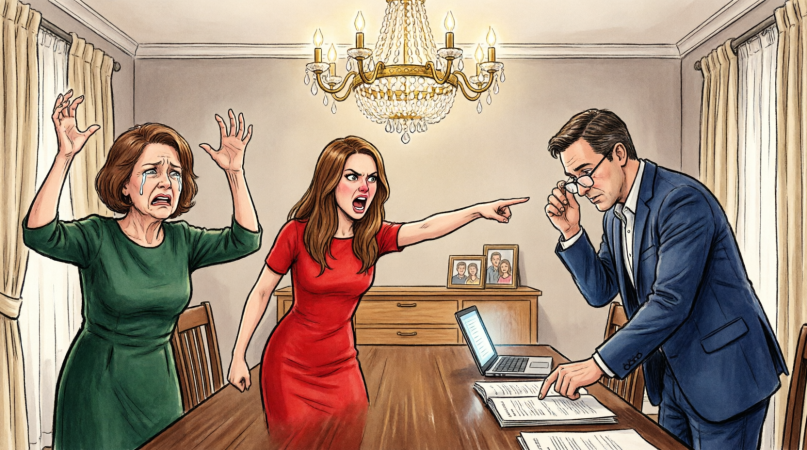
“Pension doesn’t cover property taxes,” she countered smoothly. “And what if you fall? What if you break a hip? Who pays the mortgage then? The bank forecloses. You lose everything. Or… you sell to us. We take over the payments. You live with us. No rent. No worries.”
She leaned forward, placing her hand over mine. Her skin was warm, but her grip was tight. “We love you, Mom. We just want you safe. Marcus has drawn up a power of attorney. Just a temporary one. So if you get confused, he can handle the bills. It’s standard.” Standard. The word hung in the air like smoke.
“And the house?” I asked. “If I sign this… who owns the house?” “Technically, the trust would,” she said. “But we manage the trust. It’s the same thing, really. It prevents probate. It prevents… complications.” Complications. That was the word they used for my independence.
I looked at her. Really looked at her. I remembered when she was five, when she scraped her knee on the sidewalk and cried until I kissed it better. I remembered when she was fifteen, when she stole twenty dollars from my purse and lied about it for a week. I remembered when she was twenty-five, when she introduced me to Marcus and I saw the way he looked at her wallets, not her face.
I had ignored the signs because I wanted to believe my daughter was good. I wanted to believe that blood was thicker than greed.
“Let me think about it,” I said, pulling my hand away. “It’s a big decision.”
Sophie’s smile tightened. “Don’t think too long, Mom. Marcus says the window for this refinancing option closes at the end of the month. If we miss it, the rates go up. We don’t want you to lose the house.”
We don’t want you to lose the house. Translation: We don’t want to lose the house.
“I understand,” I said. I picked up my menu. “i’ll let you know by Friday.”
She exhaled, a sound of relief disguised as patience. “Good. That’s all we ask. Just… don’t wait too long. Stress isn’t good for your heart.”
When the check came, she reached for it, but I insisted on paying. It was a small thing, but I needed to feel like I still had agency. I handed over my credit card. My hand didn’t shake.
As we walked out to the parking lot, she kissed my cheek again. “Call me tomorrow, okay? I love you, Mom.”
“I know,” I said.
I watched her drive away in her SUV—a car I had helped them pay for three years ago. Then I got into my sedan, started the engine, and drove home in silence. When I arrived, I plugged the recorder into my computer. I listened to the conversation twice. Every word was clear. Every lie was documented. She had admitted to the plan. She had admitted to the pressure. She had admitted to the power of attorney scheme.
It was enough. But it wasn’t enough to stop them permanently. I needed to ensure they couldn’t try this with someone else. I needed to ensure they understood the cost of what they had tried to do.
I called Margaret again. “I have it,” I said.
“Good,” she said. “Now we need the lawyer. Not a family lawyer. A litigator. Someone who bites.”
She gave me a name: David Ross. He specialized in elder financial abuse. He had a reputation for being ruthless with predators. I made an appointment for the next morning.
PART 4: The Attorney and the Strategy
David Ross’s office was in a modern building downtown, all glass and steel. He was a man in his fifties with sharp eyes and a handshake that felt like a promise. He didn’t offer me coffee. He offered me strategy.
I played the recording for him. I showed him the loan documents. I showed him the bank manager’s statement about Marcus’s behavior during the signing. David listened without interrupting, taking notes on a legal pad.
When the recording ended, he leaned back in his chair. “This is criminal,” he said quietly. “Financial exploitation of a vulnerable adult. In this state, that’s a felony. They could face prison time.”
“I don’t want them in prison,” I said. The words surprised me. I had thought I wanted revenge. But the thought of my daughter in a cell… it felt heavy. “I want my house safe. I want them away from me. I want them to know I know.”
David nodded. “We can do that. We file a civil suit to void the loan based on fraud and undue influence. We file a police report for the criminal aspect, but we can negotiate a plea deal that includes a restraining order and restitution. They pay your legal fees. They stay away from your property. They lose access to your finances.”
“And the grandchildren?” I asked. This was the wound that hadn’t healed. My grandchildren, Leo and Mia. They were eight and six. They were innocent in this.
“That’s complicated,” David said. “If there’s a restraining order against your daughter, it usually limits contact. But we can petition for supervised visitation. You decide the terms.”
I thought about Leo’s laugh. I thought about Mia’s drawings. They had been used as bait in this scheme. Do it for the family. Do it for the kids. They didn’t know. But would they understand later? Would they hate me for putting their parents in trouble?
“I want supervised visitation,” I said firmly. “At my house. Or a public place. No overnight stays. Not until I feel safe.”
“Done,” David said. He began typing on his laptop. “i’ll draft the cease-and-desist letter first. We send that before we file. Sometimes the threat of litigation is enough to make them back off. It saves time.”
“Send it,” I said.
I left his office feeling lighter, but also hollow. I was declaring war on my own child. There is no manual for that. There is no support group for mothers who have to sue their daughters to keep a roof over their heads.
When I got home, the house was quiet. I walked through the rooms, touching the walls. The woodwork my husband had polished. The garden we had planted. This wasn’t just资产; it was memory. They wanted to sell my memories to buy their future.
That evening, Sophie called. “Did you think about it, Mom?”
“I’m meeting with a financial advisor,” I lied. “Just to be sure.”
There was a pause. A sharp intake of breath. “A financial advisor? Why? Marcus is handling everything.”
“Marcus isn’t a fiduciary,” I said. I used the word David had taught me. “I need independent advice.”
“Mom,” she said, her voice dropping an octave. “Don’t do this. You’re making things difficult. We’re trying to help you.”
“I know,” I said. “i’ll let you know what the advisor says.”
I hung up. I knew they would panic. Panic made people careless. Careless people made mistakes. I waited.
Two days later, Marcus showed up at my door unannounced. He didn’t smile. He stood on my porch, blocking the light.
“Eleanor,” he said. “We need to talk. Now.”
“I’m busy,” I said through the screen door. I didn’t open it.
“You’re listening to strangers,” he said. “People who don’t know your family. Sophie is upset. She’s crying. Do you want your daughter to cry because you’re being stubborn?”
Guilt. The oldest weapon in the book.
“Tell Sophie i’ll call her when I’m ready,” I said.
“This isn’t a game,” he snapped. “Sign the papers. Before you lose everything.”
“I already have a lawyer,” I said. “David Ross. You might know him. He handles fraud cases.”
Marcus’s face went pale. The color drained so fast I thought he might faint. He knew the name. Everyone in local real estate knew the name. David Ross was the guy you didn’t want across the table from you.
“You… you’re suing us?” he stammered.
“I’m protecting myself,” I said. “Leave, Marcus. Before I call the police for harassment.”
He stared at me for a long moment. Then he turned and walked to his car. He didn’t look back. He knew the game had changed. The prey had teeth.
PART 5: The Confrontation
The cease-and-desist letter arrived at their house three days later. David had ensured it was delivered by certified mail. They had to sign for it. They had to acknowledge receipt.
That evening, my phone rang. It was Sophie. She wasn’t crying anymore. She was angry.
“How could you?” she shouted. “How could you hire a lawyer against your own family? Do you want to ruin us? Do you want the kids to grow up with parents who have criminal records?”
“I want to keep my house,” I said calmly. I was sitting in my living room, the recording device on the table between me and the phone. I was recording this call too.
“It’s our house!” she screamed. “We put the work in! We managed the loan! You’re just… you’re just an old woman who doesn’t understand finance!”
“I understand enough to know when I’m being robbed,” I said.
“You’re crazy!” she yelled. “Marcus said you were getting confused. He said you were forgetting things. I didn’t want to believe him, but look at you! You’re attacking us!”
“Marcus said that?” I asked. “Did he say I was confused in writing?”
“Stop trying to trap me!” she shrieked. “Just sign the power of attorney. Withdraw the lawsuit. We can fix this. We’re family.”
“Family doesn’t steal from each other, Sophie,” I said. “Family protects each other. You chose money. Now you have to live with the choice.”
“I hate you,” she whispered. The anger vanished, replaced by a cold, hard venom. “I hope you die in that house alone.”
“I’d rather die alone than live surrounded by vultures,” I said.
I hung up. I saved the recording. I hope you die in that house alone. That was evidence of intent. That was evidence of malice.
David called me an hour later. “They’re scrambling,” he said. “Marcus is trying to find a lawyer, but most won’t touch this. The evidence is too clear. They’re offering a settlement.”
“What kind of settlement?”
“They withdraw the loan application. They sign a confession of fraud to keep it from going to criminal court. They agree to a permanent restraining order. They pay your legal fees. And they agree to supervised visitation with the grandchildren.”
“And the house?”
“The loan is voided. Your title is clear. They have no claim.”
“Accept it,” I said.
“Are you sure?” David asked. “We could push for more. We could push for criminal charges.”
“No,” I said. “I want it over. I want them gone. I want my life back.”
“Okay,” David said. “i’ll draft the agreement.”
PART 6: The Signing
The settlement signing took place in a conference room at David’s office. I didn’t want to see them, but David said it was necessary for the final acknowledgment.
When I walked in, Sophie and Marcus were sitting on the other side of the table. They looked smaller. Marcus’s suit was wrinkled. Sophie’s eyes were red. They looked like people who had realized the safety net they had built was made of glass.
David placed the documents in front of them. “Sign here. And here. And initial here.”
Marcus signed quickly. He wanted it over. Sophie hesitated. She looked at me.
“Mom,” she said softly. “Please. We made a mistake. We were… desperate. The business was failing. We thought… we thought you wouldn’t mind. You have the house. You don’t need the money.”
“I needed the security,” I said. “And I needed a daughter.”
“We are your daughter,” she said.
“Not anymore,” I said. “Not the way you are.”
She signed. Her hand shook.
When it was done, David collected the papers. “It’s finished,” he said. “The loan is canceled. The restraining order is filed with the county. You are not to contact Mrs. Higgins directly. All communication regarding the grandchildren goes through the supervisor.”
Marcus stood up. He didn’t look at me. “Come on, Sophie.”
Sophie stood up slowly. She looked at me one last time. “You’ll regret this,” she said. “When you’re old and sick, who will come? Not us.”
“i’ll hire someone,” I said. “At least i’ll know they’re there because I pay them, not because they’re waiting for me to die.”
They walked out. I heard their footsteps fade down the hallway. I sat in the chair for a long time, listening to the silence. It was over.
PART 7: The Aftermath
The weeks following the settlement were quiet. The loan was officially voided. My bank account was no longer linked to theirs. The power of attorney was destroyed. I changed the locks on my house again, just to be sure.
The hardest part was the grandchildren.
The first supervised visit was scheduled for a Saturday afternoon at a park near my house. A social worker appointed by the court was present. She sat on a bench nearby, reading a book, watching but not interfering.
Leo and Mia ran toward me. They didn’t understand the legalities. They just knew Grandma was here.
“Grandma!” Leo shouted. He hugged my legs. “Mom said you were sick.”
“I’m fine, sweetheart,” I said, kneeling down. I looked at Sophie. She was standing near the car, arms crossed, watching us like a warden. She didn’t come closer. She wasn’t allowed to.
“Can we go to the playground?” Mia asked.
“Yes,” I said. “Let’s go.”
We spent an hour on the swings. I pushed them. I laughed when they jumped off. I took photos. But every time I looked up, I saw Sophie watching. Her face was hard. She didn’t wave. She didn’t smile. She was there because the court said she had to be.
When the hour was up, the social worker signaled time.
“Have to go,” I said, hugging them tight. “I love you.”
“Love you too, Grandma,” Leo said.
As they walked back to Sophie, Mia turned around. “Why don’t you come to our house, Grandma?”
I looked at Sophie. Sophie looked at the ground.
“Maybe someday,” I said.
They got in the car. Sophie didn’t start the engine immediately. She rolled down the window.
“You’re winning,” she said. “But you’re alone.”
“I’m not alone,” I said. “I have myself. And that’s enough.”
She rolled up the window and drove away. I watched the taillights disappear. Then I sat on the park bench and cried. Not because I missed them. But because I mourned the mother I thought I had raised. I mourned the future I had imagined.
PART 8: Rebuilding
Winter came early that year. The snow covered the garden, hiding the flowers my husband had planted. I spent most of my time inside, reading, knitting, organizing.
David called me in January. “There’s something you should know,” he said. “Marcus and Sophie filed for bankruptcy. The legal fees wiped them out. They lost their SUV. They’re renting an apartment.”
“I see,” I said. I didn’t feel joy. I didn’t feel sorrow. I just felt… final.
“They’re asking if you’d consider modifying the visitation,” David said. “Supervised is hard on them. They want unsupervised.”
“No,” I said. “Not yet. Maybe not ever.”
“Understood,” David said. “i’ll tell them.”
I started volunteering at the local library. I helped seniors with their computers. I helped them fill out forms. I saw the same fear in their eyes that I had felt. The fear of being used. The fear of being alone.
“I don’t want to be a burden,” one man told me. He was eighty, trying to figure out how to email his grandson.
“You’re not a burden,” I told him. “You’re a person. You have rights.”
I helped him send the email. I saw the smile on his face. It was small, but it was real.
I realized then that my fight wasn’t just for me. It was for everyone who thought they had to choose between family and safety. I started speaking at community centers. I told my story. Not the polished version. The real version. The version where I cried in the car. The version where I hated my daughter for a moment. The version where I chose myself.
People listened. Women my age nodded. They told me their stories. Sons who stole credit cards. Daughters who forged signatures. Grandchildren who were used as leverage.
“We think we have to protect them,” one woman said to me after a talk. “Even when they hurt us.”
“We have to protect ourselves first,” I said. “You can’t pour from an empty cup. And you can’t love someone who is using you.”
PART 9: The Letter
Two years after the settlement, I received a letter. No return address. The postmark was from a city three states away.
I opened it at my kitchen table. The handwriting was Sophie’s.
Mom,
I don’t expect you to reply. I don’t expect forgiveness. I’m writing this because I need to say it.
Marcus left me last year. He said I was too much work. He said I cared more about money than him. Maybe he was right. Maybe I learned that from somewhere.
I lost the house. I lost the car. I lost you. I look at Leo and Mia, and I see you in them. They ask about you. I tell them you’re busy. I don’t tell them you don’t want to see us.
I know I hurt you. I know I tried to take what wasn’t mine. I don’t have an excuse. I was greedy. I was scared. I thought you wouldn’t fight.
I was wrong.
I hope you’re safe. I hope you’re warm.
Sophie.
I read the letter twice. I folded it. I didn’t put it in the scrapbook. I didn’t burn it. I put it in a box with the legal papers. Evidence of a war I had survived.
I didn’t write back. Forgiveness wasn’t something I owed her. Safety was something I owed myself.
PART 10: The Garden
Spring arrived. The snow melted. The garden woke up.
I stood on the porch, looking at the tulips pushing through the soil. They were purple, my husband’s favorite color.
Margaret came over for tea. She was slower now, using a cane, but her mind was sharp.
“You look good,” she said. “Better than last year.”
“I feel good,” I said.
“Any news from them?”
“No,” I said. “And I prefer it that way.”
“You know,” Margaret said, sipping her tea. “People talk. They say you were hard on them. They say a mother should forgive.”
“People talk,” I said. “They don’t live in my house. They don’t sleep in my bed. They don’t know what it feels like to hear your own child planning your ruin.”
“No,” Margaret said. “They don’t.”
We sat in silence for a while. The sun was warm. The birds were singing.
“I’m thinking of updating my will,” I said.
Margaret raised an eyebrow. “Oh?”
“The house doesn’t go to Sophie,” I said. “It goes to the grandchildren. In a trust. They can’t touch it until they’re twenty-five. And Sophie doesn’t control it.”
“That’s smart,” Margaret said.
“And the rest,” I said. “I’m donating it. To the elder abuse hotline. To the legal aid society. To help people like me.”
Margaret smiled. “Your husband would be proud.”
“I hope so,” I said.
PART 11: The Visit
Six months later, the social worker called. “Sophie is requesting a modification,” she said. “She’s completed parenting classes. She’s employed. She wants unsupervised visitation.”
“i’ll consider it,” I said.
I thought about it for a week. I talked to David. I talked to Margaret. I talked to my own heart.
I agreed to one unsupervised visit. A dinner at my house. Just her. No Marcus. No children yet.
She arrived on a Tuesday evening. She looked different. Thinner. Older. She wore jeans and a simple sweater. No blazer. No perfume.
She stood on my porch. I opened the door.
“Hi, Mom,” she said.
“Come in,” I said.
We sat in the living room. I served tea. We didn’t talk about the lawsuit. We didn’t talk about the money. We talked about the weather. We talked about the grandchildren’s school.
“I’m working at a grocery store,” she said. “Checkout clerk.”
“That’s honest work,” I said.
“It is,” she said. “It’s… quiet. No schemes. Just scan, bag, repeat.”
“That sounds peaceful,” I said.
“It is,” she said. She looked at me. “I’m sorry, Mom. I know I said it in the letter. But I need to say it to your face. I’m sorry.”
“I know,” I said.
“Can we… can we try again?” she asked. “Not the way it was. But… something new.”
“I don’t know,” I said. “Trust is like a mirror. You can fix it if it’s broken, but you can still see the crack in the reflection.”
“I know,” she said. “I’m willing to wait.”
“We’ll see,” I said.
She stayed for an hour. Then she left. She didn’t ask for money. She didn’t ask for anything.
When she was gone, I locked the door. I stood in the hallway and listened to the silence. It wasn’t heavy anymore. It was just silence.
PART 12: The Legacy
Five years after the lawsuit, I turned seventy-four. I decided to sell the house. It was too big for one person. The garden was too much work.
I bought a condo in a senior community. It was secure. It had staff. It had friends.
The grandchildren came to visit me there. Leo was thirteen. Mia was eleven. They knew the story now. Sophie had told them, partially. They knew Grandma had been hurt. They knew Mom had made mistakes.
“Are you mad at Mom?” Leo asked me one day. We were playing chess.
“I’m not mad,” I said. “I’m careful.”
“Will you leave us the house?” Mia asked.
“The house is sold,” I said. “But there’s a trust. For your education. For your future.”
“Why?” Mia asked.
“Because I want you to be free,” I said. “I want you to know that you don’t have to steal to survive. You don’t have to hurt people to get what you want.”
Leo moved his knight. “Check.”
I smiled. “Good move.”
Sophie picked me up from the condo sometimes. She drove a used sedan. She wore uniform scrubs; she had become a nursing assistant. She helped people who couldn’t help themselves.
“Is it hard?” I asked her once.
“It is,” she said. “But it’s real. I like knowing that when I help someone, they don’t have to worry about what I want from them.”
“That’s good,” I said.
We weren’t close. We weren’t the mother and daughter I had dreamed of. But we were civil. We were safe.
PART 13: The Final Reflection
I am seventy-nine now. I sit on the balcony of my condo, watching the sunset. My hands are spotted with age. My back hurts when it rains. But my mind is clear.
I think about that day I went back for my glasses. I think about the moment I froze against the brick wall. I think about the choice I made.
I could have signed. I could have let them take the house. I could have lived with them and been miserable until I died.
Instead, I fought. I lost a daughter to save myself. But I gained a life.
People ask me if I regret it. If I wish I had been more forgiving.
I tell them the truth.
“Forgiveness is for you,” I say. “Protection is for you too. Don’t confuse the two.”
My phone buzzes. It’s a message from Sophie. Coming over for dinner tomorrow? Leo is making lasagna.
Yes, I type. I’ll bring the salad.
I put the phone down. I watch the sun dip below the horizon. The sky is purple and orange. It looks like the tulips in my old garden.
I am alone in my condo, but I am not lonely. I am safe. I am respected. I am free.
And that is the greatest inheritance I could ever leave.
Epilogue: The Glasses
I found the glasses a few months after the lawsuit ended. They were in my coat pocket, the one I wore that day I went back to the house.
I had forgotten them not because I was confused, but because I was distracted. Distracted by love. Distracted by hope.
I put them on now. They still work. The lenses are scratched, but they help me see.
I look at the world through them. I see the cracks in the wall. I see the beauty in the flowers. I see the truth in people’s eyes.
I clean them with a cloth. I put them in the case. I put the case in the drawer.
I don’t need them to see the truth anymore. I learned that lesson the hard way.
I close the drawer. I turn off the light. I go to bed.
Tomorrow is a new day. And for the first time in a long time, I am not afraid of what it brings.
The End.