The first time Lily complained about the toothache, it sounded ordinary.
“Mom, this one hurts when I chew,” she said.
She was standing barefoot in the kitchen, still wearing her school uniform, pointing to the back left side of her mouth with the dramatic seriousness of a child delivering medical news.
She was ten years old.
She made a big deal out of math homework.
She left socks in impossible places.
She hated peas.
She loved strawberry yogurt.
She was brave about pain only when bravery helped her avoid appointments.
So at first, I did what any mother would do.
I told her to rinse her mouth.
I checked for swelling.
I asked if she had been chewing ice again.
She said no too quickly. Then, when she mentioned the pain for the second time that week, I called Dr. Harris and booked the earliest appointment they had for Saturday morning. That should have been simple. It wasn’t. The moment I told my husband, Daniel, he looked up from his phone too fast.
“I’m coming with you,” he said.
I paused with my hand still on the refrigerator door.
“You don’t have to.”
“I want to go.”
There was nothing wrong with the sentence.
Fathers went to dentist appointments.
Stepfathers went too.
Good husbands supported their wives.
Normal men did normal things.
But Daniel had never cared about dentist appointments.
He went years without cleanings and once joked that he would rather pull his own tooth with pliers than sit in a waiting room.
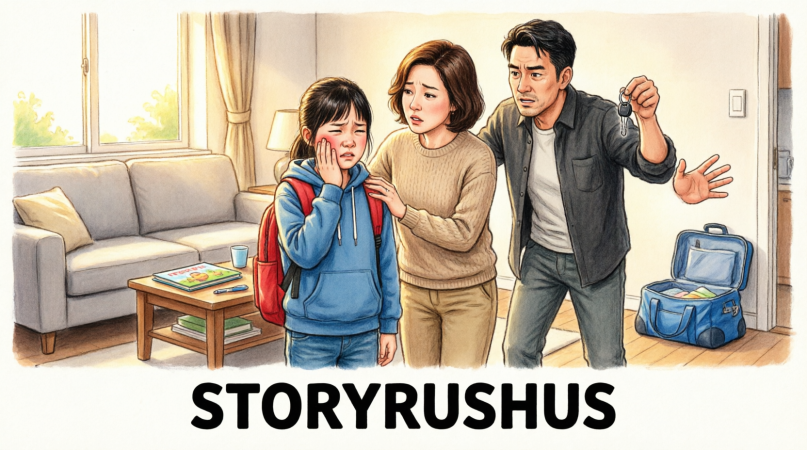
Now, suddenly, he wanted to come.
“It’s just a checkup,” I said.
He smiled.
The smile was neat.
Controlled.
Wrong.
“Exactly.”
“There’s no reason I shouldn’t be there.”
I told myself not to overthink it.
I had become very good at that.
Not overthinking.
Not noticing.
Not naming things.
For two years, I had trained myself to find harmless explanations for everything.
For the way Lily stopped running into the living room when Daniel came home.
For the way she kept her bedroom door half closed instead of open.
For the way she no longer asked him to help with homework.
For the way she locked the bathroom door completely, even if she was only brushing her teeth.
For the way she sometimes watched him from under her lashes, as if she were measuring how much space existed between them.
Adjustment.
Grief.
Preteen moods.
New family dynamics.
Those were the words I used.
They sounded calm.
They sounded reasonable.
They sounded much easier than fear.
Daniel was not Lily’s father.
Her father, Mark, died when she was six.
A heart attack at thirty-eight.
Sudden.
Cruel.
Impossible to understand.
For almost three years after that, it was just the two of us.
Me and Lily.
A small apartment.
Late bills.
School drop-offs.
Grief in the cereal aisle.
Grief in parent-teacher conferences.
Grief every time Father’s Day came around and Lily brought home a craft she did not know what to do with.
Then Daniel appeared.
He was careful at first.
Patient.
Polite.
He fixed the loose cabinet door in my kitchen before I even asked.
He remembered Lily’s teacher’s name.
He brought soup when I had the flu.
He never rushed me.
He said he understood that loving a widow meant loving someone who already knew how quickly life could collapse.
I mistook that sentence for depth.
Maybe it was depth at first.
Maybe I only wanted it to be.
By the time we married, Lily had stopped calling him “Mr. Daniel” and started calling him just Daniel.
He never asked her to call him Dad.
I liked that.
I thought it meant he respected boundaries.
Now I wonder how many things I labeled respect because I was desperate to believe I had chosen safety.
Saturday morning came gray and cold.
The kind of morning that makes every errand feel heavier than it should.
Lily sat in the back seat clutching her stuffed rabbit even though she claimed she was too old for it.
Daniel drove.
He had insisted.
I sat in the passenger seat, hands folded in my lap, watching his fingers tighten and loosen around the steering wheel.
“You okay?” I asked.
He glanced at me.
“Why wouldn’t I be?”
“I don’t know.”
“You seem tense.”
“I’m fine.”
That was Daniel’s favorite answer.
Fine.
A locked door disguised as a word.
In the rearview mirror, I saw Lily looking out the window.
Her face was too still.
“Does your tooth still hurt, sweetheart?” I asked.
She nodded.
“A little.”
Daniel’s eyes flicked to the mirror.
“Then let’s get it fixed.”
Lily lowered her gaze to the rabbit in her lap.
The dental office smelled like peppermint polish, latex gloves, and old magazines.
The waiting room had blue chairs, a fish tank, and a plastic bin full of toys no child over five would willingly touch.
Dr. Harris had treated Lily since kindergarten.
He was in his fifties, gentle, soft-spoken, and patient in the rare way that did not feel fake.
Lily usually relaxed as soon as she saw him.
This time, she didn’t.
She sat pressed against my side, flipping through a puzzle book without solving anything.
Daniel stood by the fish tank with his hands in his pockets.
He was watching the hallway.
Not the fish.
The hallway.
When the hygienist called Lily’s name, Lily looked at me first.
Then she looked at Daniel.
I stood.
“I’ll go with you.”
Daniel stepped forward.
“Let’s both go.”
The hygienist hesitated.
Just a fraction.
Then she smiled professionally.
“Of course.”
The exam room was too bright and too cold.
Lily climbed into the chair.
The paper bib crinkled against her uniform.
Dr. Harris entered with his usual calm smile.
“Good morning, Lily.”
“Still giving your mom trouble?”
Lily tried to smile.
It barely moved her mouth.
Dr. Harris noticed.
I saw him notice.
His eyes shifted briefly from Lily to Daniel, then back again.
“How long has the tooth been hurting?” he asked.
“A few days,” Lily said.
“Does cold water bother it?”
“Sometimes.”
“Does it hurt when you chew?”
She nodded.
Daniel stood near the counter.
Too close.
His arms were crossed.
His face was pleasant, but his eyes were sharp.
Dr. Harris put on gloves.
“Mom, you can sit right there.”
He nodded toward the chair beside Lily.
Then he looked at Daniel.
“There’s limited space, sir.”
Daniel smiled.
“I’m fine standing.”
Dr. Harris held his gaze for one second too long.
“Of course.”
The exam began.
The overhead light clicked on.
Lily squinted.
Dr. Harris spoke gently, explaining each step before he did it.
Open wide.
Tiny mirror.
A little air.
Let me know if something hurts.
Lily obeyed.
But her hands were curled tightly around the armrests.
Her knuckles were pale.
I reached over and touched her ankle.
She did not relax.
Dr. Harris leaned in.
Then stopped.
Not dramatically.
Not enough for anyone else to notice, maybe.
But I noticed because I was watching his face.
Something changed in his eyes.
He adjusted the light.
Looked again.
His jaw tightened.
Then he looked at Daniel.
Not at me.
At Daniel.
Daniel shifted.
“What is it?” he asked.
Dr. Harris looked back into Lily’s mouth.
“Just checking.”
His voice remained calm.
Too calm.
He asked Lily to bite down.
Then open again.
He checked the sore tooth.
Then the gums.
Then the inside of her cheek.
Then he paused again.
“Lily,” he said gently, “did you bump your mouth recently?”
Daniel answered before she could.
“She probably did at school.”
Dr. Harris did not look at him.
“I asked Lily.”
The room went silent.
My heart gave one hard beat.
Lily’s eyes flicked toward Daniel.
Then down.
“I don’t know,” she whispered.
“You don’t know?”
She shook her head.
Daniel laughed lightly.
“She’s clumsy.”
“Kids fall.”
Dr. Harris stood up slowly.
He removed the mirror from Lily’s mouth.
His eyes moved to Daniel again.
There was recognition in them now.
Not personal recognition.
Professional recognition.
The kind doctors get when they have seen a pattern before.
My stomach tightened.
“What’s wrong?” I asked.
Dr. Harris turned to me.
“There is some inflammation.”
“And a small injury near the back gumline.”
Daniel stepped closer.
“So it’s a cavity?”
Dr. Harris did not answer him.
“We’ll take an X-ray.”
Daniel’s smile thinned.
“For a toothache?”
“Yes.”
“For a toothache.”
The hygienist came in with the X-ray apron.
Lily sat very still.
Too still.
Dr. Harris watched Daniel while the hygienist adjusted the equipment.
Then he said, “Parents usually wait outside during imaging.”
“I’ll stay,” Daniel said.
“It’s clinic policy,” Dr. Harris replied.
Daniel’s face hardened.
“No one mentioned that before.”
“It’s standard.”
“I’m her stepfather.”
“And I’m her dentist.”
The words were quiet.
But they changed the room.
Daniel looked at me.
I felt the old pressure of his gaze.
The silent instruction.
Smooth this over.
Make this easier.
Do not embarrass me.
I almost did.
Then I looked at Lily.
She was staring at me with wide, pleading eyes.
I stood.
“We’ll wait outside.”
Daniel’s head turned toward me.
“What?”
“We’ll wait outside.”
“For the X-ray.”
His jaw moved.
For a second, I thought he might argue.
Then he smiled.
“Sure.”
The hallway felt colder than the exam room.
Daniel leaned close as soon as the door closed.
“What was that?”
“What was what?”
“Taking his side.”
“I wasn’t taking anyone’s side.”
“You made me look like a problem.”
I stared at him.
Something in me recoiled.
Not from his words.
From how familiar they sounded.
My fault.
My tone.
My reaction.
My responsibility to protect his image.
“She’s getting an X-ray,” I said.
“That’s all.”
His eyes narrowed.
“You’ve been strange lately.”
I almost laughed.
The absurdity of that.
I had been strange.
Lily had been quiet.
He had been watching too closely.
But I was the strange one.
Before I could answer, the door opened.
The hygienist stepped out.
“You can come back in now.”
Dr. Harris stood at the counter looking at the X-ray on the screen.
Lily was back in the chair.
Her face was pale.
I went to her immediately.
Daniel followed.
Dr. Harris kept his eyes on the image.
“The tooth itself looks healthy,” he said.
“No cavity.”
My hand tightened on Lily’s.
“Then why does it hurt?”
“There may be trauma to the tissue.”
Daniel spoke quickly.
“So she hit her mouth.”
Dr. Harris turned.
“Possibly.”
His voice was careful.
“Lily, can you tell me if anyone touched your face or mouth recently?”
The room disappeared around me.
All I heard was that question.
Anyone touched your face or mouth.
Daniel went very still.
Lily’s fingers tightened around mine.
“I don’t remember,” she whispered.
That was not no.
My body understood before my mind did.
Dr. Harris nodded as if that answer meant something.
“Okay.”
“That’s okay.”
He removed his gloves.
“I’m going to prescribe a rinse and schedule a follow-up.”
“She should avoid hard foods for a few days.”
Daniel exhaled.
A little too loudly.
“Great.”
“So we’re done?”
Dr. Harris looked at him.
“Yes.”
“For today.”
Those two words settled over the room.
For today.
As we left, Dr. Harris walked us to the front desk himself.
That had never happened before.
He chatted lightly with Lily about school.
Asked if she still liked drawing cats.
She nodded.
Barely.
At the desk, the receptionist printed instructions.
Daniel stood behind us, close enough that I felt his presence like heat.
Dr. Harris handed me the paper.
Then, as if adjusting his coat on the chair beside mine, he slipped something into my coat pocket.
A folded piece of paper.
Small.
Quick.
Almost invisible.
But I felt it.
My eyes snapped to his.
His face did not change.
He only said, “Call me if anything changes.”
The way he said anything made my throat tighten.
Daniel put his hand on my lower back.
“Ready?”
I nodded.
I do not remember walking to the car.
I remember Lily getting into the back seat without speaking.
I remember Daniel checking his phone before starting the engine.
I remember my coat pocket feeling like it was burning.
At home, Daniel acted normal.
Too normal.
He made coffee.
Asked if we needed groceries.
Told Lily to rest.
Then he looked at me.
“I’m going to run to the hardware store.”
I almost asked why.
I didn’t.
The moment the front door closed, I locked it.
Then I pulled the folded paper from my coat pocket.
My hands were already shaking before I opened it.
The note was written in quick, slanted handwriting.
Do not confront him.
Your daughter is afraid of him.
Call police.
Ask for Detective Morales.
I read it once.
Then again.
Then a third time.
The room tilted.
My knees nearly gave out.
I looked toward the hallway.
Lily’s bedroom door was closed.
For two years, I had been explaining things away.
Her silence.
Her stiffness.
Her locked doors.
The way she stopped being alone in rooms where Daniel entered.
The way she said she hated movie nights.
The way she started sleeping with her desk chair pressed under the doorknob when she thought I wouldn’t notice.
I had seen everything.
And I had explained everything.
Because explanations are easier than terror.
I walked to Lily’s room.
Knocked softly.
“Sweetheart?”
No answer.
“Can I come in?”
A pause.
Then, “Okay.”
She was sitting on the bed with the stuffed rabbit in her lap.
Her shoes were still on.
I sat beside her slowly.
Not too close.
Not suddenly.
Every movement felt important now.
“Lily,” I said.
My voice almost broke.
“Dr. Harris gave me a note.”
Her eyes filled with fear so fast it stole my breath.
I did not ask for details.
Not then.
I remembered enough from parenting articles, school meetings, safety talks.
Do not interrogate.
Do not lead.
Do not force.
Protect first.
Questions later.
“I need you to know something,” I said.
“You are not in trouble.”
Her chin trembled.
“Whatever happened, you are not in trouble.”
A tear slid down her cheek.
I reached out my hand, palm up.
She stared at it.
Then she took it.
That tiny movement shattered me.
“Are you scared of Daniel?” I asked softly.
She squeezed my hand once.
Not a word.
Just once.
That was enough.
I stood.
“Put on your shoes.”
“They’re on.”
“Good.”
“Bring Rabbit.”
Her face crumpled.
“Where are we going?”
“To get help.”
“Is he coming?”
“No.”
“He is not coming.”
Her whole body sagged with relief.
That relief nearly killed me.
I grabbed our coats.
My purse.
Her school backpack.
Her birth certificate from the file drawer.
I don’t know why I grabbed it.
Instinct, maybe.
Proof that she was mine.
Proof that I could take her somewhere and not ask permission from the man I had married.
I called 911 from the car.
My voice sounded like someone else’s.
“My name is Claire Bennett.”
“I need to speak to Detective Morales.”
“My daughter’s dentist gave me a note.”
“My husband may have hurt her.”
The dispatcher’s tone changed instantly.
Calm.
Precise.
“Where are you now?”
“In my car.”
“With my daughter.”
“Is your husband with you?”
“No.”
“Do not return home.”
“Drive to the police station on Westbrook.”
“Officers will meet you there.”
Lily sat in the back seat clutching Rabbit so tightly its ear folded over.
“Mom?”
“Yes, baby?”
“Are you mad?”
I almost had to pull over.
“No.”
“No, sweetheart.”
“I’m not mad at you.”
“Never at you.”
She looked out the window.
“I tried to tell you.”
The sentence entered me like a knife.
I gripped the steering wheel until my fingers hurt.
“I know.”
“I’m sorry.”
“I’m so sorry.”
She began to cry silently.
No sound.
Just tears.
That was worse than sobbing.
At the police station, a woman officer met us at the entrance.
She crouched to Lily’s level.
“My name is Officer Reyes.”
“You’re safe here.”
Lily looked at me.
I nodded.
Detective Morales arrived ten minutes later.
She was in her forties, with tired eyes and a voice that did not waste words.
She read Dr. Harris’s note.
Then she looked at me.
“You did the right thing by coming here.”
I broke then.
Not loudly.
Just folded forward with my face in my hands.
“I didn’t know.”
Detective Morales did not comfort me with lies.
She did not say, Of course you didn’t.
She said, “You know now.”
“Now we protect her.”
Those words became the rope I held onto.
Now we protect her.
Lily was taken to a private room with a child advocate.
I was told not to question her.
Not to ask for details.
Not to react strongly in front of her.
Let trained people help her speak.
Let her set the pace.
Let her know she is believed.
Believed.
That word crushed me.
Because children know when adults don’t want to hear them.
They learn silence from the shape of our denial.
While Lily spoke with the advocate, Detective Morales asked me about Daniel.
How long we had been married.
Whether he was Lily’s biological father.
Whether Lily had changed behavior.
Whether he had access to her alone.
Whether he had ever been violent with me.
I answered.
Each answer felt like lifting a stone and finding something alive underneath.
He controlled my schedule.
He disliked when Lily and I had “private little secrets.”
He said she was dramatic.
He said I spoiled her.
He once got angry when I changed the bathroom lock because the old one stuck.
He insisted family meant no locked doors.
I had argued with him.
He apologized.
I accepted it.
God help me, I accepted it.
Detective Morales wrote everything down.
When I mentioned the bathroom lock, her pen paused.
“Did Lily specifically ask for that lock to be fixed?”
I closed my eyes.
“Yes.”
“What did she say?”
“That the old one didn’t work right.”
“And Daniel objected?”
“Yes.”
My voice broke.
“He said locks made homes feel hostile.”
Detective Morales looked at me for a long moment.
Then wrote that down too.
Police went to our house that evening.
Daniel was back by then.
He called me fourteen times while I sat inside the station.
Then texts came.
Where are you?
Why is Lily’s backpack gone?
Claire, answer me.
This is childish.
You’re scaring me.
Then:
If you’re trying to punish me for caring about the dentist, don’t come home until you’re ready to apologize.
I stared at that message until my vision blurred.
Even now.
Even with everything cracking open.
He still thought the right pressure could make me manage his feelings.
Detective Morales read the messages and asked permission to photograph them.
I gave it.
An emergency protective order was filed that night.
Daniel was told not to contact me or Lily.
He violated it within twenty minutes.
First by phone.
Then email.
Then by calling my sister.
Then my mother.
Then showing up at the police station parking lot.
That was when they arrested him.
I did not see it happen.
I only heard later that he was furious.
Not frightened.
Furious.
That mattered to me.
It told me Dr. Harris had been right.
Do not confront him.
Men like Daniel did not fear being wrong.
They feared being exposed.
That night, Lily and I stayed at my sister Emma’s house.
Emma did not ask questions in front of Lily.
She made grilled cheese.
Put clean sheets on the guest bed.
Set a nightlight in the hallway.
When Lily finally fell asleep, curled into me like she had when she was little, I stared at the ceiling until dawn.
I thought about every moment I had missed.
Every sign.
Every rationalization.
Every time I had chosen calm over suspicion.
And underneath the guilt, something else grew.
Rage.
Not loud.
Not wild.
A steady, clean-burning rage.
At Daniel.
At myself.
At every social rule that teaches women to protect a man’s reputation before they trust a child’s fear.
The next days blurred.
Police interviews.
A medical evaluation.
Therapist referrals.
Court papers.
My house becoming a place I could no longer enter without officers.
Daniel’s family calling him misunderstood.
His sister leaving a voicemail saying Lily was “confused” and I was “destroying a good man.”
I saved every message.
Then blocked them.
Dr. Harris called me personally.
His voice sounded older than it had in the office.
“I’m sorry,” he said.
“I wish I could have said more directly.”
“You did enough,” I told him.
And I meant it.
Because he had looked.
He had noticed.
He had not explained away my child’s fear.
He had done what I should have done sooner.
He believed what her body was saying before her mouth could.
Weeks later, Detective Morales told me the investigation had uncovered other concerns.
Other children.
Other complaints that had never become cases because adults minimized, families denied, and Daniel moved carefully through the spaces between suspicion and proof.
I sat in her office and felt the world narrow.
“How many?” I asked.
She did not answer immediately.
That was answer enough.
Lily began therapy with a woman named Dr. Patel, whose office had soft lamps and shelves full of art supplies.
The first few sessions, Lily barely spoke.
She drew houses with tiny windows.
Then houses with doors.
Then houses with locks.
One day, she drew a house with no roof and a giant sun above it.
Dr. Patel showed it to me afterward with Lily’s permission.
“She said this one can breathe.”
I cried in the parking lot for fifteen minutes.
Healing did not look like a movie.
Lily did not suddenly become the child she had been before.
She had nightmares.
She hated being surprised.
She checked locks.
She asked me where I was going even if I only walked to the mailbox.
I answered every time.
Kitchen.
Bathroom.
Porch.
Right here.
I’m right here.
Some nights she crawled into my bed and slept with her hand wrapped around my sleeve.
Some nights she got angry at me.
Those were the hardest.
“You didn’t see,” she shouted once.
We were in the kitchen.
A bowl of cereal sat between us, untouched.
“You were supposed to see.”
There was no defense.
No explanation that would not be selfish.
So I said the only true thing.
“You’re right.”
Her face crumpled.
“I’m sorry.”
“I know that doesn’t fix it.”
“But I’m here now.”
“And I believe you.”
She cried then.
So did I.
We sat on the kitchen floor holding each other while the cereal went soggy on the table.
Daniel’s trial took almost a year.
He denied everything.
Of course he did.
He wore suits.
He kept his hair neat.
He looked wounded in court, as if he were the one betrayed.
His lawyer suggested Lily was grieving her father and confused about Daniel’s role in the home.
That was the first time I nearly stood up and screamed.
Detective Morales warned me before court that defense attorneys sometimes made cruelty sound professional.
She was right.
But Lily was brave.
Not in the way people mean when they praise children for enduring pain.
I hate that kind of bravery now.
She was brave because she told the truth even while adults tried to make silence more comfortable.
Dr. Harris testified.
He spoke calmly.
Clinically.
He explained what he observed.
Not just the injury.
The behavior.
The fear response.
The way Lily watched Daniel before answering.
The way Daniel tried to answer for her.
The way the pattern concerned him enough to intervene discreetly.
He did not embellish.
He did not dramatize.
That made him powerful.
When the prosecutor asked why he slipped me a note instead of confronting Daniel in the office, Dr. Harris looked directly at the jury.
“Because abusers often become most dangerous when they realize they’ve been exposed.”
Daniel stared at the table.
I watched him.
For the first time, I did not feel afraid.
I felt disgusted that I had ever mistaken his control for steadiness.
He was convicted.
Not on every charge.
Justice is rarely as complete as people imagine.
But enough.
Enough that he was taken away.
Enough that Lily would not have to see him again.
Enough that the house could finally exhale.
We moved.
I sold the home where I had married him.
I could not keep walls that had learned my daughter’s fear.
Our new place was smaller.
A townhouse with a blue front door, a tiny backyard, and sunlight in Lily’s room every morning.
The first thing we did was install locks.
Good ones.
On bedrooms.
Bathrooms.
Front door.
Back door.
Lily chose the locksmith.
She stood beside him while he worked.
When he finished, he handed her the keys.
Not me.
Her.
She held them like treasure.
That night, she slept six hours without waking.
It was the first time in months.
I started therapy too.
At first, I thought I was going so I could be a better mother to Lily.
Then my therapist asked me why Daniel had seemed safe to me.
That question opened a door I had nailed shut years earlier.
Because Daniel was calm.
Because he did not drink much.
Because he did not shout often.
Because he helped.
Because after Mark died, I was so tired of being alone that I confused assistance with character.
Because I wanted Lily to have a family again.
Because I wanted myself to have one too.
That was the hardest admission.
Not that I had been fooled.
But that loneliness had made me easier to fool.
I am kinder to that version of myself now.
Not fully.
Not every day.
But more than I was.
Because shame does not protect children.
Truth does.
Action does.
Belief does.
Lily is twelve now.
She still hates peas.
She still loses socks.
She has braces, which she complains about with theatrical misery.
She draws less often, but when she does, her houses have doors and windows and roofs and gardens.
Sometimes she asks about Daniel.
Not because she misses him.
Because children need to revisit the shape of what happened as they grow old enough to understand it differently.
I answer honestly, carefully, with help from Dr. Patel’s guidance.
He hurt you.
You did nothing wrong.
Adults should have protected you sooner.
I am sorry.
He cannot come here.
You are safe.
She always listens quietly.
Then asks something ordinary, like whether we have ice cream.
That is childhood trying to return.
Not all at once.
In pieces.
One afternoon, almost two years after the dentist appointment, we passed Dr. Harris’s office while running errands.
Lily looked out the window.
“Can we bring him cookies sometime?” she asked.
My throat tightened.
“Yes.”
So we did.
Chocolate chip.
Slightly burned on the bottom because I am still me.
Dr. Harris came into the waiting room when he heard we were there.
Lily handed him the box.
She was shy.
But she looked him in the eye.
“Thank you,” she said.
Two words.
Small.
Enormous.
Dr. Harris’s eyes filled, though he blinked quickly.
“You’re very welcome.”
As we left, Lily slipped her hand into mine.
Not because she was scared.
Just because she wanted to.
There is a difference.
I know it now.
That night, after she went to bed, I stood by our blue front door and listened to the quiet of the house.
Not tense quiet.
Not frightened quiet.
Safe quiet.
The kind I once thought was boring.
The kind I now know is sacred.
Sometimes I still think about that Saturday morning.
The toothache.
Daniel insisting on coming.
The cold exam room.
Dr. Harris staring at him.
The folded note in my pocket.
I wonder what would have happened if I had ignored it.
If I had explained it away too.
If I had chosen not to believe what was finally placed directly in my hand.
I cannot live in that thought for long.
It is too dark.
So I return to what happened instead.
I read the note.
I listened.
I went to the police.
I believed my daughter before the world had time to teach me doubt.
And if there is one thing I know now, it is this.
A child does not need a perfect mother.
A child needs a mother who will turn around the moment she sees the truth and run toward help, even if guilt is chasing her.
That day, I stopped protecting the image of my marriage.
I stopped protecting the comfort of a man.
I stopped protecting the lie that normal-looking homes cannot contain danger.
I chose Lily.
Late.
But fully.
And every day since, I choose her again.