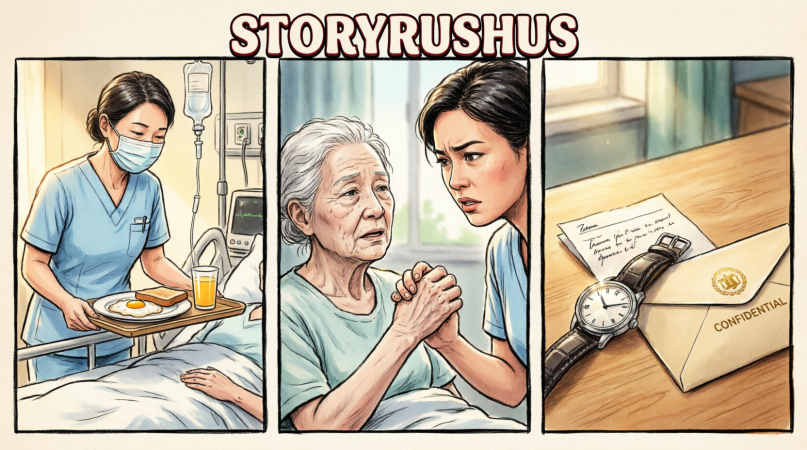
My son was rushed to the hospital after a terrifying crash. In the next room, an older woman sat alone with no one coming to see her. Every morning, I brought her breakfast and tried to make her feel less forgotten. But on the day she was discharged, she held my hand so tightly my heart stopped for a second… then whispered, “Please, get away from him before it’s too late.” I thought pain had made her confused. I thought she had mistaken my son for someone from her own past. But three days later, a folded note, a silver watch, and one envelope from the bank made me realize that stranger had seen my life more clearly than I had.
The Watch That Stopped at 3:15
My son was rushed to the hospital after a terrifying crash. In the next room, an older woman sat alone with no one coming to see her. Every morning, I brought her breakfast and tried to make her feel less forgotten. But on the day she was discharged, she held my hand so tightly my heart stopped for a second… then whispered, “Please, get away from him before it’s too late.” I thought pain had made her confused. I thought she had mistaken my son for someone from her own past. But three days later, a folded note, a silver watch, and one envelope from the bank made me realize that stranger had seen my life more clearly than I had.
The call came on a Tuesday afternoon while I was standing in the back office at Portland Metal Works, holding an inventory sheet and arguing with myself over a shipment of stainless fasteners that had been counted wrong twice. The shop floor behind me roared the way it always did: machines humming, carts rolling, somebody laughing too loudly near the loading bay. Then my phone lit up with a number I did not know. I almost let it go.
At sixty-seven, I had learned that unknown numbers usually meant insurance offers, appointment reminders, or someone trying to sell me something I did not need. But something in my chest tightened before I even answered. Maybe a father knows. Maybe the body hears bad news before the ear does.
“Is this Graham Mercer?” a woman asked.
“Yes.”
“This is Providence Portland Medical Center. Your son, Blake Mercer, has been brought into our emergency department after a motor vehicle accident. He is stable, but you should come right away.”
The inventory sheet slipped from my hand. I remember watching it drift to the floor, slow as a leaf, while the whole shop seemed to pull away from me. Men were still moving. Machines were still running. Somewhere, a radio was playing an old country song. But I heard none of it. I only heard one word.
Blake.
My son was forty-two years old, married, a father himself, a real estate agent with nice shoes and confident handshakes and a way of making every room feel like it belonged to him. But when I heard his name from that hospital voice, I did not see the man. I saw the little boy who used to run across our yard in grass-stained jeans. I saw him at seven, wobbling on a bicycle while his mother, Linda, stood on the porch with both hands pressed over her heart. I saw him at twelve, asleep on the couch with a baseball glove tucked under his arm. I saw him at eighteen, standing in a graduation gown, rolling his eyes because I kept taking pictures.
I do not remember telling my foreman I was leaving. I do not remember driving across town. I only remember my hands trembling around the steering wheel and the terrible thought that kept rising no matter how many times I pushed it down.
Please don’t let me lose him too.
I had already buried my wife. Eight years earlier, Linda went into that same hospital for what we all thought would be a manageable procedure, and she never came home. Since then, hospitals had smelled to me like endings. Antiseptic, coffee, floor wax, fear. When I pulled into the parking lot and saw the tall concrete building against the gray Portland sky, my legs almost refused to move.
But fathers move anyway.
A young nurse at the desk sent me to the third floor. A doctor named Vanessa Hartley met me near the elevators. She had calm eyes and a voice practiced in delivering frightening information gently.
“Your son has a concussion and a few other injuries we’re monitoring closely,” she told me. “He’s awake, but groggy. We want to keep him under observation for the next forty-eight to seventy-two hours.”
“Can I see him?”
“Of course.”
She led me down a hallway washed in white light. Machines beeped behind half-open doors. Nurses moved like quiet shadows. When she pushed open Blake’s room, I saw him lying in bed with a bandage at his temple, an IV taped to his arm, his eyes half closed.
For one second, he looked like a child again.
“Dad,” he rasped.
I moved to him so fast the chair scraped the floor. “I’m here.”
He tried to smile. “You look scared.”
“I am scared.”
“I’m fine.”
“No, you’re in a hospital bed. Let me be the judge of fine.”
His mouth twitched, and for a moment I felt something loosen inside me. He was alive. He could speak. He could be annoyed with me. That was enough to make gratitude fill my chest until it hurt.
I pulled the visitor’s chair beside him and took his hand. He let me hold it for maybe five seconds before his fingers shifted away. I told myself it was the IV, the discomfort, the embarrassment of being seen weak. Blake had never liked needing help. Even as a boy, he would rather spend an hour forcing a stuck zipper than ask his mother to fix it.
The room was divided by a pale curtain. On the other side, I could hear the small movements of another patient: sheets rustling, a breath catching, a water cup being set down. I did not look. My world had narrowed to Blake’s face, the monitor line, the slow rise and fall of his chest.
By evening, he was asleep. I stayed in the chair with my jacket folded under my head, too tired to read, too wired to rest. The hallway light painted a thin gold line across the floor. Rain touched the window in little taps.
Then I heard a voice from behind the curtain.
“Stay away from him.”
I sat up.
Blake slept on, mouth slightly open, one hand curled against the blanket.
The voice came again, weaker but clearer. “Please. Stay away from him while you still can.”
I stood slowly and pulled the curtain back a few inches.
An older woman lay in the other bed. She was thin, with white hair pinned loosely at the back of her head and skin so pale the blue veins showed at her temples. But her eyes were not weak. They were fixed on me with a terrible, sharp urgency.
“I’m sorry,” I whispered. “Did you need the nurse?”
Her hand trembled against the blanket. “You need to listen.”
“I think maybe you’re confused. That’s my son.”
“I know who he is.”
The words landed strangely. I looked over my shoulder at Blake, then back at her.
“You know Blake?”
“I heard him.”
Before I could ask what she meant, a nurse came in to check the woman’s IV. She smiled politely, pulled the curtain closed, and the moment was over. But my pulse would not slow. I sat back down, staring at the curtain, telling myself what any reasonable man would tell himself.
She was elderly. She was medicated. She had mistaken us for someone else.
Still, long after midnight, I kept seeing her eyes.
The next morning, Blake was more alert. He complained about the hospital coffee, asked for his phone, and told me I did not need to hover. That word—hover—stung more than it should have. I had spent the night folded into a plastic chair with my back aching and my heart beating holes in my ribs. But Blake said it casually, the way a man might wave away a waiter.
Around eight, a nurse suggested I go down for breakfast. I was halfway to the cafeteria before I realized I had not eaten since the day before. I bought two coffees, a breakfast sandwich for myself, and, without really deciding to, a cup of oatmeal and toast for the woman behind the curtain.
When I returned, Blake was asleep again. I set his water on the table and stood there for a moment with the coffee warming my hands.
Then I stepped to the curtain.
“Ma’am?”
A pause.
“Yes.”
“I brought you breakfast. If you want it.”
I pulled the curtain back. In daylight she looked smaller, less frightening, but no less watchful. The tag on her wrist read Beatrice Halford.
She studied the oatmeal like it might be a trick. Then she nodded. “Thank you.”
I helped adjust her tray and handed her the coffee. We sat in quiet for a while. Outside the window, Portland moved under a low sheet of clouds. Cars slid along wet streets. Somewhere in the hallway, someone laughed softly.
“I’m Graham,” I said at last.
“I know.”
“Because of the nurse?”
“Because your son said your name.”
The spoon stopped halfway to her mouth.
I waited.
She looked at the curtain between our beds. “That first night, before you came, he made a call. He was groggy, yes, but he was awake enough to talk. He said, ‘Graham can’t find out yet.’ Then he said something about accounts. About the house. About signatures.”
My fingers tightened around the coffee cup. “You must have misheard.”
“I wish I had.”
“Blake wouldn’t talk like that.”
She gave me a look I did not like, not because it was cruel, but because it was pitying.
“I had a son,” she said. “Only one. Charming. Successful. Always smiling in public. He used to bring me flowers on Sundays and tell everybody what a good mother I was. Then he told me he wanted to help with my bills so I wouldn’t have to worry. He asked for passwords, account numbers, little bits of trust. I gave them to him because he was my child.”
I knew before she finished that the story would not end kindly.
“One day my lawyer called,” she said. “There were transfers I had not approved. A second mortgage I had not understood. Papers with my name on them. Perfect signatures. By the time I accepted what was happening, my savings were nearly gone, and the house my husband built had been moved out of my reach.”
“I’m sorry,” I said.
“Don’t be sorry for me. Be careful for yourself.”
I almost stood then. The old protective anger rose in me. Not at Blake, but at her, because she had placed a shadow over my son while he lay ten feet away with a bandage on his head.
“You don’t know him,” I said.
“I know the sound of a son who has stopped seeing his father as a person.”
That silenced me.
She did not push. She finished two bites of oatmeal, then turned her face toward the window. I went back to Blake’s side feeling offended, shaken, and ashamed of both.
For the next two days, I lived between those beds. Blake slept, woke, complained, texted, slept again. Beatrice drank the coffee I brought her each morning and spoke only when spoken to. No one visited her. No flowers came. No phone rang except once, and she let it go unanswered.
On the fourth morning, Dr. Hartley discharged Blake. He was lucky, she said. He needed rest, no driving for a while, and a follow-up appointment.
“I’ll bring the truck around,” I told him.
Blake did not look up from his phone. “Sabrina’s coming.”
“Oh. I thought I’d take you home.”
“She’s got it covered.”
“I don’t mind.”
“I said she’s got it, Dad.”
The words were not loud. They did not need to be. They were firm, clipped, the way he spoke to clients when a deal was no longer negotiable. I stood there with my jacket in my hand, suddenly aware of my unshaven face, my wrinkled shirt, the stale hospital smell clinging to me.
“All right,” I said.
Sabrina arrived twenty minutes later in heeled boots and a camel coat, her dark hair smooth around her shoulders. She rushed to Blake’s side with practiced concern.
“Baby, are you okay?”
“I’m fine,” he said, and gave her a smile he had not given me once.
She touched his face, adjusted his collar, checked the discharge folder in his hand. Then she glanced at me.
“Graham. Thanks for staying.”
Not Dad. Not Mr. Mercer. Graham.
“Of course,” I said. “He’s my son.”
She had already turned away.
They moved toward the elevator together, Sabrina’s arm around Blake’s waist, Blake leaning into her more than he needed to. Just before the doors closed, Sabrina looked back at me over his shoulder. Her expression was calm, almost pleasant, but there was something measuring in it. Something that made me feel less like family and more like an obstacle.
When the elevator doors slid shut, the hallway felt colder.
I went back to the room to say goodbye to Beatrice, but her bed was already stripped. The pillow was bare except for a folded piece of hospital stationery.
My name was written across the front in shaky blue ink.
Graham.
Inside were four words.
Trust your instincts.
I read them until the letters blurred.
Three days later, I saw Beatrice again in the hospital cafeteria after my own routine checkup. She was sitting alone with a magazine open on her lap, though her eyes were not moving across the page. I almost walked past. I did not know whether I wanted to thank her or ask her to stay out of my life.
She looked up first.
“Graham.”
I stopped. “Mrs. Halford.”
“Coffee?”
I should have said no. Instead, I bought two cups, and we sat in a corner by the vending machines.
“How is your son?” she asked.
“Recovering.”
“And how are you?”
That was the question that broke through. I looked down at my coffee. “I don’t know.”
She nodded as if that was the most honest answer I could have given.
I told her Blake had barely called. That when I checked in, his replies were short. That Sabrina treated me like an unwelcome guest in my own son’s life. I told her I kept replaying her warning even though I did not want to.
Beatrice opened her purse and took out a silver watch.
It was old, heavier than it looked, with a scratched crystal and a narrow band. The hands were frozen at 3:15.
“My husband’s,” she said. “It stopped the day I finally saw the truth about my son. I was sitting in my lawyer’s office, looking at papers I should have read months earlier. I remember staring at this watch and realizing time had stopped for the woman I used to be.”
She placed it in my palm.
“I can’t take this,” I said.
“You can.”
“Why would you give it to me?”
“Because one day soon, something will stop in you too. When it does, do not rush past it. Do not explain it away. Look at it.”
The watch was cold against my skin.
“That sounds dramatic,” I said, trying to force a smile.
“So does betrayal before it happens,” she answered. “Afterward, it sounds like paperwork.”
That night, I worked late. Inventory again. The ordinary world was good at pretending nothing had changed. By the time I drove home, the streets were mostly empty, the city dark and wet under the streetlights.
I pulled into my driveway at exactly 3:15 in the morning.
Blake’s car was parked in front of my house.
For a while, I just sat there with the engine off, staring at it. Blake lived twenty minutes away. He had no reason to be at my house in the middle of the night. The porch light was off. Every window was dark.
Inside, I heard movement from my office.
I turned on the hall light.
Blake stood at my file cabinet with one drawer open and a stack of papers in his hand.
He spun around. “Dad. You scared me.”
I stepped into the room. “What are you doing here?”
He looked at the papers, then back at me. His face rearranged itself quickly, too quickly. “Looking for the title to my old car. I thought it might still be here from when I lived here.”
“At three in the morning?”
“I couldn’t sleep.” He smiled, but it did not reach his eyes. “Figured I’d save myself a trip tomorrow.”
The file drawer was not where I kept car titles. It was where I kept tax returns, bank statements, mortgage documents, copies of Linda’s estate papers, the deed to the house.
“How did you get in?” I asked.
“I still had my old key.”
That was the first time the house I had lived in for thirty-one years felt unsafe.
He set the papers down and moved toward the door. “I’ll come back another time.”
“Blake.”
He paused.
“If you need something from my files, you ask me.”
His jaw tightened. “Sure, Dad.”
After he left, I stood in my office until the sound of his car faded. Then I opened the drawer and looked through the folders. Everything was there, but not the way I kept it. The bank statements were out of order. Linda’s probate folder had been moved. My signature card from Providence Bank sat on top of a file where it did not belong.
In my pocket, the silver watch rested against my thigh.
Three days later, the envelope from the bank arrived.
It was not large. White, business-sized, with my name typed cleanly across the front. I almost set it with the other mail, but something made me open it at the kitchen counter.
Inside was a notice confirming a transfer of five thousand dollars from my savings account to Blake Mercer.
I read it twice. Then again.
I had not transferred Blake five thousand dollars.
My hands moved without asking me. I opened my laptop, logged into my bank account, and stared as the transaction history loaded. There it was. Five thousand dollars. Two weeks earlier. Authorized by signed form.
I called Providence Bank and asked for Lindsay Crawford, the manager who had helped me after Linda died.
“Graham?” she said warmly. “Everything all right?”
“No,” I said. “I need to come in.”
Her office smelled like paper, coffee, and lemon polish. Family photos lined her desk. She had known me for years, long enough to understand I was not a man who made financial accusations lightly.
She pulled up the transfer, then printed the authorization form.
At the bottom was my signature.
The G looped exactly as mine did. The M crossed with the same slight downward angle. Even the pressure looked right.
But I had not signed it.
Lindsay watched my face. “Graham?”
“I didn’t authorize this.”
Her expression changed. She clicked a few more times, then went very still.
“What?” I asked.
“This is not the only one.”
The room seemed to tilt.
She turned the monitor slightly. There had been three transfers over nine months. Twenty thousand in March. Thirty-five thousand in June. Five thousand in October. All to Blake. All with authorization forms bearing my signature.
Sixty thousand dollars.
My first thought was not anger. It was embarrassment. A hot, humiliating rush that I had been foolish enough not to notice. My second thought was Blake in my office at 3:15, holding my papers. My third was Beatrice Halford’s voice.
Trust your instincts.
“I need copies,” I said.
Lindsay printed everything and placed it in a thick envelope. Before handing it to me, she lowered her voice.
“Graham, I can freeze outgoing transfers today. I strongly suggest you speak to your attorney.”
I took the envelope. It felt heavier than paper should.
Philip Weston had been my family attorney for thirty years. He handled Linda’s estate, our wills, the house deed, everything important enough that I could not afford to misunderstand it. His office downtown had brick walls, dark shelves, and a way of making every problem feel both serious and manageable.
When I told him I thought Blake was taking money from me, he did not tell me I was overreacting.
He said, “Show me.”
I placed the bank envelope on his desk. Then I told him everything. The hospital. Beatrice. The warning. The watch. Blake in my office. The transfers. The signatures.
Philip listened without interrupting. When I finished, he removed his glasses and rubbed the bridge of his nose.
“Have you confronted him?”
“No.”
“Good.”
That surprised me. “Good?”
“If you confront him now, he will explain. He will say you forgot. He will say you offered the money during a stressful week. He will make the question about your memory instead of his behavior.” Philip tapped the papers. “Right now, we need facts no one can soften.”
Facts.
It sounded cleaner than betrayal.
Over the next week, facts arrived like stones through a window.
There was a joint account opened in my name and Blake’s, funded by money moved from one of my retirement accounts. I had no memory of opening it. The balance was zero. There were electronic requests made from an IP address traced to Blake’s office. There were copies of my signature stored in a scanned document he had once asked me to send “for convenience.” There were emails between Blake and Sabrina that Philip obtained through a civil records request after Lindsay flagged the bank activity.
The first line I read made my stomach turn.
We have to deal with the old man before he locks everything down.
The old man.
Not Dad.
Not Graham.
The old man.
Sabrina had replied, He’s not just going to hand over the house.
Blake’s answer was short.
He trusts me. He’ll sign whatever I put in front of him if I make it sound like protection.
I stood in Philip’s office holding those pages while rain streaked the windows behind him. Philip said something about immediate safeguards, new passwords, an asset protection trust, changing the locks. His voice was steady, professional.
Mine was not.
“I taught him to write his name,” I said.
Philip looked at me.
“I sat at the kitchen table with him when he was six years old. He couldn’t make the B right. He kept getting mad. Linda told him letters didn’t need to be perfect. Now look at this.”
I lifted the forged forms.
“He learned mine well enough.”
Philip did not try to fill the silence. Good attorneys know when silence is the only decent answer.
Blake called that night.
His name glowed on my phone while I sat at my kitchen table under the same yellow light where he had once done homework.
“Hey, Dad,” he said when I answered. Warm. Casual. Almost cheerful. “Listen, I hate to ask, but I’m in a bind. Could I borrow some money?”
I looked at the envelope from the bank.
“How much?”
“Maybe thirty. Fifty would be safer, but I can make thirty work.”
Thirty thousand dollars. Asked as if he needed a lawn mower.
“What for?”
“Business bridge. Commercial property deal. It’s temporary.”
“Come by tomorrow,” I said. “We’ll talk.”
The next afternoon, Blake walked into my living room wearing a blue sweater Linda had bought him years ago. I knew the choice was not accidental. He hugged me with one arm and looked around the room as if measuring what might soon be his.
We sat across from each other. The house was quiet. Linda’s framed photo smiled from the mantel.
Blake started with small talk. Lucas’s school. Sabrina’s schedule. His recovery. Then he leaned forward and gave me the face he used with clients.
“So, Dad, I’ve got an opportunity.”
“No,” I said.
He blinked. “You haven’t heard it yet.”
“I’ve heard enough.”
I set the bank envelope on the coffee table. Then the emails. Then the joint account statement. Then a copy of the signature card he had taken from my office.
Blake stared at them.
For one beautiful, terrible second, the mask dropped.
Then anger rushed in to cover it.
“You went through my private emails?”
“You went through my private accounts.”
“That’s different.”
“Yes,” I said quietly. “It is.”
He stood and began pacing. “You don’t understand the pressure I’ve been under.”
“Then explain it.”
“I made some bad investments. I owed people. Sabrina was scared. Lucas needed stability. I was trying to keep my family from falling apart.”
“By taking from me?”
“I was going to pay it back.”
“With my house?”
He stopped.
I lifted the email. “You wrote that I’d sign whatever you put in front of me.”
His face hardened in a way I had never seen. Not panic. Not guilt. Resentment.
“You sit here in this paid-off house acting like you’re struggling,” he said. “Do you know what it’s like out there? Do you know what houses cost now? Do you know what it’s like trying to keep up?”
I looked around the room. The old couch. The worn rug Linda had chosen on sale. The mantel with family photos.
“This house was not luck,” I said. “It was thirty years of work.”
“And what am I supposed to do? Clap for you?”
The sentence struck harder than shouting would have.
I waited for him to take it back.
He did not.
Instead, he pointed at the papers. “You made me desperate.”
“No,” I said. “You made choices.”
“You hired people to spy on your own son.”
“I protected myself from someone using my name.”
His mouth twisted. “Listen to yourself.”
“I am. For the first time in a long time.”
The room changed then. I felt it. The air shifted away from him and back toward me. For years, Blake had been the confident one, the quick one, the man who could turn any conversation until I felt slow and old and unsure. But now the papers lay between us, and paper does not blush. Paper does not get offended. Paper does not say you misunderstood.
Paper simply waits to be read.
“What happens now?” he asked.
“That depends on you.”
His eyes flicked toward the mantel, toward Linda’s picture. “Mom would be ashamed of you.”
For a moment, I could not breathe.
Then I said, “Your mother would have read every page.”
His face went red. He grabbed his jacket and walked out, slamming the door so hard Linda’s photo tipped forward and fell from the mantel. The glass cracked across her smile.
I stood there looking at it for a long time.
That night, I called Chelsea.
My daughter lived in Seattle, worked as a graphic designer, and called me every Sunday. She had never asked for money except once in college when her car needed tires, and even then she mailed me a repayment check in installments because she said dignity mattered.
“Dad?” she answered. “You okay?”
“No,” I said. “I need to tell you something about Blake.”
By the time I finished, she was crying. Not loudly. Chelsea had Linda’s way of crying, quiet and controlled, like she hated giving pain too much room.
“I’m coming down,” she said.
“You don’t have to.”
“I’m already packing.”
She arrived the next morning with two suitcases, a laptop bag, and the kind of furious tenderness only daughters can carry. She hugged me in the driveway, then walked through the house checking windows, doors, locks, office drawers, as if love had made her practical.
For the first time since the hospital, I slept through most of the night.
Over the next two weeks, my life became a careful arrangement of safeguards. Philip created a new trust. Lindsay froze vulnerable accounts and added verification steps. A locksmith changed every exterior lock. Chelsea sat beside me as I changed passwords, reviewed statements, and removed Blake from anything he had touched.
We changed the will.
That was the document that hurt the most.
The old version gave Blake sixty percent, Chelsea forty. Linda and I had written it when both children were younger, when fairness seemed mathematical and love seemed simple. The new version placed Chelsea in charge of the trust, set aside education money for Lucas that Blake could not access, and left Blake nothing directly.
I stared at the signature line for a long time.
Philip said, “You don’t have to do this today.”
“Yes,” I said. “I do.”
My hand shook when I signed, but the signature was mine.
For a while, Blake disappeared.
Then he returned wearing humility like a clean shirt.
He came to the door on a Sunday afternoon with red eyes, unshaven cheeks, and a paper card in his hand from a support meeting. Chelsea stood behind me in the hall, arms crossed.
“Dad,” he said. “Please. Five minutes.”
I should have closed the door. I know that now. But fatherhood is not a switch you turn off. Even after betrayal, there are rooms inside you where your child is still small and barefoot and calling your name.
I let him in.
He sat on the edge of the couch. He cried. He admitted the transfers. He said he had been ashamed, trapped, afraid of losing everything. He said Sabrina did not know the full truth. He said Lucas needed a father who could change. He said he was attending meetings, looking for steady work, willing to report to Philip, willing to rebuild trust one day at a time.
Chelsea did not soften.
I did.
Not completely, but enough.
“One chance,” I told him. “No access to my money. No papers. No keys. No private conversations about finances. You meet with Philip weekly. You stay honest. One lie and this is over.”
He nodded, tears running down his face. “I promise.”
That promise lasted twenty-three days.
In fairness, they were good days, or at least they were good imitations of good days. Blake came by with Lucas and helped rake leaves from the backyard. He cooked pot roast from Linda’s old recipe and stood at the stove asking whether she used thyme or rosemary. He sat with me during a baseball game, Lucas asleep between us, and whispered, “Thank you for not giving up on me.”
I wanted so badly to believe him that wanting became its own kind of blindness.
Even Chelsea began to watch him with less suspicion. Not trust, exactly, but hope. Hope is dangerous because it feels like goodness while it loosens your grip on caution.
Then Lindsay called.
Her voice was tight. “Graham, I need you to come to the bank. Today.”
“What happened?”
“A policy application came through using your information. It names Blake as a primary beneficiary.”
The kitchen seemed to shrink around me.
At the bank, Lindsay handed me a folder. The application was for a large personal coverage policy, dressed in polite language about family planning and long-term security. My name was listed as the insured party. Blake would receive the largest share if I died during the term. Chelsea’s name appeared too, smaller, almost decorative, as if adding her made the paper look less ugly.
The signature at the bottom was perfect.
Too perfect.
“I didn’t sign this,” I said.
“I know,” Lindsay replied. “That’s why I called.”
There are moments when anger would be easier than clarity. Anger moves. Clarity sits still and lets you see the whole room.
I saw Blake at my kitchen table, asking about thyme. Blake handing me coffee I did not drink. Blake looking at my house with wet eyes and a practiced voice. Blake saying, “Thank you for not giving up on me,” while another document waited somewhere with my name copied at the bottom.
Philip reviewed the folder that afternoon. Chelsea sat beside me, her hand over mine.
“This changes things,” Philip said.
Chelsea’s voice was cold. “It proves he never stopped.”
“No,” I said. “It proves he was never trying to stop.”
That was the moment something inside me finally did what Beatrice’s watch had done.
It stopped.
The father who wanted to explain Blake away fell silent. The man who remained was older, sadder, but no longer willing to be used.
Philip arranged a meeting. Not with shouting. Not with threats. With paper.
Blake believed he was coming to my house to discuss “a family reset.” He asked if Sabrina could join. I said yes. He asked if a financial planner he knew could come help us structure repayment and future care. I said yes to that too.
“What are you doing?” Chelsea asked after I hung up.
“Letting him bring the rope,” I said.
On Friday evening, they arrived at six.
Blake wore a charcoal jacket. Sabrina wore cream and carried a leather folder. The planner, a man named Mason Reed, had a glossy smile and the kind of handshake that lasted one beat too long. He complimented my home before he had taken off his coat.
“What a beautiful property, Mr. Mercer. A place like this should really be protected from unnecessary complications.”
Chelsea’s eyes met mine.
We sat in the dining room under the brass light Linda had picked out in 1994. I had set coffee on the sideboard but no one touched it. Outside, rain slid down the glass doors to the backyard.
Mason opened his folder and began speaking in soft, polished phrases. Estate efficiency. Temporary authority. Medical convenience. Family continuity. He placed documents on the table one by one.
Power of attorney.
Trust amendment.
Property transfer authorization.
They did not look dramatic. That was the sickest part. They looked boring. Neat margins. Fine print. Blue tabs where my signature should go.
Blake leaned toward me. “Dad, this is just to make sure nobody can take advantage of you.”
Chelsea let out a small laugh without humor.
Sabrina looked at her. “Is something funny?”
“Yes,” Chelsea said. “The wording.”
Blake ignored her and pushed a pen toward me. “You said you wanted to rebuild trust.”
“I did.”
“Then trust me enough to let me help.”
I looked at the pen. Then at my son.
There was a time when he could have handed me anything and I would have signed because I believed blood was a promise. That time was gone.
I slid a different envelope onto the table.
Blake’s eyes narrowed. “What’s that?”
“The only papers being signed tonight.”
He opened it. His face changed as he read.
Revocation of prior access.
Notice of frozen accounts.
New trust certification.
Updated will summary.
Copies of the bank transfers.
Copies of the emails.
Copies of the policy application.
A letter from Lindsay confirming suspected signature misuse.
A statement from Philip putting Blake and Sabrina on notice that any further attempt to access my assets would be handled through counsel.
Sabrina’s hand went to her throat.
Mason stopped smiling.
Blake stared at the pages, then looked up slowly. “What is this?”
“The end,” I said.
His chair scraped back. “You set me up.”
“No. I gave you exactly what you asked for. A family meeting.”
“You humiliated me in front of strangers.”
“You brought the stranger.”
Mason lifted both hands. “I was told this was a voluntary estate planning discussion.”
Philip stepped out from the kitchen doorway then. He had been there the whole time, silent, listening. Lindsay followed him, carrying her own folder. Chelsea stood and moved to my side.
Blake’s face drained.
“Philip,” he said, voice suddenly thin.
“Blake,” Philip answered. “Sit down.”
For the first time in my life, my son obeyed me without my asking.
Philip placed a clean set of documents on the table. “Mr. Reed, I suggest you leave your file and excuse yourself. If you were unaware of the prior suspected forgeries, you will want counsel before answering questions.”
Mason packed quickly, muttered that he had been misled, and left without looking at Blake.
The front door closed.
Rain filled the silence.
Sabrina began crying, but quietly, angrily, as if tears offended her. “Blake, what did you do?”
He turned on her. “Don’t.”
“What did you do?”
“You knew enough,” Chelsea said.
Sabrina looked at the table.
That was answer enough.
Blake stood again, but this time there was nowhere for his confidence to go. The documents had cornered him. The witnesses had heard him. The house he had planned to take was full of people who could read.
“You’re my father,” he said, and now his voice broke. Not from remorse. From realizing the door had closed.
“I was,” I said. “I was your father when I stayed in that hospital chair. I was your father when I gave you a chance after you took from me. I was your father when I tried to see the boy instead of the man sitting in front of me. But tonight, I am also a person. And I am done letting you forget that.”
His eyes shone. “So that’s it? You choose money over your son?”
“No,” I said. “I choose truth over being used.”
He opened his mouth, but nothing came out.
For years, Blake’s power had been speed. He could talk faster than I could think, turn guilt into obligation, obligation into signatures, signatures into money. But that night, every sentence he reached for ran into a document.
The power in the room had moved.
Not loudly.
Completely.
The legal process took months.
There was a civil hearing in a downtown courtroom with high windows and worn wooden benches. Blake sat across the aisle in a dark suit, looking smaller than he ever had in my living room. Sabrina testified that she had known about the plan to pressure me into signing over control of the house, though she claimed she believed Blake would “make it right later.” Mason Reed submitted a statement that Blake had misrepresented the purpose of the meeting. Lindsay testified about the signatures. Philip presented the documents in a sequence so clean it felt almost merciful.
I testified last.
Blake would not look at me when I took the stand.
The attorney asked me what hurt most.
I thought about the money. The forged signatures. The insurance form. The plan to move me out of my own life with polite language and blue signature tabs.
Then I thought about the hospital chair.
“What hurt most,” I said, “was realizing my son had been standing in front of me for years, and I had been looking at a memory instead of the man he had become.”
The courtroom went very quiet.
A judge validated the trust changes, restricted Blake from accessing my finances or property, ordered restitution, and placed all communication through attorneys. The house remained mine. Lucas’s education fund was protected. Chelsea became my legal backup for medical and financial decisions, not because she demanded it, but because she had earned my trust by never asking for it.
Blake left the courtroom without speaking to me.
At the door, he looked back once. For half a second, I saw the boy with grass-stained jeans. Then he turned away, and I let him.
Six months later, I sold the Portland house.
People thought that would be the hardest part, but it was not. The hardest part had been staying in it after I knew what Blake had wanted from it. Every room held two versions of my life: Linda laughing at the stove, Blake searching my files in the dark; Chelsea doing homework at the dining table, forged papers spread across it under the brass light; Christmas mornings, legal folders.
Chelsea helped me pack.
In the back of my office drawer, I found a Father’s Day card Blake had made when he was nine. The letters leaned uphill. Best Dad Ever. A crayon baseball floated in the corner.
I sat on the floor for a long time holding it.
Chelsea came in and lowered herself beside me.
“You can keep it,” she said.
“I don’t know if it helps.”
“It doesn’t have to help today.”
So I kept it. Not as proof that Blake was still that boy, but as proof that I had loved him honestly once. That mattered. Loving someone honestly does not make you responsible for what they become.
I moved to Seattle in early spring, into a small apartment near Capitol Hill with enough light for houseplants and enough quiet for sleep. Chelsea lived fifteen minutes away. We met for coffee twice a week, sometimes more. On Saturdays, we walked through Pike Place Market, buying flowers neither of us needed because Linda would have approved. I joined a book club where nobody knew my story at first. I found a therapist who did not rush me toward forgiveness like it was a finish line.
“Forgiveness is not the same as access,” she told me once.
I wrote that down.
Lucas wrote me letters from Beaverton. Sabrina, to her credit, allowed it. His handwriting changed month by month, taller, steadier. He told me about science projects and basketball practice and a book about space he liked. I wrote back every time. I never spoke badly about his father. Children should not have to carry adult wreckage before they are strong enough to name it.
One morning, while dusting my dresser, I picked up Beatrice Halford’s watch.
The hands still pointed to 3:15.
I realized then that I had never thanked her properly.
It took three days of calls to find her. Riverside Assisted Living, room 3B, on the east side of Portland. I drove down on a clear Thursday with a bouquet of roses on the passenger seat, Linda’s favorite kind.
Beatrice sat by the window in a blue cardigan, thinner than before but with the same alert eyes. When she saw me, she smiled as if she had been expecting me all along.
“Graham Mercer,” she said. “You’re still here.”
“Because of you.”
I handed her the roses and told her everything. Not quickly. Not dramatically. I told her about the bank envelope, the watch, Blake in my office, the forged papers, the family meeting, the courtroom, the move to Seattle. She listened with her hands folded over the blanket on her lap.
When I finished, she closed her eyes.
“I am sorry,” she said.
“You saved me.”
“I warned you. You saved yourself.”
I took the watch from my pocket. “I wanted to return this.”
She shook her head. “No. It belongs to you now.”
“It was your husband’s.”
“And he would want it used for something good.”
We sat in the soft afternoon light. Outside her window, a caregiver helped a man in a red sweater along the garden path. Somewhere down the hall, a television murmured.
“Do you ever forgive yourself?” I asked.
Beatrice looked at me for a long time.
“Some days,” she said. “Other days, I practice.”
That answer felt truer than anything easy would have.
Before I left, she took my hand with the same fierce grip she had used in the hospital.
“Don’t waste what happened to you,” she said. “There are others who need someone to say what I said to you. Not everyone gets a warning in time.”
On the drive back to Seattle, I thought about that sentence for three hours.
Not everyone gets a warning in time.
A year later, Chelsea and I rented a small room at a community center and hosted our first workshop on family financial protection for older adults. We expected maybe ten people. Fifty-three came. Some arrived with daughters. Some with neighbors. Some alone, carrying folders in reusable grocery bags and shame in their faces.
I stood at the front of the room with Beatrice’s watch in my pocket.
“My name is Graham Mercer,” I began. “I am not here because I was smarter than the person who hurt me. I am here because someone warned me before I lost everything.”
No one moved.
So I told them what I had learned.
Check your accounts. Read before you sign. Do not confuse secrecy with privacy. Do not give passwords to someone simply because they share your last name. Let trustworthy people help you before a crisis. Keep copies. Ask questions. Believe patterns more than apologies.
Afterward, a man about my age came up with tears in his eyes. He held a folder so tightly the paper bent.
“My daughter said I was being difficult,” he whispered. “She wants me to sign something next week. I didn’t understand it, but I felt wrong saying no.”
“Bring it to an attorney,” I said.
He nodded. “I will.”
That was the beginning.
We named the program The Halford Project, after Beatrice. She cried when I told her, then pretended she had something in her eye. Chelsea became the organized heart of it, building the website, designing the flyers, coordinating volunteer attorneys and financial counselors. I told my story in churches, libraries, senior centers, and community rooms with bad coffee and folding chairs.
In the first year, we helped dozens of families secure accounts, review documents, and stop quiet financial harm before it became ruin. We could not save every relationship. That was not the promise. The promise was simpler and stronger.
You are allowed to protect yourself.
Blake wrote to me once.
The letter arrived two years after the hearing, forwarded from my old Portland address. I recognized his handwriting immediately. For a day, I left it unopened on the kitchen counter. Then Chelsea came over, saw it, and sat beside me while I read.
He said he was sorry.
He said he had lost himself.
He said he hoped one day I could remember the good parts.
There was no request for money. No accusation. No clever turn. Just three pages of regret that may have been real.
I folded the letter and placed it in a box with the Father’s Day card.
Chelsea asked, “Are you going to answer?”
“Not now.”
“Maybe someday?”
“Maybe.”
That was the honest truth. Not forgiveness. Not rejection. A door not opened, not nailed shut. Healing had taught me that peace sometimes means refusing to decide before your heart is ready.
On my seventieth birthday, Chelsea brought Lucas to Seattle.
He was taller than I expected, all elbows and shy smiles. He hugged me at the door and said, “Happy birthday, Grandpa,” like nothing in the world had ever broken. We spent the day at the waterfront, ate clam chowder from paper bowls, and took a picture by the big wheel with the gray sky behind us.
That evening, Lucas gave me a card.
Inside, in careful handwriting, he had written, Thanks for always writing back.
I had to step into the kitchen for a minute.
Chelsea found me there, one hand on the counter, crying quietly.
“You okay?” she asked.
“Yes,” I said. “I think I am.”
Later that night, after they left, I sat by my apartment window and looked at the city lights. The silver watch lay on the desk beside my journal, still stopped at 3:15. For a long time, I had thought of that time as the moment everything ended. The moment Beatrice lost her trust. The moment I found Blake in my office. The moment my life split into before and after.
But I understand it differently now.
Sometimes time stops not to punish you, but to give you one clear second to see where you are standing.
At 3:15, Beatrice saw the truth.
At 3:15, I saw it too.
And after that, slowly, painfully, honestly, life began again.
I lost my son, but I did not lose my family. I found my daughter in a deeper way than I had known her before. I kept a place in my life for my grandson, innocent of the choices adults made around him. I found friends who understood that love without boundaries is not love; it is surrender. I found work that turned my worst season into someone else’s warning.
People still ask me if I forgave Blake.
I tell them I forgave myself first.
I forgave myself for missing the signs. For wanting to believe. For mistaking charm for care and apology for change. For being a father who loved his son so much he almost let that love erase him.
Blake made his choices.
I made mine.
I chose to stop signing papers I had not read. I chose to stop answering guilt with obedience. I chose to stop handing my peace to someone who only saw what he could take.
And then, one ordinary morning, I woke before sunrise, made coffee, opened the window, and felt the cool Seattle air move through my apartment.
No fear.
No waiting for the next call.
No footsteps in the hall.
Just quiet.
Real quiet.
The kind of quiet that does not feel empty.
The kind that feels earned.