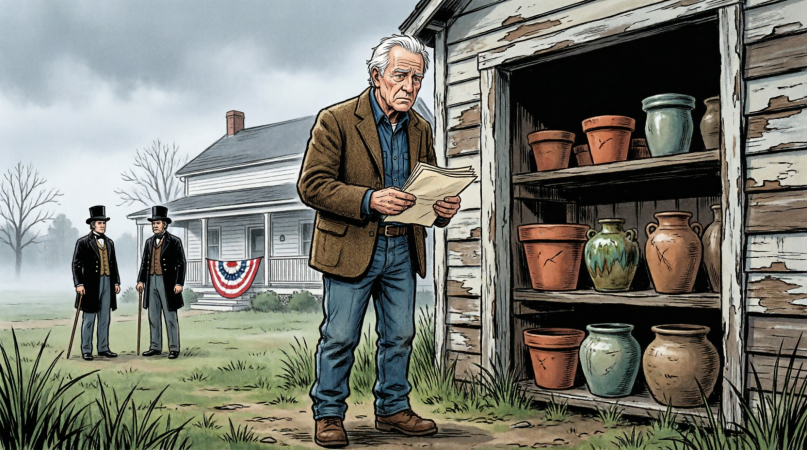
After Burying My Wife, I Opened The Storage Door She’d Kept Me Out Of For 37 Years. Then My Son
AFTER BURYING MY WIFE, I FOUND A NOTE IN HER JEWELRY BOX. IT READ: “PLEASE FORGIVE ME.” ALONG WITH IT WAS A KEY TO A STORAGE HOUSE SHE’D ΚΕΡΤ ΜΕ OUT OF FOR 37 YEARS. WHEN I OPENED THE STORAGE DOOR, WHAT WAS INSIDE NEARLY MADE ME COLLAPSE
After Burying My Wife, I Opened The Storage Door She’d Kept Me Out Of For 37 Years. Then My Son
After burying my wife, I finally unlocked the barn she had never allowed me to enter. For 37 years, it had been sealed off, a place she insisted held nothing but old tools and useless clutter. I expected dust, silence, and memories long forgotten.
But the moment I stepped inside, something felt wrong.
My hands began to tremble. My chest tightened, and I realized this barn had never been about storage at all.
It was about hiding something from me.
A secret she took to her grave.
That secret changed my family forever.
Hello everyone, and thank you for being here with me today. Before we continue, take a moment to comment below and let me know where you’re watching from. I truly love seeing how far this story reaches. And just a quick note before we go on, this story includes some fictional elements added for storytelling and educational purposes. Any similarity to real people, names, or places is purely coincidental, but the message behind it is meant to be meaningful.
I never thought saying goodbye to Brenda would be the easy part. It was everything that came after that nearly destroyed me.
The church was quiet that morning. Too quiet. I stood at the front staring at the wooden casket covered in white lilies. Brenda had always loved lilies. She used to grow them in the garden every spring. Now they were here resting on top of her like a blanket she would never feel.
Pastor Graham stood beside me. He said something about heaven and peace and how Brenda was in a better place now. I nodded. I did not hear most of it. My mind was somewhere else, somewhere far away from this small church in Iowa, far from the rows of neighbors and friends sitting behind me whispering their condolences.
Thirty-seven years.
That was how long we had been married. Thirty-seven years of waking up next to her, of hearing her laugh in the kitchen, of watching her work in the garden behind our farmhouse. And now she was gone.
I looked around the room. Faces I recognized. Faces I did not. And then I saw him.
Dennis, my son.
He walked in late. His suit perfectly pressed, his expression cold and distant. He did not look at the casket. He looked at me. He sat down in the back row. He did not come up to say hello. He did not put his hand on my shoulder. He just sat there checking his phone like he had somewhere better to be.
I felt something heavy settle in my chest. Disappointment, anger, maybe both.
After the service ended, people came up to shake my hand. They told me how sorry they were. They told me Brenda was a wonderful woman. I thanked them. I said all the right things, but I did not feel anything. I was numb.
Dennis finally approached me as everyone was leaving. He did not hug me. He did not ask how I was holding up.
Instead, he said, “We need to talk about the will.”
I stared at him.
“The will?”
“Yes,” he said flatly. “The farm. The estate. We need to figure out what happens now.”
I could not believe what I was hearing. His mother had just been buried, and all he cared about was money. I wanted to say something. I wanted to tell him how disgusted I was. But I was too tired, too broken.
“Not today, Dennis,” I said quietly.
He frowned.
“Dad, we cannot avoid this forever.”
“Not today,” I said.
He sighed, then turned and walked away without another word.
I watched him leave. I watched my only son walk out of that church without looking back.
And I realized something in that moment.
I had lost more than just my wife.
I had lost my family too.
By the time I got home, the sun was setting. The farmhouse looked empty without Brenda. The front porch where she used to sit with her coffee. The kitchen where she used to hum old songs while cooking dinner. The bedroom where we used to talk late into the night. Everything felt hollow now.
I walked to the window in the living room and looked out at the fields.
And that was when I saw it.
The garden shed.
It sat at the edge of the property, small and weathered, surrounded by tall grass. Brenda had always kept it locked. She had always told me to stay away from it.
I remembered the day she made me promise. It was years ago, not long after we got married. We were standing in the backyard, and she took my hand and looked me straight in the eyes.
“Promise me something.”
“Anything,” I said.
“Promise me you will never go into that shed. No matter what happens, promise me.”
I did not understand why it mattered so much to her, but I saw the fear in her eyes, the desperation. So I promised. I promised Brenda I would never go in there. She smiled then, relieved, like I had just saved her from something terrible.
For 37 years, I kept that promise. I never asked her why. I never tried to open the door. I trusted her. And she trusted me to stay away.
But now she was gone, and I was alone.
Three days after the funeral, I found something in Brenda’s jewelry box that made my hands shake.
I had been avoiding it, the bedroom, her closet, her things. Every corner of that house reminded me of her, and I was not ready to face it yet. But three days had passed, and I knew I could not keep living like this. I had to start going through her belongings. I had to start letting go.
So that morning, I woke up early. The sun was barely rising over the fields. I made myself a cup of coffee and walked upstairs to our bedroom. The door creaked when I opened it. The room still smelled like her, lavender and vanilla. The scent hit me hard, and for a moment I almost turned around and left.
But I did not.
I walked over to her dresser and opened the top drawer. Scarves. Gloves. A few old letters tied together with string. I set them aside carefully. Then I opened the second drawer. More clothes. A photo album I had never seen before. I made a mental note to look through it later.
And then I saw it again.
The jewelry box.
The same one I had opened the night of the funeral.
I stared at it for a long time. My heart was already racing, and I had not even touched it yet. I picked it up slowly and sat down on the edge of the bed.
I opened the lid.
The rings were still there. The necklace, the earrings. And beneath them, tucked into the corner of the box, was the small brass key.
I lifted it out carefully. It was cold in my hand, heavy, old, the kind of key that had been used for decades.
And attached to it, folded neatly, was a small piece of paper.
I unfolded it with trembling fingers.
The handwriting was hers, neat and familiar, and it said only two words.
Forgive me.
I read it again and again.
Forgive her. For what? What could she possibly need forgiveness for?
I looked out the window. The garden shed sat at the edge of the property, exactly where it had always been. Small. Weathered. Locked.
For 37 years, I had walked past it every single day. And for 37 years, I had never once tried to go inside because I had promised her.
I stood up and walked to the window. The key was still in my hand. I could feel its weight pulling me toward something I did not understand, something I was not sure I wanted to understand.
But I had to know.
I had to know what she had been hiding from me all these years.
I went downstairs, put on my boots, and stepped outside. The morning air was cool and crisp. The fields were quiet. The only sound was the wind rustling through the tall grass.
I walked slowly across the yard toward the shed. Each step felt heavier than the last. My heart was pounding in my chest. My hands were sweating. I told myself I could turn back. I could leave the key on the kitchen counter and forget about it. I could keep my promise to Brenda even now, even after she was gone.
But I could not.
I reached the shed and stood in front of the door. It was old. The wood was cracked and faded. The lock was rusted. I wondered how long it had been since anyone had opened it. Ten years. Twenty. Maybe longer.
I lifted the key and held it in front of the lock. My hand was shaking so badly I almost dropped it.
Promise me, Paul.
I could still hear her voice, clear as day, like she was standing right behind me.
Promise me you will never go in there.
I closed my eyes and took a deep breath.
“I am sorry, Brenda,” I whispered. “I am so sorry, but I have to know.”
I slid the key into the lock.
It fit perfectly.
I turned it slowly.
The lock clicked.
The sound echoed in the quiet morning air.
For a moment, I just stood there, my hand on the door handle, my heart racing. I thought about turning around. I thought about locking it again and walking away.
But I did not.
I pushed the door open.
The hinges creaked loudly. The sound made me flinch. Sunlight poured into the dark space, illuminating dust particles floating in the air. The smell hit me immediately. Old wood. Dirt. Something musty and forgotten.
I stepped inside slowly.
My eyes adjusted to the dim light.
Shelves lined the walls, covered in old gardening tools, pots, bags of soil, rusted shovels. Everything was coated in a thick layer of dust.
And then I saw it.
In the corner of the room, hidden behind a stack of old flower pots, was a wooden desk.
It was small, simple, the kind of desk someone might use for writing letters or keeping records.
But it did not belong here. Not in a garden shed. Not covered in dust like it had been forgotten for decades.
I walked toward it slowly. My boots crunched on the dirt floor. I reached out and touched the surface of the desk. My fingers left trails in the dust. There was a drawer at the front, a small brass handle.
I hesitated for just a moment.
And then I pulled it open.
The door creaked behind me as the wind pushed it slightly. Sunlight streamed through the dusty shelves and old pots, and there in the corner was a wooden desk I had never seen before.
I had been married to Brenda for 37 years.
I thought I knew everything about her.
I was wrong.
The inside of the shed was darker than I expected. Even with the door open, the sunlight only reached so far. The air was thick and stale, like no one had breathed in here for decades. I took a step forward, and the floorboards creaked beneath my boots. I looked around slowly.
Shelves lined both walls, covered in things I recognized. Old ceramic pots cracked and chipped. Rusted gardening tools. Bags of soil that had hardened into stone. A watering can with a broken handle. Everything looked forgotten, abandoned.
But none of it explained why Brenda had kept me out of here for so long.
I moved deeper into the shed, my eyes adjusting to the dim light.
And then I saw it again.
The desk.
It sat against the back wall, half hidden behind a stack of empty flower pots. It was small and plain, made of dark wood that had dulled with age. But it looked out of place here, too clean, too intentional.
I walked toward it carefully, as if getting too close might make it disappear.
When I reached it, I ran my hand across the surface. The wood was smooth under my fingers. Someone had taken care of this desk.
Someone had used it.
Brenda.
I crouched down and looked closer. There was a single drawer at the front fitted with a small brass lock. My heart started to race. I reached into my pocket and pulled out the key, the same key I had found in her jewelry box, the same key that had brought me here. I slid it into the lock.
It turned easily, like it had been waiting for me.
I pulled the drawer open.
Inside was a leather-bound journal.
It was old and worn. The edges frayed from years of use. Beside it was a small wooden box no bigger than my hand. I lifted the journal out carefully and set it on top of the desk. The leather felt soft and warm, like it had been held many times before.
I hesitated.
My hands were shaking again.
Part of me wanted to close the drawer and walk away. Part of me wanted to pretend I had never found this place.
But I could not.
Not anymore.
I opened the journal to the first page.
The handwriting was hers.
I recognized it immediately.
Neat and careful, just like the note she had left with the key.
But this time there were more than two words.
Mighty, it began. If you are reading this, then I am gone. And I am so sorry. I am sorry for keeping this from you. I am sorry for lying to you all these years, but I need you to know the truth. You need to know about Brian.
I stopped reading.
My breath caught in my throat.
Brian.
The name hit me like a punch to the chest. I stared at it written there in her handwriting and felt nothing. No recognition. No memory. Nothing.
Who was Brian?
I read the line again.
You need to know the truth. You need to know about Brian.
My mind raced. Was Brian an old friend? A relative I had never met? Someone from her past? I tried to think back through all the years we had been together, every conversation, every story she had ever told me.
But I could not remember anyone named Brian.
Not once.
I set the journal down and pressed my hands against the desk. My heart was pounding. My head was spinning. I felt like the ground beneath me was starting to shift.
For 37 years, I had thought I knew my wife. I had thought we had no secrets, no lies. But here I was, standing in a shed she had forbidden me from entering, holding a journal I had never known existed, reading about someone named Brian.
Who was he?
I looked down at the journal again. There were more pages. So many more pages. I could see the edges of them filled with her handwriting, waiting to be read, waiting to tell me the truth.
But I did not want to read them.
Not yet.
I was not ready.
I picked up the small wooden box and held it in my hands. It was light. I shook it gently and heard something shift inside. Photographs, maybe. Or letters.
I thought about opening it, but I could not. Not right now. Not when my hands were still shaking and my mind was still reeling from that one name.
Brian.
I set the box back in the drawer and closed it carefully. Then I picked up the journal again and stared at the first page, at her words, at that name. I wanted to stop. I wanted to walk out of the shed and lock the door behind me and pretend I had never opened it.
But I knew I could not do that.
I knew I had to keep reading. I had to know the truth no matter how much it hurt.
I took a deep breath.
And then I turned the page.
The second page began with a date. Forty years ago. Long before we were married. Long before I ever met her.
And the first sentence read:
I was eighteen when I got pregnant.
I felt the air leave my lungs.
Brian.
The name meant nothing to me, but as I turned the page and kept reading, my entire world began to fall apart.
Brenda was eighteen years old when she got pregnant. I was twenty-six at the time, working on a farm three counties away. We had not even met yet.
I found an old wooden stool in the corner of the shed and pulled it over to the desk. The light from a small window above me cast a pale glow across the pages of the journal.
I sat down slowly and began to read.
Her story unfolded in front of me, word by word, like a life I had never known.
She was young, just out of high school. She had dreams of going to college, of becoming a teacher. But then she met someone, a boy from another town. She did not write his name. She just called him a mistake I made when I was too young to know better.
She got pregnant that summer.
And when she told her parents, they were furious.
They gave her two choices.
Give up the baby or leave their home forever.
She was eighteen. She had no money, no job, no place to go.
So she made the only choice she thought she could.
She gave him up.
His name was Brian.
She wrote about the day she handed him over to the orphanage, how she held him for the last time, counted his tiny fingers, kissed his forehead. How Mrs. Baker, the woman who ran the place, promised to take good care of him. How Brenda walked out of that building with empty arms and a broken heart.
But she did not stop there.
She could not.
For forty years, she watched over him from a distance. She hired a private investigator named Alan Ross. She paid him every month to keep track of Brian, to send her photographs, to tell her where he was, what he was doing, if he was safe.
I read page after page. Reports from Alan Ross. Updates on Brian’s life. School records. Jobs he worked. Places he lived.
Brenda had kept everything.
Every scrap of paper. Every photograph. Every piece of evidence that her son was still out there, still alive, still breathing.
And then I got to the last few pages, the ones written just weeks before she passed away.
Brian is forty years old now, she wrote. He works as a carpenter in a small town about two hundred miles from here. He lives alone in a one-bedroom apartment above a hardware store. He has no family, no wife, no children. He has spent his whole life thinking no one wanted him.
And I did that to him.
I made him believe he was unwanted.
Unloved.
Her handwriting became shaky here. I could see where the ink had smudged, like she had been crying as she wrote.
Paul, she continued, I know I should have told you about him. I know I should have trusted you. But I was so afraid. Afraid you would think less of me. Afraid you would leave. Afraid you would not understand. So I kept him a secret. I kept him locked away in this shed, hidden from the world. Hidden from you. And now I am dying and I cannot fix what I have done.
I stopped reading.
My hands were shaking. My chest felt tight. I could barely breathe.
I set the journal down and looked at the small wooden box in the drawer, the one I had seen earlier but had not opened. I picked it up carefully and lifted the lid.
Inside were photographs.
Dozens of them.
All of Brian.
The first one showed a baby wrapped in a blue blanket. His eyes were closed. His little fists were curled up against his chest. On the back, someone had written Brian, three days old.
I flipped to the next one. A toddler sitting on a swing, smiling at the camera. Then a boy in a school uniform holding a lunchbox. A teenager standing in front of a car, looking awkward and unsure.
And finally, a man.
A grown man with dark hair and tired eyes.
He was standing in front of a woodworking shop, holding a piece of carved oak in his hands.
On the back of that photograph, it said Brian, age 40, still alone.
I stared at the picture for a long time.
He looked like her.
He had Brenda’s eyes, her nose, her smile. I had looked at my wife’s face every day for 37 years.
And now I was looking at a stranger who had her face too.
I set the photograph down and picked up the journal again.
There was one more page.
One final entry.
Paul, she wrote, if you are reading this, then I am gone. And I am so, so sorry. I am sorry for lying to you. I am sorry for keeping this from you. But I need you to do something for me. Please, Paul, find him. Find Brian. Give him the family I never could. He deserves a chance. He deserves to know he was loved. Please do this for me. Do this for him.
I closed the journal and set it down on the desk.
I leaned back against the wall and closed my eyes. My mind was spinning. My heart was breaking.
Brenda had a son.
A son she had never told me about.
A son who had spent his entire life alone, thinking no one cared about him.
A son who was out there right now, two hundred miles away, living in a one-bedroom apartment above a hardware store, carving pieces of wood and wondering why his life had turned out this way.
And she wanted me to find him.
I opened my eyes and looked at the photograph again.
Brian.
Forty years old. Dark hair. Tired eyes. Brenda’s face.
Could I do it?
Could I drive two hundred miles to a town I had never been to and knock on the door of a man I had never met and tell him that his mother had loved him all along? Could I bring him into my life, into my home, and give him the family Brenda had asked me to give him?
I did not know.
I did not know if I was strong enough.
I did not know if I was brave enough.
But I knew I had to try.
I sat there until the sun went down, staring at the photograph of a man I had never met, Brenda’s son.
And I made a decision that would change everything.
Finding Brian was not hard.
Brenda had kept detailed records.
The hard part was figuring out what I was going to say to him.
I woke up early the next morning before the sun rose. I could not sleep. My mind had been racing all night, replaying everything I had read in that journal. Everything I had learned. Everything I still did not understand.
I went downstairs and made coffee. Then I sat at the kitchen table and spread out the papers Brenda had left behind. The journal. The photographs. The handwritten notes with addresses and phone numbers. Everything Alan Ross had sent her over the years.
There it was.
The address of the woodworking shop where Brian worked.
A small town called Millbrook, five hours away by car.
I memorized the directions, folded the papers carefully, and put them in my jacket pocket.
I was halfway out the door when my phone rang.
Dennis.
I stared at the screen for a moment. Part of me wanted to ignore it. But I knew he would just keep calling, so I answered.
“Morning, Dad,” he said. His voice sounded flat, distant, like always.
“Morning,” I said.
“What are you doing today?”
I hesitated. I did not want to lie to him. But I also could not tell him the truth. Not yet. Not until I understood what I was doing myself.
“I’m going to visit an old friend,” I said finally.
There was a pause on the other end of the line.
“An old friend?” Dennis repeated. “Who?”
“Just someone I used to know,” I said. “No one you would remember.”
Another pause.
“All right,” he said slowly. “Well, call me if you need anything.”
“I will.”
He hung up without saying goodbye.
I stood there for a moment, staring at my phone. I hated lying to him, but I did not know what else to do. How could I explain that I was driving five hours to meet a man I had never heard of until yesterday? How could I tell him that his mother had kept a secret from both of us for nearly forty years?
I could not.
Not yet.
I grabbed my keys and walked out to my old pickup truck. It was the same truck I had been driving for fifteen years. The paint was faded. The seats were worn.
But it still ran.
And that was all I needed.
I climbed in, started the engine, and pulled out of the driveway. The sun was just beginning to rise over the fields. The sky was pale and clear.
It was going to be a long day.
For the first hour, I did not think about anything. I just drove. I watched the farms roll by, the open fields, the silos and barns scattered across the landscape. It was peaceful. Quiet. The kind of quiet that made you forget the world existed beyond the next mile marker.
But then the thoughts started creeping in.
What was I going to say to Brian?
How do you walk up to a stranger and tell him his mother loved him? How do you explain that she spent forty years watching over him from a distance, too afraid to reach out, too ashamed to tell the truth?
And what if he did not believe me?
What if he thought I was lying?
What if he slammed the door in my face and told me to leave him alone?
Or worse, what if he believed me but did not care?
What if he looked at me with those tired eyes and said, It is too late. She is gone. There is nothing left to fix.
I gripped the steering wheel tighter.
My hands were shaking.
Maybe this was a mistake.
Maybe I should turn around.
Maybe I should go home and forget I ever opened that shed.
But I could not.
I had made a promise.
To Brenda. To Brian. To myself.
I kept driving.
By the time I reached Millbrook, it was almost noon. The town was smaller than I expected. One main street. A few shops. A diner. A gas station. And at the far end of the street, tucked between an old hardware store and a vacant lot, was a small workshop with a hand-painted sign that read Brian’s Woodworks.
I parked my truck across the street and sat there for a moment. My heart was pounding. My mouth was dry. I stared at the workshop, trying to build up the courage to get out of the truck.
Through the large front window, I could see movement inside. A figure bent over a workbench, tools scattered around, wood shavings on the floor.
That was him.
That was Brian.
I took a deep breath.
Then I opened the truck door and stepped out.
I walked slowly across the street, my boots crunching on the gravel. When I reached the window, I stopped and looked inside.
He was standing at the workbench, his back to me. He was wearing a faded flannel shirt and jeans. His sleeves were rolled up to his elbows. His hands moved carefully over a piece of oak, sanding it smooth with steady, practiced strokes.
I watched him for a moment.
He looked focused. Calm. Like this was the only place in the world where he felt at peace.
And then, as if he sensed someone watching, he turned around.
He was bent over the workbench, sanding a piece of wood. When he looked up, I forgot how to breathe.
“Can I help you?” he asked.
I opened my mouth.
But no words came out.
How do you tell a stranger that he is your wife’s son?
He stepped out of the workshop, wiping his hands on a rag. He was tall, thin. His hands were rough and calloused from years of working with wood. His dark hair was streaked with sawdust.
And his eyes.
Those eyes.
They were Brenda’s eyes, the same shape, the same color, the same quiet sadness behind them.
“Sir,” he said again, tilting his head slightly. “Are you all right?”
I cleared my throat and forced myself to speak.
“My name is Paul Patterson,” I said. “I was married to a woman named Brenda.”
He frowned, clearly confused.
“Brenda?” he repeated slowly. “I do not know anyone named Brenda.”
I took a deep breath.
This was it.
There was no going back now.
“She was your mother,” I said.
The words hung in the air between us.
For a moment, neither of us moved.
Then Brian took a step back, his expression hardening.
“My mother,” he said, his voice sharp. “My mother abandoned me when I was three days old. I do not know who you are, but you need to leave.”
“Wait,” I said quickly, holding up my hands. “Please just listen to me. I know this sounds crazy. I know you do not know me, but I am telling you the truth. Brenda was your mother, and she never forgot about you.”
He stared at me, his jaw tight.
“Why should I believe you?”
I reached into my jacket pocket and pulled out the journal. Then I pulled out the photographs. I held them out to him.
“Because she kept this,” I said. “For forty years, she kept track of you. She hired someone to watch over you, to make sure you were safe, to send her pictures. She never stopped thinking about you, Brian. Not once.”
He looked down at the journal in my hands, then at the photographs. His expression softened just slightly. Curiosity replaced anger.
“What is that?” he asked quietly.
“It is her journal,” I said. “She wrote about you, about the day she had to give you up, about how much she regretted it, about how she watched you grow up from a distance.”
He hesitated.
Then slowly, he reached out and took the journal from my hands.
He opened it carefully like it might break. His eyes moved across the first page, reading Brenda’s handwriting.
His hands started to shake.
“This is…” he whispered. “This is about me.”
“Yes,” I said.
He flipped through the pages slowly, carefully. His breathing became shallow. His eyes welled up with tears.
He stopped on a page and read it out loud, his voice breaking.
“He says, Brian turned five today. Alan sent me a photograph. He was wearing a blue shirt and holding a toy truck. He looked so happy. I wish I could have been there. I wish I could have given him that truck myself.”
Brian closed the journal and looked up at me. Tears were streaming down his face now.
“She… she never forgot me,” he whispered.
“Never,” I said. “Not for a single day.”
He wiped his eyes with the back of his hand and set the journal down on the workbench. Then he looked at the photographs.
I watched as he picked up the first one. A baby wrapped in a blue blanket. Then a toddler on a swing. Then a boy in a school uniform. And finally the most recent one, himself at forty years old, standing in front of this very workshop.
“She had all of these?” he asked, his voice barely audible.
“Yes,” I said. “She kept them in a box in a shed behind our house. She made me promise never to go in there. I did not know why. Not until she passed away.”
Brian looked up at me, his eyes red and swollen.
“She is gone.”
I nodded.
“Three weeks ago.”
He sat down on a wooden crate and buried his face in his hands. His shoulders shook. He was crying. Not loud, sobbing cries. Just quiet, heartbroken tears.
I did not know what to do.
So I just stood there, waiting. Giving him time.
After a long moment, he looked up at me.
“I spent my whole life thinking no one wanted me,” he said quietly. “I grew up in that orphanage wondering why my mother left me, why she did not come back. I told myself it did not matter, that I did not need her. But it did matter. It always mattered.”
“She wanted to come back,” I said. “She wanted to find you. But she was scared. She thought you would hate her. She thought it was too late.”
“It was not too late,” Brian said, his voice breaking again. “It was never too late.”
We stood there in silence for a while. The sun was beginning to set, casting long shadows across the workshop floor. The smell of fresh-cut wood filled the air.
It was peaceful.
Quiet.
But heavy with emotion.
Finally, I spoke.
“Brian,” I said. “Brenda left you something in her journal. A final request.”
He looked up at me, his eyes filled with hope and fear.
“She wanted you to have a family,” I said. “She wanted you to have a home. She asked me to find you, to bring you back to the farm, to give you the life she could not give you herself.”
Brian stared at me.
“You want me to come live with you?”
“Yes,” I said. “I know it sounds strange. I know we just met, but Brenda loved you, and I want to honor her wish. I want to give you a home.”
Brian shook his head slowly.
“I do not belong there,” he said. “I am just a stranger. A mistake from her past.”
“You are not a mistake,” I said firmly. “You are her son. And if you were her son, then you are part of my family too.”
He looked at me for a long time. His eyes searched my face, looking for something. Honesty, maybe. Sincerity.
Whatever it was, he must have found it because his expression softened.
“I have never had a home,” he said quietly. “Not a real one.”
I took a deep breath.
“Brian, I want you to come home with me to the farm. That is what Brenda would have wanted.”
He looked at me for a long time.
Then he whispered, “Home? I have never had a home.”
Brian followed me in his old pickup truck. I watched him in my rearview mirror and wondered how Dennis was going to react.
The drive back felt longer than the drive out. Maybe it was because I was not alone anymore. Maybe it was because I knew what was waiting for me when I got there.
Dennis, my son. The son who had always been cold and distant. The son who cared more about money than family.
How was I going to explain this to him? How was I going to tell him that his mother had a secret? That he had a brother he never knew existed?
I glanced in the mirror again. Brian was still there, his truck rattling along behind me. His hands gripped the steering wheel tightly. His eyes were focused on the road ahead. He looked nervous, scared even.
And I did not blame him.
He was driving toward a life he had never imagined, a family he had never known, a place that felt like a dream.
By the time we reached the farm, the sun was starting to set. The sky was painted in shades of orange and pink. The fields stretched out on either side of the road, golden and endless. It was the kind of view that made you stop and remember why you loved this place.
I pulled into the driveway and parked near the house. Brian parked beside me. I got out of my truck and waited for him. He sat there for a moment, staring out the windshield at the farm, at the barn, at the house, at the land. Then he opened his door and stepped out slowly.
He looked around, his eyes wide with wonder. He had never seen anything like this. I could tell he had spent his whole life in small apartments and cramped spaces, and now he was standing in the middle of three hundred acres of open land.
“This is it,” I said. “This is the farm.”
He nodded slowly.
“It is beautiful.”
“Brenda loved it here,” I said. “She used to sit on the porch every morning and watch the sun rise over the fields. She said it was the most peaceful place in the world.”
Brian did not say anything. He just kept looking around, taking it all in. The barn. The chicken coop. The old tractor parked near the shed. The garden where Brenda used to grow vegetables. Everything.
“Come on,” I said. “Let me show you inside.”
We walked up the front steps and into the house. The screen door creaked as I opened it. The inside was warm and quiet. It smelled like coffee and old wood, like a place that had been lived in for decades.
I led Brian into the living room. The walls were covered in framed photographs. Pictures of me and Brenda on our wedding day. Pictures of Dennis when he was a little boy riding his first bike. Pictures of the farm through the years. A whole lifetime captured in a dozen frames.
Brian stopped in front of one of the pictures. It was Brenda. She was young in the photo, maybe twenty-five years old. She was standing in the garden, holding a basket of tomatoes. She was smiling. Happy. Beautiful.
Brian reached out and touched the frame gently, his fingers trembling.
“That was taken a few years after we got married,” I said quietly. “She loved that garden. She spent hours out there every summer.”
Brian did not say anything. He just stood there staring at the picture. His eyes filled with tears, but he did not let them fall. He just kept looking at her, at the woman who had given him life, at the mother he had never known.
After a long moment, he turned to me.
“Thank you,” he said softly, “for bringing me here, for showing me this. I do not know how to thank you.”
“You do not need to thank me,” I said. “You are family now.”
He looked at me, his expression uncertain.
“Am I?”
“Yes,” I said firmly. “You are.”
He nodded slowly, but I could tell he did not quite believe it yet.
How could he? He had spent his whole life being told he was unwanted, unloved. And now, in the span of a few hours, everything had changed. It would take time for him to accept it, to believe it.
“I will teach you everything you need to know about running this place,” I said. “How to work the land, how to take care of the animals. You will learn fast. I can tell.”
Brian smiled faintly.
“I hope so.”
We stood there for a moment, surrounded by photographs and memories.
The house felt alive again, like it had been waiting for someone to come home.
But then Brian asked the question I had been dreading.
“What about Dennis?” he said. “Your son. How is he going to feel about this? About me?”
I hesitated. I did not know what to say because the truth was I had no idea how Dennis was going to react. I knew he would be angry. I knew he would feel betrayed.
But I also hoped that deep down he would understand, that he would accept Brian as his brother.
“I will talk to him,” I said. “He will understand.”
Brian looked at me, his eyes searching my face.
“Are you sure?”
“Yes,” I said. “I am sure.”
But even as I said it, I knew I was lying to both of us.
Dennis arrived the next morning without warning.
He walked into the kitchen and saw Brian sitting at our table.
The look on his face made my blood run cold.
Brian and I had been having coffee. We were talking about the farm, about what needed to be done that day, about where he would sleep. Simple things. Quiet things.
And then the door opened.
And Dennis walked in.
He stopped in the doorway. His eyes moved from me to Brian, then back to me. His expression was unreadable, cold, calculating.
“Who is this?” he asked.
I stood up slowly.
“Dennis, sit down. We need to talk.”
“I’m not sitting down,” Dennis said flatly. “Who is he?”
Brian looked down at his coffee cup. He did not say anything. I could see his hands tighten around the mug.
I took a deep breath.
There was no easy way to do this. No way to soften the blow.
So I just said it.
“His name is Brian,” I said. “He is your mother’s son.”
Dennis stared at me for a moment. He did not move. He did not blink. He just stared.
“What?” he said finally.
“Your mother had a son before we got married,” I said. “She was eighteen years old. Her family made her give him up. She put him in an orphanage, but she never stopped watching over him. She hired someone to keep track of him, to make sure he was safe. She kept records, photographs, everything.”
Dennis’s face turned red.
“You are joking.”
“I am not joking,” I said. “I found her journal in the shed. She left it for me. She asked me to find him. To bring him home.”
Dennis looked at Brian again. His jaw was tight. His fists were clenched at his sides.
“So you just show up,” Dennis said to Brian, his voice sharp, “and suddenly you are my brother.”
Brian did not answer. He just sat there looking uncomfortable, like he wanted to disappear.
Dennis turned back to me.
“And you, Dad, you’re just going to give him half of everything, right? Half of the farm, half of the estate, half of what Mom left behind.”
“This is not about money, Dennis,” I said firmly.
“Not about money?” Dennis repeated, his voice rising. “This is a farm, Dad. This is our livelihood. And you are bringing in some stranger and handing it to him like it is nothing.”
“He is not a stranger,” I said. “He is your mother’s son. That makes him family.”
Dennis laughed bitterly.
“Family? He is a stranger. Mom lied to you for thirty-seven years. She kept this secret from you, from me, from everyone. And now you are rewarding her for it?”
“Wait. I am not rewarding anyone,” I said, my voice hardening. “I am doing what she asked me to do. Brian is her son. That makes him part of this family, and I am going to teach him how to run this farm.”
Dennis took a step forward. His eyes were burning with anger.
“Over my dead body,” he said.
The words hung in the air like a threat.
I felt my chest tighten. I had never heard Dennis speak to me like that before. Not with that much venom. That much hatred.
“Dennis,” I said quietly, “I know this is hard. I know it is a shock. But Brian did not ask for any of this. He did not know about your mother. He did not know about me. He spent his whole life thinking no one wanted him. And now he has a chance to have a family, to have a home. I am not going to take that away from him.”
Dennis shook his head slowly.
“You’re making a mistake, Dad.”
“Maybe I am,” I said. “But it is my mistake to make.”
Dennis looked at Brian one more time. His expression was cold, hard, unforgiving.
“You do not belong here,” Dennis said to him.
Brian finally looked up. His eyes were tired, sad, but he did not argue. He just nodded slightly, like he had expected this all along.
Dennis turned and walked toward the door. He grabbed the handle and pulled it open. Then he stopped and looked back at me.
“You are choosing him over me,” he said quietly.
“I am not choosing anyone,” I said. “There is room for both of you.”
Dennis laughed again. A short, bitter sound.
“No, Dad,” he said. “There is not.”
And then he walked out.
The door slammed behind him so hard that the windows rattled. The sound echoed through the house, through the silence, through everything.
I stood there for a moment, staring at the door. My heart was pounding. My hands were shaking.
I felt like I had just lost something I could never get back.
Brian spoke quietly from behind me.
“Maybe I should leave,” he said.
I turned to look at him. He was still sitting at the table, his shoulders slumped, his eyes downcast. He looked like he was ready to walk away. To disappear. To go back to being alone.
“No,” I said firmly. “You are staying. This is your home now.”
Brian looked up at me.
“He hates me.”
“No, he does not hate you,” I said.
But even as I said it, I was not sure I believed it anymore.
Over the next two weeks, I threw myself into teaching Brian everything I knew about the farm. He learned fast, maybe too fast, and that only made Dennis angrier. I saw it in the way Dennis would show up unannounced, standing at the edge of the property, watching us work. He never came close. He never said a word. He just stood there, his arms crossed, his face hard and unreadable.
And then, after a few minutes, he would get back in his car and drive away.
But I could feel his eyes on us.
Cold. Calculating. Waiting.
I tried not to think about it. I had work to do, and Brian was eager to learn.
On the first day, I taught him how to drive the tractor. It was an old John Deere, the same one I had been using for twenty years. The engine was loud and the gears were stiff, but Brian picked it up quickly. He had good hands. Steady. Confident. The kind of hands that came from years of working with wood.
“You are a natural,” I told him as we drove across the south field.
He smiled.
It was a small smile, but it was genuine.
“I have never done anything like this before,” he said. “But it feels right, you know.”
I nodded.
I knew exactly what he meant.
Over the next few days, I taught him how to fix the equipment when it broke down. How to change the oil in the tractor. How to replace a belt on the hay baler. How to sharpen the blades on the mower.
Brian absorbed it all like a sponge. He asked questions. He took notes. He practiced until he got it right.
And every evening, after the work was done, we would sit on the front porch and talk.
The porch had always been Brenda’s favorite spot. She used to sit out there every morning with her coffee, watching the sun rise over the fields.
And now Brian and I were sitting in the same spot, watching the sunset.
One evening, Brian asked me the question I had been waiting for.
“What was she like?” he said quietly. “Brenda. My mother. What kind of person was she?”
I leaned back in my chair and thought about it for a moment. How do you describe someone you loved for thirty-seven years in just a few words?
“She was kind,” I said finally. “She had the biggest heart of anyone I ever met. She loved this farm. She loved working in the garden. Every spring, she would plant tomatoes and peppers and cucumbers. She would spend hours out there pulling weeds and watering the plants. And every summer we would have more vegetables than we knew what to do with.”
Brian smiled.
“She sounds wonderful.”
“She was,” I said. “But she was also stubborn. Once she made up her mind about something, there was no changing it. And she was private. She kept things to herself. Like that shed. I never understood why she wanted me to stay away from it, but I trusted her, so I stayed away.”
“Do you wish she had told you?” Brian asked. “About me?”
I thought about that for a long time.
Did I wish she had told me?
Yes.
It would have saved us all a lot of pain.
But I also understood why she did not. She was scared. She was ashamed.
She thought I would judge her. She thought I would leave.
“I wish she had trusted me,” I said. “But I understand why she did not. And I do not blame her for it.”
Brian nodded slowly.
“I wish I could have met her.”
“So do I,” I said.
We sat in silence for a while, watching the sun disappear behind the trees. The air was cool and quiet. The only sound was the distant hum of crickets in the grass.
And for the first time in weeks, I felt at peace.
But that peace did not last long.
A few days later, I was in the barn with Brian, showing him how to feed the cattle. We were pouring grain into the troughs when I looked up and saw Dennis standing at the barn entrance.
He did not say anything.
He just stood there watching us.
“Dennis,” I said, straightening up. “Do you need something?”
He did not answer. He just stared at Brian for a long moment and then, without a word, he turned and walked away.
Brian looked at me, his face pale.
“He hates me,” he said quietly.
“He does not hate you,” I said.
But even as I said it, I was not sure I believed it anymore.
Over the next week, Dennis showed up three more times. Each time, he would stand at a distance and watch. And each time, he would leave without saying a word. It was like he was studying us. Waiting for something. Planning something.
And that was when I realized something that should have been obvious from the start.
I was starting to love Brian like he was my own son.
He was hardworking. Honest. Kind. He reminded me of Brenda in so many ways, the way he smiled, the way he tilted his head when he was thinking, the way he cared about things, about people, about doing the right thing.
And I realized that, in some strange way, Brenda had given me a second chance. A second son. A second opportunity to be a father.
“Thank you, Brenda,” I whispered to myself one night as I stood in the kitchen looking out at the dark fields. “You gave me another son.”
But that night, I could not sleep. I lay in bed staring at the ceiling, listening to the house creak and settle around me. And I could not shake the feeling that something bad was coming. Something I could not stop. Something I should have seen.
I thought about the way Dennis had been watching us. The cold look in his eyes. The silence. The distance.
And I realized I had made a terrible mistake.
I had ignored the signs. I had told myself Dennis would come around, that he would accept Brian, that everything would be fine.
But it was not going to be fine.
That night, I could not shake the feeling that something terrible was about to happen.
I just did not know how terrible it would be.
Another week passed.
Then the rumors began.
Whispers at the feed store. Side glances at church.
I didn’t understand what was happening until I finally heard what Dennis had been saying about Brian.
At first, it was subtle. Too subtle to recognize right away. I drove into town one morning to pick up supplies at the hardware store. Bob Freeman stood behind the counter as he always did. We had known each other for years. Normally, he greeted me with a smile and a few questions about the farm.
That morning, he looked at me differently. Not hostile. Just cautious.
“Morning, Paul,” he said, scanning the items I placed on the counter.
“Morning, Bob.”
That was it. No small talk. No farm talk.
He rang me up, took my money, and handed me the bag without another word. I left the store with an uneasy feeling in my chest.
A few minutes later, I ran into George Johnson outside the post office. George had been my neighbor for two decades. He stopped me, shifting his weight nervously.
“Hey, Paul, can I ask you something?”
“Sure.”
He hesitated.
“I heard some things about that guy working for you.”
“Brian.”
My stomach tightened.
“What things?”
“People are saying he’s got a rough history. Debt. Bankruptcy. Maybe legal trouble. Is that true?”
I stared at him.
“Where did you hear that?”
He shrugged.
“You know how towns are. I figured you should know.”
I drove home in silence, my thoughts racing. Someone was poisoning the town against Brian.
And I already knew who it was.
Back at the farm, I found Brian in the barn repairing a fence post.
I walked over and asked him directly.
“Brian, did you ever have financial trouble? Bankruptcy?”
He looked startled, then ashamed.
“Yes. About ten years ago. I lost my job. Couldn’t keep up with the bills. I filed for bankruptcy, but I paid everything back. Worked three jobs. It took years.”
“Why didn’t you tell me?”
“I didn’t want you to think less of me.”
I nodded.
“Someone’s been spreading rumors, saying you’re a con artist, that you’re here to take advantage of me.”
His eyes widened.
“That’s not true.”
“I know. But someone wants people to believe it is.”
We both knew who.
A few days later, things escalated. Brian came to me early one morning.
“The plow won’t start. I tried everything.”
I went to the equipment shed. The plow was old, but dependable.
I opened the engine panel.
And froze.
The wires were cut.
Clean. Precise.
My chest tightened.
“Brian,” I said sharply, “did you do this?”
He looked horrified.
“No. I swear I didn’t.”
“Then how did this happen?”
“I don’t know,” he said, his voice shaking.
I should have believed him.
But I was angry.
And I took it out on him.
“You need to be more careful,” I said coldly. “Mistakes like this cost money.”
He stared at me, wounded.
“I didn’t break it.”
“Then who did?”
He turned away without answering.
That night, I couldn’t sleep. The cuts were too clean. Too deliberate.
Then I remembered the cameras.
I went to my office and pulled up the footage.
Dennis.
He walked into the shed late at night, opened the panel, cut the wires.
I watched it three times.
My son was framing Brian.
The next morning, I drove to Dennis’s law office. My hands shook as I entered. He looked up, surprised.
“Dad?”
“I saw you on the cameras.”
“What cameras?”
“The equipment shed. You cut the wires.”
He leaned back and smiled.
“You don’t have proof.”
“I have video.”
“Is it clear? Can you prove it’s me, or that the footage wasn’t altered?”
He shrugged.
“Even if you could, who would believe you? I’m your son. And I’m a lawyer,” he said.
“What you’re doing is wrong.”
“What’s wrong,” Dennis said, “is you bringing a stranger into my inheritance.”
I realized then that I had already lost him.
He smiled coldly.
“You don’t have proof. And even if you did, it wouldn’t matter.”
He was right.
And I didn’t yet know how far he would go.
I should have seen it coming. Brian had been doing so well, learning so fast.
Dennis could not stand it.
A week after our confrontation, he made his next move.
It was early morning. The sun had just started to rise over the fields.
“Brian and I were standing outside the grain silo, looking up at the roof. I noticed a leak yesterday,” Brian said, pointing to a dark stain on the ceiling inside. “Water is getting in. If we do not fix it soon, the grain will get wet and spoil.”
I nodded.
“All right. You go up and check the roof. I will get the tools ready.”
Brian looked up at the old wooden ladder leaning against the side of the silo. It was tall, maybe twenty feet. It had been there for years.
“Be careful,” I said. “That ladder is old.”
“I will,” Brian said.
He started climbing. I watched him for a moment, then turned and walked back toward the house to make breakfast. I figured he would be up there for a while, checking the shingles, figuring out what needed to be fixed.
I was in the kitchen, pouring coffee, when I heard it.
A loud crash.
The sound of something heavy hitting the ground.
My blood went cold.
I dropped the coffee pot and ran outside.
Brian was lying on the ground near the base of the silo. The ladder was on the ground beside him. One of the rungs snapped in half.
He was not moving.
“Brian!” I shouted, running over to him.
He groaned. His eyes were open, but he was not looking at me. He was staring up at the sky, his face twisted in pain.
“Do not move,” I said, kneeling beside him. “Just stay still. I am calling for help.”
I pulled out my phone and dialed 911. My hands were shaking so badly I almost dropped it.
“911, what is your emergency?”
“My son fell from a ladder,” I said, my voice breaking. “He is hurt. He is not moving right. We are at Patterson Farm, Route 12.”
“Paramedics are on the way,” the operator said. “Stay with him. Do not move him.”
I set the phone down and looked at Brian. His breathing was shallow. His face was pale. He tried to sit up, but I put my hand on his shoulder.
“Stay down,” I said. “Help is coming.”
“It hurts,” he whispered. “My chest. I cannot breathe right.”
“I know,” I said. “Just hold on. They are almost here.”
It felt like hours before the ambulance arrived, but it was probably only ten minutes. The paramedics loaded Brian onto a stretcher and drove him to the hospital. I followed behind in my truck, my heart pounding the entire way.
At the hospital, Dr. Stevens came out to talk to me after they finished examining Brian.
“He is going to be okay,” Dr. Stevens said. “But he has three broken ribs and a mild concussion. He is lucky he did not have any internal injuries. We are going to keep him here for at least two weeks to monitor him.”
I nodded, relief flooding through me.
“Can I see him in a little while?”
Dr. Stevens said he is resting now. “We gave him something for the pain.”
I sat in the waiting room for an hour, staring at the white walls, trying to process what had just happened. Brian had fallen. He was hurt.
And it was my fault.
I should have checked that ladder. I should have made sure it was safe.
But something did not feel right.
When I got back to the farm that afternoon, I went straight to the silo. The broken ladder was still lying on the ground where it had fallen. I picked up the piece with the broken rung and examined it closely.
The wood was not rotten.
It was not worn.
It had been cut.
Sawed almost all the way through, just enough so that it would hold Brian’s weight for a few steps, but not enough to support him once he reached the top.
My stomach turned.
I walked over to the security camera mounted on the barn, the one that faced the silo. I pulled out my phone and accessed the footage.
And there he was.
Dennis.
The timestamp said 11:30 the night before.
Dennis had walked onto the property carrying a small handsaw. He climbed up the ladder, stopped at the eighth rung from the top, and carefully sawed through it. Not all the way. Just enough to weaken it. Then he climbed back down and left.
I felt sick.
I called Detective Walsh.
He arrived an hour later. I showed him the ladder. I showed him the video.
He watched it twice, his expression grim.
“Mr. Patterson,” he said finally, “I believe you. This is clearly sabotage. But the video quality is not great. And a good lawyer could argue that the person in the video is not clearly identifiable.”
“Dennis is a good lawyer,” I said bitterly.
“Exactly,” Walsh said. “Without clearer evidence, we cannot arrest him. But I will file a report, and if anything else happens, we will have this on record.”
“Anything else?” I repeated. “Brian is in the hospital with broken ribs and a concussion. What more does Dennis have to do before you can stop him?”
Walsh looked at me with tired eyes.
“I am sorry, Mr. Patterson. I really am. But my hands are tied. The law requires proof beyond a reasonable doubt, and right now we do not have that.”
I stood there staring at him, feeling completely helpless. Brian was lying in a hospital bed, and Dennis was out there free, unpunished, planning his next move.
Detective Walsh looked at me with tired eyes.
“Mr. Patterson, I believe you, but without clearer evidence, we cannot arrest him.”
Brian was in the hospital.
Dennis was free.
And I knew then that I had to protect Brian myself.
But I did not know that Dennis’s next move would nearly cost me my life, too.
The hospital became my second home for the next two weeks. Every day, I sat beside Brian’s bed. Every night, I went home alone, wondering how I was going to keep him safe.
Brian was healing slowly. The doctors said he was doing well, considering the fall, but I could see the pain in his face every time he moved, every time he took a deep breath, every time he tried to sit up.
Nurse Parker was kind to him. She checked on him every few hours, made sure he was comfortable, brought him extra pillows when he needed them. She reminded me of Brenda. Gentle. Patient. The kind of person who made you feel like everything was going to be okay, even when it was not.
One afternoon, I was sitting in the chair beside Brian’s bed when he said something that caught me off guard.
“Paul,” he said quietly, “maybe I should leave after I get out of here. Maybe it would be better if I just went back to Millbrook.”
I looked up at him.
“Why would you say that?”
“Because I am causing too much trouble,” he said. “Dennis is doing all of this because of me. The rumors, the sabotage, the ladder. If I were not here, none of this would be happening.”
“Dennis is the one causing trouble,” I said firmly. “Not you.”
“But he is your son,” Brian said. “Your real son. And I am just—”
“You are Brenda’s son,” I interrupted. “And that makes you my son, too. You are not going anywhere.”
Brian looked at me for a long moment. His eyes were red. He looked tired, worn down, like he had been carrying the weight of the world on his shoulders for too long.
“I do not want to come between you and your family,” he said.
“You are not coming between us,” I said. “Dennis is doing that himself. And I am not going to let him win.”
Brian nodded slowly. But I could tell he did not quite believe me.
Over the next few days, I tried to take his mind off everything. I told him stories about Brenda that I had never told anyone before. Stories about the early days of our marriage, about the time she tried to learn how to ride a horse and fell off three times in one afternoon, about the way she used to sing old country songs in the kitchen while she cooked dinner, even though she could not carry a tune to save her life.
Brian listened to every word. Sometimes he smiled. Sometimes his eyes filled with tears. And I realized that in some small way, I was giving him the mother he had never had. The memories. The stories. The proof that she had been real, that she had been loved.
One evening, Brian asked me a question I had been dreading.
“What if Dennis tries again?” he said.
I did not hesitate.
“Then I will be ready.”
“How?”
“I have been installing more cameras,” I said. “Better locks. Motion sensor lights. I am not going to let him hurt you again.”
Brian was quiet for a moment.
Then he said, “I am not afraid for me. I am afraid for you.”
I looked at him, surprised.
“For me?”
“Yes,” he said. “Dennis is not just angry at me. He is angry at you too, for choosing me, for bringing me into the family. What if he does something to you?”
“No, he would not,” I said.
But even as I said it, I was not sure I believed it.
Two weeks passed slowly.
And finally, Dr. Stevens said Brian was ready to go home.
I drove him back to the farm in my truck. He moved carefully, wincing every time we hit a bump in the road. But he did not complain. He just stared out the window at the fields, the barn, the house.
“Home,” he said softly.
“Yes,” I said. “Home.”
When we pulled into the driveway, Brian looked around and noticed the changes. The new cameras mounted on the barn and the house. The motion sensor lights above the doors. The new locks on every entrance.
“You know, you were serious,” he said.
“I told you I was on your side.”
That night, after Brian went to bed, I walked through the house one more time. I checked every lock, every window, every door. I made sure the cameras were working. I made sure the lights were on.
And then I went to bed.
But I did not sleep.
I just lay there staring at the ceiling, listening for sounds, waiting for something to go wrong.
But nothing happened.
The house was quiet. Peaceful. Safe.
For now.
But I was wrong.
Dennis’s next plan was not aimed at just Brian.
It was aimed at both of us.
I could not sleep that night. Something felt wrong. At two in the morning, I got out of bed and went downstairs.
That was when I smelled the smoke.
A few days had passed since Brian came home from the hospital. He was still recovering, still moving slowly, still in pain.
But he was home.
And I thought we were safe.
I was wrong.
That night, I lay in bed staring at the ceiling. My mind would not stop racing. I kept thinking about Dennis. About the ladder. About what Detective Walsh had said, about how Dennis was still out there, free, unpunished. I tried to close my eyes. I tried to tell myself that everything was fine, that the cameras would catch him if he tried anything, that the new locks would keep us safe.
But I could not shake the feeling that something bad was about to happen.
At 2:00 in the morning, I gave up trying to sleep. I got out of bed and went downstairs to the kitchen. I poured myself a glass of water and stood by the sink, looking out the window at the dark fields.
And that was when I smelled it.
Smoke.
Faint at first, but unmistakable.
I set the glass down and walked to the window.
And then I saw it.
A glow, orange and flickering, coming from the barn.
Fire.
The barn was on fire.
And Brian was in there.
I had converted the loft above the barn into a small living space for Brian. It was quiet, private, a place where he could rest without feeling like he was in the way. He had gone to bed a few hours earlier, exhausted from the day’s work.
“Brian,” I shouted, even though I knew he could not hear me from inside the house.
I ran.
I did not even think.
I just ran.
Out the back door. Across the yard. Toward the barn.
I pulled my phone out of my pocket as I ran and dialed 911.
“911, what is your emergency?”
“Fire,” I shouted. “My barn is on fire. Someone is inside. We are at Patterson Farm, Route 12.”
“Fire department is on the way,” the operator said. “Stay outside. Do not go in.”
But I could not stay outside.
Brian was in there.
When I reached the barn, I grabbed the door handle and pulled.
It did not move.
I pulled harder.
Still nothing.
The door was stuck.
No.
Not stuck.
Blocked.
Something had been wedged against it from the outside.
I could see smoke seeping through the cracks around the door. I could hear the roar of the flames inside.
“Brian!” I screamed. “Brian, can you hear me?”
No answer.
I ran around to the side of the barn. There was a window, small, high off the ground, but it was my only option. I grabbed a metal rod from the ground and swung it at the window. The glass shattered. I knocked away the remaining shards and pulled myself up.
The opening was narrow, but I squeezed through and dropped down into the barn.
The heat hit me like a wall.
The smoke was thick. Black. Suffocating.
I could barely see two feet in front of me. The flames were climbing up the walls, spreading across the hay bales stacked along the sides.
“Brian!” I shouted, coughing. “Where are you?”
I heard a sound above me. Coughing. Weak. Desperate.
The loft.
I stumbled through the smoke toward the ladder that led up to the loft. My eyes were burning. My lungs were screaming.
But I kept moving.
I climbed the ladder. Each step felt heavier than the last. The smoke was worse up here. Thicker. Hotter.
And then I saw him.
Brian was on his knees near the back wall, coughing violently. His face was covered in soot. His eyes were red and watering. He looked at me, his expression a mix of fear and relief.
“Paul,” he gasped. “I could not… I could not get out. The door…”
“I know,” I said, grabbing his arm. “Come on. We have to go now.”
I helped him to his feet. He was shaking, weak. I could feel how hard it was for him to move. His ribs were still healing. Every breath was painful.
We made it to the ladder.
I went down first, then reached up to help Brian. He climbed down slowly, carefully, but halfway down, he started coughing so hard he almost lost his grip.
“Hold on!” I shouted. “Just a little further!”
We reached the ground floor. The flames were everywhere now. The entire back wall was engulfed. The smoke was so thick, I could barely see my own hands.
I led Brian toward the main door, but when we got there, it was still blocked. I pushed with everything I had.
It would not budge.
“The window,” Brian shouted, pointing back the way I had come.
We turned and stumbled through the smoke toward the broken window.
But the flames had spread.
They were blocking the path.
We were surrounded.
“We are trapped,” Brian said, his voice breaking.
I looked around desperately. There had to be another way out. There had to be.
But there was not.
The smoke was getting thicker. Brian was coughing so hard he could barely stand. I held on to him, trying to keep him upright, trying to think of something. Anything.
“Help!” I shouted, even though I knew no one could hear me. “Somebody help us!”
Brian leaned against me, his body trembling.
“Paul,” he whispered. “I cannot… I cannot breathe.”
I wrapped my arm around him and pulled him close.
“Just hold on,” I said. “Just hold on a little longer.”
But I did not know how much longer we had. The smoke was overwhelming. My vision was blurring. My chest felt like it was on fire.
And then, through the roar of the flames, I heard something.
A sound from outside.
A car door slamming. Footsteps running fast, getting closer.
The smoke was getting thicker. Brian was coughing harder. His body was shaking. I could barely see my own hands anymore.
And then, cutting through the roar of the fire, I heard it.
A sound outside.
A car door slamming and footsteps running straight toward us.
Before I reveal who came running through the smoke, take a moment to pause and tell me what you think is about to happen. Who do you believe it was and why? Share your thoughts or predictions in the comments below so I know you’re still here with me. And just a quick note, the next part of this story includes some dramatized and fictional elements that may not be entirely real. So if you’d rather not continue, you’re free to stop the video here.
The door burst open.
Through the smoke, I saw a figure running toward us.
It was Dennis.
For a moment, I thought I was imagining it. The smoke. The heat. The lack of oxygen. My mind was playing tricks on me.
But then I heard his voice.
“Dad!” he shouted. “Dad, where are you?”
I tried to answer, but all that came out was a cough. I grabbed Brian and pulled him closer, trying to shield him from the flames.
“Here,” I finally managed to shout. “We are up here.”
I heard footsteps pounding up the ladder.
And then, through the thick black smoke, Dennis appeared.
His face was twisted in panic. His eyes were wide and wild. When he saw me, he froze. His face went pale.
“Dad,” he said, his voice breaking. “Oh, God. Dad, what are you doing in here?”
“Saving Brian,” I gasped, coughing. “The door, it was blocked.”
Dennis stared at me.
And then his expression changed.
Horror. Guilt. Realization.
“I know,” he said, his voice barely a whisper. “I… I will explain later. We have to go now.”
He grabbed my arm and pulled me to my feet. I stumbled, my legs weak, my lungs burning.
Dennis wrapped his arm around me and started pulling me toward the ladder.
“Wait,” I said, reaching for Brian. “Brian, we have to—”
“I will get him,” Dennis said. “But I need to get you out first.”
He guided me down the ladder. Every step felt impossible. My vision was blurring. My chest felt like it was on fire.
But Dennis held on to me, half carrying me through the smoke. When we reached the main floor, I saw the door.
It was open now.
The wooden beam that had been wedged against it was lying on the ground.
Dennis had moved it.
He had cleared the way.
“Go!” Dennis shouted, pushing me toward the door. “Get outside!”
I stumbled through the doorway and collapsed onto the grass. The cool night air hit my lungs and I gasped, coughing violently. My eyes were watering. My throat was raw.
But I was alive.
I looked back at the barn. The flames were climbing higher. The smoke was pouring out of the open door.
“Brian!” I shouted.
And then I saw Dennis.
He was running back into the barn.
Back into the fire.
“No!”
I tried to get up, tried to follow him, but my legs gave out. I fell to my knees, helpless, watching the flames.
It felt like an eternity, but it was probably only seconds.
And then Dennis emerged from the smoke, dragging Brian behind him. He pulled Brian through the door and out onto the grass, then collapsed beside him.
Dennis was covered in soot. His hands were red and blistered. His face was burned.
But he was alive.
And so was Brian.
Brian was coughing, gasping for air, but he was breathing.
He was alive.
I crawled over to them.
“Brian,” I said, grabbing his hand. “Are you okay?”
He nodded weakly, unable to speak.
And then I heard sirens.
The fire trucks were pulling into the driveway. Captain Hughes jumped out of the lead truck, shouting orders to his crew. Firefighters ran toward the barn with hoses. An ambulance pulled up behind them, and paramedics rushed over to us.
I sat there on the ground staring at Dennis. He was sitting a few feet away, his head in his hands, his shoulders shaking.
“Dennis,” I said.
He looked up at me. His face was streaked with soot and tears.
And then he broke.
He crawled over to me and fell to his knees.
“Dad,” he said, his voice cracking. “I am so sorry. I am so, so sorry.”
“I know,” I said quietly.
“I did this,” he said, tears streaming down his face. “I started the fire. I blocked the door. I just… I just wanted Brian gone. I wanted him to leave. I wanted everything to go back to the way it was. But I never… I never thought you would be in there. I never thought…”
His voice broke, and he buried his face in his hands, sobbing.
“I almost lost you,” he whispered. “I almost… I almost killed you.”
I reached out and took his hand. His burned hand. He flinched, but I held on.
“I know,” I said.
“I am sorry,” he said again. “I am so sorry. I do not know what is wrong with me. I do not know why I did this. I just… I was so angry. I was so scared. And I did not know how to stop.”
I looked at him. My son. The son I had raised. The son I thought I knew. He had done terrible things. He had hurt people. He had almost taken everything from me.
But he had also come back.
He had run into the fire.
He had saved us.
“You came back,” I said quietly.
Dennis looked at me, his eyes red and swollen.
“I could not let you… I could not let you…”
He could not finish the sentence.
He just sat there crying, holding my hand.
The paramedics came over and started checking us over. One of them tried to pull Dennis away to treat his burns, but he would not let go of my hand.
“Sir,” the paramedic said gently, “we need to treat your injuries.”
“I am not leaving him,” Dennis said, his voice firm.
“It is okay,” I said. “I am right here.”
They loaded us into the ambulance. Brian first, then me, then Dennis.
Captain Hughes came over before they closed the doors.
“Mr. Patterson,” he said, “we will get the fire under control. Do not worry about the barn. Just focus on getting better.”
I nodded.
I could not find the words to thank him.
As the ambulance doors closed, I looked over at Dennis. He was sitting across from me, staring down at his burned hands. His face was pale. Exhausted. Broken.
I reached over and took his hand again.
He looked up at me, surprised.
“Thank you,” I said quietly.
He shook his head.
“I do not deserve your thanks.”
“Maybe not,” I said. “But you saved us. You came back. That has to count for something.”
Dennis closed his eyes. Tears slipped down his cheeks.
As the paramedics loaded us into the ambulance, I held on to Dennis’s burned hand.
He had tried to destroy us.
But in the end, he had saved us.
Now I had to figure out if I could ever forgive him.
I woke to the smell of antiseptic and the steady beep of a heart monitor. My throat felt like fire. Each breath a sharp reminder of the smoke I’d inhaled.
But I was alive.
And the first thing I thought about wasn’t myself.
It was my sons.
Both of them.
The hospital room was small and sterile, bathed in pale morning light. My right arm had an IV line, and when I tried to sit up, my chest protested. The last thing I remembered clearly was the ambulance, the oxygen mask, and Dennis’s bandaged hands.
Dr. Stevens knocked and entered, a woman in her fifties with kind eyes.
“Mr. Patterson, good to see you awake. How are you feeling?”
“Like I’ve been breathing sandpaper,” I rasped.
She checked my vitals, nodding.
“That’s the smoke inhalation. Your lungs took a hit, but your oxygen levels are improving. With rest and medication, you should recover fully in a few weeks.”
“And Brian?” I asked immediately. “My son, who was trapped with me?”
“He’s stable. Room 412, two doors down. The smoke complicated his head injury, but he’s going to be fine. He’s been asking about you.”
Relief flooded through me.
“And Dennis? The one who pulled us out?”
Her expression grew serious.
“Room 414. Second-degree burns on both hands and parts of his face. Healing will take time, but no permanent damage expected. He’s asked not to see anyone yet.”
After she left, I gathered my strength and insisted on seeing Brian. When I shuffled into room 412, Brian was sitting up in bed eating hospital oatmeal. His face broke into a smile.
“Paul,” he said, “man, you look terrible.”
I laughed, which hurt.
“You’re one to talk.”
The bandage on his temple reminded me of his fall, and he still moved carefully, protecting his ribs. But his eyes were clear.
“How are you holding up?” I asked, sitting beside his bed.
“A bit better than I should be.”
Brian set down his bowl.
“I’ve been thinking all morning. Dennis tried to hurt me three times. The rumors, the equipment, the ladder, the fire.”
He looked up at me.
“But then he came back. He saved us both. I don’t know how to feel about that.”
“Neither do I,” I admitted. “But he did come back. That has to count for something.”
“Does it?” Brian’s voice wasn’t angry, just uncertain. “Does doing one good thing erase three bad ones?”
I didn’t have an answer.
I was still working through it myself.
Detective Walsh knocked and entered. He was tall, with graying hair and a weathered face.
“Mr. Patterson. Mr. Patterson. Sorry to interrupt, but I need your official statements about last night.”
For twenty minutes, Walsh walked us through everything. I described waking to smoke, trying to get Brian out, being trapped with flames closing in. Brian corroborated the timeline. Then Walsh’s voice became formal.
“I also need to inform you that Dennis Patterson has given a full confession to three separate incidents targeting Brian Patterson.”
My heart sank.
“He admitted to spreading rumors about Brian’s background, tampering with farm equipment, deliberately causing Mr. Brian Patterson’s fall that resulted in three broken ribs and a concussion, and setting the fire last night. He’s been very forthcoming about all of it.”
Brian closed his eyes.
I felt something inside me crumble.
“What happens now?” I asked.
“The district attorney will file charges. Likely multiple felonies, reckless endangerment, and related charges. Dennis will face prosecution.”
Walsh’s expression was sympathetic.
“His actions last night saving you both will be part of the record and may influence sentencing, but it doesn’t erase what he did before.”
After Walsh left, I stood.
“I need to see him.”
“Paul…”
“I need to see my son,” I repeated.
Brian nodded, understanding.
I stood outside room 414 for a long moment before pushing the door open.
Dennis was lying in bed, staring at the ceiling. Both hands were wrapped in thick white bandages, with smaller bandages on his cheek and forehead. His eyes were red.
When he saw me, his whole body tensed.
“Dad,” he whispered.
I sat down in the chair beside his bed. Neither of us spoke for a moment.
“They told me you confessed to everything,” I finally said.
Dennis nodded.
“I did. All three times. The rumors, the ladder, the fire. I’m not going to lie about it. I’m not going to make excuses.”
“Why, Dennis?”
The question came out broken.
“Why did you do it?”
His bandaged hands clenched.
“Because I was angry. Because I felt like everything I’d done for you and Mom suddenly didn’t matter. Because Brian showed up and it felt like he was taking my place. Taking Mom’s love even after she was gone. Taking your attention. Taking the farm I thought would be mine.”
Tears streamed down his face.
“I know how selfish and cruel it sounds, but that’s the truth.”
“You could have ended both our lives,” I said quietly.
“I know.”
Dennis’s voice cracked.
“I didn’t think it through. I just wanted him gone. I wanted things back to how they were. But when I saw those flames, when I realized you were both in there…”
He couldn’t continue.
“I’ve never been more terrified. All I could think was that I’d destroyed everything, that I’d lose you both because of my own stupidity and jealousy.”
I looked at my son, this man I’d raised, who’d become someone I didn’t recognize in his darkest moments, but who’d also run into fire to save the brother he’d tried to hurt.
“You saved us,” I said. “You got burned doing it.”
“That means something.”
“Does it?”
His question echoed Brian’s.
“Does one good thing fix three terrible ones?”
“I don’t know,” I answered honestly. “But it’s a start. It’s the first step toward being the person I know you can be.”
I leaned forward.
“You’re going to face consequences for what you did. Legal consequences. You understand that?”
Dennis nodded.
“Detective Walsh told me.”
“And James Sullivan called,” I said, referring to Dennis’s colleague from his law firm. “He wants to represent you.”
“I told him no,” Dennis said firmly. “I’m not fighting this, Dad. I did what I did. I deserve whatever punishment comes.”
“Dennis—”
“No.”
His voice was steady despite the tears.
“I’m not going to hide behind lawyers and technicalities. I hurt Brian. I endangered both of you. I need to face that. I need to own it.”
I sat back, studying his face. There was something different in his eyes now. The beginning of accountability, of genuine remorse beyond fear.
“But I’m not saying I forgive you,” I said slowly. “Not yet. What you did will take time for me to process. And Brian—you owe him more than you can ever repay.”
“I know.”
“But you’re still my son,” I continued, my voice breaking. “You’re still my boy, and I’m not going to abandon you, even now. We’re going to get through this somehow as a family.”
Dennis’s face crumpled, and he began to sob. I reached out carefully, mindful of his bandaged hands, and gripped his shoulder.
“I’m so sorry,” he whispered over and over. “I’m so, so sorry.”
We sat like that for several minutes, father and son, in the wreckage of choices made and consequences coming.
It wasn’t forgiveness.
Not yet.
It wasn’t resolution.
But it was honest.
And it was real.
And it was the only place we could start from.
Six weeks later, I sat in the courtroom and watched my son face justice. It was the hardest thing I’d ever had to do.
The courtroom was packed. Neighbors from town filled the benches behind me, their faces a mixture of sympathy and curiosity. Local reporters sat in the back rows, notebooks ready. The whole county knew about the fire, about Dennis, about everything that had happened on our farm. Now they’d come to see how it would end.
I sat in the front row beside Brian. His ribs had healed and the bandage was finally gone from his temple. He looked stronger now, more settled. He squeezed my shoulder as we waited for the proceedings to begin.
Judge Cooper entered, a stern woman in her sixties with steel-gray hair and sharp eyes that had seen too many broken families.
“All rise,” the bailiff called.
We stood.
“Be seated,” Judge Cooper said, settling into her chair. “We’re here today for the sentencing of Dennis Patterson. Counsel, are we ready to proceed?”
Prosecutor Thompson stood, a tall man with a commanding presence. He’d been fair throughout this process, which I appreciated.
“Yes, Your Honor. The defendant has entered guilty pleas to charges of assault and arson. The prosecution is prepared to present our sentencing recommendation.”
I looked at Dennis. He sat at the defendant’s table in a dark suit, his posture rigid, his hands still wrapped in lighter bandages now, rested on the table. James Sullivan sat beside him, impeccable in his attorney’s attire, but I knew Dennis had refused to let him argue for reduced charges.
My son wanted to face the full weight of what he’d done.
Thompson began presenting the case.
“Your Honor, the defendant engaged in a systematic campaign against his half-brother, Brian Patterson. He spread malicious rumors, tampered with farm equipment, deliberately caused Mr. Brian Patterson’s fall that resulted in three broken ribs and a concussion, and ultimately set fire to a barn while both his father and brother were inside, fully aware they were trapped.”
Each word felt like a punch to my chest. Hearing it laid out so clinically, so formally, made it real in a way it hadn’t been before.
“However,” Thompson continued, “the defendant then risked his own life to rescue both victims, sustaining second-degree burns in the process. He has also cooperated fully with law enforcement, making no attempt to minimize his actions or shift blame.”
Judge Cooper made notes, her expression unreadable.
“I’ve read the pre-sentencing report. Mr. Patterson, I’m going to hear from the victims before I make my decision. Paul Patterson, please come forward.”
My legs felt weak as I walked to the witness stand. The bailiff held out a Bible.
“Do you swear to tell the truth, the whole truth, and nothing but the truth?”
“I do,” I said, my voice already shaking.
Thompson approached.
“Mr. Patterson, can you tell the court what happened over the past months?”
I took a breath and began. I told them about finding out about Brian. About bringing him to the farm. About the rumors that started spreading, though I hadn’t known Dennis was behind them. About the equipment problems. About finding Brian at the bottom of that ladder, broken and bleeding.
My voice broke when I described the fire.
“I woke up to smoke. I couldn’t see, couldn’t breathe. Brian was trapped with me. We were going to…”
I couldn’t finish that sentence.
“And then Dennis was there. He pulled us out.”
Thompson’s next question cut to the heart of everything.
“Mr. Patterson, do you believe your son Dennis committed these acts?”
I looked at Dennis. He met my eyes, and I saw the shame and remorse there.
“Yes,” I said quietly. “Yes, my son Dennis did all of these things.”
“But he also saved you.”
“Yes.”
My voice grew stronger.
“He risked his life to save both of us. My son made terrible choices out of jealousy and fear, but when it mattered most, he chose to be the man I raised him to be.”
When I stepped down, Brian was called.
He walked to the stand with steady confidence.
“Mr. Brian Patterson,” Thompson said, “you’re the victim of three separate incidents. What would you like to say to the court?”
Brian looked at Dennis for a long moment.
“Dennis hurt me. He endangered my life and my father’s life. I won’t pretend that didn’t happen or that it doesn’t matter.”
He paused.
“But he also saved my life. He saved our father’s life. He had every reason to run, to save himself, but he came back for us. That took courage.”
Brian’s voice softened.
“I’m asking the court to show mercy. Dennis needs to face consequences, but he also deserves a chance to make things right.”
Judge Cooper studied Brian with what might have been respect.
“You’re remarkably forgiving, Mr. Patterson.”
“I’m trying to be,” Brian said simply.
Finally, Dennis stood to address the court. James Sullivan touched his arm, perhaps offering a last chance to let him speak instead, but Dennis shook his head.
“Your Honor,” Dennis began, his voice steady despite the emotion in his eyes, “I’m guilty. I have no excuses to offer. I was jealous of my brother. I was afraid of losing my father’s love and the life I’d always known. Those feelings led me to make horrible, dangerous decisions.”
He looked at me, then at Brian.
“I hurt people I should have protected. I endangered lives. I accept full responsibility for my actions, and I’m prepared to accept whatever punishment this court decides.”
He paused, his bandaged hands trembling slightly.
“I just want my family to know that I’m deeply, profoundly sorry. I can’t undo what I did, but I’ll spend the rest of my life trying to be worthy of the second chance they’re giving me.”
The courtroom was silent as Dennis sat down.
Judge Cooper took ten minutes to deliberate, reviewing documents and making notes. When she looked up, her expression was grave.
“Dennis Patterson, stand.”
Dennis rose, James Sullivan beside him.
“You committed serious crimes,” Judge Cooper said. “You hurt someone who should have been welcomed as family. You put lives at risk, including your own father’s life. These are not minor offenses, and this court does not take them lightly.”
I held my breath.
“However,” she continued, “your actions in saving your father and brother demonstrate a capacity for redemption. Your cooperation with authorities and your willingness to accept responsibility without attempting to manipulate the system speak to genuine remorse.”
She looked directly at Dennis.
“I hereby sentence you to three years of supervised probation. You will complete five hundred hours of community service. You will attend mandatory counseling to address the issues that led to these actions, and you will make full restitution to your brother for medical expenses and other damages incurred.”
Relief and something else, maybe hope, flickered across Dennis’s face.
“Mr. Patterson,” Judge Cooper’s voice hardened, “this is an opportunity to rebuild your life and your relationships. Don’t waste it. If you violate the terms of your probation, you will serve substantial prison time. Do you understand?”
“Yes, Your Honor,” Dennis said, his voice thick. “Thank you.”
As the officers came forward to process Dennis’s probation paperwork, I stood. Dennis looked back at me one last time, his eyes asking a question I wasn’t quite ready to answer.
I nodded.
It wasn’t forgiveness.
Not yet.
But it was a beginning.
Six months later, life on the farm had moved forward. Brian and I had rebuilt the barn that burned.
Rebuilding a family, however, was far more complicated.
The new barn stood where the old one had once been, its frame strong and its roof secure. Brian and I had spent countless hours working side by side, measuring boards, driving nails, lifting beams into place. There was something deeply healing in the physical labor, in creating something solid from what had been reduced to ash.
“Hand me that level,” I called to Brian, who stood on a ladder fitting the final section of siding.
He passed it down easily, with the confidence of someone who knew he belonged. Six months earlier, he had been uncertain about everything, his place here, his future, whether this farm could ever be home.
Now, I saw a man who had found his footing.
“I used to think I’d never have a real home,” Brian said, climbing down and stepping back to study our work. “A place that was mine.”
He looked at me, his voice quiet.
“Now I’m building one with my own hands.”
My throat tightened.
“You’re good at this. All of it.”
“I had a good teacher,” he said with a faint smile. “And I finally have a reason to stay.”
We worked in comfortable silence, the steady rhythm of tools echoing across the fields. The farm had become ours, not just mine, not just Brenda’s, but ours together.
Several times a week, I drove into town to visit Dennis at the probation office. He was required to check in regularly, and I went when I could. Over these months, the change in him had been undeniable. That afternoon, I found him in the common area reviewing paperwork from his community-service hours. He looked up and smiled, genuine warmth in his eyes.
“Dad,” he said, standing carefully to embrace me.
“How are you holding up, son?”
“Better than I was,” he said, showing me his logbook. “Three hundred hours completed. They’ve assigned me to the rehabilitation wing at the county hospital.”
“What do you do there?”
“I help with therapy sessions. Talk with patients recovering from injuries.”
He hesitated.
“A lot of them made bad choices. I understand that now.”
I saw humility where arrogance once lived.
“You’ve changed.”
“I’m trying to,” he said. “Counseling helps. Dr. Martinez helped me see why I acted the way I did. The fear, the jealousy, the panic. Understanding it doesn’t excuse it, but it helps me make sure I don’t repeat it.”
We spoke about the farm, the rebuilt barn, ordinary things. Then Dennis grew serious.
“I’ve been thinking,” he said. “When my probation officer says I’m ready, do you think Brian would see me so I can apologize, not as defendant and victim, as brothers?”
I answered honestly.
“That’s not my decision.”
“I know,” he said. “But would you ask him?”
That evening, as Brian and I cleaned up our tools, I brought it up.
“Dennis wants to visit. To apologize.”
Brian was quiet, coiling rope carefully.
“What do you think?”
“I think he’s sincere. But what matters is what you’re ready for.”
Brian looked out across the fields, then nodded.
“I think I’m ready. Tell him yes.”
Two weeks later, Dennis’s probation officer approved a supervised visit.
I stood on the porch as the county vehicle arrived. Dennis stepped out, his officer remaining by the car. Dennis walked slowly toward the house, his gaze fixed on the new barn.
“It’s beautiful,” he said quietly.
“Brian built most of it.”
Dennis nodded.
“I should have been here helping.”
“You weren’t ready then,” I said. “Maybe you are now.”
I called toward the barn.
“Brian, you have a visitor.”
Brian emerged, wiping his hands on his jeans. For a moment, the two brothers simply stood there, separated by everything that had happened.
Dennis spoke first, his voice breaking.
“I’m sorry for everything. You came here looking for family, and I tried to destroy you. I endangered you and Dad. I’ll regret that forever.”
Brian studied him.
“I know you mean it.”
“I don’t expect forgiveness,” Dennis continued. “I just want you to know I’m trying to be better.”
Brian nodded slowly.
“Family isn’t about perfection. It’s about effort. You hurt me, and that doesn’t disappear. But you’re doing the work.”
He extended his hand.
Dennis took it, trembling.
“Welcome home, brother,” Brian said.
Dennis broke down, and Brian pulled him into a brief embrace. Nothing was fully healed. Trust would take time.
But it was a beginning.
I watched my sons take their first real step toward being a family.
The new barn stood behind us, strong and whole.
Maybe we could rebuild this too.
It was only a beginning.
But it was enough.
Two years later, on Thanksgiving Day, I sat at my dinner table and looked at both of my sons.
Both of them.
And I thought about Brenda.
The morning had started early. Brian and I worked side by side in the kitchen preparing the Thanksgiving feast. He’d become a skilled cook over these years. I’d taught him using the recipes Brenda had once taught me. Now, as he basted the turkey with practiced hands, I saw echoes of her in the care he took with each detail.
“Emily’s going to love this,” Brian said, checking the oven temperature. “She’s never had a real farm Thanksgiving before.”
Emily Clark, Brian’s girlfriend of eight months, a kind woman who worked at the county library. She’d brought a gentle steadiness into my son’s life.
I was glad he’d found someone.
“She’s family now,” I said simply. “Anyone you love is family to us.”
The doorbell rang just after noon.
When I opened it, Dennis stood on the porch holding a carefully wrapped package. He looked healthy. The years had been good to him. His probation had ended four months ago, and he’d slowly rebuilt his law practice while staying active in community service.
“Happy Thanksgiving, Dad,” he said.
I pulled him into a tight embrace.
“Welcome home, son.”
Inside, Dennis greeted Brian with a hug that held no hesitation, no lingering tension. They’d worked hard to reach this place, and it showed in the easy way they stood together.
“I brought something,” Dennis said, unwrapping the package.
Inside was a beautiful wooden frame he’d crafted himself, holding a photo of Brenda, the same one that had been in the garden shed.
“I thought she should have a place at the table today.”
My throat tightened.
“That’s perfect. Thank you.”
Emily arrived shortly after, her arms full of homemade pies. I introduced her to Dennis and watched as my sons made her feel welcome.
This was what family looked like.
Not perfect.
But real.
Growing.
We gathered around the table, me at the head, Brian and Emily on one side, Dennis on the other. Brenda’s photo sat in the center, surrounded by dishes we’d prepared together. The turkey. The mashed potatoes. The green bean casserole. The cranberry sauce.
All of it made with love.
Before we ate, I bowed my head. The others followed.
“Lord,” I began, my voice thick with emotion, “I’m grateful for this family, for second chances, for forgiveness, and for Brenda, who brought Brian into our lives even if we didn’t know it until later.”
I paused, looking at my sons.
“Thank you for teaching us that family isn’t just about blood. It’s about choice, about showing up, about loving each other through the hard times.”
“Amen.”
“Amen,” they echoed.
The meal was filled with laughter. Brian told stories about farm mishaps I’d forgotten. Dennis shared anecdotes from his community-service work. Emily fit right in, her warm smile lighting up the room.
For hours, we simply enjoyed being together. No shadows. No secrets.
Just a family sharing a meal.
After dinner, as Emily helped clear the dishes, I caught Brian’s eye and nodded toward the door.
He understood.
Dennis followed us out into the cool November evening. We walked across the yard to the garden shed. Its white paint gleamed in the fading light, the door standing unlocked, something that had changed after we’d found healing.
I pushed it open and we stepped inside. Brenda’s workspace looked much as it had two years ago. But now there was peace here instead of pain. More photos lined the walls. Pictures I’d added of Brian, of Dennis, of all of us together.
I stood before the original photo of Brenda, the one that had watched over her secret for so long.
“Brenda,” I said softly, my sons flanking me, “you left a secret in this shed. A secret that nearly destroyed us.”
I felt Brian shift beside me, Dennis’s breath catch.
“But it also gave me something priceless. Two sons who learned to love each other. A family that learned forgiveness.”
My voice broke.
“Thank you for Brian. Thank you for believing we could become a family even after you were gone.”
Brian placed his hand on Dennis’s shoulder. Dennis leaned into his brother’s support, and I saw tears on both their faces.
“Oh, we’re not perfect,” I continued, speaking to all of them now. “We’re scarred inside and out. We’ve made mistakes. We’ve hurt each other. But we’re a family. A real one. And that’s everything.”
We stood there for a long moment, three generations of pain and love and redemption contained in that small space.
Then, together, we walked back toward the house where Emily waited with coffee and pie. As we crossed the yard, I looked up at the darkening sky. Stars were beginning to appear, bright pinpoints against the deep blue.
Somewhere, I hoped Brenda was watching. I hoped she could see what her secret had ultimately created. Not division, but unity. Not destruction, but healing. I hoped she knew that Brian had found his home. That Dennis had found redemption. That I had found peace.
I hoped she was proud.
Behind us, the garden shed stood quiet in the twilight, its door wide open.
No more locks.
No more hidden truths.
No more secrets dividing us.
Just a family finally whole.
Inside the house, laughter drifted through the windows. Brian’s deep chuckle. Dennis’s lighter laugh. Emily’s warm voice joining in.
The sounds of home.
I took one last look at the stars, then turned toward the light and warmth waiting inside.
We were home.
All of us.
And to you listening to this story, remember this. God doesn’t make mistakes, even when we can’t see His plan. When I discovered Brenda’s secret, I felt betrayed. But now I see God’s hand in everything. Bringing Brian when I was drowning in loneliness. Teaching Dennis about forgiveness. Showing me that family is defined by love, not blood.
The Lord gives us second chances.
Dennis got his. Brian got the family he’d prayed for. I got two sons when I thought I’d lost everything.
God turned Brenda’s secret, something that could have destroyed us, into a blessing I never expected.
If I could advise my past self that day I opened the garden shed, I’d say this.
Don’t let anger consume you. Don’t push people away out of fear. Don’t handle everything alone.
I wasted months being furious at Brenda instead of thanking God for bringing Brian to me. Don’t be like me. Don’t let pride steal the blessings right in front of you.
This family story taught me that healing takes time. Every family story has scars and secrets, but those struggles make you stronger. Our family story could have ended in tragedy.
Instead, it ended in grace.
Some might say Dennis was unforgivable. That a dad revenge would have been justified. But real dad revenge isn’t about punishing.
It’s about redeeming.
The best dad revenge I took was refusing to give up on either son.
That’s what fathers do.
Here’s my truth.
Family is messy.
Forgiveness is hard.
But both are worth fighting for.
If you’re struggling with family secrets or pain you can’t forgive, there’s hope. It won’t be easy or quick. But if an old Iowa farmer can rebuild a broken family, so can you.
If this story touched your heart, leave a comment sharing your thoughts. Have you forgiven the unforgivable? How did you find your way back to family? Share your story. It might help someone struggling.
Subscribe and hit the notification bell for our next story. Thank you for staying until the very end.
Important note: stories on this channel may contain fictionalized elements for educational purposes. If this isn’t for you, feel free to explore other content that suits you better. We respect your choice.
God bless you and your