My husband shoved me against the refrigerator, then kicked me so hard with his knee that my nose broke. I was bleeding, trembling, and reached for my phone—until my mother-in-law snatched it away. “Just a small scratch,” she snapped. And my father-in-law? “Drama queen,” he muttered. They had no idea what I was going to do next.
The night my life cracked open smelled like bleach and burned oil. I remember that first—the sharp, clean sting in my nose just before everything went red. Mark had been shouting about dinner being cold, about the electricity bill, about how I “never listened.” I stood near the refrigerator, hands tight around a dish towel, trying to keep my voice calm. That was my mistake.
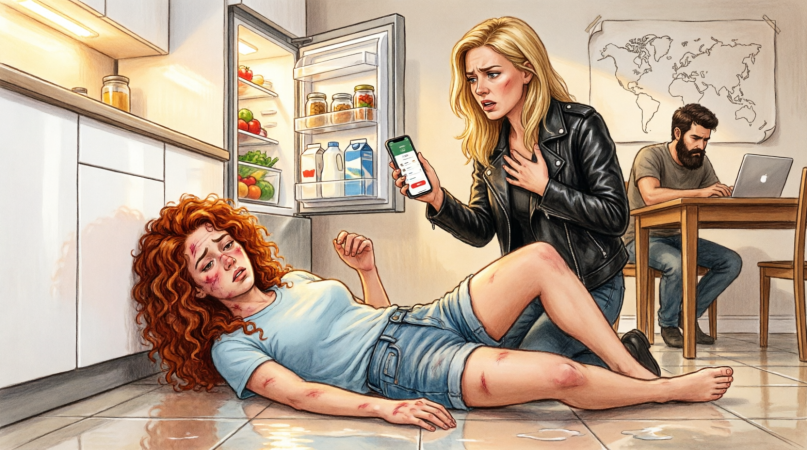
“Don’t look at me like that,” he snapped, stepping closer. Before I could move, his hands slammed into my shoulders. My back hit the refrigerator door with a hollow metallic bang. The magnets rattled, a grocery list slid to the floor. Then came the knee—fast, brutal, aimed straight at my face.
I felt the crunch before the pain. Warm blood poured down my lips and chin, dripping onto my shirt. I screamed, not from fear, but shock. My knees buckled. I slid down the fridge, trembling, my vision blurring as my nose throbbed like it was on fire.
Instinct kicked in. I reached for my phone on the counter, fingers slippery with blood. I didn’t even unlock it before a hand snatched it away.
“Give me that,” my mother-in-law, Carol, hissed. She stood in the doorway like she’d been there all along. “What are you doing? Trying to embarrass this family?”
“I need help,” I whispered, my voice broken.
She rolled her eyes. “It’s just a small scratch. Stop being dramatic.”
Mark paced the kitchen, breathing hard. “She loves attention,” he said.
From the table, my father-in-law, Richard, didn’t even look up from his phone. “Drama queen,” he muttered.
Something inside me went cold. This wasn’t just Mark. This was the house. The silence. The way they closed ranks around him. I realized then that no one here was going to save me.
I wiped the blood from my mouth with my sleeve and stood up, swaying but steady enough. I met Carol’s eyes and then Richard’s. They saw nothing—no fear, no regret. Just annoyance.
They thought they’d won. They thought I was trapped.
As Mark turned his back to grab a beer, I felt it clearly for the first time: a decision forming, sharp and irreversible. And as the blood kept dripping onto the kitchen floor, I silently promised myself this—this will be the last time any of you touch me……
PART 2
I locked myself in the bathroom that night, pressing a towel to my face while my hands shook uncontrollably. My nose was swollen, crooked, unmistakably broken. I stared at my reflection and barely recognized the woman looking back—eyes red, skin pale, lips split. But beneath the fear, something else was there. Clarity.
When the house finally went quiet, I did what I should have done years ago. I packed. Slowly. Quietly. I didn’t take much—documents, a change of clothes, the cash I’d hidden inside an old makeup bag. I left behind the wedding photos, the furniture, the lies.
At dawn, I walked to the nearest urgent care clinic. The nurse didn’t ask many questions at first. She didn’t have to. When she gently touched my nose and I flinched, her eyes softened.
“Did someone do this to you?” she asked.
“Yes,” I said. My voice shook, but the word was firm.
That single answer changed everything. The doctor documented my injuries. X-rays confirmed the fracture. Photos were taken. A social worker came in, calm and steady, and slid a card across the desk. Domestic Violence Hotline.
By noon, I had filed a police report. Saying Mark’s name out loud felt unreal, like betraying a secret I’d been trained to protect. But with every sentence, my spine straightened. The officer listened. He believed me.
Mark called thirty-seven times. Carol left voicemails accusing me of destroying the family. Richard texted once: You’ll regret this. I didn’t respond…
PART 3
The first time the police knocked on their front door, it was just after sunset. I wasn’t there—but I didn’t need to be. I had already given my statement, my photos, my X-rays, my timeline. Every detail they dismissed as “nothing” had been carefully documented, labeled, and handed over. When the officer said my husband’s name out loud, I was told Carol’s voice cracked for the first time. Funny how quickly “just a scratch” turns into a criminal charge when it’s written in ink.
Mark tried to call again that night. Number thirty-eight. Then thirty-nine. I let it ring. For years, I had answered every call, softened every argument, absorbed every explosion. This time, I sat in a quiet shelter room, my phone face-down on the table, and listened to the silence instead. It felt unfamiliar—but it didn’t feel empty. It felt like space. Like something inside me finally had room to breathe without asking permission.
Two days later, I stood in a courtroom that smelled faintly of old paper and polished wood. My nose was still bruised, a deep yellow fading into purple, but I didn’t try to hide it. When Mark walked in, he looked smaller. Not physically—but something in him had shrunk. The confidence, the certainty that I would protect him, that I would stay quiet—it was gone. And when the judge read the restraining order, his silence said everything.
Carol avoided my eyes. Richard didn’t bother pretending anymore. The same man who called me a “drama queen” now sat stiffly as the officer explained the consequences of intimidation and interference. Voicemails, texts, threats—every word they had thrown at me thinking it would scare me back into place had become evidence. I didn’t raise my voice. I didn’t need to. The truth, once spoken, doesn’t require volume.
Weeks passed, and the house I left behind stopped feeling like something I lost. It became what it always was—a place I survived. I found a small apartment with sunlight in the mornings and a lock that only I controlled. I learned how quiet safety sounds. No shouting. No footsteps that made my stomach drop. Just the hum of my own life, steady and mine again.
The last thing Mark ever said to me wasn’t an apology. It was, “You didn’t have to do this.” I looked at him—really looked this time—and realized something simple. He still thought this was about him. About his reputation, his consequences, his loss of control. But it wasn’t. It never was.
Because the moment they called my pain “nothing”…
was the moment I decided to become something they couldn’t ignore.