WHEN I WAS SORTING THROUGH MY DECEASED HUSBAND’S BELONGINGS I FOUND AN ENVELOPE WITH A KEY AND ADDRESS. INSIDE, A NOTE: “COME ALONE. NO CHILDREN.” I WENT TO THAT ADDRESS. WHAT I SAW, TURNED MY..
When I Was Sorting Through My Deceased Husband’s Belongings, I Found An Envelope With An Address And A Key
When I was sorting through my deceased husband’s belongings, I found an envelope with an address and a key.
Inside was a note.
Come alone. Don’t bring the children.
I went to that address.
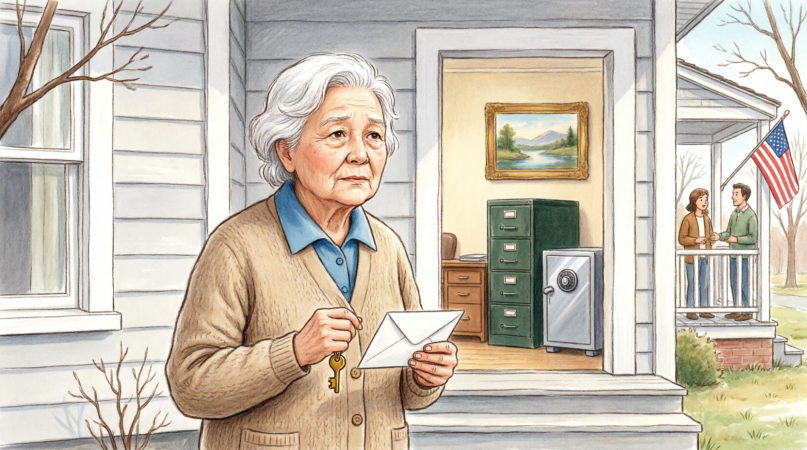
What I saw behind the door turned my life upside down.
Good day, dear listeners. It’s Clara again. I’m glad you’re here with me. Please like this video, listen to my story all the way through, and let me know which city you’re listening from. That way I can see how far my story has traveled.
My name is Dorothy Ellen Whitmore, and I am seventy-two years old.
I spent forty-four years married to Richard.
And for forty-four years, I believed I knew that man down to the last crease in his worn leather wallet.
We raised two children in a yellow house on Maple Creek Road in Asheville, North Carolina. We planted a garden together every April. We argued about whose turn it was to pay the electric bill and whose turn it was to apologize first.
That is what a real marriage looks like.
Ordinary.
Imperfect.
Deeply familiar.
Richard died on a Tuesday in February.
Heart attack.
He was shoveling snow off the porch, which I had asked him not to do, and his heart simply stopped. He was sixty-nine years old. The paramedic said he likely felt very little. I told myself that was a mercy, though in the weeks that followed, I was not sure mercy was the right word for any of it.
After the funeral, after the casseroles stopped arriving and the sympathy cards stopped coming, and the house grew quiet in a way I had never experienced before, I began the task of sorting through Richard’s belongings.
It is something no one prepares you for, the intimacy of it.
Every drawer you open, every jacket you take down from a hanger, every old receipt you unfold feels like a small conversation with someone who can no longer answer.
I started with his study.
Richard had been a methodical man, a retired civil engineer, and his desk was organized the way his mind had always been organized—logical, compartmentalized, nothing out of place. I worked through the files slowly, one folder at a time.
Tax returns.
Insurance documents.
The deed to the house.
A folder labeled Retirement that contained nothing but an outdated brochure for a fishing resort in Montana.
I smiled at that.
He had always talked about Montana.
It was in the bottom drawer, beneath a stack of old utility invoices, that I found the envelope.
It was a plain white envelope, letter-sized, sealed. My name was not on it. Nothing was written on the outside at all.
But when I turned it over, a small brass key slid out.
The kind of key used for a lockbox or a storage unit.
Along with it came a folded note and a scrap of paper with an address written in Richard’s handwriting.
The address was on the other side of town, on a street I did not recognize.
The note was brief.
Four sentences.
I read them standing at his desk.
Then again sitting down.
Then a third time after I had poured myself a glass of water and tried to steady my hands.
Dorothy, if you’re reading this, I’m already gone.
Go to this address.
Go alone.
Do not bring the children.
Do not bring the children.
I sat with those four words for a long time.
Richard and I had two children—our son Michael, who was forty-three, and our daughter Patricia, who lived in Portland and had always been the steadier of the two.
Richard adored both of them.
Why would he leave a note asking me to keep them away from whatever was behind that door?
I told myself it was probably nothing alarming. A storage unit, perhaps. Some private financial arrangement he had wanted to handle quietly. Men of his generation sometimes compartmentalized things not out of deception, but out of habit, out of the belief that worrying the people you loved was a failure of character.
I told myself that several times.
But I also noticed that my hands still were not entirely steady.
I placed the envelope, the key, and the note in the pocket of my cardigan and went to make dinner. I made too much, as I always did now, and I ate alone at the kitchen table with the television on for company.
Outside, the February dark came early and complete.
That night I did not sleep well.
I lay in the bed that still smelled faintly of Richard’s soap and stared at the ceiling, thinking about that address. I thought about the phrasing of the note. Not you don’t need to bring the children, but do not bring the children.
There is a difference.
One is a suggestion.
The other is a warning.
By morning, I had made no decision.
But I had also put the envelope in my purse, which is its own kind of decision, isn’t it?
Three days passed before I did anything.
In those three days, I cooked meals I barely touched, answered phone calls from Patricia and from Michael’s wife, Karen—who called more than Patricia did, and asked more questions than Patricia did—and sat in Richard’s study for long stretches of time doing nothing in particular.
Grief is strange that way.
It does not move in a straight line.
One hour you are functional, and the next you are standing in front of the open refrigerator trying to remember what you came for.
Karen called on Wednesday morning. She was solicitous, as she had been since the funeral, bringing food, offering to help organize paperwork, asking whether Richard had left any documents she should know about. She and Michael had power of attorney over certain financial accounts, an arrangement Richard had set up two years earlier when he had a minor health scare.
At the time, it had seemed practical.
Now, standing in the kitchen with the phone pressed to my ear and the envelope sitting in my purse on the counter, I noticed something I had not noticed before.
Karen asked about documents the way a person asks about something they are already looking for.
“Has the estate attorney been in touch?” she asked.
“Not yet,” I said.
“You should call him soon. These things have timelines.”
“I’m aware, Karen.”
There was a brief pause.
“Of course. I just want to make sure you’re not overwhelmed. Michael and I can handle a lot of this if you need us to.”
I thanked her and ended the call.
Then I stood in the kitchen for a moment.
Karen had always been efficient. She was a real estate agent, good at her job, comfortable with paperwork and transactions. I had never disliked her exactly, but I had never entirely warmed to her either. There was something about the way she moved through a room, purposefully, with an awareness of what was valuable, that had always made me feel—without being able to articulate why—slightly observed.
That afternoon, I drove to the address on Richard’s note.
I told no one.
I simply got in my car, typed the address into my phone’s navigation, and drove.
It was a residential neighborhood I had passed through before but never stopped in. Modest houses, well kept, the kind of street where people mowed their lawns on Saturday mornings.
The address led me to a small gray house at the end of a cul-de-sac.
Single story.
Covered porch.
Window boxes, though it was February and they were empty.
The driveway was vacant.
There was a mailbox at the end of the walk.
I sat in my car for several minutes.
Then I got out, walked to the door, and used the brass key.
The door opened.
What I found inside was not what I had feared.
No evidence of a second family.
No photographs of strangers on the walls.
No woman’s clothing in the closets.
What I found was a single clean room converted into a private workspace.
A small desk.
A filing cabinet.
A safe built into the wall behind a framed watercolor of the Blue Ridge Mountains.
And on the desk, a sealed envelope with my name on it in Richard’s hand.
I sat down in the desk chair and opened it.
The letter was four pages long, handwritten, and it told me things that changed the shape of everything I thought I understood about the last two years of my marriage.
Richard had discovered, fourteen months before his death, that Michael and Karen had been systematically moving money out of a joint investment account—one Richard had established decades ago and intended in its entirety to pass to me as part of his estate.
They had not stolen it outright.
They had done something more insidious.
Karen, using her real-estate connections, had facilitated a series of transfers disguised as investments, shell purchases, consulting fees, and loans on paper that were never meant to be repaid.
The total, Richard estimated, was somewhere between two hundred and two hundred fifty thousand dollars.
He had discovered it by accident.
He had not confronted them.
He had been afraid, not for himself, but for what it would do to our family, to Patricia, to the grandchildren. And he had been, he wrote, deeply ashamed that he had not acted sooner, that he had let his fear of family fracture override his obligation to protect what was mine.
The safe contained documentation.
Account statements.
Printed emails.
A USB drive.
I’m sorry I didn’t tell you while I was alive, he wrote near the end. I was a coward about this. You never were. Trust yourself.
I folded the letter, placed it back into its envelope, and sat very still for a long time.
Then I opened the safe.
The safe contained exactly what Richard promised.
A manila folder held twelve months of printed bank statements for an investment account I had not known existed in its current form. What had once been a joint account Richard and I opened in 1987 had been through a series of modifications I had never been asked to authorize, restructured so that Michael held co-signatory status.
The statements showed a pattern so clear it almost looked naïve.
Regular withdrawals in amounts just below the threshold that would trigger automatic bank review, routed to three different receiving accounts. Two of those accounts, cross-referenced with the printed emails Richard had saved, were linked to a holding company registered in Karen’s maiden name.
The USB drive held more scanned documents.
A chain of emails between Karen and a contact she referred to only as DW, a name I did not recognize, discussing the relocation of assets and the importance of completing the transfers before the estate situation becomes complicated.
The most recent email in the chain was dated eleven days before Richard died.
I sat at that desk in the gray house for nearly two hours.
I read everything twice.
I photographed every page with my phone.
I copied the contents of the USB drive into a folder in my cloud storage using the Wi-Fi network Richard had set up there. The password was written on a sticky note inside the safe door in his neat engineer’s hand.
By the time I locked the house and drove away, I had made my decision.
I would not call Michael.
I would not call Karen.
And I would not, under any circumstances, let them know what I had found until I had spoken to a lawyer.
Not the estate attorney Richard and I had used for our wills. He had also been copied on some of the account-restructuring paperwork, and I did not yet know what his role had been.
I needed someone new.
Someone who owed nothing to anyone in my family.
I drove home and spent that evening researching estate and probate attorneys in Asheville.
I made a list of four.
I eliminated the first because his office had done work for Karen’s brokerage in the past. I found that in a footnote on a Chamber of Commerce event page.
I eliminated the second because he had retired, according to his firm’s website.
The third was a woman named Sandra Okafor who had been practicing for twenty-two years and whose firm’s reviews described her as thorough and, in one particularly useful sentence, not intimidated by difficult family situations.
I called her office the next morning and made an appointment for Friday.
It was Thursday when Karen’s behavior shifted.
I did not go back to the gray house that week, but I did drive past it once while running an errand through that neighborhood, and I noticed a car parked two houses down that I was almost certain I had seen before.
A silver Audi.
Karen’s Audi.
It may have been coincidence.
The neighborhood was not exclusive.
But I noted it.
That evening, Karen called again.
The tone was different.
Still warm. Still helpful.
But with a new quality beneath it, a subtle urgency I could not yet name.
“Mom,” she said.
She had called me Mom since the first year of her marriage to Michael, and I had always been ambivalent about it.
“I was thinking about coming over this weekend to help go through Richard’s study, just to make sure nothing gets accidentally thrown away before the estate is sorted.”
“That’s thoughtful,” I said. “But I’ve already been through the study.”
A pause.
Brief.
But present.
“Oh. Did you find everything in order?”
“Everything I needed,” I said.
Another pause.
“Of course. Well, if you need help with the filing cabinet or any of those old account documents—”
“I’ve got it handled, Karen. But thank you.”
I hung up.
Had I handled it with complete composure?
No.
My voice had been steady, but my heart had done something unpleasant in my chest.
I had been married to a civil engineer for forty-four years, and one thing that man had taught me, without ever meaning to, was the importance of what he called load-bearing information.
The piece of data that, if removed, causes everything above it to collapse.
Karen was looking for the safe.
Or she was looking for whatever Richard had left behind.
She did not yet know whether I had found it.
But she was beginning to suspect I had found something.
Friday morning, I drove to Sandra Okafor’s office on the fourth floor of a building downtown, took the elevator up, and sat across from a woman with calm eyes and a yellow legal pad.
Then I told her everything.
She listened without interrupting.
When I finished, she uncapped her pen.
“Do you have the documents with you?”
I opened my purse and placed the originals on her desk.
Sandra Okafor looked at them for a long time.
Then she looked at me.
“Mrs. Whitmore,” she said, “you have a case.”
Sandra filed the first motions within seventy-two hours.
She was efficient in a way that reminded me, strangely, of Richard.
Not warm exactly.
But precise.
She explained what she was doing in plain language. Filing a formal objection to the account modifications on the grounds that I had not provided informed consent. Requesting a full audit of the restructured investment account. Submitting a referral to the North Carolina State Bar’s financial crimes unit, which in turn would notify the bank.
The process, she said, would not be fast.
But it would be thorough.
And the documentation Richard left behind was, in her assessment, unusually complete.
“Your husband was an engineer,” she said, almost to herself, while reading the statements again.
“He was.”
“He documented this the way an engineer documents a structural failure. Step by step. Cause and effect.”
I felt something tighten in my throat.
“He always said if you couldn’t show your work, you didn’t really know what you were doing.”
Sandra nodded.
“It will serve you well.”
I drove home from her office and tried to settle back into the routine of my days.
I called Patricia that evening, not to tell her everything—not yet—but because I needed to hear her voice. She asked how I was doing, and I said I was managing, which was true in the narrowest possible sense. She said she was thinking of coming for a visit in March.
I told her I would like that very much.
The call from Michael came four days later.
Not from Karen.
From Michael.
Which told me Karen had assessed the situation and decided that a son confronting his mother would land differently than a daughter-in-law doing the same.
She was not entirely wrong.
Michael’s voice was doing the thing it always did when he was managing something.
Too controlled.
Too even.
Like a man reading from a script he had rehearsed.
“Mom, we need to talk about what you’ve been doing.”
“What have I been doing, Michael?”
“You retained a lawyer without talking to us.”
“I’m entitled to retain a lawyer.”
“Of course you are. But you need to understand that what you’re doing could damage this family. Audits. Investigations. Do you know what that does to people’s reputations? To their careers? Karen is in real estate. Her name is attached to transactions that will look—”
“Will look what?” I asked.
Silence.
“Michael,” I said, “I found the documents your father left me. I found the account statements. I found the emails. I know what happened.”
The silence on the other end became a different kind of silence.
Not thoughtful.
Stunned.
Then Karen’s voice came on the line.
She had been there the whole time, listening.
“Dorothy.”
Her voice was composed in a way Michael’s had not been.
Harder.
More deliberate.
“You are making a serious mistake. What you think you found is not what it looks like. There were conversations between Richard and Michael about those transfers. They were agreed upon. Richard understood what he was doing.”
“Then you will have no difficulty demonstrating that to the auditors,” I said.
“If you pursue this,” Karen said, and her voice dropped slightly—not a shout, but something more dangerous than one—“you will lose your son. Is that what you want? To blow up your family over money at your age?”
At your age.
I held the phone very steadily.
“If my son can be lost by his mother asking for what is legally hers, then I think the loss happened long before this phone call.”
I heard Karen make a sharp sound.
Then Michael.
“Mom, I’m going to hang up now.”
“Please do not contact me directly again,” I said. “If you have something to say, say it to my attorney.”
I ended the call.
Then I sat in Richard’s armchair in the living room for a long time afterward.
When I finally looked at my hands, they were completely still.
I was surprised by that.
I had expected them to shake.
In the days that followed, there was no contact from Michael or Karen.
Sandra informed me that their attorney had been in touch—a firm Karen had used for real-estate closings, which Sandra said was not a strong choice for this type of case.
The formal proceedings were underway.
There was nothing for me to do but wait.
And take care of myself.
So that is what I did.
I slept.
I called Patricia and we talked for a long time about nothing important.
I walked in the neighborhood in the mornings, even when it was cold, because Richard had always said motion is medicine.
I made soup and ate it at the kitchen table with a book instead of the television.
I was not happy.
But I was not afraid.
And there is a great deal of space between those two things in which a person can rest.
It was Betty Calhoun who saved me, though she would laugh at that description.
Betty had been my closest friend for thirty years, ever since we served together on the same church auxiliary committee and discovered, over a folding table covered with donation envelopes, that we shared an identical contempt for inefficient meetings.
She was seventy, a retired schoolteacher, a widow herself since 2019, and she had an unerring ability to say the true thing without making it feel like surgery.
I called her on a Sunday morning, three weeks after the formal proceedings began, and I told her everything.
All of it.
I had not told anyone else. Not the neighbors. Not my book club. Not the women from church.
But I told Betty because keeping it entirely to myself had begun to feel like a weight lodged in my chest.
She listened.
Did not interrupt.
When I finished, she was quiet for a moment.
Then she said, “Dorothy, that woman has been waiting for Richard to die for years.”
It was not a kind thing to say.
It was a true thing to say.
“How do you know?” I asked.
“I watched her at family gatherings. The way she watched the room. People who love you look at you. People who are calculating what you’re worth look at the room.”
I thought about that for a long time.
The indirect approach from Karen came the following Tuesday.
Not a phone call.
Karen was too controlled for that after our last exchange.
A letter.
Hand-delivered by Michael to my mailbox.
Which told me a great deal about the nature of their arrangement.
Michael was, when it came down to it, Karen’s errand boy in this. He drove the car. Rang the bell. Put the letter in the box.
Did not knock on the door.
I found the letter when I went out for my morning walk.
The letter was civil in language and surgical in intent.
It proposed a private resolution.
A lump-sum payment to Dorothy of seventy-five thousand dollars, structured as a voluntary family gift, in exchange for Dorothy’s withdrawal of all formal proceedings. It framed this as a practical option that would allow the family to avoid painful public exposure.
And near the end, there was a line I read twice.
At this stage of your life, a prolonged legal process may cost you more in time and in health than the outcome would be worth.
At this stage of your life.
Karen had used a version of that phrase twice now. Once on the phone. Once in writing.
I understood it for what it was.
A strategy.
Not cruelty for cruelty’s sake.
A calculated assessment that I could be made to feel old and tired and not worth the fight.
It was, I realized, the same strategy someone uses when they underestimate a load-bearing wall.
They push against it expecting it to give and are surprised when it holds.
I brought the letter to Sandra.
She read it with a professional neutrality that I had come to find comforting.
“Seventy-five thousand,” she said, “when the original amount was closer to two hundred fifty.”
“Yes.”
She set the letter down.
“They’re frightened. This offer is a measure of how frightened they are.”
“Should I be concerned about the offer?”
“No. About their next move? Moderately.”
She looked at me steadily.
“People who make this kind of offer and are refused tend to escalate before they collapse. Be prepared for that.”
I thanked her and drove home.
That evening I attended, for the first time, a support group for widows that met in the basement of the Lutheran church on Merrimon Avenue. Betty had been going for two years and had suggested it gently three times before I finally agreed.
I had resisted in the way I resist most things that require me to be witnessed by strangers.
But I was glad I went.
The group was eight women ranging in age from fifty-nine to eighty-one. They were funny and honest, and several of them had navigated estate complications that made mine feel, if not simple, then at least not unprecedented.
A woman named Gloria, who was sixty-six and had spent three years in probate litigation with her late husband’s business partners, looked at me over her paper coffee cup and said, “The first year they test you to find out how much you’ll put up with. After that, they know.”
I drove home from that meeting feeling, for the first time since February, something that was not grief and not anger.
Something closer to solidarity.
I was not alone in this.
I had never been alone in it.
I had simply forgotten to look around.
They came on a Saturday morning in April.
I saw the silver Audi in my driveway from the kitchen window while I was making coffee. I had not been warned. They had not called.
That told me everything I needed to know about the nature of the visit before I even opened the door.
Michael was wearing the expression he had worn as a teenager whenever he had done something wrong and hoped charm would cover the distance. A studied look of openness, sincerity, reasonableness.
Karen stood slightly behind him, which was unusual.
She was not a woman who stood behind people.
She wore a soft camel-colored coat and carried a small paper bag.
Pastries.
From the bakery on Lexington Avenue that she knew I liked.
The bag sat on my coffee table for the entire visit.
Unopened.
Neither of us acknowledged it.
We sat in the living room, Michael and Karen on the sofa, me in Richard’s armchair, a pot of coffee on the table between us because having something to do with your hands is useful in situations like that.
I did not pour for them.
I poured for myself.
Michael began.
He was sorry, he said.
Sorry for the phone call.
Sorry for the way things had become.
He and Karen had been under a great deal of financial stress. The real-estate market. Interest rates. Two children in college at once.
He did not use the word theft.
He used phrases like borrowing against future inheritance and an informal arrangement and something Dad understood and approved of.
He said all of it with the conviction of someone who had practiced until he half believed it.
I noticed that he did not make eye contact while he spoke.
He looked at the coffee table.
At his own hands.
At the window.
Everywhere except at me.
I listened without interrupting.
This too I had learned from Richard.
Let the structure show its own weaknesses.
Push too early and you might miss where the real fault is.
Then Karen spoke.
She leaned forward slightly, and her voice changed.
Dropped a register.
Became intimate.
Woman to woman.
In a way that was deeply calculated.
“Dorothy, I know this has been a terrible year. Losing Richard. Going through all of this alone. The last thing any of us wants is for you to spend whatever time and energy you have left on lawyers and courtrooms. Think about what this is costing you. Not just financially. Emotionally. You deserve peace. You deserve to spend this time with your grandchildren, with Patricia, not in depositions.”
She paused, reading my face for movement the way a person reads water for current.
“If you drop the proceedings,” she continued, “we can work something out directly. Something fair. Something that doesn’t hurt anyone.”
I looked at her for a long moment.
I thought about the paper bag of pastries.
I thought about the word fair, and how easily it comes to people who have taken something that did not belong to them. How they reach for it as if they are entitled to use it.
I thought about Richard in that gray house, sitting at the desk, printing those emails, documenting every transfer, building the case he was too frightened to use while he was alive.
He had done all of that work alone.
I was not going to let it mean nothing.
I set down my coffee cup.
“What you took from me,” I said, “was approximately two hundred and fifty thousand dollars. The offer in your letter was seventy-five. What you are describing now as something fair—what figure did you have in mind?”
Karen’s expression shifted.
Almost imperceptibly.
“That’s not really—”
“Because fairness is a number,” I said. “It isn’t a feeling. And the number I can demonstrate to a court is two hundred fifty thousand dollars plus my legal costs.”
Michael started to say something.
Karen touched his arm.
A small, quick gesture.
He stopped.
“We’re not here to negotiate in your living room,” Karen said.
The warmth was gone now.
Not all at once.
But the way a sky clears of clouds and you realize the blue was always behind them.
“We came to give you an opportunity to handle this quietly. You’ve said no to that opportunity. I just want to make sure you understand what you’re choosing.”
“I understand perfectly,” I said. “I think you should go.”
Michael looked at me then.
Actually looked at me.
And for one moment, he looked like my son.
Not the rehearsed, managed version.
The boy who cried when his dog died at eleven.
The one who slept with the light on for a week after.
I had sat beside him on his bed then, in the dark, until he fell asleep.
I still remembered the weight of his head against my shoulder.
I wondered if he remembered it too.
Then the expression closed like a shutter.
Karen stood first.
She picked up her bag—the pastries still untouched—and tucked it beneath her arm with a composure that was, I thought, the most honest thing she had done all morning.
She was not leaving them behind as a gesture of warmth.
She was taking back what she had brought.
They left.
I listened to the Audi back out of my driveway and disappear down the street.
Then I sat very still for several minutes.
What I felt was not confidence exactly.
It was something more complicated.
Fear, if I am honest.
A real, cold knowledge that these two people had both the means and the motive to make the next several months difficult.
But beneath the fear was something harder.
Richard had been afraid too.
And his fear had cost both of us.
I had made a different choice.
I intended to keep making it.
The pastry bag was gone.
The case was not.
The hearing was scheduled for the third Thursday in May, in a civil courtroom on the second floor of the Buncombe County Courthouse.
Sandra had spent the preceding weeks preparing me with the same thoroughness she brought to everything. We reviewed the documents repeatedly. She walked me through the sequence of transfers, the paper trail, the emails, the account modifications.
She told me what to expect from Michael and Karen’s attorney—a man named Garrett Foss, who primarily handled real-estate litigation and whose understanding of estate fraud law, Sandra said with professional understatement, was not deep.
She also told me what to expect from myself.
That I might feel the impulse to speak when I should be silent, to react when I should be still, and that the most powerful thing I could do in that room was to be exactly what I was.
A seventy-two-year-old widow sitting calmly beside her attorney with a folder of impeccable documentation.
“You don’t need to perform anything,” Sandra said the afternoon before. “The evidence performs. You just need to be present.”
I dressed carefully that morning.
Gray blazer.
White blouse.
Low heels, because I had learned decades ago that physical comfort matters when you are going to be sitting in a hard chair for several hours concentrating.
I arrived before Michael and Karen.
I found my seat beside Sandra.
I folded my hands in my lap.
And I waited.
The courtroom was smaller than the ones on television.
Wood-paneled.
Fluorescent-lit.
With the peculiar stillness of institutional spaces.
I looked at the judge, a woman in her late fifties with reading glasses on a chain, and thought, she has sat in this room and heard versions of this story before.
People lying about money.
Families splitting along the fault lines of inheritance.
She would not be shocked.
That was, unexpectedly, a comfort.
They came in together.
Karen wore a well-cut navy dress and carried herself with the composure of someone who had decided composure was the only remaining tool available to her.
Michael walked slightly behind her, as he always did now.
Garrett Foss settled in beside them with the ease of a man who had not yet fully assessed his own disadvantage.
Foss opened on their behalf exactly as Sandra had predicted, asserting that the account modifications had been made with Richard’s full knowledge and verbal approval, that this had been a family arrangement for estate-planning purposes, and that Dorothy’s challenge represented a misunderstanding of her late husband’s intentions.
He was smooth.
Confident.
Building on sand.
Sandra’s opening was quieter.
And half as long.
She presented the documentary record in chronological order. She did not editorialize. She let the numbers speak.
I watched the judge’s face as Sandra walked through each exhibit—the account statements, the modification forms, the printed emails.
The judge’s expression did not change, but her pen moved steadily across her notepad.
And it moved more when Sandra was speaking than when Foss was.
The hearing’s first break came after two hours.
I stood in the hallway with Sandra and drank water from a paper cup and said very little. Through the tall windows at the end of the corridor, I could see the May sky.
Blue.
Genuinely blue.
The kind of day that has no interest whatsoever in the proceedings of human beings and their betrayals.
I was glad for it.
I breathed the recycled courthouse air and thought about the garden at home, which would need watering when I got back.
When proceedings resumed, Karen was called to testify.
She was composed at first.
Careful.
Deliberate.
Consistent with the verbal-approval narrative.
She spoke of Richard with an affection she deployed like a prop. She described their relationship as close, trusting, transparent. She used the word family frequently.
I sat and listened and kept my face still.
Sandra cross-examined her with the email chain.
Not all of it.
Three emails specifically.
The ones referring to completing transfers before the estate situation becomes complicated.
Emails dated eleven days before Richard died.
“Can you explain,” Sandra asked, “how this language—before the estate situation becomes complicated—is consistent with a voluntary, openly agreed-upon family arrangement?”
Karen said the language was informal. A shorthand. Not indicative of concealment.
Sandra showed her the second email.
“In this message, you refer to your co-signatory as completely insulated. What were you insulating him from?”
“I was referring to—”
Karen stopped.
“It was business language. Real-estate language.”
“This is not a real-estate account,” Sandra said. “This is a retirement investment account in Dorothy Whitmore’s name.”
A silence fell over the room.
Different from the silences before it.
Even Foss was still.
I did not look at Karen.
I looked at the judge.
The judge was writing.
Karen’s composure held for another twenty minutes.
It was the account-modification documents that finally fractured it.
Specifically, a form requiring my co-signature that the records showed had been submitted without it.
Sandra placed the form on the table and asked Karen to identify the signature on the co-authorization line.
Karen said it was possible there had been an error in processing.
Sandra asked if Karen was familiar with the term signature forgery under North Carolina statute.
For the first time, Karen’s eyes moved.
Not to Sandra.
Not to her attorney.
Not to the judge.
To Michael.
It was a small movement. Involuntary.
The reflex of someone who had run out of prepared responses and was looking for a lifeline.
Michael was looking at the table.
He did not look back at her.
That moment—Karen turning toward him and finding nothing there—was, I thought, its own kind of verdict.
Michael was called next.
His testimony was the testimony of a man trying to hold two contradictory stories together at once.
He confirmed the verbal-approval narrative, as Karen had.
But when Sandra asked him to describe the specific conversation in which Richard had agreed to the transfers, his account differed from Karen’s in three details.
The date.
The location.
And whether anyone else had been present.
When Sandra pointed this out, placing both sets of testimony side by side on her legal pad, Michael looked at the table.
He had been doing that all day.
Looking at the table.
At his hands.
At the floor.
Anywhere the truth was not pointing back at him.
I had watched my son for forty-three years.
I knew what that posture meant.
It was the same posture he had used at nine years old when he broke a neighbor’s window and tried to explain how the ball had somehow gotten there on its own.
He had never been a skilled liar.
He had simply found someone who was.
“Mr. Whitmore,” Sandra said, “did your father ever, in your direct presence, explicitly authorize the transfer of funds from his personal retirement account to the holding company registered in your wife’s name?”
Michael was quiet for seven seconds.
I counted.
“He understood what we were doing,” he said finally.
“That is not what I asked,” Sandra replied.
The room was very quiet.
Outside, somewhere, the May afternoon continued without us.
The ruling came six weeks after the hearing.
I was sitting in Sandra’s office when her paralegal brought in the document.
Sandra read it in silence, her expression professionally neutral, the way it had been throughout.
Steady.
Contained.
Revealing nothing until she had something worth revealing.
Then she looked up.
“Full restitution,” she said. “Two hundred forty-seven thousand dollars, plus your legal costs. The court has also accepted the referral to the financial crimes unit.”
I sat with that for a moment.
Outside Sandra’s window, the downtown buildings held the late-morning light the way they always did in summer—indifferently and completely.
And I thought how strange it was that the world looked exactly the same on the day a thing was resolved as it had on the day the thing began.
“And Karen’s signature on the modification form—the court found it to be unauthorized. That finding has been forwarded to the district attorney’s office.”
Sandra set the document down.
“It’s a felony, Dorothy. It will be prosecuted separately from the civil matter.”
I nodded.
I did not feel elation.
I felt something more like the release of a long-held tension.
The way a structural flaw in a building feels, Richard had once told me, when the repair is finally complete and the load is properly distributed again.
Not dramatic.
Not triumphant.
Just right.
The way a thing is supposed to feel when it returns to the position it should have held all along.
Sandra slid a copy of the ruling across the desk toward me.
I read the operative paragraph twice, slowly, the way Richard had always taught me to read contracts—not for what they say, but for what they commit to.
The language was clear.
Unambiguous.
The court had found in Dorothy Ellen Whitmore’s favor on all primary counts.
I thanked Sandra.
She accepted that with the same professional equanimity she brought to everything.
Then she said something I did not expect.
“Your husband did good work.”
“He did,” I said. “He just waited too long to show it.”
“You didn’t,” she said.
The civil judgment was enforceable immediately.
Karen and Michael’s attorney filed a motion to delay enforcement on the grounds that the funds had been dispersed and would require time to liquidate. The court gave them ninety days.
Sandra told me this was standard, and that the judgment would be paid. Given Karen’s real-estate assets, there was no question of ability, only willingness.
And willingness was no longer the operative variable.
Karen’s real-estate license came under review by the North Carolina Real Estate Commission within three weeks of the criminal referral.
I did not seek that outcome.
It was a consequence of the process.
Not a target I had aimed at.
But I will not pretend I was sorry.
She had used her professional standing, her industry connections, her knowledge of how money moves through property transactions, to systematically drain what Richard and I had built over four decades.
The license had not been incidental.
It had been instrumental.
The holding company was dissolved.
The three receiving accounts were ordered frozen pending the fraud investigation.
The financial crimes unit, Sandra told me, was particularly interested in the entity Karen referred to in the emails as DW—a mortgage broker named Dale Whitaker who had facilitated two of the transfers.
He was not my problem.
He was someone else’s.
But I noted, without satisfaction and without its opposite, that the circle was wider than just my kitchen table.
Michael called me once after the ruling.
I answered because he was still my son, and I was not entirely sure what that meant anymore.
But I knew it meant something.
Some things persist long after they stop being comfortable.
Parenthood is one of them.
“Mom,” he said.
He sounded very tired.
Not the managed tiredness of someone performing exhaustion.
The real thing.
The kind that comes from months of holding a story together that keeps coming apart at the seams.
“Michael.”
“I didn’t…”
He stopped.
Started again.
“I let her run too much of it. I knew it was wrong. I told myself it was just money, just accounting, that you’d never notice and Dad was sick anyway.”
“Don’t,” I said. “Don’t make that your story. You knew what you were doing.”
He did not argue.
That at least was honest.
I had expected deflection.
Justification.
The familiar architecture of self-protection.
Instead, he was quiet.
And in that quiet, I heard something that might have been the beginning of accountability.
Or might simply have been exhaustion so complete it had no room left for anything else.
I did not know which.
I was not sure it mattered yet.
“I love you,” I said. “And what you did was a profound betrayal. Both of those things are true. I’m not going to pretend one cancels the other.”
He said, “I know.”
I ended the call.
Patricia flew in from Portland the weekend after the ruling.
She had known by then. I had told her before the hearing because she deserved to know, and because I was tired of managing information in ways that served no one, least of all me.
She had been quiet for a long time after I told her.
A long, specific silence.
The silence of someone rearranging the furniture of a relationship she thought she understood.
Then she said, “I’m coming.”
That was all.
That was enough.
We sat on the porch together Saturday evening with two glasses of wine, and the garden was doing what gardens do in June—quietly, insistently, without any interest in human difficulties.
The first roses were open along the fence.
Richard had planted those roses twenty years earlier and never fully figured out how to prune them correctly.
Every year they grew in a way that was slightly wrong and completely alive.
Patricia said, “Dad would have liked Sandra Okafor.”
“He would have.”
We sat with that for a while.
The evening was warm.
Neither of us needed to say anything else.
Summer came, and with it a kind of lightness I had not expected.
I kept the gray house.
That surprised me when I made the decision.
It surprised Sandra.
And it certainly would have surprised Karen, who had likely assumed I would sell it and be done.
But it had been Richard’s last project.
His meticulous, private act of preparation.
And there was something in me that was not ready to let it go.
I hired a painter, had the window boxes replanted with lavender and trailing white alyssum, and made it into what it had perhaps always been intended to be.
A place of my own.
I went there on Tuesday mornings with coffee and a book and sat at the small desk and did whatever I liked.
Sometimes I read.
Sometimes I simply sat and listened to the neighborhood.
A lawnmower two streets over.
Children somewhere.
The quiet of a weekday morning.
It was not merely a house.
It was proof that Richard had known me well enough to leave me something I did not yet know I needed.
It was a small thing.
But it was entirely mine.
Betty and I began walking together three mornings a week, something we had always meant to do and never organized. We walked the River Arts District in the early hours, when the light was good and the tourists were not yet out. We talked about our husbands, about our children, about the accumulated ordinary wisdom of long lives.
Betty was, as she had always been, the best kind of company.
Someone who did not require you to perform.
On one of our walks in late July, she said, “You seem different.”
I asked how.
She thought about it and said, “Like you’re inside your own life again instead of standing outside it watching.”
I turned that over carefully, the way Richard checked measurements, and decided she was right.
The widows’ group continued.
Over time, I became one of the longer-standing members, and occasionally a newer woman would come in—shell-shocked, recently alone, navigating some version of what I had navigated—and I would find myself across the table from her saying the kinds of things Gloria had once said to me.
That it was survivable.
That you were allowed to be angry.
That being old did not mean being without recourse.
Patricia visited twice that summer, and we talked—really talked—in ways we had not since she was a girl. She was, I came to understand, more like Richard than I had realized.
Careful.
Private.
Loyal to the point of self-erasure.
We were relearning each other.
It was good work.
Michael was harder.
The criminal proceedings against Karen moved slowly, as such things do. She was charged in September with three counts of financial fraud and one count of document falsification. She retained a criminal-defense attorney—a different firm, a better one than Garrett Foss, though not good enough ultimately to change the fundamental problem with her case, which was that the documentation Sandra had presented was exhaustive.
She was not a woman who had made a careless mistake.
She was a woman who had run a careful operation.
And careful operations leave records.
Her real-estate license was formally revoked in August.
She contested it.
The commission’s ruling stood.
I am told—not by anyone close to the matter, but by the ordinary channels of a small city—that Michael and Karen sold their house that fall.
The sale was not voluntary in any meaningful sense.
It was a liquidation.
The life Karen had built—the referrals, the professional network, the reputation—collapsed with a thoroughness I suspect even she had not fully anticipated when she first decided that my retirement account was an opportunity.
The children, my grandchildren, were staying with Karen’s mother during the upheaval.
That grieved me in a way the financial betrayal had not.
Because those children had done nothing.
And would carry the weight of it anyway.
I wrote each of them a card by hand, with my phone number and one simple statement.
Your grandmother loves you and is not going anywhere.
One of them called me.
Emma, who was nineteen.
We spoke for forty minutes.
She cried.
I did not.
Only barely.
She came for dinner the following Sunday, ate two helpings of chicken and rice, and fell asleep on the sofa afterward. I covered her with the quilt from Richard’s reading chair and turned off the lamp.
That was, I think, the evening I understood that I was going to be all right.
Michael attended two of the criminal-proceeding hearings without Karen, sitting in the back of the courtroom. He was not charged. The evidence established his awareness, but placed the primary operational responsibility on Karen and her contact.
I did not speak to him at the hearings.
But at the second one, as we were leaving in opposite directions, he looked at me across the parking lot.
Just looked.
I looked back.
Then I got into my car and drove to Betty’s house for lunch because that is what I had planned to do that afternoon.
And I intended to keep doing the things I had planned.
Karen was convicted in March on two of the three counts.
She was sentenced to eighteen months of probation, mandatory financial restitution, and community service.
She was also, for all practical purposes, unemployable in her industry in this state for the foreseeable future.
The three things together had a thorough completeness to them.
I was not glad she had suffered.
But I was glad that what had been taken from me now had a name and a consequence and a resolution.
Those are different things.
The tulips came up again in spring.
I planted more.
A new variety.
Deep burgundy along the front walk where they would be the first thing visible from the street.
Richard had always said the garden was the house’s way of introducing itself.
I thought it was time for a new introduction.
Richard always said, “Measure twice, cut once.”
He meant it about engineering.
But it was true about people too.
I learned this:
Grief makes you soft.
And the wrong people know how to use that softness.
But soft is not the same as weak.
Soft things absorb pressure.
They do not always break.
If someone you love leaves you a locked door, go through it.
You deserve to know what is on the other side.
What would you have done in my place?
I’d genuinely like to know.
Leave a comment below.
And thank you for listening.