I wanted to surprise my family by returning home three weeks ahead of schedule from deployment.

After months overseas, all I wanted was to see my eight-year-old daughter, Sophie, come running into my arms the way she always did. But the moment I walked through the door, the house felt… wrong. Too quiet.

My wife, Laura, was standing in the kitchen, startled to see me home early. She forced a smile, but it never reached her eyes. “Where’s Sophie?” I asked. “She’s spending the weekend at my mother’s,” she answered quickly.

“They’re having a sleepover.” My stomach tightened. Laura’s mother, Evelyn, was extremely strict, the kind of old-fashioned that felt more cruel than disciplined. I had never liked Sophie staying there too long.

Even so, I tried to trust Laura’s judgment. I took a shower, changed clothes, and tried to shake the unease. But something was off. Laura kept avoiding my eyes. Her phone buzzed constantly, and every time she looked at the screen, she angled it away from me. Finally, I couldn’t take it anymore.
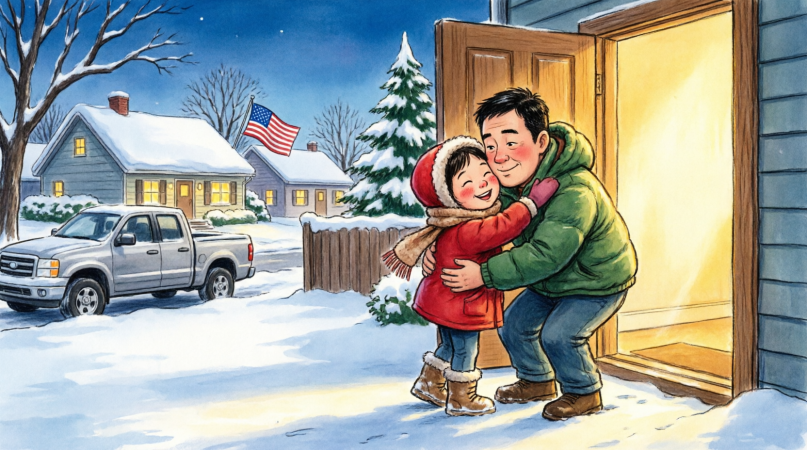
“I’m driving to Aurora,” I said. “I want to see Sophie.” Laura froze. “Now? It’s late.” “Exactly,” I answered. “She should already be asleep.” The drive was cold, dark, and tense. Snow flurries drifted across the road, and the temperature hovered around 4°C, just above freezing.

When I reached Evelyn’s property, the house was completely dark. Not a single light was on. I walked up the driveway and knocked on the door. No answer. I checked the windows and saw nothing. Then I heard it. A faint, muffled cry drifting through the air. “Sophie?” I called out. Her voice cracked. “Dad?”

My chest tightened. I followed the sound to the guest cottage behind the house, a tiny building Evelyn used for storage. The door was padlocked from the outside. Inside, Sophie’s sobbing grew louder. “Dad, it’s cold… please hurry.” My hands shook as I grabbed a crowbar I found nearby and smashed the lock. When the door swung open, a blast of freezing air hit me.

Sophie was sitting on the floor in her pajamas, shivering violently, her cheeks red from crying. “Oh God, Sophie…” I pulled her into my arms. She clung to me with desperate strength. “Grandmother said disobedient girls need correction,” she whispered, her voice trembling. “I’ve been in here for twelve hours.” My blood boiled. “Where is Evelyn?” “She left. She said she’d come back tomorrow.”

I picked Sophie up and carried her outside. As I buckled her into the car seat, she tugged on my sleeve. “Dad… don’t look in the filing cabinet in that little house.” The fear in her voice made me go still. “What’s in there?” I asked gently. She shook her head, her eyes wide with terror. “Please… don’t.” But that warning only made my heart pound harder. There was something in there Evelyn never wanted me to find.

I walked back to the cottage, each step heavier than the one before, and opened the drawer. What I saw made my whole world tilt…. Inside the filing cabinet was a folder labeled SOPHIE – BEHAVIORAL RECORDS. At first, I thought it was something harmless, maybe just Evelyn’s obsessive notes about Sophie’s chores or homework. But the moment I opened the folder, my stomach twisted.

Dozens of handwritten pages documented every small mistake Sophie had made over the past year: forgetting to say “thank you,” not finishing her meals, talking back, crying, laughing too loudly. Each page listed the “correction” Evelyn believed she deserved. Ice baths.

Hours of isolation. Withholding meals. There was even a chart tracking the moments Sophie “broke” — that word underlined in red ink. My hands were shaking so badly I almost tore the papers. The deeper I went, the more horrifying it became. Notes described locking Sophie outside in winter, forcing her to kneel on rice, making her sit in silence for hours without moving.

There were dates, times, descriptions. Evelyn had documented everything as if she were proud of it. But the worst part was a small envelope taped inside the folder. Inside were photographs. Sophie curled up on the cement floor of the cottage. Sophie crying beside a locked door. Sophie wrapped in a thin blanket, her lips blue from the cold. I felt physically sick. I grabbed the entire folder, shoved it under my jacket, and ran back to the car.

Sophie was half asleep in the backseat, still trembling. I drove straight to the nearest emergency room. One look at her vitals, and the doctors moved fast: mild hypothermia, dehydration, emotional shock. While they worked on her, I sat beside her bed, rage burning under my skin.

I had survived firefights overseas, but nothing compared to the fury I felt knowing my daughter had suffered like that while I was gone. A social worker arrived soon after. I showed her everything inside the folder. Her expression hardened immediately.

“This is serious abuse,” she said. “We need to notify the authorities right away.” Laura arrived an hour later, frantic and pale. “Where is she? Is she okay?” But the second she saw the folder in my lap, all the color drained from her face. “You knew,” I said quietly.

Her lips trembled. “I didn’t know it was that bad. My mother said Sophie was exaggerating. I thought she was just being dramatic, trying to get attention.” I stared at her in disbelief. “Twelve hours locked in a freezing cottage? You thought that was exaggerating?”

Tears streamed down her face. “I didn’t know what to do. I was scared of her. I’m sorry, Daniel.” Her apology felt far too small for the weight of what had happened. The police questioned us for hours. Evelyn was arrested the next morning. Laura was placed under investigation for neglect.

And Sophie, broken, fragile, but safe, slept with her hand wrapped around my thumb the way she had when she was a baby. Over the next few days, I stayed by her side as she slowly recovered. She barely spoke, flinched at sudden noises, woke up from nightmares. Every time she cried out, I sat next to her until she drifted back to sleep. I wasn’t sure what our family was anymore.

I wasn’t sure what could still be salvaged. But I knew one thing: I would never let anyone hurt her again. On the fourth morning, while Sophie quietly colored in her hospital bed, a detective knocked on the door. “There’s something you need to see,” he said. My heart clenched. It wasn’t over……..”

Detective Miller stepped inside, closing the door softly behind him. He didn’t look like a man bringing good news. He held a manila envelope in his hand, thick and heavy.
“We recovered data from your wife’s cloud backup,” Miller said, his voice low. “We found messages. Between her and Evelyn. Going back months.”
He placed the envelope on the bedside table, next to Sophie’s coloring books. She didn’t look up. She was drawing a house, but it had no door.
“I didn’t want to show you this until we were sure,” Miller continued. “But you need to know the full scope. Laura didn’t just neglect Sophie, Daniel. She authorized the corrections.”
My throat closed up. I looked at the envelope. I didn’t want to open it. I wanted to burn it. But I owed it to Sophie to know the truth.
I slid the papers out. Printed text messages.
Laura: She’s talking back again. I can’t handle it. Evelyn: Bring her to me. I’ll fix her. Laura: How long? Evelyn: Until she learns. Laura: Just don’t hurt her. Evelyn: Pain is a teacher.
There were dozens of them. Dates that matched the entries in the behavioral folder. Dates when Sophie was supposedly at “sleepovers” or “playdates.”
I looked at Laura. She was standing in the doorway, having followed Miller up. She saw the papers in my hand. Her face crumpled.
“Daniel,” she whispered. “I was scared. She threatened to take Sophie away permanently if I didn’t comply. She said I was an unfit mother.”
“You let her freeze,” I said. My voice wasn’t loud. It was dead flat. “You let her sit in the cold for twelve hours because you were scared of your mother?”
“I thought… I thought she was exaggerating,” Laura sobbed, sinking into the chair beside the bed. “I didn’t think she’d actually… I’m sorry. I’m so sorry.”
Sophie stopped coloring. She looked up, her eyes finding mine. She didn’t look at her mother. She looked at me. Waiting.
I stood up. I walked over to Laura. I didn’t hug her. I didn’t touch her.
“You’re not sorry enough,” I said. “You chose her over Sophie. And I won’t make that mistake.”
I turned back to Detective Miller. “What happens now?”
“Evelyn is facing multiple counts of child endangerment and abuse. With this evidence, she’s looking at significant prison time. As for your wife… Child Protective Services is recommending supervised visitation only. Pending a full psychological evaluation.”
I nodded. It wasn’t justice, not really. Nothing could undo the twelve hours Sophie spent in the cold. But it was safety.
“Get out,” I said to Laura.
She looked up, shocked. “Daniel, please. She needs her mother.”
“She needs to feel safe,” I said. “And right now, you’re the reason she isn’t.”
Laura stood up slowly. She looked at Sophie, hoping for a plea, a hug, anything. Sophie turned her back and drew a roof over the house. A solid roof. No cracks.
Laura left. The door clicked shut.
I sat back down beside Sophie. I took her hand. Her fingers were warm now.
“Is Mommy coming back?” she asked. Her voice was small, fragile.
“Not right now,” I said. “But I’m not going anywhere. I’m right here.”
“Forever?”
“Forever,” I promised.

The trial took six months. Evelyn didn’t plead guilty. She claimed she was disciplining a “wild child.” But the photos don’t lie. The logs don’t lie. The texts don’t lie.
She was sentenced to fifteen years. No parole for the first ten.
Laura fought for custody. She went to therapy. She wrote letters. She claimed she was healed, changed, ready. But Sophie didn’t want to see her. And the court listened to Sophie.
I got full custody. Laura got supervised visitation, once a month, at a center with glass walls and guards. She stopped coming after the third time. Sophie didn’t ask for her after the second.
We moved. Far away. To a house with a big yard and no guest cottage. I left the military. I couldn’t go back to fighting wars overseas when there was so much work to do healing the war at home.
I took a job nearby. 9 to 5. No deployments. No surprises.
It’s been two years now.
Sophie still sleeps with the light on. She still checks the locks on the doors. Sometimes, when it snows, she asks to sleep in my room. I always say yes.
But she’s smiling more. She’s drawing houses with doors again. She’s laughing, loud and unfiltered, without looking over her shoulder to see if someone is watching.
Tonight, I tucked her in. She grabbed my hand before I could turn off the lamp.
“Dad?”
“Yeah, bug?”
“Are you mad at Grandma?”
I sat on the edge of the bed. “I was. Very mad.”
“Are you still?”
I thought about Evelyn, sitting in a cell somewhere. I thought about Laura, living alone in a city three hours away. I thought about the rage that used to burn in my chest like gasoline.
“No,” I said. “I’m not mad anymore. I’m just glad you’re here.”
She smiled. A real smile. “Me too.”
I turned off the light. I walked to the door. I checked the lock. Not because I thought anyone was coming. But because it was a ritual. A promise.
I walked down the hallway to my own room. I didn’t lock my door. I left it open. So she could find me if she needed me.
I sat at my desk and opened the bottom drawer. The folder was still there. The evidence. The photos. The texts.
I took them out. I looked at them one last time.
Then I put them in the shredder.
The machine hummed, chewing the paper into thin, unreadable strips. The past disappearing into the bin.
I wasn’t doing it to forget. I was doing it because we didn’t need it anymore. The evidence had done its job. It had bought us safety. It had bought us time.
Now, all we needed was tomorrow.
I walked to the window and looked out at the yard. Snow was falling, soft and quiet. It covered the ground, white and clean.
I put my hand on the glass. It was cold on the outside. But in here, it was warm.
I turned away from the window. I went to check on Sophie one more time. She was asleep, breathing steady, her hand tucked under her cheek.
I stood there for a long time, listening to the rhythm of her breath.
It was the only sound that mattered.
I had come home from war to save her. But in the end, she was the one who saved me. She taught me what was worth fighting for.
And I would fight for it. Every day. For the rest of my life.
I turned off the hallway light. I went to bed. And for the first time in years, I slept without dreaming.

Leave a Reply

Your email address will not be published. Required fields are marked *