While everyone shouted in horror, she laughed, “She’s not pregnant!” I couldn’t swim and lost consciousness. But the real shock came in the hospital—when I found out the truth about my husband. It was a humid Sunday in late June, and the entire Whitmore family had gathered at my husband’s parents’ house in Westchester County, just outside New York City.
The backyard looked like something from a magazine—trim hedges, white stone patio, a blue pool sparkling under the afternoon sun, and a long table crowded with grilled salmon, corn, fruit salad, and sweating glasses of iced tea. I was twenty-nine, five months pregnant, and trying not to throw up from the smell of chlorine and barbecue smoke mixing in the heat.
My husband, Daniel, had been distant for weeks. Not cruel, not openly cold, just distracted in a way that made every silence feel deliberate. He checked his phone too often.
He stepped away to “take work calls” on weekends. At night, when I tried to place his hand over my stomach, he would smile faintly and kiss my forehead, but his eyes never stayed on me for long. Eleanor noticed everything. She always had. She watched me through lunch with narrowed blue eyes while the family talked over one another.
Daniel’s younger sister, Paige, was showing everyone nursery paint samples. His uncle Raymond made bad jokes about future college tuition. I barely touched my plate. The baby had been sitting low all morning, and my back ached.
When I shifted in my chair, Eleanor set down her glass and said, too loudly, “Funny how she’s so tired all the time but never shows us a single doctor’s report unless Daniel is standing right there.” The table went quiet. Daniel looked up sharply. “Mom.”
“What?” Eleanor said, lifting one shoulder. “I’m just saying what everyone’s thinking.” “No one is thinking that,” Paige muttered. I swallowed hard. “I don’t need to prove my pregnancy at a cookout.”
Eleanor gave a dry laugh. “No, of course not. Convenient.” I should have left then. I remember that with painful clarity. I should have stood up, gotten my bag, and walked through the side gate to call a cab. But humiliation has a way of freezing the body. I stayed in my chair, one hand on the edge of the table, the other over my stomach, trying to breathe.
Then Eleanor rose. She walked around the table with frightening calm, as if she had already rehearsed every step. At first I thought she was going to lean down and whisper something vicious in my ear. Instead, she stopped beside me, placed one manicured hand on my shoulder, and in one brutal motion shoved me sideways.
I remember the scream that tore out of Paige. The scrape of my chair tipping. The shocking cold of the pool swallowing me whole. I could not swim. The weight of my dress dragged me down instantly. Water rushed into my nose and mouth.
My arms thrashed blindly, but panic makes the body stupid, heavy, useless. Somewhere above me, everything sounded distorted—shouting, splashing, someone yelling, “What are you doing?” and Eleanor’s voice, sharp and triumphant: “It’s not pregnant!” A violent cramp seized my abdomen. My chest burned. Light fractured above me like broken glass. Then even that disappeared. When I opened my eyes again, the world was white, bright, and humming.
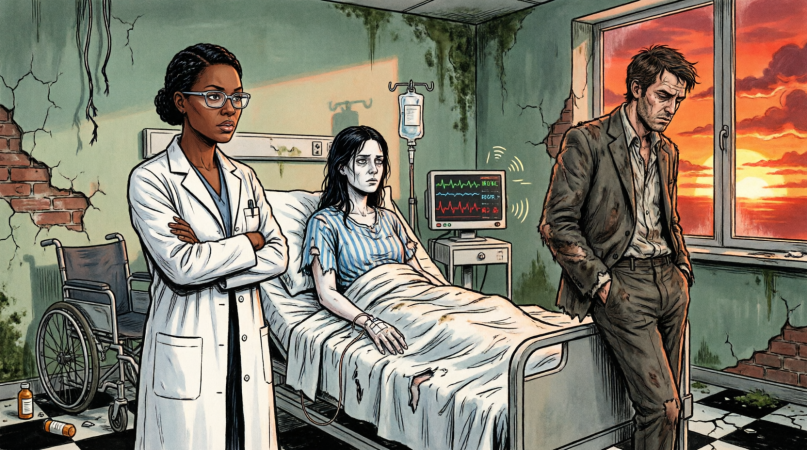
A hospital ceiling. An IV in my arm. Pain deep in my body. And beside my bed, standing stiffly with his face drained of color, was Daniel. I thought he was going to tell me whether our baby had survived. Instead, in a voice so flat it frightened me more than the water had, he said, “Maya… the doctors ran tests.
They found something else. And I need to tell you the truth before the police come back.” For a few seconds, I genuinely thought I was still dreaming. The room smelled of antiseptic and warm plastic. A monitor beeped somewhere near my head. My throat felt raw, my lungs tight, and there was a deep soreness low in my stomach that made me afraid to move.
I looked down first, because that was all I cared about. My hand went to my abdomen. Still rounded. Still there. “The baby?” I whispered. Daniel shut his eyes briefly, then looked away. “The baby is alive.” A shaky breath escaped me so suddenly it turned into a sob. Tears stung my eyes. “Then what—what truth?”
Before he answered, the door opened and a woman in navy scrubs stepped in with a clipboard. She introduced herself as Dr. Carla Bennett, calm and direct, the kind of doctor whose face told you she had delivered bad news before and knew how to keep her voice steady while doing it. “You were unconscious for a short time from oxygen loss and shock,” she said.
“We monitored the fetus immediately. There is distress, but at the moment there is still a heartbeat. However, the fall and near drowning triggered significant complications. We are watching you very closely.” I nodded, barely hearing the middle of her sentence. “You said they found something else?” She glanced at Daniel.
That look—brief, professional, and loaded—turned my blood cold. “In the imaging we performed,” she said carefully, “we found an old surgical scar pattern and internal evidence consistent with a prior second-trimester termination. Approximately two years ago, maybe a little less. We need your medical history to treat you properly.”
I stared at her. “No,” I said. She waited. “No,” I repeated, stronger. “That’s impossible.” Daniel’s face had gone gray. “Maya…” “I never had that procedure.” Dr. Bennett’s tone remained neutral.
“Medical imaging is rarely wrong about this kind of tissue change.” My heartbeat climbed so fast the monitor started chirping. I looked at Daniel, and then I knew. It was not certainty at first. It was memory rearranging itself with horrible speed—two summers ago, the “severe ovarian cyst” that had sent me to a private clinic Eleanor recommended.
Daniel had driven me there himself because I was bleeding lightly and dizzy. I had been given paperwork to sign while half-sedated from medication. Daniel told me the doctor had handled everything. He said I had been lucky. He said I needed rest and shouldn’t stress over details. At the time, we had just found out I was pregnant.
I had cried with relief after months of trying. Then, after that procedure, Daniel told me the pregnancy had not been viable, that there had been “complications,” that the doctor had to act quickly to save my health. I had believed him. Dr. Bennett was saying something about requesting prior records, but her words blurred. I turned to my husband slowly.
“You told me I lost that baby.” Daniel pressed his palms against the back of the chair near the window so hard his knuckles blanched. He looked trapped, cornered, smaller than I had ever seen him. “I didn’t know how to tell you,” he said.
The sentence was so weak, so cowardly, that I almost laughed. “You told me,” I said, each word slicing on the way out, “that our child died.” He swallowed. “My mother thought it would ruin everything.” That was the moment the room changed. Until then, some broken part of me had still expected confusion, a mistake, an explanation with loopholes and misunderstandings.
But his mother. He said it plainly. He said it as though it were an explanation any sane wife should accept. Dr. Bennett stepped back. She was no longer just a physician; she was a witness. “My mother thought a baby would trap me,” Daniel continued, voice trembling now. “We were struggling financially. I had just started at the firm.
She said we weren’t ready, that you were emotional, that if we waited a few years it would be better. She knew a doctor through a charity board. She arranged the clinic. She told them you were bleeding, that the pregnancy was failing, that immediate intervention was necessary.” I could not feel my fingers. “And you agreed?” I asked.
He opened his mouth, but whatever he meant to say died under the weight of the truth. Because agreement was too soft a word. Agreement sounded passive. Agreement did not capture driving your pregnant wife to a clinic, holding her hand while strangers prepared her, lying to her after her child was taken without her informed consent.
“Yes,” he said finally, and the single syllable was uglier than any scream. I looked at him and saw my marriage all at once: the gentle voice, the careful smiles, the way he had always asked his mother’s opinion before major decisions, the way Eleanor treated him less like a son and more like property she had loaned to the world. The door opened again.
This time it was a police officer with a notebook and a hospital security supervisor. They had already spoken to the family. They had statements. Paige had told them everything Eleanor said before and after shoving me.
Uncle Raymond had nearly jumped into the pool fully clothed to help pull me out. There were security cameras covering part of the patio. Eleanor had left the house before paramedics arrived, but officers were already looking for her. Then the officer asked a question that made Dr. Bennett set down her clipboard and sit beside me.
“Mrs. Whitmore,” he said gently, “based on what the doctor told us, and what your husband has now admitted, do you want to make a statement not only about the assault today, but also about the procedure performed on you in 2024 without your informed consent?”
Daniel’s head snapped toward me, panic finally breaking through his numbness. “Maya, please.” I had nearly died in his mother’s pool. I had lost a baby because my husband let his mother decide that my body was family property. And now, with another child still fighting inside me, he wanted mercy.
I lifted my eyes to the officer. “Yes,” I said. “I do.” The criminal case began before I was discharged. Because I was considered high-risk after the near drowning, the hospital kept me under observation for eight days. During that time, my room turned into a revolving door of doctors, detectives, and lawyers.
Dr. Bennett coordinated with a maternal-fetal specialist who explained, in plain terms, that stress could trigger preterm labor, so everyone needed to stop speaking to me like I was merely a source of evidence and remember I was still a patient carrying a viable pregnancy. For that alone, I could have kissed her. Paige came every day. She brought me unscented lotion because the hospital soap dried out my hands.
She brought me my phone charger, fresh clothes, and, on the fourth day, a thick envelope she slid onto the tray table without a word. Inside were printed screenshots: messages between Daniel and Eleanor dating back over two years. I read them in silence. At first, there was his hesitation. Are you sure this is necessary?
Then her command. You are not throwing your life away because she got pregnant at the wrong time. Then his weakness hardening into compliance. The clinic said they can classify it as emergency management if she arrives symptomatic.
Eleanor’s reply came three minutes later. Good. Tell Maya only what helps her recover. Grief passes. Ruined careers don’t. I thought I had run out of ways to be shocked. I had not…..”
I had not realized how deeply the roots of their control went until I held those pages in my hands. The ink was black, but the words felt like bruises. Grief passes. Ruined careers don’t. That was what my child had been worth to them. A potential inconvenience. A barrier to Daniel’s partnership track.
I handed the envelope back to Paige. My hands were steady now. The shock had hardened into something colder, something sharper. Resolve.
“Keep these safe,” I said. “I don’t want them in my room. If Daniel comes back…”
“He’s not coming back,” Paige said firmly. She was sitting in the visitor’s chair, her legs tucked under her, looking nothing like the woman who had shown me paint samples a week ago. She looked tired, but her eyes were clear. “I packed his things. I changed the locks on his apartment. Mom is staying with Uncle Raymond, but the police have her location. She’s not going anywhere.”
“Did he say anything else?” I asked.
“He tried to call me,” Paige said. “He was crying. Said he didn’t know Mom would push you. Said he thought the clinic thing was… necessary back then.” She shook her head, disgust curling her lip. “He still doesn’t get it, Maya. He thinks if he explains the why, the what becomes okay.”
“It doesn’t,” I said.
“No,” Paige agreed. “It doesn’t.”
The police officer returned ten minutes later. He took my statement formally this time. He asked about the pool, the push, the words Eleanor had shouted. Then he asked about the clinic. I told him everything. The dizziness, the paperwork, the waking up alone, the lie about the miscarriage. He wrote it all down. When he left, he told me that warrants were being drafted for both Eleanor and Daniel. Conspiracy to commit assault. Coercion. Medical fraud. Child endangerment.
The list was long.
I was discharged from the hospital two weeks later. The baby was stable, though the doctors warned me that the stress had aged the placenta. I needed rest. I needed quiet. I needed to be nowhere near the Whitmore family.
Paige took me in. Her apartment was small, filled with plants and soft light, a stark contrast to the sterile marble of the Whitmore estate. She set up a guest room for me with a view of the street below. She bought me pillows that supported my back and groceries that didn’t smell like barbecue smoke.
Daniel tried to send flowers. Paige intercepted them and threw them in the trash. He tried to send letters. I didn’t open them. He tried to show up at the hospital lobby once, but security escorted him out after I filed for an emergency restraining order.
The divorce papers were served a month later. My lawyer, a sharp woman named Sarah who specialized in high-conflict familial estates, handled everything. She didn’t just ask for a split. She asked for everything. Prenup be damned. Fraud voids contracts. Coercion voids agreements. And the public scandal was beginning to leak.
Someone from the hospital staff talked. Then someone from the police department. Then Paige, who decided silence was no longer loyalty.
The story hit the local news first. Socialite Pushes Pregnant Daughter-in-Law into Pool. Then the deeper stuff came out. Hospital Discovers Prior Coerced Abortion. Husband Charged as Accomplice.
Daniel’s firm didn’t wait for the trial. They issued a statement saying they were “deeply troubled by the allegations” and placed him on immediate administrative leave. By the time the leave turned into termination, his reputation was ash. The law community is small. People talk. He wasn’t just a man who couldn’t control his mother; he was a man who had lied to his wife about her own body.
Eleanor’s trial was scheduled for the spring. I was eight months pregnant by then. My belly was high and tight, a constant reminder of what I was fighting for. I didn’t want to testify. Sarah told me I didn’t have to. But I wanted to. I wanted Eleanor to see me. To see that I was still standing. That the baby was still kicking.
The courtroom was cold, much colder than the hospital had been. Eleanor sat at the defense table, wearing a suit that cost more than my car. She looked smaller than I remembered. The arrogance was gone, replaced by a brittle defensiveness. She didn’t look at me. She stared at her lawyer’s notes.
Daniel was there too. He had taken a plea deal. Testify against his mother in exchange for reduced sentencing. He sat in the gallery, hands clasped, eyes red-rimmed. When I walked in, he stood up. Instinct, maybe. Or guilt. I walked past him without breaking stride.
On the stand, I spoke quietly. I didn’t shout. I didn’t cry. I just told the truth. I described the pool. I described the clinic. I described the way Daniel had held my hand while they took my child away. I described the way Eleanor had laughed as I sank beneath the water.
The jury didn’t take long. Four hours.
Eleanor was found guilty on all counts. Aggravated assault. Criminal coercion. Fraud. The judge sentenced her to twelve years in state prison. No parole for the first eight. When the gavel fell, she didn’t scream. She just looked at Daniel, her eyes wide with betrayal. She had done it for him. For his career. For his future. And he had traded her for a lighter sentence.
Daniel got three years probation and community service. He lost his license to practice law in the state. He lost his home. He lost his wife. He lost his mother. He stood in the hallway after the verdict, waiting for me.
“Maya,” he said. His voice was rough. “I know you can’t forgive me. But I want you to know… I loved you. In my way.”
I stopped. I turned to look at him. He looked hollowed out. The suit hung loosely on his frame. The confidence was gone.
“Your way,” I repeated. “Your way involved lying to me. Your way involved letting your mother decide what happened to my body. Your way involved watching me drown and doing nothing until it was too late.”
“I panicked,” he whispered.
“We all panic, Daniel. But we don’t build lives on it.” I shifted my weight. The baby kicked, a strong roll against my ribs. “I hope you find someone who accepts your way. But it won’t be me. And it won’t be any woman who knows the truth.”
I walked away. I didn’t look back.
The baby came three weeks later. A boy. Seven pounds, four ounces. Perfect fingers, perfect toes, lungs that screamed with the fury of someone who had fought to be here. I named him Leo. It means lion. Because he was fierce. Because he had survived.
I held him in the hospital bed, the same room where I had almost died, and I cried. Not tears of sadness. Tears of relief. He was real. He was warm. He was mine.
Paige was there, holding a camera. “He has your nose,” she said.
“And Daniel’s chin,” I replied, tracing the line of Leo’s jaw. It wasn’t a complaint. It was just a fact. He was his own person. Not a Whitmore. Not a prop. Just Leo.
We moved out of New York six months later. The city held too many ghosts. Too many memories of pool parties and secret clinics and smiling lies. I took the settlement money—the substantial sum Sarah had negotiated—and bought a small house in Vermont. Green mountains. Quiet roads. Air that smelled like pine and snow, not chlorine.
I started working again. Not in finance, not in the corporate world that Daniel had prized so highly. I opened a small consultancy from my home. I helped women navigate financial independence after divorce. After trauma. I told them what I had learned: that money can be replaced. That careers can be rebuilt. But that you must never let anyone convince you that your body is not your own.
Paige visited often. She and her parents were estranged now. She spent holidays with me and Leo. She was the aunt he deserved. The one who brought gifts without strings. The one who loved him without conditions.
Daniel sent child support checks every month. They cleared without issue. He never asked to visit. I think he knew he had lost that right. Sometimes I saw his name in the news—local papers, brief mentions. He was working at a legal aid clinic now. Pro bono work. Maybe he was trying to fix something. Maybe he was just trying to survive. I didn’t care.
One afternoon, a year after the trial, I was in the garden. Leo was asleep in his stroller, wrapped in a blanket. The sun was warm on my back. I was pulling weeds, my hands dirty in the soil.
The phone rang. I wiped my hands on my jeans and answered. It was an unknown number.
“Maya?” The voice was familiar. Older. Frailer.
I froze. It was Eleanor. Calling from prison.
“How did you get this number?” I asked.
“Paige,” she said. “She… she relented. For a moment.”
“What do you want, Eleanor?”
“I wanted to hear his voice,” she said. “My grandson.”
“No,” I said.
“Maya, please. I made mistakes. I see that now. The prison… it gives you time to think. I did it for Daniel. I did it for the family.”
“You did it for control,” I corrected. “And you lost everything because of it.”
“I have nothing left,” she whispered. “Just this phone. Just this voice.”
I looked at Leo. His chest rose and fell peacefully. He was safe. He was loved.
“You had a family,” I said. “You threw them away. Don’t ask me to fix what you broke.”
“Maya—”
“Goodbye, Eleanor.”
I hung up. I blocked the number.
I sat down on the bench beside the stroller. The sun was setting, casting long shadows across the grass. The air was cooling. Inside the house, the phone was silent. The past was silent.
Leo stirred. He opened his eyes, blue and clear, and looked up at me. He didn’t know about the pool. He didn’t know about the clinic. He didn’t know about the courtroom or the lies or the betrayal. He only knew that I was here. That he was warm. That he was safe.
I leaned down and kissed his forehead.
“We’re okay,” I whispered. “We’re really okay.”
And for the first time in my life, I believed it.
The Whitmore name was tarnished. The estate in Westchester was sold to pay legal fees. Eleanor was serving her time. Daniel was living in a small apartment in Queens, working a job that didn’t matter. They had wanted to protect their legacy. Instead, they had destroyed it.
I stood up and pushed the stroller toward the house. The porch light was on, a warm yellow beacon in the twilight. I unlocked the door. I walked inside. I locked it behind me.
I made dinner. I bathed Leo. I read him a story about a little bird who learned to fly. He fell asleep halfway through, his hand curled around my finger.
I sat in the rocking chair and watched him sleep. I thought about the woman I had been two years ago. The one who stayed quiet at the cookout. The one who apologized for taking up space. The one who trusted when she should have questioned.
She was gone.
In her place was someone stronger. Someone who knew the cost of silence. Someone who knew that love shouldn’t hurt.
I turned off the lamp. I walked to the window and looked out at the dark yard. No pool. No patio. Just grass. Just trees. Just space to breathe.
I went to the kitchen and poured a glass of water. I drank it slowly. Then I washed the glass and put it in the drying rack.
Tomorrow, I would wake up. I would make coffee. I would work. I would play with Leo. I would live.
And no one would ever push me under again.