My parents told everyone at their family reunion, “She’s just a cook on a ship.” Everybody laughed. Then the admiral walked straight past my father and saluted me. What Grandpa left behind… destroyed them all in one room.
Have you ever been invisible to the people who were supposed to see you most? Not forgotten, not ignored— invisible like you were standing right there in the same room, at the same table, under the same roof, and they simply looked through you. Like the space you occupied didn’t register, like you were furniture they had stopped noticing years ago.
That was my family.
For thirty-one years, I was the background of their story. The one they mentioned last, explained away quickly, moved past without lingering. My brother Kyle got the parties, the investment, the pride. I got the silence.
And when I joined the Navy at eighteen, my father laughed. “The Navy doesn’t need little girls,” he said. “Maybe you can cook on the ship.”
He said that at the dinner table in front of everyone.
I didn’t argue. I didn’t cry. I just made a decision—quiet, certain, the way I made every decision that mattered. And I carried it with me for the next sixteen years.
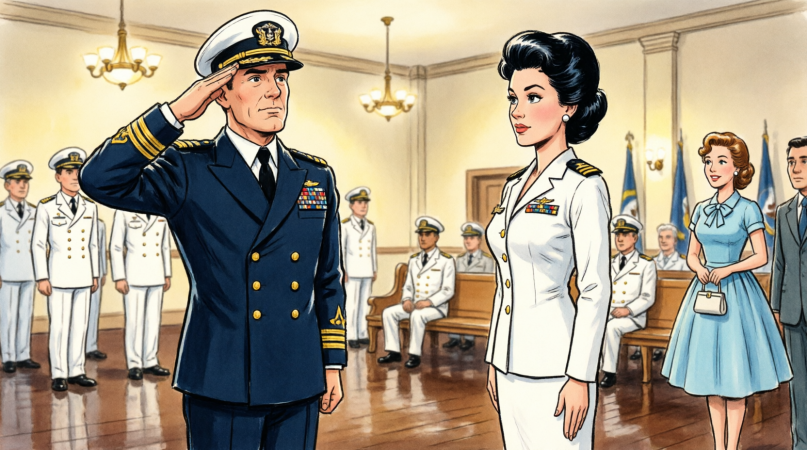
My name is Petra Callahan. And three months ago, at Naval Air Station Pensacola, my mother stood in the front row of my promotion ceremony and watched two stars get pinned onto the shoulders of the daughter she had spent years calling nothing special. What she didn’t know was that I had heard her say those words in that hallway, ten steps behind her, seven minutes before they called my name.
Before I tell you what happened next, please take a moment to like and subscribe, but only if you genuinely enjoy this story. Also, I’d love to know where you’re watching from and what time it is there. Drop a comment below.
Now, let me take you back to where it all started.
The Callahan house on Birchwood Drive in Raleigh, North Carolina, was the kind of house that looked perfectly fine from the outside. Three bedrooms. A covered porch. A backyard big enough for a grill and a folding table. Ray Callahan’s truck parked in the driveway every evening by five-thirty, still carrying the dust of whatever job site he had worked that day. Linda Callahan’s rose bushes lined the front walk, trimmed every Saturday morning without fail.
From the outside, it looked like a home where everyone was taken care of.
From the inside, it was a home where everyone understood, without anyone ever saying it directly, exactly who mattered most.
That person was Kyle.
Kyle was four years older than me, broad-shouldered, easy-laughing, the kind of son who filled a room without trying. He had our father’s jaw and our mother’s confidence and the particular gift of making every adult in his vicinity feel important just by paying attention to them. Teachers loved him. Neighbors loved him. The guys at Ray’s job site asked about him by name.
Kyle was the story our family told the world.
I was the footnote.
I understood this early. Not from a single moment—no one sat me down and explained the hierarchy. It was something I absorbed the way children absorb everything that isn’t spoken directly. In the way dinner conversation circled back to Kyle’s baseball stats and never lingered on my honor roll certificate. In the way Ray’s face changed when Kyle walked into a room, a brightening subtle but unmistakable, like a lamp turning on. In the way that same face stayed perfectly neutral when I walked in after him.
I told myself it didn’t mean anything. I almost believed it.
Ray Callahan was not a cruel man. I want to be careful about that. He worked hard. He came home every night. He never raised his hand to anyone in that house. But he was a man who had very specific ideas about what was worth being proud of. And those ideas had been formed long before I was born—on job sites and in locker rooms and in the particular silence of a generation of men who showed love through provision and assumed that was enough.
A son who could build something with his hands. A son who could run something. A son who could be pointed to and said, “That one is mine.”
A daughter who wanted to join the military was, at best, a curiosity. At worst, a detour from the real life she was supposed to be living.
Linda was different in the way that made it almost harder.
She wasn’t indifferent. She was warm, genuinely warm, the kind of mother who remembered your favorite color and packed your lunch with a note inside until you were old enough to be embarrassed by it. But her warmth had a shape, and that shape fit Kyle more naturally than it fit me.
With Kyle, her love was expansive, enthusiastic, loud in the way love should be loud when it has no reason to hold back. With me, it was careful, measured, like she was always slightly uncertain of what I needed, and rather than ask, she defaulted to less. Less attention. Less expectation. Less space.
I learned to take up less space.
The first time I understood the difference clearly—not felt it, but understood it—was the summer Kyle graduated from high school. He had a 3.1 GPA. He had been accepted to a state school in Charlotte on partial scholarship, mostly because Ray had called in a favor from someone who knew someone on the admissions board. He had not distinguished himself academically. He had, however, played two years of varsity baseball and been voted most likely to succeed by a class of two hundred and forty-three students who liked him enormously.
The party Ray and Linda threw in the backyard that June had forty-one guests. I counted. I was thirteen years old, and I sat on the back porch steps and counted every single one of them.
Forty-one people. Folding tables borrowed from the church. A banner from the print shop downtown that read, “Congratulations, Kyle,” in blue and gold letters two feet tall. A catered spread from the barbecue place on Glenwood Avenue—ribs, pulled pork, three kinds of sides. A cake from the French bakery near Crabtree Valley Mall. Three tiers, buttercream frosting, Kyle’s full name written in icing across the top.
Ray stood at the grill in his good shirt and laughed louder than I had ever heard him laugh. Linda circulated between tables in her yellow dress, accepting congratulations like they were her own.
It was the happiest I had ever seen my parents.
Four years later, I graduated from the same high school with a 4.0 GPA. I had been accepted to the United States Naval Academy in Annapolis, Maryland, one of the most selective institutions in the country, with an acceptance rate under nine percent. I had earned it on merit alone. No favors. No connections. Just four years of work that I had done quietly and without anyone asking how it was going.
The night I graduated, we had pizza delivered to the living room.
My mother had ordered a cake from the grocery store bakery three days earlier and forgotten to pick it up. She remembered at nine o’clock that evening, after the stores had closed. She apologized. I told her it was fine.
There was no banner. There was no table from the church. There were no forty-one people in the backyard. There was Ray on the couch watching a preseason game. There was Linda on the phone with her sister. There was Kyle, who stopped by for twenty minutes between plans, said, “Good job, Petra,” in the tone of someone completing a minor errand, and then left.
I sat at the kitchen table with a slice of pizza and my acceptance letter from Annapolis. And I told myself it didn’t matter.
I was getting very good at telling myself things.
The one person who sat down next to me that night, who pulled out the chair, who asked to see the letter, who read every word of it slowly and carefully the way you read something that deserves to be read, was Grandpa Harold.
Harold Callahan was seventy-four years old that summer. He had served in the United States Navy during the Korean War, two years aboard a destroyer in the Sea of Japan. And he carried that service the way certain men carry certain things—not loudly, not for display, but present always in the way he held himself, in the way he listened, in the way he understood without needing to be explained to.
He read my letter twice. Then he set it down on the table and looked at me for a long moment.
“You know what I see when I look at you?” he said.
I shook my head.
He tapped the letter once with two fingers. “I see someone who already knows how to be alone and keep moving. That’s not nothing, Petra. That’s almost everything.”
He folded the letter carefully and handed it back to me.
“You’ve got the kind of quiet that becomes commanders,” he said. “Don’t let them talk you out of it.”
I didn’t know what to say, so I didn’t say anything. I just held that letter in both hands and nodded.
Outside, I could hear the television from the living room, the game, Ray’s voice low and comfortable, saying something that made Linda laugh. Neither of them came into the kitchen that night.
I didn’t expect them to.
But I kept Grandpa Harold’s words in a part of me that nothing could reach—the part I had been quietly building for years, brick by brick, in the dark without anyone watching.
The summer I turned seventeen, I found Grandpa Harold’s Navy medals displayed in a worn wooden box on the shelf above his desk. A Purple Heart. A Korean Service Medal. A ribbon I didn’t recognize but looked up later in the school library. I held them in my hands for a long time, and something inside me shifted, something that would never shift back.
The conversation happened on a Tuesday night in October. I was seventeen, senior year, four months away from submitting my application to the Naval Academy. I had already spoken with my school’s military liaison, already gathered my teacher recommendations, already begun the physical fitness requirements on my own—running three miles every morning before school, doing push-ups in my bedroom at night while Kyle’s music thumped through the wall between our rooms.
I had been preparing quietly for eight months.
That night at dinner, I decided to stop being quiet.
“I want to apply to the Naval Academy,” I said. “In Annapolis. I’ve already started the process.”
The table went still.
Ray set down his fork. Not quickly—slowly, deliberately, the way he set things down when he was deciding how to respond to something that had surprised him. Linda looked at me, then at Ray. Kyle kept eating. He reached for the salt without looking up.
Ray leaned back in his chair. He looked at me for a long moment with an expression I had seen before, the one he used when someone said something he found mildly absurd but didn’t want to be rude about. The expression he used on telemarketers, on neighbors with bad ideas.
Then he laughed.
Not a mean laugh. Not a sharp laugh. Just a low, easy, dismissive laugh. The kind that doesn’t need words because the laugh itself is the entire sentence.
“The Navy doesn’t need little girls, Petra,” he said.
He picked his fork back up. “Maybe you can cook on the ship.”
Kyle snorted once into his water glass, then looked out the window.
Linda said nothing. She reached over and touched Ray’s arm, not to correct him, just the reflexive gesture of a woman smoothing the air after a bump. Then she said, “Have you thought about something closer to home, honey? There’s a good nursing program at State.”
I looked at my plate.
I did not argue. I did not raise my voice. I did not cry. Not at that table. Not in front of them. Not ever about this.
I just noted, with a clarity that surprised me with its coldness, that my father had just described my ambition as a punchline, and my mother had responded by offering me a smaller version of a life she found more comfortable to imagine for me.
I ate the rest of my dinner. I cleared my plate. I went to my room, and I kept preparing.
But that laugh—low and easy and completely unbothered—lived in me for a long time after that.
I heard it in quiet moments on the USS Harmon. I heard it during qualification exams at Annapolis. I heard it at 0400 on a deployment when the Persian Gulf was flat and black and I was the senior officer on watch. I heard it every single time I was tempted to believe that maybe they had been right.
The next year, while I was in my first semester at Annapolis, Ray made a decision about money.
Kyle had come home from his second year at the state school in Charlotte with a business plan. He wanted to open an auto dealership. He had found a location in a suburb north of Raleigh, a former used-car lot available for lease in a corridor that was growing fast. He had done some research. He had a number in mind.
He needed seventy thousand dollars to get started.
Ray and Linda had been saving for twenty-two years. They had a joint account that Ray referred to, in the rare moments he mentioned it, as the family fund. I had grown up understanding that money existed in that account—not how much, not what it was for exactly, just that it was there, a quiet fact in the background of our lives, like the water heater and the mortgage.
Ray wrote Kyle a check within forty-eight hours of hearing the plan.
I found out from Linda on a Sunday phone call, mentioned almost in passing between updates about the rose bushes and a new recipe she had tried.
“Your father helped Kyle get started on his business,” she said. “We’re very excited for him.”
I was sitting on my bunk at Annapolis. I had three hundred and twelve dollars in my personal checking account. I was on a full academic scholarship, so tuition was covered, but incidentals were not—textbooks, uniform accessories, personal supplies, the small things that add up when you have nothing.
“That’s great,” I said. “Good for Kyle.”
“How are your classes?” Linda asked.
“Fine,” I said.
She asked two more questions, both about whether I was eating enough and whether I had made any friends. Then the call ended.
I had not asked for seventy thousand dollars.
I had not asked for anything close to seventy thousand dollars.
Three months earlier, before I left for Annapolis, I had asked Ray once—carefully, briefly—whether they could help with the cost of some required equipment that my scholarship didn’t cover. The total was four hundred and twenty dollars.
He had told me to figure it out.
I figured it out. I picked up extra hours in the dining facility on weekends for six weeks until I had enough. I never asked again.
The contrast became a language of its own over the years, a grammar I learned to read fluently without needing to be taught. Kyle’s dealership opened the following spring. Ray and Linda drove up for the ribbon cutting. Linda baked two dozen cookies for the staff. Ray spent the weekend helping Kyle hang signage and set up the small office in the back. He came home sunburned and pleased, talking about Kyle’s instincts, Kyle’s location, Kyle’s potential.
I completed my plebe year at Annapolis with a 3.9 GPA and was selected for the surface warfare track, one of the most demanding paths in the academy, the one that would eventually put me in command of a ship.
There was no ribbon cutting.
There was no phone call from Ray. Linda sent a card, a generic congratulations card from the grocery store, the kind with a foil balloon on the front, with a twenty-dollar bill tucked inside and a note in her handwriting.
So proud of you, honey. Stay safe.
The twenty dollars was meant warmly. I understood that. I kept the card for years.
But I also understood the grammar.
Kyle’s milestones were events. They were occasions that required presence, investment, celebration, the full weight of the family’s attention brought to bear on a single point. My milestones were things that happened somewhere else, to someone who had chosen to go somewhere else, and were acknowledged from a comfortable distance with a card and a bill.
I told myself I had made peace with it.
I was still working on that.
The one constant through all of it was Grandpa Harold. He called me every Sunday without exception for the four years I was at Annapolis. Always at seven o’clock in the evening Eastern time, always from the landline in his den on Merit Avenue in Raleigh. The calls lasted between twenty and forty minutes.
He asked specific questions.
Not “How are you?” in the vague way people ask when they don’t really want to know, but real questions. What are you working on this week? What’s the hardest part right now? What did you figure out that you didn’t know last month?
He listened to the answers, all of them, without changing the subject.
In the four years I was at the academy, my father called me six times. My mother called more often, but rarely asked anything that required more than a two-sentence answer.
Grandpa Harold called every single Sunday.
In my second year, I told him about a navigation exercise I had nearly failed, a night simulation that had gone wrong in three different ways, and how I had stood in the debrief room afterward feeling, for the first time since arriving, genuinely uncertain about whether I belonged there.
He was quiet for a moment after I finished.
“Did you fail it?” he asked.
“No,” I said. “I passed. Barely.”
“Barely counts,” he said. “Barely is how most things worth doing get done the first time.”
He paused.
“Don’t let one hard night make you small, Petra. You hear me?”
I heard him.
I drove to Annapolis alone. I signed my name alone. And I told myself that was fine.
I almost believed it.
The first time I came home in uniform was the summer after graduation. I had pressed my whites the night before, every crease exact. The single gold stripe of an ensign on my sleeve—earned through four of the hardest years of my life at an institution with an acceptance rate under nine percent, in a program that had broken people who were stronger than me in every way except one.
I was still standing.
I drove to Raleigh on a Friday afternoon and walked through the front door of the house on Birchwood Drive for the first time in nearly four years.
Linda hugged me at the door, warm and genuine the way she always was. She said I looked wonderful and asked if I was hungry.
Ray looked up from his chair in the living room. He looked at my uniform for a long moment—not the way Harold looked at a uniform, with recognition and respect, but the way he looked at things he didn’t fully understand. Neutrally. Like he was deciding whether a response was required.
“You look like a waitress,” he said.
No malice. No intent. Just a man who had looked at his daughter in the dress whites of a commissioned officer of the United States Navy and reached without effort for the most reductive comparison available to him.
I put my bag in my room and did not respond.
That evening, Kyle came for dinner. He arrived in a new silver Lexus, and Ray was at the door before the engine cut off. The greeting was physical, loud, immediate—nothing like the nod I had received three hours earlier.
Dinner was animated. Ray asked Kyle specific questions about the dealership—inventory, margin, staffing, expansion plans—with the focused attention of a man who had been tracking a situation closely and genuinely cared how it turned out.
At some point, someone remembered I was there.
“How’s the Navy?” Kyle asked. He was already looking at his phone.
“Good,” I said.
“Cool,” he said.
The conversation moved on in under four seconds.
Ray asked Kyle two more questions before the plates were cleared. He asked me nothing further for the rest of the evening.
I counted that night, staring at the ceiling of my childhood bedroom.
Eleven questions for Kyle.
Zero for me.
The call that finally broke something open happened eight months later. I was at Mayport by then, deep in my surface warfare officer qualification, fourteen months of study and practical assessment, mastering the systems of a warship well enough to be trusted with its operation. It was the hardest professional challenge I had faced since Annapolis.
It was also the most alive I had ever felt.
I passed my final qualification board on a Thursday morning in February. The examining officer shook my hand and said my performance had been among the strongest he had seen in three years of running the board.
I called home from the parking lot, still in uniform, still carrying the clean, particular high of having done something genuinely difficult very well.
Linda answered on the third ring.
“Mom,” I said, “I just finished my surface warfare qualification. It’s one of the most demanding certifications in the Navy. I wanted to tell you.”
“Oh, honey, that’s wonderful,” she said. Her voice was warm, reflexively warm. “What does that mean exactly?”
I started to explain. I was three sentences in when I heard it—the slight flattening of attention, the breath shift of a person beginning to disengage.
Then, clearly in the background, Kyle’s voice, and Linda half turned away already.
“Hold on, sweetheart. I’m on with Petra.”
A pause.
Then back to me, brighter, wrapped in apology. “Honey, Kyle is on the other line. Can I call you back? I want to hear all about this. I really do.”
She did not call back.
I sat in that parking lot until the sun went down over the St. Johns River, watching the sky do something extraordinary in oranges and pinks, and I thought about how many times I had tried to be heard by people who had never learned how to listen.
I drove to Raleigh the following Saturday.
Grandpa Harold was in his den on Merit Avenue, sitting in his good chair by the window. He was thinner than I remembered. His hands rested in his lap with the careful stillness of a man who had started conserving his energy, deliberately measuring it out in precise portions against an uncertain supply.
He looked up when I walked in, and his face did what it always did when he saw me.
It opened.
“There she is,” he said.
I sat with him for two hours. We talked the way we always talked—specifically, honestly, without the social padding that filled conversations with everyone else in my family. He asked about the qualification. He asked about the board. He asked what the hardest part had been and listened to the full answer without redirecting.
When I finished, he was quiet for a moment.
“You know what the difference is between you and most people?” he said.
I shook my head.
“Most people need someone watching to keep going.” He looked at me steadily. “You keep going in the dark. That’s the rarer thing, Petra. That’s the thing that matters.”
He reached over to the small table beside his chair and picked up an envelope, white, plain, my name written on the front in his careful handwriting. He pressed it into my hands.
“Don’t open it yet,” he said. “When you need it, you’ll know.”
I turned it over, sealed. Light. A letter and something small inside.
“There’s something else.”
He reached into the side drawer of the table and brought out a small box, worn at the corners, the kind that has been opened and closed many times over many years. He set it on his knee and lifted the lid. Inside, on a bed of faded felt, was his Korean Service Medal.
He picked it up carefully and held it toward me.
“I want you to have this,” he said.
“Grandpa—”
“I’ve thought about it.” His voice was quiet, but without uncertainty. “I know who should carry it next.”
I took it from him. It was lighter than I expected, cool against my palm.
“Don’t let them tell the story of who you are,” he said. “You do that yourself.”
He squeezed my hand once. I held on longer than I needed to.
Six months later, Grandpa Harold passed away quietly in a VA hospital in Raleigh on a Tuesday morning in November. A nurse he had apparently charmed thoroughly in his final two weeks was holding his hand. I drove up that same afternoon. I sat with him for a while in that room the way you sit with someone who is no longer there but whose presence has not fully left the space yet.
I held his hand.
I read the letter from the envelope he had given me there in that room, finally, because I understood that this was the moment he had meant. It was one page, his careful handwriting, seven sentences.
The last one was this:
You carry something I never had the words for. Carry it all the way.
I folded the letter and put it back in the envelope. I put the envelope in my jacket pocket beside the Korean Service Medal. I drove back to Jacksonville in the dark.
I did not tell Ray and Linda what the letter said. I did not tell them about the medal. These were things that belonged to Harold and to me, in the private space between two people who had understood each other without requiring an audience.
Some things are not for sharing.
Some things you simply carry.
All the way.
Eight years after I first walked through the gates at Annapolis, I went home for Thanksgiving. I almost didn’t go. I had legitimate reasons not to. I was deep in a transition between postings. There was paperwork that needed attention. Eli had invited me to spend the holiday with his family in Savannah, which sounded quieter and warmer in every sense of the word.
But Linda had called in October and asked, in that particular voice she used when she wanted something but wouldn’t say so directly, whether I was planning to come home this year.
“It would mean a lot to your father,” she said.
I had learned over the years to hear what that sentence actually meant. It meant, I want you there, but I won’t say I want you there because wanting things from you directly has never been something I’ve practiced. It meant, Come home, Petra, wrapped in someone else’s name because her own was too vulnerable to use.
I booked the flight.
The house on Birchwood Drive looked the same as it always had. Ray’s truck in the driveway. Linda’s rose bushes cut back for winter, the canes tied with twine against the cold. The porch light on even though it was two in the afternoon.
Linda hugged me at the door and said I looked thin and asked about the flight before I had fully crossed the threshold. Ray appeared from the living room, nodded once, said, “Petra,” in the tone of a man acknowledging a piece of furniture that had been rearranged without his input, and returned to his chair.
I put my bag in my old room.
Nothing in it had changed. The same comforter. The same desk. The same water stain on the ceiling. There was a stack of Kyle’s dealership brochures on the desk, which told me the room had been used for storage at some point and only recently cleared.
I sat on the edge of the bed for a moment and breathed.
Eight years, I thought. Eight years, and it still smells exactly the same.
The gathering that evening had twenty-two people—extended family, a few neighbors, Ray’s brother and his wife from Greensboro, Linda’s cousin Patricia and her husband, who had driven up from Fayetteville.
The house was full in the particular chaotic way of Southern Thanksgiving—overlapping conversations, football on the television, the smell of sweet potato casserole from the kitchen. It should have felt like home.
It felt like a party I had been invited to as an afterthought.
Ray moved through the room with the ease of a man in his natural habitat, greeting people by name, accepting a beer from his brother, standing at the center of a cluster of men near the television who were arguing cheerfully about the game. He was relaxed in a way I had rarely seen him be anywhere else.
Kyle arrived at five-thirty with his girlfriend, a woman named Amber who worked in real estate and had the particular confidence of someone who had never once questioned whether they belonged in a room.
Kyle walked in like he owned the square footage. Handshakes from Ray’s brother. A hug from Linda that lasted longer than the one she had given me at the door.
I was in the kitchen refilling my water glass when I heard it begin.
“Kyle just signed a contract for fifty new vehicles this quarter,” Linda was telling Patricia, her voice carrying the warm elevation it always carried when she talked about Kyle. “The dealership is just doing so well. We’re so proud of him.”
Patricia said something appreciative. Linda continued.
I carried my water glass back to the living room and found a seat near the window.
Ray made the introductions sometime after dinner, when the plates had been cleared and people were settling into the comfortable looseness of a holiday evening well-fed. He moved through the room with a kind of practiced ease, steering from one cluster to the next, performing the function of family patriarch with the confidence of a man who had never questioned his right to that role.
When he reached me, he put a hand briefly on my shoulder.
“You all know Petra,” he said to the small group nearby—Ray’s brother, his wife, and a neighbor I recognized from years ago whose name I could not immediately place. “She’s in the Navy, works on ships.”
He moved on before anyone could respond.
Works on ships.
Eight years. Three deployments. A surface warfare officer qualification that had taken fourteen months. A posting as department head aboard a guided-missile destroyer. A record that my superiors had described in formal evaluation language as exceptional.
Works on ships.
Ray’s brother turned to me with the friendly openness of a man who genuinely wanted to make conversation.
“What do you do on the ship, Petra?”
I opened my mouth to answer.
Ray, already three feet away and apparently still within earshot, called back without turning around. “She does whatever they tell her to do.”
He said it lightly, almost cheerfully, the way you say something you believe is simply true.
Ray’s brother laughed—not cruelly, just reflexively, the way people laugh at things that seem like they might be jokes.
I smiled. I answered Ray’s brother directly, calmly, with as much specificity as the moment could hold. I explained what a surface warfare officer did. I described the qualification process. I mentioned that I had served as department head and was transitioning to a new posting.
Ray’s brother nodded, genuinely interested. His wife asked a follow-up question.
For four minutes, the conversation was real.
Then Kyle appeared at the edge of the group with a fresh beer and said something about the dealership, and the current shifted the way currents do in that house—naturally, effortlessly—toward him.
I stepped back.
I did not fight the current. I had stopped fighting it years ago. I simply noted it with the same cold clarity I had developed at seventeen, sitting at a dinner table, listening to my father laugh at my ambitions.
Later, I stood alone in the hallway outside the kitchen and looked at the wall of family photographs Linda had assembled over thirty years. School photos, holiday photos, candid shots from various summer gatherings. Kyle’s dealership opening framed prominently, the ribbon-cutting image—Kyle and Ray shoulder to shoulder, both of them grinning.
I found three photographs of myself on that wall.
One from elementary school, second grade, gap-toothed and squinting into the sun. One from a Christmas when I was approximately twelve, standing slightly apart from the rest of the family in the way I always stood slightly apart in photographs, as if I already understood that I was adjacent to the center of the story rather than in it. One from high school graduation.
Not from my graduation from the Naval Academy.
From high school.
The academy graduation, which I had attended alone and which had been one of the defining moments of my young life, was not on the wall.
I stood there for a long time.
Eight years, I thought again. Eight years and not one photograph in this uniform. Not one photograph of anything I had built. Not one image that said, This person, this life, this achievement—this also belongs to us.
I went to bed at nine-thirty. I lay in my childhood bedroom staring at the ceiling, and I counted slowly, carefully, the way I counted things when I needed to stay calm.
How many times, in the eight years since I had left for Annapolis, my parents had asked me a single question about my career. Not about whether I was safe. Not about whether I was eating. About my career. About what I did. About who I was becoming.
I counted.
The answer was zero.
That night, I lay there in the dark and felt something I had not let myself feel in a very long time. Not anger. Not sadness. Just the clean, quiet exhaustion of a person who has been trying to be seen by people who have never once learned how to look.
I did not sleep well. And I did not know, lying there in that room, that the worst moment was still three months away.
The morning after Thanksgiving, I woke at 5:15. Old habit. The body forgets a lot of things over the years, but it never forgets a watch schedule.
I lay there for a few minutes in the dark, listening to the house. It was the particular silence of a house where everyone else was still asleep. Thick. Undisturbed. The silence of people with nowhere to be.
I got up. I put on running clothes. I ran four miles through the quiet Raleigh streets in the cold November dark, the way I had run every morning for sixteen years, and I came back to the house with my mind clear and my breathing steady and something almost like peace sitting lightly in my chest.
It did not last.
I was in the kitchen at 7:45 making coffee when I heard Linda’s voice. She was in the small sitting room off the hallway, the room she used for phone calls, for the crossword, for the quiet separate life she maintained alongside the louder one in the rest of the house. The door was half open. I was ten steps away, on the other side of the kitchen wall, close enough to hear everything clearly and too far away for her to know I was there.
She was talking to her sister, Carol.
I knew Carol’s voice in the gaps, that particular rhythm of a long-distance call between two women who had been talking to each other their entire lives—the easy overlapping, the shared shorthand of decades.
I poured my coffee.
I was not listening, and then I was.
“Kyle just had his best quarter yet,” Linda was saying. Her voice carried the warmth it always carried when she talked about Kyle. Unguarded. Genuinely proud. “Ray and I are just so happy for him. He’s really built something, Carol. You should see the lot. They’ve expanded twice now.”
Carol said something.
Linda laughed.
“Petra’s here, too. She came in yesterday.”
A brief pause. The pause of a woman searching for something to say about a topic she hasn’t prepared for.
“She’s still in the Navy.”
Another pause.
“Oh, you know.” Linda’s voice shifted slightly, lighter now, almost breezy, the tone of someone setting something down that they don’t want to carry very far. “She’s just a cook on a ship, Carol. Nothing special. Kyle is the one we’re proud of.”
I stopped.
The coffee cup was in my hand. The steam was rising. I stood completely still in that kitchen, and I listened to the silence that followed my mother’s words—the comfortable, untroubled silence of a woman who had just summarized her daughter’s life in twelve words and felt no particular discomfort about it.
Nothing special.
I heard it once, twice, three times in my head. The words didn’t change.
Just a cook on a ship.
Nothing special.
Sixteen years. Three deployments to active conflict zones. A surface warfare qualification earned in the top percentile of my cohort. Command of a guided-missile destroyer. A record that had, just three weeks ago, in a formal board review I had not told my family about because I had stopped expecting them to ask, been nominated for promotion to rear admiral.
Nothing special.
Linda was still talking. She had moved on to something about Carol’s daughter’s new apartment. Her voice was warm again. Easy again. The voice of a woman for whom the previous twelve words had required no effort and left no mark.
I set the coffee cup down on the counter carefully, quietly. My hands were steady. That surprised me faintly, that my hands were so steady. I had expected something to shake, but there was nothing like that.
There was only the cold, crystalline clarity of a moment in which something that had been slightly blurred for a very long time came suddenly, irreversibly, into focus.
I had spent sixteen years trying to earn a sentence.
Just one.
We’re proud of Petra.
I had earned degrees. I had earned qualifications. I had earned command. I had earned the right to stand on the bridge of a warship in the Persian Gulf at three in the morning with forty-seven lives depending on my judgment.
And I had not failed them.
And in that kitchen, in that house, on that ordinary Friday morning after Thanksgiving, I finally understood with a completeness I had never allowed myself before:
The sentence was never coming.
Not from them. Not ever.
And for the first time in sixteen years, standing in that kitchen in my running clothes with a cup of coffee I no longer wanted, I stopped needing it.
It happened quietly. No dramatic rupture. No flood of feeling. Just a door closing softly from the inside.
I was done.
Linda came into the kitchen four minutes later. She was in her robe, her hair still loose, carrying her phone and her reading glasses. She saw me at the counter and her face arranged itself into the pleasant morning expression she wore before the day had made any demands on her.
She stopped when she registered my face.
Not because I looked angry. I did not look angry. I think she stopped because I looked different in a way she couldn’t immediately identify, like something that had been present for a very long time was no longer there.
“Oh,” she said. “I didn’t see you there.”
I looked at her for a moment. She held my gaze for two seconds, then glanced toward the coffee maker. No apology. No flicker of recognition. Just, I didn’t see you there, as if the problem had been proximity rather than everything else.
“I know,” I said.
I picked up my car keys from the counter. I took my coffee cup to the sink and rinsed it. I went to my room, changed out of my running clothes, packed my bag in eleven minutes, and came back downstairs.
Ray was in his chair. He looked up.
“You leaving?”
“Yes,” I said. “I have things to get back to.”
He nodded. No argument. No stay a little longer. Just the nod of a man for whom my departure required no adjustment to his morning.
Linda appeared in the hallway.
“You’re not staying for breakfast?”
“No,” I said. “Thank you for having me.”
I hugged her briefly, genuinely, because she was my mother and I had not stopped loving her. I just had, in the last forty minutes, stopped hoping.
I walked past Ray’s chair on the way to the door. He raised a hand—half wave, half dismissal.
“Drive safe,” he said.
I drove to Jacksonville.
Somewhere on Interstate 95, south of the South Carolina border, I picked up my phone at a rest stop and sent a text message to both my parents.
I have a promotion ceremony in March. I’d like you to be there. No pressure either way.
I put the phone down and kept driving.
What I did not tell them was what kind of promotion it was. What I did not tell them was that three weeks earlier, a formal board of senior Navy officers had reviewed my sixteen-year record and recommended me for promotion to rear admiral, one of fewer than two hundred and fifty people in the entire United States Navy to hold that rank.
What I did not tell them was that the ceremony would be held at Naval Air Station Pensacola in a hall that seated three hundred, with full military honors, before an audience of senior officers from across the fleet.
I decided they could find out when they arrived.
Some things, I had learned, are better shown than explained.
Something shifted inside me that morning on that highway.
Something that would never shift back.
Let me take you back.
Before the ceremony, before the cream-colored envelopes, before any of the things that were about to happen in March, let me take you back sixteen years to the person who drove to Annapolis alone at eighteen and built something in the dark without an audience, without a family watching from the stands.
Because the stars on my shoulder did not appear from nowhere. They were made piece by piece, year by year, in the particular unglamorous way that everything real gets made—through repetition and failure and recovery and the quiet daily decision to keep going when keeping going is the hardest available option.
This is that story.
My first posting after Annapolis was aboard the USS Gettysburg, a guided-missile cruiser homeported at Naval Station Mayport in Jacksonville, Florida. I reported aboard in June as a newly commissioned ensign, the lowest commissioned rank in the Navy, the rank of someone who has been trained extensively and trusted with essentially nothing yet.
I was twenty-two years old. I had a stateroom the size of a large closet and a division of eighteen sailors who were, on average, older than me and significantly more experienced and entirely willing to find out whether I was worth following.
I was terrified.
I did not show it.
I learned early that the most useful thing a junior officer can offer her sailors is not brilliance or charisma or the kind of confidence that announces itself loudly. It is steadiness, the kind of presence that says, I will not panic. I will not abandon you. When something goes wrong at two in the morning in the middle of the Atlantic, I will be the same person I was at two in the afternoon in port.
I practiced steadiness the way I had practiced everything—quietly, consistently, without waiting for anyone to notice.
They noticed.
My first formal evaluation, written by my department head at the end of that year, used a phrase I kept: Ensign Callahan demonstrates a maturity of judgment rarely observed at this grade. Recommended for early promotion.
I called Grandpa Harold that Sunday and read him the sentence.
He was quiet for a moment.
“Put it somewhere you can find it when you need it,” he said.
I did.
I folded it once and put it inside the envelope he had given me in his den on Merit Avenue, beside his letter, beside his Korean Service Medal. Everything that mattered went in that envelope.
The years that followed were a montage only in retrospect. Living them was slower than that, harder, more specific.
There was the night in the Arabian Gulf during my second deployment: a mechanical failure in the ship’s steering system, discovered at 1:17 in the morning, forty nautical miles from the nearest friendly port. I was the officer on watch. The engineering officer of the watch appeared on the bridge at 1:23 and told me, in the flat controlled voice of a man delivering information he would prefer not to be delivering, that we had lost steering control and were running on manual backup.
I had trained for this scenario forty-one times in simulations.
Nothing about simulations prepares you for the weight of a real ship under your feet, moving through real water in real dark.
I made eleven decisions in the next four hours. I made them one at a time, in sequence, without looking ahead to the twelfth until the eleventh was resolved.
At 5:14 in the morning, the chief engineer came to the bridge and told me steering had been restored. Full operational capacity. No casualties. No mission impact.
He looked at me for a moment before he left.
“Good watch, ma’am,” he said.
That was all.
It was enough.
In my fourth year, I completed my surface warfare officer qualification, the certification that authorizes an officer to stand watch aboard a warship as the senior responsible officer. I had studied for it across six months of deployment, reviewing materials in my rack at night with a pen light while the ship moved through dark water, the pages lit in a small circle while everything outside that circle was ocean and dark and the particular silence of a vessel at sea.
The final qualification board lasted four hours. The examining officer shook my hand afterward and said, in the clipped serious way of men who do not waste praise, that my performance had been among the strongest he had seen in three years of running the board.
I sat in my car in the parking lot at Mayport for fifteen minutes after getting the news. I thought about a seventeen-year-old girl at a dinner table in Raleigh and a low, easy laugh and twelve words spoken without malice or hesitation.
The Navy doesn’t need little girls.
Maybe you can cook on the ship.
I sat with that for exactly fifteen minutes.
Then I drove back to base.
In my eighth year, I was selected for commanding officer of the USS Harmon, a guided-missile destroyer, homeported at Mayport, three hundred and thirty feet long, a crew of two hundred and eighty sailors and officers, armed with the full surface warfare capability of the United States Navy.
I want you to understand what that means.
The commanding officer of a Navy destroyer is responsible for every person aboard, every system aboard, every decision made in every condition, from routine transit to combat operations. There is no one above you on that ship. There is no one to defer to. When something goes wrong at three in the morning in the Strait of Hormuz, the decision is yours. The consequence is yours. The weight of it, all of it, belongs to you alone.
I was thirty years old.
I was one of fewer than forty women in the history of the United States Navy to command a destroyer.
The change-of-command ceremony was held on the pier at Mayport on a Tuesday morning in September, with a clear sky and a sharp wind off the St. Johns River and two hundred people in dress uniforms standing at attention on the deck of my ship.
My ship.
Nobody from Raleigh was there. I had not told them it was happening. I made that choice deliberately and cleanly, without bitterness, because I had finally understood that I was not doing this for an audience in Raleigh, North Carolina. I was doing it for the two hundred and eighty people aboard that ship who deserved a commanding officer who showed up completely, without the distraction of an old wound still waiting to close.
I thought about Harold on that pier. About a Tuesday morning in November in a VA hospital and a promise made in a room that smelled like antiseptic and old wood and the particular quiet of a life reaching its end.
All the way, Harold.
I’m here.
Three years in command of the USS Harmon took me to the South China Sea, the Persian Gulf, and the Eastern Mediterranean. I earned the Navy Commendation Medal. I earned the Defense Meritorious Service Medal. My final evaluation as commanding officer used language I will carry for the rest of my life: among the most operationally effective command tours in the history of this hull.
I read that sentence alone in my cabin the night it was given to me.
And I thought about twelve words spoken in a kitchen in Raleigh, North Carolina.
She’s just a cook on a ship. Nothing special.
I sat with that for a long time—not in anger, not in triumph, just in the quiet recognition of a distance traveled, the specific, measurable, undeniable distance between what they had decided I was and what I had, over sixteen years and without their help or their attention or a single question asked in good faith, actually become.
It was Captain Sandra Yun who told me what was coming.
She called me into her office on a Wednesday afternoon in October, four months before Pensacola, and stood at her window for a moment before she turned around.
“Callahan,” she said, “I’ve been watching your record for three years.”
I waited.
“There’s a board recommendation coming,” she said. “I want you to be ready.”
I understood immediately. A board recommendation at my grade level meant one thing.
“Yes, ma’am,” I said.
She looked at me with the direct, unhurried assessment of a woman who has spent a career reading people under pressure and has long since stopped needing to be subtle about it.
“You’ve earned this,” she said. “Every piece of it. Don’t let anyone tell you otherwise.”
She said it simply, like a fact, like a correction to a record that had been wrong for a long time and was finally being set straight.
The letter from the Department of the Navy arrived on a Thursday afternoon three weeks later. I read it twice. Then I sat down on my kitchen floor in uniform after a twelve-hour day, and I cried.
Not from sadness.
From the specific relief of a person who made a promise a long time ago in a hospital room and has just realized, holding official letterhead in both hands on a kitchen floor in Jacksonville, Florida, that they kept it.
I got up. I washed my face. I went to my desk. I took out three cream-colored envelopes. I wrote three names on the front.
I did not write the rank inside.
Three weeks later, I bought stamps from the post office on Riverside Avenue and mailed them on a Tuesday morning. And on the drive back, I thought about Harold’s words one last time—not because I needed them anymore, but because some things deserve to be carried all the way to the end.
Don’t let them tell the story of who you are.
You do that yourself.
The invitations went out on a Monday morning in January. Three envelopes. Cream-colored, heavy stock, the kind the Navy provides for ceremonies of this particular weight. Inside each one, a single card printed with the date, the location, the time, and the nature of the occasion, described in the formal language of military correspondence as a promotion ceremony.
I did not include the rank.
I want to be precise about that choice because it was a choice—deliberate, considered, made over several evenings in my apartment while Eli sat across the table and said nothing, which was one of the things I loved most about him. He understood when I was working something out. He did not fill the silence.
I could have written it plainly. I could have sent a press release, a newspaper clipping, the formal Navy announcement that had already gone out through official channels.
I did not.
Not for theater. Not for revenge in the small, petty sense of the word.
I sent those plain envelopes because I had spent sixteen years explaining myself to people who had never once asked, and I was finished explaining. They wanted to know who I was. They could come to Pensacola and find out.
The Navy would do the talking.
The responses came within a week.
Linda called on a Thursday evening, her voice pleasant and slightly uncertain, the voice of someone who has received a piece of information she is not sure how to categorize.
“It sounds very official,” she said. “Should we dress up? Business formal?”
“I said so on the invitation.”
“Is there a party afterward? Should I bring something?”
“It’s a formal military ceremony,” I said. “There will be senior officers present from across the fleet. It matters to me that you’re there.”
That last sentence cost me something. I said it anyway because it was true—not in the desperate way it would have been true ten years earlier, but in the quieter way of a person who has made peace with wanting things from people who cannot always give them and has decided to want them anyway without expectation.
“Of course we’ll be there,” Linda said. “We wouldn’t miss it.”
Kyle called the following Sunday.
“Is this like a big-deal thing?” he asked.
“Yes,” I said. “It’s a big-deal thing.”
“Cool. Should I bring Amber?”
“You’re welcome to.”
“Okay. What time does it start?”
“Ten o’clock,” I said. “Sharp. It’s a military event, Kyle. It starts when it’s scheduled to start.”
A pause. The pause of a man recalibrating his Saturday night plans.
“We’ll make it work,” he said.
I sealed the last envelope and mailed them from the post office on Riverside Avenue and did not think about them again for three weeks.
March fourteenth arrived the way significant days always arrive: with complete indifference to their own significance.
I was in the preparation room off the main hall at Naval Air Station Pensacola at 9:40 when my aide informed me the Callahan party had checked in at the visitors’ entrance. Four people: Ray, Linda, Kyle, and Amber.
I did not go to meet them.
I stayed where I was, with Harold’s Korean Service Medal in my breast pocket and his letter in the inside pocket of my jacket, and I listened to the building fill around me—the particular sound of two hundred and thirty-seven officers in dress uniform assembling in a formal space, a sound I had heard many times and never stopped finding significant.
What I learned afterward from Eli, who had been seated in the family section with a clear sightline to the entrance, I am going to tell you exactly as he described it to me that evening, sitting at the kitchen table in Jacksonville with two cups of coffee going cold between us.
Ray walked through the main doors first.
He took three steps into the hall and stopped.
Eli said it was not a dramatic stop, not the stop of a man encountering something frightening. It was the stop of a man whose internal processing had simply exceeded its available capacity and needed a moment to catch up. He stood there for what Eli estimated was four full seconds, which in a moment like that is a very long time.
And he looked at the room.
Two hundred and thirty-seven people in dress uniform, white and blue and gold filling every row of chairs. Admirals, captains, commanders, the flags of every naval district flanking the stage in the precise arrangement that protocol demands. The accumulated rank and service of careers measured in decades, all of it gathered in one hall, on one morning, for one reason.
Ray Callahan, retired construction worker from Raleigh, North Carolina, looked at that room, and his face did something Eli had never seen a face do before.
It did not go pale. It did not show shock in the ordinary sense. It simply reorganized, like a man whose entire map of a territory has just been proven wrong and who is in real time trying to draw a new one from scratch.
Linda walked in behind him and stopped one step back. She opened the program immediately, the reflexive action of a woman who processes unfamiliar situations by finding the nearest available text.
Eli watched her scan it. He watched her find the name. He watched her hand come up slowly and cover her mouth and stay there.
Kyle came through last, Amber beside him. He looked around the hall with the expression of a man who has arrived somewhere expecting one thing and encountered something categorically different. He looked at the uniforms. He looked at the insignia. He looked at the flags. He looked, Eli said, like a person trying to locate a frame of reference and finding that none of his available frames were remotely large enough.
He leaned toward Amber and said something Eli couldn’t hear.
Amber shook her head slowly.
Kyle said nothing else.
An usher guided them to the family section, third row center. Good seats. The seats of people whose presence at a ceremony of this kind is considered significant.
Linda sat down and opened the program again. She read it more carefully this time. All of it. From the top. The way you read something when you understand that you missed something important on the first pass and need to go back to the beginning.
Eli watched her reach the section that listed the presiding officers. He watched her trace the text with one finger, slowly. He watched her stop. He watched her turn to Ray and show him the page.
Ray read it once, twice. He set the program on his knee and looked at the stage for a long moment without speaking. Then he straightened his back slowly, deliberately, with the particular posture of a man deciding in real time how to hold himself in a room that has just demanded something of him he was not prepared to give.
He did not look at Linda. He did not look at Kyle.
He looked at the stage.
And he stayed that way, straight-backed, still facing forward, until the ceremony began.
At ten o’clock exactly, the room came to attention. Not in pieces. All at once. The sharp collective movement of two hundred and thirty-seven people responding to a single command, the sound of it filling the hall like a single breath drawn by something very large and very certain of itself.
Eli told me later that he watched Ray flinch at the sound—not from fear, from the sudden physical understanding of what that sound meant, what it represented, what kind of institution produced it. What kind of person had spent sixteen years earning the right to walk into a room that sounded like that.
The ceremony proceeded with the particular precision of military ritual. Every element in its place, every word in its order, the whole of it moving with the quiet authority of a tradition that has been practiced long enough to know exactly what it is doing and why.
When they called my name, the hall was completely still.
I walked to the front, chin level, shoulders back, the same step I had taken a thousand times before it.
Vice Admiral Howard Sterns lifted the insignia from the velvet tray.
Two stars.
He pinned the first to my right shoulder, then the second to my left.
From the third row center, Eli heard Linda make a sound—small, involuntary, the sound a person makes when something lands before they have had time to prepare for it.
He looked at Ray.
Ray was not making a sound. Ray was sitting completely still, both hands on his knees, looking at his daughter standing at the front of a hall full of senior officers of the United States Navy with two stars on her shoulders.
And his face, Eli told me this carefully, choosing the words slowly, looked like a man who had just understood, all at once and too late, the full distance between what he had assumed and what was true.
The room erupted in the formal acknowledgment of rank conferred—two hundred and thirty-seven salutes held in silence, the full weight of an institution saying, in the only language it knows: this person, this record, this life.
I returned the salute.
I did not look at the third row.
Not yet.
But I felt something leave me in that moment. Something I had been carrying for sixteen years without fully knowing its weight until the moment it was gone.
I stood at the front of that hall in my dress whites with Harold’s medal in my breast pocket and two stars on my shoulders, and I was, for the first time in thirty-one years, seen.
Not by my family.
By myself.
Finally. Completely. Without condition.
By myself.
The ceremony lasted forty-seven minutes. I know this because military ceremonies are timed with precision and because I have run that forty-seven minutes back in my memory more times than I can count in the three months since. Not obsessively. Not painfully. But the way you run back something that was both very hard and very necessary to make sure you remember it correctly.
The hall at Naval Air Station Pensacola holds its formality the way old buildings hold cold—completely, without apology. High ceilings, dark wood panels, the flags of every naval district flanking the stage in the precise arrangement that protocol demands. The rows of chairs filled with two hundred and thirty-seven officers in dress uniforms. The accumulated white and blue and gold of careers spent at sea. The quiet weight of people who understood exactly what was happening in that room.
When they called my name, the room went still. Not the restless waiting stillness of an audience anticipating something. The specific stillness of two hundred and thirty-seven people in uniform who have heard a name called in a formal military context and have come simultaneously to attention. The deeply conditioned physical response of people whose bodies understand ceremony the way civilians’ bodies understand gravity.
I walked to the front of the hall, chin level, shoulders back, every step the same step I had taken a thousand times before it on every ship, every deck, every quarterdeck, from Jacksonville to the Strait of Hormuz.
The presiding admiral, Vice Admiral Howard Sterns, a forty-year veteran whose record I had studied with the particular attention you give to the careers of people you intend to follow, lifted the insignia from the velvet tray his aide held.
Two stars.
He pinned the first to my right shoulder, then the second to my left.
The room erupted—not in noise, in motion. Two hundred and thirty-seven people coming to attention simultaneously. A sound like a single breath drawn by a very large and formal organism, and then the salutes, precise and held, the full formal acknowledgment of rank earned and conferred in the tradition of a service older than the country it serves.
I returned the salute.
I did not look at the third row.
Not yet.
The reception afterward was held in the adjoining hall, a long, well-lit room with high windows and tables arranged in the careful geometry of official gatherings, trays of food and coffee, and the particular controlled informality of military social events where everyone is simultaneously relaxed and aware of rank.
I moved through the room the way you move through rooms like that—deliberately, unhurriedly, receiving congratulations with the warmth they deserved and the steadiness that the moment required.
Captain Sandra Yun found me within the first five minutes. She shook my hand with both of hers, which from Sandra Yun was the equivalent of a standing ovation.
“Well done, Petra,” she said simply.
“Thank you, Sandra,” I said. “For everything.”
She held my gaze for a moment, nodded once in the way of a woman who understood that some things do not require elaboration, and moved on.
I found my family near the windows. They had clustered together the way people cluster when they are somewhere unfamiliar and somewhat overwhelmed—close to each other, slightly apart from the larger room, the unconscious formation of people seeking the comfort of the known.
Linda had her hands folded in front of her. Ray was standing very straight in a way that told me the posture was deliberate, that he was working to hold himself together in some way he would not have been able to name. Kyle stood slightly behind them, Amber beside him, both of them quiet in a way I had never seen Kyle be quiet before.
I walked toward them.
The crowd between us parted naturally, the particular social physics of a room in which one person is the reason everyone else is there. And I watched my family’s faces as I approached, watching them the way I had spent a lifetime watching things—with the patient attention of someone who has learned that what a face does before it knows it’s being observed is the most honest thing about it.
Linda saw me first.
Her face did something I had not prepared for.
It crumpled.
Not in the theatrical way of movie scenes. In the small, involuntary way of a woman who has just understood something she cannot un-understand, whose face is doing the work her words had never been asked to do. Her eyes filled before she had taken a single step toward me.
Ray saw me a second later. His jaw tightened. He blinked twice. He looked at the stars on my shoulders once, then again, as if the second look might resolve the first into something more manageable.
It did not.
He said nothing.
I stopped in front of them.
For a moment, nobody spoke. The room moved around us—conversations, the clink of glasses, the formal warmth of a military reception—and the four of us stood in a small pocket of silence that contained between us thirty-one years of everything that had never been said directly.
Linda moved first.
She stepped toward me with her arms open and her face still doing that involuntary crumpling and said, in a voice that was smaller than I had ever heard from her, “Petra, we had no idea.”
I let her hug me.
I stood in it for a moment, her arms around me, the familiar smell of her perfume, the particular physical reality of my mother holding me that no amount of distance or history entirely erases. I felt it fully and honestly without armoring against it.
Then I stepped back.
One step. Gentle. Unambiguous.
“I know you didn’t,” I said.
Ray cleared his throat. He looked at me with an expression I had never seen on his face before in thirty-one years, something stripped of its usual comfortable certainty, something that was not quite shame. Ray Callahan was not a man who moved easily through shame, but something adjacent to it—the expression of a man standing in a room that has just demonstrated, with two hundred and thirty-seven witnesses and the full authority of the United States Navy, that his framework for understanding his daughter had been wrong in every particular.
“Why didn’t you tell us?” he said, his voice rougher than usual. “What this was, what you’d done—why didn’t you just—”
“I told you for ten years, Dad,” I said.
I said it quietly, without anger, with the flatness of a simple fact. “I told you at the dinner table when I was seventeen. I told you when I graduated from Annapolis. I told you about my qualification, my department head posting, my command. Every time I called home.”
I paused.
“You just never asked the right questions.”
He looked at the floor for a moment.
“I didn’t know,” he said.
“I know you didn’t,” I said. “That’s the part I’ve had to make peace with.”
Kyle stepped forward. He looked, for the first time in my memory, genuinely uncertain. Not the mild social uncertainty of a man outside his usual environment, but something deeper, something that looked briefly like the beginning of understanding.
“Petra,” he said, “I had no idea any of this.”
“I know, Kyle.”
I looked at him steadily.
“I know.”
There was no accusation in it, no performance of forgiveness either. Just the clean acknowledgment of two people who had grown up in the same house and emerged from it as near strangers and were now standing in a room that had just made the distance between them visible in a way that could not be unseen.
Linda reached for my hand. I let her take it for a moment. Then I moved it gently away.
“I need some time,” I said. “I’m not—I’m not closing a door. I want you to understand that. But I need some time.”
Linda nodded. She was still crying quietly in the way of a woman who has realized something too late and is only now beginning to measure the cost of it.
Ray nodded too. Once. Slowly. The nod of a man accepting something he did not choose and could not argue with.
It was, I thought, the most honest he had ever been with me.
Captain Sandra Yun appeared at my shoulder. She had read the room with the precision of a woman who had navigated thirty years of complex human situations in high-stakes environments, and she had timed her arrival exactly right.
She extended her hand to my father.
“You must be Ray,” she said. Her voice was warm, professional, carrying the particular authority of a woman who has never needed to raise it. “I’m Captain Sandra Yun. I’ve had the privilege of working alongside your daughter for the past three years.”
Ray shook her hand automatically. His grip was reflexive.
“She is,” Sandra said, without qualification, “one of the finest officers I have encountered in twenty-six years of service.”
She let that sit for a moment.
Then she looked at Ray directly with the steady, unhurried gaze of someone who has decided that a thing needs to be said and has chosen to say it plainly.
“Admiral Callahan is not ‘nothing special,’” she said.
She said it quietly, without drama, like a correction to the record.
Then she smiled, nodded to Linda, and moved back into the room.
The silence that followed lasted approximately four seconds.
I watched my father’s face as he heard those words.
Admiral Callahan is not “nothing special.”
The words that told him, without telling him directly, that someone in that room had heard what my mother said in a hallway and that the room itself had answered.
Something moved across his face.
I had been waiting my whole life for that moment—not for him to see it, for myself to finally stop needing his permission to believe it.
I excused myself gently and walked back into the room and let the Navy’s light fall on my shoulders and felt, for the first time in thirty-one years, completely and entirely free.
Three months have passed since Pensacola. I am sitting at my desk in Jacksonville on a Tuesday morning in June, and the St. Johns River is doing what it does on clear mornings, catching the early light and holding it flat and bright and utterly indifferent to everything that has happened since March.
The river was here before any of us. It will be here after. There is something steadying about that.
On my desk, in a small glass case that Eli gave me the week after the ceremony, is Harold’s Korean Service Medal. Beside it, pinned to a square of dark velvet, is the rear admiral insignia. Two silver stars, smaller than you would imagine for something that took sixteen years to earn.
I look at them together every morning.
I do not do it to feel proud, though pride is part of it. I do it to remember the distance between them, between a shoebox under a bed in Raleigh and a velvet tray in Pensacola, and to remind myself that distance is not the same as loss, that the long way around is still a way through.
Ray calls on the first Sunday of every month now. The calls are short—ten, maybe fifteen minutes. They have the careful quality of conversations between two people who are learning late a language they were never taught, feeling for words in the dark, occasionally finding the right one, more often finding something approximate and deciding it is enough for now.
He asked me on the second call what exactly it is that I do.
I told him.
I started at the beginning—at Annapolis, at the Gettysburg, at the qualification board in my fourth year—and I talked for nearly an hour. I described deployments. I described the night in the Arabian Gulf when the steering failed and the four hours that followed. I described what it means to stand on the bridge of a destroyer at three in the morning with the weight of two hundred and eighty lives resting on your judgment and what it requires of you and what it costs and what it gives back.
Ray listened.
He did not interrupt. He did not change the subject. He did not mention Kyle once in that entire hour, which was, for Ray Callahan, an act of sustained attention that I recognized as the closest thing to an apology he knew how to offer.
At the end, he was quiet for a moment.
“I didn’t know any of that,” he said.
“I know, Dad,” I said. “I know.”
Another pause.
“I should have asked,” he said.
Three words. Quiet. Unadorned.
I held the phone for a moment and looked out at the river.
“Yes,” I said. “You should have.”
We did not hug through the phone. We did not resolve thirty-one years in a single Sunday call. But we stayed on the line for another ten minutes and talked about nothing in particular—the weather in Raleigh, a documentary he had watched, whether the Gettysburg was still in commission.
And when we said goodbye, we said it in the tone of two people who intend to talk again.
That was enough.
Not everything.
But enough.
Linda sent photographs. She had taken them at the ceremony, not with professional equipment, just her phone, the way mothers take photographs at every occasion whether or not the lighting cooperates. And she sent them to me in a message three days after Pensacola with a note that said, “I’ve been carrying these since March. I wanted you to have them.”
There were eleven photographs. The admiral pinning the first star. The salute. Me at the podium during the remarks portion of the ceremony, shoulders back, chin level, the posture of someone who has spent sixteen years learning to stand in exactly that way in exactly those rooms. Sandra Yun shaking my hand. A wide shot of the hall, two hundred and thirty-seven people in uniform, the flags of every naval district catching the light from the high windows.
And one more.
The last photograph in the sequence.
Me walking back across the hall after the ceremony. Dress whites, two stars, Harold’s medal in my breast pocket, invisible but present the way it had always been. And on my face, caught in the particular honesty of a moment when a person does not know they are being photographed, an expression I did not recognize immediately because I had so rarely seen it on myself.
Peace.
Simple, unperformed, complete peace.
I looked at that photograph for a long time. Then I printed it. I put it in a frame, plain wood, nothing elaborate, and set it on the desk beside Harold’s medal and the stars.
I look at it every morning, too.
Linda also did something I did not expect.
The week after she sent the photographs, I received a package in the mail from Raleigh. Inside was a framed picture, the kind you hang on a wall. It was a photograph of me at my Naval Academy graduation in full dress whites that I had never seen before.
I did not know anyone had taken it.
I thought I had graduated with no one watching.
On the back of the frame, in Linda’s handwriting, were six words:
I was there. I should have been louder about it. I’m sorry.
I sat with that for a long time.
She had been there.
All those years, I had told myself I graduated alone. She had been there somewhere in that crowd, watching—too uncertain or too far or too much of something I cannot name to make herself known. She had watched and said nothing and carried the photograph for twelve years and mailed it to me in a plain box from a post office in Raleigh with those words on the back.
I called her that evening.
We talked for two hours.
It was the longest conversation we had ever had.
At the end of it, we were not fixed. We were not the mother and daughter from a different story, the one where everything had gone differently from the start. We were Linda and Petra, specific and imperfect and carrying the particular weight of a relationship that had been shaped by silence for a very long time and was now carefully learning something else.
I do not go home for Thanksgiving.
But I call, and I send a card at Christmas, the kind I choose deliberately rather than grabbing from a rack, and I write something real inside it.
And sometimes, late at night, sitting at my desk with the river dark outside the window and the medal and the stars catching the light of my desk lamp, I think about what it means to have a family that failed you and is trying, unevenly and imperfectly and far too late, to do something different.
I think it means you get to decide what you do with that.
You do not owe them a return to what was. You do not owe them a version of yourself that erases what it cost. But you are also not required to close the door completely just because they were slow to knock.
Boundaries are not walls.
They are doors you control.
Eli asked me once, on a quiet evening not long after Pensacola, whether I wished they had known sooner. Whether I wished the ceremony had not been necessary. Whether some part of me wanted the version of this story where my father was in the stands at Annapolis and my mother called back from the parking lot in Jacksonville and nobody needed a formal military ceremony to understand who their daughter was.
I thought about it honestly.
“No,” I said.
He waited.
“Because if they had known sooner,” I said, “I might have done it for them. And this had to be for me.”
He nodded. He reached across the table and put his hand over mine and did not say anything else, because he understood that nothing else was needed.
Outside, the St. Johns River caught the last of the evening light. Harold’s medal was on the desk. The stars were beside it.
And I was, for the first time in thirty-one years, exactly where I was supposed to be.
You don’t need anyone’s permission to know your value. Not your parents. Not your family. The stars on my shoulder didn’t make me worthy. I was already worthy. It just took me sixteen years and a thousand miles to stop waiting for someone else to say it first.
Stop waiting.
Say it yourself.
Thank you so much for staying with me until the end.