Pre-order the new Fellowship of the Ring audiobook: available now across all major platforms. But behind that simple call to action lies a journey far more complex than pressing “record.”
To understand the weight of this release, one must understand the weight of the man behind the microphone, and the shadow cast by the character who made him a household name.
When Peter Jackson’s The Lord of the Rings trilogy began filming in New Zealand in 1999, Andy Serkis was not yet the king of performance capture. He was a talented British actor known for stage work and gritty television roles. He was hired to provide the voice for Gollum. He was not supposed to be on set.
He was not supposed to be the physical embodiment of the wretched creature. But Serkis, driven by an instinctual understanding of the text, began miming the movements during the recording sessions.
He crawled on the floor. He contorted his spine. He hissed through clenched teeth until his jaw locked. The filmmakers saw something electric. They put him in a motion capture suit. The rest, as they say, is history.
Gollum became the first fully realized CGI character driven by performance capture to steal the show from human actors. Serkis didn’t just voice a monster; he gave it a soul. He gave it a tragedy.
When Gollum wept over the loss of the Precious, audiences wept with him. That role defined a generation of visual effects, but it also defined Serkis’s public identity. For two decades, he has been synonymous with Middle-earth.
He directed The Hobbit motion capture units. He consulted on the new Amazon series. But he always maintained a boundary. He was the actor who brought the creature to life on screen. He was not the narrator who guided you through the book.
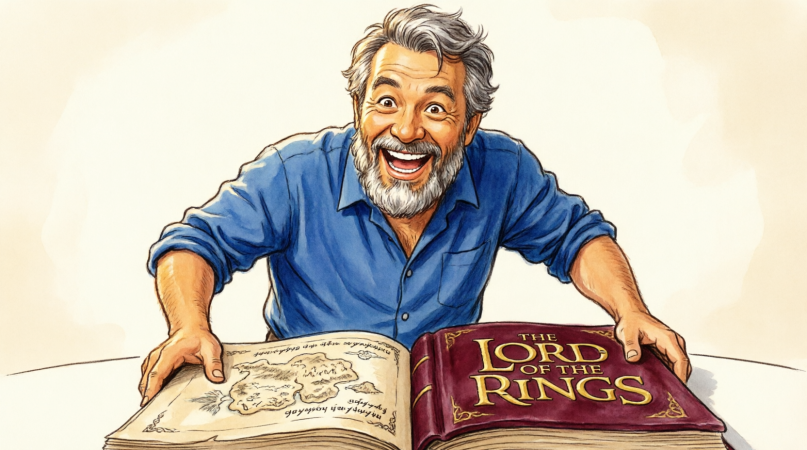
The decision to record the audiobook was not made lightly. In the world of publishing, especially with a property as sacred as Tolkien’s, there is a reverence that borders on religious. You do not mess with the text.
You do not interpret the tone too heavily. You serve the words. For Serkis, this presented a unique challenge. How do you separate yourself from Gollum when reading a book where Gollum is such a pivotal, terrifying presence?
The recording process began in early 2023. Serkis set up a dedicated sound booth in his home, treated acoustically to professional standards. He isolated himself. No visitors. No distractions. Just him, the text, and the microphone.
He treated it like a theatre run. He would arrive at 9 a.m. He would warm up his voice. He would read for four hours. He would break. He would return for another four.
“It’s physically demanding,” he said. “People don’t realize how much endurance it takes. You’re using muscles you don’t normally use. You’re breathing in a specific way to sustain the sentences. Tolkien’s prose is rhythmic. It’s poetic. It has a cadence that requires breath control.
If you run out of breath in the middle of a description of the Shire, you break the spell. You have to hold the listener’s hand and walk them through the landscape without letting go.”
The psychological toll was perhaps even greater. Serkis described the experience of reading the Book of Mordor as particularly draining. “You spend days in the dark,” he said. “You’re reading about despair. You’re reading about hunger. You’re reading about the corruption of power. Even though you know the ending, even though you know Frodo survives, you live in the moment. And in the moment, the Shadow is overwhelming.”
He recounted a specific session recording the passage where Frodo and Sam ascend the stairs of Cirith Ungol. “I was alone in the booth. It was late afternoon. The light was fading outside the window. I was reading about the smell of the land, the ash, the silence. And I felt a genuine sense of dread. I had to stop.
I had to walk away from the mic. I had to go outside and look at the trees in my garden just to remind myself that the world was still green. That’s the power of Tolkien. He doesn’t just write adventure. He writes about the state of the world.”
This connection to nature is a theme Serkis returns to often. Tolkien was a man who loved the English countryside, who mourned the industrialization of the landscape. Serkis, too, is an advocate for environmental causes.
He sees the struggle in The Lord of the Rings not just as a fight against a dark lord, but as a fight against the destruction of the natural world. Saruman’s destruction of the trees in Fangorn is not just a plot point; it is a sin.
The audiobook is not just Serkis reading alone, however. There are musical interludes. There are soundscapes. But they are subtle. They do not overpower the text. The focus remains on the words.
This was a deliberate choice. In an era of immersive audio dramas where sound effects can sometimes distract from the narrative, the producers decided to trust the source material. Tolkien’s writing is vivid enough to create its own sound effects. When he describes the sound of the Nazgûl’s cry, you don’t need a synthesizer. You need a voice that can convey the terror.
Serkis’s approach to the different characters was meticulous. He did not simply imitate the actors from the films. He did not try to sound like Ian McKellen or Viggo Mortensen. He created his own interpretations based on the text. Gandalf is wise, but also weary. Aragorn is regal, but also burdened. And Gollum… Gollum is there, but he is contained.
“I didn’t want Gollum to become a caricature,” Serkis noted. “In the films, he had to be visual. He had to be big for the screen. In the book, he is more subtle. He is a whisper in the dark. So I pulled back. I made him smaller. More intimate. When he speaks to Frodo, it’s like he’s inside your head. That’s more frightening than any scream.”
The production team worked closely with the Tolkien Estate. This was crucial. The Estate is notoriously protective of the legacy. They have turned down many adaptations over the years. They agreed to this project because they trusted Serkis. They knew he understood the material. They knew he wasn’t doing it for a quick cash grab. He was doing it because he loves the book.
“Christopher Tolkien was very particular about how his father’s work was presented,” said the producer of the audiobook. “Andy didn’t try to change anything. He didn’t try to modernize the language. He respected the archaic terms. He respected the songs. He read the poems with the rhythm they were intended to have. That earned him the Estate’s trust.”
The response from early listeners has been emotional. Many fans have reported listening to the audiobook while re-reading the physical book. They say Serkis’s voice adds a layer of depth they hadn’t noticed before. They say they hear the pain in Frodo’s voice more clearly. They say they understand the weight of the Ring better.
One fan, a teacher from Ohio, wrote to Serkis saying, “I’ve read this book ten times. I thought I knew it. But hearing you read the passage where Frodo gives up the Ring at the Cracks of Doom… I cried. I actually cried. You made me feel the relief of that moment.”
That is the goal. Not to replace the reader’s imagination, but to enhance it. An audiobook is a partnership between the narrator and the listener. The narrator provides the voice; the listener provides the images. Serkis understands this dynamic. He leaves space for the listener to dream.
“There are pauses,” he said. “Intentional pauses. After a big moment, I let the silence sit. I let the listener absorb it. In film, you cut away. You move to the next shot. In audio, you can stay in the moment. You can let the emotion linger. That’s a luxury. And I tried to use it.”
The recording of The Fellowship of the Ring is just the beginning. Serkis has committed to recording the entire trilogy. The Two Towers is already in post-production. The Return of the King will follow. It is a massive undertaking. It represents hundreds of hours in the booth. It represents a significant portion of his life dedicated to this one project.
Serkis smiled. “Because it’s not about me. It’s about the book. There are new generations of readers. There are people who struggle with dyslexia who can experience the story through audio. There are people who don’t have time to sit and read but can listen on their commute. I want to make this story accessible. I want to keep it alive.”
He also spoke about his own children. “My kids grew up with the films. They know me as Gollum. But I want them to know the book. I want them to understand that the films are an interpretation. The book is the source. The book is where the truth lies. By recording this, I’m leaving something for them. Something that isn’t about CGI or box office numbers. It’s about the story.”
The technical aspects of the recording were also a point of pride. Serkis worked with some of the best sound engineers in the industry. They used vintage microphones to capture a warmth that digital recording sometimes lacks. They treated the voice to sound natural, not processed. There is no autotune. There is no correction. If he stumbles, they keep it. If his voice cracks with emotion, they keep it. They wanted it to feel human.
“Perfection is boring,” Serkis said. “If you hear me take a breath, that’s real. If you hear the slight catch in my throat when Gandalf falls in Moria, that’s real. I don’t want to be a machine. I want to be a storyteller. And storytellers make mistakes. They get tired. They get emotional. That’s part of the experience.”
The release of the audiobook coincides with the anniversary of the publication of The Fellowship of the Ring. It is a celebration. There are special editions available. There are signed copies. There are behind-the-scenes videos showing Serkis in the booth. But the core product is the audio. It stands on its own.
Critics have praised the performance. The Guardian called it “definitive.” Empire magazine said it “sets a new standard for audiobook narration.” But for Serkis, the reviews are secondary. The connection with the listeners is what matters.
He hosts live Q&A sessions online. He talks to fans. He listens to their stories. He hears about how the book helped them through depression. He hears about how it inspired them to become writers. He hears about how it brought families together.
Looking ahead, Serkis is already thinking about The Silmarillion. Would he record that? He laughs. “One thing at a time. The Lord of the Rings is a mountain. I’m still climbing it. But never say never.”
For now, the focus is on The Fellowship. The focus is on the Shire. The focus is on the beginning of the journey. Serkis wants the listeners to feel the comfort of Bag End before they feel the terror of Mordor. He wants them to love the world before they see it threatened.
“The Shire is home,” he said. “We all need a home. We all need a place where we feel safe. Tolkien wrote about that safety, and he wrote about the threat to it. That’s why it resonates. Because we all feel that threat. We all feel the world changing. We all feel the shadow growing. But we also feel the hope. The hope that small people can do great things.”
And with that, the interview ends. The microphone is turned off. The light in the booth dims. But the story continues. It continues in the ears of millions. It continues in the hearts of those who love Middle-earth.
The audiobook is more than a product. It is a love letter. It is a testament. It is a bridge between the past and the future. Between the page and the ear. Between the actor and the audience.
The release date is set. The pre-orders are open. The anticipation is palpable. Fans are counting down the days. They are ready. They are waiting.
And when the first word is spoken, when the first page is turned, the world will stop. For a moment, there will be no news. No politics. No noise. Just the voice. Just the story. Just Middle-earth.
It is a rare thing in this modern age to have something so pure. Something so dedicated to the art of storytelling. Something that asks nothing of you but your attention.
Serkis has given us a gift. He has given us his time. His energy. His soul.
To truly appreciate the audiobook, one must understand the technology behind it. The recording was done in a custom-built booth designed to eliminate all external noise. The walls are lined with acoustic foam. The floor is floating to prevent vibration. The microphone is a Neumann U87, a industry standard for voice work, but modified to capture the lower frequencies of Serkis’s voice with greater clarity.
The mixing was done by a team who have worked on major film soundtracks. They balanced the voice with the music so that neither overpowers the other. The music was composed specifically for the audiobook. It uses themes from the films but re-orchestrated for a smaller ensemble. It is more intimate. More chamber-like.
Social media has been ablaze since the announcement. Fans are sharing their excitement. They are posting photos of their copies. They are sharing clips of the trailer.
#SerkisLOTR is trending.
“I’ve waited twenty years for this,” one fan tweeted. “Andy Serkis reading Tolkien is a dream come true.”
“My kids are listening with me,” another posted. “It’s becoming a family tradition.”
“There’s no one else who could do this,” said a third. “He knows the soul of the book.”
The Tolkien Society issued a statement praising the project. “Mr. Serkis has a deep understanding of the text. His narration honors the legacy of Professor Tolkien.”
Bookstores are reporting high pre-order numbers. It is one of the fastest-selling audiobooks of the year. Libraries are placing multiple copies on hold lists.
This project may signal a shift in the industry. High-profile actors recording full-cast audiobooks with original scores. It raises the bar. It shows what is possible.
Publishers are taking notice. They are looking for other franchises that could benefit from this treatment. Harry Potter. Dune. A Song of Ice and Fire. The potential is huge.
But for now, the focus is on Middle-earth.
Serkis is humble about the impact. “I’m just doing my job,” he says. “But if it inspires others to do better, then that’s good.”
As I finish writing this article, I put on my headphones. I press play. I hear Serkis’s voice. “When Mr. Bilbo Baggins of Bag End announced that he would shortly be celebrating his eleventy-first birthday with a party of special magnificence…”
The voice is warm. It is inviting. It is familiar.
I close my eyes. I am back in the Shire. I am sitting in Bag End. I am safe.
And I understand why Serkis did it. He didn’t do it for the money. He didn’t do it for the fame. He did it for the magic.
The audiobook is available for pre-order now. It releases globally on [Date]. It is available on Audible, Apple Books, Google Play, and all major platforms. There is a special collector’s edition available with exclusive artwork and a behind-the-scenes booklet.
Keep the story alive.
Just as it should be.