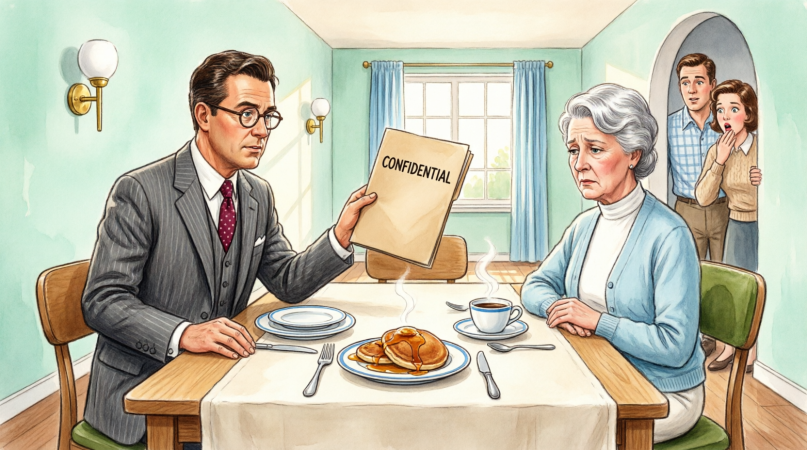
My daughter-in-law spit in my face during an argument, and my son said I deserved it. I said nothing and went to bed. The next morning, they woke up to the smell of pancakes and found the table covered with breakfast. My son looked at the spread and said, “Good. You finally understood your place.”
But when they saw who was sitting next to me at the table, they froze.
I’m Margaret Williams, sixty-two years old, and until three days ago, I thought I was living a peaceful retirement in my own home.
My son, David, moved back in six months ago with his wife, Jessica, after they lost their apartment.
“Just temporary, Mom,” he had said. “Until we get back on our feet.”
I should have known better. David has always had a way of making temporary situations permanent whenever they benefit him.
The argument started over something ridiculous. Jessica had rearranged my kitchen without asking, moving everything into places that made no sense. When I politely asked her to put things back, she exploded.
“This is exactly what I’m talking about,” she screamed, her face red with fury. “You’re so controlling. No wonder David’s father left you.”
My late husband hadn’t left me. He died of a heart attack five years ago. But Jessica has never let facts interfere with a good insult.
“Jessica, I just want my measuring cups back in the drawer where I can find them,” I said calmly.
That was when she lost it completely.
“I am so sick of walking on eggshells around you. This house feels like a museum where we’re not allowed to touch anything.”
David came running in from the living room. Instead of defending me, he immediately sided with his wife.
“Mom, you have been pretty rigid about things,” he said, not meeting my eyes. “Maybe you could be more flexible.”
Then Jessica stepped closer, her eyes blazing with a hatred that shocked me.
“I’ve had it with your passive-aggressive little comments and your precious routines,” she snarled. “You want to know what I really think of you?”
Then she spit directly in my face.
The warm saliva hit my cheek and slowly dripped down. I stood there frozen, unable to process what had just happened. In my sixty-two years, no one had ever shown me such deliberate disrespect.
I looked at David, waiting for him to say something, anything, to defend his mother.
Instead, he shrugged.
“Well, Mom, you kind of brought this on yourself. You’ve been making Jessica feel unwelcome since day one.”
Those words hit me harder than the spit. My own son was telling me I deserved to be humiliated in my own home.
I wiped my face with a kitchen towel, set it on the counter, and without saying a word, went upstairs to my bedroom. I locked the door and sat on the edge of the bed, staring at nothing.
Forty years I had lived in that house. Forty years of memories with David’s father. I had raised David there, sacrificed for his education, supported his dreams, and this was what I got in return.
But as I sat there in the darkness, something began to shift inside me. The hurt was turning into something else—something colder, something more purposeful. I had options they didn’t know about, resources they had never bothered to ask about, and patience they had never tested before.
By morning, I had a plan.
I woke up before dawn and went straight to the kitchen.
The smell of vanilla and cinnamon filled the house as I prepared the most elaborate breakfast I had made in years: pancakes, fresh fruit, bacon, sausage, hash browns, and my famous French toast.
When David and Jessica came downstairs, their eyes widened at the feast spread across the dining room table.
“Good,” David said with satisfaction. “You finally understood your place.”
That was when they noticed I wasn’t alone.
The man sitting at my dining room table was wearing a perfectly tailored navy suit and eating my pancakes like he belonged there. When David and Jessica saw him, the color drained from their faces.
“Mom,” David stammered. “Who is this?”
“David, Jessica,” I said pleasantly, “I’d like you to meet Thomas Richardson. He’s a lawyer.”
Jessica dropped her coffee mug. The ceramic shattered on my hardwood floor, but nobody moved to clean it up.
Thomas stood and extended his hand with the kind of professional courtesy that costs five hundred dollars an hour.
“Pleased to meet you both. Your mother has told me so much about you.”
The way he said it made it very clear that what I had told him was not flattering.
“A lawyer?” Jessica’s voice cracked. “What do you need a lawyer for, Margaret?”
I always notice how she only calls me Margaret when she’s scared. Usually I’m just Mom when she wants something.
“Well, after last night’s conversation, I realized I needed to make some adjustments to my estate planning,” I said, buttering my toast with deliberate calm. “Thomas specializes in situations like mine.”
“What kind of situations?” David asked, trying to sound casual, though I could see the panic in his eyes.
Thomas opened his briefcase and removed a thick folder.
“Elder abuse situations. Your mother called me at six this morning and described what happened. Spitting on a senior citizen in her own home qualifies as assault under state law.”
Jessica went very still.
“I didn’t assault anyone. It was just an argument that got heated.”
“Bodily fluids constitute assault,” Thomas replied matter-of-factly. “But we’re not here to discuss criminal charges. We’re here to discuss your mother’s will.”
The silence that followed was so complete I could hear the grandfather clock ticking in the hallway.
“My will?” I repeated. “Oh, yes. I’ve decided to make some significant changes.”
David sat down heavily.
“Mom, you’re being dramatic. Jessica apologizes for last night, don’t you, Jessica?”
But Jessica wasn’t apologizing. She was staring at Thomas like he was a rattlesnake.
“What changes?” she asked directly.
Thomas pulled out several documents.
“Mrs. Williams currently has you and David listed as primary beneficiaries for this house, her savings accounts, and her life insurance policy—approximately 1.2 million dollars total.”
Had. Past tense.
I watched that word land on them like a physical blow.
“However,” Thomas continued, “given recent developments, she’s decided to explore other options for her legacy.”
“Other options?” David’s voice had dropped to a whisper.
“Charitable organizations,” I said cheerfully. “The animal shelter has always been close to my heart. And there’s a scholarship fund at the community college that could use support.”
Jessica finally found her voice.
“You can’t do this. We’re family.”
“Family doesn’t spit on family,” I replied simply.
“Margaret, I apologize,” Jessica said quickly. “I was stressed. I wasn’t thinking clearly. It won’t happen again.”
“Of course it won’t,” I said. “Because you’re going to be moving out.”
The bomb dropped exactly the way I had planned it.
“Moving out?” David shot to his feet so fast his chair tipped backward. “Mom, we can’t afford to move out. You know our situation.”
“I’m well aware of your situation, David. You’ve been unemployed for six months, and Jessica was fired from her last job for stealing office supplies.”
“I wasn’t stealing,” Jessica protested. “Those were just pens and paper.”
“Forty-seven dollars’ worth of pens and paper,” I corrected. “I called your former boss yesterday. She had quite a lot to say about your work ethic.”
Thomas watched the exchange with professional interest. He had probably seen plenty of family dynamics like this.
“You called my former boss?” Jessica’s voice went shrill. “You had no right.”
“I had every right to investigate the character of the people living in my house,” I said calmly. “Especially people who assault me.”
“One incident,” David pleaded. “Mom, you’re willing to destroy our family over one incident?”
“One incident?”
I set down my fork.
“David, in the six months you’ve lived here, you’ve contributed exactly zero to household expenses. You’ve eaten my food, used my utilities, and treated me like hired help. The spitting was just the final insult.”
Thomas cleared his throat.
“Mrs. Williams, shall we discuss the timeline for the changes?”
“What timeline?” Jessica demanded.
“The new will goes into effect immediately,” I explained. “And I’ll need you both to vacate the premises by the end of the week.”
David looked as if he might cry.
“Where are we supposed to go?”
“I suggest you figure that out quickly,” Thomas said, closing his folder, “because Mrs. Williams has also decided to change the locks on Friday.”
But I wasn’t finished.
“Actually,” I said, reaching for the envelope beside my coffee cup, “there is one way you could change my mind about all of this.”
David practically lunged for the envelope. Hope flickered in his eyes for the first time since Thomas had introduced himself.
“What do you mean?” Jessica asked suspiciously.
I opened the envelope slowly, savoring their desperate attention.
Inside were three photographs I had printed from my laptop that morning.
“Well, I was doing some cleaning yesterday, and I found something interesting in the basement storage room.”
The photographs showed David’s collection of vintage comic books, still in their protective sleeves, stacked neatly in boxes. Comics he had told me were worthless and asked me to store “just temporarily.”
Thomas leaned forward.
“Are those what I think they are?”
“First edition Amazing Fantasy number fifteen,” I said. “The first appearance of Spider-Man. David’s father bought it for him when he was twelve.”
David’s face went white.
“Mom, you didn’t.”
“Oh, I did.”
I pulled out my phone and showed them the eBay listing I had created at five that morning.
“Current bid is at eight thousand dollars, and the auction doesn’t end until Sunday.”
“Eight thousand?” Jessica gasped.
“That’s just the opening bid,” Thomas said with admiration. “A mint-condition Amazing Fantasy fifteen can sell for twenty thousand or more.”
“You can’t sell my comics,” David shouted. “Those are mine.”
“Are they?” I asked mildly. “Because when you moved them into my basement, you said they were just worthless old books you didn’t want taking up space. I offered to throw them away, and you told me to just stick them somewhere.”
That was true. David had dismissed the collection as kid stuff when he moved back in. He had no idea it had become valuable.
“Besides,” I added, “the storage room is in my house. Abandoned property laws are quite clear about items left on premises without an ownership agreement.”
Thomas nodded.
“Legally speaking, after six months without claim or payment of storage fees, the property transfers to the homeowner.”
Jessica’s mind was racing so fast I could almost hear it.
Twenty thousand dollars was more than they would see in months.
“Margaret,” she said carefully, “perhaps we’ve all been too hasty here. Maybe we could work out some kind of arrangement.”
“What kind of arrangement?” I asked, though I already knew exactly where this was going.
Jessica glanced at David.
“What if we paid rent? A fair amount for staying here.”
“How much do you think would be fair?” Thomas asked.
I hadn’t told him about this part of my plan, but he was playing along beautifully.
“Five hundred a month,” David said hopefully.
I laughed. Actually laughed out loud.
“Five hundred? David, this house is worth 1.2 million dollars. Fair market rent would be at least twenty-five hundred.”
The hope died in his eyes. They couldn’t afford that any more than they could afford their own apartment.
“However,” I said, watching them closely, “I might consider a different kind of arrangement.”
“What kind?” Jessica asked.
I pulled out a piece of paper. I had prepared a formal contract.
“You can stay here rent-free for exactly ninety days while you find jobs and save for your own place.”
“And in exchange?” Thomas prompted.
“In exchange, you’ll both attend family counseling with me once a week. You’ll contribute to household expenses based on your actual income once you find work. And most importantly, you’ll treat me with the respect I deserve as the owner of this home.”
It was a reasonable offer. More than reasonable, considering Jessica had assaulted me less than twelve hours earlier.
“That sounds fair,” David said quickly.
“I’m not finished.”
I held up a hand.
“There’s also a penalty clause. Any disrespect, any argument that escalates toward violence, any damage to my property, and the agreement is void. You’re out immediately, with no further discussion.”
Jessica scanned the contract.
“This is very specific.”
“It has to be,” Thomas said. “Clear boundaries prevent future misunderstandings.”
“And if we sign this,” David asked, “you’ll take the comics off eBay?”
I smiled.
“Oh, no. I’m keeping those proceeds either way. Consider it back rent for the six months you’ve been freeloading.”
The silence stretched while they absorbed that. I was offering them a chance to stay, but it was going to cost them their pride and David’s childhood treasures.
“We need to discuss this privately,” Jessica said at last.
“Of course,” I said. “Thomas and I will be having coffee on the back patio. Take your time.”
As we walked outside, Thomas shook his head with admiration.
“You’ve backed them into a corner beautifully. They can’t afford to leave, but they can’t afford to stay on your terms either.”
“They’ll sign,” I said. “Jessica’s too proud to admit defeat, and David’s too scared to face the real world without me.”
“And if they don’t honor the agreement?”
I smiled, watching them through the kitchen window as they argued in hushed voices.
“Then I get my house back, and they get nothing. Either way, I win.”
Twenty minutes later, they came outside with the contract signed. But I could tell from Jessica’s expression that she was already planning to break it.
I was right about Jessica.
She lasted exactly eleven days before she tested my new boundaries.
It started small, the way it always does with people who can’t help themselves. She forgot to clean up after herself. She made passive-aggressive comments about the house rules. She started leaving little messes for me to find, testing to see whether I would enforce the contract.
I documented everything.
Photos of dirty dishes left in the sink. Screenshots of text messages where she complained to her friends about living with her “controlling mother-in-law.” Even recordings of her phone calls where she badmouthed me to anyone willing to listen.
Thomas had suggested I keep evidence, just in case.
The breaking point came on a Tuesday morning when I discovered she had been going through my personal papers.
For several days I had noticed things in my bedroom were slightly out of place—a drawer not quite closed, my jewelry box angled differently on the dresser. At first I thought I was being paranoid. But when I found my bank statements scattered across my desk instead of neatly filed where I had left them, I knew.
“Jessica,” I called downstairs. “Could you come up here, please?”
She appeared in my doorway wearing that fake innocent expression she always used when she’d been caught.
“You wanted to see me?”
I gestured toward the desk.
“Can you explain why my personal financial documents are all over my room?”
“I don’t know what you mean.”
But her eyes flicked to the papers and back too quickly.
“My bank statements were filed in that folder. Now they’re spread across my desk like someone was reading through them.”
“Maybe you forgot where you put them. It happens when people get older.”
There it was. The disrespect-clause violation I had been waiting for.
“Jessica, are you suggesting I’m having memory problems?”
“I’m just saying maybe you’re confused about where you left things.”
I pulled out my phone and showed her the photos I had taken of my organized desk two days earlier, timestamped and dated.
“These photos prove my papers were exactly where I said they were. Unless you’re claiming I have memory problems about taking pictures too.”
She realized she had been caught. Her whole demeanor shifted from fake sweetness to open hostility.
“Fine. I was looking at your bank statements. Do you know how frustrating it is to be broke while living with someone who has hundreds of thousands of dollars just sitting in accounts?”
“So you decided to invade my privacy and go through my personal financial information.”
“I needed to know what we were dealing with. David’s been talking about asking you for money for a business idea, and I wanted to see if you could actually afford it.”
That made the situation even more interesting.
“What business idea?”
“He wants to start a landscaping company. He needs about thirty thousand dollars for equipment and a truck.”
Thirty thousand dollars.
They had been planning to ask me for thirty thousand dollars while contributing nothing to the household and treating me like an inconvenience.
“And you thought going through my private papers would help with that request?”
“I thought it would help me understand whether you were really as tight with money as you pretend to be, or if you’re just being mean.”
That was enough.
The contract violation was clear, documented, and spoken in her own voice.
“Jessica, you need to pack your things.”
“What?”
“You violated the respect clause of our agreement. You’re out.”
She laughed. Actually laughed.
“You can’t kick me out for looking at some papers. That’s ridiculous.”
I held up my phone.
“I’ve been recording this entire conversation. You just admitted to going through my private financial documents without permission and insulted my character in the process.”
The laughter disappeared from her face.
“You were recording me?”
“It’s my house. I’m allowed to record conversations in my own home.”
She sputtered for a moment, then found her voice again.
“David won’t let you do this to me.”
“David signed the same contract you did. He’s bound by the same terms.”
“We’ll see about that.”
She stormed downstairs, shouting for him.
I followed at a calmer pace, already knowing how it would go. David would try to negotiate. Jessica would demand he choose sides. And I would remind them both that contracts have consequences.
“David!” Jessica’s voice echoed through the house. “Your mother has lost her mind. She’s trying to kick me out for looking at some stupid papers.”
David emerged from the living room, where he had been watching television all morning instead of job hunting.
“What’s going on?”
“Your wife violated our agreement,” I said. “She went through my private financial documents without permission, and then insulted me when I confronted her.”
David looked between us, calculating. His wife or his housing situation. His marriage or the comfortable life of living off his mother.
“Mom, maybe we could work this out. Jessica, apologize to my mother.”
“I’m not apologizing for anything,” Jessica snapped. “She’s the one who set up this ridiculous contract with all these impossible rules.”
“The rules aren’t impossible,” I said. “You just have to treat me with basic respect. Apparently that’s beyond your capabilities.”
David was sweating now.
“Jessica, just say you’re sorry and promise not to go through Mom’s things anymore.”
“No. I won’t be controlled and manipulated by someone who’s using her money to make us dance like puppets.”
And that was when David made his choice.
“Jessica, stop.”
His voice was firmer than I had heard it in months.
“Just stop talking.”
She turned on him in fury.
“Are you seriously taking her side right now?”
“I’m taking the side of having a roof over our heads,” he snapped. “Do you have any idea how good we have it here? Free housing, free food, no responsibilities except being decent human beings.”
“Decent human beings?” Jessica shrieked. “She’s treating us like servants in our own home.”
“It’s not our home,” David exploded. “It’s her house, her food, her electricity, her everything. And instead of being grateful, you’re acting like we’re entitled to it.”
I watched with fascination. It was the first time I had seen David stand up to his wife about anything.
“Grateful?” Jessica nearly choked on the word. “Grateful for what? Being treated like children? Having to ask permission to rearrange a kitchen? Living under a microscope with someone who documents every little thing we do wrong?”
“Yes,” David shouted. “Grateful for all of that, because without my mother’s generosity, we’d be sleeping in your car.”
That stopped her cold.
They had never told me they had lost their car, but apparently their finances were even worse than I had realized.
“We wouldn’t be sleeping in my car,” she said quietly.
“Why not?” David demanded.
“Because I sold my car three months ago to pay our credit card bills.”
The room went silent.
Even I was shocked.
“You sold your car?” David stared at her. “When? Why didn’t you tell me?”
“Because I was trying to handle our problems without running to Mommy for help.”
“By going through my mother’s private papers instead?”
Jessica deflated a little.
“I was desperate. David, we’re thirty thousand dollars in debt. We have no income and no prospects. When you mentioned wanting to start a business, I thought maybe if I knew how much money your mother had—”
“You thought you could figure out the best way to manipulate me into giving it to you,” I finished.
She didn’t deny it.
David sat down heavily on the couch.
“Thirty thousand in debt? Jessica, what haven’t you told me?”
“The credit cards, the student loans, the personal loan my mother co-signed for my business idea that failed.”
“What business idea?”
“The online boutique I tried to start last year. I maxed out our cards buying inventory that never sold.”
I was learning more about their financial situation in five minutes than I had learned in six months of living with them.
“So let me understand this,” I said. “You’re thirty thousand dollars in debt. You’ve sold your car. You have no income. And you thought the solution was to go through my private papers to figure out how to convince me to give you more money.”
“When you put it like that, it sounds bad,” Jessica muttered.
“It doesn’t just sound bad. It is bad.”
I pulled out the signed contract.
“And more importantly, it’s a violation of our agreement.”
David looked defeated.
“Mom, please don’t make us leave. We literally have nowhere to go.”
“You should have thought about that before your wife decided to snoop through my bedroom.”
“I’ll make it right,” David said quickly. “I’ll get a job. Any job. I’ll pay rent. I’ll make Jessica apologize properly.”
“David, no,” Jessica started, but he cut her off.
“Jessica, either you apologize to my mother right now, or we’re both homeless. Your choice.”
She stared at him as if she had never seen him before.
“You’re choosing her over me.”
“I’m choosing survival over pride,” he said. “Something you might want to consider.”
Jessica looked from him to me, her face cycling through anger, disbelief, and finally resignation.
She turned to me with the most insincere expression I had ever seen.
“Margaret, I apologize for going through your personal papers. It was wrong of me, and I promise it won’t happen again.”
“And?” David prompted.
“And I’m sorry for being disrespectful to you in your own home.”
I studied her face. The apology was forced, but at least it was an apology.
“Thank you, Jessica. I accept your apology.”
David exhaled in relief.
“So we can stay?”
I folded the contract carefully and slipped it into my pocket.
“You can stay on one condition.”
“What condition?” Jessica asked.
“David, you’ll start a job search today. Not a business plan, not a scheme to get money from me. An actual job search. Retail, food service, whatever you can find.”
“Done,” he said immediately.
“And Jessica, since you’re so interested in my financial situation, you’re going to help me organize my paperwork. Under supervision, of course.”
She winced.
“Organize your paperwork?”
“All of it. Tax documents, bank statements, insurance policies, investment accounts. You’ll learn exactly what my financial situation is, but you’ll do it legitimately.”
“Is that supposed to be punishment?”
I smiled.
“Oh, no, Jessica. That’s supposed to be education. Because once you see the reality of my finances, you’ll understand why I’m so careful about how I spend my money.”
“What do you mean?”
“I mean my hundreds of thousands of dollars may not be quite what you think they are.”
David and Jessica exchanged a glance. They were about to learn that their assumptions about my wealth were wildly inaccurate.
But they would not learn the whole truth until later.
Jessica’s education began the next morning in my home office. I had prepared several file boxes and a detailed spreadsheet for organizing my documents.
“We’ll start with tax returns,” I said, handing her a stack of papers. “The last five years should be sufficient.”
She sat down reluctantly and began sorting.
Within an hour, her attitude had changed.
“Margaret,” she said slowly, “according to these tax returns, your income is only about forty thousand a year from Social Security and your pension.”
“That’s correct.”
“But the bank statements show hundreds of thousands in savings accounts.”
“Those would be the proceeds from selling your father-in-law’s business after he died.”
David looked up from his laptop, where he had been halfheartedly job searching.
“Dad’s business? I thought it was just a small accounting firm.”
“It was. But small doesn’t mean worthless. Your father spent thirty years building relationships with local businesses. When he died, I sold the client list and office lease to a larger firm.”
“How much did you get?” Jessica asked.
I pulled out the purchase agreement.
“Two hundred thousand after taxes and legal fees.”
David whistled.
“I had no idea it was worth that much.”
“Most people don’t understand the value of a well-established service business,” I said. “But keep reading through those statements, Jessica. You’ll notice something interesting about the balances over time.”
She flipped through several months of bank statements, frowning.
“The balances keep going down.”
“Exactly. When you’re living on a fixed income and drawing from savings, the money doesn’t last forever.”
“How long will it last?” David asked quietly.
I pulled out a financial planning worksheet Thomas had helped me prepare.
“At my current rate of spending, approximately twelve years. Less if I need long-term care or have major medical expenses.”
That finally began to sink in.
I wasn’t a wealthy widow with unlimited resources. I was a retiree trying to make modest savings last for the rest of my life.
“But the house,” Jessica protested. “It’s worth over a million dollars.”
“It’s worth that if I sell it. But if I sell it, where do I live? Comparable housing would cost me three thousand a month in rent, which would drain my savings in four years instead of twelve.”
David closed his laptop.
“Mom, I never realized. I thought you were comfortable.”
“I am comfortable, as long as I’m careful. But supporting two additional adults indefinitely would change that calculation significantly.”
Jessica stared at the financial projections.
“So when you said you couldn’t afford to support us, you meant it literally.”
“Yes. If I paid for your housing, food, and expenses for more than a few months, it would threaten my own financial security.”
That was mostly true. I was being conservative with my numbers, but the math itself was sound.
“What I wasn’t telling them,” I thought then, “was that I had additional resources they didn’t know about.”
“I’m sorry,” David said suddenly. “I never thought about it from your perspective. I just assumed that since you owned the house—”
“You assumed I was wealthy because I have assets. But assets and cash flow are different things.”
Jessica was still studying the bank statements.
“What about this investment account? The one with Richardson Financial?”
I tensed slightly. She had found the one account I had hoped she would overlook.
“That’s my emergency fund. It’s managed by a financial adviser to protect it from inflation.”
“How much is in it?” she asked.
“That’s not relevant to our current discussion.”
“It shows quarterly dividends of about three thousand dollars,” she pressed. “That suggests a significant principal balance.”
Now David was paying full attention.
“Mom, how much is in the investment account?”
I could have lied. Probably should have. But I had been caught off guard by Jessica’s attention to detail.
“About four hundred thousand.”
The silence that followed was deafening.
“Four hundred thousand?” David said, his voice cracking. “Mom, that changes everything.”
“No, it doesn’t.”
“But with that money, you could afford—”
“I could afford to destroy my retirement security to enable your lack of responsibility,” I finished. “That account is untouchable. It is what will pay for my care when I’m too old to live independently.”
Jessica set down the papers.
“So you do have money. You’ve been playing poor this whole time.”
“I’ve been playing realistic. There’s a difference.”
“You let us think you were barely getting by.”
“You never asked about my finances until you decided to snoop through my papers.”
David stared at me as if he had never quite seen me clearly before.
“Six hundred thousand in total savings, plus the house. Mom, you’re worth over a million dollars.”
“On paper. But I’m seventy years old with no income beyond Social Security.”
“Sixty-two,” I corrected in my mind, though I let it pass in the moment.
“A million has to last me for potentially twenty more years. That’s fifty thousand a year.”
Jessica did the calculation quickly.
“Plus Social Security, you could live very comfortably on that.”
“Unless I need assisted living, which can cost sixty thousand a year. Or memory care, which can cost ninety thousand. Or long-term medical care, which can cost even more.”
They were both quiet.
“So you’re not poor,” David said finally. “But you’re not rich either.”
“I’m financially secure if I’m careful and don’t get hit with any major surprises.”
“Like supporting unemployed adult children,” Jessica said quietly.
“Exactly.”
But even as we sat there having that conversation, I was thinking about the phone call I had received that morning from my real financial adviser—the one who managed accounts Jessica had never seen. The call that was about to change everything again.
My phone rang during lunch, interrupting what had turned into a surprisingly civil discussion about household budgets and job searches.
“Margaret Williams speaking.”
“Mrs. Williams, this is Patricia Sullivan from Henley and Associates. I have some news about your father’s estate that requires immediate attention.”
I stepped away from the table, though not far enough that David and Jessica couldn’t hear.
“My father’s estate was settled fifteen years ago.”
“That’s what we thought,” Patricia said. “But we’ve discovered an error in the original probate filing. There’s an asset that was never properly transferred.”
David and Jessica had stopped eating and were watching me with open interest.
“What kind of asset?”
“A commercial property in downtown Portland. Your father apparently owned it through a subsidiary company that wasn’t identified during the estate proceedings. The current tenants have been paying rent into an escrow account for fifteen years.”
“How much rent?”
“Approximately four thousand dollars a month. The escrow account currently holds over seven hundred thousand dollars in accumulated rental payments.”
I gripped the phone tighter.
“Seven hundred thousand?”
“Mrs. Williams, are you there?”
“I’m here. What do I need to do?”
“We need you to come to our office to sign the transfer documents. The property and the escrow funds will be transferred to you immediately.”
“I’ll be there this afternoon.”
I hung up and turned around to find David and Jessica staring at me with wide eyes.
“Seven hundred thousand?” David whispered.
“It appears so.”
Jessica stood abruptly.
“Margaret, this changes everything. With that money, you could—”
“I could what?” I asked.
“You could help us get back on our feet. You could loan us the money for David’s business.”
I sat back down and continued eating my sandwich.
“Could I?”
“Mom,” David said urgently, “this is like winning the lottery. That’s enough money to solve all our problems.”
“All of whose problems?”
“Our problems. The family’s problems.”
I took another bite and chewed thoughtfully.
“David, what exactly are your problems?”
“You know what they are. We’re in debt. We don’t have jobs. We don’t have a place to live.”
“Those sound like your problems, not family problems.”
Jessica leaned forward.
“Margaret, be reasonable. This is an opportunity for all of us to benefit.”
“You don’t need all that money just sitting in an account.”
“Don’t I?”
“You just told us you have enough saved for retirement. This is extra money. Found money.”
I set down my sandwich.
“Jessica, let me ask you something. If you found seven hundred thousand dollars, would your first thought be to give it to someone else?”
“That’s different.”
“How?”
“Because we’re family. Family helps family.”
“Family?” I repeated. “Jessica, what exactly have you contributed to this family since you’ve been here?”
“I’ve been trying to find work.”
“You’ve been sleeping until noon and complaining about my house rules. That is not the same thing.”
David jumped in.
“Mom, that’s not fair. We’re both trying.”
“Are you? You’ve applied for exactly three jobs in six months. All of them were positions you considered beneath you.”
“I don’t want to waste my education working retail.”
“But you’re willing to waste my retirement savings avoiding work entirely.”
The truth was beginning to crystallize for both of them. They had spent six months treating me like their personal ATM, and now they wanted access to even more money.
Jessica tried a different approach.
“What if we made this a business arrangement? You could invest in David’s landscaping company, and we’d pay you back with interest.”
“What’s David’s business plan?”
“We haven’t written it up yet, but—”
“What’s his experience in landscaping?”
“He’s always been good with yard work.”
“What’s his market research? Who are his potential customers? What services will he offer? What are his startup costs beyond equipment? What’s his projected timeline for profitability?”
Jessica’s silence answered every question.
“You want me to invest thirty thousand dollars in a business that exists only in David’s imagination, run by someone with no relevant experience, no business plan, no market research, and no timeline for success.”
“When you put it like that—”
“I’m putting it accurately. And that is exactly the kind of financial decision that turns found money into lost money.”
David looked desperate.
“Mom, what would it take for you to consider helping us?”
I stood up and began clearing the table.
“Show me you can help yourselves first.”
“What do you mean?”
“Get jobs. Any jobs. Show me you can earn money and manage it responsibly. Develop an actual business plan with research and projections. Prove you’re worth investing in.”
“How long would that take?” Jessica asked.
“However long it takes.”
“But we need help now.”
“You needed help six months ago. You’ve had half a year to figure this out, and instead you’ve been living off my generosity while planning to ask me for more money.”
I carried the dishes into the kitchen and left them sitting in stunned silence.
What I didn’t tell them was that I was going to Portland that afternoon for a very different reason than just signing paperwork.
The meeting at Henley and Associates was everything I had hoped it would be. Patricia Sullivan was a sharp woman in her fifties who had clearly spent decades handling complicated estate matters.
“Mrs. Williams,” she said, “I have to tell you, this is one of the most unusual cases I’ve ever handled. Your father was quite the businessman.”
She spread the documents across her conference table. The property was a small office building with three commercial tenants. The escrow account contained exactly seven hundred forty-three thousand dollars.
“However,” Patricia continued, “there’s something else you should know about this property.”
“What’s that?”
“One of the tenants is having financial difficulty. They’re three months behind on rent and have asked about purchasing the building.”
“Purchasing it?”
“They’ve made a preliminary offer of 1.8 million dollars.”
I set down the papers.
“1.8 million, plus the accumulated rent money?”
“Over 2.5 million total.”
“Mrs. Williams, are you all right?”
“I’m fine. I’m just processing the magnitude of this.”
“There is one more thing,” Patricia added. “The purchase offer comes with a condition that the sale close within sixty days. Apparently the tenant company is expanding rapidly and needs to secure permanent space quickly. If you don’t sell, they’ll likely find another location and terminate their lease. Since they’re your largest tenant, that would significantly reduce the property’s value and rental income.”
I leaned back in my chair.
This wasn’t just found money. This was a decision that could shape the rest of my life.
“I need some time to think.”
“Of course. But, Mrs. Williams, may I speak frankly?”
“Please do.”
“At your age, liquid assets are generally preferable to managing rental property. The sale would give you complete financial independence for the rest of your life.”
She was right. With that money properly invested, I would never have to worry about finances again.
I could even afford to help David and Jessica, if I chose to.
The question was whether they deserved it.
I drove home with the signed transfer documents and a cashier’s check for seven hundred forty-three thousand dollars in my purse. By the time I pulled into the driveway, I had already made my decision about the property sale.
But first, I wanted to see what David and Jessica had done with their afternoon.
I found them exactly where I had left them.
David was back on his laptop, and instead of job searching, he was researching landscaping equipment. Jessica was making lists of business names and logo ideas.
“How did the meeting go?” David asked.
“The property is mine, and the money is in my account.”
“That’s wonderful,” Jessica said. “So you can help us get started?”
I sat down across from them.
“Actually, I have an opportunity to sell the property for 1.8 million dollars.”
Their mouths dropped open at the same time.
“1.8 million?” David whispered.
“Plus the rental money, it would be about 2.5 million total.”
Jessica was practically vibrating.
“Margaret, this is incredible. We could all be set for life.”
“I could be set for life,” I corrected. “This is my inheritance.”
“But family—” David started.
“Yes,” I said, cutting him off. “Let’s talk about family. David, what did you accomplish this afternoon while I was claiming my inheritance?”
He gestured weakly toward the laptop.
“I’ve been researching commercial lawnmowers.”
“You’ve been shopping for equipment for a business that doesn’t exist instead of looking for work that could actually provide income.”
“I was planning.”
“You were fantasizing. Jessica, what about you?”
She held up her notebook.
“I’ve been working on branding concepts.”
“More fantasizing.”
I closed the notebook gently.
“Neither of you spent a single minute this afternoon doing anything that would actually improve your situation.”
“We were planning our future,” Jessica protested.
“You were planning to spend my money.”
“There’s a difference.”
David leaned forward desperately.
“Mom, with 2.5 million dollars, you could afford to invest in our future. It would barely make a dent.”
“Could I afford it? Yes. Should I invest in people who won’t even look for jobs while living in my house rent-free? Absolutely not.”
“You’re being cruel,” Jessica said.
“I’m being practical. And I’ve made a decision about the property sale.”
They both held their breath.
“I’m accepting the offer. But there’s a condition attached to how that money gets used.”
“What condition?” David asked.
I pulled out my phone and showed them the rental listing I had found during the drive home.
“It’s a lovely two-bedroom apartment about twenty minutes from here. Available immediately.”
“You want us to rent an apartment?” Jessica asked flatly.
“I want you to become independent adults. The lease would be in your names. I’ll pay the first month’s rent as a move-out gift. After that, you support yourselves like every other married couple in America.”
David stared at the listing.
“Mom, we can’t afford this on our own.”
“Then you’d better find jobs quickly.”
“What if we can’t find work in time to make the rent?”
I smiled.
“Then you’ll learn what real financial pressure feels like, and maybe that will motivate you in ways my generosity never could.”
But I still wasn’t finished with surprises.
The apartment viewing was scheduled for Thursday morning. I insisted on driving them there myself, ostensibly to help them evaluate the place, but really to make sure they couldn’t back out at the last minute.
The apartment was perfect for them. Two bedrooms, a modern kitchen, washer and dryer hookups. The rent was fifteen hundred a month, which would require both of them to work, but it wasn’t impossible.
“It’s nice,” David admitted reluctantly as we walked through the living room.
“The kitchen is bigger than I expected,” Jessica said, though her tone suggested she was already searching for flaws.
The property manager, a woman named Carol, was explaining the lease terms when my phone buzzed with a text from Thomas Richardson.
Important development. Call me immediately.
I stepped outside and returned the call.
“Margaret, we need to meet today. Something significant has happened with your case.”
“What case? I’m not involved in any legal case.”
“You are now. Jessica’s former employer has filed a criminal complaint against her for embezzlement. The police want to interview you as a witness.”
My blood ran cold.
“Embezzlement? I thought she was fired for stealing office supplies.”
“That was apparently only the beginning. They’ve discovered she forged purchase orders and invoiced fake vendors for almost fifty thousand dollars over six months.”
“Fifty thousand?”
“No wonder they were so deeply in debt.”
“Thomas, what does this mean for me?”
“Since Jessica has been living in your house, they’ll want to verify you weren’t involved. And Margaret, there’s something else.”
“What?”
“They’ve also opened an investigation into David’s unemployment benefits. Apparently he’s been claiming to look for work while receiving payments, but there’s no record of actual job applications.”
Benefit fraud.
Both of them were potentially facing criminal charges.
“How bad is it?”
“Jessica could be looking at felony charges. David’s situation is less serious, but still problematic. Margaret, you need to distance yourself from their legal problems immediately.”
I looked through the window at David and Jessica, still inside discussing the apartment with Carol. They had no idea their past was about to catch up with them.
“I’ll call you back in an hour,” I said, and went inside.
“So,” I asked brightly, “what do you think?”
“We’ll take it,” David said.
Jessica shot him a surprised look, but apparently he was finally ready to commit to independence.
“Excellent,” Carol said. “I’ll need first month’s rent, last month’s rent, and a security deposit. Forty-five hundred total.”
I pulled out my checkbook.
“I’ll cover the first month’s rent as promised. You two will need to handle the rest.”
“The rest?” Jessica’s voice cracked. “We don’t have three thousand dollars.”
“Then I guess you’d better figure out how to get it quickly,” I said, writing the check. “The apartment won’t hold itself.”
David was panicking now.
“Mom, we can’t come up with that kind of money by ourselves.”
“Sure you can. You have until tomorrow to make this work.”
I handed Carol the check for fifteen hundred.
“This holds the apartment for twenty-four hours?”
“That’s correct,” she said. “They have until tomorrow at noon to bring the balance, or the apartment goes to the next applicant.”
On the drive home, David and Jessica argued frantically about where they might find three thousand dollars.
“We could sell something,” Jessica said.
“Sell what?” David snapped. “We don’t own anything valuable.”
“We could ask friends for loans.”
“What friends? We’ve already borrowed money from everyone we know.”
I listened to their desperation with growing satisfaction. This was the real-world pressure they had needed all along.
“There is one option,” I said casually as we turned into the driveway.
“What option?” David asked immediately.
“You could get jobs today. Any jobs. Even minimum-wage work would get you enough money for the deposit if you could both start right away.”
“Nobody pays on the first day,” Jessica protested.
“Restaurants do. Construction companies do. Cleaning services do. You’ve both been too proud to consider that kind of work.”
“Mom, please just loan us the money, and we’ll pay you back.”
“With what income? You still haven’t solved the fundamental problem of not having jobs.”
I parked the car and turned to face them.
“David. Jessica. I need to tell you something important.”
“What?”
“The police called while we were looking at the apartment.”
The color drained from both of their faces.
“What did they want?” Jessica whispered.
“They want to interview me about some irregularities in your former employment records.”
Jessica started crying. David simply stared at me in horror.
“How much trouble are we in?” he asked quietly.
“That depends on how honest you’ve been with me about your situations.”
“We told you the truth,” Jessica sobbed.
I shook my head slowly.
“Jessica, embezzling fifty thousand dollars is not the same thing as taking office supplies.”
She looked like she might faint.
“And David, claiming unemployment benefits while not actually looking for work is fraud.”
“Who told you that?” he demanded.
“People talk, David. This is a small town.”
Actually, Thomas had excellent sources in both the police department and the unemployment office, but they didn’t need to know that.
“What happens now?” Jessica asked through tears.
“Now you decide whether you want to face these problems as independent adults with your own apartment, or as unemployed criminals living with David’s mother.”
The choice was stark.
And it was about to get even more complicated.
The next morning, I woke to find David and Jessica already dressed and sitting at my kitchen table, deep in what looked like an unusually serious conversation.
“Good morning,” I said, pouring my coffee. “Did you figure out how to handle the apartment deposit?”
“We need to tell you something,” David said nervously.
“I’m listening.”
Jessica took a breath.
“Last night we applied for jobs at six different places. Fast food, retail, a cleaning company—anything that would hire us quickly.”
That was unexpected.
“And three places called us back for interviews today,” David said. “But even if we both get hired, we still won’t have enough for the deposit by noon.”
I sat down at the table.
“So what are you asking me?”
“We’re not asking for anything,” Jessica said quietly. “We’re going to tell Carol we can’t take the apartment.”
“And then what?”
“We’d like to stay here for thirty more days while we work and save for a place we can actually afford,” David said. “We’ll pay you rent from our first paychecks. Whatever you think is fair.”
I studied their faces. Something had changed overnight. The desperation was still there, but now it was mixed with something that looked almost like determination.
“What happened?” I asked. “What changed your minds?”
Jessica glanced at David, then back at me.
“We stayed up all night talking about our situation. Really talking. Not complaining. Not planning how to spend your money.”
“And we realized everything you’ve been saying is true,” David admitted. “We’ve been acting like entitled children instead of adults.”
“The police investigation scared you,” I said.
“Yes,” Jessica answered honestly. “But it also made us realize we can’t keep running from our problems. Whether we’re living here or in that apartment, we still have to face what we’ve done.”
It was the most mature conversation I had heard from either of them since they moved in.
“So,” I said, “you want to stay here and work toward becoming independent?”
“If you’ll let us,” David said. “With real jobs. Paying real rent. Following the house rules without complaint.”
I sipped my coffee and thought it over. The truth was, despite all the drama, I had grown somewhat fond of having people in the house again. And if they were genuinely willing to work and contribute, perhaps there was still something worth salvaging.
“What about the business plan?” I asked. “The landscaping company?”
“Maybe someday,” David said. “But first I need to prove I can hold down a regular job and manage money responsibly.”
“And Jessica, what about your legal problems?”
“Thomas Richardson recommended a criminal defense attorney. I have an appointment this afternoon to discuss my options.”
She was facing her problems instead of running from them. That was progress.
“I have a counterproposal,” I said.
They both tensed.
“You can stay here for ninety days while you get established in your jobs. You’ll pay me five hundred a month in rent once your paychecks start coming in.”
“That’s very reasonable,” David said gratefully.
“I’m not finished,” I said.
He stopped talking.
“In exchange for this arrangement, you’ll both attend financial literacy classes at the community college. You’ll put twenty percent of your earnings into savings accounts that I will help you set up. And Jessica, you will cooperate fully with the police investigation and make restitution for whatever you are found to have taken.”
“Agreed,” Jessica said immediately.
“And when the ninety days are up, you’ll move into your own place whether you think you’re ready or not. No extensions. No negotiations.”
“Understood,” David said.
I stood and walked to the window, looking out at the garden David’s father and I had planted together thirty years earlier.
“There’s one more thing I haven’t told you about the property sale.”
“What’s that?” Jessica asked.
I turned back to them.
“I’m not keeping all the money.”
“What do you mean?”
“I’m putting two million into conservative investments for my retirement. But the other five hundred thousand is going into a trust fund.”
David’s eyes widened.
“A trust fund for what?”
“For my grandchildren’s education. And if the two of you can prove you’re capable of managing money responsibly, there might be something left for you someday.”
The silence that followed felt different from all the others. This one held possibility instead of fear.
“Mom,” David said quietly, “we won’t let you down.”
“See that you don’t. Because this is the last chance you’ll get from me.”
Jessica stood.
“I should get ready for my interview.”
“What position?”
“Night shift at the grocery store. Stocking shelves.”
“That’s honest work.”
“Yes,” she said simply. “It is.”
After they left for their interviews, I called Thomas and updated him.
“You’re giving them another chance?” he asked.
“I’m giving them the opportunity to earn another chance. There’s a difference.”
“And if they fail again?”
“Then they fail as independent adults living somewhere else, not as dependents living in my house.”
“That’s fair,” Thomas said. “Was there anything else?”
“Yes. I want to update my will again.”
“More changes?”
I looked around my kitchen, seeing it not as a museum of the past anymore, but as a place where new memories might still be made.
“I want to make sure kindness is rewarded and selfishness has consequences. Can you help me structure that legally?”
“Margaret,” Thomas said, and there was admiration in his voice, “I think we can create exactly the incentives you want.”
Six months later, David had been promoted to assistant manager at the hardware store where he started as a stock clerk. Jessica completed her community service and was working full-time as a bookkeeper, having earned back her employer’s trust despite her past mistakes.
They moved into their own apartment exactly ninety days after our agreement, just as promised.
And when I got the call from the hospital three years later, it was David who dropped everything to drive me to my appointment, and Jessica who brought homemade soup while I recovered.
Sometimes the best gifts you can give people are the ones they have to earn for themselves.
THE END.