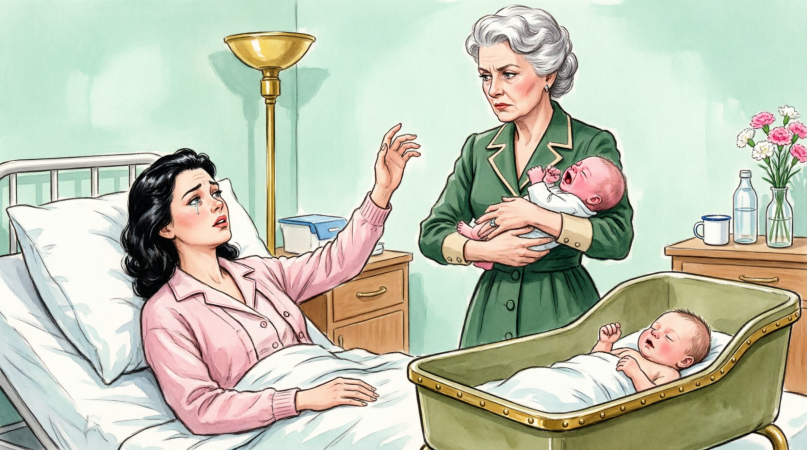
I had just survived an emergency C-section when my mother-in-law walked into my recovery suite, dropped adoption papers on my bed, and calmly told me she was taking my newborn son for her daughter.
Then she called me unstable and tried to turn security against me. What she didn’t know was that I had spent years hiding who I really was—and the moment the chief recognized my name, the entire room changed.
Part 1
The recovery suite at St. Mary’s Medical Pavilion looked more like a five-star hotel than a hospital room.
Soft lighting. A private nurse station. Floor-to-ceiling windows overlooking the city skyline in silver and gold.
At my request, the nurses had quietly removed the extravagant orchid arrangements sent by the District Attorney’s Office, along with the formal bouquet that had arrived from the Supreme Court. I didn’t want attention. I didn’t want questions.
Most of all, I didn’t want my mother-in-law finding out who I really was.
In her world, I was just Olivia Carter—the jobless wife living off her son.
And for years, I had let her believe exactly that.
Only a few hours earlier, I had gone through an emergency C-section.
Pain still moved through my body in slow, burning waves, but none of it mattered when I looked at the two tiny lives sleeping beside me.
Noah.
Nora.
My babies. My whole heart.
I brushed a finger lightly across Nora’s cheek, then tugged Noah’s blanket a little higher. For the first time in what felt like forever, I let myself breathe.
Peace. Just one fragile moment of it. Then the door flew open.
Margaret Whitmore swept in like a storm front.
She wore a fur-trimmed coat, sharp heels, and the kind of expensive perfume that arrived in a room before kindness ever could. Her presence filled the suite instantly, turning the air hard.
Her eyes traveled across the room. Then narrowed.
“A VIP recovery suite?” she said with open disgust. “Unbelievable.”
She stepped closer, gaze cold and cutting.
“My son works himself to death, and this is how you thank him? Living like royalty while contributing absolutely nothing?”
I said nothing. I had learned years ago that answering Margaret only gave her more ground.
But today, I was too exhausted to pretend it didn’t hurt. “I just gave birth to your grandchildren,” I said quietly.
“That doesn’t make you special,” she snapped.
And then, without warning, she kicked the edge of my hospital bed. Pain tore through my abdomen.
I gasped and instinctively curled toward my incision, every muscle locking as I tried to protect the fresh wound.
Margaret didn’t flinch. Didn’t apologize.
Instead, she reached into her designer handbag, pulled out a thick stack of papers, and tossed them onto my tray table.
“Sign these.” I blinked, still trying to breathe through the pain. “What… is this?”
“A parental rights waiver,” she said, almost casually. “Karen can’t have children. It’s tragic, of course. But now we have a solution.”
For one second, my brain refused to understand the words. Then it hit me. Cold. Hard.
“You’re giving her one of my twins.” The room seemed to lose all warmth.
“No,” I said immediately. My voice shook, but it did not break. “Absolutely not.”
Margaret rolled her eyes like I was the one being difficult.
“Don’t be ridiculous. You can barely manage yourself, let alone two newborns. Karen will raise him properly. You can keep the girl.”
I stared at her. Not because I hadn’t heard her. Because I had.
And some part of me still couldn’t believe a human being could say something so monstrous with such ease.
“You’re talking about my son,” I whispered. “I’m talking about what’s best for this family,” she shot back.
Then she moved. Straight toward Noah’s bassinet. “No—”
I tried to sit up, but the pain was blinding. “Don’t touch him!” I cried. Margaret ignored me.
She lifted Noah into her arms. He started crying immediately.
“Enough,” she muttered, adjusting him with impatient hands. “He’ll be fine.” Something inside me broke loose.
“Put him down!” I shouted. Margaret turned— and struck me across the face.
My head hit the metal side rail. For a second the whole room tilted. My ears rang. Light burst behind my eyes.
“You ungrateful little fool,” she hissed. “I am his grandmother. I decide what happens to him.” That was the last line. The final one. With shaking hands, I slammed my palm onto the red emergency button beside the bed.
CODE GRAY. SECURITY.
The alarm echoed through the hallway. Margaret froze for half a second. Then her expression changed.
“Oh, good,” she said coolly. “Let them come. They need to see how unstable you are.” Within seconds, the door burst open.
Four security officers rushed in, led by Chief Daniel Ruiz.
“She’s dangerous!” Margaret cried instantly, clutching Noah tighter. “My daughter-in-law attacked me! She’s not well—she could hurt the baby!”
The officers hesitated. I saw it happen in real time. A crying newborn.
A polished, composed older woman. A bruised, disoriented patient in a hospital bed.
The wrong picture was forming. “Ma’am,” one officer said carefully, stepping toward me, “we’re going to need you to—”
Then Daniel looked at me. Really looked. And everything changed. “Judge… Olivia Carter?” His voice dropped.
Recognition. Shock. Respect. The whole room went still.
I held his gaze, breathing unevenly but steadily enough. “Yes,” I said quietly.
Daniel removed his cap at once. “Stand down,” he ordered his team. The officers froze where they stood.
Margaret blinked in confusion. “What is going on?” Daniel stepped forward, tone calm, controlled, and suddenly firm. “Ma’am,” he said to Margaret, “please return the baby to his mother.”
Margaret gave a sharp, incredulous laugh. “Excuse me? No. I just told you—she’s unstable.” Daniel did not raise his voice.
He did not need to. There was steel in it now. “You are currently holding an infant without the mother’s consent,” he said. “Return the child.”
For the first time, Margaret hesitated. “She doesn’t even have a job,” she snapped. “She’s been lying to all of you.”
I spoke before Daniel could. “I am a federal judge,” I said. “And you are seconds away from committing a very serious crime.”
Silence. Margaret’s face lost its color. “You’re bluffing,” she said weakly. Daniel made the smallest signal.
One of the officers stepped forward and, despite her protests, carefully removed Noah from her arms.
“No—wait—what are you doing?” A second later, Noah was back against my chest. He quieted almost instantly.
Tears blurred my vision as I pulled both babies close. Safe. Finally safe.
“You brought unauthorized legal documents into a medical facility,” I said, forcing my voice to stay level. “You attempted to pressure a patient under medical distress into surrendering her child. And you physically assaulted me.”
Margaret shook her head, panic finally breaking through her arrogance.
“I was helping my family!” “You were taking my son,” I said. Daniel turned toward the door. “Mrs. Whitmore, you need to come with us.”
Her head snapped toward him. “You cannot be serious.” “We are,” he said evenly. Her eyes cut back to me—calculating, angry, desperate. “You’ll regret this,” she whispered.
I met her stare without flinching. “No,” I said. “I won’t.”
Moments later, they escorted her out, her heels striking the hallway floor like the fading tail of a storm.
And for the first time since she entered, the room fell quiet again.
Part 2
Too quiet.
The kind of silence that comes after something violent has passed through a room and left the air trembling behind it.
Daniel turned back to me, his expression stripped of all official distance now.
“Your Honor… are you alright?”
I gave the smallest nod. “I will be.”
He glanced at the bruise forming on my cheek, then at the papers still scattered across the tray.
“We’ll post security outside your room,” he said. “Nobody gets in unless you approve it.”
“Thank you.”
He gave a short nod, signaled the rest of the team, and the room emptied one officer at a time until only the steady hospital hum remained.
When the door finally closed, I exhaled.
My whole body shook.
Not from fear anymore.
From release.
From the aftermath.
From the unbearable effort of holding myself together long enough to protect my children.
I looked down at Noah and Nora.
Noah was tucked against my chest, still warm from panic, his tiny face scrunched from crying. Nora stirred in the bassinet, restless but safe. I brushed my hand over both of them like I could erase what had almost happened through touch alone.
An hour later, the door opened again.
Slowly this time.
Ethan.
My husband.
His eyes found mine first.
Then the bruise on my face.
Then the papers.
“What happened?” he asked, voice tight and thin in a way I had never heard before.
I didn’t soften it.
Didn’t make it easier.
“Your mother came here,” I said. “She tried to take Noah. She hit me.”
He stopped moving.
“What?”
“She brought legal documents,” I said. “She wanted to give him to Karen.”
Silence.
Dense and crushing.
Ethan dragged a hand through his hair and paced once, like motion alone might keep the truth from settling fully onto him.
“She wouldn’t—”
“She did.”
He turned and looked at me again.
Really looked.
At the swelling on my cheek.
At the emergency button.
At Noah in my arms and Nora beside me.
At the bed I could barely move in.
And something in his face cracked.
“I’m sorry,” he said quietly. “God, Olivia, I’m so sorry.”
I studied him for a long second.
For years I had shrunk myself to keep the peace in his family. Hidden my position. Hidden my authority. Hidden whole sections of myself so his mother could feel superior and he could avoid choosing conflict.
I had stayed smaller than I was.
Softer than I was.
Safer for everyone else.
But today had burned something out of me.
“Ethan,” I asked softly, “if they hadn’t recognized me… would you have believed me?”
He didn’t answer immediately.
And that hesitation said more than any denial ever could.
His mouth parted, then closed.
Finally, quietly, he said, “I don’t know.”
It hurt.
More than Margaret’s hand.
More than the bruise.
More than the papers on the tray.
Because it was honest.
And because honesty, when it comes this late, can feel like a door closing instead of opening.
But somewhere inside that pain was something else.
Freedom.
“I can’t raise our children like this,” I said. “In a place where I’m not safe. Where they’re not safe.”
He stepped closer. “Olivia, please—”
“I’m not asking you to choose,” I said gently. “I’m choosing.”
My eyes dropped to Noah and Nora.
“They deserve better.”
Ethan swallowed hard. “What do you want me to do?”
“Set boundaries,” I said. “Real ones. Not temporary ones. Not convenient ones. Not the kind that disappear the minute she cries or threatens or calls you ungrateful.”
He went still.
“And if I can’t?” he asked.
I lifted my eyes to his.
“Then I will.”
That landed between us with the weight of a verdict.
Not shouted.
Not dramatic.
Final.
Ethan looked like a man standing in the ruins of something he had pretended for too long was stable. He glanced toward the door, where a security officer’s shadow moved faintly beneath the frosted glass, then back to me.
“I never thought she would do something like this.”
I almost laughed, but I was too tired.
“No,” I said. “You just never thought she’d do it where you couldn’t explain it away.”
He flinched.
Because he knew I was right.
For a long moment, neither of us spoke. The city skyline beyond the windows had deepened into blue-black evening, lights flickering on one building at a time. Somewhere in the hall, a cart rolled past. My room smelled faintly of antiseptic, clean linens, and milk-warm newborn skin.
Finally Ethan said, “What happens now?”
I looked at my children.
Then at him.
“Now,” I said, “you decide whether you want to be a husband and father with a spine, or a son who keeps pretending the damage isn’t real.”
His throat moved.
He nodded once, though it looked more like something breaking than agreeing.
“I understand.”
I wasn’t sure he did.
Not yet.
But for the first time, I was no longer willing to make that easier for him.
That night, with the city glowing beyond the glass and both babies finally asleep, I held Noah and Nora close and let the truth settle all the way in.
For years, I had hidden my strength.
Today, it had been dragged into the light.
And maybe that was the only gift in any of this.
Because once people finally saw what I was capable of, I couldn’t go back to pretending I was powerless.
I was never weak.
I had only been waiting for the moment I needed to stop acting like I was.
Part 3
Sleep came in fragments.
A nurse checking my vitals.
Nora stirring.
Noah fussing softly until I rested a hand against his blanket.
The ache from the C-section cut through every movement, slow and hot and relentless, a reminder that my body had been opened only hours earlier and was still trying to understand how to hold itself together again.
Sometime after midnight, I woke to the low murmur of voices outside my room.
One of them was Daniel’s.
The other belonged to a hospital administrator speaking in the clipped, overly careful tone people use when they realize far too late that the wrong person has been mistreated.
I caught only pieces.
“…incident report already filed…”
“…legal counsel has been contacted…”
“…restricted access list updated…”
They were scrambling.
Good.
They should have been.
I lay there in the dim light, staring at the ceiling while Noah slept against my chest and Nora made tiny, uneven newborn noises in her bassinet.
My face still stung where Margaret had struck me.
But the deeper ache came from Ethan’s hesitation.
That pause.
That tiny, brutal pause before I don’t know.
It kept replaying in my mind.
Because it meant something I had always suspected but never forced myself to name.
If the room had belonged to Margaret’s version of me—jobless, dependent, soft, easy to dismiss—then even my own husband might have needed proof before he believed I was telling the truth about what had been done to me.
Recognition had saved me.
Title had saved me.
Authority had stepped in where trust should already have lived.
That realization changed something fundamental.
Not just in my marriage.
In me.
By morning, the bruise had darkened along my cheekbone.
The nurses were careful not to stare, but I saw the flicker in their expressions—the quick, contained outrage of people who had heard enough of the story to understand what kind of woman Margaret was.
One of them, a kind older nurse named Janet, adjusted Nora’s blanket and said quietly, “Security has your floor locked down. No one gets past the desk without clearance.”
I nodded. “Thank you.”
She hesitated, then asked, “Do you want your flowers put back in?”
For one moment, I almost said no.
Almost kept hiding.
Then I looked at Noah. At Nora. At the room I had deliberately stripped of signs that I mattered.
“Yes,” I said.
Janet smiled once. “I’ll take care of it.”
By noon, the suite had changed.
The orchids were back, elegant and impossible to ignore. The formal arrangement from the Supreme Court sat near the windows. A discreet card from the District Attorney’s Office rested on the side table. Nothing flashy. Nothing theatrical.
Just truth, placed quietly back where I had removed it.
Anyone who entered that room now would know this was not the recovery space of a woman nobody needed to take seriously.
Ethan returned that afternoon.
He looked exhausted, as though whatever conversation he had with his mother—or about his mother—had stripped years off him in a single night.
He stopped when he saw the room.
The flowers.
The cards.
The details I had hidden for so long.
“You had them bring everything back,” he said.
“Yes.”
He looked at me carefully. “Because of what happened?”
“No,” I said. “Because I’m done helping people misunderstand me.”
That hit harder than if I had yelled.
He moved closer to the bassinet and looked down at the twins.
“They’re beautiful.”
“They are.”
He swallowed once. “I spoke to my mother.”
I waited.
“She says she was only trying to help Karen.”
“Of course she does.”
“She says you overreacted.”
I gave him a long look.
“And?”
His jaw tightened.
“And I told her she is not coming near you or the babies again.”
The words were good.
Necessary.
Late.
But I had learned enough to know that one sentence did not equal transformation.
“For how long?” I asked.
He frowned. “What?”
“For how long, Ethan? A week? A month? Until Christmas? Until she cries? Until Karen calls? Until the first time you decide peace is easier than principle?”
He looked down.
“I deserve that,” he said.
“Yes,” I replied. “You do.”
The honesty of it left no room for performance. No room for the old dance where I softened first so he could avoid feeling what he needed to feel.
Ethan rubbed the back of his neck and said, “I called a lawyer.”
That got my attention.
“For what?”
“To understand what formal restrictions can look like,” he said. “No-contact terms. Visitation limitations. Whatever we need.”
We.
It was a better word than he had earned yet, but at least this time he sounded like he understood it might require action, not sympathy.
I nodded once. “Good.”
He looked at me then, cautiously, like he was standing at the edge of something fragile.
“I don’t expect you to forgive me for the hesitation.”
“Good,” I said again. “Because I don’t.”
Pain moved across his face.
I did not rescue him from it.
That was another thing I was done doing.
After a while, he asked, “Do you want me here?”
The question was so simple it almost felt cruel.
I looked at the twins.
At the bruise in the reflection of the window.
At the flowers I had once hidden to make other people comfortable.
Then back at my husband.
“I want consistency,” I said. “Not speeches. Not apologies. Not shock. Consistency.”
He nodded slowly.
“I can try.”
“That’s not enough anymore.”
He closed his eyes for one second, absorbing that.
Then he said, quietly, “I know.”
And maybe, for the first time, he did.
Part 4
By evening, word had spread farther than the hospital administration would have liked.
Not publicly. Not in headlines. Not yet.
But in the private networks where judges, senior attorneys, court officers, and law enforcement professionals quietly inform one another that a line has been crossed.
My phone—secured, muted, face down on the side table—had already received messages from three colleagues, two senior clerks, and a former prosecutor who now worked in federal oversight. They all said versions of the same thing.
We heard.
We’re here if needed.
Don’t let this get buried.
It wouldn’t.
Not this time.
The official incident report had been filed. Security footage had been preserved. The unauthorized legal forms Margaret brought into the hospital had been logged and photographed. Daniel had already arranged for a written statement from each responding officer before shift change could muddy the edges of memory.
Every detail mattered.
Every second mattered.
Because women like Margaret survived on distortion.
On status.
On family loyalty.
On the hope that everyone around them would feel too embarrassed, too tired, or too conflicted to say plainly what had happened.
I had spent years protecting people from the consequences of underestimating me.
I would not do it again.
That evening, once the babies were sleeping and the skyline had turned into a field of scattered light, Daniel himself stopped by the room.
He remained respectfully near the doorway.
“Your Honor,” he said.
“Daniel.”
He glanced at the twins and let a brief smile soften his face. “How are they?”
“Unbothered by legal chaos,” I said.
He gave a quiet laugh. “A rare gift.”
Then his expression turned professional again.
“I wanted to update you personally. Mrs. Whitmore was removed from the building without incident after processing. Hospital counsel is cooperating. We also flagged the attempted waiver documents. They’re being reviewed for coercive intent.”
I held his gaze. “Thank you.”
He hesitated, then added, “For what it’s worth, the team knows what they walked into yesterday. There’s no confusion now.”
That mattered more than he probably realized.
Because the first few seconds had nearly gone the other way.
Because visual narratives are fast and dangerous.
Because one composed lie from a polished woman can do extraordinary damage when it lands in the right kind of room.
“I appreciate that,” I said.
Daniel inclined his head. “There’s one more thing.”
I waited.
“We’ve had a request.”
“From whom?”
“Mrs. Whitmore’s attorney. She wants this handled privately.”
Of course she did.
I almost smiled.
“Meaning quietly?” I asked.
“Yes.”
“With concern for family reputation?”
He gave the smallest nod. “Something like that.”
I looked out toward the windows. The city beyond the glass glittered like nothing had happened. Somewhere below, traffic moved, people laughed, doors opened and closed, lives carried on. That ordinary motion always amazed me after a rupture—how the world kept moving even when yours had been split open.
“No,” I said.
Daniel’s answer was immediate. “Understood.”
He didn’t ask me to reconsider. Didn’t offer compromise language. Didn’t suggest a cooling period or family mediation or any of the softer tools people often hand women when they are expected to absorb damage gracefully.
He simply accepted my answer.
That, too, mattered.
After he left, I lay back against the pillows and watched the monitor lights blink softly in the dim room.
Noah slept with one tiny fist near his face.
Nora made a small sighing sound and tucked herself deeper into her blanket.
I thought about Margaret calling me unstable.
About how quickly she had tried to weaponize the image of motherhood against me.
A bleeding patient. A crying baby. An older woman with a neat coat and an offended tone.
She had counted on a story older than any of us: that the calmest liar in the room usually gets believed first, especially when the truth belongs to a tired woman in pain.
But she had miscalculated.
Not because I was a judge.
Because I was done surrendering the narrative.
When Ethan returned late that night, he sat in the chair by the window instead of beside my bed.
A careful choice.
Maybe the first careful one he had made in years.
“She retained counsel fast,” he said.
“She always moves quickly when consequences show up.”
He looked tired enough to fold in half. “Karen called me.”
I turned my head slightly. “And?”
“She said Mom was emotional. That she didn’t mean it literally. That the papers were just exploratory.”
I stared at him.
“Exploratory.”
He winced. “I know.”
“No,” I said. “You’re only just beginning to.”
He looked down at his hands.
“I told Karen not to contact you,” he said. “And I told her if she keeps minimizing this, she won’t see the children either.”
That was better.
Better than before.
Still late.
Still reactive.
But better.
I closed my eyes for a moment and let the exhaustion wash over me.
“You should go home and sleep,” I said.
He looked up. “Are you sure?”
“Yes.”
He stood slowly. “Can I come back tomorrow?”
I opened my eyes and met his.
“You can come back when you’re ready to act like protecting this family means protecting the people in this room.”
He nodded once.
Then he left.
I listened to the door click shut and felt, for the first time, no instinct to call him back.
No urge to smooth it over.
No compulsion to make the ending gentler than the truth.
The room was quiet again.
But it no longer felt empty.
It felt defended.
And somewhere in that quiet, with my children breathing softly beside me and the city burning gold beyond the glass, I understood something with a clarity I had never allowed myself before.
Strength that stays hidden too long doesn’t disappear.
It waits.
And when the moment comes, it does not ask permission to emerge.
Part 5
The next morning, sunlight spilled through the floor-to-ceiling windows and turned the recovery suite pale gold.
For the first time since the emergency surgery, I woke before the babies did.
For a few precious seconds, the room was completely still.
No alarms.
No sharp voices.
No intrusion.
Just the soft mechanical hush of a high-end medical suite and the faint sound of traffic far below the glass.
Then Noah stirred first, making a small hungry noise. Nora followed half a breath later, her expression scrunching into the serious complaint only newborns can manage.
I smiled despite everything.
Life insisted on itself.
Even after fear.
Even after betrayal.
Maybe especially then.
A nurse came in just after seven with medications, warm towels, and the kind of respectful gentleness I had wanted from this place all along. She checked my incision, updated my chart, and asked if I wanted the bassinet moved closer.
Simple questions.
Respectful tone.
No power game hidden inside them.
I said yes.
By midmorning, the suite no longer felt like a space I was merely surviving in. It felt like somewhere I could recover.
The orchids stood quietly near the window.
The Supreme Court bouquet gave the room a formal dignity I no longer felt obligated to hide.
On the side table sat the unsigned waiver documents, now sealed in an evidence sleeve Daniel had arranged overnight.
That sight steadied me.
Proof has its own kind of comfort.
Not because it erases what happened.
Because it prevents people from rewriting it later.
Around noon, my clerk Maya arrived with a garment bag, a case folder, and the no-nonsense expression of someone who had already been briefed and chosen outrage on my behalf.
She set everything down, took one look at my face, and said, “I’m trying very hard to remain professional.”
That actually pulled a laugh out of me.
“You’re doing beautifully.”
“I’d be doing better if certain people were already regretting every life choice that led them here,” she said.
I looked at her for a moment, grateful almost to the point of pain.
Maya had worked with me for six years. She knew the version of me I had buried from Ethan’s family. The one who made hard calls, held a courtroom steady, and never let manipulation pass for confusion.
“She came in with adoption papers,” I said quietly.
Maya went still.
“She what?”
“She wanted Noah for Karen.”
The silence that followed was almost elegant in its fury.
Then Maya sat down very carefully in the chair by the bed and said, “Good. Then we’re not dealing with misunderstanding. We’re dealing with intent.”
Exactly.
That was the word.
Intent.
Margaret had not drifted into cruelty by accident. She had arrived with documents. With a plan. With entitlement. With the confidence of a woman who believed she could walk into my recovery room, override my motherhood, and walk out carrying my son.
Maya glanced toward the evidence sleeve on the table.
“I’ve already had chambers preserve your calendar, call log, and the private security notice from the hospital,” she said. “If anyone tries to imply confusion or emotional misinterpretation, they’ll have to do it against a clean timeline.”
“Thank you.”
She softened a little. “You don’t have to thank me for doing my job.”
“No,” I said. “But I can.”
That quieted her.
Then she looked at the twins, and her whole expression changed.
“So these are the two tiny people causing all this chaos.”
“Noah and Nora,” I said.
Maya stepped closer, smiling in spite of herself. “They look extremely innocent.”
“They are. For now.”
She laughed softly, then turned back to me.
“And Ethan?”
I leaned my head back against the pillow.
“He knows.”
“That’s not what I asked.”
I exhaled slowly.
“He’s trying to become the kind of man who should have stopped this long before yesterday.”
Maya’s face stayed neutral in the way only very loyal people can manage when they know honesty matters more than comfort.
“That sounds exhausting.”
“It is.”
She gave a short nod, then said, “Don’t let guilt make you generous.”
I looked at her sharply.
She shrugged one shoulder. “You’ve done that before. With them. Especially with him.”
She was right.
I hated that she was right.
Because generosity, when handed to the wrong people, becomes permission.
And I had handed out too much of it for too long.
When Maya left later that afternoon, the room felt clearer somehow.
Not lighter.
Clearer.
As if every conversation since Margaret walked in had been stripping away one more layer of denial I no longer needed.
That evening, Ethan returned again.
This time he came with a folder.
Real folder. Legal tabbing. Printed notes.
Something in me sharpened.
He placed it on the side table near the orchids and said, “Draft no-contact language. Temporary hospital restriction first. Then private residence. Then child access limitations unless mutually approved.”
I studied him.
“And?”
“And I told the attorney I want enforceable language, not symbolic language.”
That was new.
That, finally, sounded like a man who understood that boundaries are not feelings. They are structures.
I nodded once.
“Good.”
He sat down but didn’t try to touch me.
Didn’t move toward the babies without asking.
Didn’t offer another apology dressed up as progress.
Instead he said, “I should have seen who she was when it mattered, not when it got this bad.”
I let the words sit.
“Yes,” I said.
He took the hit without defense.
Also new.
The city outside the windows began shifting toward evening again. Another day almost gone. Less than forty-eight hours since surgery. Less than forty-eight hours since my life split cleanly into before and after.
Ethan looked toward Noah and Nora, then back at me.
“I can’t undo the hesitation.”
“No.”
“I can only decide what I do next.”
That, at least, was true.
I looked at him for a long moment, then said, “Then decide like their father. Not like her son.”
He closed his eyes briefly.
When he opened them, he nodded.
“I will.”
Maybe he meant it.
Maybe this time he really did.
And maybe that still wasn’t the point.
Because whether he rose to meet the moment or not, I already had.
That was the difference now.
My future—and my children’s—no longer depended on other people becoming better before I protected us.
I had already begun.
Part 6
That night, after everyone left and the suite settled back into its soft electronic quiet, I watched the city from my bed with both babies asleep beside me.
The skyline looked almost unreal from that height—glass towers lit in gold and white, traffic threading red through the streets below, the whole city moving as if nothing in the world had cracked open inside one private room.
But something had cracked open.
Not just the illusion I had built for Margaret.
Not just the marriage I had kept cushioning with silence.
Something inside me had shifted too.
For years, I had mistaken concealment for peace.
I told myself I was being patient. Strategic. Kind. That it was easier to let Ethan’s family see me as less than I was if it kept the temperature down, if it kept holidays manageable, if it let me move through their world without becoming the target of their resentment.
But people like Margaret never take your silence as generosity.
They take it as permission.
They do not see restraint and think grace.
They see it and think weakness.
That was the lesson underneath everything.
Not the slap. Not the papers. Not even Ethan’s hesitation.
The deeper truth was this: every lie I told to protect their comfort became a tool they later used against me.
I looked at Noah.
Then Nora.
And I knew with absolute clarity that I would not pass that lesson on to them.
They would not grow up watching their mother make herself smaller to keep dangerous people calm.
They would not learn that love means enduring disrespect until it becomes impossible to hide.
They would not mistake silence for virtue when silence only feeds cruelty.
Around midnight, I reached for my phone and opened a blank secure note.
Not a legal filing.
Not yet.
Just a list.
No-contact provisions.
Hospital access restrictions.
Residence security updates.
Childcare authorization list.
Revised estate guardianship language.
Formal statement if needed.
Documentation backup to chambers and private counsel.
I typed slowly because of the pain medication and the ache in my abdomen, but every line felt like a brick settling into place.
Protection.
Not performance.
Structure, not hope.
When I finished, I looked at the note for a long moment, then saved it under a neutral file name no one would think twice about.
That, too, was habit.
Not fear.
Just experience.
A little after one in the morning, Nora stirred. I picked her up carefully, every movement pulling against my incision, and held her against my chest until she relaxed again.
Her tiny weight settled into me like an anchor.
Noah shifted in his bassinet and made a soft, sleepy sound.
My children.
My center.
My responsibility.
Mine.
By dawn, the bruise on my cheek had deepened, but it no longer embarrassed me.
I wasn’t hiding it with makeup.
Wasn’t asking for special lighting.
Wasn’t preparing an explanation that made it easier for anyone else to sit with.
Let them see it.
Let them understand exactly what comes of mistaking access for ownership.
A little after sunrise, Ethan sent a message instead of coming in.
Filed temporary restrictions with counsel. Security copy en route. I’m not asking anything from you today. Just updating you.
I stared at the screen for a few seconds.
Then I set the phone down.
No answer.
Not to punish him.
Because updates are not intimacy. Action is not absolution. And I was finally learning the difference.
The babies slept on.
The morning light spread slowly across the suite, touching the orchids, the legal folder, the city beyond the windows, the edge of Noah’s blanket, the tiny curl of Nora’s hand.
And sitting there in that softened light, sore and tired and more awake than I had ever been in my life, I understood something that should have come to me years ago.
Power does not begin the day people recognize it.
It begins the day you stop hiding it from those who benefit most from pretending you don’t have any.
I had spent years letting other people believe I was harmless.
Dependent.
Easy to dismiss.
Never again.
Because now there were two sleeping children beside me.
And whatever else I had once been willing to endure, I would never let their lives be built on my silence.
I touched Noah’s blanket.
Then Nora’s hand.
And under the pale gold of the waking city, I made myself one final promise:
No one would ever walk into my children’s world and mistake my restraint for surrender again.