After covering every expense, my mother-in-law still demanded another $5,000. When I refused, she lost control and threw hot coffee in my face. I left in tears, promising she would regret it. The next morning, she woke up to a harsh surprise waiting for her.
My mother-in-law demanded another five thousand dollars from me on a Tuesday night, despite the fact that I was already paying for everything in that house.
The mortgage. Utilities. Property taxes. Groceries. Her medications. My husband’s truck payment after he lost his job. Even the premium cable package she insisted helped her “nerves.” For eleven months, I had supported three adults on one income while working sixty-hour weeks as a senior claims analyst in Dallas.
I kept telling myself it was temporary. My husband, Eric, said his mother, Diane, just needed “a little time” after her second divorce and financial issues. That “little time” turned into her taking over my kitchen, criticizing how I cooked, and acting like my paycheck was something she was entitled to.
That night, I walked in exhausted, dropped my laptop bag by the door, and saw Diane sitting at the breakfast bar in a silk robe, her red nails wrapped around one of my mugs.
She didn’t greet me.
She said, “I need another five grand by Friday.”
I laughed at first, thinking I’d misheard. “Another five grand for what?”
Her eyes narrowed. “Don’t play dumb. I saw the bonus deposit hit your account.”
My stomach dropped. She had been going through the mail again, maybe even opening banking alerts that still printed to the shared office printer because Eric never fixed the settings.
“That money is not yours,” I said.
“It is if you expect peace in this house.”
I set my keys down carefully. “I already pay for everything.”
“And?” she snapped. “You married into this family. Family helps family.”
I glanced toward the den where Eric was half-watching a game. He had gone completely still, but he didn’t move. That told me everything: he knew this was coming.
I turned back to her. “What do you need five thousand dollars for?”
Diane lifted her chin. “That’s none of your business.”
That was all I needed. I pulled out my phone, opened my banking app, and checked the joint household card linked to my account. There they were—three recent charges from a luxury casino resort in Oklahoma and one from a boutique handbag store in Plano.
I looked up. “You’ve already been using my card.”
Eric finally stood. “Lena, just calm down—”
I stared at him. “You gave her my card?”
“It was for emergencies,” he muttered.
Diane slammed her mug down. “Don’t act like I’m stealing from some saint. You have money. I want five thousand, and I want it by Friday.”
“No.”
Her expression hardened instantly. “Excuse me?”
“I said no.”
The silence barely lasted a second.
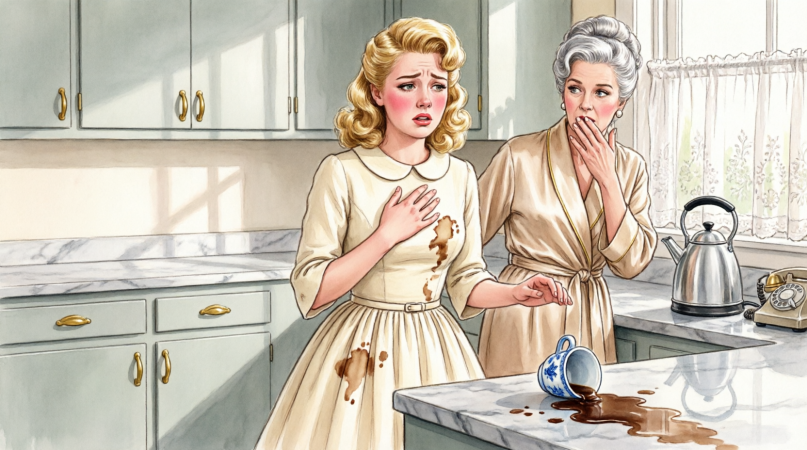
Then she grabbed the mug and hurled the hot coffee straight at my face.
The pain was immediate—scalding, blinding, shocking enough to force a cry out of me before I could stop it. Coffee splashed across my cheek, neck, collarbone, and blouse. The mug shattered against the tile near my feet. I staggered back into the counter, one hand clutching my skin, tears streaming from pain and disbelief.
Eric shouted, “Mom!”
Diane stood there breathing hard, still furious, as if I had done something to her.
I looked at both of them through burning eyes. “I’ll never forgive you,” I said, my voice shaking. “You’re going to regret this.”
Then I grabbed my purse, my keys, and the folder from the office drawer Eric had never once asked about—the house deed, in my name alone—and I walked out.
At 6:12 the next morning, Diane woke to loud pounding on the front door.
When she opened it, two police officers were standing there.
And behind them was a locksmith.
By the time the sun rose, Diane’s idea of “peace in this house” had turned into a criminal assault report, an emergency protective order request, and the fastest legal consultation I had ever paid for.
After I left, I drove straight to urgent care. The doctor documented first-degree burns across the left side of my face, neck, and upper chest, took photos, and told me to return within forty-eight hours in case blistering worsened.
While a nurse pressed cool compresses to my skin, I called my older brother, Mason—a real estate attorney and the only person in my family who never confused kindness with surrender.
His first question was, “Whose name is on the house?”
“Mine,” I said.
“Only yours?”
“Yes.”
“Good,” he replied. “Then stop panicking and start documenting.”
So I did.
I photographed my injuries. Saved the medical records. Wrote a timeline while everything was still fresh. Uploaded screenshots of the casino and handbag charges. Then Mason connected me with a criminal attorney who made it clear that hot coffee thrown in someone’s face is not “family drama.”
It is assault.
I filed the report before midnight.
The officers were direct. If Diane admitted it was intentional, that mattered. If Eric witnessed it, that mattered. If there were cameras, that mattered most. There were. I had installed indoor cameras six months earlier after prescription pills went missing from the guest bathroom and Diane blamed one of my nieces. I never proved that, but I never removed the cameras either. One was aimed directly at the breakfast bar.
The footage was undeniable.
At 4:30 a.m., after reviewing the video and consulting the on-call magistrate, the officers approved a temporary removal order while the protective request moved forward. Mason arranged the locksmith, and I authorized a same-day security reset since the property was legally mine and both Eric and Diane were there by permission, not ownership.
So when Diane opened the door that morning in her robe and slippers, she was met by officers telling her to step outside.
According to Mason, her first words were, “This is my son’s house.”
It wasn’t.
Eric stumbled into the hallway moments later, disheveled and pale, looking like someone whose decisions had finally caught up with him. He kept saying, “Can we just talk about this?” Funny how people discover the importance of conversation only after consequences arrive.
I showed up ten minutes later with Mason, the locksmith, and legal paperwork in hand.
Diane looked at my face and, for the first time, seemed shaken by what she had done. My skin was red and swollen despite treatment, my eye puffy, burns visible down my neck.
She still said, “It was an accident.”
One of the officers answered before I could. “Ma’am, the video says otherwise.”
Eric turned to me. “Lena, please. Don’t do this.”
I met his eyes. “You watched your mother demand money, admitted you gave her my card, and stood there while she threw boiling coffee in my face.”
His shoulders dropped. “I didn’t think she’d actually—”
“Exactly.”
Mason handed Eric an envelope—revocation of account access, fraud dispute forms already filed. The joint card had been frozen hours earlier. The bank was investigating the charges as unauthorized.
Diane’s expression shifted to fear. “Wait—what does that mean?”
“It means,” I said, “the card you treated like your personal allowance stopped working six hours ago.”
Her mouth fell open.
Mason added calmly, “And because Ms. Carter is the sole homeowner, both of you are being removed pending further legal action.”
Eric went pale. “Removed to where?”
I almost laughed.
For eleven months, they treated me like an unlimited resource. Not once did they consider what would happen if I stopped paying.
Now they were finally asking.
By noon, they were out.
Not permanently—not yet—but under the temporary order, Diane could not remain after the assault complaint, and Eric chose to leave with her when I made it clear he could not stay without full cooperation, repayment, and a separation agreement.
He chose his mother.
That didn’t hurt as much as I expected. It just made things clear.
The harsh surprise Diane woke up to wasn’t dramatic revenge.
It was something far worse for someone like her: documentation, legal action, and consequences that couldn’t be shouted away.
By midmorning, the locks were changed, garage access reset, gate code updated. Security access revoked. My accountant froze the household account and redirected my income. Utilities stayed in my name, of course—but Diane’s phone line, streaming services, and the department store account I had co-signed were canceled or flagged before lunch.
She sat in the driveway, muttering, while officers supervised. Eric loaded suitcases, glancing at me like I might change my mind.
I didn’t.
When Diane realized the fraud dispute included the handbag store, she exploded. “You can’t accuse me of fraud! We’re family!”
I stood on the porch with an ice pack against my neck. “You stopped being family when you burned my face and tried to extort me.”
Her voice shook. “I was angry.”
“So was I,” I said. “I still didn’t assault anyone.”
That ended it.
Eric approached me one last time. “Can we talk?”
“We are talking.”
His eyes lingered on my injuries, then dropped. “I messed this up.”
“Yes.”
“I thought if I kept Mom calm, things would settle.”
“You didn’t keep her calm. You made her comfortable while she disrespected me, used my money, and treated my home like hers.”
He swallowed. “What do you want me to do?”
There it was—the question he should have asked a year earlier.
“I want a signed separation agreement. Repayment for every unauthorized charge. A written statement about what happened. And I want you to understand that whether this marriage survives depends on what you do next—not what you say right now.”
He nodded slowly.
From the driveway, Diane shouted, “Eric, don’t you dare side with her!”
He closed his eyes.
Then said, without turning around, “Mom, stop.”
It was the first decent thing he had done in months.
Three weeks later, Diane was charged with misdemeanor assault causing bodily injury. She accepted a plea deal—anger management, restitution, and no contact while the case remained active. The bank reversed the casino charges. The handbag purchase was reversed too after store footage confirmed she used the card while falsely claiming I had sent her.
Eric moved into a temporary hotel, then a small apartment. We began mediation. Whether it ends in divorce or not is still undecided.
But the morning after Diane threw hot coffee in my face, she learned something she had avoided her entire life:
Some women cry when you hurt them.
And then they call the police, the bank, the lawyer, and the locksmith.
By the time people like Diane realize what’s happening, the real shock isn’t revenge.
It’s that the woman they thought they could control has finally started choosing herself.
Part 2: The Silence of the House
The house was quiet after they left. Not the tense, walking-on-eggshells quiet of the previous eleven months, but a deep, resonant silence that felt like a held breath finally released. I stood in the foyer for a long time, listening to the hum of the refrigerator, the tick of the hallway clock, the distant sound of a neighbor’s lawnmower. For the first time in a year, the air didn’t smell like Diane’s perfume or Eric’s stale coffee. It smelled like lemon polish and fresh paint.
I walked into the kitchen. The tile where the mug had shattered was clean—the cleaners I’d hired that morning had scrubbed it thoroughly—but I could still see the ghost of the stain in my mind. I ran my hand over the counter. Cold. Solid. Mine.
My face throbbed. The urgent care doctor had prescribed antibiotic ointment and painkillers, and he’d warned me about scarring. “It’s shallow,” he’d said gently, “but burns on the face are sensitive. You need to keep it out of the sun. You need to keep it moisturized. And you need to be prepared for the possibility that it might not fade completely.”
I looked in the bathroom mirror. The left side of my face was a patchwork of red and pink skin. My eye was still swollen shut. It was ugly. It was painful. But looking at it didn’t make me feel shame anymore. It made me feel angry. And that anger was fuel.
I spent the first week alone. I worked from home. I ate takeout. I slept in the master bedroom with the door locked, even though there was no one to lock it against. Old habits die hard.
Eric texted me on day three. Can I come get some clothes? Mom is freaking out. She says you stole her stuff.
I replied: Your clothes are in bags on the porch. Take them. Diane’s stuff is gone. I donated it. Tell her to check the local shelter.
He called immediately. I let it go to voicemail. Lena, please. You didn’t have to donate her things. She needs her medication. She needs her jewelry.
I listened to the message twice. He was worried about his mother’s jewelry before he asked about my face. That told me everything I needed to know about where his priorities still lay.
I texted back: Her medication was in the bag. The jewelry was paid for with my card. I filed a police report for theft. If she wants it back, she can talk to the detective.
That stopped the calls for two days.
On day ten, Mason called. “How are you holding up?”
“Physically? Healing. Emotionally? Numb.”
“That’s normal,” he said. “But you need to prepare for the next phase. Diane’s lawyer is trying to plead this down to a misdemeanor disturbance. They’re claiming it was a ‘heated domestic disagreement’ and that you provoked her by threatening to kick them out.”
I laughed, a dry, humorless sound. “I provoked her by saying no to extortion?”
“Exactly. That’s their angle. They want to paint you as the aggressor who locked them out of their home.”
“It’s my home, Mason.”
“I know. And we have the deed. We have the bank records. We have the video. But family court judges can be unpredictable when ‘family’ is involved. They like to push for reconciliation. They like to suggest that everyone calm down and share a meal.”
“I’m not sharing a meal with the woman who burned me,” I said.
“Then we need to be firm. I’ve scheduled a hearing for the protective order extension in two weeks. You’ll need to be there. And you’ll need to be ready for Eric to show up.”
“Eric?”
“He’s filing for temporary spousal support,” Mason said. “He’s unemployed. He’s claiming you abandoned the marital residence.”
I gripped the phone tighter. “I didn’t abandon anything. I evicted squatters.”
“Legally, it’s messy because you’re married. Even if the house is in your name, he has marital rights. But given the assault, we have leverage. I just want you to be ready for the narrative they’re trying to spin.”
“Let them spin,” I said. “I have the video.”
“Video is good. Testimony is better. Are you ready to testify against your husband?”
I looked at my reflection in the black screen of my phone. The burns were peeling now. The skin underneath was shiny and tight.
“Yes,” I said. “I’m ready.”
Part 3: The Courtroom Encounter
The courthouse was a labyrinth of beige walls and anxious people. I sat in the waiting area wearing a high-collared blouse to cover the healing skin on my neck. Mason sat beside me, reviewing notes.
Across the room, Diane sat with her public defender. She wore a modest suit, her hair pulled back, looking like a chastened grandmother. She caught my eye and offered a small, tremulous smile. I didn’t smile back. I didn’t frown. I just looked at her until she looked away.
Eric wasn’t there yet.
When his name was called, we moved into the courtroom. It was smaller than I expected. The judge, a woman with sharp eyes and gray hair pulled into a severe bun, reviewed the file quickly.
“Ms. Carter,” she said, looking at me. “You are requesting an extension of the protective order?”
“Yes, Your Honor.”
“And you are filing for exclusive use of the marital residence?”
“Yes.”
Diane’s lawyer stood up. “Your Honor, my client is a elderly woman with health issues. She has nowhere to go. Her son is also homeless due to this situation. We are requesting the order be dismissed and the residence be made accessible to the family again.”
“The residence is not ‘family property’ in the legal sense,” Mason interjected. “It is sole separate property owned by my client prior to the marriage. Furthermore, there is video evidence of aggravated assault.”
The judge held up a hand. “I’ve seen the video. It’s disturbing.” She looked at Diane. “Mrs. Vance, do you deny throwing the liquid?”
Diane stood up. Her voice was shaky. “It was an accident, Your Honor. I was upset. I didn’t mean to hit her. The mug slipped.”
I felt my blood boil. “It didn’t slip,” I said, my voice clear. “You looked at me. You aimed. You threw.”
The judge looked at me. “Ms. Carter, please let counsel speak.”
“I’m speaking for myself,” I said. “She demanded money. I said no. She attacked me. This isn’t a slip. This is violence.”
Eric walked in then. He looked disheveled. He hadn’t shaved in days. He sat down beside his mother, not looking at me.
“Mr. Vance,” the judge said. “You are the husband. Where do you stand on this?”
Eric swallowed. He looked at his mother, then at me. “I… I just want everyone to be safe.”
“That’s not an answer,” the judge said. “Did your mother assault your wife?”
Eric hesitated. The silence stretched out, heavy and suffocating. Diane grabbed his arm. “Eric, don’t lie.”
“I didn’t see her throw it,” Eric mumbled.
I felt a coldness spread through my chest. He was lying. He was sitting there, knowing what happened, knowing the video existed, and he was lying to protect her.
Mason stood up. “Your Honor, we have the video file marked as Exhibit A. We also have the medical records documenting first-degree burns consistent with a projected liquid assault, not a spill.”
The judge sighed. She looked tired. “Mrs. Vance, I am granting the protective order extension. You are to have no contact with Ms. Carter. You are to stay at least 500 yards away from her residence and her place of employment. Mr. Vance, you are granted temporary access to the residence only to retrieve personal belongings under police supervision. No overnight stays.”
She looked at Eric. “And I am denying the request for spousal support at this time. Given the circumstances of the separation, the court finds that the applicant contributed to the breakdown of the household stability.”
Diane gasped. “But he has no money!”
“Then he should find some,” the judge said firmly. “Court is adjourned.”
As we walked out, Eric caught up to me in the hallway. “Lena, wait.”
I stopped. I didn’t turn around immediately. “What do you want, Eric?”
“Why did you have to make it so public?” he asked. His voice was bitter. “We could have handled this privately.”
“Privately?” I turned to face him. “You mean like you handled the credit card charges? Like you handled the fact that your mother was living in my house rent-free? There is no private way to handle assault, Eric.”
“She’s my mom,” he said. “She’s old. She’s sick.”
“She’s violent,” I corrected. “And you chose her. You sat in that courtroom and lied for her. You watched me get burned and you stood there. And now you’re asking me why I won’t let you back in?”
“I’m asking for a chance to fix it,” he said. “I lost my job. I lost my home. I have nothing.”
“You have a degree,” I said. “You have hands. You have a voice. You chose not to use them when it mattered.”
I walked away. I didn’t look back to see if he was crying. I didn’t care. The pity I used to feel for him was gone, replaced by a hard, clear boundary. He was an adult. He made his choices. Now he had to live with them.
Part 4: The Mediation Table
Three months later, we sat across from each other at a long wooden table in a mediator’s office. The air conditioning was humming loudly. There was a box of tissues in the center of the table. Neither of us took one.
Eric looked better. He had shaved. He was wearing a suit, though it was slightly wrinkled. He had found a job—sales, according to Mason. It wasn’t much, but it was something.
Diane was not there. Her criminal case was pending, and her lawyer advised her not to attend any civil proceedings regarding the divorce.
The mediator, a neutral third party named Mr. Henderson, shuffled some papers. “We are here to discuss the dissolution of the marriage and the division of assets.”
“There aren’t many assets,” Eric said. “Most of the debt is in Lena’s name.”
“The debt incurred during the marriage is marital debt,” Henderson said. “However, given the protective order and the findings of financial misuse, the court is likely to assign the unauthorized charges to Mr. Vance.”
Eric flinched. “How much are we talking about?”
Mason slid a paper across the table. “Approximately eighteen thousand dollars. Plus the legal fees for the criminal defense, which Ms. Carter is not responsible for.”
Eric looked at the number. He went pale. “I can’t pay that.”
“Then you will carry the debt,” I said. “Your credit score will take a hit. You’ll have to work it off. Just like I did for the last year.”
Eric looked at me. His eyes were red-rimmed. “Is this about the money? Or is this about punishing me?”
“It’s about accountability,” I said. “You enabled her. You benefited from her exploitation. You knew she was using my card. You knew she was demanding money. You did nothing. Now you pay the price.”
“I loved you,” he said quietly.
“I know,” I said. “But love isn’t enough when respect is missing. You didn’t respect me. You didn’t respect my boundaries. You didn’t respect my safety.”
“I can change,” he said. “I’ve started therapy. I’ve cut contact with Mom. I’m living in a studio apartment. I’m trying.”
“I’m glad you’re trying,” I said. “But you should have tried before I got burned.”
Henderson cleared his throat. “Ms. Carter, are you open to reconciliation? Or are you filing for divorce?”
I looked at Eric. I thought about the eleven months of stress. The sixty-hour work weeks. The nights I cried in the shower so they wouldn’t hear me. The morning I woke up with blisters on my face because the woman who was supposed to be my family threw coffee at me.
I thought about the silence of the house now. The peace. The way I could walk into the kitchen without fearing an argument. The way I could spend my money on myself without guilt.
“I’m filing for divorce,” I said.
Eric closed his eyes. He nodded slowly. “Okay.”
“There are no children,” Henderson said. “The house is separate property. The vehicles are separate. The only marital asset is the retirement account, which we will split equally. The debt will be assigned as discussed.”
“Agreed,” I said.
“Agreed,” Eric whispered.
We signed the papers. The sound of the pen scratching against the paper was loud in the quiet room. When I signed my name, it felt like closing a door. A heavy, iron door that locked out the past.
Eric stood up. He looked at me one last time. “I hope you’re happy, Lena.”
“I’m not happy,” I said. “I’m free. There’s a difference.”
He walked out. I stayed in the chair for a moment, listening to his footsteps fade down the hallway. Then I stood up, gathered my things, and walked out into the sun.
Part 5: The Criminal Verdict
Two weeks after the divorce was finalized, Diane’s criminal case went to trial. I didn’t have to testify in person; my deposition and the video evidence were sufficient. The jury deliberated for four hours.
Guilty.
Assault causing bodily injury.
The sentence was probation for two years, mandatory anger management classes, community service, and restitution paid to me for the medical bills. She was also forbidden from contacting me directly or indirectly.
I read the verdict in the newspaper. There was a small photo of her leaving the courthouse, head down, hiding behind a sunglasses. She looked small. Defeated.
Part of me expected to feel vindicated. triumphant. But I didn’t. I just felt relieved. The threat was gone. The legal leverage was gone. She was just a woman now. Not a monster. Just a woman who made terrible choices and was facing consequences.
I called Mason. “It’s over.”
“It’s over,” he confirmed. “You’re safe.”
“Thank you,” I said. “For everything.”
“You did the hard part,” he said. “I just filed the paperwork.”
I hung up. I drove home. I parked in the driveway. I looked at the house. It was painted a soft blue now. I had changed the color a month ago. The old beige was gone. The past was gone.
Part 6: One Year Later
The scars faded. They didn’t disappear completely—there was still a slight discoloration on my cheekbone if the light hit it just right—but they were no longer painful. They were just a part of my face. A reminder.
I stood on the back patio of the house, holding a glass of wine. It was a Tuesday night. The house was quiet. My cat, Luna, was asleep on the railing.
My phone buzzed. It was a text from Eric. Hey. I heard Mom moved to Florida. Just wanted you to know. I’m doing okay. Got a promotion.
I read it. I didn’t feel anger. I didn’t feel sadness. I felt nothing. He was a stranger now. A person I used to know.
I typed back: Glad to hear you’re doing well. Take care.
I put the phone down. I didn’t wait for a reply.
I had started dating someone new a few months ago. His name was David. He was a teacher. He was kind. He asked me how my day was. He listened when I spoke. He never asked for money. He never criticized my cooking. He never touched me without permission.
He was coming over for dinner later. I was making pasta. Nothing fancy. Nothing to prove anything.
I walked inside. The kitchen was clean. The counters were clear. The mug I was using was mine. I bought it myself. It was blue, with a chip on the handle. I loved it.
I thought about the woman I was a year ago. The woman who came home exhausted, who apologized for existing, who thought love meant sacrifice. She was gone. She had been burned away, literally and figuratively.
In her place was someone harder. Someone sharper. Someone who knew her worth.
I chopped the garlic. I boiled the water. I put on some music.
The doorbell rang. It was David.
I opened the door. He smiled. He held out a small bouquet of wildflowers. “For you.”
“Thank you,” I said. I took them. I smelled them. They smelled like earth and sun.
“How was work?” he asked.
“Good,” I said. “Busy. But good.”
He stepped inside. He didn’t walk like he owned the place. He walked like a guest. He waited for me to lead the way.
We ate dinner. We talked about books. We talked about movies. We talked about nothing important. And it was perfect.
After he left, I washed the dishes. I dried my hands. I walked into the living room and sat on the couch. I looked at the fireplace. It was cold. It hadn’t been used in months.
I picked up the remote and turned on the TV. I flipped through the channels. I stopped on a news report. They were talking about housing prices. About inflation. About the economy.
I turned it off.
I didn’t need to worry about the economy. I had savings. I had a job. I had a house. I had myself.
I stood up and walked to the hallway mirror. I looked at my reflection. The scar was faint. A silver line against my skin.
I touched it. It was smooth.
“You’re going to regret this,” I had told Diane that night.
She had thought I meant revenge. She had thought I meant I would scream, or fight, or try to hurt her back.
She didn’t understand that the biggest regret I could give her was my absence. She didn’t understand that the biggest punishment I could give Eric was my independence.
I had taken away the one thing they valued most: me. My labor. My money. My patience. My silence.
And without me, they had collapsed.
I turned off the hallway light. I walked to the bedroom. I locked the door. Not because I was afraid. But because I could.
I lay down in the bed. The sheets were cool. The pillow was soft. I closed my eyes.
I slept deeply. I didn’t dream. I didn’t wake up in the night. I didn’t check the locks.
I just slept.
And when I woke up the next morning, the sun was shining. The birds were singing. The house was quiet.
I made coffee. I poured it into my blue mug. I walked to the window and looked out at the street.
A car drove by. A neighbor waved. I waved back.
It was a normal day. A simple day. A day that belonged to me.
I took a sip of coffee. It was hot. It was bitter. It was perfect.
I smiled.
I was free.
Epilogue: The Letter
Six months after the divorce, I received a letter in the mail. No return address. Handwritten.
I recognized the handwriting. It was Diane’s.
I almost threw it in the trash. But curiosity got the better of me. I opened it with a letter opener.
- Lena,*
- I don’t expect you to read this. I don’t expect you to forgive. I am writing this because I am in anger management class and the teacher says we need to write to the people we hurt.*
- I hurt you. I know that now. I thought I was the matriarch. I thought I deserved respect because I was older. I thought money was something to be taken, not earned.*
- I was wrong.*
- Eric is doing okay. He visits me sometimes. He says you look happy. I hope you are.*
- I am sorry for the coffee. I am sorry for the money. I am sorry for the pain.*
- I won’t contact you again. This is the last time.*
- Diane.*
I read the letter twice. I folded it. I put it in the drawer with the divorce decree and the police report.
It wasn’t forgiveness. It was closure.
She had admitted it. She had owned it. It was too late to change anything, but it was enough to let me let go of the last bit of anger.
I closed the drawer.
I walked out to the kitchen. David was coming over tonight. We were going to paint the guest room. We were going to make it a home office.
I picked up my phone. I texted him. Can’t wait to see you.
He replied immediately. Me too.
I put the phone down. I picked up a paintbrush. I dipped it in the can. The color was yellow. Bright, sunny yellow.
I started painting the wall.
The brush moved smoothly. The color covered the old white. The room changed. It became brighter. It became new.
I stepped back. I looked at the wall.
It was beautiful.
I smiled.
I was ready for the next chapter.
The End.