After My Husband Passed Away, I Kept the $28 Million Inheritance a Secret. My Daughter-in-Law Told Me to Go Live on the Streets. Three Months Later, an Eviction Notice Arrived at Her Door.
Part 1
The first thing I noticed about Vanessa that afternoon was her shoes.
Black patent leather, red soles, sharp enough to leave marks in hardwood if the heel caught just right. She wore them to the house five days after we buried Daniel, clicking across the floorboards I had polished with Murphy Oil Soap for twenty-two years, as if my husband’s death were just another event she had dressed for. I knew exactly what those shoes cost because I had seen the credit-card statement in February when Daniel asked me to help him sort the mail. One pair, fourteen hundred dollars. More than I used to make in a month working night shifts at St. Vincent’s when Robert was a boy and Daniel was still driving that rusted company van with the broken heater.
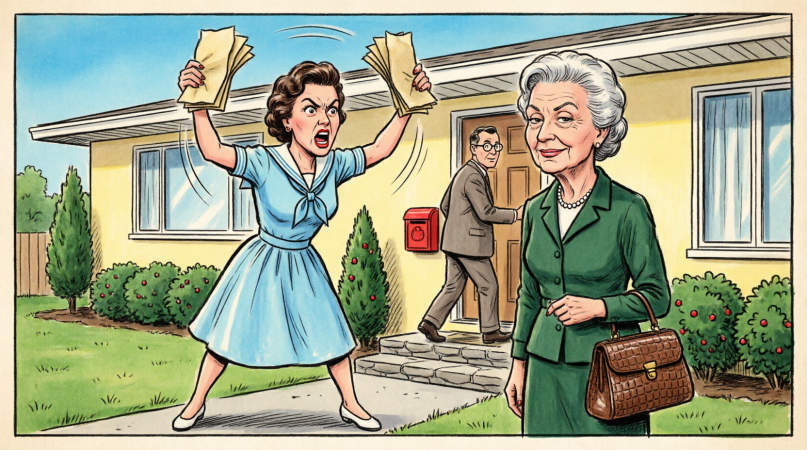
Vanessa stood in my living room, looked around at my furniture, my curtains, my wedding china still stacked in the breakfront, and said, “Now that the funeral is over, let’s be practical. Cry it out if you need to, pack your things, and go live on the streets.”
Just like that.
No lowering of her voice. No shame. No glance toward the framed photograph of Daniel on the mantel with the white funeral lilies already starting to turn brown at the edges.
My son Robert stood a few feet behind her with his hands in the pockets of his expensive coat and his eyes fixed on the rug. Forty-two years old, broad shoulders, thinning hair at the temples, and in that moment he looked exactly like he had at nine when he broke the lamp in the den and waited for me to decide whether he was in trouble.
Only this time, he was not a child.
This time, he let his wife throw me out of my own home and said nothing.
Linda, my sister, had stationed herself in Daniel’s armchair like she’d been invited to witness a legal proceeding. She had flown in from Ohio for the funeral wearing too much perfume and grief that came and went depending on who was in the room. She crossed one ankle over the other and watched me the way people watch a pot they expect to boil over.
Vanessa wanted a scene. I could see it in the way she held her phone low against her thigh, ready to record if I cried or shouted or called her what she deserved.
Instead I looked at her, then at Robert, then at the little brass key in my coat pocket pressing into my palm through the lining.
Daniel had given me that key three weeks before he died.
He’d been in a hospital bed by the window, skin gray, lips cracked, his voice weak but stubborn. He took my hand and pressed the key into it with surprising force. “Keep this safe, Maggie. Don’t tell anyone. Not Robert. Not anybody.”
I thought the medication was making him dramatic. Daniel had always handled illness badly, even a cold. I tucked the key into my purse and told him to rest. Two days later he was gone, and now here I was in the house we had paid off together, being told to disappear by a woman who had been in this family for eight years and still called meatloaf “that loaf thing.”
“Did you hear me?” Vanessa asked.
I nodded once. “I heard you.”
She blinked, probably disappointed by how calm I sounded.
Robert cleared his throat. “Mom, Vanessa and I have been talking, and with Dad gone, the house situation needs to be streamlined.”
Streamlined.
He used to come home from high school and ask me for grilled cheese with tomato soup on rainy days. He used to call me from college when he had the flu because he said no one else knew how to make him feel less awful. Now he was talking to me like an underperforming department head.
I should tell you that Daniel and I built that house one shift and one skipped purchase at a time. We bought it in 1989 when Robert was eight, when the shingles curled at the edges and the upstairs plumbing groaned like an old man every winter.
I worked nights at St. Vincent’s, twelve-hour shifts in orthopedic recovery, and Daniel moved up from logistics coordinator to regional operations director by swallowing every miserable hour they offered him. We clipped coupons.
We drove the same Honda for fifteen years. I sold my mother’s jewelry to pay the last of Robert’s tuition when the aid package came up short. I made curtains from fabric bolts on clearance. Daniel built the coffee table in the garage with his own hands and sanded it so smooth he kept running his fingertips over it like he didn’t trust wood could feel that soft.
Nobody mentioned any of that at the funeral.
Vanessa had insisted on a professional eulogist because, as she put it, “We need someone who speaks well.” The man talked about Daniel’s “executive instincts” and “market brilliance” and mispronounced our last name twice.
He never once said that Daniel woke up at four-thirty for twenty years to make my coffee before my night shift ended because he said the world felt less mean if at least one person handed you a warm mug when you were tired.
By the time Vanessa and Robert left that afternoon, she had already put yellow sticky notes on half the furniture.
Sell.
Donate.
Trash.
My wedding china was boxed by the front door with a note that said Donate. Upstairs, Daniel’s suits were gone from the closet. So were three of my dresses, including the blue one I bought for our fortieth anniversary dinner that never happened.
On our bed was a stack of papers from Whitmore & Associates, a law firm whose stationery looked cheap and overdesigned.
Vanessa had left a pink note on top.
Sign here, here, and here. Voluntary transfer to Robert J. Hayes. Witnessed by Linda Schultz.
Voluntary.
I sat on the edge of the bed where Daniel used to untie his shoes every evening, and the mattress dipped under my weight in the place his body had shaped over decades. The room still smelled like his shaving cream and peppermint lozenges. I looked at those papers for a long time.
Then I picked up the pen and signed.
My signature did not shake.
What people miss about older women is how much practice we have at surviving while everyone assumes we are folding. By the time I was done, the light outside had gone watery and gray. I packed one small suitcase. Jeans, sweaters, underwear, my Bible, my blood-pressure pills, the quilt my mother stitched in 1972, my nursing shoes, a photograph from our wedding day, and the bar of Ivory soap I always kept in the linen closet because hotel soaps smell like strangers.
In the kitchen, the coffee maker had a sticky note on it too.
Trash.
I bought that coffee maker in 2001 with a holiday bonus from the hospital. I left it on the counter.
I left everything.
The East Side Motel on Route 119 charged sixty-seven dollars a night and didn’t ask questions if you paid cash up front. My room smelled like bleach, cigarettes, and old heat. The carpet was the color of weak tea. The bedspread was orange with little brown diamonds that had probably looked cheerful sometime during the Reagan administration. Trucks droned all night on the road outside. The bathroom mirror had a crack running diagonally through it so my face split into two crooked halves every time I looked up.
I sat on the bed with the brass key in my hand and listened to the mini-fridge hum.
I had three hundred and twelve dollars in my purse, a dead husband, a son who had not defended me, and a daughter-in-law who thought she had already won.
At five the next morning, after a night with no sleep and too much thinking, I took a wrinkled business card out of my wallet. Daniel had slipped it into my purse two months earlier and told me not to lose it. Donald P. Brennan, Esq. No explanation.
I dialed the number.
Three rings.
Then a man said, “Brennan.”
“This is Margaret Hayes,” I said. My voice sounded older than I felt. “Daniel Hayes’s widow. I think… I think we need to talk.”
There was a brief pause, paper rustling somewhere in the background, and then the man said, very quietly, “Mrs. Hayes. I’ve been waiting for your call.”
I looked down at the brass key in my lap and felt the room tip beneath me. If he had been waiting, then Daniel had known exactly what was coming. The question that made my skin go cold was why.
Part 2
Donald Brennan’s office was on West 47th Street, four floors up in a brick building squeezed between a deli and a jewelry repair shop with a flickering neon sign that said WE FIX WATCHES while only half the letters worked. There was no elevator. By the third flight my knees were complaining and I could smell hot dust coming off the radiators in the hall.
His secretary, a woman with silver hair and cat-eye glasses, led me into an office lined with filing cabinets and law books that looked heavy enough to settle arguments by falling on people. Brennan rose from behind his desk when I came in.
He was younger than I expected, maybe mid-fifties, broad-shouldered, graying at the temples, with the tidy kind of face lawyers have when they make a living noticing details other people miss. His suit was navy, his tie was plain, and the first thing I noticed about him was that he did not perform sympathy. I liked him immediately for that.
“I’m sorry for your loss, Mrs. Hayes,” he said, and sat down only after I did.
I put the brass key on his desk.
He turned it over in his palm, nodded once, and set it carefully on a legal pad.
“Daniel was my client for thirty-two years,” he said. “Estate planning, trust structure, some real-estate acquisitions, investment vehicles, and, toward the end, specific instructions related to asset protection.”
The phrase asset protection made me sit up straighter.
“I don’t understand.”
“I know.” He opened a manila folder. “That’s why you’re here.”
He slid a single sheet across the desk.
At the top, in clean black type, were the words: Estate of Daniel Jacob Hayes — Confidential Summary.
I read down the page once. Then again. My eyes snagged on words I recognized only in the abstract—irrevocable trust, beneficiary designation, holdings structure, offshore account—before stopping hard at the number at the bottom.
Estimated consolidated value: $28,000,000.
For a second, nothing in the room made sense. Not the buzzing fluorescent light overhead, not the smell of old paper and coffee, not the legal pad under Brennan’s hand. Twenty-eight million dollars belonged to other people. Men in glossy magazines. Women named Meredith who owned summer houses on islands. Not to Daniel and me, who bought our paper towels in bulk when they were on sale and saved takeout containers because they were still perfectly good.
“There’s a mistake,” I said.
Brennan did not blink. “No, ma’am.”
“My husband drove a twelve-year-old Honda.”
“Yes.”
“We lived in a Victorian in White Plains with one bathroom that rattled in the winter.”
“Yes.”
“We shopped at Stop & Shop.”
Brennan folded his hands. “Daniel’s father left him a minority stake in the manufacturing company in 2003. Daniel sold it quietly, invested through structures designed to keep his name out of public records where possible, and compounded that capital aggressively for nearly two decades. He was very good at it.”
I stared at him.
“Why didn’t he tell me?”
Brennan’s expression shifted then, just slightly, and I saw something almost like pity.
“He tried,” he said. “Repeatedly.”
I opened my mouth to argue and then closed it again, because memory is a cruel little clerk when it wants to be. Daniel, at the kitchen table with spreadsheets spread out between the salt shaker and the grocery list. Daniel, asking if I wanted to come with him to meet someone in the city “just so you’re looped in.” Daniel, starting a sentence with We should really talk about the future and me cutting in with Honey, I trust you. You’ve always handled that stuff.
I thought I was being loving.
I thought love meant not asking questions.
Brennan continued. “Daniel was also deeply concerned about your son’s marriage.”
That landed differently. Colder.
“He said, and I’m quoting him, ‘My son married a predator. If she smells money, she’ll strip him to the bone and smile while doing it.’”
I heard Vanessa’s voice in my living room telling me to go live on the streets.
I thought about the way she had first walked through our house eight years earlier when Robert brought her to Sunday dinner. She had complimented the roast chicken, asked whether the wallpaper was original, and then stood in the doorway to the den looking around with those bright, searching eyes of hers before saying, “So this place is paid off, right?”
Not “What a beautiful house.” Not “You must have wonderful memories here.”
Paid off.
Back then Daniel caught my eye over the mashed potatoes and lifted one eyebrow. After they left, he said, “That woman inventories things.”
I laughed and called him dramatic.
I sat in Brennan’s office now feeling that old laugh burn all the way down.
“There’s more,” he said gently.
Of course there was.
Daniel had bought a penthouse on Park Avenue eight years earlier, in cash. He had never taken me there. It had been meant, Brennan told me, as a surprise for our fortieth anniversary. “A second act,” Daniel had called it in his planning notes. He had wanted to hand me the keys over dinner, take me upstairs, and tell me we were done living for everyone else.
Instead, he died with that apartment empty.
Everything—investments, cash reserves, property—sat in an irrevocable trust established in 2019. Sole beneficiary: Margaret Louise Hayes. Me. Legally clean. Difficult to challenge. Nearly impossible to seize. Robert and Vanessa had no direct access. None.
“Not even discovery?” I asked, thinking of Vanessa’s sharp little eyes and Linda’s eager silence.
Brennan smiled without humor. “Not unless someone presents a court with a reason stronger than greed dressed up as suspicion.”
My hands were cold. I tucked them under my thighs to warm them.
“What about those transfer papers I signed yesterday?”
“Meaningless,” he said. “The Maple Avenue house was never the major asset, and Daniel moved title protections years ago. Vanessa used a cut-rate firm because cut-rate firms don’t ask why a grieving widow is being rushed into voluntary transfers. But they can’t reach what isn’t there.”
I should have felt relief. What I felt instead was a strange floating sensation, like stepping off a curb you thought was still under your foot.
Brennan picked up the brass key.
“This opens a private deposit box at Manhattan Trust. Daniel left documents there for you personally. Letters too.”
“Letters?”
He nodded. “Quite a few, actually.”
An hour later I was in a narrow vault room with brushed steel walls, a small table, and air so cold it smelled sterile. Box 447 was shallower than I expected. Inside were folders, statements, property deeds, a USB drive, and a bundle of envelopes tied with faded blue ribbon. On top lay one sealed in Daniel’s handwriting.
Maggie.
My throat closed just looking at it.
I opened it with the little silver letter opener the bank clerk had left on the table.
If you’re reading this, I’m gone. And first, I’m sorry. I’m sorry I ran out of time. I’m sorry I let you think our life was smaller than it was. I was trying to protect you, and maybe I was also trying to protect the version of us that didn’t have to talk in numbers.
Halfway through, I had to stop because I couldn’t see through the tears.
He wrote that he bought the Park Avenue apartment for us. That he wanted a home untouched by Robert’s growing pains, by family obligations, by the ghosts that settle into old houses like dust in curtain hems. He wrote that he knew Vanessa watched money the way foxes watched henhouses. He wrote that he feared Robert mistook softness for love and control for care.
Don’t let them bully you, he wrote. You gave me forty years. I’m giving you freedom. Use it.
Under that letter were twenty-three more.
The earliest one was dated May 1985.
You’re asleep with one hand on your belly while I write this, he had written. If something happens to me before I ever get my act together, I need you to know you are the only person on this earth I ever wanted to build with.
I sat in that cold little room and cried so hard my ribs hurt.
When I finally looked up, my reflection in the steel wall was blurred and old and furious.
There were twenty-three more envelopes beneath the first one, one for almost every year I had loved him. I had come to the bank thinking Daniel might have hidden money. What he had really hidden, all those years, was a map of the life I never knew he’d been building around me.
Part 3
I stayed in the motel.
That surprises people when they hear the story later. They imagine the estate summary, the trust documents, the deed to a Park Avenue penthouse, and they think I should have gone straight from Room 12 on Route 119 to marble floors and a doorman who knew my name. But grief makes ordinary things feel safer than luxury. Also, I am a nurse by training and temperament. When something catastrophic happens, my first instinct is never to faint onto a chaise lounge. It is to assess, organize, wait for the next bad thing, and keep my shoes where I can find them in the dark.
So I stayed in the motel and built a routine around the ugly little room.
Housekeeping came at nine with a cart that squeaked like a wounded animal. The woman who cleaned my room wore lavender body spray and hummed along to Spanish radio under her breath. The ice machine rattled all hours of the day and night. The faucet spat brown water for half a minute every morning before clearing. On Thursdays the couple in Room 14 screamed at each other through the wall over money, or fidelity, or maybe both. In the mornings I ate stale toast from the lobby and peanut-butter crackers from the vending machine when my blood sugar dipped. At night I sat cross-legged on the bed under the jaundiced yellow lamp and read Daniel’s letters one by one.
He had written them in hotel rooms, airport lounges, hospital waiting rooms, and once, according to the date and the smudged handwriting, during a thunderstorm when Robert was twelve and afraid to sleep alone. Some letters were two pages. Some were only a paragraph. None had ever been mailed.
In one from 1997 he apologized for missing my birthday because a shipment got held at port and he had to fly to Savannah. In another from 2008 he said he watched me fall asleep on the couch with a crossword on my chest and thought, for no reason he could explain, that there was no wealth in the world that felt bigger than being known by the same person for twenty-five years.
And in almost every one, there was money tucked between the lines. Not showy money. Not greed. More like careful scaffolding. An extra account opened. A property considered. A strategy adjusted. Daniel had never wanted to look rich. He had wanted to become impossible to corner.
By the second week in the motel, Vanessa started calling.
Not to apologize. Not to ask if I had somewhere warm to sleep. She wanted my mother’s emerald ring.
“It belongs in the family,” she said in that bright brittle tone she used when she was pretending reason.
“It is in the family,” I said. “It’s on my finger.”
She hung up on me.
Robert texted twice. The first was a bland Are you okay? that landed like junk mail. The second asked whether I had seen some “old insurance paperwork” because Vanessa was “trying to keep things organized.” I didn’t answer either one.
Then came a message from an unknown number.
We know you went into the city. Don’t get clever. We have access to everything.
There was no signature, but the voice was Vanessa’s all the same. She believed intimidation was a kind of intelligence. I stared at the message until the words seemed to sweat on the screen.
Then I called Brennan.
“She says they know about the city,” I told him. “She’s threatening audits. Discovery. Something.”
He was quiet for a second.
“Mrs. Hayes,” he said, “I need you to hear me clearly. Stop being afraid of her.”
Easy for him to say. He had not stood in his own bedroom looking at sticky notes on his dead husband’s furniture. Still, there was something in his voice—dry, patient, a little ruthless—that cut through the panic.
“She has a leased Audi,” he went on. “You have twenty-eight million dollars in a trust she cannot reach. At some point, this stops being a question of legal exposure and becomes a question of whether you’re willing to act like the stronger party.”
That stung because it was true.
“What am I supposed to do?” I asked.
Brennan did not answer immediately. I could hear him flipping pages, maybe not even related ones. Letting me sit in the silence.
“Tell me,” he said at last, “what matters most to Vanessa.”
“My house,” I said without thinking.
He made a satisfied little sound. “Good. Now expand.”
Status mattered to Vanessa. Addresses mattered. Brand labels, parking spots, where a dinner reservation got you seated, whether a handbag had to be set carefully on a chair because it cost more than the chair. She measured security in visible things. Robert had once joked that Vanessa treated every room like an audition and every person like a ladder.
Brennan listened.
Then he said, “What if I told you the building where they rent is currently for sale?”
I sat up so fast the motel bed springs squealed.
“How do you know where they live?”
“I know many things. That is most of my value.” He paused. “The Ashford. Luxury rental, White Plains. The owner overleveraged, fell behind, listed six months ago, still unsold because the books are messy and most buyers don’t like uncertainty.”
My pulse was loud in my ears.
“You’re suggesting I buy the building?”
“I’m suggesting,” he said, “that if you want Vanessa to understand what it means to tell someone to go live on the streets, you stop speaking in feelings and start speaking in deeds.”
Three days later I was in a private office at Manhattan Trust with a woman named Caroline whose manicure was the color of cream and whose expression did not shift when she moved five million dollars at my request.
“Would you like checks on the account, Mrs. Hayes?” she asked.
“No,” I said. “Just a debit card.”
She gave the sort of small nod people give when they have already decided not to underestimate you.
By Friday, Brennan had formed a shell company: Hayes Capital Holdings. No direct tie to me in any ordinary search. By Sunday, after two hurried due-diligence calls and one ugly set of maintenance reports on a parking garage membrane I did not fully understand, we made an all-cash offer.
Four point two million.
The owner accepted before the weekend was over.
The closing documents were emailed to my motel room on a gray June evening. I sat on the edge of the narrow bed with my reading glasses sliding down my nose, trucks groaning past outside, and signed papers that would make me the owner of the building where Robert and Vanessa lived.
When I clicked the last signature line, I felt something move inside me. Not joy exactly. Not revenge in the hot childish sense. It was colder than that. Straighter. Like finally standing up after hunching too long.
Vanessa had told me to go live on the streets.
Three weeks later, without ever speaking my name, I became the woman who could take hers away.
Part 4
The notice went out on June 15.
Thirty days to vacate. Standard language. New ownership, restructuring, no renewal of month-to-month tenancy. Clean, professional, and so stripped of emotion it almost looked merciful.
Brennan had a real-estate attorney review every line. Janet Cho, sharp voice, no wasted words, twenty-three years of property law. “You’re well within your rights,” she told me over the phone. “If they call screaming, let them scream. Rights don’t care about tone.”
Vanessa called at 7:12 that evening.
I knew it was her before I answered because I could hear her breathing hard on the line.
“You did this.”
I sat on the motel bed with the TV on mute and the little paper envelope from the takeout Chinese place still folded beside me. I had ordered hot-and-sour soup and vegetable lo mein because it was the first day in weeks I had felt hungry.
“Did what?” I asked.
“Don’t play stupid with me, Margaret.”
Margaret. She only used my first name when she wanted to sound superior.
“We got an eviction notice. The building sold. This is you. I know it’s you.”
I looked around Room 12. Brown carpet, chipped lamp base, one of my sneakers sticking half out from under the bed, and the mini-fridge humming like it had asthma.
“I don’t own any buildings, Vanessa,” I said. “I live in a motel.”
The sound she made then was half snarl, half disbelief. “You’re lying.”
“Am I? Check the deed.”
She hung up.
I sat there for a minute with the phone in my hand and felt my pulse in my fingertips. Then I laughed. Not loudly. Not beautifully. It came out like something rusty opening, but it was mine.
The fallout arrived fast.
Three days after the notice, Robert called me from a number I didn’t recognize. He sounded tired in a way I had only heard once before, when he was twenty-two and his first job in Manhattan cut half the junior staff without warning.
“Mom,” he said, “I lost my job.”
I closed my eyes.
His biggest client had gone bankrupt. The company was “restructuring.” He’d been let go with six weeks’ severance and a handshake he described as “insultingly warm.”
Then he said what I knew he would say. “Can you lend us some money? Just until I figure things out.”
Us.
I thought about the $2,000 I gave him the previous November when his account went short. The $1,200 for the Audi down payment two years before that. The surprise transfer to cover a canceled vacation deposit because Vanessa had booked a resort they couldn’t afford and then cried. Every time I said yes, I told myself I was helping my son. In truth, I had been padding the walls of his life so he never felt the full hit of his own decisions.
“No,” I said.
Silence.
Then, “Mom.”
“No.”
He exhaled like I had slapped him. “You know we’re under pressure.”
“You let your wife throw me out five days after your father’s funeral.”
“I didn’t know what to do.”
“You could have said no.”
I heard him swallow.
Then, quieter, “Vanessa’s pregnant.”
That should have softened me. It almost did. For a split second I saw a blurry future version of a grandchild in my kitchen, little socks in a laundry basket, a car seat in the back of Robert’s car. But the feeling passed almost immediately because something about the sentence sat wrong in my body.
Vanessa had been “trying” for years, which mostly seemed to involve expensive supplements, astrology-friendly wellness retreats, and refusing to see an actual fertility specialist because, according to her, “I don’t need a stranger making my body feel like a project.”
“Did you go to a doctor?” I asked.
“She took a test.”
“A home test.”
“Yes.”
“Did you see a doctor’s note?”
He was quiet.
I pushed. “Robert. Did you see a doctor’s note?”
“No.”
I looked at the rain crawling down the motel window in thin gray lines.
Home tests can be wrong. Home tests can be faked. Home tests can be bought already positive online for less than the cost of one of Vanessa’s face serums.
“You think she’s lying?” he asked.
I thought of the timing. Job loss. Eviction notice. My sudden refusal to bankroll them. Walls closing in.
“I think,” I said carefully, “that desperate people are inventive.”
He got angry then, which at least was preferable to passive. “You hate her so much you can’t even hear this.”
“No. I hear it too clearly.”
He hung up on me.
That night I couldn’t sleep. The motel air conditioner clicked on and off like an irritated nurse. Every time I closed my eyes I saw Vanessa’s face from the funeral—calm, dismissive, certain I would fold. Pregnancy was exactly the kind of shield she would grab if she believed sympathy could still buy her leverage.
At six the next morning, I called Brennan.
“I need a private investigator,” I said.
He didn’t ask why. That was another thing I appreciated about him. People who truly know what they’re doing don’t waste time on fake surprise.
By eight-thirty I was sitting across from Nicole Chen in a coffee shop in Yonkers. She wore a black jacket, no jewelry, and had the kind of neutral face that made other people fill silence too quickly. She stirred nothing into her coffee and took notes on an actual paper pad, which I respected.
I explained the pregnancy claim. The eviction. The timing. The home test.
Nicole listened, then said, “If she’s lying, she’ll either avoid medical verification or overperform confidence.”
“Can you find out?”
“Yes.”
“How?”
She gave me the smallest hint of a smile. “People with money problems and a taste for drama usually make themselves easier to track than they realize.”
The plan came together faster than I expected. Vanessa, it turned out, had scheduled a blood test through a Labcorp in Yonkers after Robert pushed for “something official.” Nicole arranged what she arranged. I didn’t ask for every detail because I have worked in enough hospitals to know the less said aloud, the cleaner everyone sleeps. By the next afternoon, she called me.
“Bloodwork confirms zero HCG,” she said. “She isn’t pregnant. Not recently either.”
I sat very still.
Outside, a truck backfired on Route 119 and someone in the room next to mine started laughing too loud at a sitcom.
“Send me the report,” I said.
“Already on its way.”
I forwarded it to Robert with one line.
Read the lab values, not her tears.
He called me thirty minutes later, and the sound coming through the phone wasn’t really crying. It was worse. It was the sound a person makes when a structure inside them gives way all at once.
“She said it was a miscarriage,” he choked out. “She said it happened yesterday.”
“The report shows she was never pregnant.”
He made that broken sound again.
Then he whispered, “What do I do?”
I looked down at the brass key Daniel had given me, which I still kept in the little dish beside the motel lamp even though I no longer needed it. Habit, maybe. Or reverence.
“You leave her,” I said.
Outside my room, a car door slammed and footsteps passed by. Inside, all I could hear was my son trying to breathe through a lie too big to hold. The next thing I did would either pull him out of the hole or show me he meant to stay buried in it.
Part 5
I offered Robert a house before I offered him forgiveness.
That sentence used to bother me when I first said it out loud. Now I think it was the most honest order possible.
Three days after the fake-pregnancy report, Robert came to the motel. I buzzed him up from the front desk phone and watched through the cracked curtain as he crossed the parking lot in a wrinkled polo and yesterday’s guilt. He looked like he hadn’t slept in a week. His shoulders had dropped. His jaw, usually so set when Vanessa was around, seemed loose with exhaustion.
When I opened the door, he froze.
I don’t think he had believed it until then. Not really. He knew intellectually that I was staying in a motel. But there is a difference between knowing and standing in a room that smells like industrial cleaner and old heat, seeing your mother’s quilt folded over a chair because there is nowhere better to put it, noticing her prescription bottles lined up beside a lamp with a cigarette burn in the shade.
“You’ve been living here,” he said.
“Yes.”
“For how long?”
“Almost three months.”
His face changed. Not enough to erase what he’d done. But enough that I knew he had finally stopped picturing this as a temporary inconvenience and started seeing it as what it was: abandonment, with furniture.
He sat on the edge of the bed. The springs complained. He covered his face with both hands and stayed like that so long I had time to fill the coffee maker in the hallway and come back.
When he spoke, his voice was raw. “I didn’t know.”
I set the paper cup down in front of him. “You didn’t ask.”
That one hurt him. Good.
He told me about Vanessa’s screaming, the fake miscarriage, the way she tried to twist blame until even the lab report sounded, in her version, like a technicality. He said he’d slept on the couch for two nights. Then in his car. Then he laughed once, ugly and embarrassed, and said, “It’s leased, so technically even the car doesn’t really feel like mine.”
That was the moment I understood that Robert had lived much of his adult life inside borrowed definitions—borrowed money, borrowed confidence, borrowed choices.
“I can help you,” I said.
He looked up fast.
“There’s a house in Tarrytown. Small colonial. Three bedrooms. Tree-lined street, old lilac bush in the front yard, creaky stairs, decent roof. Rent-free if you want it.”
His throat moved. “Why would you do that?”
“Because you are still my son.” I let him feel the warmth of that for exactly one second. “There’s one condition.”
He knew before I said it.
“Vanessa.”
“Yes.”
He stared at the motel carpet, where a dark stain near the dresser could have been coffee or blood or engine oil for all I knew.
“She’s my wife.”
“She was also willing to fake a pregnancy to keep control of you.”
He pressed the heels of his hands into his eyes. “You’re asking me to choose.”
“No,” I said. “She already did that for both of us. I’m asking you to admit the choice exists.”
He left without answering.
Three days later, he called from a diner in Tarrytown. I could hear silverware clinking and someone shouting an order in the background.
“I’m taking the house,” he said.
I did not ask whether Vanessa cried or threw things or played dead under a weighted blanket. I no longer cared about the style of her collapse.
Brennan handled the property transfer through the same LLC structure that owned the Ashford. The Tarrytown house sat on Willow Street, white clapboard, green shutters, the kind of place that looks ordinary until late afternoon light hits the porch rail and makes it glow. I went there once before Robert moved in. The previous owner had left behind a jar of nails in the garage, a child’s chalk drawing on the patio, and a faint smell of apples in the kitchen from a bowl that was no longer there. I stood in that little empty house and thought, This is more kindness than he has earned, and maybe exactly enough.
Vanessa did not go quietly.
She filed first.
Of course she did.
Whitmore & Associates sent over a fourteen-page petition so aggressive it practically shouted through the paper. Emotional abuse. Financial manipulation. Alienation of affection by a controlling mother-in-law. Concealment. Fraudulent transfers. Elder abuse, which was rich considering I had spent a summer in a motel because of her.
Brennan called me while I was in the grocery store comparing chicken prices out of habit I no longer technically needed.
“They’re throwing spaghetti at the wall,” he said. I could hear his amusement even over the bad cell connection. “Most of it won’t stick. None of it has teeth.”
“What does she want?”
“Money. Validation. An audience. Possibly all three in no particular order.”
I bought the chicken anyway. Old instincts.
The legal mess dragged through July and into August. Vanessa’s lawyer demanded disclosures that had nothing to do with Robert’s actual finances because she still believed there had to be a hidden river somewhere, one she could step into if she shouted loudly enough. Brennan drowned them in the truth instead: Robert’s checking account balance, his unemployment paperwork, the lease obligation on the Audi, the joint credit-card debt Vanessa had helped build, the grocery receipts from Tarrytown, the job applications, the diner tabs.
Whitmore’s attorney kept asking the same question during mediation in increasingly theatrical tones.
“Where is the money?”
Brennan, in the voice of a man reading weather reports, answered each time, “There is no marital money you can reach.”
The best part was that he was telling the truth.
Vanessa tried another angle. She hired an investigator who followed Robert for two weeks and produced photographs of him at the hardware store, at two job interviews, at church once with his tie crooked, and eating pot roast alone in a diner like a man whose biggest luxury was extra gravy.
The investigator’s own report, Brennan told me later, became one of our best exhibits.
“He documented modesty beautifully,” he said.
Then Linda called.
I was sitting on the little porch at Willow Street with a glass of iced tea and a plate of sliced tomatoes when my phone lit up with Ohio.
I almost let it ring out. Curiosity got me.
Her voice came on too fast, already defensive. “Margaret, before you hear this from somebody else—Vanessa came to me.”
I said nothing.
“She offered me fifteen thousand dollars.”
The evening air felt suddenly cooler.
“For what?”
“To say you stole from Daniel. That you isolated him. That you manipulated paperwork when he got sick.” Linda rushed the words like speed might soften them. “I didn’t say yes.”
“But you listened long enough to hear the number.”
“Tom isn’t paying child support, and I’m behind on rent—”
I stood up so abruptly the tea sloshed over my hand.
“You were going to sell me out to a woman who threw me out of my home.”
“I said I didn’t say yes.”
“You also didn’t say no.”
On the other end of the line, Linda started crying. Real tears, fake tears, sister tears—it didn’t matter. I had become allergic to tears that arrived after calculations.
When I hung up, my hand was shaking hard enough I had to set the phone down on the porch rail.
Vanessa had lied about pregnancy, lied in court, lied in the marriage, and now she was shopping for witnesses.
The next hearing was in four days.
I went inside Willow Street, stood in the quiet little kitchen, and looked out at the lilac bush trembling in the evening breeze. Brennan said the case was weak. He was probably right. But weakness had never stopped Vanessa before. The question burning in my chest wasn’t whether she could win. It was what she would destroy trying.
Part 6
Vanessa lost in slow motion.
There was no single dramatic collapse, no courtroom gasp, no judge pounding a gavel while she clutched pearls she did not own. Real legal defeat is usually less cinematic and more humiliating. It arrives in paperwork. In motions denied without flourish. In lawyers whose voices get flatter each time they realize the story they sold their client cannot survive contact with facts.
Judge Patricia Okonkwo denied Whitmore’s request to subpoena my bank records in under fifteen minutes.
“I fail to see how the finances of a non-party widow,” she said, peering over her glasses, “have any bearing on the dissolution of this marriage.”
Vanessa’s lawyer tried to say something about patterns of influence and concealed support. Judge Okonkwo cut him off with one lifted finger. I have used that finger myself on difficult surgeons. It is more powerful than shouting.
“No fishing expeditions,” she said. “Move on.”
I sat in the back of the courtroom wearing a navy coat and shoes polished enough to make me feel prepared. Vanessa sat at counsel table in cream wool and desperation. Robert, beside Brennan, looked pale but steady. When Vanessa glanced over and saw me in the gallery, her face did something ugly. Not fear. Something closer to hatred realizing it has run out of language.
By mid-August, her lawyer stopped returning calls with the same confidence he had shown in June. By late August, he sounded tired. Whitmore & Associates always struck me as the kind of firm that promises drama to clients who cannot afford outcomes. Once it became clear Brennan had every angle covered and that Robert’s real financial picture resembled a man drowning in monthly payments, not a prince hiding a treasury, the case started leaking air.
Vanessa signed the divorce papers on August 22.
No alimony. No emergency support. No magical access to money that was never hers. She kept the Audi lease and half the credit-card debt. There was some poetry in that. So much of her life had been spent curating surfaces; in the end, she walked away responsible for both the wheels and the shine.
Robert called me from the courthouse steps after it was final.
“It’s over,” he said.
The relief in his voice sounded dangerous to me. Relief can make people sloppy. It can make them think ending the fire is the same as repairing the house.
“Good,” I said. “Now do something useful with the next hour.”
There was a beat of silence, then a short laugh. “I actually have an interview in Tarrytown at three.”
“What kind of job?”
“Construction supply company. Assistant manager position.”
“Then go get it.”
He did.
Forty-two thousand a year. Not glamorous. Solid. Inventory, scheduling, contractor accounts, forklift noise, steel-toed boots, fluorescent break room, the smell of sawdust in his jacket when he came by Willow Street on Sundays. For the first time in years, he began to resemble a man inhabiting his own life instead of leasing it from someone more forceful.
I watched him carefully.
That part matters. People hear the rest of the story and imagine I folded the minute Vanessa was gone and Robert looked properly sorry. I didn’t. My love for him never vanished, but trust is not a faucet. It does not run clear because a liar leaves the room.
He started therapy on his own. I made note of that. He stopped asking me for money. I noticed that too. He repaid small things without ceremony—the lawn service at Willow Street, the broken porch light, the tank of gas after borrowing my car one Sunday. He showed up for dinner when he said he would. He washed dishes without acting like he deserved applause.
Small things, maybe. But character is usually just small things stacked consistently.
Linda called three times after I hung up on her. I answered none of them. Then she mailed me a six-page letter full of explanations, money trouble, loneliness, bad timing, old resentment, and one line that made me laugh out loud in my kitchen: Families should not let outsiders come between blood.
As if she had not nearly sold my blood for fifteen thousand dollars.
I left the letter unanswered.
In October, I put Maple Avenue on the market.
Walking through that house one last time felt stranger than grief. Grief had already worn grooves in me. This was different. It was like touring a museum where the exhibits kept whispering back.
The dining room still had the faint mark on the baseboard where Robert drove a toy truck into it in 1991. The kitchen window still stuck a little in damp weather because Daniel never got around to replacing the frame. The den still smelled faintly of cedar because I lined the drawers myself years ago. Every room held versions of us I could not carry forward, and I realized then that keeping the house would not honor those versions. It would trap me among them.
The sale closed at nine hundred and twenty thousand.
I donated the entire net amount to St. Vincent’s nursing scholarship fund.
The administrator cried on the phone. I did not tell her that I was partly paying a debt to the woman I used to be—the one in white scrubs, swollen feet, cheap lunch in a plastic container, saying yes to extra shifts because the mortgage was due and Robert needed braces and Daniel’s mother’s prescriptions were somehow never covered. Twenty nursing students, maybe more, would get a smoother start because I finally had more money than fear.
When I told Robert what I had done, he stared at me across the Sunday roast like I had announced I’d bought Nebraska.
“You donated all of it?”
“Yes.”
“That was almost a million dollars.”
I passed him the green beans. “The nurses need it more than my savings account does.”
He did not argue. Another small thing I noticed.
On the first of November, Brennan called and said, “It’s time you see Park Avenue.”
I had been avoiding the apartment as if it were a sealed room in my own mind. The penthouse did not feel real while I was still sleeping in a motel, then balancing court calendars, then helping my grown son remember what accountability looked like. But now the legal smoke had mostly cleared. Vanessa was out. Maple Avenue was gone. The trust remained untouched except for the moves I had chosen.
I took Daniel’s key to the city on a cold bright morning that smelled like roasted chestnuts from a street cart and bus exhaust.
In my purse was one of his letters, folded so many times the paper had gone soft at the edges. It was dated just six months before he died.
When you are ready, he had written, go home.
I still did not know whether the apartment would feel like freedom or grief dressed in better lighting. What I knew was this: Daniel had hidden a second life for us behind one brass key, and after everything that had happened, I was finally standing in front of the door.
Part 7
The elevator opened directly into the apartment.
I had never seen anything like that outside movies where rich people talk too quietly and drink out of crystal. One moment I was in a polished brass box with my own reflection looking older and smaller than I felt, and the next I was standing in a private vestibule with stone floors, high ceilings, and a silence so deep it made the building seem to inhale around me.
The apartment itself was empty.
Not abandoned empty. Waiting empty.
Sun poured through floor-to-ceiling windows in long pale sheets that landed on hardwood floors the color of honey. Central Park spread below like a green-and-gold quilt, the trees half turned, tiny people moving along the paths like dark stitches. The kitchen was all brushed steel and white marble I would have called impractical if I weren’t too stunned to think clearly. The living room was huge, but because there was no furniture, my footsteps echoed in it like I was walking through a church.
Daniel had bought me a penthouse and never furnished it.
That detail undid me more than the square footage.
He had really meant it as a beginning. Not a trophy. Not a speculative asset. A beginning. The kind you don’t rush by filling with random couches and houseplants you bought because a catalog told you to. He had been waiting to bring me there himself.
In the master bedroom, there was exactly one object.
A framed copy of our wedding photograph sitting on the windowsill.
The same photograph I had packed into my motel suitcase, only larger. Younger me in cream lace and nervous bangs. Daniel looking lean and serious in a tuxedo that had been rented because we couldn’t afford to own anything that nice. Behind us, my father’s church steps and June sunlight. I picked up the frame and sat on the bare floor beside the window and cried so hard the skyline blurred into water.
When I finally got myself together, I called Patricia.
That wasn’t planned. Brennan gave me her number months earlier, tucked into a folder as casually as if everyone emerging from an inheritance also needed a decorator. Patricia answered on the second ring in a voice that sounded like silk over gravel.
“Patricia Sloane.”
“My name is Margaret Hayes,” I said. “I think I need help making an apartment look less… like an art museum that forgot the art.”
She laughed once, warm and practical. “Good. I hate museums people try to live in.”
Patricia came the next morning in a camel coat and sensible shoes that made me trust her. She walked through the rooms slowly, not gaspingly, which I also appreciated. She touched walls. Looked at light. Opened cabinets. Stood at the bedroom window with her hands in her coat pockets and said, “This place wants warmth more than glamour.”
“Yes,” I said instantly.
“No chrome nonsense?”
“No.”
“No white sofas nobody can sit on?”
“I’m a retired nurse. I want sofas that forgive soup.”
She grinned. “Now we’re talking.”
Over the next month she built the apartment into something I could imagine breathing in. Soft rugs. Deep couches. Lamps that cast amber light instead of sterile shine. Bookshelves. Linen curtains. A kitchen table big enough for real meals instead of decorative fruit. In the den she put an armchair by the window that reminded me of the one Daniel used to read in at Maple Avenue, only better for my knees.
The penthouse began to feel less like a secret and more like a choice.
Robert came by Willow Street every Sunday, and I said nothing to him about Park Avenue.
That was deliberate.
I needed to see what kind of man he would become when there was no prize on the table.
He got up early for work now. He started keeping a planner, which sounds small until you realize he used to let Vanessa hold every schedule in his life like a leash. He paid his bills. He started cooking for himself and once brought me a pan of underseasoned baked ziti with such visible effort that I ate two helpings and only added salt after he left.
One Sunday in late November, he stood at my kitchen sink drying plates and said, not looking at me, “I’m in therapy because I liked letting her decide things.”
The honesty of it startled me.
He kept going. “I used to think I was easygoing. My therapist says maybe I was just relieved when someone else took over.”
I rinsed the gravy boat and set it on the towel. “That sounds uncomfortably true.”
“It is.” He swallowed. “It also means I saw things I should have stopped way before she told you to get out.”
There it was.
Not a clean apology. Better. An accurate sentence.
I dried my hands and looked at him. “I know.”
He nodded once and went back to the plates.
Then Vanessa showed up at Park Avenue.
I wasn’t there. The doorman called me while I was at a scholarship luncheon for St. Vincent’s, sitting between two women discussing endowments in voices so polished I wanted to hand them actual mops. His voice was crisp and discreet.
“Mrs. Hayes, there is a woman downstairs insisting she is family. She is requesting access to the residence.”
“What is her name?”
A brief pause. “Vanessa Hayes, ma’am.”
Formerly Hayes, I thought.
She had found out somehow. Maybe through a loose thread in public records. Maybe Linda. Maybe sheer predatory instinct. However she got there, I could picture her exactly—coat tailored too tightly at the waist, lips pressed into that injured line she used when she wanted the room to think she had been wronged.
“Do not let her upstairs,” I said.
“Yes, ma’am.”
I ended the call, then sat through the rest of the luncheon while someone praised my anonymous donation and I smiled into my coffee as if the woman who once tried to force me out of a family home was not currently downstairs in my building trying to sniff out another one.
When I returned to Park Avenue, Vanessa was gone.
The doorman handed me an envelope she had left.
Inside was a single sheet of stationery.
You got what you wanted. I hope you enjoy it. Some of us don’t have the luxury of pretending money doesn’t matter.
I read it twice.
Then I laughed, because there it was again—Vanessa mistaking my restraint for performance. As if I had spent a summer in a motel to stage humility. As if she, of all people, got to lecture me about the price of things.
That evening, I sat in the den with one of Daniel’s letters and a glass of iced tea and opened an envelope I had not yet had the courage to read. The paper crackled softly.
This one was dated just after Robert’s wedding.
There was a smaller envelope tucked inside.
On the front, in Daniel’s neat block letters, it said: For Robert, if he ever learns the difference between love and surrender.
I stared at it until the room went dim around the edges.
I had spent months testing my son without telling him why. Now Daniel, dead and stubborn as ever, had apparently left a test of his own. The question that made my stomach tighten was whether Robert had finally become a man who deserved to hear from his father.
Part 8
I did not give Robert the letter right away.
That may sound cruel. Maybe it was. But I had spent most of my adult life rushing in too quickly—smoothing, rescuing, absorbing, explaining. If grief taught me anything useful, it was that timing matters. People do not become trustworthy because you are lonely for a better version of them.
So I waited through Thanksgiving.
I cooked dinner at Willow Street because the kitchen there felt human-sized and because I still was not quite ready to attach Daniel’s memory to the Park Avenue oven. Turkey, mashed potatoes with too much butter because I was tired of pretending cholesterol could control every holiday, green beans with almonds, the cornbread dressing Daniel liked even though he always called it “that bread casserole thing” just to annoy me.
Robert arrived in a pressed shirt carrying cranberry sauce he had made himself and clearly over-researched. We ate at the little dining table by the window. Outside, the bare branches scratched the darkening sky. Inside, the house smelled like roasted turkey skin, sage, coffee, and the kind of peace that feels fragile because you remember too vividly what noise can do to a room.
Before we ate, Robert said grace.
He had not done that since he was maybe twelve.
His voice shook on the first line, then steadied.
“Thank you for this food, for this house, for second chances we don’t deserve and still need.”
I kept my eyes open while he spoke. Old nursing habit. I like to know what faces are doing when the heart gets involved. He looked older. Not just worn—older in the useful sense. Less polished. More inhabited.
After dinner we sat on the porch with coats over our laps and mugs of coffee cooling too fast in the cold.
“Mom,” he said, “are you happy?”
I looked out at Willow Street. Porch light glowing. Small yards, old maples, somebody down the block dragging a trash bin through leaves. An ordinary street. A decent street. The sort of place where no one cared what purse you carried so long as you waved if they waved first.
“I’m getting there,” I said.
He nodded like that was more honest than “yes,” which it was.
A week later, Brennan called and asked whether I had any intention of showing Robert the Park Avenue apartment.
“Why?” I said.
“Because if you wait too long, the secrecy becomes its own kind of story.”
He was right, and I hated when he was right in ways that felt like therapy.
So I invited Robert to the city on December 15, exactly six months after he moved into Willow Street.
He arrived in a dark suit and shoes polished enough to tell me he was nervous. The doorman let him in. The elevator closed behind him. And when the doors opened into my apartment, he actually stopped walking.
The late afternoon sun was coming in low and gold. Patricia had done her work beautifully. The living room glowed. Books lined the shelves. The rug in the den looked like it had always belonged there. The kitchen lights warmed the stone instead of hardening it. Central Park beyond the glass looked almost painted.
Robert turned in a slow circle.
“Mom,” he said softly, “whose place is this?”
“Mine.”
He laughed once, the kind of laugh people make when they think maybe a joke is being laid gently at their feet and they’re afraid to step on it.
Then he saw my face and stopped.
I handed him the smaller envelope first.
He looked at Daniel’s handwriting and the color drained from his face.
He sat in the armchair by the window before opening it, as if his knees had made the decision for him. I stayed standing.
Robert, the letter began, if your mother gives this to you, then you have already failed her once and may have finally understood what that cost. I hope so. If you ever let the woman you marry make you smaller, crueler, or weaker toward your mother, you are not protecting your marriage. You are abandoning your character.
Robert read in silence for almost ten minutes.
At one point he rubbed the heel of his hand over his mouth the way Daniel used to when something cut too close. At another he put the letter down entirely and stared out at the park until he could see again.
When he finished, he folded it very carefully along the original lines and set it in his lap.
“He knew,” he said.
“Yes.”
“How much did he know?”
“Enough.”
I handed him the second envelope.
Inside was the estate summary Brennan had shown me back in June. Not every account. Not every holding. Just enough. Trust structure. Property. Consolidated value.
Robert read that one faster. Then he looked up at me as if the room had shifted under him.
“Twenty-eight million?”
“Twenty-six now,” I said. “I’ve been busy.”
He stood so quickly the letter slid to the floor.
“You had this the whole time?”
“Yes.”
“And you stayed in that motel?”
“Yes.”
“Why?”
There are some questions people ask hoping for a complicated answer because a simple one would indict them too clearly.
I met his eyes.
“Because I needed to know who you were without Vanessa in your ear and without me saving you.”
The room went very quiet.
Robert sat back down as if someone had cut strings inside him.
“You tested me.”
“Yes.”
“Did I pass?”
I thought about the missed chances. The way he let Vanessa speak at the funeral. The calls that came only when he needed money. Then I thought about the dishes dried without fanfare, the therapy, the job, the apology that named the real failure instead of dancing around it, the choice to leave when leaving cost him comfort.
“Eventually,” I said. “Not gracefully.”
He bowed his head.
When he looked up again, his eyes were wet. “I don’t deserve any of this.”
“That’s true.” I crossed the room, picked up a third envelope from the console table, and held it out. “But this isn’t all of it.”
Inside that one was a deed transfer.
Willow Street.
His hands began to shake.
“The house,” he said. “You’re giving me the house?”
“I’m giving you stability,” I said. “Not inheritance. Not a shortcut. Not a rescue every time life pinches you. A house. One house. You’ll pay taxes, maintenance, repairs, insurance, and every bill with your own money. If you can’t, you sell it. If you can, you keep it. But it’s yours.”
He stared at the pages like they might vanish if he blinked.
“What about the rest?”
“The rest is mine.”
He swallowed hard. “Can you ever forgive me?”
There it was, plain and unvarnished.
I did not dodge it.
“No,” I said.
He flinched, but he held my gaze.
“I love you,” I continued. “I may even trust you in certain ways again, slowly, over time. But forgiveness is not the same as moving forward, and what you let happen to me cannot be unwritten.”
He covered his face with both hands, and for a moment he looked heartbreakingly like the boy afraid of thunder, only older and no longer entitled to being soothed out of consequences.
Then the intercom buzzed.
The doorman’s voice came up clean through the speaker. “Mrs. Hayes, I’m sorry to disturb you. There are two women downstairs insisting they are family. One identifies herself as Linda Schultz. The other is Vanessa.”
I looked at Robert. He looked at me. And just like that, the past was downstairs in my lobby wearing lipstick and old claims, waiting to see whether this new life of mine had a weak lock on the door.
Part 9
“Do not send them up,” I said into the intercom.
The doorman answered at once. “Of course, ma’am.”
I released the button and turned back to Robert.
He had gone very still. The deed to Willow Street rested across his knees. Daniel’s letter sat open beside him. Outside, the city had gone blue with early winter dusk and the windows reflected us back into the room—my son on the edge of becoming someone better, me in a room my husband bought for a life we never got to live together, both of us interrupted by exactly the people who had tried to make sure neither happened.
Robert stood. “I’ll go.”
“No.”
“They’re here because of me too.”
“They’re here because vultures circle light,” I said. “Sit down.”
He sat.
I called downstairs and asked security to walk both women out if they refused to leave. Then I made tea. That’s one of the least dramatic sentences in this story, but it matters. Years ago I might have gone straight to panic or anger. That night I filled the kettle, chose the good Earl Grey Patricia had stocked in a tin I kept meaning to refill, and listened to water come up to a boil while two women who had both tried, in different ways, to leverage blood against me waited downstairs.
Control does not always look like a courtroom. Sometimes it looks like steam rising from a kettle while you let other people discover they no longer dictate your pulse.
Robert watched me set cups on the tray.
“Mom.”
“Yes?”
“I’m sorry they came here.”
“I know.”
He hesitated. “Linda texted me yesterday. Said she wanted to ‘repair family relationships before Christmas.’ I didn’t answer.”
I turned and looked at him.
“When were you going to mention that?”
His face tightened. “Tonight. After… all this.”
That was fair enough.
We drank tea in the den while the city deepened into lights. Twenty minutes later, the doorman called back.
“They’ve left the premises, Mrs. Hayes. Ms. Schultz asked me to tell you that she only wanted five minutes. Ms. Vanessa Hayes said you would regret humiliating her.”
I thanked him and hung up.
Robert let out a long breath.
There was a time not long ago when a threat like that would have set every nerve in me buzzing. That night it mostly made me tired. Vanessa’s imagination had always been narrower than her appetite. She believed money solved every problem because she had never built anything sturdier than appearance.
Still, Brennan would need to know.
Robert stayed another hour. We spoke about practical things after that—insurance on Willow Street, property taxes, whether the furnace was old enough to replace before winter bit hard. It was almost funny, the way adult life keeps dragging people toward sensible topics right after emotional earthquakes. Before he left, he stood in the foyer with his coat on and the deed tucked carefully inside his briefcase.
“I meant what I said,” he told me. “About not deserving any of this.”
“I know.”
“I’m still glad you gave it anyway.”
That, more than anything, sounded like progress. Not entitlement. Gratitude.
After he left, I called Brennan.
He listened to the Park Avenue visit, the letter, the deed, the surprise visit downstairs, and made the soft thoughtful noise he always made when arranging things in his mind.
“I’ll draft a cease-and-desist for Vanessa,” he said. “And one for your sister if necessary.”
“I don’t want drama.”
“Then it’s fortunate I bill by its prevention.”
I smiled for the first time that evening.
The cease-and-desist went out the next morning.
Vanessa responded with a six-line email accusing me of “weaponizing wealth” and “emotionally destabilizing the family system.” I read it over toast at my kitchen island while the morning light slid across the marble and Central Park looked silver under a low winter sky.
Then I deleted it.
Linda’s attempt came two days later in the form of a voicemail.
Margaret, please. I was under pressure. You know what men have put me through. I made mistakes. We’re sisters. Daniel wouldn’t want—
I deleted that too before she could finish using my dead husband as a bridge she had not earned the right to cross.
In the week before Christmas, St. Vincent’s held a small ceremony for the first nursing scholarship recipients. I had not wanted my name on anything. The hospital administration convinced me to attend anyway with promises of no speeches longer than three minutes and refreshments that would not, in their words, “insult New York with dry cookies.”
The auditorium smelled like coffee, wool coats, and floor wax. The students looked young enough to startle me. One of them, a single mother from the Bronx with tired eyes and beautifully ironed scrubs, cried when she shook my hand.
“This changes everything,” she whispered.
I believed her because forty years earlier, a few hundred dollars would have changed everything for me too.
On my way out, my phone buzzed.
It was a text from Vanessa.
You think you won because you have money. You only won because men hid it for you.
I stopped in the hospital hallway under fluorescent lights that made everyone’s skin look exhausted and stared at the screen.
There are insults that work because they contain a blade of truth. Daniel had hidden money. Brennan had structured it. Men had indeed built some of the walls that protected me. But Vanessa, in her hunger to diminish me, had missed the real thing entirely. Money hidden for me was not the same as power used against me. One had been a gift. The other had been a weapon. She had wielded the second and despised me for surviving with the first.
I wrote back only once.
No. I won because when you tried to corner me, I learned how to use what was mine.
Then I blocked her.
On Christmas Eve, snow started around dusk, slow and dry and beautiful against the dark. I sat by the den window in the penthouse with one of Daniel’s letters open in my lap and the city glowing below me. I had thought freedom would feel grander. Trumpets, maybe. Champagne. Some cinematic swell.
Instead it felt like quiet with strong bones.
The next morning, when I opened my front door to collect the paper, there was an envelope on the floor just inside the threshold.
No stamp. No return address.
Inside was a photocopy of an article about elderly financial abuse and a handwritten note in Linda’s slanted script.
You may have money now, but one fall and one probate fight and it all changes. You still need family.
I stood in the warm apartment with snowlight filling the hall and realized my sister had finally shown me the shape of her soul without decoration. It wasn’t greed alone. It was belief—the deep conviction that fear would eventually bring me back to anyone who called themselves mine.
She was wrong.
But wrong people can still be persistent, and I had a feeling Christmas was not the last time one of them would come knocking.
Part 10
By New Year’s, I stopped bracing for the knock.
That may be the clearest way I can explain what changed in me. It wasn’t that Vanessa disappeared into a cautionary tale or that Linda grew a conscience in the dark. It was that I no longer arranged my body around their possible next move. They became weather—sometimes ugly, sometimes inconvenient, not something I could control and no longer something that controlled the furniture of my mind.
Vanessa tried twice more.
The first time was through a lawyer with stationery fancier than Whitmore’s but not much smarter. He sent Brennan a letter heavy with phrases like reputational harm and malicious interference, as if being denied access to my life now qualified as a tort. Brennan answered with six brutal paragraphs, two attachments, and the kind of closing sentence only an old-school lawyer can land properly: Any further contact with Mrs. Hayes, direct or indirect, will be treated as harassment and handled accordingly.
That ended the legal flirting.
The second time Vanessa came herself.
It was a Thursday afternoon in late January, sharp cold, sky white as paper, the kind of day when the city sounds brittle. I had just come back from lunch with Patricia, who was trying to convince me I needed a reading lamp shaped “less like a hospital instrument and more like a woman with self-respect.” The doorman called upstairs before I even took my coat off.
“Mrs. Hayes, the lady you previously requested not be admitted is downstairs. She says she’ll wait all day.”
I walked to the window. From eighteen floors up, Park Avenue looked organized enough to be fake. Taxis slid by. People bent into the wind. Somewhere down there, Vanessa was probably standing in a wool coat she could no longer quite afford, telling herself persistence was dignity.
“Call security if she refuses to leave,” I said.
I almost left it there.
Then I changed my mind.
“Actually,” I added, “send her to the lobby sitting area. I’ll come down.”
The lobby smelled faintly of citrus polish and fresh flowers. Vanessa stood when she saw me, too quickly, almost knocking her knee against the glass coffee table. She looked good in the superficial way she always had—hair blown out, makeup expensive, posture trained. But the seams showed now. The coat was last season. The handbag had been repaired. And beneath the foundation there was a grayness around her mouth I recognized from years of hospital work: a person running on adrenaline and resentment.
“What do you want?” I asked.
Her laugh came out thin. “Straight to it. Still charming.”
“Vanessa.”
That clipped something in her. She dropped into the chair again.
“I need help,” she said.
It was so simple, so nakedly practical, that for a second I respected it more than all her old manipulations.
“With what?”
“Rent.” She swallowed. “And debt. I’m in Bridgeport. The car’s underwater. I’ve been consulting, but cash flow’s—”
“Stop.”
She did.
I sat across from her, gloved hands folded in my lap.
“You told me to go live on the streets.”
Her nostrils flared. “That was after the funeral. Everyone was emotional.”
I almost smiled. There it was: the old instinct to flatten cruelty into weather.
“No,” I said. “You were specific.”
She looked away toward the revolving doors where cold light kept spinning in.
“I was angry,” she muttered.
“You were certain.”
That landed. I watched her feel it.
She tried one more angle. “Robert says you’re doing well.”
“Robert doesn’t discuss my finances with you.”
“He doesn’t answer me at all anymore.” Bitterness sharpened her voice. “You took him too.”
I leaned back.
“No. I stopped cushioning him while you hollowed him out.”
She went still then, and for the first time since I had known her, I saw the absence beneath the polish. Vanessa had spent so long arranging herself as the woman who should be chosen—best dressed, quickest tongue, strongest claim to the room—that she had no language for the moment when she simply wasn’t.
“I made mistakes,” she said.
“That’s one word for it.”
“People recover from mistakes.”
“Sometimes,” I said. “Not always with the same people.”
Tears gathered in her eyes. Real ones, I think. Not because she suddenly understood me, but because consequences had finally lasted longer than an afternoon.
“Please,” she whispered. “Just enough to get stable.”
A year earlier that word would have touched something in me. I had spent decades stabilizing everyone around me—Daniel’s mother after her strokes, Robert through school, our budget through layoffs and medical scares, our meals through bad months and busy months and months when I was too tired to taste them. Stability used to feel like my sacred duty.
Now it sounded like a bill someone else had brought to my table.
“No,” I said.
She stared. “Just like that?”
“Yes.”
“You’d let me drown?”
I stood.
“No. I’d let you meet the water.”
Security appeared not because I signaled but because good staff read rooms. Vanessa saw them, understood what came next, and some final pride pulled her upright.
“This isn’t mercy,” she said, grabbing her bag.
“You’re right,” I answered. “It’s memory.”
She left without another word.
Linda came in February.
Not to the penthouse—she had learned that address was a locked door. She came to Willow Street on a Sunday while Robert and I were eating pot roast. Snowmelt dripped from the gutters. The house smelled like onions, rosemary, and the kind of meal that asks you to stay seated a little longer than your feelings want to.
Robert opened the door and then called for me in a voice that made it clear he wasn’t sure whether to sound apologetic or alarmed.
Linda stood on the porch in a puffy navy coat and boots with salt stains at the toes. She looked older than the last time I’d seen her, not because months had passed, but because bitterness had finally found a face that fit it.
“I just want to talk,” she said.
I stepped into the hallway but didn’t invite her in.
“You had your chance.”
“Margaret, I am your sister.”
“You were.”
Her eyes filled. “I was desperate.”
“So was I. I just didn’t sell blood to solve it.”
Robert stayed back by the dining room doorway. I appreciated that. He had learned, finally, that not every family rupture needs his body placed in the middle as furniture.
Linda’s voice went shrill with the familiar old injury. “You think money makes you better than everybody now.”
I almost laughed because both she and Vanessa had landed on the same accusation, as if they were reading from a manual on how to shame women for no longer being easy to use.
“No,” I said. “Money just removed my excuses.”
She opened her mouth to answer, then saw my face and understood before she spoke that there was nothing to do with this version of me. No guilt lever. No old dynamic. No younger sister who still mistook endurance for virtue.
I closed the door gently. That part mattered to me. Gently. Not because she deserved softness, but because I did.
In March, one full year after Daniel’s last hospital stay, St. Vincent’s named the first cohort of Hayes Scholars. I attended in a navy dress and low heels because I have earned the right to choose comfort over spectacle. Three young women hugged me afterward. One of them smelled faintly of baby powder and cafeteria coffee. Another had ink smudged on the side of her hand from taking notes too quickly. I loved them instantly.
That night I came home to the penthouse, took off my shoes by the door, and stood at the window with the city glittering below like something spilled and valuable. On the table behind me sat the last of Daniel’s letters. I had saved it on purpose.
The final line said only this:
Be free, Maggie.
So I was.
Not in the foolish way people mean when they think freedom is the absence of responsibility. I still paid bills. I still worried when Robert drove in bad weather. I still woke some nights reaching for a man who was gone and felt the old grief settle on my chest like a second blanket.
But I was free of something heavier.
Free of being the person who keeps peace at her own expense.
Free of mistaking silence for grace.
Free of family members who only remembered my value when they needed access to it.
Free of Vanessa’s hunger.
Free of Linda’s excuses.
Free, even, of the version of Robert who had once stood in my living room and watched me be erased.
I did not forgive them.
That matters. It is not a bitter detail. It is a clean one.
People talk about forgiveness as if it is the natural final chapter to every wound. It isn’t. Sometimes the truest ending is distance with the locks changed. Sometimes healing is not reunion. Sometimes it is eating dinner in your own kitchen, in your own life, with no one left at the table who thinks your kindness is theirs to spend.
Vanessa told me to go live on the streets.
Three months later, an eviction notice arrived at her door.
A year later, I was standing in the apartment my husband meant to give me, looking out over the park, warm light at my back, my name on everything that mattered, and a future no one else got to inventory for me.
I didn’t ruin her life.
I just stopped letting her use mine.
THE END!
Disclaimer: Our stories are inspired by real-life events but are carefully rewritten for entertainment. Any resemblance to actual people or situations is purely coincidental.