Chapter 1: The Innocent Eye
I set up the camera to monitor my baby during his afternoon naps. That was all.
It was a simple, high-definition nursery monitor, the kind that connects directly to your smartphone. My wife, Lily, had been utterly exhausted since giving birth, and our son, Noah, had started waking up crying in a sudden, frantic way that we simply couldn’t explain.
I thought maybe the monitor in his room would help us understand his erratic sleep patterns. Maybe he was waking up startled by a shadow. Maybe the old hardwood floors of the house were creakier than we thought. Maybe, just maybe, I could do something useful while I was stuck working long hours and not home enough to carry my share of the weight.
My name is Evan Brooks. I’m thirty-three years old, working in high-pressure software sales. Until that specific Wednesday afternoon, I firmly believed I was doing the absolute best I could under immense pressure.
Lily’s delivery had been traumatic. An emergency C-section had left her physically drained and emotionally vulnerable. When she was discharged from the hospital, my mother, Denise, had swooped in with suitcases and a warm, maternal smile. She insisted that new mothers needed “real, experienced help.” She claimed that my long hours at the firm would leave Lily overwhelmed, and that a grandmother’s touch was exactly what the house needed.
I let myself be convinced. I let myself believe that the sudden, suffocating tension at home was just a normal adjustment period.
Before my mother moved into our guest room, Lily was vibrant, outspoken, and full of bright, chaotic energy. But as the weeks passed, she grew quiet. She stopped wearing her colorful clothes, opting for oversized gray sweaters. She stopped singing to the radio. I noticed her eyes always seemed fixed on the floor whenever my mother entered the room.
My mother, on the other hand, became more curt, her posture more rigid. She took over the kitchen, reorganized the pantry without asking, and constantly offered unsolicited advice on how to soothe a newborn. Whenever Lily looked upset, my mother would pat my shoulder and whisper, “It’s just the postpartum hormones, Evan. She’s struggling. Just let me handle the day-to-day.”
I kept telling myself that everything would eventually calm down. I kept calling my mother’s overbearing nature her “strong opinions.” I was blind.
On Tuesday evening, I had discreetly installed the tiny, white camera on the top shelf of the nursery bookshelf, angling it perfectly to view Noah’s crib and the rocking chair beside it. I didn’t tell Lily; I wanted to surprise her with a log of his sleep habits to show her we could finally get him on a schedule.
The next day, sitting in my glass-walled office downtown, I was reviewing a quarterly sales report when my phone buzzed softly on my desk. It was a motion detection alert from the nursery app.
It was exactly 1:42 p.m.
Thinking I would see my beautiful wife gently placing our sleeping son into his crib, I smiled and tapped the notification. The live stream opened, loading with a brief buffer wheel before the high-definition video sharpened into focus.
The smile immediately fell from my face. My blood turned to ice.
I didn’t see a tender, quiet moment. I saw my mother standing directly behind my wife, her posture stiff and menacing. And then, through the small speaker of my phone, I heard my mother’s voice, stripped of all its usual sugary sweetness, dripping with pure venom.
“You live off my son, and you still dare to say you’re tired?”
Before my brain could even process the cruelty of the words, my mother raised her hand..
Chapter 2: The Silent Scream
It happened right next to Noah’s crib.
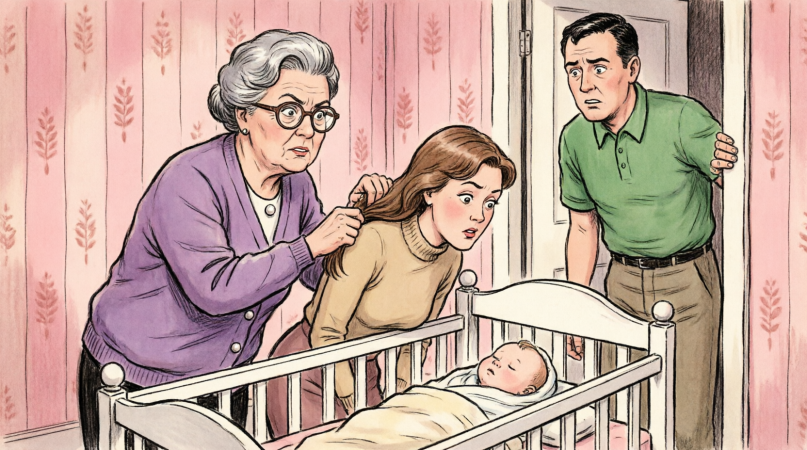
On the screen, Lily had one hand resting gently on the digital bottle warmer and the other gripping the wooden rail of the crib, her shoulders hunched. She was probably trying not to wake the baby. My mother, Denise, stood inches behind her in the nursery.
Lily turned her head slightly and said something back. Her voice was too quiet, too broken for the camera’s microphone to pick up the exact words.
My mother leaned in, her face twisted in a harsh, ugly sneer. She hissed that awful phrase again, and then, with a sudden, terrifying swiftness, she grabbed a fistful of Lily’s hair at the back of her head.
She pulled it backward, hard.
My breath caught in my throat. I half-stood from my office chair, my hand knocking over a cup of pens.
But it wasn’t the harsh physical grab that broke me. It was what happened next.
Lily didn’t scream.
She didn’t yell for help. She didn’t swat my mother’s hand away.
She just froze.
Her shoulders tensed into rigid lines. Her chin dropped toward her chest in absolute submission. Her entire body stopped resisting, adopting the horrifying stillness of a person whose resistance has failed them entirely too many times before. She gasped a sharp, shallow breath, closing her eyes as my mother held her firmly by the hair, whispering more toxic, inaudible threats into her ear before finally releasing her with a shove.
In that terrible, heavy silence streaming through my phone, my entire worldview shattered.
I understood instantly that my wife’s silence over the past few months wasn’t patience. It wasn’t exhaustion. It wasn’t postpartum mood swings, and it certainly wasn’t a noble attempt to “keep the peace” in our household.
It was pure, unadulterated fear.
My hands began to shake violently. My mind raced, trying to connect the dots I had willfully ignored. How many times had this happened? How long had my wife been living as a hostage in her own home?
With a trembling thumb, I exited the live stream and accessed the cloud storage archive on the app. The camera had been recording motion events since I set it up the night before. I frantically scrolled back through the timeline, clicking on a dozen short clips from the past eighteen hours.
The archive was a gallery of psychological torment.
In one clip from earlier that morning, I watched my mother snatching Noah aggressively from Lily’s arms the second he started to fuss, turning her back and completely ignoring Lily’s outstretched, pleading hands.
In another clip, my mother was mockingly holding up Lily’s carefully written feeding schedule, tearing it in half, and dropping it into the diaper bin.
But the most devastating clip was from the night before, captured by the camera’s infrared night vision.
Lily was sitting in the rocking chair, illuminated in a ghostly white glow. She was crying silently, her face buried in her hands while Noah slept in the crib. My mother stood in the nursery doorway, her silhouette dark and imposing.
The audio was perfectly clear.
“Cry all you want,” my mother’s voice whispered, cold and detached. “But if you tell Evan half of what I’m telling you, I will look him right in the eye and tell him you’re too unstable to be alone with this baby. I’ll tell him you’re a danger to Noah. Who do you think he’s going to believe? His mother, or a hysterical, unemployed woman who can barely get out of bed?”
I couldn’t feel my fingers. The air in my office felt thick and suffocating.
I had brought the monster into my own home, and I had handed her the keys to my wife’s sanity.
I didn’t bother logging off my computer. I didn’t tell my manager where I was going. I grabbed my car keys, bolted out of my office, and sprinted toward the parking garage.
Chapter 3: The Echoes of a Trap
The drive from the downtown office to our suburban home usually took forty minutes. I made it in twenty-two.
I gripped the steering wheel so tightly my knuckles turned stark white. The highway blurred past me as an overwhelming, nauseating mix of rage and profound guilt churned in my stomach.
How could I have been so incredibly blind? I replayed the last three months in my head, viewing every interaction through this horrifying new lens.
I remembered coming home from a long trip to find Lily with a bruised wrist. I bumped it on the baby gate, she had whispered, looking away. My mother had immediately chimed in, She’s so clumsy lately, Evan. I really have to watch her every step.
I remembered Lily suggesting, timidly, that maybe it was time for my mother to go back to her own apartment. I had sighed, exhausted from work, and said, Lily, she’s just trying to help. Can we just appreciate what she’s doing for us? I had been my mother’s greatest enabler. I had provided the cover she needed to systematically break down the woman I loved. I hit the steering wheel with the heel of my hand, letting out a frustrated, jagged breath. I swore to myself that I would never, ever let anyone make my wife feel that small again.
I slammed the brakes as I pulled into our driveway, the tires screeching against the concrete. I didn’t bother closing the car door. I practically flew up the front steps, jamming my key into the lock.
As I walked through the front door, I stopped in my tracks.
The house was silent.
It wasn’t a peaceful, restful silence. It was an oppressive, heavy stillness. The kind of quiet that follows a disaster. The air felt thick with tension. The living room was spotless, the vacuum marks perfectly straight on the carpet—my mother’s trademark.
I moved quietly toward the staircase, my heart hammering against my ribs. I heard the faint, rhythmic creak of the floorboards upstairs.
Then, I heard my mother’s voice echoing from the hallway above. It was cold, controlled, and dripping with authority.
“Clean your face before he gets here,” she ordered. “Put some makeup on those bags under your eyes. I am not going to let him come home from a hard day’s work and see you looking so pathetic.”
I froze at the bottom of the stairs.
I realized, with a chilling clarity, that I wasn’t just walking into an argument. I wasn’t stepping into a simple family disagreement that could be resolved with a cup of coffee and a compromise.
I was walking into a carefully constructed trap that my wife had been living in, entirely alone, for months.
I placed my foot on the first wooden step. I didn’t try to hide the sound of my heavy shoes. I wanted her to hear me coming. I wanted the illusion of her control to shatter before I even reached the top.
“Evan?” my mother’s voice called out, suddenly shifting octaves. The coldness vanished, replaced instantly by a warm, welcoming, maternal tone. “Evan, honey, is that you? You’re home so early!”
I reached the second-floor landing.
Chapter 4: The Reckoning
I stepped into the doorway of the nursery.
The scene was a horrifying tableau of manipulation. Lily was sitting on the edge of the rocking chair, a damp tissue clutched in her trembling hands. Her eyes were red and swollen, her beautiful face pale and drawn. She looked up at me, and I saw a flash of absolute terror in her eyes. She thought I was going to side with the enemy.
My mother stood near the changing table, holding a stack of clean baby blankets. She turned to me with a flawless, practiced smile.
“Evan, sweetheart!” she cooed, stepping forward to kiss my cheek. “What a wonderful surprise. We weren’t expecting you for hours. Lily is just having a bit of a hard day—you know how the baby blues can be. I was just helping her freshen up before you got home.”
I didn’t return the smile. I didn’t step into her embrace. I stood perfectly still in the doorway, blocking the exit.
“She doesn’t need to clean her face for me, Mother,” I said. My voice was low, flat, and completely devoid of any warmth.
My mother’s smile faltered for a fraction of a second, her eyes darting to my rigid posture. She let out a nervous little laugh. “Well, of course not, honey. But you know, it’s important to keep up appearances. It helps with the depression. I was just giving her some motherly advice.”
“Motherly advice?” I repeated, taking a slow step into the room. I looked directly at Lily. “Lily, are you okay?”
Lily swallowed hard, her eyes darting nervously toward my mother. “I’m… I’m fine, Evan. Really.”
“See?” my mother chimed in quickly, stepping between Lily and me. “She’s fine. Just a little overwhelmed. Why don’t you go downstairs and pour yourself a drink, Evan? I have dinner in the oven.”
“I don’t want a drink,” I said, my voice rising just enough to command the room. I reached into my pocket and slowly pulled out my smartphone. “And I don’t want your dinner.”
I unlocked the screen and opened the nursery camera app. I turned the volume all the way up.
“I bought this camera yesterday,” I said, holding the phone up so the screen faced my mother. “I wanted to see why Noah was waking up so abruptly. I thought maybe there was a draft. Or maybe a noise from the street.”
My mother’s eyes locked onto the screen. The color rapidly drained from her face.
I pressed play on the archived video from 1:42 p.m.
The audio filled the quiet nursery, loud and undeniable.
“You live off my son, and you still dare to say you’re tired?”
The video showed my mother grabbing Lily’s hair, yanking her head back, and whispering her toxic threats.
The silence that followed the video was deafening. My mother stared at the phone, her mouth opening and closing like a fish out of water. The carefully constructed facade of the helpful, loving grandmother had completely evaporated, leaving only the cruel, controlling reality behind.
“Evan…” she stammered, taking a step backward. “Evan, you don’t understand. That… that looks bad, but it’s out of context. She was being entirely unreasonable. She was ignoring the baby! I had to snap her out of it!”
“Out of context?” I roared, the anger finally breaking through my controlled exterior. I stepped toward her, my height and presence forcing her to back up against the wall. “I watched the other videos, Mother! I watched you threaten to tell me she was unstable! I watched you systematically break down the woman I love in her own home!”
Lily let out a quiet sob from the rocking chair, covering her mouth with her hands.
My mother’s demeanor suddenly shifted. The panicked excuses vanished, replaced by a cold, hard defiance. Her eyes narrowed.
“You’re going to take her side?” she hissed, pointing a manicured finger at Lily. “After everything I’ve done for you? I raised you! I came here to save your household because this weak, pathetic girl can’t even handle a single infant!”
“Do not speak about my wife that way!” I shouted, pointing toward the hallway. “Pack your bags. Right now. You have exactly ten minutes to get everything you own out of my house.”
“You can’t do this!” my mother screamed, her voice shrill and desperate. “I have rights! I’m his grandmother! If you throw me out, I’ll go to the courts! I’ll tell everyone in the family what a disaster this house is! I’ll make sure they all know she’s an unfit mother!”
I didn’t blink. I pulled up the video of her pulling Lily’s hair and held it inches from her face.
“Go ahead,” I said, my voice dropping to a lethal, icy whisper. “Call the lawyers. Call the family. Call whoever you want. Because the very first thing I’ll do is send this video to every single person in our contacts. Then I’ll send it to the police to file a restraining order. You will never, ever see my son or my wife again.”
Chapter 5: Reclaiming Our Home
My mother stared at the glowing screen of my phone, her chest heaving. She looked at my face, searching for any sign of hesitation, any shred of the obedient son she used to control.
She found nothing but absolute resolve.
Her shoulders slumped. The venomous fire in her eyes extinguished, replaced by the bitter, humiliating realization of utter defeat. Without saying another word, she turned on her heel and marched out of the nursery.
I stood in the doorway, watching her go into the guest room. I didn’t leave her unsupervised. I stood in the hallway, arms crossed, watching as she angrily threw her clothes into her suitcases, muttering under her breath. Exactly nine minutes later, she dragged her luggage down the stairs.
She paused at the front door, looking up at me one last time. “You’re making a terrible mistake, Evan.”
“The only mistake I made was letting you stay this long,” I replied, stepping forward and opening the front door for her. “Goodbye, Mother.”
She stepped out onto the porch. I slammed the heavy wooden door shut and immediately engaged the deadbolt.
The house was finally, truly ours again.
I took a deep, shaky breath and ran upstairs. When I walked back into the nursery, Lily was no longer sitting in the rocking chair. She was standing by the crib, looking down at our sleeping son.
I walked up behind her, slowly, making sure she could hear my footsteps. I didn’t want to startle her. I gently wrapped my arms around her waist and rested my chin on her shoulder.
She leaned back into my embrace, and for the first time in months, I felt her body completely relax.
“I’m so sorry, Lily,” I whispered, my tears finally spilling over, dampening the fabric of her sweater. “I am so incredibly sorry. I was blind. I thought she was helping. I never, ever would have left you alone with her if I had known.”
Lily turned around in my arms. She looked up at me, her eyes brimming with tears, but the terror was gone. In its place was a profound, overwhelming relief.
“She told me you wouldn’t believe me,” Lily whispered, her voice fragile but steadying. “She said that because I was struggling with the C-section recovery, you would think I was just losing my mind. She said you would take Noah away from me.”
I cupped her face in my hands, gently wiping away her tears with my thumbs. “She was lying, Lily. I will always believe you. You are the strongest woman I know, and you are the most incredible mother to our son. She is never coming back here. I promise you.”
Lily buried her face in my chest, and she cried. It wasn’t the silent, suppressed crying I had seen on the camera. It was loud, heavy, and healing. She cried out all the fear, the isolation, and the manipulation she had endured. And I held her through every single second of it.
The immediate aftermath was a whirlwind of necessary changes.
The very next morning, I called a locksmith and had every single lock on the exterior doors changed. I upgraded our security system, ensuring only Lily and I had the master passcodes. I took a two-week leave of absence from the software firm, turning off my phone and dedicating every waking moment to my family.
I sent a brief, firm message to my extended family, stating that my mother was no longer welcome in our lives due to unacceptable behavior toward my wife, and that any attempts to contact us on her behalf would result in them being blocked as well.
Healing wasn’t instantaneous. There were days when Lily still flinched at loud noises, or hesitated before making a decision in the kitchen, a phantom echo of my mother’s harsh criticisms.
But gradually, the color returned to her cheeks. She started wearing her bright, cheerful clothes again. I began waking up to the sound of her softly singing to Noah in the mornings.
And Noah? Once the oppressive, toxic tension was completely removed from the house, his sleep schedule miraculously leveled out. He stopped waking up with those frantic, panicked cries. He slept peacefully, sensing the calm, loving environment that had finally been restored.
I learned a vital, painful lesson about what it truly means to be a protector. Providing financially for your family means absolutely nothing if you aren’t protecting their emotional and psychological safety behind closed doors. Family isn’t just defined by blood; it’s defined by mutual respect, love, and the absolute refusal to allow anyone to harm the people you cherish most.
Sometimes, the greatest threat to your home doesn’t break in through a window. Sometimes, they walk through the front door with a smile and an offer to “help.”
Chapter 6: The Ghosts in the Walls
The first week after my mother left was the hardest. You would think that removing the source of the poison would instantly cure the patient, but trauma doesn’t work like a broken bone. It doesn’t heal simply because the pressure is removed. It heals in layers, often painfully, often slowly.
The house felt different, yet haunted. Every creak of the floorboards made Lily flinch. Every time the doorbell rang, her eyes would widen with a panic that tore at my heart. She would instinctively move toward Noah, placing her body between him and the door, as if expecting my mother to burst back in and snatch him away.
I had changed the locks, but I couldn’t change the memory of the keys turning in those locks for months while I was at work. I couldn’t change the memory of my wife sitting in that rocking chair, crying silently while my mother stood in the doorway threatening her livelihood and her motherhood.
I took my two weeks of leave, but I didn’t spend them relaxing. I spent them patrolling. I worked from the home office, keeping the door open so Lily could see me. I cooked every meal. I did every load of laundry. I wanted to show her, through action, that she was not alone anymore. That she was not a servant in this house. That she was a partner.
But the nights were the hardest.
One night, about four days after my mother left, I woke up to the sound of stifled sobbing. I reached across the bed, but Lily’s side was empty. I found her in the nursery, sitting in the rocking chair—the same chair where she had been abused. She was rocking back and forth, holding Noah tightly against her chest. Noah was asleep, but Lily was wide awake, staring at the door.
“Lily?” I whispered, not wanting to startle her.
She jumped, her breath hitching. “I… I heard someone,” she whispered. “I thought she came back. I thought she was going to take him.”
I walked over and knelt beside the chair. I didn’t try to pull her up. I didn’t tell her she was being irrational. I just placed my hand on her knee.
“She’s not coming back, Lily. I changed the locks. I have the security system. I’m right here.”
“She said you wouldn’t believe me,” Lily whispered, her voice cracking. “She said you loved her more. She said… she said I was crazy.”
“I believe you,” I said firmly. “I believe every word. And I am so sorry I wasn’t here to stop it.”
Lily looked down at me, her eyes swimming in the dim light of the nightlight. “I don’t know how to be normal again, Evan. I feel like… like I’m broken. Like I let this happen.”
“You didn’t let anything happen,” I said, my voice thick with emotion. “You survived. There is a difference. You protected Noah. You protected yourself until I could get home. You did what you had to do to keep us safe.”
She leaned down and rested her forehead against mine. “I’m scared to sleep,” she admitted. “I’m scared that if I close my eyes, she’ll be there.”
“Then i’ll stay awake,” I said. “i’ll watch the door. You sleep. I’ve got you.”
And I did. For the next week, I slept in shifts. I would wake up every two hours, check the locks, check the security cameras, and sit with her until she drifted off. It was exhausting, but it was necessary. I was rebuilding the foundation of trust, brick by brick.
Chapter 7: The Counter-Attack
I should have known my mother wouldn’t accept defeat gracefully. Denise Brooks was a woman who thrived on control. To her, losing access to her grandson wasn’t a tragedy; it was an insult. And she didn’t take insults lightly.
It started three weeks after she left. I received a call from my Aunt Susan, my mother’s younger sister.
“Evan, honey,” she said, her voice tentative. “Your mother is… upset. She’s telling everyone that Lily kicked her out. She’s saying Lily is unstable. That she’s denying a grandmother her rights.”
I felt a cold spike of anger in my chest. “She’s lying, Aunt Susan. You know Lily.”
“She’s showing people pictures,” Susan continued. “She’s saying Lily is on medication. That she’s dangerous. She’s trying to get the family to pressure you to let her back in.”
“Tell her to stop,” I said calmly. “And tell the family that if they want to know the truth, I have video evidence. I have police reports. I am not negotiating.”
“But Evan… she’s your mother.”
“She is a woman who assaulted my wife,” I said, my voice hardening. “And if she continues this smear campaign, I will press criminal charges. Please tell her that.”
But the calls didn’t stop. They came from cousins, from old family friends, even from my father’s old bowling buddies. My mother was weaving a narrative of a ungrateful son and a hysterical daughter-in-law who had stolen her grandson away. She was playing the victim, and she was good at it.
Then came the letter.
It arrived via certified mail. A notice of intent to petition for grandparent visitation rights. She was lawyering up. She was trying to use the court system to force her way back into our lives.
I sat at the kitchen table with the letter in front of me, my hands shaking. Lily was standing by the sink, washing bottles. She saw the letterhead and froze.
“What is it?” she asked, her voice small.
“She’s suing for visitation,” I said.
Lily dropped the bottle. It didn’t break—it was plastic—but the sound of it hitting the stainless steel sink echoed like a gunshot. She turned around, her face pale. “She can’t… she can’t do that. Evan, if she gets visitation… if she gets time alone with Noah…”
“She won’t,” I said, standing up and walking over to her. I took her hands. They were ice cold. “Listen to me. She is bluffing. She knows what she did. She knows I have the video. No judge in this state is going to grant visitation rights to a grandmother who has a documented history of abuse.”
“But what if she lies?” Lily whispered. “What if she convinces them I’m the problem? She said she would, Evan. She said she’d tell them I’m unstable.”
“Then we show them the truth,” I said. “We don’t hide. We don’t apologize. We fight.”
I called Dana Patel, the same lawyer who had helped me with a contract dispute years ago. She specialized in family law now. I emailed her the video files, the police report I had filed the day I kicked my mother out, and the log of harassment calls.
“This is open and shut,” Dana told me over the phone. “Assault is a crime. Harassment is a crime. Trying to use family court to bypass a criminal record is not going to work. But we need to be proactive. We need to file for a permanent restraining order before her hearing date. We need to set the narrative.”
“Do whatever it takes,” I said. “Cost doesn’t matter. Safety matters.”
Chapter 8: Lily’s Voice
The hearing was scheduled for a Tuesday morning in October. Two months after my mother had left.
In the weeks leading up to it, I expected Lily to want me to handle everything. I expected her to hide behind me, to let me be the shield. And I was willing to be that shield. But something changed in Lily during those weeks.
Perhaps it was the therapy. Perhaps it was the safety of the home. Or perhaps it was the realization that if she didn’t stand up for herself now, she would always be looking over her shoulder.
Two days before the hearing, I found Lily in the home office. She was typing on my laptop.
“What are you doing?” I asked.
“Writing a statement,” she said. She didn’t look up. Her fingers were moving quickly over the keys. “For the judge.”
“Lily, you don’t have to do that. I have the video. I have the lawyer.”
“I know,” she said. She stopped typing and looked at me. Her eyes were clear. The fog of fear was lifting. “But she tried to take my voice, Evan. For months, she told me I wasn’t allowed to speak. That my words didn’t matter. If I don’t speak now… she wins.”
I walked over and put my hand on her shoulder. “You don’t have to prove anything to anyone.”
“I’m not proving it to her,” Lily said. “I’m proving it to me.”
On the day of the hearing, we walked into the courthouse together. My mother was there, sitting on the other side of the aisle with her attorney. She looked immaculate, dressed in a conservative suit, holding a tissue. She looked every bit the aggrieved grandmother. When she saw us, she tried to catch my eye, to give me that look of disappointed motherhood that used to make me cave.
I looked straight ahead.
When it was our turn to speak, Dana presented the evidence first. The police report. The medical records of Lily’s scalp injury (which we had documented after I kicked Denise out). The log of harassing calls.
Then, Dana played the video.
The courtroom was silent. The only sound was the audio from my phone, echoing off the wood-paneled walls. “You live off my son, and you still dare to say you’re tired?” The sound of the hair being pulled. The threat. “i’ll tell him you’re a danger to Noah.”
When the video ended, I looked at my mother. She wasn’t looking at the screen. She was looking at her hands. Her attorney was packing up his briefcase. He knew it was over.
Then, Lily stood up.
“Your Honor,” she said. Her voice didn’t shake. “I don’t want revenge. I just want safety. For my son. For myself. I love my husband. And I love our son. But I cannot raise him in a world where his grandmother teaches him that love means control. I need the court to know that we are not keeping her away out of spite. We are keeping her away out of necessity.”
She sat down. She didn’t cry. She didn’t look at my mother. She just held my hand.
The judge, a stern woman with gray hair, looked over her glasses at my mother’s attorney. “Given the evidence of physical assault and documented psychological abuse, I am granting the permanent restraining order. No contact. No visitation. No proximity within 500 yards of the child or the residence. Any violation will result in immediate arrest.”
She banged the gavel.
It was done.
Chapter 9: The First Birthday
Noah’s first birthday was in December. We didn’t have a big party. We didn’t invite the extended family. We didn’t invite anyone who had sided with my mother during the smear campaign.
It was just us. Lily, Noah, and me. And our dog, Buster.
We decorated the living room with balloons and a banner that said Happy 1st Birthday. We ordered a small cake from a local bakery. Lily put Noah in a little denim outfit with a bowtie. He looked ridiculous and adorable.
We sat on the floor around the coffee table. Lily lit the single candle on the smash cake.
“Make a wish,” I said.
“He’s one,” Lily laughed. “He doesn’t know how to make wishes.”
“We make it for him,” I said.
Lily looked at me. She looked healthy again. The dark circles were gone. The gray sweaters were gone. She was wearing a bright yellow dress, the color of sunshine. She looked like the woman I had married.
“Okay,” she said. “We wish for peace.”
She blew out the candle. Noah clapped his hands, delighted by the smoke.
We spent the afternoon opening gifts. Mostly books and soft toys. Nothing expensive. Nothing that mattered more than the moment.
Around 3 p.m., my phone buzzed. It was a text message from an unknown number.
He’s your blood. You’re making a mistake. One day he’ll ask where his grandmother is. What will you tell him then? – D
I looked at the message. A year ago, this would have sent me into a spiral of guilt. I would have worried about what the family thought. I would have worried about hurting her feelings.
Now, I felt nothing. No anger. No guilt. Just a distant pity.
I showed the message to Lily. She read it and shook her head.
“Block it,” she said.
“I already did,” I said.
I put the phone away. I picked Noah up and kissed his head. He smelled like baby shampoo and cake frosting.
“One day,” I said to Lily, “when he’s old enough, i’ll tell him the truth. I’ll tell him that we loved him too much to let anyone hurt him. Even family.”
“He’ll understand,” Lily said. “Children understand safety better than adults do.”
We spent the rest of the day playing on the rug. We built a tower of blocks. We read The Very Hungry Caterpillar. We laughed until our sides hurt.
For the first time in my life, I understood that family isn’t about who shares your DNA. It’s about who shares your life. It’s about who shows up. It’s about who protects you when you’re vulnerable.
My mother had shared my DNA. But Lily… Lily was my family. And Noah. We were the unit. And we were impenetrable.
Chapter 10: The Long Road Home
Healing wasn’t a straight line. There were setbacks.
There were days when Lily would wake up crying from a nightmare where my mother was standing over the crib. There were days when I would come home late from work and find Lily pacing the living room, checking the locks three, four, five times.
There were days when I felt a surge of guilt so strong it made me nauseous. Why didn’t I see it sooner? Why did I leave her alone? I had to learn to forgive myself, just as Lily was learning to forgive herself.
We went to counseling together. We learned how to communicate without fear. We learned how to argue without toxicity. We learned that it was okay to say “no” to each other without it meaning the end of the world.
One evening, about six months after the court hearing, I came home to find Lily in the garden. She was planting flowers. Marigolds. Bright orange and yellow.
“What are you doing?” I asked, loosening my tie.
“Planting,” she said. She wiped dirt from her forehead. “This patch of dirt… it was where your mother used to park her car. Every time I looked out the window, I saw her car. It felt like… like she still owned this spot.”
“So you’re planting over it?”
“Yes,” she said. She patted the soil down around a small plant. “I’m growing something new here. Something beautiful. Something that’s mine.”
I watched her work. She looked strong. Not just physically, but spiritually. The trauma hadn’t disappeared—it never fully does—but it was no longer the defining feature of her life. It was just a part of her history. A scar that proved she had survived.
“I’m proud of you,” I said.
Lily looked up and smiled. It was a genuine smile. “I’m proud of us.”
Epilogue: The Letter
One year later, I received a letter in the mail. No return address. Handwritten.
I recognized the handwriting. My mother’s.
I almost threw it in the trash. But curiosity got the better of me. I opened it with a letter opener.
Evan,
I don’t expect you to read this. I don’t expect you to forgive. I am writing this because I am in a program now. A group for… people who struggle with control. The teacher says we need to write to the people we hurt.
I hurt you. I hurt Lily. I know that now. I thought I was entitled. I thought I deserved respect because I was the mother. I thought love meant obedience.
I was wrong.
I hear Noah is walking. I hear he is healthy. I am glad.
I am sorry for the hair. I am sorry for the words. I am sorry for the fear.
I won’t contact you again. This is the last time.
Mom.
I read the letter twice. I folded it. I put it in a drawer with the restraining order and the court transcripts.
It wasn’t forgiveness. It was closure.
She had admitted it. She had owned it. It was too late to change the past, but it was enough to let me let go of the last bit of anger.
I closed the drawer.
I walked out to the garden. Lily was there, chasing Noah around the grass. He was running, stumbling, laughing. Lily caught him and swung him around. They were both laughing.
The sun was setting. The marigolds were blooming. The house was quiet.
I was safe. I was respected. I was loved.
And that was enough.
The End.