Chapter 1: The Architecture of Humiliation
The sharp, caustic bite of industrial pine cleaner seared my nostrils, yet I kept my head bowed, my trembling fingers driving the coarse rag in tight, agonizing circles. My knees—wrapped in thin, fraying fabric—screamed against the unforgiving chill of the reclaimed oak planks.
Every vertebrae in my lower back throbbed with a dull, rhythmic ache that synced perfectly with my racing pulse. But I did not stop. I did not dare pause to stretch.
In this house, hesitation was a cardinal sin. Experience had brutally etched a single rule into my daily existence: pausing invited their gaze, and their gaze invited ruin.
I pushed the damp rag an inch closer to the edge of the plush, cream-colored area rug. As I did, a pair of pristine, designer loafers shifted slightly, lifting just a fraction of an inch into the air to grant me clearance. It was the exact, absentminded gesture one might afford an erratic robotic vacuum—an acknowledgment of an inconvenient appliance, devoid of any human recognition.
Sitting on the imported Italian leather sofa, bathed in the soft afternoon light that filtered through the bay windows, were Laura, my daughter-in-law, and her mother, Evelyn.
They sat shoulder-to-shoulder, scrolling through their smartphones with manicured thumbs, occasionally letting out a synchronized, hollow laugh at whatever digital distraction occupied their screens. Between Evelyn’s fingers rested a delicate porcelain teacup, its gold rim catching the sunlight.
To these women, I was not Martha Vance. I was not the fiercely devoted mother who had raised a boy into a decorated soldier. I certainly wasn’t the woman who had spent two decades meticulously building this sanctuary, room by agonizing room, alongside my late husband, Thomas. We had laid these very oak boards ourselves, our hands covered in sawdust and our hearts full of a shared future.
To Laura and Evelyn, I was simply part of the background aesthetic. I was human furniture. I was the silent, subjugated help.
I dragged myself another foot to the left, dipping the rag into a plastic bucket of tepid, gray water. My hands were a grotesque topography of cracked skin, chemical burns, and bleeding cuticles. I swallowed the thick lump of humiliation forming in my throat. Just finish the parlor, I told myself, a desperate internal mantra. If it shines, maybe they will let you eat in the kitchen tonight.
Suddenly, a sound shattered the quiet murmur of their digital scrolling.
It wasn’t a knock. It wasn’t the mail carrier dropping a package on the porch. It was the distinct, heavy metallic clack of a key sliding into the deadbolt of the front door.
My breath hitched. A cold stone of dread plummeted into the pit of my stomach. No one else had a key to this house. No one except the boy who had been deployed halfway across the globe for five agonizing years. But he wasn’t due back for another six months. The military had been clear.
The brass handle turned. The heavy oak door creaked open, letting in a gust of crisp autumn air. And as heavy, deliberate footsteps crossed the slate tiles of the entryway, the shadow of a man fell long and dark across the freshly polished wood, stretching directly toward my bruised, kneeling form.
Chapter 2: The Slow Poison
To understand how a sovereign woman becomes a servant in her own fortress, you must understand the insidious nature of a slow poison. It never kills you all at once; it merely weakens your defenses until you forget how to fight back.
When my son, Alex, first deployed five years ago, Laura wore the mask of the grieving, supportive wife flawlessly. She wept at the airport, clutching his arm, promising to take care of me. For the first few months, she was polite, if somewhat distant. But the real invasion began when Evelyn experienced a “sudden and devastating financial setback.”
“It’s just for a few weeks, Martha,” Laura had pleaded over dinner one evening, her eyes wide with manufactured innocence. “My mother has nowhere else to go. Thomas would have wanted us to be charitable, wouldn’t he?”
I foolishly opened my doors. Within a month, Evelyn’s temporary stay metastasized into permanent residency. The guest room wasn’t “airy enough,” so they systematically pressured me out of the master suite Thomas and I had shared, relocating my belongings to the drafty, unfinished attic room. When my arthritis flared up and I struggled to manage the estate taxes and utility bills, Laura smoothly convinced me to sign over a temporary Power of Attorney to her. “Just to handle the boring paperwork, Mom. You rest.”
It was a fatal tactical error.
The moment the ink dried on that legal document, the velvet gloves came off. The subtle requests turned into sharp demands. My pension was redirected into a joint account I couldn’t access without their permission. When I finally found the courage to object to Evelyn throwing away Thomas’s antique clock, the trap was sprung.
Laura had leaned across the kitchen island, her pretty face twisted into something venomous. “You’re getting forgetful, Martha. Confused. Belligerent. If you can’t maintain a peaceful environment here, Mother and I will have no choice but to use the Power of Attorney to move you into a managed care facility. For your own safety, of course. State-run homes are so depressing, but what choice will we have?”
The threat of being locked away in a sterile, fluorescent-lit ward, robbed of the last physical connection I had to my husband and son, broke me. I surrendered. I became the ghost haunting my own hallways, scrubbing floors to earn my keep, terrified that one wrong word would result in my exile. I lived only for Alex’s rare, crackling phone calls, pretending everything was perfect so my boy could focus on surviving his war, completely unaware of the one raging in his childhood home.
Now, as the heavy footsteps echoed in the foyer, my heart pounded a frantic rhythm against my ribs. I instinctively lowered my gaze, scrubbing faster, harder. If the floor wasn’t spotless, there would be another sigh from Evelyn. Another threat from Laura. Another reminder that I was merely tolerated space.
“Mom?”
The voice was rougher, deeper than the one that lived in my memory, carrying the unmistakable gravel of exhaustion and sand. But it was a frequency my soul recognized instantly.
My hands froze mid-circle. The rag slipped from my trembling fingers, splashing into the murky gray water of the bucket.
Slowly, fighting the paralyzing fear that my desperate, fractured mind was finally hallucinating, I lifted my chin.
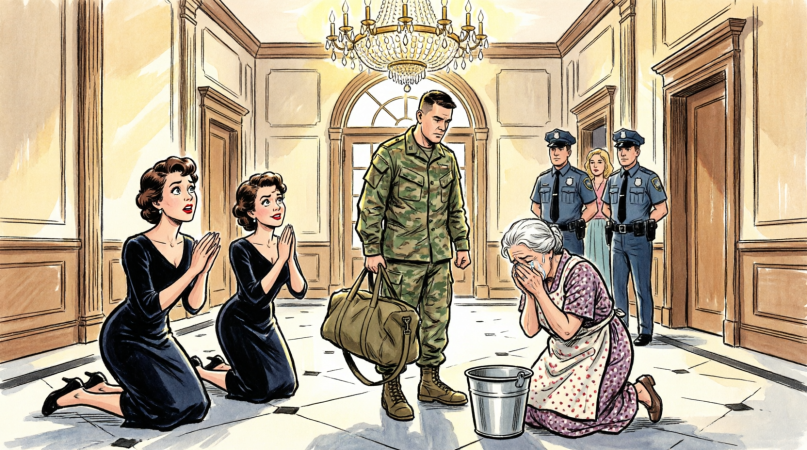
There, framed in the archway of the parlor, stood my son. He was a portrait of weary survival. His combat uniform was dusted with the pale dirt of foreign transit. A heavy, olive-drab tactical backpack hung loosely from his broad right shoulder. His jawline had sharpened into hardened angles, and his eyes—once bright and full of youthful mischief—carried the haunted, heavy weight of a man who had seen too much.
For a singular, suspended heartbeat, as he scanned the room, his rigid posture relaxed. A profound, glowing relief washed over his weathered features. Home.
Then, his gaze drifted downward. It bypassed the designer furniture, bypassed his wife on the sofa, and landed squarely on me.
On his mother. Kneeling in a filthy, stained apron. Hair hastily shoved back with a plastic clip. Hands red, peeling, and clutching a scrubbing brush like a beggar holding a tin cup.
The light in his eyes didn’t just fade; it was violently extinguished.
Chapter 3: The Ghost in the Doorway
“Mom…” Alex whispered, the word catching in his throat like a jagged shard of glass. “What… what are you doing?”
The silence that descended upon the parlor was absolute. It was a heavy, suffocating vacuum, thicker than any screamed argument could ever be. I couldn’t speak. Shame, hot and acidic, flooded my veins. I wanted the reclaimed oak planks beneath me to splinter open and swallow me whole. I tried to hide my ruined hands behind my back, a pathetic, childlike instinct to conceal the evidence of my subjugation.
On the sofa, Evelyn barely reacted. She leaned back into the plush leather, languidly crossing one leg over the other, ensuring her shoe didn’t graze my shoulder. She brought the porcelain teacup to her lips, taking a slow, deliberate sip, entirely unfazed by the sudden materialization of the man who owned the deed to the house she was occupying.
Laura, however, possessed enough survival instinct to recognize the sudden drop in atmospheric pressure. She shot up from the couch, hastily adjusting the collar of her silk blouse, a nervous, trilling laugh tumbling from her lips.
“Alex! My god, baby, you’re back sooner than command told us!” she chirped, her voice falsely bright as she stepped forward, arms extended for an embrace. “We were… we were going to throw a massive surprise party for you next week! Look at you!”
Alex didn’t blink. He didn’t drop his heavy backpack. He simply shifted his weight, allowing Laura’s outstretched arms to grasp empty air as he effortlessly side-stepped her. He didn’t even look at her face. His eyes, burning with a terrifying, cold intensity, remained locked entirely on me.
He closed the distance between us in three long, deliberate strides.
“Alex, please,” I stammered, my voice sounding like dry leaves crushing together. “I’m just… I was just cleaning up a spill…”
He didn’t listen. With a grace that belied his size and the heavy combat boots strapped to his feet, my son dropped to his knees on the wet hardwood floor. He ignored the gray water seeping into the fabric of his uniform. He reached out and gently, so gently, took my hands from behind my back.
As his rough, calloused thumbs brushed over my cracked, bleeding knuckles and the raw, chemical-burned skin of my palms, I felt a violent shudder rack his massive frame. His jaw clenched so hard I thought his teeth might shatter.
“What is this?” he asked. His voice was a terrifyingly quiet whisper, stripped of all emotion, revealing the lethal steel of the soldier beneath.
Before I could formulate a lie to protect him, Evelyn chimed in from the sofa, her tone dripping with condescending authority.
“Oh, for heaven’s sake, Alex, don’t overreact and make a scene the moment you walk through the door,” she sighed, waving a dismissive, manicured hand. “She insists on staying active. We try to tell her to rest, but you know how she gets. Cleaning keeps seniors from feeling useless and deteriorating. It’s good for her.”
Useless.
The word hung in the air, a poisonous vapor seeking a spark.
Alex’s head tilted slightly. He didn’t release my hands, but his gaze slowly detached from my bruised fingers and dragged upward, fixing on Evelyn.
I had raised a gentle, compassionate boy. But the man kneeling in front of me possessed eyes that had stared down death in the desert. And right now, he was looking at his mother-in-law with the exact same calculating, devoid-of-mercy expression he would reserve for an enemy combatant.
The temperature in the room plummeted to absolute zero.
Chapter 4: The Reckoning
For a long, agonizing moment, the only sound in the house was the faint ticking of the grandfather clock in the hallway—the one Evelyn had tried to throw away.
Then, Alex did something that shattered the last remaining fragments of my broken heart. Still kneeling in the dirty water, he pulled me forward and crushed me against his chest. His arms wrapped around my frail shoulders like iron bands, and burying his face into my graying hair, my battle-hardened son began to weep. His broad back heaved, shaking with the force of repressed agony, holding me exactly the way he used to when he was a seven-year-old boy terrified of the booming summer thunderstorms.
“Forgive me, Mom,” he choked out, the tears hot against my neck. “God, please forgive me for leaving you alone. Forgive me for trusting the wrong people with your life. I didn’t know… I swear on my life, Mom, I didn’t know they were doing this to you.”
“Shh, my boy,” I wept, burying my face in the scratchy fabric of his uniform, inhaling the scent of dust, sweat, and salvation. “You’re home. That’s all that matters. You’re home.”
We stayed like that for what felt like hours, a sanctuary built of two broken pieces fitting back together. Behind him, the silence of the usurpers was absolute. Even Laura, with her endless arsenal of manipulations, couldn’t find a single word to bridge the chasm that had just opened beneath her feet.
When Alex finally pulled back, the sorrow in his eyes had entirely evaporated. In its place was a chilling, absolute resolve. He stood up slowly, towering over the room. The weary soldier who had crossed the threshold a minute ago was gone. In his place stood an executioner.
He unslung his heavy tactical bag, letting it hit the hardwood floor with a deafening, final thud.
“Alex, honey,” Laura began, her voice trembling as she finally recognized the catastrophic danger she was in. She took a tentative step forward, her hands raised defensively. “It’s not what it looks like. You’ve been gone so long, you don’t understand the dynamic—”
“Quiet,” Alex commanded. It wasn’t a shout; it was a low, vibrational order that demanded immediate compliance.
He turned his back on me, placing himself squarely between my kneeling form and the two women on the couch.
“The dynamic,” Alex said, his voice dripping with lethal calm, “is that I trusted you to protect the woman who gave me life. Instead, I find her scrubbing floors like a medieval serf while you drink tea. You have five minutes.”
Evelyn scoffed, standing up with a rigid, indignant posture. “Excuse me? Young man, I understand you’re emotional from your little tour of duty, but you will not speak to my daughter or me with that tone. We have managed this household perfectly while you were off playing soldier. We have legal rights—”
In a flash of movement so fast it made me flinch, Alex crossed the distance to the sofa. He didn’t strike her, but he crowded Evelyn’s personal space, his chest mere inches from her face, looking down at her from his formidable height.
“You have no rights here,” he whispered, his voice a razor blade sliding over silk. “The Power of Attorney you bullied her into signing is revoked as of right now. I am the executor of this estate. I am the co-owner of this property. And you are a parasite.”
He turned slightly, his cold eyes locking onto his wife. Laura was trembling violently, tears streaming down her carefully contoured face, realizing the wealthy, comfortable life she had stolen was disintegrating before her eyes.
“Alex… please…” she sobbed, reaching for his sleeve. “I’m your wife. I love you.”
Alex looked at her hand as if it were a venomous snake. “A wife builds a home. You built a prison.” He grabbed her wrist firmly, removing it from his arm, and then locked his grip around her forearm. He did the same to Evelyn with his other hand.
“Hey! Let go of me!” Evelyn shrieked, her aristocratic facade entirely shattered.
With relentless, terrifying momentum, Alex marched both women toward the front door. They stumbled over the slate tiles, their protests echoing wildly off the high ceilings. He wrenched the heavy oak door open, the autumn wind rushing in to meet them.
He thrust them out onto the porch. Evelyn stumbled, catching herself on the railing, her porcelain cup shattering into a dozen pieces on the brick walkway. Laura turned, her face a mask of panicked desperation.
“You can’t do this! My clothes! My jewelry! My mother’s things!”
Alex stood in the doorway, a monolithic guardian of the threshold. “I will have a moving company pack your possessions. They will be left at the curb tomorrow morning. If you attempt to enter this property before then, or if you ever come within fifty feet of my mother again…”
He leaned forward, the shadows of the porch obscuring his eyes.
“I have spent five years in the worst hellscapes on this planet,” he promised, his voice devoid of any human mercy. “I have seen cruelty you cannot even fathom. But what you did to an old, defenseless woman who trusted you? That makes you an enemy combatant. And I know exactly how to handle my enemies. Do not test me.”
Before either woman could utter another sound, Alex gripped the brass handle and slammed the heavy oak door shut. The deadbolt slid home with a loud, absolute crack.
Leaving the two of us utterly alone in the deafening, beautiful silence of our reclaimed sovereignty.
Chapter 5: Reclaiming the Hearth
The adrenaline that had sustained the confrontation abruptly vanished, leaving a heavy, exhausted peace in its wake. Alex leaned against the front door for a long moment, his chest rising and falling rhythmically, his eyes closed.
When he finally opened them and turned back to me, the executioner was gone. He was just my boy again.
He walked back into the parlor, picked up the plastic bucket filled with gray water, and carried it straight out the back door, hurling it into the woods bordering our property. He returned, gently untied the filthy apron from my waist, and dropped it into the kitchen trash can.
“Come here,” he murmured, his voice infinitely gentle.
He led me not back to the drafty attic, but to the center island of the kitchen. He pulled out one of the padded barstools, lifted me by my waist as if I weighed nothing, and set me down. He retrieved the first-aid kit from beneath the sink—a kit he remembered the location of after five years—and spent the next hour meticulously cleaning, disinfecting, and wrapping my raw, abused hands in cool, soothing bandages.
That night, for the first time in years, I did not cook, and I did not clean. Alex ordered a massive feast from the Italian restaurant Thomas and I used to frequent for our anniversaries. We sat at the formal dining table, the one Laura had forbidden me to use. We ate until we were full, and then, wrapped in a thick wool blanket he had brought down from the closet, I finally found the courage to speak.
I poured out every secret I had harbored. The coercion, the financial manipulation, the fear of the nursing home, the slow, agonizing erasure of my identity within the walls I had built. Alex didn’t interrupt. He simply held my bandaged hand, his thumb tracing the back of my wrist, absorbing the poison I was finally expelling.
Later, as midnight approached, he carried my meager belongings down from the attic and placed them exactly where they belonged—in the master bedroom. He found the box of Thomas’s framed photographs hidden in the basement and spent an hour hanging them back on the walls, restoring the soul of The Oakhaven House.
When he finally tucked me into the plush mattress of my own bed, pulling the down comforter up to my chin, I felt a tear slip down my cheek.
“Are you going to be okay, Mom?” he whispered, kissing my forehead.
“I am now,” I replied softly.
And for the first time in an eternity, I slept without a sliver of fear in my heart. I didn’t sleep because the house was finally quiet, or because the usurpers were gone. I slept because the true master of the house had returned, and the fortress was secure.
In the months that followed, the divorce was brutally swift. Armed with military lawyers and the documented evidence of financial elder abuse, Laura and Evelyn were stripped of everything they had tried to steal. They vanished into obscurity, a bad memory washed away by the tide.
My hands healed, the scars fading into faint, silver lines—reminders of a war survived. The house filled with light and laughter once more. I reclaimed my gardens, I reclaimed my finances, and above all, I reclaimed my dignity.
Alex never went back overseas. He took a position training recruits locally, ensuring that he was never more than a short drive away. We rebuilt our lives, not as a broken mother and an absent son, but as two survivors who knew the true value of a safe harbor.
I learned a painful but vital lesson during those dark years: a home is not just wood, stone, and reclaimed oak planks. It is a sovereign territory of the heart, and it must be guarded fiercely. I am the matriarch of this family, and I will never let anyone make me feel like an inconvenience in my own life again.
Because I know, with absolute certainty, that I will never, ever kneel in my own home again.
If this story resonated with you or struck a nerve, please drop a comment below sharing what you would have done if you were in Alex’s shoes! Don’t forget to like and share this post with a friend who might need the reminder: true family protects you, they never reduce you to shadows.
Chapter 6: The Morning After the Storm
The silence that followed the slamming of the door was not empty; it was heavy, pregnant with the weight of five years of suppressed screams. I sat on the kitchen stool, my bandaged hands resting on the cool granite of the island, watching Alex pace the length of the room. He was no longer the boy who left for basic training with a bright smile and a duffel bag. He was a man who had just declared war on his own household to save his mother.
“Are you hungry, Mom?” he asked, stopping abruptly. His voice was gentle, but his eyes were still scanning the room, checking the locks on the windows, assessing the perimeter.
“I’m not sure I can eat,” I admitted. My stomach was a knot of tight, anxious wire. The adrenaline that had fueled me during the confrontation was fading, replaced by a trembling exhaustion.
“You need to eat,” Alex said firmly. He moved to the fridge, pulling out containers of food I had prepared days ago—food I had been forbidden to eat unless there was leftovers. He plated a portion of roast chicken and vegetables, setting it in front of me. “Eat. Then sleep. I’ll take the first watch.”
“Watch?” I asked, picking up my fork.
“Until I know they’re really gone,” he said. He pulled a chair out and sat directly opposite me, not touching his own food. He just watched me eat, ensuring I swallowed every bite. “I’m not leaving this room until you’re in bed.”
That night, I slept in the master bedroom. The sheets smelled of lavender and dust, the scent of a room undisturbed for years. But sleep did not come easily. Every creak of the house settling sounded like a footstep. Every rustle of the wind against the window sounded like Evelyn’s sigh of disapproval. I woke up three times in the first hour, my heart hammering, expecting to see Laura standing in the corner, pointing out the dust on the nightstand.
Each time I woke, I heard the sound of heavy boots pacing the hallway outside my door. Alex was walking the perimeter. He was guarding me. Knowing he was there, a sentinel in the dark, finally allowed me to drift into a deep, dreamless sleep.
When I woke the next morning, the sun was streaming through the windows—windows that had been covered by heavy drapes Evelyn claimed were “more elegant.” They were open now. The house was filled with light.
I walked downstairs to find Alex in the kitchen. He had changed into civilian clothes—jeans and a t-shirt that stretched across his broad shoulders. He was scrubbing the floor. The exact spot where I had been kneeling yesterday.
“Alex,” I said, my voice raspy. “Let me do that.”
He stopped immediately. He stood up, wiping his hands on a rag, and looked at me with such fierce intensity that I took a step back.
“No,” he said. “You never scrub this floor again. Do you hear me? Never.”
“It’s just dirt,” I said weakly.
“It’s not dirt, Mom. It’s shame. And I’m washing it away.”
He finished cleaning the spot, then poured the gray water down the sink. He walked over to me and hugged me again. “Today, we call the lawyers. Today, we take everything back.”
Chapter 7: The Legal Siege
I expected Laura and Evelyn to disappear into the wind, ashamed of their exposure. I underestimated their greed.
Two days after the eviction, a thick envelope arrived via certified mail. It was a cease-and-desist letter from a high-priced family law firm, claiming that Alex had committed “illegal lockout” and “domestic disturbance.”
They were demanding immediate reinstatement to the property and threatening to sue for half the value of the house based on “marital contribution.”
I held the letter with shaking hands. “They’re going to take the house, Alex. They have lawyers. We don’t.”
Alex took the letter from me. He didn’t even open it. He tossed it into the trash bin.
“They don’t have lawyers, Mom. They have billable hours. We have the truth.” He pulled out his phone. “And I have friends.”
The “friends” turned out to be a team of JAG officers—Judge Advocate General lawyers from the military who owed Alex favors from his deployments. They descended on our house like a special operations unit. They reviewed the Power of Attorney documents. They reviewed the bank statements I had secretly kept in a safe deposit box. They reviewed the medical records of my hands.
“They committed elder abuse, Mom,” Captain Reynolds, the lead attorney, told me three days later. He spread photos across my dining table. Photos of my bruised knuckles. Photos of the attic room where I had been stored away.
Photos of the bank transfers showing my pension being siphoned into Laura’s personal accounts. “This isn’t a civil dispute. This is criminal fraud. If they push this, we press criminal charges. Evelyn could go to prison. Laura could lose custody of any future children.”
I felt a chill run down my spine. “I don’t want them in prison,” I said. “I just want them gone.”
“Then they need to understand the stakes,” Reynolds said. “We schedule a settlement meeting. We let them see the evidence. They’ll fold.”
The meeting was set for two weeks later at a neutral conference room downtown. I was terrified. The thought of sitting in the same room as Laura, even with lawyers present, made my hands sweat.
“You don’t have to go,” Alex said, seeing my hesitation. “I can handle it.”
“No,” I said, straightening my spine. I was wearing a new dress, one I had bought with my own money, not the hand-me-downs Laura had allowed me. “I need to be there. I need them to see me.”
Chapter 8: The Deposition
The conference room was sterile, lit by harsh fluorescent lights that reminded me too much of the interrogation rooms I had seen on TV. Laura and Evelyn sat on one side of the table. They looked diminished. Evelyn’s hair was unkempt, her expensive suit wrinkled. Laura was wearing no makeup, her eyes red-rimmed. They looked like what they were: women who had lost their power.
Their lawyer, a slick man named Sterling, opened a briefcase. “We are here to discuss the equitable distribution of assets regarding the property at Oakhaven Lane…”
“Stop,” Alex said. He didn’t shout. He just spoke.
Sterling blinked. “Excuse me?”
“We are not discussing assets,” Alex said. He slid a folder across the table. “We are discussing immunity.”
Sterling opened the folder. His face went pale. He looked at Laura. “You didn’t tell me about the pension transfers.”
“It was… it was a misunderstanding,” Laura stammered, looking at me. “Martha, tell them. You wanted me to handle the bills. You told me to use the money.”
I looked at her. For five years, her voice had been the voice of God in my house. If she said I was confused, I was confused. If she said I was useless, I was useless.
“I never told you that,” I said. My voice was quiet, but it didn’t shake. “You threatened to put me in a nursing home. You took my keys. You stole my life.”
Laura’s face crumpled. “I did it for us! For Alex! We needed the money to maintain the lifestyle he deserved!”
“I don’t deserve a lifestyle built on my mother’s suffering,” Alex said. His voice was cold steel. “Here are the terms. You sign over all rights to the house. You repay the stolen pension funds within thirty days. You sign a non-contact order. In exchange, my mother agrees not to press criminal charges for fraud and elder abuse.”
“And if we don’t?” Evelyn snapped, her old arrogance flaring up for a second.
Captain Reynolds leaned forward. “Then we file the police report we have drafted. And given the amount stolen, your mother is looking at significant federal prison time, Mrs. Vance. And you, Laura, as an accomplice.”
The silence stretched out. Laura looked at her mother. Evelyn looked at the table. The bluff was called. They had no cards left.
Laura picked up the pen. Her hand was trembling so badly she could barely sign her name. “I hate you,” she whispered to me as she slid the paper back. “You turned him against me.”
“No, Laura,” I said, standing up. I gathered my purse. “I didn’t turn him against you. You turned yourself into someone he couldn’t recognize.”
We walked out of the room without looking back.
Chapter 9: The Garden Blooms
With the legal threat neutralized, the real work began. Not the work of lawyers, but the work of healing.
The house was physically clean, but it still held memories. The parlor where I had scrubbed the floors still felt tainted. The attic where I had slept still felt cold.
“I want to change it,” I told Alex one morning. “I don’t want to live in a museum of what they did.”
“Then we change it,” Alex said.
We started with the attic. We cleared out the boxes of my life that had been shoved up there. I found Thomas’s old tools. I found the sketches I had made for the garden before I got sick. I found the diary I had kept during the first year of Alex’s deployment, before Laura and Evelyn arrived.
“We should make this a studio,” Alex suggested. “For your painting.”
“I haven’t painted in years,” I said.
“Then start again.”
We cleared the attic together. We painted the walls a bright, sunny yellow. We bought a easel. We put a comfortable chair by the window. It was no longer a storage room for a discarded mother. It was a sanctuary for a creator.
Then we tackled the garden. Evelyn had hated the garden. She called it “messy” and “unrefined.” She had wanted to pave it over for a patio. I had fought her on it quietly, hiding the pruning shears so she couldn’t destroy the rose bushes Thomas had planted.
Now, those roses were overgrown, choked by weeds.
I spent hours outside, kneeling in the dirt. But this time, the kneeling was different. It wasn’t submission. It was cultivation. I was nurturing life, not scrubbing away shame.
Alex joined me on the weekends. He wasn’t good at gardening—he broke more than a few trowels—but he tried. He listened to me explain the difference between pruning and cutting. He learned the names of the flowers.
“This one,” I said, pointing to a cluster of purple blooms. “Your father planted this the year you were born. He said it was because your eyes were the same color.”
Alex touched the petals gently. “I don’t remember him much,” he said softly. “I was so young.”
“I remember,” I said. “And now you’re here to help me keep them alive.”
By summer, the garden was blooming. The roses were vibrant red and pink. The weeds were gone. The patio was clean, not from scrubbing, but from use. We sat out there in the evenings, drinking tea, watching the sun set over the trees.
One evening, Alex looked at me. “Are you happy, Mom?”
The question caught me off guard. Happiness felt like a foreign country I had visited once, long ago.
“i’m… safe,” I said. “And I’m free. I think that’s what happiness feels like.”
Alex smiled. “Good. That’s all I want.”
Chapter 10: The Soldier’s Peace
Alex never went back overseas. He turned down the promotion that would have sent him to a command center in Europe. He took a position at the local recruiting office, training new enlistees. It was a desk job, mostly. It paid less. It meant less prestige.
“Why did you do that?” I asked him one night. “You loved the field.”
“I loved protecting people,” he said. “But I realized I can’t protect anyone if I’m not here. I missed five years of your life, Mom. I’m not missing any more.”
He started dating again, slowly. A woman named Sarah, a teacher at the local high school. She was kind. She was quiet. She didn’t try to take over the kitchen. She asked me for my recipes. She asked me for advice.
When he brought her over for dinner, I watched them interact. I watched how he checked in with her, how he listened. I saw the way he treated her with respect. It healed a part of me that feared he had learned toxicity from his marriage. He hadn’t. He had learned what not to do.
One night, Sarah stayed late. We were washing dishes together.
“He talks about you a lot,” Sarah said, drying a plate. “He says you’re the strongest person he knows.”
“I feel weak,” I admitted. “Sometimes I still wake up afraid.”
“That’s not weakness,” Sarah said. “That’s survival. Strength isn’t not being scared. It’s being scared and still making breakfast.”
I smiled. I liked her.
Epilogue: The Open Door
One year after Alex came home, we hosted a party. It wasn’t a big affair. Just friends, neighbors, and the few family members who had stood by us during the legal battle.
The house was full of noise. Laughter. Music. It was the kind of noise I had been terrified of for five years. But now, it was music to my ears.
I stood on the front porch, watching the sun set. The air was cool, crisp with the scent of autumn leaves. The hardwood floor inside was shining, not from bleach and scrubbing, but from polish and care.
Alex came up behind me, handing me a glass of wine. “Everyone’s asking for you. They want to hear the story.”
“What story?” I asked.
“About how you took your life back,” he said.
I took a sip of the wine. It was sweet. “There’s not much of a story, Alex. You did the work.”
“No,” he said. “I opened the door. But you were the one who walked out.”
He was right. He had evicted the women. He had fought the lawyers. But I was the one who had to learn to walk without looking over my shoulder. I was the one who had to learn to speak without waiting for permission.
I looked out at the driveway. It was empty. No luxury cars blocking the way. No threats lurking in the shadows.
“Do you ever wonder where they are?” Alex asked quietly.
“Sometimes,” I admitted. “I hope they found peace. But I hope they found it far away from here.”
“Me too,” Alex said.
He put his arm around my shoulders. “Come inside, Mom. It’s time to cut the cake.”
“Lead the way,” I said.
We walked back into the house. I stepped over the threshold, my head high. I walked through the parlor, past the spot where I had once knelt in shame. I didn’t look at the floor. I looked at my son. I looked at my friends. I looked at my life.
I am Martha Vance. I built this house. I raised this son. I survived this war.
And I will never, ever kneel in my own home again.
The End.