They didn’t realize I was still standing in the kitchen doorway. I had come in through the back the way I always did, the way I had done for years, because family does not usually ring the bell at a house where there is already a key waiting in the bottom of a purse.
David had given me that key a long time ago, back when Sophie was still in pigtails and Tyler still needed help tying his cleats, back when he used to say, with that easy sincerity young men have before life starts teaching them to ration their tenderness, “This is your home too, Mom.”
He had meant it then. Or maybe he had meant it for as long as he was still the boy who could be lured down a staircase by the smell of pot roast on a Sunday afternoon faster than by any alarm clock ever made.
I had let myself in quietly because I did not want to interrupt whatever they had going on. It was late enough in the day that the light had gone that honey-colored shade across the kitchen counters, and I remember thinking, even before anything else happened, that Serena had finally replaced the old brass drawer pulls with brushed nickel.
I had noticed because I notice those kinds of things. Women like me always do. We are the keepers of domestic details, the silent archivists of households that do not technically belong to us and yet somehow bear our fingerprints anyway.
I set my canvas bag on the counter and eased the peach cobbler down beside it. It was still warm, wrapped in a dish towel with little blue stripes faded from years of washing, the same way my own mother used to wrap hot dishes before carrying them across a yard or into a church hall or over to a neighbor’s porch.
The peaches were from a farm stand off Route 33, twenty minutes out of my way, because once, maybe three years earlier, David had said in passing that Georgia peaches tasted better than the ones from Kroger. He had probably forgotten saying it as soon as the sentence left his mouth. I had not forgotten. Mothers are made, in part, out of unnecessary memory.
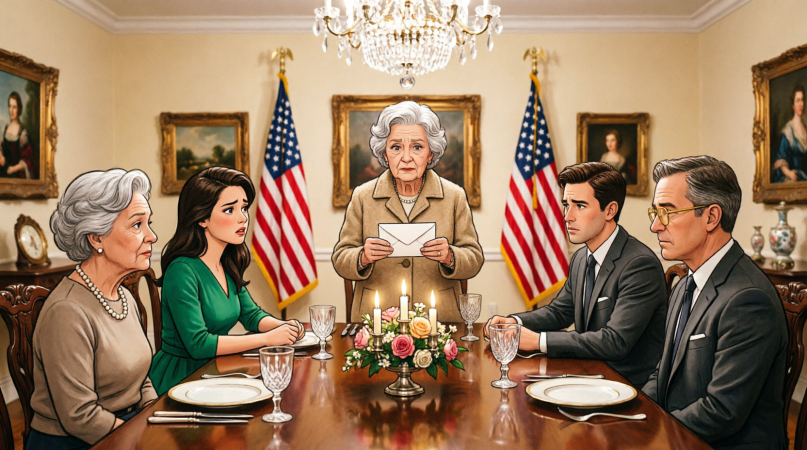
Then I heard my name.
Not spoken with warmth. Not in the tone a son uses when he is about to call his mother into the room. Not as an invitation, not even as a complaint softened by affection. It was the way people say a name when they think the person who owns that name is safely elsewhere, the way someone might say rain or traffic or another small inconvenience.
“Eleanor just shows up,” Serena said. “Every single time. It doesn’t matter what we have going on.”
There was a beat of silence, and then David, my David, said, “I’ll talk to her.”
That voice. That same voice I had heard at five years old ask if worms drowned in the rain, at ten beg me not to make him go to summer camp, at sixteen say with too much false calm that he was fine after a girl at school broke his heart.
That same voice I had heard from a hospital gurney at two in the morning when he was thirteen and had fallen from a roof he had no business climbing in the first place, his right wrist bent at an angle that turned my blood to ice even though I was a nurse and had seen worse a hundred times over.
I had driven him to six years of baseball practice, sat through choir concerts with other people’s coughing children behind me, hauled boxes into four separate apartments before he finally bought that house in Dublin, on a street with identical maples and respectable lawns and mailboxes that all looked as though they had been selected from the same catalog.
“You always say that,” Serena answered. “She’s not our responsibility, David. I need you to understand that. She is not a priority in this house. Not anymore.”
The silence after that felt larger than the room itself. I stood absolutely still in the kitchen doorway, the dish towel still warm in my hands, and something in me changed shape so quietly that I did not recognize it until much later. There are injuries that arrive like broken glass, all noise and damage and immediate blood. And then there are the ones that slide in so softly they almost feel like understanding.
I set the cobbler down without making a sound. I picked up my bag again, turned around, and walked back out the way I had come. I closed the back door so gently it barely made a click.
I sat in my Buick for a long time before I started the engine.
I would like to tell you that I was always the kind of woman who handled hurt with perfect grace. I would like to say I drove home, made myself a cup of tea, and decided in one clean moment to release the whole thing into the hands of God and maturity and go on with my life.
Some women can do that. Some women have the gift of taking pain, sealing it in a mason jar, labeling it in neat cursive, and putting it on a high shelf where it will not disturb the room. I was not always that woman. I was learning, but I had not fully learned yet.
For thirty-one years I had worked as a nurse, mostly in pediatrics, and then for the last stretch of my career in surgical recovery. When you spend that much time around people in pain, you learn that the real damage in a life rarely comes from the dramatic emergencies.
It does not come from the ambulance siren, or the clean bright violence of a diagnosis, or even the kind of grief that drops like weather and announces itself to everyone in the county. No, most of the true damage comes from erosion. It comes from what is withheld.
The birthday acknowledged with one dry text message. The grandchild dropped off and picked up without anyone stepping inside. The invitation that arrives too late to be real. The meal accepted without thanks. The conversation that never quite becomes one.
My husband Harold had died four years earlier. Pancreatic cancer. Six weeks from diagnosis to the end, which sounds brutal because it was brutal, though there was also something almost merciful in the speed of it. Harold was the kind of man who fixed things that did not need fixing just so he could feel useful on a Saturday.
He would have hated a long illness. He would have hated becoming someone other people had to lift and wash and worry over. I sat with him at the end and held his hand and told him he had been a good man, and I meant every word. Even now, when I think of my life divided into before and after, it is not the diagnosis that marks the line. It is the silence in the house after he was gone.
After Harold, I had David. I had Sophie, who was seven then and still young enough to crawl into my lap without first checking whether she was too old for it. I had Tyler, already at that age where boys start drifting toward their own weather systems and you can feel them turning into strangers even while they still live under your roof. And I had the house on Clover Ridge, where Harold and I had lived for twenty-two years.
We had planted sugar maples in the front yard when we moved in. Harold had built raised beds in the back for tomatoes and zucchini and basil, standing there in an old Ohio State sweatshirt with his reading glasses sliding down his nose, measuring boards twice because that was the kind of man he was. The house had been our longest conversation.
For a while, I believed that would be enough.
The first time I noticed the distance, I told myself I was imagining it. Grief can make a person suspicious. When you lose a husband after nearly four decades, every room in the world develops an echo, and it is easy to mistake loneliness for revelation.
So when things began to shift with David and Serena, I explained them away. Young families get busy, I told myself. Children have soccer and school projects and winter colds and birthday parties at trampoline parks. Working couples juggle schedules. Everybody is tired. Nobody means anything by it.
It started small, the way rot starts under a porch board.
The first Thanksgiving after Harold died, I did what I had always done. I planned the menu in my head before Halloween was over. My dining room table seated twelve with the leaf in, and for years I had used every inch of it. I made Harold’s mother’s stuffing recipe and green bean casserole and two pies and cranberry sauce from real cranberries because canned sauce looked to me like something from a chemistry experiment, and Serena had once laughed and said it seemed like a lot of effort for something people only took three bites of anyway. I had laughed too. I thought she was joking. Maybe she was. Maybe everything important starts with a joke that no one bothers to examine closely enough.
Two days before Thanksgiving, David called and said they were going to keep it low-key that year. Just the four of them at their place. I was welcome to come by for dessert.
I said, “Of course. That sounds lovely.”
And because I was raised properly, and because women of my generation can turn almost any humiliation into a hostess instinct if given ten seconds, I baked a pie and brought it over.
I sat on their couch for an hour and a half while Sophie showed me a drawing of a horse and Tyler scrolled on his phone without lifting his eyes. In the kitchen, David and Serena moved around the remains of a meal I had not been invited to share. Plates clinked.
Cabinet doors opened and shut. Serena ran the faucet. David scraped leftovers into a container. Nobody was cruel. That is the insidious part. Nothing was dramatic enough to object to.
It was just that I was no longer part of the center of things. I had become decorative, like one of those good serving bowls that only comes out for certain occasions and then gets put back on the shelf when the important work is done.
I drove home in the dark with the empty pie dish riding shotgun beside me.
The year after that they went to Serena’s parents’ place in Phoenix. I was not invited. David said it was a Callaway family thing. I was a Marsh, he said, with a laugh that suggested there was no injury in the distinction.
Marsh had been Harold’s last name. David’s last name. My name for nearly forty years. I had not stopped being a Marsh because Harold died, but apparently widowhood had changed the geometry of the family in a way no one felt the need to explain to me.
That Thanksgiving, I signed up for a shift at the community center downtown. We served turkey and mashed potatoes and canned corn to people who had nowhere else to go, and I sat across from a ninety-year-old Korean War veteran named Curtis who told me stories for two solid hours about train depots, cold weather, and a woman in Louisville he had once planned to marry.
There are worse ways to spend a holiday than in the company of someone who is honest about loss. Still, when I drove home that night and unlocked my own front door, the silence waiting for me was heavier because it had been earned.
But I did not pull back. This is the thing I need understood. I did not become cold. I did not become dramatic. I did not announce boundaries on Facebook like younger people do now, with inspirational graphics and captions about protecting their peace. I kept calling. I kept dropping off food.
I kept offering to take Sophie for the weekend, which David and Serena accepted whenever it suited them and declined whenever it did not, without any pattern I could identify.
I went to Tyler’s school play even though nobody had told me about it. Sophie let it slip on the phone one Tuesday, in that absentminded way children reveal the truths adults are trying not to state aloud.
I sat in the fourth row of the middle school auditorium and watched my grandson stand on stage as a tree in some production I could not now name if you paid me. Afterward he looked mildly surprised to see me and said, “Oh. Hi, Grandma,” before hurrying off with his friends, and I smiled as if that were enough.
I kept trying because that is what women like me do. We call it loyalty when sometimes it is only fear of admitting the story has changed without our permission.
And then there was that morning in the kitchen.
After I drove home, I sat at my own table with a cup of coffee that went cold untouched, and I thought about all the times I had not been invited. I thought about the Sundays I had driven over with casseroles that were received with the polite exhaustion reserved for things no one asked for.
I thought about the key in my purse, how for years it had felt like belonging and had gradually become something else, something closer to tolerated access. I thought about the way Serena had said my name. Not angry. Not even especially cruel. Just final.
I did not call David that day. I did not call the next day either. Then a week passed. Then two. And I realized, with the kind of quiet humiliation that comes not from a blow but from arithmetic, that my silence had lasted no longer than the usual gap between his calls to me. He did not seem to notice.
So I did something I had not done properly in years. I turned my attention back toward my own life.
I went out into the garden. Harold’s raised beds had become overgrown. I had been meaning to get to them for two summers and had somehow kept not getting to them, because it is remarkable how much of a widow’s life can be spent waiting to see if someone else needs something.
Three mornings in a row, before the August heat came up off the pavement and settled over everything, I worked the back yard. I pulled weeds. I turned soil. I cut away dead growth and found, under the mess, the stubborn perennials that had returned without assistance. Black-eyed Susans. Coneflowers.
A rosebush I had planted the year we moved in, still alive after every winter Ohio had thrown at it. There was something deeply clarifying about discovering that beauty, if neglected, does not always die. Sometimes it simply waits.
I called Patricia, who had been my friend since nursing school and whose invitations I had been canceling for months because I was always “keeping the weekend open, just in case.”
Patricia drove forty minutes to meet me for lunch at a little place by the Scioto River, and we sat there for three hours over iced tea and chicken salad sandwiches while kayaks drifted by and college girls in sundresses laughed too loudly at the next table. Patricia looked at me halfway through the meal and said, very matter-of-factly, “You know you are allowed to have a life that isn’t organized around whether your grown son remembers you exist.”
Patricia had always had a gift for saying the exact thing most people spend six paragraphs circling.
I made an appointment with my attorney the following week.
Howard Gaines had handled Harold’s estate from the beginning. He was one of those old-school lawyers who still kept real paper files in real cabinets and wore ties with tiny patterns on them that seemed faintly out of step with the century, which made me trust him more, not less.
His office smelled like coffee, dust, and legal pads. I sat across from him in a chair that squeaked when I shifted, and he looked at me over his glasses and asked if I had any particular changes in mind regarding my will.
“Several,” I said.
The original will had been written two years after Harold died, when grief was still raw enough to make sentiment feel like judgment. At the time, David was still the person I believed him to be, or the person I needed to believe he was in order to keep moving through the day.
I had left nearly everything to him, with the house intended for the grandchildren when they came of age. It had seemed natural then, the continuation of a family line, the ordinary passing down of what two careful people had built.
But ordinary only works when love does.
I sat there for two hours with Howard and changed everything.
David would receive enough to be called remembered, but not enough to call it inheritance. A modest amount. A gesture. The house on Clover Ridge, paid off and worth more than I had ever fully allowed myself to calculate, would become something else entirely.
A portion would go directly into a trust for Sophie, accessible when she turned twenty-five. A portion would go to the children’s hospital where I had worked for the best years of my career, designated for the pediatric wing.
Another portion would fund a scholarship at the community college in Harold’s name for nursing students in their final year, the ones hanging on by a thread, the ones who needed help with tuition, books, gas money, and the thousand practical indignities that can ruin a decent future before it starts.
When I walked out of Howard’s office that afternoon into the bright, blunt light of a Columbus parking lot in late summer, I felt lighter than I had in years. I am not sure what that says about me. Maybe nothing flattering. Maybe only that truth, even late, relieves the body.
David called that Sunday.
I let it ring once before I answered.
“Hey, Mom,” he said, in the tone of a man beginning at the convenient part of the conversation. “Any chance you could watch Sophie next Saturday? Serena’s got some work thing, and I have plans.”
He did not specify what kind of plans. He did not ask how I was. He did not say he had missed me the past two weeks. He did not ask why I had gone quiet.
“Of course,” I said. “I’d love to see her.”
There was a small pause on the line, as though he had been bracing for resistance and found none. “Great. We’ll drop her off at nine.”
When Sophie arrived that Saturday morning, she came in with her backpack and the stuffed rabbit she had carried since she was two, a sad-looking thing named Captain whose left ear was half detached and held together with fabric glue. She wrapped her arms around my waist the moment she stepped through the front door. Children know where ease lives. Adults talk themselves out of that knowledge. Children don’t.
We made pancakes together, which meant batter on the counter and a streak of flour near the ceiling fan that I did not bother cleaning until the next day. We watched a nature documentary she was obsessed with.
We went out into the garden, and she helped me transplant the coneflowers that had outgrown their bed. She asked the names of everything I pointed to, repeating them under her breath as if studying for a test no one had assigned. In the afternoon she fell asleep on the couch with Captain tucked under her chin, one small sneaker dangling halfway off her foot.
I sat in the armchair across from her and watched her breathe.
There are moments with grandchildren that split a person open in a softer way than motherhood ever did. With your own child, love is tangled up in fear, exhaustion, bills, appointments, discipline, and the practical business of keeping a small body alive.
With a grandchild, love arrives clarified. Not smaller. Cleaner. I sat there looking at Sophie’s sleeping face and thought of all the things I wanted for her that I had never managed to secure for myself with any consistency. I wanted her to know her own worth early.
I wanted her to understand that the people who truly show up are worth more than the people who merely retain access. I wanted her to build a life that felt chosen rather than inherited by habit.
When David came at five, Sophie hugged me twice at the door, which was unusual enough that he noticed.
“She loves coming here,” he said.
There was something in his voice I could not quite name. Not guilt. Something smaller and more fleeting than guilt. A memory, perhaps. A recognition. The faint discomfort of a man who has just glimpsed a version of his own life from outside it.
“I know,” I said. “I love having her.”
He nodded, but he did not come inside. He put Sophie in the car, waved once, and drove away.
I stood at the door a moment longer than necessary. Then I went back into my house and sat at the kitchen table and let a thought finally become real.
I could leave.
The idea had occurred to me before, but only in the abstract way certain fantasies visit people when they are folding laundry or waiting in line at the pharmacy. I was sixty-eight years old, a retired nurse from Columbus, Ohio.
Women like me did not usually uproot themselves and begin again somewhere else unless there was a crisis, a remarriage, or a daughter in labor. We stayed put. We tended gardens. We learned to drive to the airport more often. We waited to be useful. But once the thought arrived in full, it would not go away.
Harold and I had once talked about Savannah.
Years earlier, on the drive home from Charleston, we had stopped there for lunch and ended up wandering for two hours under live oaks draped with Spanish moss. Harold, who rarely said anything impulsive about place, had stood in one of those squares and looked around at the old brick, the ironwork, the filtered light, and said, “I could live here.” I had stored that sentence in me the way I had stored everything else. Women like me are built of remembered offhand remarks.
Now, for the first time, I began to wonder what it would mean not merely to endure the rest of my life, but to choose it.
I spent three months researching the move before I said a word to anyone.
That is another thing people misunderstand about women my age. They imagine that because we are polite, because we have spent so much of our lives appearing agreeable, we are incapable of private resolve.
The truth is almost the opposite. By the time a woman in her late sixties makes a serious decision, she has usually already lived with it alone long enough to know its full weather. I did not need permission. What I needed was a plan.
I made lists on yellow legal pads. I compared property taxes. I read about neighborhoods in Savannah the way some people read mystery novels, circling names and underlining details. I studied maps, flood zones, hospital systems, grocery stores, and average January temperatures.
I checked the route from Columbus to Georgia as if memorizing an escape. I read about humidity and termites and hurricane season and pretended the practical details were the whole reason I was doing any of it. But underneath all of that was something simpler. I wanted a place where I would not feel myself thinning out at the edges while waiting for a phone call.
In September, Patricia said, “We are driving down there, and that’s final,” in the same tone she had once used to inform a difficult attending physician that he was standing on the wrong side of sterile protocol.
We left before dawn on a Thursday with coffee in travel mugs and peanut butter crackers in the glove compartment, crossed through Kentucky and Tennessee, and made the whole thing feel almost ridiculous in the best possible way. Patricia had brought three playlists, two mysteries on audio, and enough opinions about motel bedspreads to sustain a person across state lines.
We spent four days in Savannah walking neighborhoods and looking at houses. The city had that layered feeling old places sometimes have, as though every porch and cracked brick step had been used by five different versions of America and remembered them all.
There were squares everywhere, little pockets of shade and monument and movement, and people out walking dogs beneath trees that seemed older than several towns I had lived in. The air was softer than Ohio air, even in September. It did not press on the body the same way. There was salt faintly under everything, and the whole city moved as though it had decided haste was a private weakness.
I found the house on the third day.
It was on a quiet street twelve blocks from Forsyth Park, with a small front stoop, a deep back garden in need of rescue, and a sun porch that caught the afternoon light like a secret. The ceilings were taller than anything I had lived with since childhood. The floors sloped slightly in one room, which I found charming rather than alarming. The kitchen had a gas stove.
I had wanted a gas stove for thirty years.
That may not sound like the kind of detail upon which a woman should base the next chapter of her life, but it was not really about the stove. It was about permission. About all the tiny preferences that had been deferred in the name of family, budget, habit, compromise, duty, motherhood, practicality, and widowhood, until one day you realized you could no longer hear yourself under all the accommodations. Standing in that kitchen, hand resting on the edge of the counter, looking at a stove with real blue flame instead of electric coils, I had the sudden, absurd urge to laugh.
Patricia stood beside me and said, “Oh, this is it.”
I put in an offer before we drove back to Columbus.
The next step was telling David.
I chose a Sunday afternoon because people are often softer then, especially in autumn, when the week has not yet hardened into logistics. I called him after lunch, while standing at my own kitchen sink, looking out over the raised beds Harold had built. He answered on the fourth ring.
“Hey, Mom.”
“I wanted to tell you something,” I said. “I’m selling the house on Clover Ridge.”
The silence that followed went on long enough that I briefly thought the call had dropped.
“You’re what?” he said at last.
“I’m selling it.”
Another silence. Then, slower: “And going where?”
“Savannah.”
“Savannah, Georgia?”
“Yes.”
He exhaled, and I could picture him doing it, one hand on his hip, forehead tight, the way he looked when a contractor came in over estimate or Tyler forgot an assignment or Serena moved his keys somewhere practical that he immediately resented.
“Mom,” he said, “you don’t know anyone there.”
“I will.”
“What about Sophie? You’ll be eight hours away.”
“Eleven, if you drive straight through and stop only when necessary,” I said. “But Sophie is welcome to visit any time. I’ll keep a room ready for her. The invitation stands for as long as I’m alive.”
That landed somewhere between us. I could feel it.
“I just don’t understand why you’d do this.”
I had considered telling him the truth. I had rehearsed versions of that conversation while gardening, while driving, while lying awake at four in the morning with the ceiling fan turning above me and Harold absent from the bed beside me in the specific old way absence can become almost architectural.
I knew exactly which words would land hardest. I knew how to say kitchen doorway and warm cobbler and not a priority in this house in a tone calm enough to be devastating. I knew how to tell him that the house he thought of as my place had become, in truth, a waiting room.
Instead I said, “Harold and I talked about it once, years ago. I think it’s the right time.”
He was quiet so long I could hear the faint television noise in the background, one of those home renovation shows where everyone talks in tones of fake crisis about cabinets.
“Okay,” he said finally.
He said it the way people say okay when they do not understand, do not approve, and are not entirely sure whether they have earned the right to object.
The house sold in eleven days.
That was the part that stunned me. I had expected months of showings, negotiations, second thoughts, and emotional ambushes. Instead a young couple with a toddler made an offer above asking price, and suddenly my home of twenty-two years became a stack of disclosures, signatures, and closing dates.
I moved in January, which some people might consider a bleak time to begin again, but I have always liked January. It strips everything down. It asks for honesty. Spring offers hope whether you deserve it or not. January requires intention.
Patricia helped me pack. We spent three days wrapping dishes in newspaper, labeling boxes in thick black marker, and stopping every hour for coffee we did not need. We laughed more in those three days than I had laughed in years, which told me something I should probably have admitted sooner.
My neighbor Robert, who was seventy-two and had shoveled my driveway every winter since Harold died without ever once making it feel like pity, brought over a bottle of red wine the night before the movers came. We sat on the back steps in our coats while the January dark settled over the garden.
“Harold would’ve liked this for you,” he said.
“I think so too,” I answered.
The drive down took two days. I stopped outside Knoxville the first night at a roadside inn with clean sheets and a diner attached, and I ate dinner alone in a booth under fluorescent lights while a waitress with a Tennessee accent called everyone honey, regardless of age or gender.
I read for two hours afterward and went up to my room with that strange sensation that comes when no one in the world knows where you are for the night except the person at the front desk. It did not frighten me. It felt like freedom wearing practical shoes.
Savannah in winter was everything I had hoped and something quieter besides. The light was lower, slower. The house looked even better than it had in September, though the back garden had gone wild in my absence, all tangled vine and neglected ambition. But I knew what to do with that. I had done it before. There is something deeply reassuring about recognizing a problem that yields to patience, gloves, and decent pruning shears.
I unpacked the kitchen first. I always have. A functional kitchen makes everything else feel survivable. I lined up the dishes, found the canisters, stacked the baking pans, and stood for a moment looking at the gas stove as if it were a promise I had made to myself and, for once, kept.
That first evening I made soup and listened to the satisfying soft whoomph of the flame catching beneath the pot. I ate at the kitchen table with the back door open to the cool southern air, listening to the neighborhood ease into evening. Somewhere nearby a screen door slapped shut. A dog barked once and then gave it up. A car rolled slowly past with music low enough to feel more like memory than sound.
I slept better that first night than I had in years.
Savannah opened slowly after that, the way certain people and certain places do when approached without trying to own them. I found a garden club through the botanical society and met women who could discuss soil amendments and hydrangea fungus with the kind of seriousness usually reserved for tax law or cardiac procedures.
I found a yoga class on Tuesday mornings taught by a woman named Deirdre, who was sixty-four and had the exact posture of someone who had long ago stopped apologizing for taking up her rightful space on earth.
I began volunteering at the children’s hospital on Thursday afternoons, reading to kids in the waiting room and helping parents fill out paperwork when they looked too exhausted to see straight. I had not realized how much I missed the feeling of being useful in a place where usefulness was not confused with obligation.
Patricia came for a long weekend in March and declared the house “an entire personality,” which in Patricia’s language was near canonization. We sat on the front steps with wine in actual glasses and watched the neighborhood move past us.
A young man in paint-splattered pants walked a bassett hound. Two little girls rode by on scooters with helmets too loose under their chins. Somewhere down the block a radio played old Motown. The evening light caught in the live oaks and made the whole street look temporarily forgiven.
That was when it hit me most clearly: how much of my life in Columbus I had spent waiting to be needed by someone who had long since stopped truly needing me and simply had not thought to say so out loud.
Sophie called me on a Tuesday evening in April.
It startled me so badly I almost dropped the dish towel in my hand. She had never called on her own before. David must have given her my number and, more important, permission to use it.
“Grandma?” she said when I answered.
“Hi, sweetheart.”
“Are you busy?”
“Never for you.”
There was a rustling on the line, the little breathy urgency of a child trying to organize information before it escaped her. “I drew a picture of your new house. I haven’t seen it really, but Dad showed me a photo. I got the porch right, but I made the garden too small.”
I laughed. “The garden is very big now.”
“Can I plant something when I come?”
“You can plant whatever you like,” I said. “I’ll save a whole bed for you.”
She came in July, by herself, on a plane for the first time.
That was, according to David, an enormous event involving gate passes, instructions repeated six times, and a level of maternal concern from Serena that I gathered was sharp enough to be audible from several states away.
I met Sophie at the arrivals gate, and she spotted me instantly in the crowd. She ran the last twenty feet with Captain the rabbit tucked under one arm, and when she hit me at full speed I had to widen my stance to stay upright.
We spent eight days together. We planted zinnias and sunflowers and a tomato plant she insisted on naming Gerald. We walked through Savannah’s squares, and I told her the histories I had learned, though not all at once because children deserve stories in digestible portions.
We went to the children’s museum and to the waterfront and to a little restaurant where she ordered shrimp and grits and ate every bite with a concentration so sincere it made me laugh. She sat on the sun porch in the mornings with coloring books and in the evenings with questions. Some of them were the usual questions children ask when they are safely curious about the world.
Why do people put metal on horses’ feet?
Why does Spanish moss grow like that?
Who decided a tomato was a fruit?
Some of them were not.
“Do you miss Ohio all the time,” she asked one evening, “or only sometimes?”
I looked at her in the slanting light and answered with the truth. “Only sometimes.”
She seemed to approve of that answer. Children are good judges of emotional weather when the adults around them are not lying.
The night before I took her back to the airport, she sat beside me on the sun porch with her shoulder leaning into mine and said, “I told Dad it was really nice here. He asked if it feels like home yet.”
“What did you tell him?”
She was quiet for a moment, looking out at the street where the oak branches moved slowly in the evening wind. “I said it feels more like home than home does.”
I did not answer. I simply put my arm around her and let the words sit where they landed. Children say the truest things because they have not yet learned how expensive truth can become.
It was in October, twenty-two months after I had moved, that David called on a Friday afternoon and did not open with a request.
That was what I noticed first.
“Mom,” he said, and his voice was different. Thinner in places, as if some private scaffolding had been removed. “How are you?”
I told him I was well and asked how he was.
A long pause followed, the kind that has weight in it.
“Serena and I are separating,” he said.
I sat down at my kitchen table. The late-afternoon light was coming through the back door, and out in the garden Gerald the tomato plant had already done what tomatoes do in the South: overperform with almost embarrassing generosity and then begin to decline gracefully before the first real cold. I let the information settle.
“I’m sorry, David,” I said, and I meant it.
Whatever else was true, I had watched my son build a life around that marriage. Watching a structure fail carries its own sadness, regardless of what you thought of the materials.
He talked then, and I listened the way I had learned to listen over three decades of nursing. Fully. Without assembling my response while the other person was still speaking.
He told me about the last year, about how distance had turned every conversation into negotiation, how affection had become administration, how one morning he had come downstairs and understood without needing anyone to say it aloud that something essential had gone missing from the house. He was moving into an apartment. Tyler would stay primarily with Serena through the school year. He would have Sophie every other week.
When he finished, there was silence.
“I’ve been thinking,” he said carefully, “about a lot of things.”
I waited.
“I know I wasn’t…” He stopped. Started again. “I know things got off track between us a while back. I went along with a lot I should’ve pushed back on. I’m sorry for that, Mom.”
I looked out at the garden and said, after a moment, “I appreciate you saying that.”
He exhaled, and the sound of it seemed to carry years.
“Sophie talks about you all the time,” he said. “She wants to come back to Savannah.”
“She has a garden bed waiting for her.”
He was quiet again. Then, almost cautiously: “I’d like to come too. If that’s okay.”
I thought then of the woman standing in a kitchen doorway in Ohio, holding a warm cobbler and hearing herself reduced to a scheduling problem. I thought of all the Sundays and holidays and small exclusions that had taught me, slowly, that love without dignity curdles into something unrecognizable. I thought, too, about what twenty-two months in Savannah had done for me. How I had built something new not out of revenge, not even out of pain, but out of long-neglected appetite for my own life.
“You’re welcome here, David,” I said. “You always were.”
I did not say anything else. I did not need to.
After I hung up the phone, I went out into the back garden and stood there in the late light, the way I sometimes do when I want to feel the full weight of a moment before it becomes memory.
The zinnias Sophie had planted were still bright, stubborn in that October warmth. The rosebush in the far corner was offering up a few last red blooms as if unwilling to close the season without one more graceful effort. I stood there with my hands at my sides and felt, not triumph exactly, but confirmation.
There is a difference. Triumph depends on someone losing. Confirmation is quieter. It is the sudden understanding that the life you rebuilt was not imaginary, not compensatory, not a temporary arrangement while waiting for something else to improve. It is your life now. Fully yours. And because it is yours, anyone who enters it must do so as a guest of your choosing, not as the beneficiary of your endurance.
I went inside and made myself a proper dinner. Roasted chicken with herbs from the garden. Good bread from the bakery two streets over. A glass of wine I had been saving for no special occasion except that I no longer believed special occasions were things bestowed from outside.
Sometimes a day becomes worth marking because you decided to tell the truth, or because someone else finally did. I sat at my kitchen table with the gas stove cooling behind me and the October evening gathering itself outside, and I thought Harold would have liked this life. This town. This table. This version of me.
David texted two days later asking about dates.
That, more than anything, told me how much had changed. He did not assume. He did not call and announce a plan as though my time were a stable shelf waiting beneath whatever he needed to set down. He asked if the second weekend in November might work, adding that Sophie had a teacher workday on Friday and could miss school only if absolutely necessary, and closing, somewhat awkwardly, with, Let me know what’s convenient for you.
I read that last sentence twice.
Convenient for you.
It is astonishing how much emotional history can fit inside five ordinary words.
I answered that the weekend would be fine, that I would have the guest room ready, and that Sophie’s bed still held the quilt she liked with the faded yellow flowers. He wrote back, She’ll be excited. Then, after a minute: Thank you.
The week before they came, I found myself cleaning in a way I had not done for company in a long time. Not because I was anxious to impress them. That was not it. It was more that I wanted the house to reflect the life I had made.
I polished the kitchen table, deadheaded the zinnias, freshened the sheets, bought extra coffee, and made a list for the market that included bacon, pancake mix, oranges, and the little cinnamon cookies Sophie liked from the bakery near Monterey Square.
I trimmed the rosemary by the back steps and swept the sun porch and stood in the hallway once, looking toward the guest room, taking stock of the peculiar fact that my grown son would soon be walking into a home that existed entirely outside his history of me.
In Columbus, he had known where things belonged because he had grown up among them. He knew which kitchen drawer held tape, where Harold kept the flashlight, which hall floorboard squeaked in winter. In Savannah, none of that was true. He would have to look around. He would have to ask.
That mattered more than I could easily explain.
The morning they arrived, the sky was pale and clear, and the air had that mild southern softness November can still carry before winter thinks to show up. I drove to the airport early because I have never believed in cutting close the things that matter.
At baggage claim, I spotted Sophie first, hopping in place while waiting for the suitcase, her hair longer now, Captain tucked under one arm even though she was getting old enough to feel a little embarrassed by him in public.
David stood beside her looking older than the last time I had seen him in person, which startled me more than it should have. There was gray at his temples I did not remember earning. His shoulders had the slight inward pitch of a man who had been sleeping badly for a while.
Sophie saw me and grinned so hard it changed her entire face.
“Grandma!”
She ran to me and nearly knocked my purse off my shoulder. I hugged her and laughed and said, “Goodness, child, you’ve grown half an inch since July.”
“Probably more,” she said with complete seriousness.
Then David stepped forward.
For one second there was that awkward American adult-child hesitation, the little social pause where both parties pretend the correct level of intimacy is difficult to determine. Then he leaned in and hugged me. Not the one-armed side hug of obligation. A real hug. Brief, but real.
“It’s good to see you, Mom.”
“You too.”
In the car, Sophie did most of the talking, as children often do when the adults are carrying too much unsaid material between them. She told me about school, a girl in her class who cried when asked to do multiplication at the board, a hamster named Marvin that had escaped in the science room, and the fact that Tyler had recently become interested in cooking but only if it involved meat and a grill.
David laughed at some of this in the right places, but he was distracted, looking out the window as the city unfolded. Live oaks. Stucco. Brick. Wrought iron balconies. Side streets that curved when Midwestern roads would have insisted on order.
“It’s beautiful here,” he said finally, almost to himself.
“Yes,” I said. “It is.”
At the house, Sophie ran in as if returning to a second address she had always had tucked inside her. She went straight to the guest room, dropped her backpack, then ran to the garden to inspect “her” bed, where the soil had been turned and the little slate marker with SOPHIE etched into it still stood at the edge. I had made that marker with a paint pen and a steady hand one afternoon after her July visit. She crouched beside it now as though confirming her own existence.
David stood in the kitchen, one hand on the back of a chair, taking it all in.
“This really suits you,” he said.
I looked at him, at the unfamiliar humility in his face, and realized he was not complimenting the house. He was speaking of the life.
“Thank you,” I said.
I showed him the coffee mugs, the guest room closet, where I kept extra towels, how the back door stuck a little when the humidity rose. He nodded and listened. It was such an ordinary thing, so small and practical, and yet I could feel in my own body the significance of it. He was learning my house. Not assuming it was already an extension of himself. Learning it.
That first afternoon passed easily because Sophie made ease inevitable. We planted cool-weather annuals in her garden bed and she narrated the process with solemn authority, deciding the pansies looked “like flowers trying to be fancy on purpose.”
We ate grilled cheese and tomato soup at the kitchen table. She read on the sun porch while I chopped onions for dinner, and David stood awkwardly nearby at one point and asked, “Need help?”
It had been years since he had asked me that in any room.
“Yes,” I said, because the truth deserved room to breathe. “You can slice the carrots.”
He smiled faintly, took the knife, and stood at my counter while late sun moved across the floorboards. For a few minutes there was only the sound of cutting, the soup simmering, Sophie turning pages in the next room, and the ordinary peace of people occupying a kitchen without strategy.
After dinner Sophie fell asleep halfway through a movie, curled under the same yellow-flowered quilt, Captain pinned beneath her arm like evidence. David and I sat on the sun porch with two glasses of wine and the screen door closed against the evening insects. Down the block, someone laughed. A dog barked once. The neighborhood settled around us.
For a long time neither of us spoke.
Then David said, “I should have called you sooner.”
I turned my glass slowly in my hands and waited.
“I’ve thought about that day more times than I can count,” he said.
I looked at him. “What day?”
His expression told me he knew I knew.
“The day you came by with the cobbler,” he said quietly. “I didn’t know you’d heard us until much later. Serena said she thought maybe you had. I told myself if you had really heard, you would’ve said something. You always said something when something mattered.”
There it was. The old misunderstanding. Children who grow up loved by steady women often mistake our restraint for lack of injury. They think if we do not raise our voices, the bruise is smaller.
“I did hear,” I said.
He lowered his eyes.
“I was standing in the kitchen doorway.”
The porch went still. Not silent exactly. The city still breathed around us. Somewhere a car moved past. A branch shifted. But between us there was the kind of stillness that arrives when truth finally occupies its rightful chair.
“I’m sorry,” he said.
His voice broke on the second word, not dramatically, but enough.
“I know you are,” I answered.
He rubbed a hand over his face and stared out through the screen. “I can say Serena was difficult and that things had gotten bad and that I was trying to keep peace in the house, and some of that would be true. But the whole truth is I let it happen because going along was easier than standing up in the middle of it. And I told myself I’d fix it later. I kept telling myself later.”
That sentence, more than any apology, struck me as honest. Most family failures are built on later. Later I’ll call. Later I’ll explain. Later I’ll make it right. Later is the finest disguise neglect has ever worn.
I set my glass down.
“David,” I said, “when you’re young, you think betrayal always looks dramatic. Raised voices. Slammed doors. Big declarations. But sometimes betrayal is just standing there while someone else reduces the people who loved you to a burden. Sometimes it’s silence. Sometimes it’s convenience.”
He nodded without looking at me.
“I know.”
“No,” I said gently. “I think you know now.”
That landed. I saw it land.
We sat there a while longer. Then he said, “Did you move because of that day?”
I considered the question.
“I moved because that day forced me to stop pretending,” I said. “The house in Ohio had become a place where I was waiting. Waiting to be included. Waiting to be needed. Waiting to matter in the right way again. Savannah wasn’t punishment. It was what happened when I finally chose not to wait.”
He let out a long breath.
“I don’t expect things to just go back,” he said.
“They won’t.”
He nodded again. There was no self-pity in him then, only the sober look of a man beginning to understand the size of a thing he cannot undo.
“I’d still like to try.”
“You can try,” I said. “But trying isn’t the same as needing comfort from me because your marriage ended. If we’re going to have a relationship, it has to be a real one. Not one where I become useful when your life falls apart and invisible again when it stabilizes.”
He flinched, but only slightly. “That’s fair.”
“It’s not about fair.”
“What is it about?”
“Respect,” I said. “Consistency. Truth. The unglamorous things.”
We left it there for the night, which was wise. Not every wound benefits from being handled all at once. Sometimes the kindest thing is to stop before the old habits return and make everything mushy with relief.
The next morning Sophie woke us before seven because she had spotted a squirrel on the back fence and considered this information urgent. We made pancakes. David drank coffee at my kitchen table in an old T-shirt and watched Sophie draw on the back of a grocery receipt while I cooked. At one point she looked up and said, “Dad, Grandma flips pancakes better than anyone.”
“She does a lot of things better than anyone,” he answered.
It was said lightly, almost casually, but I felt something in me go very still. Praise from a child is pure instinct. Praise from an adult son who has withheld recognition for years is not instinct. It is repair trying to find a form.
That afternoon we walked through Forsyth Park. Sophie climbed all over the roots of an old live oak while David and I sat on a bench and watched a wedding party taking photographs near the fountain.
The bride’s veil kept blowing sideways, and a woman who was probably an aunt kept rushing in to smooth the dress and retreat before the photographer snapped. There is always something touching to me about weddings, even now, even after everything.
Not because I believe marriage itself is a guarantee of goodness. God knows it is not. But because every wedding contains, for one brief afternoon, the public version of hope. Humans remain loyal to hope in a way that is almost unreasonable.
“Do you ever miss it?” David asked suddenly.
“What?”
“Being married.”
I smiled a little. “That depends on the day.”
He waited.
“I miss Harold,” I said. “That’s different.”
He nodded. “I don’t think I understood that before.”
“There are many things you didn’t understand before.”
He winced, and I let him. Love without honesty is how families rot from the inside.
On Sunday morning, before the airport, Sophie and I planted bulbs in her bed so there would be something waiting for her in spring. She pressed each one into the soil with great seriousness and asked whether flowers remembered who planted them.
“I like to think they do,” I said.
When it was time to leave, she hugged me so hard my necklace caught in her sleeve. Then she climbed into the car and rolled down the window.
“Don’t let anybody touch my garden,” she said.
“I wouldn’t dream of it.”
David loaded the suitcase into the trunk, then came back toward me. For a second I thought he might say something formal and cautious and disappoint both of us. Instead he said, “Would it be okay if I came back in December? Just me, maybe. Or with Sophie, depending on schedules.”
“Yes,” I said. “It would be okay.”
He looked at me directly then, the way he had not done in years.
“Thank you for not shutting the door on me.”
I thought of the back door in Ohio, the quiet click as I left with the untouched cobbler still cooling on the counter behind me. I thought of how easy it would have been, later, to harden. To convert every injury into policy. To make pain the architect of the future. Some people call that strength. Sometimes it is only grief wearing armor.
“I didn’t say the door was always open,” I answered.
A faint, rueful smile passed over his face. “No. I guess you didn’t.”
That, too, mattered. He heard the boundary in it.
After they left, the house was quiet again, but not empty in the old way. There is a quiet that feels like abandonment, and there is a quiet that feels like a room returning to itself after company has gone.
This was the second kind. I washed the breakfast dishes, folded the guest-room quilt, and went out to the garden where the fresh-turned soil in Sophie’s bed still held the little half-moons from her fingertips.
Over the next months, David did come back. Not constantly. Not theatrically. That would have made me suspicious. He called when he said he would. He asked about my life and then listened to the answer instead of waiting for his turn to speak.
He came in December and repaired a loose porch latch without making a production of usefulness. He came in March with Sophie, and the bulbs she had planted had pushed up in bright color exactly where we had left them.
He stood in the garden one morning with coffee in his hand while she showed him every corner of the yard like a tiny landowner, and I saw in his face the recognition of a man who had once believed his mother existed only in relation to his own household and was now being forced, thankfully, to see her as a whole person.
That is one of the hardest adjustments adulthood asks of children. To realize your parents are not set pieces in the drama of your life. They are entire countries you visited young and then assumed would wait unchanged.
Serena never came. She sent one brief message through David about Christmas presents for Sophie and later a short note thanking me for something I mailed. I answered politely. There are some distances that do not need dramatic closure. Not every fracture deserves an epilogue. She had been, in the end, not the cause of everything but the revealer of it. I did not need more from her than that.
As for me, I kept living.
I kept volunteering at the hospital. I kept the Tuesday yoga class. I learned which fishmonger sold the best shrimp, which corner store had the expensive olives worth buying anyway, which square in Savannah was best in the very early morning when the city was still stretching awake.
I joined Patricia twice a year for long weekends, one in Ohio and one in Georgia. I sat on my sun porch in the evenings with a book and a candle and the old rocking chair Harold had found at an estate sale and repaired himself.
Sometimes I missed him so sharply I had to set the book down and wait it out. Sometimes I laughed aloud at something and reached instinctively to tell him before remembering where grief lives. Both things remained true. Missing the dead and choosing the living are not opposites. They are neighboring rooms.
What changed was not that life became painless. It was that I stopped offering myself where I was merely tolerated and began investing myself where I was honestly received.
That is the part people are often least comfortable hearing, especially in families. We are taught so early that love means availability, that motherhood means endurance, that good women absorb disappointment quietly and call it grace.
But there is a moment, if you are lucky and brave and tired enough, when you begin to understand that grace is not the same as surrender. You can love people deeply and still refuse the shape they prefer you in. You can forgive and still require change. You can leave the table without flipping it over.
Sometimes I think back to that cobbler.
To the peaches from the farm stand. The handmade crust. The dish towel warm in my hands. To the woman I was when I stood in that kitchen doorway in Ohio and heard myself named as an inconvenience. I feel tenderness toward her now, which is not the same as pity.
She did not yet know what would happen if she stopped begging inwardly for ordinary regard. She did not know she would someday stand in a garden twelve blocks from Forsyth Park with dirt under her nails and a granddaughter laughing nearby and a son relearning how to approach her with respect. She did not know that leaving would not diminish her life but return it.
If I could say anything to that earlier version of myself, it would not be some triumphant speech. It would be simpler.
Go home, Eleanor.
Not to the old house. Not to Columbus. To yourself.
And maybe that is what I am really writing here for. Not because I think every family wound should end in reconciliation, and not because I believe boundaries magically fix what years of neglect have done. They do not. Some doors close and remain closed for good reason. Some apologies arrive too late to be anything but decorative.
But sometimes a person does not need revenge. Sometimes she needs distance long enough to hear her own mind again. Sometimes the most life-changing thing you can do is walk out quietly, take inventory, and build a life so solid that anyone who wants back in must knock.
Would you have left when I did, or would you have stayed one season longer hoping love might finally sound like love again?
If you’re still here, thank you. That means more than you know.
Hit subscribe if you want to hear more stories like this one. Drop a comment and tell me, have you ever had to set a boundary with family.
Until next time, take care of yourself.