My grandma had emergency surgery. I called my parents: “She’s critical, please come.” No one showed up. Dad—John—texted: “You’re already there. You’ll take better care of her.”
Grandma didn’t survive.
A week later, at the funeral, the pastor read her last note:
“If John is here, do not…”
My grandma had emergency surgery. I called my parents. “She’s critical. Please come.” No one showed up. Dad, John, texted, “You’re already there. You’ll take better care of her.” Grandma didn’t survive. A week later, at the funeral, the pastor read her last note. “If John is here, do not…”
My name is Maria Schaffer. I’m 34 years old, and I’m a hospice nurse in Pittsburgh.
On January 16th, 2025, at exactly 9:05 p.m., my grandmother, Eleanor, died after emergency surgery while I sat alone in the waiting room. I had called my parents three times. Neither of them came. Eighteen minutes after my first call, my father, John, texted me, “You’re already there. We’ll come if she actually dies.”
She did.
A week later, at her funeral, the pastor opened a sealed note my grandmother had left behind. The first line said, “If John is here, do not let him speak for me.” What my parents didn’t know was that my grandmother had been preparing for that moment for a long time. And they definitely didn’t know I’m a hospice nurse who documents everything—every time stamp, every missed call, every visitor log, every lie.
If you’ve ever been abandoned by family when someone you loved was dying, subscribe right now and comment what city you’re watching from. Because what I’m about to show you isn’t just my story. It’s a warning.
Let me take you back to the beginning.
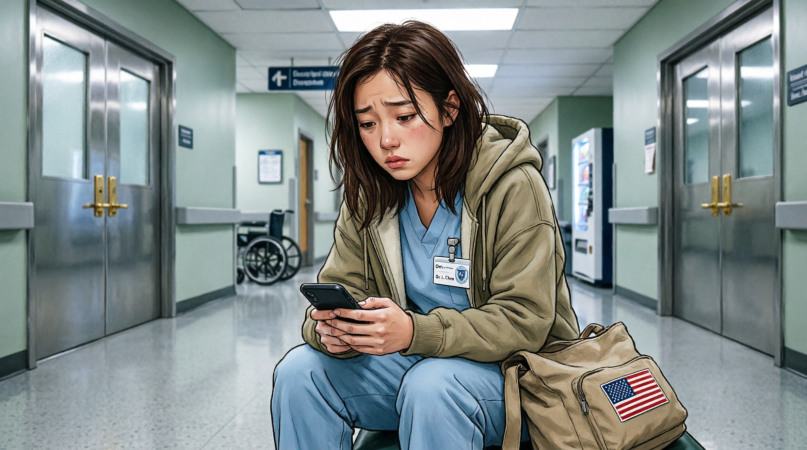
The call came at 4:03 p.m. on a Thursday. I was finishing my shift at Three Rivers Hospice, sitting in the break room with a cup of coffee I hadn’t touched yet. My phone rang. UPMC Presbyterian ICU.
I’ve been a hospice nurse for a long time. I’ve been a hospice nurse for eleven years. You learn to read the tone in someone’s voice before they finish their sentence. The charge nurse transferred me to Dr. Lorna Fitzpatrick. She didn’t waste time.
“Miss Schaffer, your grandmother, Eleanor, was brought in by ambulance twenty minutes ago. Perforated bowel, advancing sepsis. We need to get her into surgery within the hour. I need you to understand this is high risk. Her age, the infection, the stress on her heart. She may not survive.”
I grabbed the napkin under my coffee and started writing. Perforated bowel. Sepsis. High risk. I didn’t need to write it down. I know what those words mean, but writing keeps me in control.
“I’m coming,” I said. “Fifteen minutes.”
“Is there other family we should contact?”
“I’ll call them.”
I hung up and immediately dialed my father. Four rings. Voicemail. I called my mother. Six rings. Voicemail. I stared at my phone, trying to process the fact that neither had picked up during a family emergency. Then I opened our family group chat, the one my mother created last year because families need to stay connected, and typed: Grandma in emergency surgery. UPMC Presbyterian. Critical. Need you here now.
Sent at 4:05 p.m.
The message showed delivered immediately. Then, seconds later, read by John and read by Diane.
I waited.
I grabbed my coat, grabbed my bag, knocked over my untouched coffee, and I waited.
Nothing.
I got in my car and drove. UPMC Presbyterian is fourteen minutes from the hospice facility. I drove with my phone on the passenger seat, screen up, waiting for it to light up. Anything.
At 5:02 p.m., my phone buzzed. Finally. But it wasn’t a call. It was a text from my father.
You’re already there. We’ll come if she actually dies.
I read it twice. Then I read it again. A car honked behind me. The light had turned green.
I drove.
I parked in the garage, level three, spot C29. I took a picture of the parking sign so I wouldn’t forget where I’d parked. Then I walked into the hospital, took the elevator to ICU, and checked in. The nurse, Bethany, handed me visitor badge 1293.
“Are other family members coming?”
“They said they were.”
I lied. I don’t know why I lied. Maybe because admitting the truth—that my father had just told me he’d only show up if his mother died—was too humiliating.
Bethany walked me to the ICU family waiting room. Pale blue walls. Eight chairs. A vending machine. A window looking out over the parking lot. Nine other people were already there. An elderly man asleep, a woman knitting, two sons whispering.
I sat in chair D7, facing the hallway to the OR.
At 6:01 p.m., they took Eleanor into surgery. A nurse told me it could be two to four hours. I nodded. I pulled out my phone and texted my parents again.
She’s in surgery.
Read at 6:14 p.m. No reply.
Over the next four hours, I sent updates every thirty minutes like I was filing a police report. Still waiting. No news yet. Surgeon hasn’t come out.
Every message was read within minutes. Not one got a response.
At 7:04 p.m., a different nurse asked if my family was coming soon. I said, “They’re on their way.”
Another lie.
At 8:15 p.m., I bought coffee from the vending machine. Two dollars and fifty cents. Too hot. I burned my tongue but kept holding the cup because I needed something in my hands.
An older woman next to me said, “How long have you been waiting?”
“Almost two hours.”
“Is your family with you?”
I looked at her. I wanted to tell her the truth. Instead, I said, “They’re coming.”
She smiled. “Good. No one should wait alone.”
I walked back to my chair before I started crying.
At 9:00 p.m., the shift changed. A nurse named Gregory checked the visitor log, then looked at me. “Still just you?”
I nodded.
“Do you need us to call anyone?”
“No,” I said. “They know.”
At 9:07 p.m., the OR doors swung open. Dr. Fitzpatrick walked out, still in her surgical cap, mask pulled down. I stood up. I’ve seen that face a hundred times in my work. I know what it looks like when someone is about to tell you that the person you love is gone.
She walked over.
“Miss Schaffer, I’m so sorry. We did everything we could, but her heart couldn’t sustain the procedure. She arrested at 9:05 p.m. We were unable to resuscitate.”
I heard myself ask, “Was she in pain?”
“She was under anesthesia the entire time. She didn’t suffer.”
I nodded. I thanked her. I don’t know why I thanked her.
They let me see Eleanor in a small room off the ICU. She looked smaller than I remembered. Her hands were still warm. I stayed for ten minutes. I sat next to her and whispered, “I’ll protect you. I don’t care what they say. I’ll make sure people know who you really were.”
Then I walked out, sat on a bench near the elevators, and called my father. He picked up on the third ring.
“Yeah?”
“Dad. Grandma didn’t make it. She died in surgery.”
Pause. Three seconds.
Then: “Okay, we’ll handle arrangements tomorrow.”
I waited for more. Anything. But he didn’t speak.
“That’s it?” I said. My voice cracked. “That’s all you’re going to say?”
“What do you want me to say, Maria? She’s gone.”
“I want you to say you’re sorry you didn’t come. I want you to ask if I’m okay.”
“You’re fine,” he said. “You work with dying people. This is what you do.”
Then he hung up.
Call duration: 47 seconds.
I took a screenshot.
I called my mother next. She picked up on the second ring. I could hear the TV in the background.
“Mom, Grandma’s dead.”
Pause.
“Oh. Well, I suppose that’s for the best. She was suffering.”
“She wasn’t suffering. She had a ruptured bowel. It was sudden.”
“Still, at her age.”
“Are you coming to the hospital?”
“What for? She’s already gone, isn’t she?”
I didn’t answer.
“Your father will take care of the details,” she said, and hung up.
I sat on that bench for twenty minutes. Then I drove home. I didn’t cry. I didn’t scream. I sat at my kitchen table and started making a list.
The next morning, my father called at 9:00 a.m. He’d chosen Kowalski Funeral Home and said I should handle the coordination since I was off work anyway.
“I’m not off work, Dad. I took emergency leave.”
“Well, you’re a nurse. You know how these things work.”
“I’m a hospice nurse, not a funeral director.”
He sighed like I was being difficult. “Maria, just do it. We trust you.”
I met with Raymond Kowalski that afternoon. He was kind. Early sixties, silver hair, soft voice. As I signed paperwork, he asked gently, “Will your parents be involved in planning?”
I didn’t know how to answer. “My father thinks I should do it because I work with dying people.”
Raymond set his pen down. “That’s not the same as burying your own.”
Near the end, Raymond mentioned that Eleanor had prearranged some things two weeks prior. She’d chosen the casket, picked hymns, written instructions, and she’d left two sealed envelopes—one with Pastor Callahan at St. Agnes, one with her lawyer, Gerald Puit.
“Did she say what was in them?”
He shook his head. “Just that they were only to be opened if certain people were present.”
Something cold settled in my chest.
Over the next few days, I couldn’t sleep. I kept replaying my father’s text. We’ll come if she actually dies. I kept thinking about how they never called the hospital. Not once.
On January 18th, at 2:00 a.m., I opened my phone and started counting. Eleven unanswered calls. Eight text messages during surgery. One reply. I took screenshots of everything. I didn’t know why. I just couldn’t stop.
On January 19th, I requested the official visitor log from UPMC. They printed it that afternoon.
January 16th, 2025. Patient: Eleanor Schaefer. Visitor: Maria Schaffer. Badge: A-1293. 4:45 p.m. to 10:22 p.m. No other names.
That same day, I went to Eleanor’s house to pick out funeral clothes. On the kitchen table was a manila envelope with my name in her handwriting.
Maria—open if I don’t come home.
Dated January 10th, 2025. Six days before surgery.
I sat at her yellow Formica table and opened it. Inside: a handwritten letter, photocopied hospital documents from 2017, and a USB drive labeled VOICEMAILS.
The letter started:
Maria, if you’re reading this, I’m gone. I need you to know some things while the truth still matters.
She told me she didn’t expect my father to come, that she’d made peace with it, that she’d told Dr. Fitzpatrick to only call me if things became critical. She’d signed paperwork making it legal. She wrote, You’ve always been the one who stayed. When I was lonely, you came. When I was afraid after the stroke, you sat with me. You didn’t check your watch. You just stayed.
Then she dropped the bomb.
Your father visited me once during my stroke recovery in 2017. Once in six weeks. Fifteen minutes, and twelve of those were spent asking if I’d thought about selling the house. I kept the visitor log. It’s in this envelope. I’ve kept everything, Maria, because I knew a day would come when I’d need proof.
I looked at the photocopies.
Allegheny General Hospital, October to November 2017. Eleanor admitted October 1st after a stroke. Six days acute care. Six weeks rehab.
Visitor logs:
Maria Schaffer — nine visits.
John Schaefer — one visit, October 3rd, 11:04 to 11:19 a.m.
Diane Schaffer — zero visits.
Fifteen minutes. My father visited his mother for fifteen minutes during a six-week stroke recovery. And I hadn’t known, because he told me she was fine, that they were handling it, that I shouldn’t worry.
I felt sick.
I plugged in the USB drive. Seven audio files, all dated.
October 5th, 3:42 p.m. My father’s voice, casual.
“Hey, Mom. It’s me. I know you’re in rehab, but I’ve been thinking. Have you considered selling the house? It’s a lot to maintain, especially now. Just think about it.”
Thirty-eight seconds. No how are you. Just a question about her house, two days after her stroke.
November 1st, 2017, 6:15 p.m.
“Mom, I talked to a realtor. He thinks the house could go for 425, maybe more. Just something to keep in mind. Love you.”
Love you like punctuation.
March 14th, 2019. 10:22 a.m.
“Hey, Mom. Hate to ask, but we’ve got unexpected home repairs. Could you lend me about 3,500? I’ll pay you back in a couple months. Thanks, Mom.”
I pulled out the next documents. Bank statements, highlighted in yellow. March 14th, 2019. Withdrawal: $3,200. Eleanor’s handwriting in the margin:
Asked March 10th. Promised repayment soon. Never happened.
I kept listening. Four more voicemails. All the same. Asking for money. Advice on selling. Bills he couldn’t cover. In 2022, he asked for 1,800 for car repairs. Bank statement showed she gave it. Another note:
Second time. Still no repayment from 2019. $5,000 total. Never paid back.
I sat there staring at my laptop.
Then I did something I’d never done before.
I screamed.
I slammed my fist on the table, stood up, and shouted at the empty room. “You called her just to ask for money while she was in rehab, while she was learning to walk again?”
Then I sat back down, opened a spreadsheet, and started building a case.
Evidence log. John Schaefer.
Seven voicemails requesting money.
Fifteen-minute hospital visit during six weeks of stroke recovery, 2017.
$5,000 borrowed, never repaid, 2019 to 2022.
Eleven unanswered calls during Grandma’s emergency, January 16th, 2025.
Eight ignored text updates during surgery.
One reply: We’ll come if she actually dies.
Zero hospital visits, January 16th, 2025.
I saved the file. Then I made a decision.
I wasn’t going to let my grandmother die for nothing. I was going to use every skill I had as a hospice nurse—documentation, timelines, witness statements—to make sure everyone knew exactly who my father was.
The funeral was January 23rd at St. Agnes Catholic Church. I arrived early. By the time the service started, sixty-four people had signed the guest book. My parents arrived at 10:28 a.m. My mother in navy and pearls. My father in a black suit, hand on her elbow, face composed.
They sat in the front pew. I sat three rows back.
Pastor Callahan delivered the eulogy. Eight minutes. He talked about Eleanor’s faith, her garden, her devotion to family. My father wiped his eyes with a handkerchief.
When the eulogy ended, Pastor Callahan paused.
“There is one more thing.”
He reached into the podium and pulled out an envelope sealed with red wax. Eleanor’s handwriting on the front.
“Eleanor left this with me six days before her surgery. She asked that I open it only if certain people were present.”
He looked directly at my father.
“The envelope says, ‘If John is here, do not read this aloud. Give it to Maria privately.’”
The room went silent.
My father’s face went white. My mother whispered, “What is that?”
Pastor Callahan walked down and handed it to me. “She wanted you to have this alone.”
My father stood. “That’s my mother’s writing. I have a right—”
“Your mother’s wishes were clear, John,” Pastor Callahan said calmly.
Then he walked back and continued the service.
I stood, walked to the restroom, locked myself in a stall, and opened the envelope.
Two-page letter. Cream stationery. Blue ink.
Maria, if you’re reading this, I’m gone. And John showed his face at my funeral. I knew he wouldn’t come to the hospital. He never does. Not when it costs him something.
In 2017, when I had the stroke, he visited once. Fifteen minutes. Twelve of them asking about selling the house. I kept the log. I kept the bank statements from when he borrowed $3,200 in 2019 and $1,800 in 2022. I kept the call logs showing he phones once a month, always Sunday, always six minutes.
I told Dr. Fitzpatrick to only call you if I became critical. I signed the paperwork. It’s legal. I will not die waiting for him to care.
You stayed, Maria. You always have. You are the daughter I needed. He is the son I raised, but not the son I deserved.
The house is yours. The will is filed. Pastor Callahan has a copy. Gerald Puit has another. John will be angry. He’ll say I was senile or you manipulated me. Let him. You have the logs, the statements, the voicemails. The truth is simple. He wanted what I owned, not who I was. Don’t let him take that from you.
Grandma Eleanor.
I folded the letter, walked out, and got in my car. I sat there with the envelope in my lap, and for the first time since January 16th, I cried. Not from sadness. From rage, and from something else.
Clarity.
But there was one more thing Eleanor had left. Something I hadn’t found yet, and it was about to change everything.
If you’re the kind of person who’s been taking care of aging parents or grandparents, hit the like button right now, because what comes next is going to make you check every piece of paperwork your family’s ever signed.
That evening, there was a gathering at Eleanor’s house. Tradition after a funeral. Twenty-two people showed up. My parents arrived late.
I stood in the living room at 3:30 p.m., holding Eleanor’s letter. “I have something Grandma wanted you all to know.”
My father stood. “Maria, this isn’t the time.”
“Sit down, John.”
Pastor Callahan was near the fireplace. His voice was quiet but absolute. “Eleanor asked for witnesses. Stay.”
My father sat.
I read the letter aloud. Every word. I didn’t editorialize. I just read.
In 2017, he visited once. Fifteen minutes. Twelve of them asking about selling the house. I kept the bank statements from when he borrowed $3,200 in 2019 and $1,800 in 2022. He is the son I raised, but not the son I deserved.
When I finished, I folded the letter and looked at my father. His face was red. My mother stared at the floor. My aunt Carolyn stood and left without a word.
“She was my mother,” my father said, voice shaking.
“Then where were you when she was dying?” I asked.
Silence.
“You texted me, ‘We’ll come if she actually dies.’ Do you remember?”
“We were busy.”
“You were already there because she asked the hospital not to call you, because you trained her to expect nothing.”
I pulled out my phone. “She left the house to me. The will is filed. If you want to contest it, go ahead. I have six years of receipts to show a judge.”
My father grabbed his coat and walked out. My mother followed without looking at me.
I stood in Eleanor’s living room, surrounded by people I barely knew, and felt something I hadn’t felt in a week.
Relief.
But it didn’t last long.
Three days later, I got a call from Gerald Puit, Eleanor’s lawyer.
“Maria, there’s something you need to see. Eleanor left a second envelope with me. She said to give it to you two weeks after the funeral.”
I met him at his office the next morning. He handed me a smaller envelope, this one sealed with clear tape, labeled:
Maria. Open January 30th, 2025.
Inside was a handwritten note and a flash drive.
The note said: Maria, if you’re reading this, the funeral is over and you’ve read my first letter. Good. Now I need you to see what I recorded. This is the part John can never explain away. Watch it alone, then decide what to do with it. I trust you.
Grandma.
I went home, plugged the flash drive into my laptop, and clicked the only file.
Eleanor_Confession_January_8_2025.mp4
The video opened. Eleanor was sitting in her living room facing a camera on a tripod. She was wearing her reading glasses and a cardigan. The date stamp in the corner read January 8th, 2025. Eight days before her surgery.
She took a breath and began.
My name is Eleanor Grace Schaefer. I’m 78 years old. Today is January 8th, 2025. And I’m recording this because I know I don’t have much time left. Not because I’m sick, though my doctor says my heart isn’t what it used to be, but because I’ve decided to stop pretending.
I have a son, John. He’s 52. And for 52 years, I’ve told myself that he’s a good man who’s just busy, that he cares but doesn’t know how to show it, that I’m asking too much. But I’m done lying.
In 2017, I had a stroke. I spent six weeks in rehab learning to walk again. John visited me once. Fifteen minutes. And he spent most of that time asking if I’d thought about selling my house. He didn’t ask how I was feeling. He didn’t ask if I was scared. He asked about real estate.
Since then, he’s called me once a month. Always on Sunday. Always for six minutes. I timed it because I wanted to know if I was imagining it. I wasn’t.
He’s borrowed $5,000 from me over the last six years. He promised to pay it back. He never did. I didn’t ask for it back because I didn’t want to fight, because I wanted to believe he still loved me. But he doesn’t. And I know that now.
So I’m leaving my house to my granddaughter, Maria. Not because John doesn’t deserve it, though he doesn’t, but because Maria is the only one who stayed. When I was lonely, she came over. When I was afraid, she listened. She didn’t check her watch. She didn’t ask for anything. She just stayed.
John, if you’re watching this, I want you to know something. You’re not a bad person, but you’re not the son I needed. And I’m not going to spend what’s left of my life pretending you are.
Maria, I love you. Thank you for being my daughter when I needed one most.
That’s all.
The video ended. Eleanor reached forward and turned off the camera.
I sat there staring at the screen, tears streaming down my face. Then I replayed it, and I noticed something in the background. On the bookshelf behind Eleanor, there was a small black device. A camera, pointed at the couch.
I paused the video, zoomed in, and my stomach dropped.
Eleanor had been recording everything.
I grabbed my keys and drove to her house. I went straight to the living room, moved the books on the shelf, and found it. A tiny wireless camera, still active, still recording to a cloud account. I logged into the account using the password Eleanor had written on a sticky note inside the envelope:
Maria_stays_2205
The cloud storage had over two hundred hours of footage dating back to March 2024.
I started scrolling through the files. Most were mundane. Eleanor reading, watching TV, watering plants. Then I found one dated December 19th, 2024. The timestamp showed 11:03 a.m.
I clicked play.
The video showed Eleanor’s living room. She wasn’t home. But someone else was. My father and my mother. They were standing in the middle of the room, talking.
I turned up the volume.
Camera footage transcript. December 19th, 2024.
John: “She’s not going to last much longer. Dr. Patel said her heart’s getting worse.”
Diane: “So what do we do?”
John: “We wait. Once she’s gone, the house is ours. I already talked to a realtor. We can list it for 450, maybe 500 if we stage it right.”
Diane: “But what about Maria? Doesn’t she visit her all the time?”
John: “Maria’s a bleeding heart. She’ll be sad for a while, but she’ll get over it. Besides, we’re the next of kin. The house goes to us.”
Diane: “Are you sure? What if your mom left a will?”
John, laughing: “She’s 78 and forgetful. She hasn’t updated anything since Dad died. Trust me, we’re fine.”
Diane: “I don’t know, John. This feels wrong.”
John: “It’s not wrong. It’s practical. She’s old. She’s going to die. And when she does, we’re going to sell this house and finally take that trip to Europe we’ve been talking about.”
Diane: “What if she needs surgery or something? What if Maria calls us?”
John: “Then we let Maria handle it. She’s a nurse. That’s literally her job.”
Diane, hesitating: “I just… I don’t want people to think we’re bad people.”
John: “No one’s going to think anything. We’ll show up to the funeral. We’ll cry. We’ll say nice things. That’s all anyone remembers.”
The video continued for another three minutes. They talked about contractors, staging, closing costs. Then they left.
I sat there frozen.
My mother knew. She knew my father was waiting for Eleanor to die. She knew they were planning to sell the house before the body was even cold, and she went along with it.
I grabbed my phone and called Gerald Puit.
“I need to see you. Now.”
If you’re still watching, comment the word showing up. If you agree that showing up for someone isn’t optional, it’s a moral obligation, because what happens next is going to prove that my grandmother knew exactly what she was doing.
Gerald Puit’s office was on the third floor of a building in downtown Pittsburgh. When I walked in, I handed him the flash drive without saying a word. He watched the footage. All of it. Eleanor’s confession. The hidden camera recording of my parents in December.
When it ended, he leaned back in his chair and said, “Your grandmother was sharper than most lawyers I know.”
“Can we use this?” I asked.
“Absolutely.”
He opened a file on his desk. “Eleanor updated her will on January 11th, 2025. She left the house and all assets to you. She also included a clause specifically disinheriting John, citing abandonment and financial exploitation. She had me witness it, along with Pastor Callahan and her doctor, Dr. Patel.”
“So it’s airtight?”
“It should be. But knowing your father, he’s going to fight.”
I was right.
On February 3rd, 2025, my father filed a contest against Eleanor’s will. He claimed she’d been unduly influenced, that she wasn’t of sound mind, that I’d manipulated her.
But here’s what my father didn’t know.
On February 10th, I received a call from a notary named Kathleen Briggs. She said Eleanor had contacted her in early January to notarize some documents. One of those documents was a signed statement dated January 9th, 2025, affirming that Eleanor was of sound mind and that all changes to her will were made freely and without coercion.
But that wasn’t the bombshell.
The bombshell was what Kathleen told me next.
“Your father came to see me on January 28th,” she said. “He brought a document he claimed was your grandmother’s will. He wanted me to notarize it retroactively. Said it had been signed in 2023 but never properly witnessed.”
“What did the document say?” I asked.
“That the house would be split between him and you, fifty-fifty.”
My blood went cold.
“Did you notarize it?”
“No, because the signature didn’t match the one I’d notarized two weeks earlier. I told him I couldn’t help him. He got angry and left.”
I thanked her, hung up, and immediately called Gerald.
“My father tried to forge a will.”
Gerald was silent for a moment. Then: “Do you have proof?”
“The notary will testify.”
“Then we have him.”
The court date was April 3rd, 2025. I didn’t have to testify, but I sat in the courtroom and watched. Gerald presented Eleanor’s updated will, notarized and witnessed by three people—Gerald, Pastor Callahan, Dr. Patel. Eleanor’s signed statement from January 9th affirming her mental competency.
The visitor logs from 2017 showing John’s fifteen-minute visit. Bank statements showing $5,000 in unreturned loans. Voicemail transcripts. An affidavit from Dr. Fitzpatrick stating Eleanor had been fully competent and clear when discussing her advance directive. Eleanor’s video confession. The hidden camera footage from December 19th showing my parents planning to sell the house. Kathleen Briggs’s testimony about my father’s attempt to forge a will.
My father’s lawyer had nothing.
He tried to argue that Eleanor had been confused and that I’d taken advantage of her fear, but the evidence was overwhelming.
On April 10th, the judge dismissed the case. He said, and I quote, “Mrs. Schaefer spent two years building an ironclad record of her wishes. There is no evidence of incapacity or undue influence. This case is without merit.”
My father stormed out of the courtroom.
I never heard from him again.
But my mother called me two months later. It was June 15th, 2025. I almost didn’t pick up.
“I’m leaving your father,” she said. Her voice was shaking.
I didn’t say anything.
“I didn’t know,” she said, “about the money, about the hospital. He told me you were exaggerating, that Eleanor was confused. I wanted to believe him.”
“You were on that camera footage, Mom. You knew he was waiting for her to die so he could sell the house.”
Long silence.
“I know,” she whispered. “I knew, and I’m ashamed. I was scared. Scared of losing the house. Scared of what people would think if we didn’t get anything. So I went along with it. And I’m so, so sorry.”
“Are you calling because you’re sorry or because you lost?”
Another silence.
“Both,” she said. “I can’t live with him anymore. Not after seeing what he did. Not after seeing what I let him do.”
“Good,” I said.
“Can I visit sometime?” she asked. “I know I don’t deserve it.”
“I’ll think about it,” I said, and I hung up.
I didn’t hate her. I just didn’t have room for her yet.
By the end of summer, word had spread through the church community. My father and mother stopped attending St. Agnes. I heard they’d moved to a different parish across town where no one knew the story.
The house was mine. Legally, morally, completely.
But I wasn’t done yet, because Eleanor had left me one more gift. And this one wasn’t about justice. It was about healing.
February 14th, 2026. Valentine’s Day. I officially moved into Eleanor’s house. The temperature was 52 degrees, unseasonably warm for Pittsburgh in February. The sun was breaking through the clouds.
The first thing I did was plant yellow roses in the front yard. Eleanor’s favorite. I found her old gardening gloves in the shed, still smelling like soil and lavender hand cream, and I used them to dig the holes.
Inside, I set up what I called the memory wall in the living room. Photos of Eleanor in her garden, her at my college graduation, her laughing at some joke I couldn’t remember. And in the center, in a simple silver frame, I hung her advance directive, the one that said:
In the event of critical illness, surgery, or end-of-life care, only Maria Schaffer is authorized to be contacted and present. John Schaefer is explicitly excluded from notification.
Beneath it, I placed a small plaque I’d had made.
Dignity at the end is earned, not inherited.
Eleanor Schaefer, 1943–2025.
People asked why I’d framed something so painful. I told them the truth. Because the truth shouldn’t be hidden. Eleanor had spent too long protecting people from it. I wasn’t going to make the same mistake.
But the memory wall wasn’t the only thing I did.
In July 2025, I used the money from Eleanor’s estate to establish the Eleanor Schaefer Dignity Fund, a nonprofit dedicated to helping elderly people who had been abandoned by their families.
The fund provides three things.
One: legal assistance for seniors updating wills, advance directives, and healthcare proxies.
Two: documentation services, helping elderly people create video testimonies, organize financial records, and build evidence if they suspect exploitation.
Three: emergency support, paying for hospice care, funeral expenses, or housing for seniors whose families have financially abandoned them.
In the first six months, we helped forty-three people.
One of them was a woman named Dorothy, eighty-one, whose son had drained her savings account and then stopped visiting. We helped her get a lawyer, recover the money, and update her will. She recorded a video testimony just like Eleanor. She said, “I’m not going to let him erase me.”
Another was a man named Harold, seventy-six, whose daughter only called when she needed money. We helped him set up an advance directive that explicitly excluded her from medical decisions. When he passed away six months later, his wishes were honored. His grandson, who’d been visiting him every week, inherited everything.
Every time I help someone, I think about Eleanor sitting in her living room recording that video, knowing she wouldn’t be around to see it used, but knowing it would matter.
I still work at Three Rivers Hospice. But now, when I see the warning signs—the absent child, the phone call that never comes, the sudden interest in wills—I don’t just document it for the patient’s file. I tell them about Eleanor. I tell them they have options. I tell them they don’t have to die hoping someone will care.
In late August 2025, I got a call from a woman whose mother was in hospice. Her brother hadn’t visited in three weeks, but he had called twice asking about the house.
“What do I do?” she asked.
I thought about Eleanor. I thought about the visitor logs, the voicemails, the video confession.
“Document everything,” I said. “Not to punish him, but to protect your mother’s choices. Ask her what she wants, then honor it, even if it means he’s not there at the end. Especially then.”
The call lasted eleven minutes.
When it ended, I looked at the framed visitor log on my desk, the one from January 16th, 2025, showing only my name. I keep it there not as a wound, but as a compass.
On February 28th, 2026, I’m sitting at Eleanor’s yellow Formica table, drinking coffee from her favorite mug, the one with the chipped handle and the faded floral pattern. Outside, the yellow roses are blooming.
I think about that night in the ICU waiting room. The way I sat alone, lying to nurses, covering for people who didn’t deserve it. The way I held that empty coffee cup just to have something in my hands.
I think about my father’s text. We’ll come if she actually dies.
I think about how he did come to the funeral, where people could see him, where he could perform grief, but not when it mattered. Not when she was alive.
And I think about Eleanor sitting in this kitchen two weeks before her surgery, writing letters, recording videos, sealing envelopes with red wax. She knew her son wouldn’t show up. She knew I’d need proof. She knew the world would tell me to forgive, to let it go, to be the bigger person, so she made sure I didn’t have to be.
Last week, I installed a small speaker in the living room connected to Eleanor’s video confession. I set it to play her final words on a loop, quietly in the background, whenever someone visits.
Maria, I love you. Thank you for being my daughter when I needed one most.
It’s not morbid. It’s a reminder.
A reminder that showing up isn’t a favor. It’s the whole point. A reminder that dignity at the end isn’t inherited. It’s earned. And a reminder that if someone is waiting for you to die so they can take what you own, you have the right to fight back.
Eleanor did.
And she won.
The visitor log is still on my desk at work. Every day I look at it.
January 16th, 2025.
Visitor: Maria Schaffer.
Badge: A-1293.
4:45 p.m. to 10:22 p.m.
Just one name. But it was the right name.
Because at the end of a life, the only thing that matters is who stayed.
And I stayed.
If this story resonated with you, I need you to do something. Share this video with someone who’s taking care of an aging parent or grandparent. Share it with someone who’s been abandoned by family. Share it with someone who needs to hear that they’re not alone.
And if you’re in a position where you think your family might be waiting for you to die so they can take what you have, do what my grandmother did. Document everything. Record a video. Update your will. Build your case.
Because the people who love you will show up. And the people who don’t—well, they’ll show up, too. But only when there’s something in it for them.
Don’t let them erase you.
Showing up isn’t optional. It’s a moral obligation.
And if your family can’t do that, cut them out before they cut you.