At Christmas, my mother sneered at my daughter and said, “Not my granddaughter.
Get out.”
That was the sentence that finally ended something I had spent almost two decades trying to save.
Not the relationship, because if I am honest, that had been broken long before Christmas Eve.
Not the illusion, because that had been cracking for years.
What ended that night was my willingness to keep handing comfort to people who treated my child like a stain.
I was in my classroom when the call came.
Late afternoon. The sky outside had already started dimming into that bruised blue of New England winter.
The school was nearly empty.
Most teachers had gone home hours earlier, eager to beat traffic and slide into the safe rituals of the holiday.
I was still there under fluorescent lights, red pen in hand, grading a stack of junior essays because a colleague had rushed out crying after her husband was admitted to urgent care.
That was me in every version of adulthood I had ever known.
The one who stayed.
The one who covered.
The one who made things work.
I was thirty-eight, a high school English teacher in the Boston suburbs, a single mother with an old Honda, a permanent coffee stain on the passenger seat, and a life measured in checklists.
Lesson plans. Grocery lists. Bill due dates.
Parent emails. Scholarship deadlines. Oil changes.
Doctor appointments. The calendar of a woman who knew there was no room for collapse.
My daughter, McKenzie, was seventeen.
She had my stubbornness and none of my cynicism, which was both beautiful and terrifying.
She still believed people could surprise you in good ways if you gave them enough chances.
She still believed grandparents meant warmth.
She still believed that if she walked through a front door carrying gifts she had chosen carefully, love might meet her halfway.
I should have known better for both of us.
My phone buzzed on the desk.
McKenzie.
My first instinct was ordinary concern.
My second was the kind only mothers understand—the instant shift from mild worry to full-body certainty that something is wrong.
I answered immediately.
“Hey, sweetheart. You there?”
At first all I heard was breathing.
Then rain.
Then the thud of windshield wipers.
Then my daughter’s voice, small and frayed at the edges.
“Mom.”
I stood so quickly my chair scraped backward.
“What happened? Are you okay?”
“I’m driving home.”
That made no sense. She had left less than an hour earlier for my parents’ house.
Christmas Eve dinner. The same house where I had spent enough holidays swallowing discomfort to earn a medal for emotional self-erasure.
I had not wanted her to go alone, but she insisted.
She wanted to bring the apple pie we had baked together.
She wanted to give my mother the scarf she had knitted herself.
She wanted, in the soft and reckless way children want, to believe effort could fix blood.
“Why are you coming home?” I asked.
“What happened?”
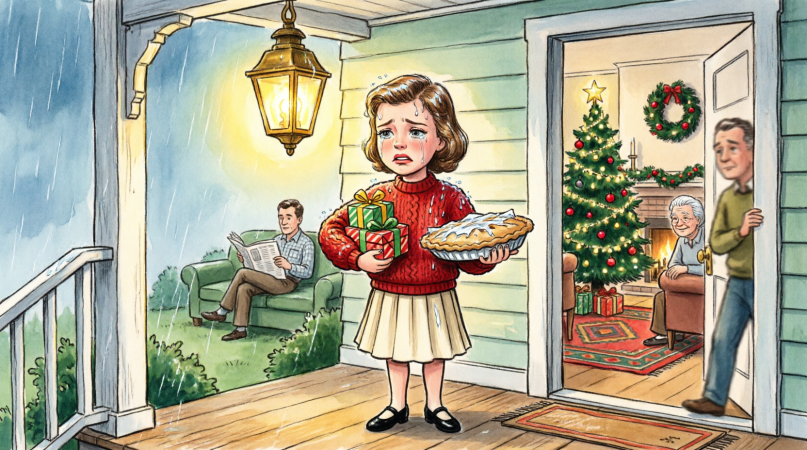
A silence followed. Then she said, “Grandma said it.”
Something in me tightened.
“Said what?”
McKenzie swallowed hard. I could hear the tears she was trying not to let turn into sobs.
“She opened the door and looked at me like she didn’t know me,” she said.
“I thought maybe she was confused.
I smiled and said merry Christmas and tried to hand her the pie.
And she said, ‘You’re not my granddaughter.
Get out.’”
The hallway outside my room was empty, but the air still changed around me, as if the building itself had heard it.
I pressed my hand against the desk to steady myself.
“What?”
“She said it twice,” McKenzie whispered.
“The second time louder. Grandpa didn’t say anything.
Taylor was in the living room and she just looked at me and then looked away.”
There are some moments in life when anger is not hot.
It is cold.
Cold and clean and frighteningly clear.
“Where are you now?” I asked.
“On Route 9. Almost home.”
I grabbed my bag, my keys, my coat.
“Stay on the phone with me.”
She made a broken sound that was almost a laugh and almost another cry.
“Mom,” she said, very quietly, “what did I do wrong?”
That question cracked something old inside me.
Because I knew that question.
I had asked it too.
At twenty, standing in my mother’s kitchen with a positive pregnancy test in my hand and fear making my bones feel hollow.
At twenty-one, when my father refused to look at me at Thanksgiving because I had chosen to keep my baby instead of choosing what would have been more convenient for the family narrative.
At twenty-five, when my sister Taylor hosted a bridal shower so elaborate it could have sponsored a small election, and my own engagement to Adam had been greeted with little more than polite disappointment because he was “nice” but not impressive.
Adam.
I still think of him in moments like that.
He was not perfect. Life is too blunt to give us perfect people.
But he was kind in a way my family never fully respected because kindness does not come with enough status markers for people like them.
He fixed things with his hands.
He laughed with his whole face.
He never treated my pregnancy like a disaster.
He treated it like a life.
When McKenzie was two, he died in a highway accident outside Worcester on a freezing March night.
One moment I was a young mother trying to build a life with someone who loved us.
The next I was a widow by legal technicality and a burden by my family’s private accounting.
My parents did not reject me outright after that.
Rejection would have required honesty.
What they did instead was worse.
They tolerated me just enough to preserve appearances.
They invited me to certain holidays and not others.
They praised Taylor in full color and spoke about me in sepia tones, like I was a cautionary tale from a past they preferred not to remember too clearly.
They never said McKenzie wasn’t family when other people were around.
But they said other things.
“Your daughter has your sensitivity.”
“She’ll need structure if she’s going to avoid your mistakes.”
“Poor thing. Life started hard for her.”
Always dressed as concern.
Always edged like a blade.
I drove home in a blur of wet roads and clenched teeth.
By the time I pulled into my driveway, the porch light was on and McKenzie’s car was already there.
She was in the kitchen still wearing the red sweater dress she had chosen because she wanted to look festive and grown-up.
Her mascara had blurred into soft gray streaks.
The apple pie sat on the counter in its dish, cracked on one side where she must have set it down too hard.
The scarf—cream-colored, with a careful ribbed pattern she had taught herself from online videos—was folded beside it like a returned apology.
The second she saw me, her face broke.
I crossed the room and pulled her into my arms.
She cried with the kind of grief that comes from humiliation, not just sadness.
Her body shook. Her fingers locked in the back of my sweater.
“I’m sorry,” she kept saying.
“I’m sorry. I don’t know what I did.”
“No,” I told her. “You do not apologize for their cruelty.”
We stayed like that until her breathing slowed.
Then I made tea she barely touched and wrapped a blanket around her shoulders and sat across from her long enough to hear the whole thing again.
How my mother opened the door.
How she looked at McKenzie’s face, then at the pie, then at the scarf.
How there had been voices inside, laughter, clinking glasses.
How my mother said the words once and then, when McKenzie stood frozen, said them again with more force, like she wanted witnesses.
I did not interrupt.
I did not soften it.
I needed the truth in full.
After McKenzie finally went upstairs to wash her face, I walked into my bedroom and opened the top dresser drawer.
Inside was a black leather folder and a business card.
Simon Hale.
Family attorney.
My grandfather’s attorney first.
Mine after he died.
This is the part nobody in my family knew.
Not my mother.
Not my father.
Not Taylor.
Not even McKenzie, not fully.
My grandfather Milton Barrett had been the one good man in that branch of the family tree.
Not gentle all the time.
Not easy. But fair. He built the family wealth the way certain men of his generation built everything—slowly, stubbornly, with receipts and calluses and a terrifying memory for numbers.
Triple-deckers turned into rental portfolios.
Small commercial units turned into development shares.
He was not glamorous money.
He was durable money.
When he got sick, I was the one who showed up.
Not because I was noble.
Because someone had to.
My mother visited when it photographed well.
Taylor came by in expensive coats and left early because the room smelled medicinal.
My father discussed estate projections in the hallway while I changed bed linens and timed medications and learned how to make bland soup sound like dignity.
Milton saw everything.
He saw who arrived when there was nothing to gain.
He saw who vanished when care became inconvenient.
Six weeks before he died, he asked Simon to come to the house.
He had me sit in the room while he signed papers with a hand that trembled but did not waver.
He told me something I did not understand fully until years later.
“People who mistake your silence for helplessness,” he said, “will eventually hand you the knife they planned to use on you.”
He made me trustee.
Not beneficiary in the symbolic way families use to avoid conflict.
Trustee.
Control over the discretionary distributions tied to the family holdings.
The monthly support checks my parents treated as if they were their birthright.
The capital infusions that kept Taylor’s boutique afloat every time it nearly collapsed under the weight of her taste and incompetence.
The property maintenance reimbursements for a house my parents lived in but did not own outright.
For six years, I signed every approval.
Why?
Because I told myself peace was worth the cost.
Because I told myself McKenzie deserved a version of family, even if it was flawed.
Because I thought I could control the damage if I stayed generous enough.
That ended the moment my mother looked my daughter in the face and denied her blood.
I picked up my phone and texted Simon.
Handle them all.
No greeting. No explanation. He knew what it meant.
Years earlier, after one especially ugly Easter when Taylor got drunk and called McKenzie “the souvenir from Claire’s mistake,” Simon and I had drawn a line in writing.
If my parents or sister ever directly humiliated, excluded, or harmed my child again, every discretionary benefit stopped immediately pending full audit.
I had never enforced it.
Until then.
Simon replied in twenty-eight seconds.
Understood.
The first call from my mother came less than an hour later.
I watched it light up the screen and let it ring out.
Then came another.
Then another.
By ten o’clock I had a dozen missed calls.
By eleven, thirty-eight.
The voicemails charted the whole emotional collapse.
First confusion.
“Claire, call me. Something is wrong with the account.”
Then irritation.
“Your father says there’s been some ridiculous hold placed on the property card.
Did you tell Simon to do something?”
Then panic.
“Taylor’s payroll didn’t go through.
The boutique account is frozen.
Claire, pick up the phone.”
Then pleading.
“Please don’t do this. It’s Christmas.”
At 10:47 p.m., she called again, openly crying now.
“Please, please don’t do this,” she said.
“We can talk. We can work this out.”
I texted back once.
You’d better start praying.
McKenzie came downstairs while I was looking at the screen.
Her eyes were puffy but dry now, the way they get after the crying is done and only the ache remains.
“Why does Grandma keep calling?” she asked.
I looked at my daughter and realized this was the first honest lesson I had ever been able to give her about power.
“Because kindness is over,” I said.
The next morning was Christmas.
Outside, the world looked offensively beautiful.
Fresh snow along the curb.
Quiet rooftops. Church bells somewhere in the distance.
The kind of postcard morning that makes cruelty feel even sharper because nature has the nerve to be lovely anyway.
At 8:06 a.m., Simon called.
“Done,” he said.
He spoke in that controlled, even tone lawyers use when everything has already moved from emotion into process.
The distributions had been suspended.
Taylor’s business draws had been halted.
The household charge accounts tied to the trust had been deactivated.
A forensic review had begun on the maintenance reimbursements my father had been submitting for three years.
And because the family home was held under a trust-owned occupancy arrangement, not deeded free and clear as my parents believed, a notice of immediate review had been hand-delivered that morning by courier and sheriff’s deputy accompaniment was already scheduled for any attempted asset removal.
I sat very still while he talked.
Not from doubt.
From the immense, almost frightening quiet that follows finally doing what you should have done years earlier.
“Your mother will escalate,” Simon said.
“She already has.”
“I know,” he replied. “Do not speak to her without me.”
Then he added, more softly, “Your grandfather would have approved.”
Half an hour later, my parents’ sedan pulled into my driveway.
So did Taylor’s white SUV.
My mother came to the front door like a storm trying to wear lipstick.
Her hair was set. Her coat was expensive.
Her face was ruined by panic.
My father stood half a step behind her, anger packed tight into every line of his body.
Taylor, meanwhile, looked less offended than terrified, which told me the account freeze had landed exactly where it needed to.
I did not let them in.
McKenzie stood behind me in the hallway, silent.
“Claire,” my mother said, “this has gone far enough.”
“No,” I said. “It hadn’t gone far enough until last night.”
She glanced over my shoulder and saw McKenzie.
For a split second I watched calculation move through her face.
She tried to soften her voice.
“Oh, honey,” she began.
“Don’t,” I said.
The word came out so flat and sharp that even my father looked startled.
My mother drew herself up.
“You are overreacting.”
“To you calling my child not your granddaughter?”
“That’s not what I meant.”
McKenzie made a small sound behind me, and I turned just enough to see her expression close in on itself.
That was what finally ended any temptation I had left to negotiate.
“Say exactly what you meant, then,” I said.
My mother’s mouth tightened.
Taylor stepped in before she could answer.
“This is insane. You froze my business account over one misunderstanding.”
I looked at her. “Your business account?”
Color rose in her face.
“You know what I mean.”
“No,” I said. “I know what you thought.
You thought the money appeared because the world loved you more than math.
That ends now.”
My father took one step forward.
“You have no right.”
I almost laughed.
No right.
The man who had spent years living inside houses he did not legally control, charging repairs to accounts he never funded, telling everyone else what family duty looked like.
I opened the storm door wider just long enough to hand him a sealed envelope Simon had sent for precisely this moment.
“What’s this?” he snapped.
“Your right,” I said. “On paper.”
He opened it on the porch.
I watched the confidence leave his face line by line.
My mother tried to grab the pages.
Taylor leaned in, reading over his shoulder.
Nobody spoke for several seconds.
Then my mother looked up at me and said, in a voice I had never heard from her before, “You did this?”
“Yes.”
She stared.
“You?”
There it was.
Not grief.
Not shame.
Disbelief that I had ever possessed the power they were suddenly experiencing.
“Yes,” I said again. “Me.”
My mother’s eyes flicked toward McKenzie, then back to me.
“For how long?”
“Long enough.”
Taylor swore under her breath.
My father folded the papers with shaking hands.
“We’re your family.”
I felt something almost like pity.
“You were,” I said. “Until you decided my daughter wasn’t.”
They left without another word.
Not because they accepted it.
Because there was nothing left to stand on.
The next three weeks were chaos in all the predictable ways.
Taylor’s boutique landlord called in past-due obligations the minute trust support disappeared.
My father’s reimbursement files turned out to include landscaping invoices for work never done, appliance replacements for units they did not own, and one spectacularly stupid attempt to bill the trust for Taylor’s “client entertainment” in Aspen.
My mother sent long emails alternating between accusation and martyrdom.
My father sent one, much shorter.
You have embarrassed us.
I wrote back only once.
You did that yourselves.
McKenzie kept asking if this was her fault.
Every single time, I answered the same way.
No.
Then I told her something I wish someone had told me when I was seventeen.
People who need to reduce you in order to feel tall are not judges of your worth.
They are evidence of their own smallness.
In late January, Simon asked me to come to his office for the final beneficiary review.
I brought McKenzie with me.
My parents were already there.
So was Taylor.
None of them looked like Christmas anymore.
My mother seemed smaller. My father seemed older.
Taylor looked furious in the brittle way of people who still believe outrage counts as leverage.
Simon laid out the revised structure with clinical calm.
The discretionary benefits for my parents and sister were terminated permanently.
The trust would retain the family home under managed review and offer them a market-rate lease if they chose to remain.
Taylor would receive nothing further beyond a one-time settlement for severance of dependency.
And the education fund originally drafted for future direct descendants of Milton Barrett would be transferred into a protected college and life-start fund for McKenzie.
My mother cried.
Not in a moving way.
In a shocked way.
As if consequences were a foreign country she had never expected to visit.
Then Simon handed me one final item.
A letter from my grandfather.
He had written it the week before he died and instructed Simon to give it to me only if the family ever forced my hand.
I opened it and read silently at first, then aloud when my voice steadied.
If they ever ask you to choose between peace and your child’s dignity, choose the child.
Peace built on surrender is just another name for control.
My mother lowered her head.
Taylor looked away.
McKenzie reached for my hand under the table.
I squeezed back.
That spring, McKenzie got into Northeastern with a scholarship package strong enough to make me cry in the driveway after I read the email.
We used part of the protected fund not for extravagance, but for freedom.
A reliable car. A dorm deposit.
Books she would not have to ration.
A future that did not depend on who approved of her bloodline.
I also did one more thing.
I created a small scholarship in my grandfather’s name for single mothers returning to school.
Because if I had learned anything, it was this:
Money is not only comfort.
It is language.
It tells people what will be tolerated.
It reveals what was always true.
The following Christmas, McKenzie and I did not go anywhere near my parents’ house.
We spent it at home.
Just us, a roast chicken, too many candles, snow gathering at the edges of the porch, and one apple pie that stayed intact from oven to table.
At one point, after dinner, McKenzie looked at me across the kitchen and asked, “Do you ever miss them?”
I thought about the question carefully.
Then I answered honestly.
“I miss the version of family I kept hoping they would become.”
She nodded like she understood exactly.
Maybe she did.
Then she smiled, reached for another slice of pie, and said, “I’m glad we stopped waiting.”
So am I.
Because the truth is, Christmas did not destroy my family.
It exposed it.
And once the truth was standing in the doorway with nowhere left to hide, all I had to do was decide whether I would keep begging to be let in.
I didn’t.
I locked the door behind us and finally chose the child who had never once asked me to be smaller so someone else could feel bigger.
Everything good in my life started there.