When I entered the courtroom, my mother rolled her eyes in disgust and my dad looked down. Suddenly the judge froze, leaned forward, and whispered, “Captain Hart? From the JAG Corps?” The entire room went silent.
My name is Rachel Hart, Captain, United States Army. At thirty-two, I thought I’d left the ghosts of Omaha behind for good. But as I walked into courtroom number three, the smell of old oak polish and the tense, heavy silence hit me, and suddenly I was nineteen again, the castoff daughter.
My mother, Helen, hissed through her teeth, her voice a low, razor-sharp whisper. “Rachel, do not embarrass us. Sit in the back and be quiet.”
My father, Robert, didn’t even grant me a glance, his eyes fixed on his lawyer as if I were nothing more than a shadow that had momentarily darkened the doorway. To them, the uniform I wore wasn’t a symbol of service. It was the evidence of my rebellion, my failure.
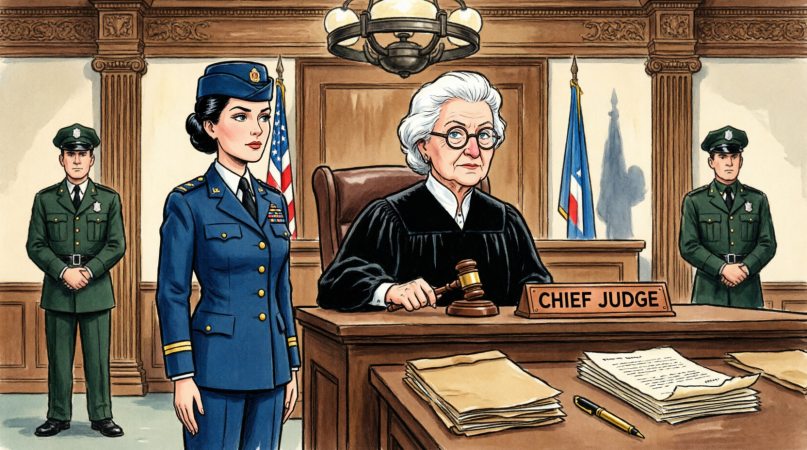
They didn’t know this uniform had given me a purpose, and law school had given me a weapon. They thought they had summoned me here to witness their power. They had no idea they had just summoned the judge who would deliver their verdict.
The Douglas County Courthouse felt like a tomb. It was a place designed to make you feel small, with its cavernous ceilings and marble floors that echoed every footstep. For me, it was familiar territory, but not like this, not as a spectator to my own family’s drama.
My parents were waiting for me just inside the courtroom doors, standing like two statues carved from disapproval. There was no hug. No, “It’s good to see you, Rachel.” Instead, my mother’s eyes did a quick, critical scan of my Army service uniform, the perfectly pressed jacket, the polished brass on my belt. Her lips thinned into a familiar line of disappointment.
My father, Robert, simply gave a curt nod, his gaze already sweeping the room, assessing the audience, ensuring their performance of wealth and respectability was playing to a full house.
“The back row,” Helen whispered, her voice laced with that old, familiar shame. She gestured with a flick of her wrist toward a wooden bench near the exit. “By the door. Just try to look normal, at least.”
That one sentence, try to look normal, was the story of my childhood. It was a dagger she’d sharpened over years of telling me I was too loud, too intense, too different, never enough. The irony was suffocating. Here I stood, an officer in the U.S. Army, a symbol of discipline and honor, being treated like a troubled teenager. They were trying to hide the injustice of it all, a feeling I knew as well as my own heartbeat, coiled hot and tight in my gut.
I didn’t say a word. I simply gave a nod that was all military precision and walked to the seat they assigned me, my back straight, my movements controlled. I was a soldier, and I knew how to follow an order, even one that felt like a slap in the face.
I sat and watched them take their seats in the front row, their lawyer fawning over them. They were the stars of this show, landlords of a downtown apartment building defending themselves against a lawsuit from a tenant. A minor inconvenience, they’d called it on the phone, a nuisance.
They had summoned me back to Omaha not for support, but as a prop, the wayward daughter forced to come home and witness their power, their influence. I was to be a silent testament to their world, a world I’d so spectacularly failed to join.
The bailiff’s voice boomed.
“All rise.”
And Judge Hullbrook entered, a severe-looking woman with graying hair and an air of no-nonsense authority.
The room settled. The preliminaries began. And then the moment came.
“Calling the case of Mitchell versus Hart,” the clerk announced. “Counsel, please state your appearances.”
My parents’ lawyer stood up, a man whose tailored suit probably cost more than my first car. He began his introduction.
But as he spoke, I rose from my seat in the back of the room.
I didn’t rush. I let every step be deliberate. The sound of my low-quarter dress shoes clicked against the tile, a steady rhythmic beat in the dead silence of the courtroom.
Click, click, click.
It was the sound of a challenge.
I walked right past the front row, right past the parents who had tried to make me invisible. I felt their eyes on me, burning with confusion. I reached the defendant’s table, where a tired-looking woman, Clare Mitchell, sat alone. I placed my leather briefcase firmly on the table beside her, the latch clicking open with a sharp, definitive sound.
I looked directly at Judge Hullbrook.
“Your Honor,” I said, my voice clear and steady, carrying easily through the stunned room. “Captain Rachel Hart, representing the defendant, Ms. Clare Mitchell.”
The silence that followed was absolute.
It was beautiful.
I saw my mother’s jaw drop, her perfectly painted mask of composure shattering into a million pieces. My father, for the first time all day, stared directly at me. His expression wasn’t anger. Not yet. It was pure, unfiltered shock. This was the moment of release, the first sweet taste of a victory they never saw coming.
Then the shock curdled into contempt.
I heard my mother’s stage whisper, just loud enough for me to hear, a final desperate attempt to wound me.
“You’re just a grunt.”
Before I could even register the insult, Judge Hullbrook leaned forward, peering at me over her glasses. Her voice cut through the air like a gavel.
“Captain Hart from the JAG Corps?”
I stood a little straighter. “Yes, Your Honor.”
A flicker of recognition crossed her face.
“I read about your work on that corruption case at Fort Riley. Impressive.”
That single word, impressive, from the highest authority in the room was more powerful than any comeback I could have imagined. It was a validation that stripped my parents of all their power. It landed like a physical blow, and I saw my father flinch. They had spent a lifetime framing me as their personal failure, only to have the outside world, the world that mattered, see me as a success. The absurdity of their judgment was laid bare for everyone to see.
The trial itself was a clinical execution.
I presented my case not with emotion, but with facts, logic, and irrefutable evidence. My military training had taught me to be precise, to leave no room for error. One by one, I dismantled their defense.
“Permission to present Exhibit A, Your Honor.”
On the large screen, a photo appeared, a wall in Clare Mitchell’s apartment covered in a spiderweb of toxic black mold. I followed it with the city health inspector’s report, which detailed multiple code violations. Then came the medical bills for Clare’s asthmatic seven-year-old son, whose condition had worsened dramatically since moving in.
My voice was even, almost monotone. I quoted the Nebraska Uniform Residential Landlord and Tenant Act, chapter and verse. Every word was a bullet aimed at their carefully constructed facade of lies.
I watched as their lawyer scrambled, as my father’s face turned from pale to a blotchy red, as my mother’s composure dissolved into barely concealed panic.
When Judge Hullbrook delivered her verdict, it was swift and brutal. She found in favor of Clare Mitchell, ordering my parents to pay for all medical bills, all relocation costs, and punitive damages. She mandated they bring the entire building up to code within sixty days or face further fines.
It wasn’t just a legal ruling. It was a judgment on their character.
I had used their world, the law, and my world, the discipline and honor they despised, to hold them accountable. I had taken the very thing they considered my failure and turned it into their defeat.
I calmly packed my briefcase, gave Clare’s shoulder a reassuring squeeze, and turned to leave. I didn’t look at my parents. I didn’t need to. I could feel the weight of their humiliation from across the room.
As I walked out, the heavy oak doors closing behind me, I wasn’t just leaving a courtroom. I was walking away from the stage where, for the first time, the truth had finally been told.
The adrenaline from the courtroom faded as I drove, leaving a hollow ache in its place. Victory felt empty, more like an autopsy of a family long dead than a celebration. My mind, free from the trial’s strategic demands, drifted back.
It wasn’t nostalgia. It was a plunge into the cold waters where the first wounds were made. The map of scars that led me to that courtroom began to unroll.
It started, as it so often did, with a dress.
I was seventeen, and in the spring of senior year, only prom mattered. My sister Melissa, two years younger but already the radiant center of our family’s universe, was giddy. My mother Helen had spent a Saturday boutique-hopping with her, buying a stunning deep-blue gown that shimmered like something from a movie.
A few days later, I asked, “Mom, can we look for a prom dress for me this weekend?”
She didn’t look up from her magazine.
“Oh, honey, don’t be silly,” she said, her tone breezy, dismissive. “You can wear Melissa’s from last year. Besides, you don’t care about all that fussy stuff, do you?”
Her words were a verdict. My desires were irrelevant. My interest predetermined by her. You don’t care.
I was the serious, studious one. So it was decided I didn’t deserve to feel beautiful.
I remember holding up the dress. She meant a pale pink, frilly thing that fit Melissa perfectly. On me, it was too wide in the shoulders, too short in the waist. The fabric felt cheap and foreign. I was an impostor, a secondhand daughter, feeling both invisible and conspicuous at once.
I never went to my senior prom.
That night, while my classmates danced under glittering lights, I sat in my room under the glow of a single lamp, reading a book on the military history of the Punic Wars. It was my first quiet act of rebellion. If they wouldn’t let me into their world, I would build my own.
That quiet rebellion solidified into a concrete plan a year later on the day of my high school graduation. I had worked relentlessly for a diploma with high honors. A small, naive part of me held out hope that this finally would be enough. This they would have to acknowledge.
I stood backstage listening for my name, my heart pounding. When Rachel Hart was called, I walked across the stage, my eyes scanning the crowd for their faces, and then I saw them.
Two empty chairs in the section reserved for the Hart family.
They weren’t there.
The smile I had practiced for weeks faltered. I shook the principal’s hand, took my diploma, and walked offstage, a cold knot forming in my stomach. They showed up just as the ceremony was ending, breezing in with complaints about traffic on Dodge Street. Their apologies were thin, their annoyance at the inconvenience palpable.
The celebration dinner I dreamed of, maybe at a nice steakhouse downtown, never happened. Instead, over a quick, tense meal at home, they made their announcement.
“We have some wonderful news,” my father said, beaming at Melissa. “We’ve decided to fund a trip to Europe for Melissa as an early graduation present.”
Melissa squealed with delight. I just stared at my plate, the food turning to ash in my mouth. My graduation, my achievement, had been erased and replaced with a reward for my sister.
It was the moment I finally understood.
It wasn’t that I wasn’t good enough. It was that, in their eyes, I simply didn’t exist in the same way Melissa did. My successes were footnotes. Hers were headlines.
That night, the quiet rebellion in my heart became a declaration of war. I needed to escape. The Army was my way out. It wasn’t a sudden choice. It was a calculated plan for survival.
I remember the day I told them. We were in the living room, the evening news droning on. I turned it off and faced them.
“I’ve enlisted,” I said. “I leave for basic training in six weeks.”
My father let out a short, sharp laugh.
“The Army?” he scoffed. “Rachel, that’s for kids with no other options.”
My mother started to cry, but not from fear for my safety. They were tears of social humiliation.
“What will the neighbors think?” she sobbed. “What will I tell the ladies at the club?”
Their reaction was all the confirmation I needed. They saw my choice not as an act of service, but as a final, unforgivable act of social defiance.
Their ultimatum: abandon this foolish idea or get out.
I chose to get out.
They packed a single suitcase for me and left it on the front porch, a final act of dismissal. As I walked away from that house, I didn’t look back. They thought it was a punishment. To me, it was my liberation day. I was finally free to find a family built on merit and camaraderie, not on blood and contempt.
Through all those dark memories, there was always one point of light, one anchor in the storm.
My grandfather, William Hart, a retired Marine Master Sergeant, a man forged from steel and quiet integrity.
He was the only one who ever truly saw me.
While my parents saw a difficult, unfeminine daughter, he saw a warrior’s spirit. He was the one who taught me how to properly handle a rifle in the fields behind his farmhouse. He didn’t tell me stories about princesses. He told me about the battles of Belleau Wood and Iwo Jima, about honor, courage, and commitment.
When my parents refused to buy me a book I wanted, he would slip a worn twenty-dollar bill into my hand and whisper, “Don’t ever let anyone tell you you’re not smart enough, kiddo.”
His praise was rare, but when it came, it was solid gold.
I remember the last time I saw him, just days before I shipped out to Fort Jackson. He drove out to my tiny apartment, his old Ford pickup rattling to a stop. He didn’t say much. He didn’t have to. He just wrapped me in a hug that smelled of sawdust and Old Spice, a hug that felt more like home than my parents’ house ever had.
He held me tight, and his voice was a low rumble in my ear.
“Live a life of honor, Rachel,” he whispered. “Make me proud.”
That memory, his voice, his unwavering belief in me, became my compass. It was the code I lived by through every grueling day of basic training, every lonely night in law school. It was his legacy of honor that I carried into that courtroom. And it was his memory that, even now, served as a beacon guiding me toward a truth far darker than I could ever have imagined.
My grandfather’s words, make me proud, echoed in the quiet of my hotel room. The man who had been my only ally was long gone. The victory in the courtroom, as righteous as it was, felt like a battle won on a lonely island.
It was a familiar feeling. The path that had led me to become Captain Hart, the woman who could dismantle her parents in a court of law, was a road I had walked entirely alone.
My mind went back to the sweltering, sticky heat of Fort Jackson, South Carolina.
Basic training was a culture shock designed to break you down and build you back up in the Army’s image. The air was thick with the scent of pine needles and sweat. The days were a relentless blur of drill sergeants’ voices so loud they seemed to vibrate in your bones, and a physical exhaustion that went deeper than muscle.
It was brutal.
And for me, it was a sanctuary.
While other recruits cried in their bunks at night, homesick and overwhelmed, I felt a strange sense of peace. For the first time in my life, the rules were clear, and they applied to everyone equally. No one cared who your parents were or where you came from. Your worth was measured in tangible things, your ability to scale the obstacle wall, the tightness of your shot group on the rifle range, the perfect hospital corners on your bunk.
The harsh, unforgiving meritocracy of the military was a relief, a blessed escape from the arbitrary emotional cruelty of my family.
I remember one night on fire watch, mopping the barracks floor at three in the morning. The world was silent except for the rhythmic slosh of the mop and the snores of fifty other women. I was tired, my arms ached, and I had to be up for PT in two hours.
And I smiled.
It was a genuine, heartfelt smile.
This was hard, miserable work. But it was my work. It was a task I had been given, a responsibility I was meeting. It was real. No one could dismiss it, belittle it, or take it away from me.
That feeling propelled me forward.
The road from private to officer was long and paved with sacrifices no one back home ever saw. While serving on active duty, I used the Army’s tuition assistance program to take night classes at a community college near my post. I remember countless nights fueled by cheap coffee and sheer will, hunched over a textbook with a tiny flashlight after a twelve-hour day of training exercises, my uniform still smelling of dirt and gunpowder.
There were moments of doubt, of profound loneliness. I recall a few of my male squad members who made it clear they thought I didn’t belong, that I wasn’t tough enough. They’d make snide remarks just loud enough for me to hear. But I had learned long ago that arguing with people like that was a waste of breath.
My grandfather had taught me that actions speak louder than words.
So I used their condescension as fuel. I didn’t argue back. I just ran faster during morning formation. I shot better on the range, earning the expert marksmanship badge they all coveted. I scored higher on every written exam.
Slowly, respect began to replace the sneer. It wasn’t given freely. It was earned inch by painful inch.
When the acceptance letter for Officer Candidate School, OCS, arrived, it felt less like a celebration and more like the logical conclusion of a long, calculated campaign. It was a quiet, deeply personal victory.
The day I stood in my dress uniform and had the gold bars of a second lieutenant pinned on my shoulders, I didn’t call my parents. I knew they wouldn’t understand the journey, the sweat, and the exhaustion represented by that small piece of polished brass. Or worse, they simply wouldn’t care.
The loneliest years were when the Army sent me to law school, back to Omaha of all places, to attend Creighton University on their dime. I was in my hometown, surrounded by familiar streets, but I was an island. I lived in a small off-campus apartment and kept my head down, focusing only on my studies.
One night, deep in a pit of exhaustion and feeling the weight of my isolation, I was scrolling through videos online, looking for anything to distract me. I stumbled upon a TED Talk by a researcher named Brené Brown. I listened as she spoke about vulnerability, about courage and shame. And then she said a sentence that hit me like a lightning strike.
“Vulnerability is not weakness. It’s our most accurate measure of courage.”
In that moment, something inside me shifted. All the years I’d spent trying to build armor to hide the wounds my family had inflicted suddenly seemed wrong. I saw that those scars weren’t things to be ashamed of. They were the source of my strength. The constant feeling of being an outsider was what forged my independence. The hunger for fairness was what drove my pursuit of justice. The pain of being unseen was what made me so determined to see and fight for others.
My past wasn’t a curse. It was a forge.
It had hammered and shaped me into the weapon I had become.
That realization was liberating. It severed the last invisible cord that tied my self-worth to my parents’ approval.
The ringing of the phone in my hotel room jolted me back to the present. The silence after the victory was heavy, oppressive. I looked at the caller ID.
Colonel Miller, my commanding officer in the JAG Corps.
I braced myself for a lecture about making waves.
I answered, my voice professionally level. “Captain Hart.”
“Hart,” he said, his voice calm and steady. He didn’t ask for details about the trial. He didn’t need to. “I heard you were stirring things up back home. Good work.”
There was a brief pause.
“Just remember, whatever happens, the Corps has your back. We’re proud of you.”
He hung up.
I stood there holding the phone, the silence of the room no longer feeling empty. Those four simple words, we’re proud of you, were the words I had longed to hear from my own father my entire life. They were a validation he was incapable of giving, offered freely by a man who knew me only through my service and my honor.
A slow warmth spread through my chest, pushing back the cold ache of the past. In that moment, I understood. I had lost a family defined by blood and obligation. But along the lonely road, I had found another one. A family forged in shared purpose, built on a foundation of honor, respect, and loyalty. And that family was unbreakable.
The warmth from Colonel Miller’s words lingered long after the call ended, a small, steady flame in the cold cavern of my hotel room. For the first time in what felt like a lifetime, a piece of the armor I’d so carefully constructed around myself seemed to melt away.
We’re proud of you.
It was a simple phrase, yet it was the validation I had spent my entire life craving and had finally given up on hearing. Maybe, I thought, this was the beginning of a new chapter. Maybe the war was finally over.
Then my phone rang again.
It was an unknown number, a local Omaha area code.
I almost let it go to voicemail, but some instinct made me answer.
“Captain Hart.”
The voice on the other end was deep, aged, and carried the careful diction of a bygone era.
“This is she,” I answered, my tone shifting back to professional caution.
“My name is Henry Bradford,” the man said. “I was your grandfather’s attorney, Master Sergeant William Hart’s attorney.”
A jolt went through me. My grandfather had been dead for twelve years.
“I’m sorry,” I said. “His estate was settled a long time ago.”
“Yes, for the most part,” Bradford said, and I could hear a rustling of papers. “But there is a matter of a highly sensitive and urgent nature pertaining to his will that your parents were never made aware of. I believe it is imperative that we meet immediately.”
His tone was not that of a typical lawyer handling a dry administrative task. It was laced with an urgency, a tightly controlled anxiety that set my teeth on edge. A knot of unease began to form in my stomach, replacing the warmth that had been there moments before.
The next afternoon, I found myself in Omaha’s historic Old Market, a district of cobblestone streets and beautifully preserved brick buildings. Bradford’s law office was on the second floor of one of them, a time capsule of dark wood, leather-bound books, and the faint sweet smell of old paper.
Henry Bradford himself was a man who looked to be in his late seventies, with kind eyes that held a deep-seated weariness. After a polite but brief greeting, he got straight to the point. He slid a thick cream-colored envelope across his mahogany desk.
“Your grandfather was a very perceptive man, Captain,” he began with a sigh. “He knew your parents, specifically their relationship with money. He said they saw the world through a dollar sign, and he worried they would use that to control you.”
He let that sink in before continuing.
“So, twelve years ago, he secretly established a trust fund for you. Fifty thousand dollars.”
I was stunned into silence.
“The terms were specific,” Bradford explained. “The funds were to be released to you only when you had achieved a significant professional milestone entirely without their help. He wanted to ensure you had your own foundation, your own escape route, if you ever needed one.”
He offered a small, sad smile.
“Becoming a captain and a lawyer in the United States Army JAG Corps, I think it’s safe to say you’ve more than met the condition.”
The money itself, which he explained had grown to nearly sixty thousand dollars, was secondary. It was the act. It was a vote of confidence sent from beyond the grave, a final act of protection from the only man who had ever truly tried to protect me.
“There’s more,” Bradford said, his voice softening.
He handed me another envelope, this one old and yellowed with age.
“He left this for you as well, to be given to you with the trust.”
My hands trembled slightly as I took it. It was my grandfather’s handwriting, strong and sure. I unfolded the single sheet of paper, my heart constricting with every word. He wrote of his pride, of the warrior spirit he’d always seen in me, even when I was a little girl. He told me he was proud of the woman I was becoming.
Then I reached the final paragraph, and the air in the room grew cold.
I’m making some changes to the will, Rachel. I’m planning on leaving you half of the farm. I don’t trust your parents with it. I don’t trust them. Period. Their nature. It’s greed. You can’t possibly imagine. Be careful—
The letter ended there abruptly, as if he had been interrupted mid-sentence, a chilling warning that hung unfinished in the silent office.
Bradford must have seen the color drain from my face. He leaned forward, his expression grave, and finally unburdened himself of something that had clearly haunted him for over a decade.
“Captain Rachel,” he said, his voice dropping to a near whisper, “just before your grandfather passed, your mother came to see me. She was agitated, frantic almost. She kept asking over and over if William could alter his will without her knowledge. She wanted to know if a change could be made that would bypass her and your father.”
He paused, taking a deep breath.
“And then he died. The official report said heart failure, but it was too convenient. He’d had a full physical the week before. His doctor told me he was healthy as a horse. His death right then stopped any changes to the will from being finalized.”
I stared at him, my mind racing, connecting dots I never wanted to connect.
“And one more thing,” Bradford said, his eyes filled with a pained reluctance. “I remember your grandfather’s garden. He was so proud of it. He grew a lot of foxglove along the back fence.”
He didn’t need to say another word.
The legal training, the long nights studying forensics and toxicology, it all came rushing back in a single horrifying wave. Foxglove. The beautiful bell-shaped flower was the natural source of digitalis, a powerful cardiac poison. In the right dose, it could induce a massive, untraceable heart attack.
The world tilted on its axis.
A version of events, an unthinkable, monstrous scenario, began to construct itself in my mind with terrifying clarity. The motive, a desperate need for the inheritance to stave off financial ruin. The opportunity, they were his children, constantly in his home. And the means, blooming innocently in his own backyard.
My role as a daughter who had been wronged vanished, replaced by the cold, analytical mind of a JAG officer. The civil case in the courtroom downstairs was child’s play compared to this.
This was a capital crime.
I left Bradford’s office with a check I didn’t care about and a letter that had just become the most important piece of evidence in the world. The question that had defined my life, why didn’t my parents love me, was suddenly eclipsed by a far more terrifying one.
Could my parents be murderers?
Walking out of Henry Bradford’s office, the daughter who had mourned her grandfather was gone. In her place stood a United States Army captain with a mission. The grief in my stomach had solidified into a cold, hard resolve. The question was no longer a phantom of horror. It was an objective.
I had a hypothesis, and I needed to confirm or deny it with actionable intelligence.
Back in the sterile anonymity of my hotel room, I didn’t weep or rage. I opened my government-issued laptop and began to formulate a plan of action the same way I would for any military operation.
Mission: confirm or eliminate the homicide hypothesis.
Primary target: Dr. Russell Hayes, signatory of the death certificate.
Method of approach: direct action, utilize surprise, psychological pressure, and the authority of my position.
A quote from General George S. Patton I’d memorized came to mind. Prepare for the unknown by studying how others in the past have coped with the unforeseeable.
I needed to understand the terrain.
I spent hours conducting a deep dive on Dr. Hayes, scanning twelve years of public records for any red flags, sudden changes in financial status, professional trouble, personal instability. I needed to understand the man before I confronted him.
The next morning, I found his clinic in a quiet suburban medical park. He was older now, frail, with thin white hair and a tremor in his hands. He looked more like a kindly grandfather than a co-conspirator.
I didn’t introduce myself as Rachel Hart. My name was a liability.
I walked into his office, closed the door, and stood before his desk in my full Class A uniform. The uniform was my armor and my weapon. It projected authority.
“Dr. Hayes,” I began, my voice even and devoid of emotion, “I am Captain Rachel Hart, Judge Advocate General’s Corps. I’m reviewing certain service-related death certificates for irregularities.”
His face paled.
I placed a copy of my grandfather’s death certificate on his desk. I let him look at it. Let the memory and guilt percolate.
Then I asked one simple, direct question, my voice cold and sharp as a scalpel.
“Doctor, is there anything in this report you’d like to amend?”
It was all it took.
The dam of his denial, maintained for over a decade, shattered. The old man slumped in his chair and began to sob, his shoulders shaking with the force of a long-imprisoned truth.
Through tears of guilt, the whole story poured out.
He told me how my father, Robert Hart, had come to him just hours after William’s death with a briefcase full of cash and veiled threats about his influential friends on the state medical board. Facing his own financial troubles, the doctor had folded. He agreed to falsify the report, listing cardiac arrest as the cause of death and omitting any toxicology screen.
But the guilt, he whispered, had been a cancer on his soul.
As his confession subsided, he fumbled with a key and unlocked a drawer. From a dusty file, he produced a single sheet of paper.
“I… I couldn’t bring myself to destroy it,” he stammered, sliding it across the desk. “It’s the original toxicology report. I ran it before your father got to me.”
I picked it up.
There it was in black and white. Lethal levels of digitalis.
It was the first concrete piece of evidence. The first bullet in a war I was now determined to win.
With the doctor’s sworn affidavit and the report, I went to see the Douglas County district attorney, a tough, no-nonsense woman named Catherine Morris. She listened to my story with a grim, unwavering focus.
When I finished, she nodded slowly.
“The doctor’s testimony is a breakthrough, Captain,” she admitted. “But it’s circumstantial. His confession implicates your father in a cover-up, but it doesn’t place the poison in their hands. A good defense attorney will paint the doctor as an old man trying to save himself.”
She leaned forward, her eyes locking onto mine.
“I need something that ties them directly to the act. A confession, physical evidence, a witness. Without a direct link, a jury will have reasonable doubt.”
I understood. Justice required more. I needed an asset on the inside. I needed my secret weapon, a weapon my parents had created, one they would never see coming.
My sister Melissa.
That night, I met her at a small all-night diner far from our parents’ neighborhood. She walked in defensive, her arms crossed over her chest. Before I could speak, she started in with the lines our parents had fed her for years.
“What do you want, Rachel? Haven’t you done enough? Coming back here, suing them, humiliating the family—”
I let her finish. I didn’t argue. I simply slid a folder across the sticky tabletop.
“Read this,” I said quietly.
Inside was a copy of our grandfather’s letter and the sworn confession of Dr. Russell Hayes. I watched as her rehearsed anger dissolved, replaced by confusion, then dawning horror. Her face went slack, her skin ashen under the diner’s fluorescent lights. The world our parents had built for her was fracturing right before my eyes.
When she looked up, the arrogance was gone, replaced by a terrified vulnerability.
“What… what is this?”
This was the critical moment. This wasn’t a family chat. It was a recruitment.
I didn’t ask. I assigned.
“Melissa, this isn’t about you and me anymore,” I said, my voice low and firm. “This is about Granddad. He was murdered. You can continue to live in the comfortable lie they’ve built for you, or you can help me get justice for the one person in this family who ever actually cared about us.”
I reached into my bag and placed a small device on the table, a digital voice recorder no bigger than a keychain.
“Your mission, should you choose to accept it,” I said, my eyes holding hers, “is to search our father’s old records. He keeps everything in boxes in the attic. Financial statements, journals, anything from that time. I need intelligence, Melissa. Anything that proves they were desperate.”
She stared at the recorder as if it were a snake, trembling, torn between a lifetime of loyalty and the horrifying truth.
But in the depths of her frightened eyes, I saw it. A flicker of her own buried resentment. A glimmer of conscience.
The recruitment was complete.
The hours I spent waiting for Melissa’s call were the longest of my life. I sat in my quiet hotel room, the evidence I’d gathered spread out on the desk like a battle plan. But the most critical piece of intelligence was still missing. I was asking my sister, who had spent her entire life sheltered and protected, to infiltrate enemy territory and face the ugliest truth imaginable.
Every passing minute was a fresh wave of anxiety. What if she lost her nerve? What if they came home early? What if this was all a terrible mistake?
As I later learned, Melissa waited until the engine of our parents’ Mercedes faded down the street. They were off to a charity gala, a perfect evening to polish their public image of benevolence and class. The irony was suffocating.
With her heart pounding against her ribs so hard she could feel it in her throat, she made her way to the attic. The pull-down stairs groaned in protest as she ascended into the dark, dusty space that held all our family’s forgotten history.
The air was thick with the smell of old wood, decaying paper, and mothballs, the scent of buried secrets. A single bare bulb cast long, dancing shadows across stacks of old furniture and forgotten childhood toys.
Her mission target was a row of cardboard file boxes against the far wall, neatly labeled by year.
Old financials.
Every instinct screamed at her to turn back. It felt like a betrayal, a sacred violation. Our mother’s voice echoed in her mind, a phantom whisper scolding her for being ungrateful, for snooping.
But then another image pushed it aside. Our grandfather’s kind, crinkling eyes, the memory of his warmth, of his quiet strength. This wasn’t for her. This was for him.
She was his soldier now.
She started with the box labeled 2012. Her hands trembled as she lifted the lid.
Inside she found exactly what I had hoped for and what she had dreaded. It wasn’t a record of wealth and success. It was a paper trail of desperation.
Stacks of bank statements with shockingly low balances. A flurry of letters from creditors, their language growing more aggressive with each page.
Final notice. Past due.
There were documents outlining failed investments and a second mortgage on their home that was on the brink of foreclosure. The life of luxury Melissa had always known, the European trips, the designer clothes, the effortless comfort, it had all been a lie. A carefully constructed illusion teetering on the edge of collapse.
The motive for murder was no longer a shadowy hypothesis. It was stark, cold, and calculated, laid out in black and white.
They didn’t just want Granddad’s inheritance. They needed it to survive, to maintain the facade that was more important to them than life itself. Greed wasn’t just a character flaw. It was a desperate, cornered animal.
Digging deeper, near the bottom of the box, her fingers brushed against something that didn’t belong. It wasn’t a financial file. It was a small leather-bound notebook, the kind our mother always used for her gardening notes.
Melissa almost dismissed it, but a cold premonition made her open it.
The first few pages were exactly what she expected, notes on pruning roses, the best fertilizer for hydrangeas. Our mother’s elegant looping script filled the pages.
But then she turned to the section on foxglove.
The handwriting changed.
It became smaller, more meticulous, unnervingly precise.
She described in chilling detail the process of extracting the plant’s potent chemical, digitalis. She noted the exact dosage required to induce cardiac arrest in a man of our grandfather’s age and weight. She even made notes on how the symptoms could be easily mistaken for natural causes by an overworked or careless physician.
It was a clinical, dispassionate recipe for murder.
Melissa felt a wave of nausea. Her hands were shaking uncontrollably. She flipped to the very last page.
There, a final entry dated the day our grandfather died was written in our mother’s hand.
Mission accomplished. William passed peacefully. Now we can finally begin again.
The world spun.
This wasn’t a gardener’s journal. It was the logbook of a monster. The confession of a cold-blooded killer.
Melissa scrambled out of the attic, gasping for air, the notebook and a handful of bank statements clutched to her chest. She ran from the house as if it were on fire, her heart threatening to burst.
She met me at our designated rendezvous point, a deserted corner of a park.
She didn’t say a word. She just placed the evidence on the picnic table between us.
I stared at the notebook, at our mother’s familiar, beautiful handwriting detailing the murder of her own father. The last of my doubts, the last sliver of hope that this was all some horrible misunderstanding, evaporated.
A coldness spread through me that had nothing to do with the night air.
These people were not my parents.
Not anymore.
They were predators who wore their faces.
I looked up at Melissa. She was trembling from head to toe, but her eyes for the first time held a new kind of fire. The sheltered, spoiled girl was gone. In her place was a woman who had stared into the abyss and hadn’t looked away.
“What do we do now?” she whispered, her voice breaking.
I reached across the table and took her hand. It was ice cold, but she squeezed back with surprising strength.
“We do the right thing,” I said, my voice steady and clear. “We end this.”
Together, we walked to my car. As I started the engine and pulled out onto the road, heading toward the district attorney’s office, I knew we had crossed a point of no return. We had chosen justice over blood. We had chosen honor over family.
District Attorney Catherine Morris moved with the speed and precision of a predator closing in. Armed with Melissa’s discovery, the gardener’s notebook that was in fact a murderer’s ledger, she secured the arrest warrants within hours.
That night, Melissa and I sat in an inconspicuous rental car parked at the end of the street where we grew up. We watched the house, a place that had been both a palace and a prison, now just a silent stage for the final act. It was surreal, watching the familiar, quiet suburban street transform into a crime scene.
The first police cruisers arrived without sirens, their red and blue lights flashing silently, painting eerie, dancing colors across the manicured lawns and pristine facades of the neighborhood. We watched as officers approached the front door. We saw the lights inside flick on, and then we saw them.
Our parents, still dressed in the expensive clothes they had worn to the charity gala.
Our father in his tailored tuxedo. Our mother in her glittering evening gown.
They were escorted out in handcuffs.
The masks of composure and social grace they had worn their entire lives shattered in an instant. Their faces were a grotesque mixture of shock, confusion, and indignant rage. As they were being led to separate cars, our mother’s head snapped around, her eyes scanning the dark street until they found our vehicle.
She couldn’t have seen us clearly, but she knew.
She screamed my name, a raw, guttural shriek of pure hatred that ripped through the quiet night air. It was a sound that would haunt me forever. It was both agonizing and, in a strange, terrible way, validating. It was the sound of a liar finally being exposed.
The story exploded like a bombshell across Omaha. The empire of respectability our parents had spent a lifetime constructing crumbled to dust overnight. The local news channels ran with it, their headlines sensational and brutal.
Prominent Omaha couple arrested in father’s decade-old murder.
Our house was besieged by a swarm of news vans and reporters, their cameras trained on the front door like vultures waiting for a carcass.
Through it all, I remained silent. The Army’s public affairs office, at my request, handled the media, issuing a single terse statement confirming my cooperation with the investigation and declining any further comment. My silence, my adherence to military protocol, stood in stark contrast to the frantic, contradictory denials issued by the high-priced defense attorney our parents had hired.
He tried to paint me as a vindictive, disgruntled daughter, a failed child seeking revenge. He tried to paint Melissa as a weak, easily manipulated pawn in my game.
The media ate it up.
But in the court of public opinion, our disciplined silence made us look credible, while their loud protests sounded like the desperate flailing of the guilty.
The six months leading up to the trial were a grueling preparation for war. Melissa and I worked closely with Catherine Morris and her team. We spent countless hours in sterile conference rooms recounting memories, verifying timelines, and preparing for the brutal cross-examination that we knew was coming.
For Melissa, it was an excruciating process. Every session forced her to confront another layer of the lifelong manipulation she had endured. She had to relive every lie, every instance of favoritism, and see it for what it was, a tool to control her.
But with each painful memory she unearthed, she grew stronger, her resolve hardening from fragile glass into tempered steel.
For me, it was a mission.
I approached the case with the dispassionate precision of a JAG officer. I organized the evidence, cross-referenced financial statements with the timeline of our grandfather’s declining health, and built a fortress of facts that would be impossible to breach.
I was no longer a daughter confronting her parents. I was an officer of the court preparing to uphold the law, no matter the personal cost.
The night before the trial was set to begin, I found Melissa in her apartment, pacing anxiously. The weight of what we were about to do was settling upon her. We were about to willingly destroy our own family in the most public way imaginable.
I walked over to the small bookshelf in her living room. On it sat an old leather-bound King James Bible, our grandfather’s. I picked it up, its worn cover familiar in my hands, and opened it to a passage he had once underlined.
I showed it to her.
Luke 8:17.
“For there is nothing hidden that will not be disclosed, and nothing concealed that will not be known or brought out into the open.”
I read aloud, my voice quiet but firm.
Melissa stopped pacing and looked at me, her eyes shining with unshed tears.
“I’m scared, Rachel.”
“I know,” I said. “Courage isn’t about not being scared. It’s about doing what’s right anyway.”
I closed the Bible.
“Everything is about to come into the light, Melissa. We just have to be brave enough to watch.”
The next morning, I did not dress in civilian clothes. I stood before the mirror and methodically put on my Army service uniform, the formal ASU with its crisp blue jacket, polished brass, and rows of ribbons I had earned.
This was a deliberate choice, a declaration.
I was not walking into that courtroom as a daughter seeking vengeance. I was entering as Captain Rachel Hart, an officer who had sworn an oath to support and defend the Constitution of the United States. My uniform was my armor. It was a physical representation of the values I had chosen to live by: loyalty, duty, respect, honor.
Values my parents had twisted and perverted.
As I walked down the courthouse hallway, I saw them standing with their lawyer, their faces pale and drawn. I walked past them without a glance, Melissa at my side. My eyes were not on them. They were fixed on the American flag that stood in the corner of the courtroom.
The final battle had begun.
The trial unfolded exactly as Catherine Morris had planned, a methodical, relentless dismantling of my parents’ carefully constructed world. It was like watching a master strategist execute a flawless campaign.
Henry Bradford was the first to take the stand, his testimony painting a clear picture of a frantic Helen Hart obsessed with her father’s will just days before his death.
Then came Dr. Hayes.
He was a broken man on the witness stand, his voice trembling as he confessed his role in the cover-up, presenting the original toxicology report that showed lethal levels of digitalis. Every word he spoke was another nail being hammered into my parents’ legal coffin.
I watched them at the defendant’s table. The initial arrogance and confident smirks they’d worn on the first day had long since evaporated. Now they just looked small, their tailored suits unable to hide the panic that radiated from them.
Their defense attorney did his best, objecting and posturing, but he was like a man trying to stop a tidal wave with a bucket.
Against the weight of the facts, his efforts were futile.
Then it was Melissa’s turn.
The entire courtroom seemed to hold its breath as she walked to the witness stand. She looked so small and fragile in a simple blue dress, a stark contrast to the imposing formality of the court. But when she began to speak, her voice was clear and strong. She told the jury about her childhood, about a lifetime of being manipulated, about the golden cage they had built for her. Tears streamed down her face as she described finding the notebook, the moment her world had shattered, but she never faltered.
She looked directly at the jury, and her raw, honest pain was more compelling than any legal argument.
When I was called to the stand, the contrast was absolute. In my full uniform, I was the embodiment of discipline and control. I answered every question from the prosecutor calmly, precisely, presenting the facts of my own past not as a tragedy, but as a series of events that led me to this point.
Then came the cross-examination.
My parents’ lawyer approached me like a predator, his voice dripping with condescending pity.
“Captain Hart,” he began, “isn’t it true that you have a long, troubled history with your parents? That you felt they favored your sister?”
“My relationship with my parents was complex,” I answered evenly.
“Complex or resentful?” he sneered. “Isn’t it true that you joined the military as an act of rebellion? That this entire spectacle,” he said, gesturing around the courtroom, “is nothing more than the elaborate revenge of a bitter, ungrateful daughter?”
I didn’t look at him. I didn’t look at my parents.
I looked directly at the twelve men and women in the jury box.
“Sir,” I said, my voice cutting through the silence, “I am an officer in the United States Army. My loyalty is not to my own resentments. My loyalty is to the truth.”
A murmur went through the courtroom.
The lawyer, flustered, had no further questions.
The climax of the trial arrived when Catherine Morris presented her final piece of evidence, our mother’s gardening notebook. It was placed under a document camera, and its pages were projected onto a large screen for the entire court to see.
The silence was absolute.
You could read every word of her elegant looping script, the notes on roses, and then the chilling, meticulous recipe for murder, the dosage calculations, the notes on masking the symptoms, and finally the last entry projected for all to see.
Mission accomplished. William passed peacefully. Now we can finally begin again.
A collective gasp went through the gallery. Melissa’s quiet sobs were the only sound in the room.
I glanced at the defendant’s table.
My father, Robert Hart, had slumped forward, his face buried in his hands in utter defeat. But my mother, Helen, just stared at the screen, her face a ghastly white mask of disbelief, as if she couldn’t comprehend that her private monstrous thoughts were now public knowledge.
In that moment, the truth, undeniable and irrefutable, had finally burned their world to the ground.
After three long weeks, the jury took only four hours to reach a decision.
The tension in the room was a physical thing as we all stood for the verdict. The jury foreman, a middle-aged man with a grim face, handed the slip to the bailiff. He cleared his throat and read the verdict for the first count, murder in the first degree against Helen Hart.
“On this charge, we the jury find the defendant… guilty.”
A wave of relief, a collective exhale, swept through the room.
He repeated the verdict for my father.
“Guilty. Conspiracy to commit murder. Guilty. Insurance fraud. Guilty.”
On every single charge, for both of them.
Judge Hullbrook, her face like stone, sentenced them both to life in prison without the possibility of parole.
Justice, after twelve long years, had finally been served.
As the bailiffs came to lead them away, my mother turned, her face contorted in a mask of pure fury. She looked directly at me, her eyes burning with a hatred so intense it was almost visible.
“You did this,” she screamed, her voice echoing in the stunned silence. “You destroyed this family.”
I stood my ground, motionless, and for the first time, I answered her directly. My voice wasn’t loud, but in the quiet room it carried with absolute clarity.
“You destroyed it,” I said, “when you violated the most basic values of honor and loyalty. Values you could never understand.”
I turned and walked away, Melissa’s hand finding mine. I didn’t look back. I left my past in that courtroom, locked away behind steel bars, and walked toward a future that was, for the first time, truly my own.
You would think that after the verdict, after justice was finally served, I would feel a sense of triumph, a soaring cinematic victory.
But the truth is, I felt none of that.
As Melissa and I walked out of the courthouse, leaving the wreckage of our family behind, the only thing I felt was a profound, bone-deep exhaustion. The roar of the battle in my head had finally gone silent, and what was left was a quiet, hollow emptiness.
The war was over, but victory felt a lot like loss.
A week later, Melissa and I returned to our childhood home. It was no longer a home, just a house, a cold, sterile museum of a life that was now over. We were there to pack up what was left, to sort through the physical remnants of our fractured past.
The task felt monumental.
Every object we touched, from a dusty photograph to a chipped coffee mug, was a landmine of memory, both good and bad. Melissa wept. She cried for the parents she thought she had, for the happy memories now tainted by an ugly truth.
I couldn’t cry.
I just moved through the rooms with a methodical, detached efficiency, placing items into boxes labeled keep, donate, or trash. It was easier to focus on the task, to treat it like clearing a barracks, than to let the weight of it all crush me.
I had won the war for the truth, but I understood the price. I had lost my parents all over again, and this time it was forever.
The letters started arriving from prison a month later.
They were written on thin, cheap paper, my mother’s elegant script and my father’s sharp, authoritative handwriting looking jarringly out of place. I read them, hoping for a flicker of remorse, a hint of accountability.
There was none.
The letters were masterpieces of manipulation and self-pity. They blamed me for everything. They accused Melissa of being a traitor. They never once mentioned our grandfather’s name or the crime they had committed.
They were not apologies.
They were attacks.
Desperate attempts to regain control from behind bars.
The old Rachel, the girl who craved their approval, would have been torn apart by those words. But I wasn’t that girl anymore. As I read them, I didn’t feel the familiar sting of anger or the hot shame of their disapproval.
I just felt a deep, profound sadness.
During my legal studies, in a psychology elective, I’d come across the work of a therapist named Marsha Linehan and her concept of radical acceptance. It meant acknowledging reality as it is, without judgment, without trying to fight it or change it. It wasn’t about forgiveness or condoning their actions. It was about letting go of the fantasy that they could ever be the parents I needed them to be.
Sitting there with their venomous words in my hands, I finally understood.
I accepted it radically.
My parents were who they were. They were incapable of remorse, incapable of seeing beyond their own selfish needs, and they would never, ever change. I didn’t need their apology to move on. My peace was no longer their prisoner.
I calmly tore each letter into small pieces and let them fall into the trash.
As their only remaining heirs, the entirety of my parents’ estate, which after legal fees and asset liquidation amounted to nearly two million dollars, was now ours. But as Melissa and I sat in a lawyer’s office looking at the number on a piece of paper, we both felt a sense of revulsion.
It wasn’t a windfall.
It was blood money.
It was the price of our grandfather’s life.
We knew we could never touch a single dollar of it for ourselves.
So we made a decision.
Together, we instructed the estate lawyer to use the entire sum to establish a new charitable trust. We called it the Hart-Mitchell Compensation Trust Fund. Its sole purpose was to provide restitution and support to Clare Mitchell and the dozens of other tenants our parents had exploited and endangered over the years. It would pay for repairs, cover medical bills, and help families find safe, decent housing.
It was an act of atonement, a way to clean a legacy of greed and transform it into a legacy of justice.
The Omaha World-Herald wrote a small article about it, calling it an extraordinary act of philanthropy. For Melissa and me, it was simpler than that.
It was the only right thing to do.
In the months that followed, something beautiful began to grow from the ashes of our old family. The bond between Melissa and me, once frayed by years of competition and misunderstanding, was reforged in the fires we had walked through together.
We were no longer the forgotten child and the golden child.
We were just two women, two survivors who had found their way back to each other.
That November, we cooked our first Thanksgiving dinner together, just the two of us in my small apartment. There were no passive-aggressive comments about the dryness of the turkey, no tense arguments over politics, no suffocating pressure to be perfect.
There was just the warm smell of roasted food, the easy flow of conversation, and laughter.
Real, genuine laughter.
Halfway through the meal, Melissa looked at me, her eyes bright with a new kind of purpose.
“I’ve been thinking,” she said. “I enrolled in the paralegal certificate program at the community college. Classes start in the spring.”
I stopped my fork halfway to my mouth and just looked at her.
She smiled a little shyly.
“I saw what you did, Rachel. In the courtroom, for Clare, for Granddad. I want to do that. I want to help people.”
A warmth spread through my chest that had nothing to do with the wine or the hot food. It was a feeling of hope, of a future I had never dared to imagine.
We had lost the family we were born into, the one defined by obligation and pain. But in its place, we had found something real, something better.
We had found each other.
The story of the trial and its aftermath, especially the creation of the Hart-Mitchell Trust, rippled far beyond the borders of Omaha. It became a quiet story of integrity in legal and military circles.
A few months after the verdict, I received an email from a name I recognized instantly: retired Colonel Diane Kestrel. She was a legend in the JAG Corps, a trailblazer who had shattered glass ceilings and was now running a nonprofit law firm dedicated to helping veterans and their families navigate legal and financial hardships.
She had read about my case. She wrote that she wasn’t just impressed by my legal skill, but by my courage and my unwavering commitment to honor, even at great personal cost.
She offered me a position at her firm.
It wasn’t just a job offer.
It was a calling.
For several nights, I lay awake thinking. The Army had been my savior. It had given me structure, purpose, and a family when I had none. It had forged me into the woman I was.
But my fight in that Omaha courtroom had taught me something new. It taught me that the most important battles aren’t always fought on distant battlefields. Sometimes the greatest service you can render is to the community you came from, to the people who have no one else to fight for them.
After a long and honorable service, I made my decision.
I would not reenlist.
I had found a new mission, a new way to serve.
A week before I was scheduled to leave Omaha and move to the city where Colonel Kestrel’s firm was based, Melissa came to my apartment. She was helping me pack the last of my boxes. She held something in her hand.
“I found this,” she said quietly. “It was tucked inside his old copy of The Old Man and the Sea.”
It was another letter, another yellowed envelope in my grandfather’s strong, familiar script. This one was addressed simply:
To my warrior girl.
My hands trembled as I opened it. It was dated just two days before he died. He wrote that he knew about my parents’ financial troubles. He had seen the desperation in their eyes, the darkness of their greed, and it had frightened him. He wrote that he had suspected they might try to do something to him or to his will, and that he had intentionally left a trail of breadcrumbs, the trust fund with Bradford, the first letter, hoping that one day my unbreakable moral compass would lead me to the truth.
He said he was sorry he had to leave me to fight this battle alone, but that he knew I was the only one strong enough to see it through.
Then I read the final lines, and tears I didn’t know I had left began to fall.
They think they can bury you, Rachel. They think they can push you down into the dirt and forget about you. But they don’t know that you are a seed. You will grow in the dark. You will push through the soil. The best revenge is not destruction. The best revenge is a life well-lived. And you, my girl, you have already won.
It was his final blessing. It was the permission I never knew I needed to let go of the fight and simply live.
Years passed.
I stood at a podium looking out at a sea of young, eager faces in a lecture hall at Creighton University’s School of Law. I was a civilian now, a respected attorney in my own right. In the front row, a woman with a warm, confident smile watched me, a legal pad in her lap.
It was Melissa, my firm’s most brilliant and indispensable paralegal.
I didn’t tell the students the salacious details of my own story. They didn’t need to know the names or the crimes. But I told them about honor. I told them about loyalty, not the blind loyalty of blood, but the profound loyalty to the truth.
I spoke about the scars we all carry, and how the measure of a person is not whether they have them, but what they do with them.
“Your scars can be a prison,” I told them, “a source of shame and anger that holds you captive for a lifetime. Or you can let them become your armor. You can let them teach you empathy and use that strength to protect those who have none. Justice isn’t just something you argue for in a courtroom. It’s a value you live every single day, in every small choice you make.”
The story ends where it began.
In Omaha.
Melissa and I walked together through Veterans Memorial Park as the sun began to set. The late-afternoon light cast a golden glow on the cool granite monuments bearing the names of the fallen. We didn’t talk much. We didn’t need to. We just walked side by side in the comfortable, easy silence that now existed between us.
I had come back to the city I’d once run away from.
But I wasn’t running anymore.
I had returned not as an escapee, but as a builder, a healer.
I had faced the darkest ghosts of my family’s past and had emerged into the light. I had refused to let their legacy of greed and deceit define my future. Instead, from the ashes of their lies, I had built a new legacy with my sister at my side, one of honor, of service, and of truth.
Standing there, watching the last sliver of the sun dip below the horizon, I felt a deep and abiding peace.
The war was finally, truly over.
A new dawn was beginning.
THE END.