My daughter threw me out after inheriting our house and $33 million from my late husband, sneering, “Go find somewhere else to die”—then the lawyer opened the will, and her face went pale…
“Find somewhere else to die, Mom. You’re useless now.”
My daughter said those words while standing in the front doorway of the house I had helped build with my husband forty years earlier. She had one hand on the door, one hand on her designer purse, and not one drop of shame on her face. My suitcase sat on the porch beside me. My late husband had been dead for only six days. Six days. And now my own child was throwing me out of my home after inheriting the house and $33 million.
I could barely breathe.
My chest felt tight. My hands were shaking. And the cold wind seemed to cut right through my sweater. Then she leaned closer and whispered, “You heard me. Go before I call someone to remove you.”
I stared at her, at the child I had once rocked to sleep, and one terrible thought pounded in my head.
How long had she been waiting for her father to die?
My name is Margaret Hail. I am sixty-eight years old, and until that day, I believed the worst pain a woman could feel was losing her husband. I was wrong. The worst pain was looking into your own daughter’s eyes and seeing that she had already buried you in her heart.
I picked up my suitcase, though my fingers were so weak I nearly dropped it. My daughter, Vanessa, stood there in black heels and a cream coat that cost more than my first car. Her makeup was perfect. Her hair was smooth and glossy. She looked less like a grieving daughter and more like a woman arriving for lunch at a country club.
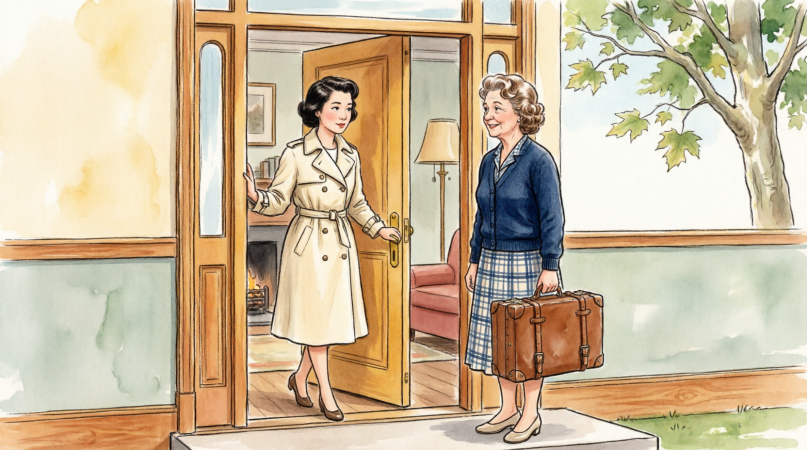
Behind her, I could still see the family room. My family room. The blue curtains I picked out fifteen years ago were still hanging by the window. Robert’s reading chair was still beside the lamp. His glasses were still on the little table where he had left them the night before he went to the hospital.
He never came home from that hospital.
And now I was being told to leave the home where every memory of him still lived.
“Vanessa,” I said, my voice thin and tired. “Your father hasn’t even been buried a week.”
She crossed her arms. “And that changes what?”
“It changes everything,” I whispered.
“No,” she snapped. “It changes nothing. Dad left me the house. Dad left me the money. It’s mine now. You need to accept that and move on.”
Move on.
As if grief were a coat a person could take off and hang by the door. As if forty-two years of marriage could be packed into one old suitcase. As if I were just some guest whose stay had finally ended.
I looked past her one last time, hoping something in her face would soften, hoping I would catch a glimpse of the little girl who used to run into my arms after school and tell me every tiny detail of her day. Hoping I would see my daughter.
Instead, I saw a stranger.
“Please,” I said. “At least let me stay until after the reading of the will.”
That made her smile.
It was not a warm smile. It was the kind of smile a person gives when they believe they have already won.
“Oh, Mom,” she said softly, almost like she pitied me. “That’s exactly why you need to go now.”
The way she said it made something cold twist inside me.
“Why?” I asked.
But she did not answer. She just opened the door wider and pointed toward the driveway.
My knees nearly gave out, but I forced myself to walk. I made it to the sidewalk before the tears came. Not loud tears, just the kind that fall in silence because the hurt is too deep for sobbing.
I stood there with my suitcase and looked back at the house. The upstairs window was open a crack. The oak tree Robert planted when Vanessa was born swayed in the wind. I could almost hear his laugh from summer evenings on the porch.
Then the front door slammed shut.
I flinched.
That sound felt final, cruel, like a lid closing over everything I used to call my life.
I did not know where to go. My sister Elaine lived two towns away, but she had a small apartment and bad knees. My church friend Donna had once told me I could call anytime, but I was too ashamed.
Shame is a strange thing. Even when someone else hurts you, shame finds a way to sit on your shoulders like it belongs there.
So I did the only thing I could think of.
I sat on the bus bench across the street from my own house and cried where my daughter could not see me.
Cars passed. A dog barked somewhere down the block. The world kept moving as if nothing had happened, as if an old woman had not just been thrown away by her own child.
After a while, my phone buzzed in my purse. For one foolish second, hope jumped in my chest. I thought maybe Vanessa had come to her senses. Maybe she was calling to say she was sorry. Maybe she was opening the door and telling me to come back inside.
But it was not Vanessa.
It was a text from my grandson, Caleb.
Grandma, are you okay? Mom isn’t answering me. Aunt Lisa said something happened.
I stared at the message. My daughter had not only thrown me out, she had already started talking. The family knew something had happened. Maybe not the truth, but enough to whisper.
My fingers trembled as I typed back.
I’m all right, sweetheart. Just a hard day.
His reply came fast.
That doesn’t sound all right. Where are you?
I looked across the street at the house, at the door that had closed on me like I was nothing.
On the bench outside home, I typed.
Three dots appeared, disappeared, then appeared again.
Don’t move. I’m coming.
I almost told him not to. Caleb was twenty-six and worked long hours at an auto shop. He was kind, steady, and far too good for the family drama his mother created. I did not want to drag him into this.
But before I could answer, a second text came in.
And Grandma, don’t let her scare you. Grandpa loved you too much to leave you with nothing.
I read that line three times.
Grandpa loved you too much to leave you with nothing.
Robert had loved me. I knew that better than I knew my own name. But during the last year of his life, things had changed in ways I still did not fully understand.
Vanessa had started visiting more often. At first, I thought it was sweet. She brought groceries. She arranged doctor appointments. She talked to Robert about finances and planning ahead. She said she wanted to help.
Then little things began to happen.
Bills I used to handle disappeared from the kitchen drawer. Bank papers showed up with sticky notes already attached. Vanessa started taking Robert to meetings I was suddenly too tired to attend. If I asked questions, she smiled and said, “Mom, I’m trying to make things easier for you.”
Robert, who had once told me everything, began saying, “Vanessa’s just helping with the paperwork.”
The paperwork.
I hated that word now, because paperwork can hide a thousand knives.
A silver SUV turned onto our street and slowed near the bench. Caleb jumped out before it even fully stopped. He was tall like his grandfather, with the same worried eyes and the same habit of running a hand through his hair when he was stressed. He hurried toward me.
“Grandma,” he said, kneeling in front of me. “What happened?”
The kindness in his voice almost broke me all over again. I tried to smile, but it came out crooked.
“Your mother happened.”
His jaw tightened. He looked across the street at the house, then back at me.
“She really threw you out.”
I nodded.
He closed his eyes for one second like he was trying hard not to explode. “Come on. You’re not staying out here.”
“I don’t want to cause more trouble,” I murmured.
“You’re not the one causing it.”
He picked up my suitcase and helped me to the car. I looked back at the house one more time. Upstairs, the curtain moved. Someone was watching.
Vanessa.
I knew it.
She wanted to make sure I left.
Caleb drove me to his apartment on the other side of town. It was small but warm, with clean dishes in the rack and a navy blanket folded neatly on the couch. He made tea the way Robert used to make it, with just a little honey. That nearly made me cry again.
We sat at his kitchen table while the sun went down. For a long time, neither of us said much.
Finally, Caleb spoke.
“Grandma, there’s something I need to tell you.”
His tone made my stomach tighten. “What is it?”
He hesitated. “A few days before Grandpa died, I went by the house to drop off his medicine. Mom was in his office.”
I looked up sharply. “His office.”
He nodded. “She didn’t know I was there at first. I heard her talking to someone on speakerphone. A man. She said, ‘Once the will is read, she’ll be out of the way. Then we can sell everything fast.’”
My cup rattled against the saucer. “What?”
“I didn’t want to upset Grandpa, so I didn’t say anything. Then I kept hoping I heard wrong. But after today…” He swallowed hard. “Grandma, I don’t think this is just about grief or greed. I think Mom’s hiding something.”
The room felt colder.
I thought of the missing papers, the secret meetings, Vanessa’s strange smile when I asked to stay until the reading of the will.
That’s exactly why you need to go now.
My heart began to pound.
“When is the will reading?” Caleb asked.
“Friday morning.”
He leaned forward. “Then we go together.”
I stared at him, fear and hope twisting inside me. “What if she’s right? What if Robert really did leave me with nothing?”
Caleb reached across the table and took my hand. “Then I’ll still be here,” he said. “But Grandma, I don’t believe for one second that Grandpa would let her do this to you.”
I wanted to believe him. I truly did.
But that night, as I lay awake on Caleb’s couch, listening to the hum of the refrigerator and the distant noise of traffic, my mind would not rest. Every memory felt different now, as if someone had reached back into my life and changed the shape of it while I wasn’t looking.
Around midnight, my phone buzzed again.
Unknown number.
With shaking fingers, I opened the message.
If you care about what’s left of your family, do not go to the lawyer on Friday.
There was no name, no explanation, just that one warning.
And before I could even catch my breath, another message came through.
He changed the will before he died. Vanessa knows, but she doesn’t know everything.
I sat up so fast the blanket fell to the floor. My mouth went dry.
Because suddenly I understood one thing very clearly.
Throwing me out was only the beginning.
I did not sleep for the rest of the night. I sat on Caleb’s couch with my phone in my hand, staring at those two messages until the words began to blur. The apartment was dark except for the small yellow light above the stove. Every little sound made me jump—the hum of the refrigerator, the creak of the floor, a car passing outside.
If you care about what’s left of your family, do not go to the lawyer on Friday. He changed the will before he died. Vanessa knows, but she doesn’t know everything.
I read them again and again.
My first thought was that Vanessa had sent them to scare me. That would have sounded like her. She always believed fear was the fastest way to control people.
But something about the second message felt different.
It did not sound cruel.
It sounded urgent, almost like a warning from someone who knew more than they should.
I looked toward Caleb’s bedroom door. He had work early in the morning, and I hated the thought of waking him. He had already done so much for me. But my hands were shaking so badly I could barely hold the phone.
So I knocked softly on his door.
It opened almost at once. He stood there in a gray T-shirt, hair messy, eyes full of concern.
“Grandma, what happened?”
I held out the phone. He read the messages, and the sleep vanished from his face.
“Well,” he said quietly, “that’s not normal.”
“No,” I whispered. “It isn’t.”
He stepped into the living room and sat beside me on the couch. For a moment, neither of us spoke. Then he asked, “Did you save the number?”
“Yes.”
“Good.”
He took out his own phone and snapped a picture of the screen. Then he looked at me.
“Did Grandpa ever say he changed the will?”
I shook my head. “Not directly. But about two weeks before he died, he asked me where I kept the blue photo box.”
“The one with all the old family papers?”
“Yes.” I frowned, trying to remember. “He wanted our marriage certificate. I asked him why, and he said, ‘I just want to make sure everything is protected the right way.’ I thought he meant insurance or taxes. I didn’t ask enough questions.”
Caleb leaned back slowly. “Grandpa knew something was wrong.”
The words hit me with a dull ache.
Maybe Robert had known. Maybe he had seen what Vanessa was becoming and tried to fix it before it was too late.
But if he had, why had he not told me plainly? Why had he left me in the dark while our daughter moved around our home like a woman measuring curtains for a house she already owned?
I looked down at my hands. “I keep asking myself what I missed.”
Caleb’s voice softened. “You didn’t miss everything. Sometimes people hide things because they know if you see the truth, you’ll stop them.”
That sounded wise. Too wise for a young man who had spent his childhood watching family smiles cover ugly secrets.
He got up and made fresh tea, though it was nearly one in the morning. We sat together in silence while the clock ticked over to two, then three.
At last, he said, “Tomorrow we start at the beginning.”
“What do you mean?”
“I mean we figure out exactly when Mom started changing. Not just becoming rude. Really changing. Because people don’t wake up one day and throw their mother onto the street. Something was building up.”
I wanted to say he was wrong. I wanted to defend the daughter I used to know. But deep inside, I knew he was right.
Vanessa had been changing for years.
I met my husband, Robert Hail, when I was twenty-three and working at a library in Cedar Grove, Missouri. He came in asking for a book about building permits, and I remember thinking he had the kindest smile I had ever seen. He was steady, patient, and gentle in a world full of noisy men trying to impress everyone around them.
Robert built homes. Not giant towers or flashy hotels, just good, strong houses for families who wanted something honest and lasting. He used to say, “A house should feel safe before it looks fancy.”
That was Robert all over.
We married a year later. We were not rich then. We had a used car that rattled at red lights, a tiny rented duplex, and a kitchen so small we had to take turns opening drawers. But we laughed all the time. We were a team.
When Vanessa was born, Robert cried harder than I did. He held her like she was made of glass and whispered, “I’m going to give this girl the world.”
And for a long time, he tried.
Vanessa grew up in a house full of love. We were not perfect parents, but we showed up. We cheered at school plays, clapped at piano recitals, stayed up through fevers, and saved for college. Robert spoiled her sometimes, yes, but in harmless ways. Ice cream after dentist visits, birthday mornings with balloons tied to her chair, notes tucked into lunch bags.
She was bright, funny, and charming, the kind of child who could make a whole room laugh.
But even as a girl, Vanessa had one trait that worried me.
She hated hearing no.
When she was eight, she threw a fit at a birthday party because another child got the bigger slice of cake. When she was thirteen, she lied to a teacher and blamed a classmate for cheating on a science test. When she was sixteen, she took money from my purse and swore she had not done it until Robert found the bills inside her dresser.
Each time there were tears, promises, apologies.
And each time Robert would say, “She’s young. She’ll grow out of it.”
Sometimes she did seem to improve. She went to college. She got a marketing job in St. Louis. She married a man named Daniel for three very loud, very expensive years. Then that marriage collapsed in a cloud of debt, secret credit cards, and ugly shouting.
By then, Caleb was twelve.
He came to stay with us often, at first on weekends, then whole weeks during summer, then more and more after Vanessa’s divorce turned bitter. He loved the quiet of our house. He loved Robert’s workshop in the garage and the cinnamon toast I made on Saturday mornings. He was always a careful child, the kind who noticed when someone was hurting before they said a word.
Vanessa, on the other hand, started coming around mostly when she needed something.
Could Robert help cover a car payment? Could we lend her money until her bonus came in? Could we maybe float her through some emergency she promised would be the last one?
Robert usually said yes.
I usually worried.
And over the years, the emergencies kept coming. At first the amounts were small. Then they were not.
Five thousand for a condo deposit. Ten thousand to settle a business mistake. Fifteen thousand because she had trusted the wrong people.
Robert would sigh, write the check, and say, “She’s still our daughter.”
I would answer, “Yes, but she is also a grown woman.”
That argument lived quietly between us for years.
Still, despite everything, I never imagined Vanessa would become cruel. Selfish, maybe. Careless sometimes. But cruel? No. A mother does not like to imagine that about her child. Even when the signs are there, love can make a person look away.
The morning after the messages, Caleb left for work at seven and begged me to keep the door locked. I promised I would. The apartment felt too still once he was gone. I washed my cup, folded the blanket, and tried to make myself useful, but my mind stayed fixed on Friday and the will reading.
At ten in the morning, my phone rang.
It was my sister Elaine.
I almost did not answer. I was tired, embarrassed, and not ready to tell the story out loud. But if I ignored her, she would only worry more.
“Margaret,” she said the second I picked up. “What on earth happened?”
So Vanessa had told people something already.
I sat at Caleb’s little table and said, “Which version did you hear?”
Elaine made a sad little sound. “That you had some kind of episode after Robert’s death, that Vanessa was worried for your health and wanted you somewhere more stable.”
For a full second, I could not speak.
An episode. More stable.
I laughed then, but it was not a happy laugh. It was the kind that comes when the truth is so ugly it almost sounds clever.
“She threw me out,” I said. “With a suitcase.”
Elaine went silent. Then she whispered, “Oh, Margaret.”
It took twenty minutes to tell her everything. By the time I finished, she was furious.
“That girl has always had a mean streak,” she said. “You remember when she told Aunt Helen that cheap bracelet was fake right in front of everybody on Christmas?”
Despite myself, I gave a weak smile. “She was ten and old enough to know better.”
Elaine’s anger warmed me in a strange way. Not because I enjoyed hearing Vanessa criticized, but because someone believed me immediately. No questions. No doubt. Just belief.
Then Elaine said something that made me sit straighter.
“Robert called me last month.”
“What?”
“He asked if you were with me. I said no. He sounded relieved.”
My heart skipped. “Relieved?”
“He said, ‘Good. Then I can talk freely.’ Margaret, he asked me if Vanessa had ever borrowed money from me.”
I gripped the edge of the table. “Why?”
“She hadn’t. I told him so. Then he asked if I had ever seen any letters or notices come to your house with red stamps or legal marks on them.”
I closed my eyes.
There had been letters.
Three of them that I remembered. Vanessa had grabbed them from the mail pile, saying they were junk from an old insurance issue.
“What did you tell him?” I asked.
“The truth. That I hadn’t seen anything. Then he said, ‘If anything happens to me, make sure Margaret gets to the lawyer in person. Don’t let Vanessa handle it alone.’”
I pressed my hand over my mouth. The room blurred.
Robert had known. Not every detail, maybe, but enough to be afraid. Enough to plan. Enough to call my sister behind my back because he thought our own daughter might block me from the truth.
“Why didn’t you tell me sooner?” I whispered.
Elaine sounded pained. “Because he asked me not to unless I had to. He said he hoped he was just being paranoid. After he died, I thought Vanessa would do the right thing. I was wrong.”
I ended the call with tears in my eyes and a strange little flame of strength starting to rise under all the grief.
This was no longer just about hurt feelings or family drama.
This was about lies. It was about paperwork moved in secret, stories twisted behind my back, and a daughter who wanted me gone before I heard something important.
At noon, someone knocked on Caleb’s apartment door. Three firm knocks.
I froze.
My first thought was Vanessa. My second thought was that anonymous number. My third thought was pure fear.
I stepped quietly to the peephole.
It was Lisa, my niece, Elaine’s daughter. Thirty-two, practical, sharp, never late for anything. The second I opened the door, she held up a bakery bag and said, “Mom sent reinforcements.”
I let her in so fast I nearly hugged the pastries.
She set the bag on the counter and looked around the apartment. “This is where she put you.”
I nodded.
Lisa’s mouth tightened. “Unbelievable.”
She had always seen Vanessa clearly. The two of them were close in age, but opposite in almost every way. Lisa worked as a paralegal for a midsized law office in St. Louis. She read contracts for fun. She color-coded her bills. She once returned a lamp to a store because the warranty wording was sneaky.
If there was ever a person I trusted to smell legal trouble, it was Lisa.
I told her about the messages. I told her what Elaine had said. I told her about Caleb overhearing Vanessa talk about selling everything fast.
Lisa listened without interrupting.
Then she said, “Okay, here’s what I think.”
She held up one finger.
“Your daughter wanted you out before the will reading because she was afraid you’d challenge something.”
Second finger.
“Either Robert updated the will very late or he added instructions outside the main gift list—trust clauses, occupancy rights, delayed transfers, something like that.”
Third finger.
“Vanessa has been acting like she already owns everything. That means either she saw an older draft and assumes it still applies, or she saw part of the final documents and misunderstood them.”
I stared at her. “Can people really misunderstand a will that badly?”
Lisa gave me a dry look. “A person blinded by greed can misunderstand almost anything.”
That made me laugh for the first time since Robert died. It was only a small laugh, but it felt like air returning to a locked room.
Lisa stayed all afternoon. She helped me write down every detail I could remember from the last month—dates, meetings, missing papers, comments Robert made, letters Vanessa intercepted. Even small things, like the day Robert asked where the blue photo box was, and the time I walked into his office and Vanessa shut a file too quickly.
“Small things matter,” Lisa said, writing fast. “Big lies are made out of small pieces.”
By five o’clock, we had three full pages.
When Caleb came home, greasy from the garage and tired around the eyes, he looked surprised to see us working at the kitchen table like detectives. Lisa handed him one page without a word. He read it, then looked at me.
“So, we are really doing this.”
I met his gaze. “Yes.”
He nodded once. “Good.”
That evening, the four of us—me, Caleb, Elaine on speakerphone, and Lisa with her legal pad—talked through every possibility. The room was crowded with coffee cups, half-eaten pastries, and tension.
Then Caleb said something none of us had considered.
“What if Mom isn’t acting alone?”
The room went still.
Lisa lowered her pen. “You mean a boyfriend?”
“Or a business partner. Or someone she owes.”
Elaine’s voice crackled through the phone. “She always wanted more than she earned.”
Caleb rubbed the back of his neck. “About six months ago, she started seeing a man named Trevor Boone. I only met him twice. Expensive watch, too-white teeth. Called Grandpa Bob after knowing him ten minutes. Grandpa hated that.”
I frowned. “Trevor.”
Caleb nodded. “He talked a lot about unlocking value and liquidating assets. Said families sit on dead money all the time. Mom loved listening to him.”
Dead money.
The phrase made my stomach turn.
Our house was not dead money. It was where Robert taught Caleb how to sand wood in the garage. It was where Vanessa took her first steps while gripping the coffee table. It was where we danced slowly in the kitchen when the power went out one winter and the radio was the only thing still working.
That house was alive with memory.
But to the wrong people, memory is just something standing in the way of a sale.
Lisa made a note. “Trevor Boone. We need to remember that name.”
Night came down softly outside the windows, but inside Caleb’s apartment, the air felt thick with truth inching closer.
At 8:43, Caleb’s phone buzzed on the table.
He glanced at the screen and went pale.
“What is it?” I asked.
He swallowed. “It’s Mom.”
My heart jumped.
He answered and put it on speaker.
Vanessa’s voice came through smooth and cold. “Caleb, I know Grandma is with you.”
Neither of us spoke.
Then she said, “Tell her to stop digging. If she goes to that lawyer on Friday, she’ll regret it for the rest of her life.”
A chill ran straight through me.
Lisa grabbed her pen.
Caleb’s jaw tightened. He said very carefully, “Why would Grandma regret hearing Grandpa’s will?”
There was a pause.
Then Vanessa laughed.
It was a soft, ugly sound.
“Because,” she said, “some truths don’t save families. They destroy them.”
And before we could ask another word, she hung up.
For a few seconds after the call ended, nobody in the apartment moved. It felt like the air itself had stopped. Caleb slowly lowered his phone and stared at the blank screen. Lisa’s pen was still in her hand, but she was no longer writing. Even Elaine, still on speaker, had gone quiet.
I was the first to speak.
“She threatened me.”
My voice came out smaller than I wanted, thin and shaky.
Caleb looked up fast. “She did more than threaten you.”
Lisa nodded. “That call matters a lot.”
Elaine’s voice crackled through the speaker. “Margaret, listen to me. Do not be alone tomorrow. Not even for five minutes.”
Tomorrow.
Friday.
The will reading.
I pressed both hands flat on the table because they had started trembling again. My own daughter had just warned me not to go hear my husband’s final wishes, and somehow that frightened me even more than being thrown out of my home.
Because people do not act like that unless they are desperate.
And desperate people are dangerous.
Caleb leaned forward. “Grandma, I’m taking the day off tomorrow.”
“You don’t have to do that,” I said automatically, even though some part of me had already been begging him not to leave my side.
“Yes, I do.”
His answer was firm, almost sharp, and for one brief second I saw Robert in him so clearly it made my chest ache. My husband had that same look whenever he decided something mattered more than convenience.
Lisa closed her notebook. “I’ll come too.”
I blinked. “To the lawyer’s office?”
“Yes. I’m not family by blood close enough to matter in the will, but I know enough law to listen carefully and notice if anyone tries anything clever.”
Elaine made a small sound of approval through the phone. “Good. Good. Take witnesses.”
The word witnesses made this all feel even more serious.
Not a family meeting. Not a sad legal appointment after a death.
Witnesses.
I suddenly felt tired all the way down to my bones. Robert had only been gone six days, and already his death had become a battlefield.
That night, none of us said much more. Lisa left around ten after hugging me so tightly my eyes filled with tears again. Caleb checked the locks twice. Then he spread extra blankets on the couch even though I told him I was fine.
I was not fine.
I lay awake in the dark, staring at the ceiling. Every time I shut my eyes, I saw Vanessa at the front door.
Find somewhere else to die.
The cruelty of it burned even hotter in the dark. Not just because she wanted the house. Not just because she wanted the money. But because she had chosen those exact words. She had wanted to wound me. She had wanted me to feel old and unwanted and finished.
That kind of cruelty does not appear out of nowhere.
It grows. It feeds on envy, bitterness, greed, and the long habit of never being told no.
Around two in the morning, I got up and walked quietly into Caleb’s kitchen for water. The apartment was cool and silent. As I stood by the sink, I looked out the small window over the counter.
A black car was parked across the street.
Maybe it meant nothing. Maybe it belonged to a neighbor. But the engine was off, and still I had the awful feeling that someone was sitting inside watching the building.
I moved back from the window and stood very still.
After a minute, the car pulled away.
I told myself I was imagining things. Grief can make every shadow feel like a threat. Fear can turn a parked car into a spy.
But even after I went back to the couch, sleep would not come.
By morning, my stomach was in knots.
Caleb made toast I could barely eat. He wore a clean buttoned shirt instead of his work clothes. And Lisa arrived just after eight carrying coffee and a face set like stone. She had dressed simply, but there was nothing soft about the way she moved. She looked ready for war.
I wore my navy dress, the one Robert always said made me look strong.
I needed strong.
The lawyer’s office sat on the second floor of an old brick building in downtown Cedar Grove. Robert had used the same attorney, Martin Kesler, for nearly twenty years. I had met him several times. He was careful with words, patient with details, and not easily impressed by rich people trying to rush him.
That comforted me a little.
Until we stepped out of the elevator and saw Vanessa already there.
She was standing near the reception desk in a white suit with gold earrings, as if she were attending a business launch instead of the reading of her father’s will.
Beside her stood a tall man with shiny brown shoes, a bright tie, and a smile that looked painted on.
Trevor Boone.
I knew it at once, even before Caleb muttered his name under his breath.
Trevor turned first and saw us. His smile stayed in place, but something sharp flashed in his eyes.
Vanessa turned next.
The second she saw me, her face hardened. Then she saw Caleb and Lisa with me, and her jaw tightened.
“Well,” she said coolly, “you brought a whole little team.”
Lisa answered before I could. “Good morning to you too.”
Trevor stepped forward with one hand half raised, trying to look warm and harmless. “Margaret, I’m so sorry for your loss.”
I stared at him. He smelled like expensive cologne and false charm. I had met men like him before—men who studied rooms the way gamblers study cards, men who talked smoothly because smoothness was cheaper than honesty.
“Have we met?” I asked, though I already knew the answer.
His smile flickered for the first time, just briefly. “Trevor Boone.”
“Yes,” I said. “You’re the one who talks about families like they are investment plans.”
His eyebrows jumped.
Caleb coughed suddenly, hiding what looked suspiciously like a laugh.
Vanessa glared at me. “Mother, this is neither the time nor the place.”
“Funny,” I said quietly. “You didn’t care about time or place when you put my suitcase on the porch.”
Her face changed then. Not much, just a tiny shift. But I saw it.
Fear.
She was afraid I would say things out loud in front of witnesses.
Good.
For too long, I had swallowed my hurt to keep peace that was never real.
A receptionist with silver glasses stepped out and said, “Mr. Kesler will see you now.”
We followed her into a long conference room with polished wood, three windows, and shelves full of heavy law books. At the far end sat Martin Kesler, gray-haired and serious, with a folder open in front of him.
He rose when he saw me.
“Mrs. Hail,” he said gently. “My deepest condolences.”
“Thank you, Martin.”
His eyes moved to Vanessa, then to Trevor, then to Caleb and Lisa. He nodded once, as if taking in the whole shape of the room before the storm began.
“Please sit.”
We did. Vanessa and Trevor on one side. Me, Caleb, and Lisa on the other.
It felt less like a meeting and more like two camps drawing a line down the middle of a battlefield.
Martin folded his hands.
“Before I begin, I need to make something clear. Mr. Robert Hail updated his estate documents seventeen days before his death. The final will before me is the only valid will recognized by this office.”
Seventeen days.
Lisa made the tiniest note on her pad.
Across from me, Trevor’s smile disappeared. Vanessa sat straighter.
“Updated how?” she asked.
Martin looked at her calmly. “I will read the document in full.”
“No,” she said too quickly. “Just summarize the assets.”
My heart kicked hard in my chest.
There it was again. That desperation. That need to rush.
Martin’s tone stayed polite, but it turned firmer. “I will read the document in full.”
Vanessa pressed her lips together and said nothing else.
So Martin began.
At first it sounded like any legal reading. Formal words, dates, names, confirmations that earlier drafts were revoked. Then he listed some donations Robert had arranged. Five percent to the children’s hospital where he had received care. Fixed amounts to church missions. Small gifts to two longtime employees from his building company.
I smiled through tears at that part.
That sounded like Robert. Even in death, he was still remembering people who had stood beside him.
Then Martin turned a page.
“The family residence on Willow Lane,” he read, “shall not be sold, transferred, mortgaged, or altered in ownership for a period of three years following my death.”
Vanessa made a sharp sound in her throat.
Trevor shifted in his chair.
Caleb looked at me, and I stopped breathing for one second.
Martin continued. “During that three-year period, my wife Margaret Hail shall have exclusive lifetime residential rights unless she voluntarily chooses otherwise. All expenses related to the maintenance of the residence during that period are to be paid from the estate.”
Vanessa shot to her feet so suddenly her chair scraped hard against the floor.
“That’s ridiculous.”
Martin did not even blink. “Sit down, Vanessa.”
“She can’t have lifetime rights if the house is mine.”
Martin looked directly at her. “It is not yours at this time.”
The room went dead silent. I could hear the wall clock ticking.
Trevor leaned toward Vanessa and whispered, but she snapped her hand away from him without even looking.
Martin continued reading.
“The remainder interest in the family residence shall pass to my daughter, Vanessa Hail, only if the following conditions are met.”
Vanessa slowly sat back down.
Her face had gone pale. She looked exactly like a person stepping onto a bridge she had believed was strong, only to hear it crack beneath her.
Martin read each condition one by one.
“Vanessa must not contest the will. Vanessa must not attempt to remove me from the home. Vanessa must not harass or intimidate me in any way. Vanessa must not enter any sales agreement or financial arrangement involving the property before the three-year period ends.”
And if she violated any one of those terms, her inheritance of the house would be revoked entirely.
Revoked.
The word landed like thunder.
Vanessa stared at Martin as if she no longer understood English. Trevor’s face had lost all color too.
Caleb reached under the table and squeezed my hand so gently I nearly cried.
But Martin had not finished.
“In the event that my daughter Vanessa Hail violates any of the above conditions,” he read, “the residence shall instead transfer to my grandson Caleb Hail, provided he permits Margaret Hail to reside there in peace for the remainder of her life.”
This time the chair did not scrape.
This time Vanessa simply froze.
Her mouth parted slightly, but no words came out.
Caleb looked stunned.
I turned to him and tears spilled down my face.
Robert. Oh, Robert.
He had seen more than I knew. He had protected me. Even from beyond the grave, he had protected me.
Vanessa suddenly slammed her hand on the table.
“This is manipulation,” she hissed. “She poisoned him against me.”
I stared at her in disbelief. “I begged you to let me stay in my own home.”
“You always played the victim.”
The words burst out of her so loudly that even Martin’s assistant looked up from her desk outside the glass panel.
And then, for the first time, Vanessa stopped pretending.
All the smooth grief, all the polished daughter act—gone.
In its place stood something raw and ugly.
“I deserved that house,” she snapped. “I deserved all of it. Do you have any idea how much of my life I wasted waiting for him to trust me? Waiting for him to hand over what should have been mine?”
I could not speak, because suddenly I understood something terrible.
This was not about one bad week.
This had been living inside her for years.
Martin’s voice came down like a hammer. “Vanessa, control yourself.”
But she was beyond control now.
She turned toward me, eyes bright with rage, and said, “He changed it because he found out about the loans. All right? Is that what everyone wants to hear? He found out I used the property files to secure bridge financing. Happy now?”
The room exploded into silence.
Lisa’s pen stopped moving.
Caleb’s head jerked up.
My ears rang, because I understood every word she had said.
And so did Martin Kesler.
He went very still.
“Vanessa,” he said slowly. “What loans?”
Vanessa’s face changed the second those words left her mouth. Not softer. Not sorry. Just shocked that she had said too much in a room full of people who now understood exactly how serious this was.
For one long second, nobody moved.
Then Martin Kesler closed the folder in front of him with calm, careful hands and said, “I’m going to ask that everyone remain seated.”
His voice was low, but it carried across the whole room.
Vanessa looked at Trevor.
Trevor did not look back at her.
That alone told me more than words.
A man who had stood beside her so smoothly in the lobby was suddenly very interested in the grain of the table. He looked like someone trying to decide whether to lie, run, or stay silent and hope silence worked best.
Caleb leaned forward. “Mom, what loans?”
Vanessa turned on him so fast it made me flinch. “Stay out of this.”
“No,” he said, his voice shaking now, not with fear but with hurt. “You threw Grandma out of her own house. You threatened her. And now you’re talking about loans against Grandpa’s property files. I’m not staying out of anything.”
Martin lifted one hand. “Caleb, let her answer.”
Vanessa stood up again. “I don’t have to answer any of this right now.”
Martin’s eyes did not leave her face. “Actually, because you just made a statement that may affect the administration of this estate, you would be wise to answer very carefully.”
Lisa sat straighter beside me. She looked less like my niece and more like a hawk that had just seen movement in the grass.
Trevor finally spoke. “Maybe we should all calm down. People are emotional. Robert just died.”
I turned and looked at him.
There it was again. That smooth voice, that polished nonsense, the kind people use when they hope calm words will cover ugly facts.
Martin gave him a cool glance. “And you are here in what capacity, Mr. Boone?”
Trevor adjusted his tie. “As support.”
Lisa let out the tiniest sound, almost a laugh.
Martin folded his hands. “Then you may continue being support without speaking for Miss Hail.”
Trevor’s jaw tightened.
Good, I thought.
Let him feel uncomfortable. Let both of them feel what they had made me feel standing on that porch with a suitcase in my hand and nowhere to go.
Martin turned back to Vanessa. “Now explain what you meant by using property files to secure bridge financing.”
Vanessa’s breathing had changed. It was quicker now, sharper. I knew that look on her face. She had worn it as a child right before blaming someone else for what she had done.
“I was trying to fix a temporary problem,” she said at last.
“What problem?” Caleb asked.
She shot him a hard look, but Martin answered for her.
“She will tell us.”
Vanessa pressed both palms flat on the table. “After my divorce, things got harder than anyone knew.”
I almost laughed at that.
Things got harder.
She made it sound like the weather had turned bad, and she had simply forgotten an umbrella. Not like she had borrowed money for years, lied about it, and built a life bigger than she could afford.
“My consulting business slowed down,” she continued. “Then I got involved in an investment group. Trevor introduced me to people who said they could help.”
Trevor’s head snapped toward her. “Vanessa.”
“No,” she said sharply. “I’m done protecting everyone.”
That sentence landed strangely in my chest. Not because it was noble—it was not—but because it revealed something important.
She had been protecting people.
Which meant she had not done all of this alone.
Martin nodded once. “Go on.”
Vanessa swallowed. “I needed short-term cash. At first, it was just supposed to cover business losses until a property turnaround deal closed. Then the turnaround failed. Then there were penalties. Then more borrowing.”
“How much?” Lisa asked before she could stop herself.
Vanessa looked at her with open dislike. “It’s none of your business.”
Lisa did not blink. “You made it our business when you used family property files.”
Martin looked at Vanessa. “Answer the question.”
Vanessa’s voice dropped. “A little over four million.”
I felt the room tilt.
Four million.
My husband had spent decades working carefully, planning carefully, saving carefully, and our daughter had torn through millions like a child kicking open drawers in the dark.
Caleb went white. “Four million?”
Vanessa’s eyes flashed. “I said I was fixing it by throwing Grandma out and selling the house.”
She turned on him. “By liquidating assets before the lenders pushed harder.”
My mouth went dry.
There it was.
Plain and ugly. Not grief. Not confusion. Not even simple greed.
Pressure. Debt. Fear.
And behind all of it, the plan to solve her disaster by using the one thing that still had enough value to save her.
Our home.
The home Robert had built with his own hands. The home where our family had celebrated birthdays, cried through illnesses, and waited by the window for snow.
To Vanessa, it had become a rescue rope for her lies.
Martin’s face had gone very still. “Did you sign any agreements involving the Willow Lane property?”
Vanessa hesitated.
That tiny pause was all the answer anyone needed.
Trevor spoke too quickly. “Nothing final.”
Martin turned to him sharply. “I did not ask you.”
Caleb stood halfway up from his chair. “Mom, did you put Grandpa’s house into some kind of loan deal?”
“It wasn’t the house itself,” Vanessa said, defensive now, words rushing faster. “It was supporting paperwork, valuation files, estate projections, preliminary holding structures. I thought once Dad passed and the transfer cleared, I’d have authority to settle everything.”
I stared at her.
She said it so coldly.
Once Dad passed.
Not if something happened. Not if the future changed.
Once Dad passed.
Like his death had become a date in a business plan.
“Vanessa,” I said quietly, and the whole room turned toward me. “Were you waiting for your father to die?”
For the first time since this began, real shame crossed her face. Not enough shame. Not clean shame. But something.
And then, like always, she covered it with anger.
“I was drowning,” she said. “Do you understand that? Drowning. Every month the calls got worse. Every month the numbers got bigger. Trevor said if I could just hold things together until the estate transfer, I could fix everything.”
I looked at Trevor.
He looked furious now, but not embarrassed.
Furious because his plan was falling apart.
So I asked the question nobody else had asked yet.
“What did Trevor get out of it?”
The room fell silent again.
Trevor smiled, but the smile was dead now. “That’s an unfair question.”
“Then answer it,” Lisa said.
He leaned back in his chair. “I advised Vanessa. That’s all.”
Lisa’s eyes narrowed. “For free?”
He did not answer.
Martin spoke. “Were you promised a fee, Mr. Boone?”
Trevor stayed quiet.
Caleb gave a harsh little laugh. “Of course he was.”
Vanessa looked exhausted suddenly, as if all the force keeping her upright was beginning to leak out. “He was going to help restructure the sale.”
“How generous,” Lisa muttered.
Martin’s voice turned even colder. “A sale of property you did not yet own.”
Vanessa opened her mouth, then closed it again, because there was nothing left to say that did not sound as bad as the truth.
I sat there hearing it all, and something inside me shifted.
Until then, I had been mostly hurt, heartbroken, shocked.
But now a different feeling rose up through the grief.
Clarity.
Vanessa had not just betrayed me in a burst of cruelty after Robert’s death.
She had built a whole secret road toward that moment. She had let Trevor push her. She had hidden letters, intercepted papers, rushed Robert into private meetings, and when he changed the will to protect me, she had panicked, thrown me out, and hoped fear would keep me away from the lawyer long enough for her to control the story.
Martin opened another folder from the stack beside him. “I have something else that may help clarify matters.”
Vanessa stared at him.
He removed a sealed envelope. On the front, in Robert’s familiar handwriting, were the words:
To be opened in Margaret’s presence only if there is conflict after my death.
My breath caught.
I knew that handwriting. I knew the slight tilt of the letters, the careful way he crossed his t’s, the pressure he used when something mattered deeply.
For a second, I forgot everyone else in the room.
It felt like Robert had reached across death itself to place one more thing in my hands.
Martin looked at me gently. “Would you like me to read it?”
I could barely speak. “Yes.”
He opened the envelope carefully and unfolded the letter.
When he started reading, Robert’s voice filled the room in my mind so clearly it was almost unbearable.
“My dear Maggie, if this letter is being read, then I was right to worry. First, I need you to know something before all else. I loved you from the first day I met you, and I have trusted you with my whole heart for more than forty years. If there is any pain around my will, please do not ever believe for one second that I meant to leave you unprotected. Quite the opposite. I made these changes because I learned things that frightened me and I wanted to make sure you would be safe.”
Tears slid down my face before Martin had finished that first part.
Caleb took my hand again.
Martin continued.
“About two months ago, I discovered that Vanessa had been using copies of business and property records in conversations with outside lenders and advisers. She did not have authority to do so. At first she denied it. Then she admitted she was in financial trouble, but claimed no harm had been done. I wanted to believe her, but more facts came to light.”
I shut my eyes.
Robert had known.
He really had known. Not every detail, maybe, but enough to act. Enough to put protection into place even while sick, even while dying.
Martin read on.
“I learned that she had accumulated large private debts. I also learned she was under pressure from a man named Trevor Boone, who presented himself as a consultant, but behaved more like a scavenger circling an estate before its owner was buried. If you are hearing this, then I fear Vanessa allowed him too much influence over her choices.”
Trevor sat perfectly still now.
Too still.
His face had the stiff look of a man trying not to react, because any reaction would make things worse.
Martin kept reading.
“I did not disinherit Vanessa completely because she is still my daughter. And I prayed she might yet choose decency over greed. But I placed conditions on her inheritance because I could not ignore what I had seen. If she treats you with cruelty, if she attempts to force a sale, or if she behaves as though my death is merely a transaction, then she will lose what I intended to give her.”
The room had gone so quiet I could hear the paper move in Martin’s fingers.
Then came the line that broke me.
“Maggie, I am sorry I did not tell you everything sooner. I hoped I could fix it quietly. I hoped I could spare you pain. That may have been my mistake. Silence protects the wrong person too often. If you take any lesson from what happens after I’m gone, let it be this. Love does not mean closing your eyes. Trust your instincts. Speak up sooner and never let cruelty hide behind family.”
I covered my mouth and cried openly then. Not loud, not wild, just the deep helpless crying that comes when grief and truth hit at the same time.
Because there it was—the lesson, the warning, the apology.
Even in his final letter, Robert was still trying to protect me. Still trying to teach me something. Still trying to help me survive what our daughter had become.
Martin finished the last lines.
“I leave Margaret not only my love, but the right to live in peace with dignity in the home we built together. If Vanessa honors that peace, then perhaps some part of this family can still heal. If she does not, then let the consequences be hers. With all my love, Robert.”
No one spoke for several seconds after the letter ended.
Even Lisa had tears in her eyes.
Caleb looked wrecked, but proud too. Proud of his grandfather. Proud that the truth had finally been dragged into the light.
Vanessa, however, looked different.
Smaller.
Not innocent. Never that.
But smaller, like a person who had spent years acting larger than life and had suddenly been forced to stand without any of her performance.
Still, when she finally spoke, she did not say sorry.
She said, “He made me sound like a monster.”
That was when something in Caleb snapped.
“You threw Grandma out six days after Grandpa died,” he said, voice cracking with disbelief. “You told her to find somewhere else to die. You were planning to sell the house. You hid things. You threatened her. What exactly do you think monsters sound like?”
Vanessa flinched.
I saw it. A tiny, painful flinch.
Because out of every word spoken that day, maybe that was the one that hurt her most.
Not mine. Not Martin’s. Not the letter.
Her son’s.
Trevor pushed his chair back suddenly. “This has become hostile. Vanessa, we should leave.”
Martin looked up at once. “Sit down, Mr. Boone. We are not finished.”
Trevor did not sit. Instead, he straightened his jacket and said, “With respect, counselor, this is a family inheritance matter. My name should not be dragged through emotional accusations.”
Lisa actually laughed that time. A short, sharp laugh. “Emotional accusations? You were named in a dead man’s letter.”
Trevor’s face darkened.
Martin reached for another file. “Mr. Boone, before you go anywhere, there is one more matter.”
Trevor stopped moving.
Martin opened the file and removed copies of several documents. “These were delivered to my office this morning by a courier from First State Commercial Review. They concern preliminary inquiries made against projected estate holdings connected to Robert Hail.”
Trevor’s eyes narrowed.
Vanessa looked confused. “What is that?”
Martin’s face was grave now. “It appears that someone used estate projections and supporting business records to seek bridge financing from more than one lender. Not one. And at least one lender flagged the submission because the signer may not have had legal authority.”
My stomach dropped.
More than one lender.
Not one desperate mistake.
A pattern.
A scheme.
Martin slid one copy across the table. I could not read all the fine print from where I sat, but I saw enough.
Robert Hail Estate Holdings. Projected liquidation value. Advisory success fee.
And near the bottom, Trevor Boone’s name.
Vanessa turned toward him so fast her chair legs squealed on the floor. “You said it was only a draft.”
Trevor did not answer.
“You told me nothing was filed yet.”
Still nothing.
Then she stood, not with rage this time— with horror, real horror—because at last she understood the full truth.
She had not just been greedy.
She had also been used.
And whatever Trevor had talked her into was bigger than she had admitted, bigger than she had controlled, and possibly bigger than she could escape.
She looked at Martin, then at me, then at the paper again, and in a voice I had not heard from her since she was a little girl caught in a lie too large to hold, she whispered, “What did he file in my name?”
Trevor did not answer right away.
That was the worst part. Not the papers on the table. Not Vanessa’s shaking voice. Not even the look on Caleb’s face as he stared at his own mother like he no longer knew who she was.
It was the silence.
Because silence can tell the truth before words do.
Vanessa took one step back from the table.
“Trevor,” she said again, louder this time. “What did you file in my name?”
He lifted his chin and tried to recover that smooth, polished tone he always used when things started falling apart.
“Nothing that can’t be sorted out.”
But Lisa made a disgusted sound. “That means something was filed.”
Martin Kesler did not raise his voice, but the room seemed to pull tighter around his words. “Mr. Boone, you would be wise to answer clearly.”
Trevor looked at Vanessa, and for the first time since I had met him, I saw that he did not care about her at all. Not really. Not in the way people care about people.
He cared about outcomes. About money. About getting to the finish line before anyone noticed how he had started the race.
He spread his hands. “The filings were preliminary. That’s all. Projections, restructuring concepts, draft applications. Nothing final.”
Vanessa stared at him. “You told me you were helping me breathe until the estate cleared.”
“I was.”
“You told me the house wasn’t actually at risk.”
“It wasn’t supposed to be.”
Those words made Caleb stand so fast his chair tipped backward and crashed onto the floor.
“Wasn’t supposed to be?” he snapped. “That’s your answer?”
“Caleb,” Martin said sharply. “Sit down.”
But Caleb was shaking now, hurt and anger mixing together in a way that made him look so much like Robert it hurt to see. He picked up the chair with one hard movement and sat again, but his eyes never left Trevor.
Vanessa turned to Martin. “What does this mean?”
Martin adjusted his glasses and looked down at the documents. “It means multiple lenders were approached using projected estate value, property records, and anticipated control of assets that did not legally belong to the applicant.”
“The applicant,” Vanessa whispered.
Martin looked up.
Her face was white.
“I didn’t sign anything final.”
“That may be true,” he said carefully. “But your information appears throughout these documents, along with digital approvals, financial disclosures, and authorizations submitted under your name.”
Vanessa turned so slowly toward Trevor that for one moment she looked like someone moving through water.
“You said I was protected.”
Trevor’s jaw tightened. “You were protected if the transfer had happened cleanly.”
If the transfer had happened cleanly.
If Robert had not changed the will.
If I had stayed silent.
If fear had kept me away from the lawyer’s office.
If all their ugly little plans had gone exactly the way they wanted.
That was when I understood something important, something painful, and something final.
Vanessa had tried to use me.
But Trevor had used her too.
That did not make her innocent. Not even close. She had made selfish choices, cruel choices, greedy choices. She had thrown her own mother out of the house. She had threatened me. She had hidden things from her father while he was dying.
Those were her choices.
But now, at last, she was staring into the face of the man she trusted more than her family.
And she was finally seeing him clearly.
It is a hard thing to watch your child suffer.
Even when that suffering is deserved.
Even when that suffering grew from seeds they planted with their own hands.
A mother’s heart does not stop being a mother’s heart just because it has been broken.
Vanessa’s voice shook. “Did you put me into debt deals I didn’t fully understand?”
Trevor’s answer came too fast. “You understood enough.”
“No,” she said, louder now. “Did you?”
He looked annoyed. Not sorry. Not ashamed. Just annoyed that the room had turned against him.
“You wanted a solution,” he said. “I gave you one.”
“A solution?” Caleb burst out. “You tried to help her sell Grandpa’s house before he was even buried.”
Trevor shrugged one shoulder. “Your grandfather was a wealthy man. Wealth requires management.”
I felt something hot rise in my chest then.
Not panic. Not grief.
Righteous anger.
A clean, fierce anger.
I leaned forward and said very quietly, “My husband was not a pile of numbers for you to manage.”
The room went still.
Trevor looked at me, maybe for the first time really seeing me. Not as an obstacle. Not as an old woman to remove. But as the wife of the man whose life he had treated like a timed investment.
I held his gaze.
“My husband built that home board by board. He spent forty-two years loving his family, even when we disappointed him. He died trying to protect us from exactly this kind of rot. So do not sit in this room and speak about him like he was nothing but estate value.”
Trevor looked away first.
Good.
Martin took a slow breath. “This meeting is no longer just about reading the will. Ms. Hail—” he looked at Vanessa “—you need independent counsel immediately. And Mr. Boone, you need to leave now.”
Trevor opened his mouth, but Martin raised a hand.
“Now.”
That time Trevor obeyed.
He gathered his folder, gave Vanessa one cold glance, and walked out without another word. He did not touch her shoulder. He did not apologize. He did not promise to fix anything.
He just left.
And in that one ugly, simple moment, every lie he had wrapped around her fell to the floor.
Vanessa stood in the middle of the conference room, breathing fast, staring at the closed door.
Then, to my shock, she started laughing.
Not because anything was funny.
Because she was breaking.
It was a thin, shaky laugh that turned into a sob halfway through. She pressed one hand to her mouth and sat down hard in her chair.
“I thought,” she whispered. “I thought I could fix it before anybody knew.”
Nobody moved. Not me. Not Caleb. Not even Lisa.
Vanessa looked at Martin through wet, ruined makeup. “How bad is it?”
He did not soften the truth. “Potentially very bad.”
She closed her eyes.
Martin continued, plain and steady. “There may be civil exposure if lenders relied on unauthorized estate documents. There may also be fraud concerns depending on what was represented and who submitted it.”
Vanessa gave a tiny broken nod.
Then Caleb asked the question all of us were thinking.
“Why didn’t you just tell Grandpa the truth?”
She opened her eyes and looked at him. “I tried once,” she said. “Months ago, I really did. But by then it was already ugly. I had borrowed too much. I had rolled one problem into another and told myself I was buying time. Trevor kept saying one good sale would fix everything. One transfer, one bridge, one closing.” She gave a bitter little smile. “There was always one more thing.”
She looked at me then, and I saw something I had not seen in her since all this started.
Not self-pity. Not arrogance.
Regret.
“Dad found some letters,” she said. “He confronted me. I admitted part of it, not all of it. He asked me if I had used business records. I said only for valuation discussions. He told me if I involved the house in anything, he would cut me off.”
Her lower lip trembled.
“I didn’t believe he would.”
Martin tapped the will folder. “He did.”
Vanessa nodded slowly. “After he got sicker, I panicked. Trevor said if I could just secure future control on paper, the lenders would stop pressing for immediate repayment. Then Dad changed the will and I found out too late.” She swallowed. “So I thought if I got Mom out of the house, maybe I could still control the timeline. Maybe I could still force a sale somehow before anyone looked too closely.”
There it was.
The whole ugly truth.
Not a mystery. Not a secret left hanging in shadows.
Just plain painful facts.
She was drowning in debt. Trevor pushed her toward risky lenders and false shortcuts. Robert found out enough to protect me. He changed the will. Vanessa panicked. She threw me out to scare me away from the reading and buy herself time.
That was the whole road.
Every step.
Every betrayal.
And the cost of it sat in the room with us.
A dead husband. A broken daughter. A grandson with tears in his eyes. A family split open.
Martin cleared his throat. “There is one more estate matter.”
Vanessa laughed weakly through tears. “Of course there is.”
He opened the folder again. “The liquid assets.”
Her head lifted sharply.
Thirty-three million.
That was the number everyone had been moving around like it was the center of the world. The number from the title of my pain. The number she thought made me useless once it was hers.
Martin read carefully. “The cash estate is divided as follows. A protected trust is established for Margaret Hail in the amount of twelve million dollars for her care, housing rights, health, travel, charitable giving, and independent security. The trust is administered outside Vanessa Hail’s control.”
Vanessa’s eyes widened.
Mine did too.
I had known Robert loved me, but I had not known the full shape of the shield he had built around me.
Martin continued. “A family recovery trust of eight million dollars is established for Caleb Hail and any future children he may have, with release milestones for education, home ownership, and business development.”
Caleb stared like he had stopped understanding the room.
Then Martin looked at Vanessa.
“The remaining thirteen million is left to Vanessa Hail, contingent upon her full cooperation with estate review, non-interference with Margaret Hail’s residence, and absence of legal findings related to misrepresentation of estate assets. If those conditions fail, the thirteen million is redirected into the family recovery trust and designated charitable causes chosen by Margaret Hail.”
Vanessa went still.
So still.
Thirty-three million.
And she had almost lost everything because greed made thirteen feel more important than family, more important than honesty, more important than her own soul.
Lisa let out a long breath. “Robert really thought this through.”
“Yes,” Martin said quietly. “He did.”
I sat there with tears on my cheeks and felt grief and gratitude crash into each other.
Robert was gone. Nothing could change that. I would never again hear his boots by the back door or his soft whistle in the garage or the way he said Maggie girl when he walked into a room and found me reading.
But he had seen the danger.
And he had not left me helpless.
Vanessa looked at me with hollow eyes. “You got twelve million.”
I should have hated the way she said it.
But I was too tired for hate.
“It isn’t about the money,” I said.
Her laugh came out broken. “That’s easy to say when you’re protected.”
“No,” I said, firmer now. “It is easy to forget that people are not accounts until everything is destroyed. That’s what happened to you.”
She stared at me.
Maybe those words landed.
Maybe they did not.
But I needed to say them, because this story was never really about millions.
It was about what greed can do when it takes a seat at the family table and no one forces it to get up.
After the meeting ended, Martin arranged for copies of the will and letter to be secured. He also said he would notify the estate review team and advise Vanessa to obtain counsel immediately.
Lisa stayed close, writing down every instruction.
Caleb stayed closer, carrying my bag and walking on the side nearest the street as if he could somehow block the whole world from reaching me.
Vanessa came out of the conference room last.
Her shoulders looked smaller. Her face looked older.
Not from time.
From consequence.
In the hallway, she said my name.
“Mom.”
I turned. Caleb stiffened beside me. Lisa watched without blinking.
Vanessa looked at the floor first, then at me. “I know saying sorry doesn’t fix this.”
“No,” I said. “It doesn’t.”
Tears filled her eyes again. “I was cruel.”
“Yes.”
“I was wrong.”
“Yes.”
“I was scared.”
I held her gaze. “You were greedy before you were scared.”
That hit her harder than shouting would have.
She nodded slowly.
Because it was true.
Fear had pushed her deeper, yes.
But greed opened the door.
She wiped her face. “I don’t know how to undo any of it.”
“You can’t undo it,” I said. “You can only tell the truth now.”
She looked at Caleb. “I never wanted you dragged into this.”
He answered softly. And somehow that softness hurt more than rage.
“You dragged Grandma into it first.”
Vanessa cried then, quietly.
No performance left. No audience to impress.
And though my heart still hurt, I did not cry with her.
Some grief belongs to the person who created it.
The next few weeks were hard. Very hard.
There were legal meetings, document reviews, calls from estate officers, questions about lenders, records, and Trevor Boone.
It turned out Trevor had approached more than one desperate client the same way. Always circling wealth he did not own. Always promising temporary solutions that somehow left other people carrying the danger.
Investigators started asking their own questions.
Some lenders backed off once the unauthorized estate links were exposed. Others demanded repayment paths.
Vanessa had to sell her condo, her luxury car, and almost everything expensive she had bought trying to look successful. She moved into a rented townhouse on the edge of the city, alone.
Not because I threw her away.
Because actions have weight, and some weights must be carried.
Trevor disappeared from her life the second he saw there was no clean profit left.
That was another lesson, plain as daylight.
People who help you betray your family will never save you when the bill comes due.
As for me, I went home.
Not to a new house. Not to some penthouse bought with revenge money.
Home to Willow Lane. To the blue curtains. To Robert’s chair. To the oak tree moving in the yard.
The first day I walked back through that front door, I stood in the hallway and cried so hard Caleb had to hold my elbow. But they were not broken tears this time. They were the tears of someone who had been thrown out and had still found her way back in with dignity.
Caleb moved into the guest room for a while after that. He said he wanted to make sure I was not alone. But I think part of him also needed the house, needed the workshop, needed the place where his grandfather had taught him what steady love looks like.
Some evenings we sat on the porch and talked about Robert—the funny things, the gentle things, the stubborn things. How he used to label every tool but still accuse everyone else of moving them. How he danced badly but happily. How he never passed a dog without speaking to it.
Those talks healed something in both of us.
About a month later, Vanessa asked if she could come by.
Not to move back in. Not to argue.
Just to talk.
I almost said no.
A deep part of me wanted to protect the peace I had fought to get back.
But another part remembered Robert’s letter.
If she honors that peace, then perhaps some part of this family can still heal.
So I said yes.
She arrived without makeup, without expensive clothes, without Trevor, without any of the sharp glitter she used to wear like armor. She looked tired. Real. Human.
We sat at the kitchen table where she used to do homework as a little girl. For a long time, she twisted a paper napkin in her hands before finally speaking.
“I keep hearing what Dad wrote,” she said. “Silence protects the wrong person too often.”
I said nothing.
She looked up at me. “I think I’ve been protecting the wrong things for years. My image. My pride. My excuses.”
“That’s true,” I said.
She nodded like she expected no softer answer.
“I’m in debt counseling now. I’m cooperating with the estate review. I told the truth about Trevor and the lenders. All of it.”
“That’s a start.”
Tears filled her eyes, but she did not let them fall. “I don’t expect forgiveness today.”
“You won’t get it today.”
She gave a tiny, painful smile. “Fair enough.”
Then she said the words I had needed to hear, not because they erased anything, but because truth matters.
“I did wait for him to die, Mom. Not because I wanted Dad gone. I didn’t. But because I thought his death would save me from my own mess. And that is something ugly I will have to live with.”
I closed my eyes for a moment.
There it was.
No hiding. No half-truths.
Plain truth.
And plain truth is where healing, if it ever comes, has to begin.
When I opened my eyes, I said, “Your father loved you. That never changed. But love is not permission to become cruel.”
She broke then. Really broke.
Head down, shoulders shaking, all the polished pride gone.
I let her cry.
Not because I was over what she did. Not because everything was fixed. But because for the first time in a very long time, those tears belonged to honesty, not manipulation.
Weeks turned into months.
Caleb stayed close. He helped me sort estate papers and repair a loose fence gate Robert had meant to fix before he got sick.
The trust gave me security, yes, but more than that, it gave me freedom.
I donated quietly to the children’s hospital Robert cared about. I funded a reading corner at the library where we first met. I set aside money for Caleb’s future because Robert would have wanted that.
And I made one decision that surprised everyone.
I kept Vanessa’s remaining inheritance protected, not released.
Not because I wanted to punish her forever. Because I wanted conditions—debt counseling, full cooperation, no hidden accounts, no harassment, no access to my trust, no property pressure.
At first, she hated that.
Then, slowly, she accepted it.
For once in her life, love came with limits.
And limits may have been the one thing she needed all along.
About six months after Robert died, we held a small family dinner in the house. Nothing fancy. Pot roast, rolls, sweet tea, Caleb at one end of the table making me laugh with stories from the garage. Vanessa across from me, quieter than before, listening more than talking.
At one point, she looked around the room and whispered, “I almost sold this place.”
“Yes,” I said. “You did.”
She nodded with tears in her eyes. “I’m glad I didn’t get the chance.”
That was the closest thing to peace we had then.
Not perfect peace. Not movie peace.
Real peace.
The kind built slowly after truth, consequence, and humility have all had their turn.
And that is how the story ended.
Not with me crushed. Not with my daughter winning. Not with some secret left unexplained.
It ended with the truth laid bare.
Vanessa betrayed us because greed and debt made her desperate. And she let the wrong man guide her deeper into danger.
Robert found out enough before he died to protect me, the house, and Caleb’s future. He changed the will, set clear conditions, and left a letter that told the truth plainly.
Vanessa threw me out because she panicked when she realized the new will blocked her plan.
Trevor used her fear for profit and abandoned her when the plan failed.
The house stayed where it belonged. The money went where Robert intended. And the family, though wounded, finally stopped living inside lies.
The life lesson was simple, and I carry it with me now every morning when I open the curtains in the house Robert built.
Love without truth becomes weakness.
Silence can protect the wrong person.
And family is not a free pass to be cruel.
So when your instincts whisper that something is wrong, listen.
When someone hides behind charm, look closer.
And when a person tells you that you are useless, do not believe them just because they share your blood.
I was not useless.
I was grieving. I was betrayed. I was almost pushed aside.
But I was still the woman who helped build that home. Still the wife Robert trusted. Still the grandmother Caleb stood beside.
Still strong enough to come back through my own front door with my head up.