The first thing I saw was my mother’s hand on the flush lever.
The second was the gray powder drifting through the air above my toilet bowl like smoke.
For one impossible second, my mind refused to understand what my eyes were seeing. I stood frozen in the doorway of my own master bathroom, one hand still wrapped around the stems of the white lilies I had bought on the way home, the other gripping the doorframe so hard my nails bent backward.
The room was bright with afternoon winter light. The marble counter gleamed. My mother’s pearl earrings caught the sun. The silver flush handle shone beneath her fingers.
Everything looked ordinary except for the open titanium urn on the counter and the ashes tumbling from it.
Leo.
My baby.
My son was falling in a pale, terrible stream into the toilet water.
The bouquet slipped from my hands and hit the tile with a wet slap.
Stems rolled. White lilies scattered around my feet like broken bones.
“What are you doing?” I heard myself say, but the voice that came out did not sound like mine. It was thin and far away, the voice of someone trapped under ice.
My mother turned as if I had interrupted her while she was wiping down a mirror. Not startled. Not guilty. Merely annoyed.
Patricia stood there in a cream cashmere sweater and black slacks, immaculate as always, a woman dressed for lunch at the club rather than desecration. A fine gray dust streaked one sleeve. She glanced at it with visible irritation and brushed at it with two fingers.
“You are making this house too depressing,” she said. “Your sister is pregnant, and she does not need all this negative energy around her.”
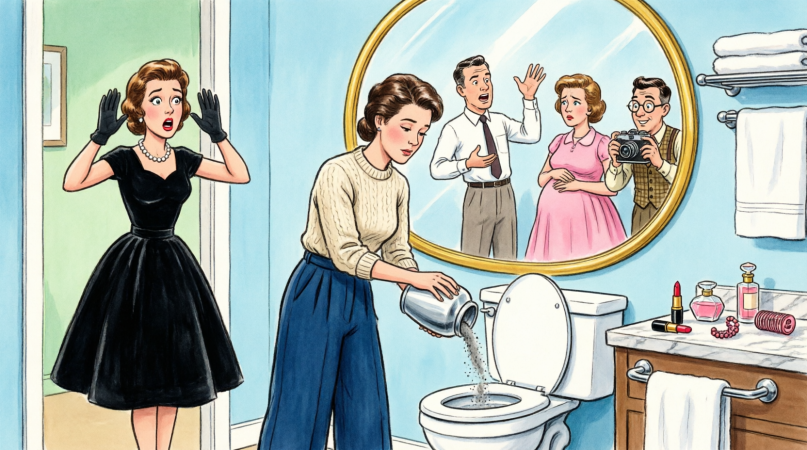
Then she tipped the urn farther.
The last of my son slid toward the bowl.
The world stopped.
There are moments so violent that time does not shatter; it thickens. Every second stretches into something heavy enough to crush you. I saw the powder drifting down. I saw the water cloud as it hit. I saw my mother’s manicured hand still poised near the flush handle as if she were making a simple household correction.
Then something inside me ripped open.
The sound that came out of me did not sound human. It was sharp and raw and primal, an animal sound from somewhere older than language. I lunged. My shoulder slammed into her ribs. The side of her body hit the vanity hard enough to rattle the tray of perfume bottles on the counter.
She shrieked in outrage.
I grabbed for the urn. She yanked it away. For one surreal second we fought over my child’s ashes like two women at a sample sale clawing for the last pair of shoes.
“Let go!” she screamed. “Have you lost your mind?”
“Yes!” I screamed back. “Give him to me!”
My fingers slipped over cold titanium. Her nails dug into my wrist. I drove my knee into the cabinet and shoved harder, and this time she lost her grip. The urn came free. I stumbled backward, nearly falling, and looked inside.
Empty.
It was empty.
Not mostly empty. Not salvageably empty. Empty in the way a body goes empty after a scream.
A terrible metallic ringing filled my ears.
“No,” I whispered.
I dropped to my knees by the toilet so fast my kneecaps slammed the tile. My hand plunged into the swirling gray water without thought, fingers clawing as though I could scoop him back out, gather him back together, reverse the last thirty seconds by sheer force of love.
My mother stepped past me in disgust.
Then, with a single efficient movement, she pushed the flush handle down.
The roar of water filled the room.
“No!”
I caught the back of her calf, but too late. The bowl churned. Pale ash turned to dirty water. The last physical trace of my son spun once, twice, then vanished into the pipes with a violent sucking rush that seemed to pull my lungs down with it.
I could only stare.
The toilet refilled, clean and bright and blank.
As if nothing had ever been there at all.
I fell back against the bathtub, the empty urn slipping from my hands and rolling across the floor until it knocked dully against the baseboard. The sound echoed inside the bathroom like a taunt.
My mother washed her hands.
That is what I remember most clearly after the flush. Not my own sobbing. Not the ringing in my ears. Not the bloodless terror sliding through me.
It was the sight of Patricia Henderson standing at my sink, turning on the faucet, rubbing soap between her hands while my son disappeared into the city sewer system.
She met my eyes in the mirror.
“Now maybe you can finally move on,” she said.
I pressed both palms to the tile floor to keep from collapsing completely. “You flushed my baby down the toilet.”
She dried her hands on one of my white guest towels and set it back down neatly.
“Stop saying it like that,” she snapped. “You are being hysterical over a pile of dust. It was unhealthy to keep carrying that thing around the house like a shrine. Madison is due in two months. She doesn’t need to be walking into a room and seeing death every time she visits.”
I stared at her.
The words were making shapes. I heard them. I understood them. But they did not land in any part of my brain that still recognized the world as rational.
She turned toward me fully then, crossing her arms over her chest.
“Your sister and Jamal are moving in next week,” she continued, as though this were the logical next item on the agenda. “They need the master suite, and frankly they need a fresh, positive environment. A healthy baby should not be born into a house that feels like a mausoleum. You will move your things into the downstairs guest room by Friday.”
I could not believe what I was hearing. The room itself seemed to reject it. The marble, the mirrors, the soft hand towels monogrammed with my initials, the expensive light fixture Brian and I had chosen together before everything collapsed—none of it matched the reality of my mother calmly standing over the death of my son’s remains while planning a nursery for my sister in my bedroom.
I pushed myself unsteadily to my feet.
“This is my house.”
My voice was hoarse, torn ragged from screaming.
Patricia gave me a look I knew from childhood. The look she used when I disappointed her by resisting.
“Your house?” she repeated. “Claire, please. You are in no condition to be making decisions.”
I took one step toward her. “Get out.”
Her expression hardened. “Don’t be ridiculous.”
“Get. Out.”
She slapped me.
Her palm cracked against my cheek so hard I stumbled sideways and hit the vanity. White stars burst in my vision. I tasted metal. For a second I was seventeen again, not thirty-three, standing in my parents’ kitchen while my mother told me my tone was the problem.
Except I was not seventeen. And the woman before me had just destroyed the last physical piece of my child.
“What are you crying for?” she shouted. “Your life cannot stop because yours ended. Madison is finally bringing something joyful into this family. Jamal has important people to host. Investors, partners, real people with real futures. They need this home presentable, not draped in grief and old flowers.”
“My life ended?” I whispered.
She rolled her eyes. “Don’t twist my words.”
I touched my cheek and looked at the smear of blood on my fingertips where my teeth had cut the inside of my mouth.
Then footsteps sounded in the hall—heavy, irritated, familiar.
My father appeared in the doorway.
Richard Henderson took in the bathroom at a glance. The lilies on the floor. The empty urn. My mother’s flushed face. Me shaking by the tub.
For one pathetic, damaged heartbeat, I felt relief.
My father is here, some ancient childish part of me thought. He’ll stop this.
Then I saw his expression.
Not horror.
Not grief.
Not even confusion.
Annoyance.
“Jesus Christ,” he muttered. “What now?”
My lips shook. “She flushed him.”
Richard frowned. “What?”
“Leo,” I said, my voice cracking open around the name. “She flushed Leo down the toilet.”
He looked at the urn. He looked at Patricia. And then he did the thing that broke something in me so completely there was no putting it back.
He sighed.
Not because his grandson had just been desecrated. Because I was making a mess of the afternoon.
“Claire,” he said in the tone of a man addressing an unruly intern, “lower your voice.”
I actually laughed—a tiny, sharp, unbelieving sound that cut my own throat on the way out.
“Lower my—”
“Your mother is trying to help you,” he snapped. “You have been living in this morbid fog for months. The whole house feels suffocating. Do you know what it has been like for the rest of us? Walking on eggshells around you? Tiptoeing around that room upstairs like it’s a crypt?”
I looked at him, and something cold began to spread through my chest.
He kept going, because men like him only stop when the room makes them.
“Brian left because he couldn’t stand it anymore,” he said. “He told us himself. He said you cry all night, you barely eat, you stare at walls, you refuse to function. No man wants to live like that forever.”
There are many ways to lose your parents.
Sometimes it happens slowly, over years, through a thousand moments of choosing other people over your pain.
Sometimes it happens all at once in a bathroom, while the toilet still hums with the memory of your son circling away.
“My son is dead,” I said.
My father spread his hands, exasperated. “Yes. And it is tragic. But people survive tragedy, Claire. They do not weaponize it. Madison is pregnant. She needs peace. She needs stability. She needs the primary bedroom and a proper nursery. You are thirty-three years old, living in a house too large for one person, clinging to grief like it gives you a personality.”
A personality.
I stared at him.
He was not a monster in the theatrical sense. He did not snarl or foam or tear the room apart. He stood there in his golf polo and expensive watch and spoke with the calm authority of a man who had spent his life being obeyed. Which somehow made it worse.
Patricia stepped beside him, rearranging herself into righteousness.
“We’ve already told Madison she can have the master suite,” she said. “Jamal’s decorator is coming tomorrow. There are a lot of things to measure. We need you to box up Leo’s room tonight as well. You can keep one or two sentimental items if you must.”
The nursery.
My mind flashed to it upstairs. Soft sage walls. A white crib no baby had slept in long enough. The mobile of little paper stars. The framed ultrasound photo on the dresser. I had not gone in much since Leo died because every visit felt like walking into a silence so complete it had teeth.
And they were already planning paint swatches.
“You’re not moving into my house,” I said.
Jamal’s name changed the expression on my father’s face. Admiration warmed it, ugly and eager.
“Jamal is building something substantial,” he said. “Do you understand that? He has investors flying in from New York. He is positioning himself for acquisition conversations. He needs a respectable environment to host. And he is considering letting me manage some real estate placement for his associates when they expand.”
There it was.
Not just greed.
Investment.
My father was not merely choosing my sister over me. He was choosing access. Status. Future proximity to money.
And my son’s ashes had been the cost of doing business.
Something in me stopped pleading.
I looked from him to my mother and back again.
“I am calling the police.”
I went for my phone in my pocket.
Patricia snorted. “And tell them what? That your mother cleaned up some dust?”
Richard gave a harsh laugh. “She’ll have you on a psych hold before the officers even finish taking the report.”
I had just pulled my phone free when Richard’s own ringtone blared through the bathroom. He reached for it distractedly, fumbling in the pocket of his golf slacks. The glossy black device slipped from his fingers, hit the doorframe, and skidded into the hallway faceup.
He swore and bent after it.
So did I.
I don’t know whether instinct or training moved me faster. Probably both. I snatched the phone first and came up with it clutched to my chest, the screen still unlocked, some text thread glowing.
“Give me that,” Richard barked, all pretense gone.
He lunged.
I twisted away, slammed my shoulder into his arm, grabbed the empty urn from the floor with my other hand, and bolted.
Patricia shrieked. Richard cursed. I heard them both behind me, but adrenaline had already taken over.
I flew down the hallway, down the stairs, through the foyer where my lilies lay crushed across the marble. The front door banged open under my hand and winter air hit my face like needles.
My silver sedan was in the driveway.
I threw myself inside, locked the doors, and jammed the key into the ignition. Richard was at my window before the engine caught, pounding on the glass hard enough to shake the door.
“Open this now!”
Patricia came up beside him, her face distorted with fury. “You ungrateful little bitch!”
The engine roared alive.
I threw the car in reverse.
“Claire!” Richard shouted. “If you drive away with my phone, I swear to God—”
I backed out so fast he had to jump away from the bumper. Patricia slapped the trunk once with the flat of her hand as I swung into the street.
In the rearview mirror, they stood in the driveway together, framed by the front of my house as if they belonged there more than I did.
Then they vanished behind the curve.
I drove until my hands cramped around the wheel.
Downtown traffic thinned the farther I got from the suburbs. The gray winter sky hung low over Chicago like a bruise. I passed gas stations, frozen medians, block after block of brick and glass and damp dirty snow pushed to the curb by plows.
My chest hurt. My cheek still throbbed. On the passenger seat, Leo’s empty titanium urn caught the weak light and glinted every time I hit a pothole.
I ended up in the parking lot of a half-abandoned strip mall on the far west side because it was empty and because I needed somewhere nobody would think to look for me until I decided what came next.
I killed the engine.
Silence slammed into the car.
My breath came in sharp, uneven pulls. For a few seconds I thought I might vomit. Then I looked down at Richard’s phone still glowing in my hand.
I am a forensic auditor.
That sentence has lived inside me for years, but that afternoon it became more than a profession. It became structure. A staircase. A handrail.
When the emotional world catches fire, numbers do not care. Records do not flinch. Metadata does not gaslight you. Paper trails do not tell you to calm down and make room for your sister.
So I wiped my face with the heel of my palm, set the urn carefully upright in the passenger seat, and opened the phone.
The passcode wasn’t needed. He had never learned the discipline of locking his device because men like my father confuse entitlement with security. He assumed access belonged to him because everything else usually did.
The first thing I saw was a group text pinned at the top.
Henderson Family VIPs.
The title alone made my mouth go dry.
I opened it.
The newest messages were time-stamped less than two hours earlier.
Madison: Mom, the planner says we lose the quartet if the extra deposit doesn’t clear by 5. Jamal is furious.
Patricia: Do not stress yourself, sweetheart. I found a buyer.
Madison: For what?
Then the picture loaded.
My living room.
My coffee table.
Leo’s urn sitting in the center like an object for sale.
Patricia’s message beneath it:
That heavy metal jar your sister keeps worshipping. I had it appraised online. Custom titanium. The broker offered $2,500 in cash if I bring it in clean. It will cover the orchestra and the ice sculpture.
My vision narrowed.
I scrolled down.
Madison: Ew. Just make sure you wash it out first. I don’t want dead baby dust paying for my shower. That is so creepy.
Richard: Get it done before Claire gets home. Flush the dust or whatever. Jamal’s people cannot walk into a house that feels like a funeral parlor.
Jamal: 👍
That little thumbs-up emoji was somehow the most obscene thing on the screen.
No remorse.
No discomfort.
No humanity.
Just approval.
The car felt suddenly too small for the force of what moved through me. I had known, in the bathroom, that my mother’s actions were monstrous. But some tiny surviving piece of me had still tried to believe her warped explanation. Negative energy. Pregnancy. Grief. Control.
No.
This was about money.
Decoration.
Entertainment.
Image.
They had sold my son’s remains for live music and an ice sculpture.
I sat very still.
Then I did what I had trained myself to do in every high-risk investigation.
I preserved evidence.
Screenshots first, with time stamps, names, and phone numbers visible.
Then message export to my encrypted work email.
Then upload to cloud storage under a newly generated archive.
Then a second backup to an external secure folder.
I worked fast and methodically, my hands steadier with each step.
Only when the messages were safe in three separate places did I let myself keep going.
Texts with contractors.
Emails from event planners.
Notes from Jamal about investor optics.
A bank app still logged in.
A finance folder.
A notes app list titled Shower Budget Final.
I kept digging.
A pair of headlights swept across the lot.
I looked up.
A black Range Rover pulled in hard, took the space directly beside me, then angled just enough to block my driver’s side exit.
Of course.
Location services on the phone.
I almost smiled.
The doors opened.
Madison got out first, one hand under her belly, the other gripping the side of the car as if her pregnancy itself were a badge of unquestionable moral authority. She wore a camel wool coat and heeled boots inappropriate for the slush at the curb. Her hair was styled. Her lipstick matched the scarf looped around her neck. Even in a parking lot confrontation she had to look expensive.
Jamal came around from the driver’s side with the smooth, irritated confidence of a man who believed all situations were negotiation problems waiting for his superior tone.
They approached my car.
Madison rapped sharply on the glass.
“Open the window.”
I lowered it two inches.
She peered in, saw the urn, and wrinkled her nose.
“Give Dad the phone back right now,” she snapped. “Mom said you completely lost it and attacked them. Honestly, Claire, I am trying to keep my blood pressure down for this baby and I do not have the bandwidth for your psychotic episodes.”
Jamal put a hand lightly on her arm, the picture of composed masculine reason.
“Claire,” he said, bending slightly to speak through the gap, “you need to think very carefully about what you’re doing.”
I said nothing.
He took my silence for weakness.
“You are upset,” he went on. “I understand that. But you’re making a catastrophic decision because you’re emotional. You took Richard’s property. You assaulted your parents. If this escalates, the police will not be sympathetic.”
Madison nodded with eager, righteous bitterness. “Exactly. You’re behaving like a lunatic.”
I looked at both of them and felt nothing warm, nothing shaky, nothing pleading.
Only clarity.
“Is that what they told you?” I asked quietly.
Jamal gave a small, patient smile. “Frankly, it aligns with what we’ve all seen from you lately.”
There it was.
The effortless consensus of people who have never had to examine who benefits when a grieving woman is called unstable.
“You should go back,” he said. “Calm down. Pack your things. Move into the downstairs room. Once the baby is born, this house needs to function around real priorities.”
Real priorities.
My dead child had been reduced to poor decor by a woman in a cashmere coat and a man who talked like a TED Talk wearing a watch worth more than my first car.
I laughed.
Madison’s eyes widened. “What is funny?”
I leaned toward the window gap.
“Tell me something, Jamal,” I said. “You always talk about due diligence. About building clean capital stacks. About never missing the story beneath the numbers. Isn’t that what you say?”
His expression shifted, just slightly.
“What does that have to do with—”
“You’re standing here threatening me over a house you never even bothered to verify,” I said. “That house is not some generous family asset you’re being welcomed into. It is a debt structure I have been carrying for five years because my parents would have lost it without me.”
Madison frowned. “What are you talking about?”
I kept my eyes on Jamal.
“When Dad’s stock bets blew up and they couldn’t make the mortgage, I stepped in. Every month. Three thousand dollars from my account to keep the bank from taking the place. Property taxes. Insurance. Roof repairs. The whole thing. Your nursery? Your baby shower? The house you’ve been planning to host investors in?” I let the words land one by one. “You do not have access to their wealth, Jamal. You are standing on mine.”
His face drained.
Madison grabbed his sleeve. “She’s lying.”
I smiled then, and it was not kind.
“No. But your parents are excellent at telling stories that flatter everyone involved.”
He stared at me.
There is a very particular look men like him get when they realize the room they thought they understood has a basement level they never accounted for. His certainty didn’t vanish all at once. It cracked. Fine lines first. Then wider.
“You’ve been living in that house for free,” I said to Madison, “because I’ve been paying to keep it standing. And your mother just flushed my son into the sewer to finance your orchestra.”
Madison actually recoiled.
“Do not say that.”
“Why not?” I asked. “Because it sounds ugly? It was ugly.”
I put the car in drive.
“Step away from the vehicle.”
Jamal did.
Not quickly. But he did.
Because suddenly the equation had changed and he knew it.
I drove off while they stood there in the parking lot, Madison’s face twisted with confusion and rising fear, Jamal looking not at me but at the locked phone in my hand, doing whatever rapid internal calculations men like him do when they realize their entire mythology may be connected to a felony.
By the time I pulled into the secure underground garage beneath my office building, the old version of my grief had burned off.
What remained was clean enough to cut with.
My office sat on the forty-second floor of a glass tower overlooking the city. The building was half-empty on weekends, which suited me fine. I wanted silence, locked doors, fluorescent certainty. I wanted systems that responded to input with output, not manipulation.
The night security guard nodded when I came through with my briefcase and Leo’s urn in my arms.
“Working late?”
“Yes,” I said.
He didn’t ask more.
That kindness—a complete stranger refusing intrusion—nearly broke me more than anything my family had said all day.
My office door clicked shut behind me.
Three monitors glowed awake in the dark.
I set the urn gently on the credenza beside the awards my firm had given me over the years for uncovering millions in hidden liability across various polished corporate disasters.
Then I went to work.
Richard’s phone was a treasure chest of stupidity.
He had banking screenshots saved in his photos.
He had login credentials stored in his notes app.
He had email threads he never bothered to archive.
He had shell-company documents forwarded between personal and business accounts because he was too arrogant to imagine anyone inside the family would ever turn evidence against him.
Within forty minutes I understood why my parents had seemed so desperate lately.
They were drowning.
They had credit card balances spread across fourteen accounts.
My father had margin debt from bad investment plays.
My mother had boutique and jewelry charges she was rolling from one card to another.
Their house was technically current only because I paid the mortgage directly every month from my account.
And they had no real liquid savings.
Everything they performed for the world—club memberships, catered holidays, good schools, tasteful charity giving—was balanced on invisible panic and my payroll.
I kept going.
The mortgage records confirmed what I already suspected: the loan remained in their names, but every payment for five years came from me. Their lenders did not care whose bank account the money came from as long as it cleared.
Which meant I had something more than moral leverage.
I had financial positioning.
Then I turned to Jamal.
If my parents were fraud wrapped in suburban respectability, Jamal was fraud wrapped in modern branding. His company presented itself as a disciplined logistics-tech platform for urban retail distribution. Clean. Efficient. “Disruption with integrity.” The sort of startup language that makes mediocre men sound visionary if they say it under good lighting.
But seed capital always leaves a scent.
The company’s first major injection—one hundred fifty thousand dollars—traveled through an LLC I had never heard of. Summit Vanguard Holdings. Delaware shell. Minimal public footprint. Final beneficial management routed to Richard Henderson.
I dug deeper.
The originating funds didn’t come from investors.
They came from three platinum consumer accounts opened under my full legal name.
I stopped typing.
My hands hovered over the keyboard.
No.
I reopened the files and traced them again.
My name.
My social.
My date of birth.
My mother’s maiden name.
My university records.
Security questions I had not answered in years because I had never opened these cards.
Then the date hit me.
Exactly when Leo was in the NICU.
I leaned back slowly, my vision dimming at the edges.
While I sat beside my son’s hospital bassinet praying he would survive, my parents had gone through my locked office cabinet at home, pulled my tax files and personal information, opened three major cards in my name, intercepted them from my mailbox, drained them, funneled the money through a shell company, and used it to build Jamal’s empire.
One hundred fifty thousand dollars.
Stolen from me while I was learning how to breathe around fear.
For a long time I just sat there staring at the screen and listening to the HVAC hum through the office ceiling.
Then I built the case.
Identity theft.
Wire fraud.
Mail interception.
Financial misrepresentation.
Use of stolen funds to capitalize a corporate entity.
Possible tax irregularities.
Potential securities disclosure issues if investor statements had ever represented capital origins falsely.
By dawn I had a binder outline so comprehensive that one of my junior associates would have cried if I’d assigned it to them on a Friday.
I didn’t cry.
I printed.
The red binder grew page by page.
By the time the sun rose over the river, my family’s entire hidden financial ecosystem sat in color-coded sections on my desk, indexed and cross-referenced.
And then came the lawyer email.
It arrived at 8:12 a.m. with a subject line so smugly formal it almost made me smile.
CEASE AND DESIST / DEMAND FOR VACANCY / RETURN OF STOLEN PROPERTY
The attorney represented Patricia and Richard Henderson. According to the letter, I was an emotionally unstable occupant with no legal claim to the house, currently endangering a vulnerable pregnant woman and wrongfully withholding Richard’s device. I was instructed to vacate within seventy-two hours, surrender all keys, and avoid entering the master suite. Madison and Jamal, it said, required immediate access to prepare for “pending family needs.”
Pending family needs.
As if my son’s death had been some temporary scheduling inconvenience and not the crater in the center of my life.
I read the letter twice.
Then I checked the signature.
A boutique firm downtown. Expensive. Aggressive.
Jamal money.
Of course.
They had escalated to force because they still thought I was the weak link in the chain. The grief-stricken daughter. The abandoned wife. The woman who would fold if authority just got louder.
Instead, the letter clarified my next step.
I called Harrison.
His full name was Malcolm Harrison III, which made him sound like the villain in a legal thriller, but in practice he was exactly what I needed: disciplined, relentless, and morally flexible enough to understand that sometimes justice requires precision delivered with a knife.
He answered on the second ring.
“Claire.”
“I need a debt acquisition and I need it fast,” I said.
His tone changed immediately. “What kind of debt?”
“Residential mortgage. I’m sending the note number and servicer details now. Current debtors are overleveraged, dependent on third-party support, and exposed to federal fraud. I want to buy the debt through a blind LLC before business close Monday.”
He was silent for one beat.
“Hostile?”
“Yes.”
“Personal?”
“Yes.”
“Good,” he said. “Those are the cleanest.”
I wired nearly all of my liquid savings that morning.
Money I had built carefully.
Money I had once thought would secure Leo’s future.
Money I had guarded through layoffs, grief, and long nights.
By 4:15 p.m., the loan was mine.
Not in my name. Not yet. Apex Financial Recovery, LLC now held the mortgage note.
Which meant the people still legally standing on title to the house were not owners in any meaningful sense.
They were debtors.
And I was the creditor.
When Malcolm emailed the assignment documents, I printed them on thick ivory paper and slipped them into the back of the red binder.
Then I sat very still in my office and thought.
I could call.
I could email.
I could have a process server deliver the notice.
But cruelty like theirs had always relied on performance. On appearances. On rooms. On who saw what and when.
They had desecrated my child so Madison could perform abundance before investors and friends.
So I decided the reckoning would happen on their stage.
I sent a carefully humble email that evening.
I apologized for “overreacting.”
I said grief had clouded my judgment.
I said I wanted to make peace and would bring the keys to the house personally at the baby shower.
I thanked them for their “patience.”
The response came from Patricia sixteen minutes later.
I knew you would come to your senses. Please be gracious on Sunday. Madison deserves peace.
I stared at the message for a long time.
Then I archived it.
Sunday arrived bright and cold.
The shower was held in the backyard of the house I had been paying for, beneath a white event tent strung with crystal drops and winter florals. A quartet played near the pool. There was a champagne fountain, for God’s sake. The caterers wore black gloves. The gift table overflowed with tissue paper and ribbons and little silver packages.
I parked down the block and sat in my car a moment longer than necessary.
My reflection in the mirror looked like someone I had known once and maybe admired from a distance. Hair sleek and pinned back. Charcoal suit. Black silk blouse. No visible softness. No pleading.
On the passenger seat sat a white gift box with a thick black ribbon.
Inside it was the red binder and the foreclosure notice.
I picked it up and got out.
The backyard was already full when I stepped through the side gate. Investors. Club wives. Madison’s friends. Jamal’s startup circle. Patricia’s social ecosystem in silk and cashmere and expensive casualwear. A photographer with two cameras. A balloon arch in pale neutrals. Little acrylic signs with phrases like Baby Henderson and Here Comes Our Blessing in looping gold script.
It would have been beautiful if it hadn’t been funded with blood.
At first only a few people noticed me.
Then Patricia did.
Her face changed instantly. Not confusion. Alarm.
That ripple moved outward across the lawn faster than sound. Heads turned. Conversation dimmed. The quartet faltered. Someone set down a champagne flute too hard and it clicked sharply on the bar.
I walked through them all carrying the box.
Not quickly.
Not dramatically.
Just with the certainty of someone who knew exactly where she was going.
At the front, beneath the floral arch, Patricia held a microphone. Madison stood beside her in cream satin, one hand on her belly, smiling for the camera like royalty at a christening. Jamal hovered a few feet away, drink in hand, performing polished control for the men who might one day write checks into his next round.
I went straight to the gift table and set the white box down in the center of it.
Patricia found her voice first.
“What are you doing here?”
I took the microphone from her hand.
The speakers carried the faint scrape of it shifting. The entire tent held its breath.
“Good afternoon,” I said.
My own voice came through the sound system calm and clean.
“Thank you all for being here to celebrate my sister and the life she is about to bring into the world.”
That part was true. I let it stand there a moment.
Then I continued.
“Before the gifts are opened, I thought I should contribute one of my own. Something that reflects the true values and financial creativity of the Henderson family.”
Patricia reached for the microphone. I stepped back smoothly.
“Claire,” she hissed. “Do not do this.”
I smiled at the audiovisual technician near the side of the tent and handed him a flash drive.
“Would you mind playing the slideshow? It should load automatically.”
He glanced at Jamal, uncertain.
I looked at him and said, very quietly, “If you do not play it, federal agents will ask you in about ten minutes why you interfered with evidence.”
He blinked.
Then he plugged it in.
The screen behind the arch lit up.
The first slide filled it instantly.
Not ultrasound photos.
Not baby pictures.
Not a sweet montage.
A pawn receipt.
Large enough that every guest could read it.
CUSTOM TITANIUM URN
CASH VALUE: $2,500
SELLER: PATRICIA HENDERSON
There was a collective intake of breath so sharp it felt like wind.
Patricia made a strangled sound.
The next slide appeared before anyone recovered.
A screenshot of the group chat.
Her message about the buyer.
Madison’s reply about bleaching “dead baby dust.”
Richard’s instruction to flush the ashes before I got home.
Jamal’s approving thumbs-up.
Somebody near the front whispered, “Oh my God.”
Somebody else said, “Is this real?”
I answered without waiting for the microphone to carry a question.
“Yes,” I said. “It is.”
Patricia lunged toward the AV table. Two waiters jumped back. The technician stumbled sideways. Jamal started moving too, but I was already speaking again.
“My mother sold my infant son’s urn for cash to fund this event,” I said. “When I came home and found her emptying his ashes into my toilet, she told me I was making the house too depressing for my pregnant sister.”
A woman in pearls near the second row covered her mouth.
Madison went white.
The screen changed again.
Now it held a financial flowchart. Clean. Professional. Corporate style. Boxes, arrows, account numbers, dates.
I turned to Jamal.
“Your startup capital did not come from ethical family support or clean entrepreneurial hustle,” I said. “It came from identity theft.”
He stood perfectly still.
I advanced the slide.
Three credit card accounts.
My name on each.
Applications time-stamped while I was in the NICU with Leo.
Cash advances.
Routing chains.
Shell company.
Final wire into Jamal’s operating account.
Murmurs broke into open voices now.
“What is this?”
“Wait—what?”
“Are they serious?”
“Jamal, is that true?”
His investors were no longer looking at the screen. They were looking at him.
That mattered.
“When my son was fighting for his life in intensive care,” I said, each word distinct, “my parents stole my identity, opened three platinum credit lines in my name, extracted one hundred fifty thousand dollars, routed it through a shell entity, and used it to capitalize my brother-in-law’s company.”
The room exploded.
Not literally. But socially. Which, for people like my family, is worse.
Patricia was screaming now about lies and grief and vengeance.
Richard was trying to get to me but two of the investors had instinctively moved back, forcing him to stop short.
Madison clutched Jamal’s arm and kept saying, “Say something. Jamal, say something.”
Jamal finally did.
He turned on Richard.
“You told me that money was clean.”
His voice came out low, disbelieving, and then rose fast. “You told me it was a family liquidity event. You told me the banking trail was managed.”
Richard looked blindsided that the rage had shifted to him.
“We were going to fix it,” he said.
“Fix it?” Jamal barked. “Fix a federal fraud trail tied to my company? Are you insane?”
He shoved Richard hard enough that he stumbled backward into the edge of the gift table.
White tissue paper spilled.
A crystal rattle hit the ground and shattered.
Madison gasped. “Jamal!”
He rounded on her.
“Did you know?”
She recoiled. “No!”
But even she heard how weak it sounded.
The sirens arrived right then.
The sound rolled over the backyard in waves.
Red and blue light flashed against the white tent fabric, turning everything surreal—florals, satin, pearls, faces all washed in emergency color. Guests began backing away, some toward the gate, some deeper into the yard, everyone suddenly desperate not to be nearest the family at the center of it.
Agents in dark jackets moved in through the side entrance, followed by local officers and financial crimes investigators. Efficient. Focused. Not remotely interested in the social embarrassment of it all.
The lead federal agent looked directly at Richard.
“Richard Henderson, Patricia Henderson—you are both under arrest for aggravated identity theft, wire fraud, and financial conspiracy.”
Patricia screamed that this was harassment.
Richard shouted for his lawyer.
Madison burst into tears.
Jamal stepped away from all of them as though even physical proximity now threatened his future.
He pulled out his phone and began barking instructions at someone—counsel, probably, or an assistant. Then he turned to Madison with such naked fury that even through everything, I felt a cold little shock.
“You told me your family was stable.”
She stared at him in disbelief. “Jamal—”
“Do not touch me.”
That line landed harder than the agents’ handcuffs. You could hear it in the silence that followed.
I opened the white gift box again.
From it I removed the final envelope.
I looked at Patricia as the agents secured her wrists.
“This,” I said, “is your real present.”
I unfolded the notice and read aloud.
“Formal notice of default, acceleration, and immediate foreclosure proceedings initiated by Apex Financial Recovery, LLC, holder in due course of the mortgage note attached to 1847 West Briar Court.”
Richard actually stopped fighting the cuffs.
“What?”
I looked straight at him.
“You heard me. I bought your mortgage Friday afternoon.”
Patricia’s face went slack.
“No,” she whispered. “You can’t. The house is ours.”
“You stopped owning it the moment you stopped paying for it,” I said. “I was covering that house for five years while you mocked me, used me, and treated my child like a line item. The debt now belongs to me. And because you are in default, I am seizing the property.”
The words felt almost unreal coming out of my own mouth.
Not because I didn’t mean them.
Because I had spent so much of my life swallowing words instead of wielding them.
Patricia’s eyes filled with something that was not grief and not love.
Fear.
Good, I thought.
At last.
Richard’s mouth opened and closed soundlessly. He finally found enough air to rasp, “Claire, please.”
Please.
I had begged harder for less.
“You sold my son for an orchestra,” I said. “You’re lucky I’m only taking the house.”
Then I stepped back.
The agents led them away.
Patricia stumbled in her heels across the grass, still trying to twist around and scream at me over her shoulder. Richard looked stunned, his face waxy under the flashing lights. Madison had sunk into a chair beneath the tent and was crying into both hands, mascara starting to run. Jamal stood several feet away from her already, phone to his ear, talking fast about reputational risk and emergency filings and insulating exposure.
Not once did he go to her.
The quartet had packed their instruments and left.
The champagne fountain kept running.
Nobody touched it.
I stood in the center of the wreckage for one long second and looked around.
The orchids.
The ribbons.
The broken gift wrap.
The frightened guests pretending not to stare.
The photographers who were no longer sure whether they were documenting a shower or a takedown.
I should have felt triumphant.
Instead I felt empty in a clean, exhausted way. Like the world had been split open and the only thing left now was what came after.
I set the microphone back on the gift table.
Then I walked through the house one last time.
The foyer smelled like flowers and cold air and too many expensive candles. The living room looked exactly as it had every other Sunday I’d been forced to host relatives and smile through my own diminishment.
The second floor was silent.
I stood at the door to the master suite and didn’t go in.
The bathroom was inside that room.
The lever was inside that room.
The moment I had become someone else was inside that room.
I didn’t need to see it again.
Instead I turned, went downstairs, crossed the kitchen, opened the garage door, and stepped out into the evening.
The neighborhood was lined with flashing lights now. Neighbors stood at windows. A few had drifted out onto driveways wrapped in coats, trying to look casual and failing.
I did not lower my head.
I walked to my car carrying only my briefcase and Leo’s empty urn.
As I drove away, the sirens behind me became smaller and smaller until they were just light in the rearview mirror.
Then even that was gone.
I slept in a hotel that night.
A bland downtown suite paid for on the company card because my managing partner, when I finally called and told him I would need emergency personal leave, listened without interrupting and then said only, “Take whatever time you need, Claire. And send everything to our external counsel. If this crosses into anything you need defended professionally, we will not let you stand alone.”
I sat on the edge of the hotel bed after that call and cried for the first time since the bathroom.
Not for my parents.
Not for the house.
Not for Jamal’s company or Madison’s marriage or the investors or the shower or the foreclosure.
For Leo.
Only Leo.
For the way his hair used to curl at the back when he was damp after a bath.
For the tiny crease at the bridge of his nose when he was about to sneeze.
For the impossible softness of his cheeks.
For the fact that no amount of evidence, no takedown, no arrest, no legal victory would ever put my son back in my arms.
I cried until there was nothing left in me but ache.
The next months were war conducted through paper.
My parents were indicted.
The case widened once the agents started tracing the cards, the shell company, and the use of stolen capital. There were tax implications. Disclosure issues. Other questionable transfers. Jamal’s company came under immediate review. Two investors pulled out within a week. One filed suit. His board forced him on leave pending internal investigation. The “self-made” founder spent the next six months trying to prove he had been naïve rather than complicit.
Madison’s baby shower became a local scandal with just enough whispers attached to it that no one ever said the real story in public, but everyone knew there had been federal agents and handcuffs and something about stolen money and an urn and a family that finally imploded.
My mother’s social world evaporated almost overnight.
My father’s did too.
People who have spent their lives curating appearances rarely survive public exposure intact.
The foreclosure went through faster than I expected because once the note accelerated, there was no real defense. They had no money. No refinancing options. No alternative financing. The house sold below market because scandal suppresses luxury price tags.
I watched the closing from a conference room downtown with Malcolm Harrison at my side and Leo’s urn in my bag.
When the final signatures were in and the sale posted, Malcolm slid the settlement sheet toward me.
“Clean title,” he said. “You recovered nearly all principal and enough surplus to matter.”
He meant the money.
But what mattered to me was simpler.
They no longer had a place to stand over me from.
After the dust settled, after the hearings and filings and ugly calls and strategic silences, I did something almost absurdly ordinary.
I rented a small apartment in a brick building near the lake.
Not huge.
Not impressive.
Not dramatic.
Two bedrooms.
Large windows.
Quiet kitchen.
A narrow balcony where the wind came hard off Lake Michigan and made the curtains move even when the doors were shut.
It was enough.
The second bedroom became Leo’s room.
Not a shrine.
A room.
Soft blue walls. A small shelf. His framed footprints. One white stuffed lamb. The mobile with paper stars I rescued from the old house before the locks changed. Light in the morning. No poison in the walls.
I placed the empty urn there on a shelf beside a photo of him smiling in the striped sleeper he wore the week before he died.
At first I thought the emptiness of the urn would crush me every time I looked at it.
Instead it became something else.
Proof.
Not of what I lost. I never needed proof of that.
Proof of what they had done.
Proof of what I survived.
Proof that love can remain even when the physical trace is stolen.
I still work as a forensic auditor.
If anything, I’m better now.
There is a cleaner edge to my work. Less hesitation. Less politeness when I know I’m right. I no longer confuse conflict avoidance with professionalism. I understand now that people who exploit others often rely on exactly that confusion.
Sometimes, late at night, I sit in my apartment with files open across my dining table and think about how my entire life changed because my mother stood in my bathroom and made the wrong calculation.
She thought grief had made me weak.
She thought losing Leo had hollowed me out enough to be managed, displaced, erased.
What she never understood was that grief can also strip a person down to the parts of themselves that are hardest to intimidate.
I had already survived the worst thing my body could imagine.
A woman in pearls with a flush handle was never going to be the end of me.
People ask whether I ever forgave them.
No.
That word is too small and too sentimental for what happened.
Forgiveness is for accidents, for ignorance, for the kinds of harms that arise out of human frailty and not out of deliberate moral vacancy.
What my parents did was not frailty.
It was strategy.
What Brian said on the phone was not pain.
It was cruelty sharpened for effect.
What Madison participated in was not blindness.
It was consent.
I do not forgive them.
I outlived them.
That is different.
Some mornings I wake before dawn and stand at the window in Leo’s room, looking out over the city as the sky softens from black to gray to silver. The first time I did that in the new apartment, I expected to feel lonely.
Instead I felt something much stranger.
Space.
For the first time in my adult life, there was room around my grief. Room around me. No one telling me it was too much, too heavy, too negative, too expensive, too inconvenient, too embarrassing for their guests.
Just space.
And sometimes that is the first mercy after devastation.
Not joy.
Not closure.
Just enough room to breathe without apology.
If there is anything I know for certain now, it is this:
People can steal money.
They can steal time.
They can steal houses, identities, inheritances, narratives, and peace.
They can even steal the physical remains of the people you love.
But if you are willing to look directly at what they are, if you are willing to document, preserve, expose, and name it without blinking, there comes a moment when the theft stops working.
The illusion collapses.
And when it does, all those people who fed off your silence suddenly discover that the quiet one in the room was never the weakest.
She was simply the one gathering evidence.