At breakfast, my father announced our family had booked a trip to Italy the way some people mention a chance of rain.He didn’t clear his throat. He didn’t build suspense. He didn’t even look at me for the first half of the sentence. He just cut into his eggs, lifted his eyes toward the center of the table, and said, “We booked a trip to Italy. Just the six of us. You get it?”
The kitchen smelled like bacon grease, burnt toast, and my mother’s dark coffee. Sunlight came through the blinds in pale bars, striping the table, the fruit bowl, the stack of unopened mail, the framed school photos on the far wall. It was such an ordinary morning that the sentence felt almost elegant in its cruelty. Nothing dramatic. Nothing cinematic. Just an exclusion laid down in the middle of breakfast like a placemat.
My mother nodded as if this had already been discussed and agreed upon by all reasonable adults. My sister Claire smiled into her orange juice. Her husband Caleb gave a little laugh, not even mean exactly, just amused in that lazy, comfortable way people get when they believe someone else will absorb the discomfort. My younger brother Mike kept scrolling on his phone, pretending not to notice. Tessa, his girlfriend, reached for the butter dish and asked whether Florence would still be crowded in July.
I looked from face to face. My father. My mother. Claire and Caleb. Mike and Tessa. Six.
Then me.
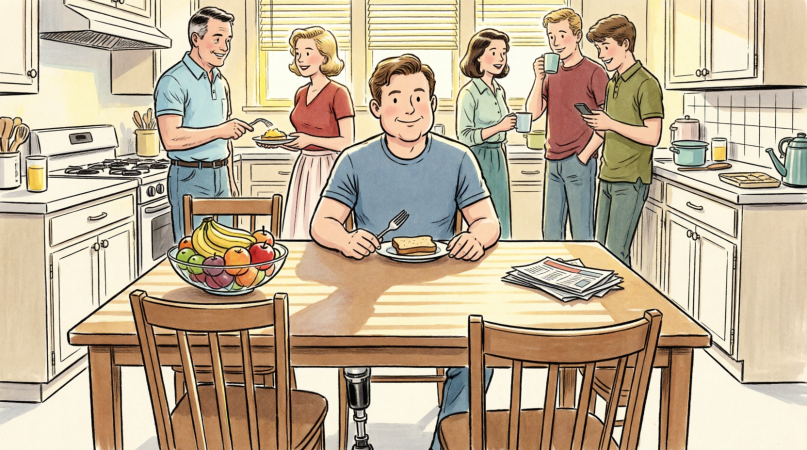
Seven chairs at the table. Six on the trip. And my father, who had always preferred blunt force over honesty, offering me a phrase instead of an explanation.
You get it.
That was his way of saying there would be no discussion, no pity, no room for interpretation. It was also his way of pretending I was part of the decision. Not invited, but expected to understand. Excluded, but still required to be gracious about it.
I put down my fork and said, “Of course.”
I even smiled.
Not a bitter smile. Not the kind designed to make anyone uncomfortable. Just enough softness around the mouth to keep the room easy for them. I had spent most of my life making things easy for them. Easy conversations. Easy rescues. Easy money. Easy forgiveness. If families had job titles, mine had given me one a long time ago and never bothered to tell me. I was logistics. I was emergency funding. I was last-minute coverage. I was the dependable line item that made everyone else’s lives more flexible.
My mother resumed talking first. “Florence will be hot,” she said, “but at least it’s a dry heat.”
Claire leaned forward, animated now that the awkward part was over. “I’m just excited for the food. I don’t even care what museums we see.”
Caleb was already looking at wine tours on his phone. “There’s one outside Siena that looks incredible,” he said. “Private tasting. Small group.”
Mike muttered something about baggage fees. Tessa laughed and said Dad would never survive with only a carry-on.
And that was that. The room closed around me like water settling after a stone drops through it. The ripples disappeared. Conversation moved on. No one asked if I minded. No one said they wished it could be different. No one invented a reason. They didn’t have to. They had long since learned that the less said to me, the less they had to account for.
I sat there eating dry toast while they discussed departure times, transfers, luggage limits, rooftop dinners, and whether Venice was too touristy now. I nodded when someone looked my way. I sipped coffee. I watched my father dab yolk from his chin with a napkin. I listened to my mother talk about linen pants as if she had discovered civilization. I watched Claire rest her head on Caleb’s shoulder, smug with the warm certainty that things would simply work out because they always had. Mike yawned and said he called window seat. Tessa laughed again.
No one noticed when I went quiet, because quiet had always been the easiest version of me to live with.
By the time I left, my mother was making a list of travel-size toiletries on the back of a grocery receipt. My father asked Mike to compare airport parking options. Claire wanted to know whether they should prebook the Vatican. Caleb said we should all do the Colosseum at sunrise, then corrected himself with an embarrassed grin.
“We should all,” he repeated, then let the sentence die.
I stood in the doorway with my keys in my hand, and for one strange second I had the urge to laugh. Not because it was funny. Because it was so familiar it bordered on parody. If I had written the scene myself, I would have toned it down to make it believable.
“Drive safe,” my mother called.
I said I would.
The whole way home, I kept waiting for anger to arrive. I expected my chest to tighten or my hands to shake or some old, hot grief to rise up and demand performance. Nothing happened. I drove through late-morning traffic with one hand on the wheel and my prosthetic adjusting slightly against the socket where humidity always made the fit feel tighter. I listened to an old jazz station. I stopped at a light behind a landscaping truck with one taillight out and thought, with total clarity, They meant every second of that.
Not because I was difficult. Not because I had done something recently to offend them. Not because of scheduling or space or expense. They excluded me because they could. Because leaving me out had become part of the family architecture. It didn’t require planning anymore. It was load-bearing.
My name is Mason. I’m thirty-six. I build infrastructure for a living.
That’s the simplest way to explain it. Networks, cloud systems, access management, digital transitions, compliance, continuity. Businesses hire me because most people don’t think about the invisible things holding their operations together until something fails. They notice the website when it goes down, the lock when it won’t open, the payroll portal when no one can log in, the phone system when customers get silence instead of help. What they don’t notice is the web beneath it all. The permissions. The redundancies. The backup lines. The quiet, expensive order that makes their chaos look effortless.
I was good at that work because I understood dependence better than most people. I had lived inside it. I knew what it meant to be needed without being valued. To be thanked in public and consumed in private. To become essential in ways that erased your personhood.
When I got home that afternoon, I took off my jacket, made tea, and sat at the edge of my couch looking out at the parking lot below. A woman in the next building walked a small white dog in slow circles. Someone somewhere was practicing scales on a piano and missing the same note over and over. I thought about Italy, about the ease with which they had arranged it in front of me, about my father’s phrasing.
Just the six of us. You get it?
He had said it like a boundary. What he meant was a command.
The bank alert came at 9:17 that night.
I was in the kitchen rinsing a mug when my phone lit up on the counter. Then again. Then again. Three vibrations in quick succession, all from the same card account. I dried my hands and picked up the phone.
ROME CITY BOOKING – $2,184.67
VENICE TRANSFERS – $863.20
FLORENCE DINING GROUP PREPAY – $1,147.90
More followed before I had finished reading the first three.
TRASTEVERE BOUTIQUE HOTEL – $2,766.11
GUIDED TOURS ITALIA – $1,009.00
AIR ITINERARY TAX/FEES – $1,229.44
By the time the screen stopped moving, the total sat just over ninety-two hundred dollars.
I stared at the numbers for a long time.
Not because I was shocked.
Because I wasn’t.
That was the part that stayed with me afterward—not the betrayal itself, but how cleanly it fit. There are moments in life that don’t hurt because they surprise you. They hurt because they confirm the thing you’ve been trying not to know.
They had used my card.
Of course they had.
My travel card was saved in half a dozen family accounts because I had used it before to book things I had been told were “temporary,” “emergencies,” “we’ll pay you back later,” or “easier this way.” There had always been a reason. Dad forgot his wallet. Claire’s card got flagged. Mike’s transfer hadn’t cleared. Mom didn’t understand the booking site. And because I made more than everyone else, because I had no spouse, no kids, no chaotic budget, because I had built a life out of discipline and structure after spending years rebuilding my body, I was always the easiest solution.
They had trained themselves to call it convenience. I had trained myself to call it love.
I didn’t yell. I didn’t call anyone. I didn’t compose a righteous paragraph and delete it twenty times. I opened the banking app, read through each charge, and disputed every single one as unauthorized. Hotels, tours, taxes, prepayments, transfers, all of it. Then I froze the card.
It took four minutes and fifty-three seconds.
The bank sent back its little confirmations one by one. Claims submitted. Card locked. Merchant investigation opened.
I placed the phone face down on the counter, turned off the kitchen light, and stood in the dark for a moment listening to the refrigerator hum. Then I made a second cup of tea, put on an old black-and-white movie I’d seen a dozen times, and sat through the entire thing without absorbing more than five minutes of plot.
At 5:42 the next morning, my mother texted.
Why did our boarding pass vanish?
I looked at the message while dawn thinned the sky outside my windows. Another one came before I answered.
Mason are you awake? We’re at the airport and nothing is showing.
Then:
Call me now.
I set the mug down. I typed five words.
I’m not on the trip.
I sent it.
Then I silenced my phone and went about my morning.
Years later, if anyone asked when things finally changed, they assumed it was the moment I disputed the card or the moment my family realized the trip had collapsed. They were wrong. The real change was quieter than that. It happened in the hour after my mother’s message, while I was standing in my apartment buttoning a shirt for work and not feeling guilty.
I had expected guilt. I had lived so long inside usefulness that withdrawing it felt, in theory, like violence. But there was none of that. No nausea. No panic. No last-minute rush of filial tenderness. Instead, there was a kind of stillness I had only ever felt in two places before: once in the rehab hospital gym when I stood on my prosthetic without parallel bars for the first time, and once years later in my first apartment after I signed the lease and realized no one else had a key.
The stillness of something ending that should have ended earlier.
The airport was only the match. The pile had been soaking in gasoline for years.
When I was nineteen, I joined the Army because home already felt like a place I was expected to survive rather than inhabit. My father respected obedience, my mother respected appearances, and both of them treated conflict like weather—something to be endured until it passed without anyone changing. I was the oldest, which in our house meant I was responsible for being mature long before anyone offered me the dignity of adulthood. Claire was the dreamer. Mike was the baby. I was the one who understood things, handled things, didn’t make scenes.
The Army gave me structure. It gave me language for endurance. It gave me rules that made more sense than whatever passed for fairness in my parents’ kitchen. It also took my left leg below the knee on a road outside Kandahar when I was twenty-four and stupid enough to think invincibility was a personality trait.
The explosion itself wasn’t the part that stayed with me. People always imagine it is—the flash, the pain, the blood, the noise. But trauma is rarely that cinematic in memory. What stayed with me was the after. The endless fluorescent light. The smell of antiseptic. The indignity of dependence. Learning how to sit, stand, balance, shower, sleep, work. Learning how strangers look at absence. Learning how loved ones say brave when what they mean is ruined, and strong when what they mean is inconvenient but still salvageable.
My parents came to the hospital twice. My mother posted photos calling me her hero. My father shook hands with everyone in uniform he could find and told them he was proud. Claire cried loudly in the room and left early because she couldn’t handle “seeing me like that.” Mike made jokes because that was his only known response to discomfort.
After I got out and used the GI Bill to finish school, after the disability checks and the insurance payout and the years of work that turned into a real career, something subtle happened in the family. They stopped treating my recovery as a tragedy and started treating my stability as a resource.
Not overnight. Not even maliciously at first. That’s what made it easy to excuse.
Dad got laid off the first time and I covered utilities for three months because “you’re doing well, and it’s temporary.” Then came the second layoff, worse than the first, and suddenly my parents were short on the down payment needed to refinance into a rate they could survive. I remember sitting in my office after hours, tie loosened, screen glowing blue in the dark, staring at the transfer amount. Forty-two thousand dollars. More money than I had ever sent anywhere in my life. My father called me son in that softened voice men use when they need something but don’t want to acknowledge the need.
“This gets us through,” he said. “Just until I’m back on my feet.”
I wired it the next morning.
There was no written agreement. No repayment schedule. Just family. Just trust. Just the unspoken understanding that one day the ledger would matter in my favor too.
Claire defaulted on two credit cards before she turned twenty-eight. I paid them down, then arranged a balance transfer, then sat at her kitchen island teaching her how interest worked while she nodded earnestly with her nails wrapped around a glass of rosé. She cried and said she had been overwhelmed. She promised it would never happen again. Three months later she leased a car she couldn’t afford and posted a beach weekend captioned healing era.
Mike wanted to start a side business with Dad—custom installations, outdoor upgrades, seasonal packages, the kind of thing men with tool belts and optimism call a venture before it becomes a tax problem. They needed a website, a booking system, a domain, email addresses, storage, cloud sync, a shared phone line, invoicing, a payment processor. I built all of it under my LLC because it was faster, cleaner, and cheaper than watching them fumble through it themselves. I told myself it would help them stand on their own.
That was my mistake, over and over. I kept confusing scaffold with foundation. I thought I was helping them build. What I was actually doing was making it possible for them never to learn.
The first time the pattern made me leave a room was Christmas Eve.
I had driven six hours through freezing rain from Columbus to my parents’ town because my mother called three days earlier and said Christmas “wouldn’t feel complete” without me. Those were her words. She said Dad had been asking whether I was coming. She said Claire was making the sweet potatoes the way I liked. She said Mike’s kids—he had twins by then from a relationship that lasted just long enough to create permanent logistical wreckage—kept asking if Uncle Mason would be there.
So I packed gifts into the trunk, drove through sleet on tired roads, and pulled up to the house just after dark with two pies from a bakery near my place and a wrapped tool set for Dad I had no reason to buy except habit.
The house was warm and loud when I walked in. Cinnamon. Ham. Someone had put on one of those old holiday compilations my mother loved. The twins were running in socks. Claire was taking photos for social media before the food had even been served. Dad was laughing too hard at something the neighbor had said.
The neighbor’s name was Ray. He owned a flooring store and wore quarter-zips like a man auditioning for regional authority. Dad had been courting him for some possible referral partnership for the side business. I shook his hand, handed over gifts, took off my coat, and realized within minutes that there were only enough seats set for everyone except me.
Not literally, of course. There was a folding chair in the kitchen near the laundry room, the kind people drag out when a child needs a place to color. But the dining table, the real table, the one laid with my mother’s inherited dishes and candles and cloth napkins, had my place occupied by Ray.
I stood there longer than I should have, still holding the pie box, while everyone settled in.
My mother saw it first. Her face flickered with irritation, not embarrassment.
“Oh, honey,” she said, as if I were the one making it awkward. “We figured you’d be fine in the kitchen. Ray’s only here because of the business connection, and you’re easy.”
Easy.
I remember that word more vividly than the rest of the night.
You’re easy.
Not loved. Not missed. Not central. Easy.
I asked where my plate was.
She blinked at me. “There are extras in the cabinet.”
No one moved. No one stood up. No one said, Wait, that’s insane, Mason drove six hours. Claire kept arranging the cranberry dish. Mike avoided my eyes. Dad clapped Ray on the shoulder and launched into some story about lumber prices. One of the twins ran through the kitchen and nearly hit my prosthetic. Caleb, who was only Claire’s boyfriend then, gave me a look that might have been sympathy if it had lasted long enough to count.
I set the pies on the counter, went back outside, and sat in my car with the heat blasting against my face until the windshield cleared.
Then I left.
Halfway home, I paused the mortgage transfer I had been quietly making every month since Dad’s refinancing. I logged everyone out of the streaming account I paid for. I drove the rest of the way in silence while my phone lit up with calls.
Mom said I was punishing the whole family over a seating issue.
Dad said I embarrassed him in front of a business contact.
Claire texted, You really couldn’t sit in the kitchen for one meal?
What I wanted to write back was: I have sat in the kitchen my entire life.
Instead I said nothing.
They wore me down by New Year’s. Mom cried. Dad said the house payment was due and it was all a misunderstanding and everyone had been stressed. Mike blamed the kids. Claire said I knew Mom got flustered when hosting. I resumed the transfer because I told myself families were messy and intention mattered more than optics.
That was how it always happened. An injury, then an explanation. A humiliation, then a reason. A cut, then a hand extended only long enough to keep me in range for the next one.
The anniversary dinner came a year later.
My parents’ thirtieth.
Mom wanted a “special evening,” which in her vocabulary meant something expensive enough to photograph. Dad wanted a private room because he liked being watched while he pretended not to enjoy it. Mike said if we were doing it, we should do it right. Claire sent me links to venues with captions like this one is classy but not stuffy and can you just call them? Caleb offered opinions without offering money.
I booked the restaurant. Private dining room. Tasting menu. Wine pairings. Floral arrangement. Dessert service. A jazz trio in the adjoining lounge. Seven thousand five hundred dollars once the final guest count shifted and my mother added people from church she swore she barely knew.
I paid the deposit and put my card on file for incidentals because the manager and I had worked together before, and because the simplest thing was always to remove friction before my family could create it.
The night itself was beautiful if you looked at it from far enough away. Candles. Crystal. Low gold light on polished silverware. My mother in navy silk pretending she didn’t love the attention. Dad standing straighter than usual, already two bourbons into magnanimity. Claire in something backless and expensive. Mike in a suit that fit like it hated him. Caleb talking loudly about wine as if pronunciation were scholarship.
I sat near the end of the table, where I always sat in rooms arranged by other people—close enough to be useful, far enough to be forgotten in photographs.
Dinner moved along. Toasts. Stories. A lot of revisionist history dressed up as sentiment. My mother thanked God, perseverance, and “the strength of family.” Dad spoke about sacrifice. Claire cried once at exactly the right moment. Mike drank too fast.
Then, during the entrée course, Mike stood to give his toast.
He raised his glass, grinning, cheeks already flushed.
“To the people who actually matter,” he said.
The room laughed before the words had even landed.
He went on. Something about blood, loyalty, the real family table, the people who stick close, the ones who build the next generation. He didn’t say my name, which somehow made it worse. He kept it abstract enough to be deniable and specific enough for everyone to know. Claire lowered her eyes and smiled into her napkin. Caleb smirked. Mom did that fake scolding face women make when they are secretly delighted by a cruelty too useful to interrupt. Dad chuckled and said, “All right, all right,” but not in a way that stopped anything.
I let Mike finish.
Then I excused myself, walked to the front desk, and asked the manager to remove my card from the final settlement and return the deposit to the house account pending “billing clarification.” We had enough professional history for him to hear the tone beneath the words. He nodded. No drama. No speech. Just administrative reversal.
I left before dessert.
Later, I heard what happened when the bill arrived. Dad had assumed it was handled. Mike had assumed Dad would handle it. Claire’s card was maxed. Caleb suddenly needed to call his bank. My mother cried in the hallway because the church friends were still in the lounge. The manager, who was kinder than he needed to be, split the check into smaller amounts and let them piece it together like a ransom. Mike sold a watch two days later to cover his share.
Did anyone apologize for the toast? Not really.
Mike said I was too sensitive. Dad said men in families give each other a hard time. Mom said it was a misunderstanding. Claire said I had “ruined the memory” by making it about me.
That phrase stuck too. Ruined the memory.
As if memory were theirs to curate and mine to endure.
Claire’s wedding was worse because I stayed.
I should have walked. Every version of me with a functioning self-respect reflex should have walked. But weddings are public, and public cruelty always has extra leverage. There were guests. There were photographs. There was our grandmother still alive then, fragile and forgetful and thrilled to see all her grandchildren in one place. Claire knew that. My mother knew that. The entire family counts on witnesses when they need me obedient.
The wedding was at a vineyard outside Asheville, all white florals and dusty pink dresses and string lights hung from oak branches like the evening had been curated by a committee of women named Brooke. Claire had been engaged to Caleb for eleven months and over budget by the third. I had already “helped” with the venue deposit, the rehearsal dinner liquor balance, and the shuttle service after Mike forgot to book transportation until the week before.
The morning of the ceremony I got a notification from my card processor.
Nine thousand eight hundred dollars.
Event balance cleared.
I was standing in the groom’s suite at the time because Caleb had asked if I could help one of the groomsmen with a cuff link. I read the notification twice, then walked across the venue grounds to the bridal cottage.
Inside, it smelled like hair spray and champagne. Claire was in a satin robe while three bridesmaids filmed everything for social media. The makeup artist stepped aside when she saw my face.
“Did you just run the venue balance on my card?” I asked.
Claire looked at me in the mirror, not turning around. “Probably. My card was doing that fraud thing again.”
“That’s nearly ten thousand dollars.”
One of the bridesmaids laughed, thinking this was rich people sibling banter.
Claire finally turned. “Mason, please don’t do this today.”
“Do what?”
“This.” She waved a manicured hand between us. “The accounting thing. We’re literally hours from the ceremony.”
“You used my card without asking.”
She exhaled hard, like I was the unreasonable one. “You don’t have a spouse or kids. You don’t have these expenses. Might as well make yourself useful.”
The room went quiet then, but not with shock. More with interest. The bridesmaids were watching now in that bright-eyed way some people watch conflict when they know they won’t be the one paying for it.
I stared at my sister in her robe, at the stylist pinning curls in the background, at the champagne tower waiting on a sideboard, and understood with humiliating clarity that she believed what she had said. She didn’t think it was cruel. She thought it was obvious.
Useful.
That was my designation in the wedding too. Not brother. Not family. Utility.
I paid it.
I hate that part of the story, but I paid it.
I paid it because Grandma was there. I paid it because Claire would have made the entire day about my “timing” if I didn’t. I paid it because every survival skill I had developed in childhood and rehab and adulthood still misfired sometimes into appeasement. I paid it and stood for photographs while the socket rubbed my skin raw by hour six and Claire cried at vows she had partially workshoped from three Pinterest boards.
People assume exploitation always looks violent. Most of the time it looks like being needed in public and resented in private.
The backyard remodel should have been the last straw before Italy, but I still found a way to explain it away.
My parents’ house had a cracked deck, sinking pavers, and a patch of yard that turned to mud whenever it rained. Dad kept talking about fixing it himself. He never did. Mom kept sending me photos of magazine patios with captions like someday. After a good year at work, I told myself I was doing something generous, something that might make the house easier for Dad as he got older, something that could serve as a place for the whole family to gather without somebody balancing a paper plate on their knee in a folding chair.
So I paid for the redesign. Hardscape, pergola, drainage, outdoor lighting, the works.
Mom cried when I told her. Dad clapped me on the back. Mike called me a machine. Claire said, “See? I always knew you were secretly sentimental.”
The project took six weeks.
Two days before the reveal dinner, my mother called and said, in a tone so casual it took me a second to understand it, “We decided the celebration will just be immediate family.”
I thought she was joking.
“I am immediate family,” I said.
“No, honey, you know what I mean. Couples. Kids. The unit. It’s just easier.”
Easier.
There it was again. That wonderful family word they used whenever they wanted me invisible and compliant at the same time.
I canceled the final payment the next morning and instructed the contractor to halt finishing work pending ownership clarification. Mom showed up at my door that afternoon furious, mascara smudged, voice pitched high with outrage.
“How dare you embarrass us like this?”
I remember opening the door only halfway. I remember the sunlight behind her making her look almost translucent with anger. I remember feeling tired rather than upset.
“How dare I?” I asked. “You excluded me from a dinner for a backyard I paid for.”
“It wasn’t exclusion,” she snapped. “It was logistics.”
In my family, every insult arrived dressed as logistics.
That was the phrase I kept coming back to after Italy. Not the card alert. Not the airport text. Logistics. Practicality. Convenience. All the sterile little words people use when they want to remove the blood from what they’re doing.
Because Italy was never about airfare or boarding passes. It was about position. It was about where I stood in the family’s emotional blueprint and how long I had mistaken access for belonging.
I didn’t sleep much the week after the bank dispute, but not because I felt guilty. I slept badly because memory got loud once the noise stopped. Every time the room went still, old scenes floated up with ugly precision. Christmas. The anniversary dinner. Claire’s wedding. The backyard. The dozens of smaller moments that never sounded serious enough on their own to repeat to outsiders.
The way Mom used my veteran status for social admiration but changed the subject when I talked about actual pain.
The way Dad introduced me to people as “the successful one” with a grin that somehow managed to sound both proud and accusatory.
The way Mike called whenever he needed money “just until Friday” and treated repayment like a philosophical category rather than a real one.
The way Claire always phrased requests as if they were chances for me to demonstrate love.
The way every generous thing I did immediately became a precedent.
That was the architecture I finally saw in full. Not random selfishness. Not forgetfulness. A system. Their spontaneity existed because my stability underwrote it. Their risks felt lighter because I was there to absorb failure. They could overspend, underplan, assume, demand, exclude, and rearrange because somewhere in the background I existed as correction. I was the hidden support beam behind every impulsive dinner, every half-funded dream, every convenient family myth.
They assumed I would never pull out.
They were wrong.
The morning after my mother’s airport text, I went into work, closed my office door, and opened a yellow legal pad.
At the top of the page, I wrote one sentence.
What still runs through me?
Then I made a list.
Communications.
Identity.
Access.
House systems.
Utilities.
Business.
Documentation.
I didn’t do it in anger. Anger clouds sequence. I did it the same way I approached disaster recovery for clients—methodically, legally, with clear distinction between what was mine, what was shared, and what I had a right to discontinue.
First came communications.
The family phone plan had started years earlier as a convenience when Dad’s carrier overcharged him and Mike missed a payment. I had moved everyone onto my business-family package because it gave better rates and unlimited data. Over time that turned into five lines under my billing responsibility: Dad, Mom, Claire, Mike, and the line Mike set up for Tessa after she cracked her phone screen and couldn’t qualify for financing on her own.
I logged into the account that afternoon.
I didn’t cancel the lines immediately. That would have been drama, and drama gives people something to rally around. Instead I initiated ownership transfer notices for each number, giving them seventy-two hours to accept and assume responsibility. If they didn’t, the lines would suspend automatically. Clean. Contractual. Not revenge. Administration.
The notices went out while they were still abroad.
Second was identity infrastructure.
The family had used a shared password manager for years because no one but me could remember their logins. It was my subscription, my vault hierarchy, my recovery key. Inside it lived access to airline accounts, shopping profiles, streaming services, utility portals, cloud drives, travel rewards, digital copies of warranties, old tax PDFs, and every note my mother had ever titled important with all the precision of a Victorian diary.
I changed the master key, exported my own data, and removed the family group.
That didn’t block them from their accounts. It blocked them from the convenience of me. From the habit of having one calm person somewhere able to reset everything when they inevitably forgot their own information.
Third was physical access.
The house I had helped save in Dad’s refinance ran on systems I had installed and licensed. Smart locks. Thermostat. Mesh Wi-Fi. Security cameras. Garage integration. Cloud backup. It had all started after a break-in on the street two years earlier. Dad wanted “the good setup.” I built one. Sensors, cameras, centralized controls, remote support, updates pushed quietly in the background. I paid for the ongoing license cluster because it was bundled with other systems under my enterprise account and easier that way.
Sunday afternoon, while they were scrambling somewhere between blame and denial in an airport lounge, I suspended the managed services tier and restored the house to local-only defaults.
The doors would still lock and unlock manually.
The thermostat would still work from the wall panel.
The cameras would still record to the local drive until storage filled.
What disappeared was remote monitoring, cloud access, mobile control, alerts, archival retrieval, and support.
I did not brick their house. I simply stopped donating a premium system.
Fourth was money.
This was the part people think is dramatic, but legally it was the most boring of all. I had been quietly covering their electric and water bills through autopay for nearly two years because Dad’s cash flow fluctuated and Mom hated “dealing with utility portals.” I had also been the backup co-signer on the mortgage restructure because my income was the difference between approval and rejection at the time.
Monday morning, I contacted the lender and informed them I would no longer serve as a secondary guarantor on any upcoming modification or hardship protections. The original paperwork had sunset language tied to review periods. My withdrawal triggered reassessment for the next cycle. Their rate benefits would not disappear overnight, but the protective buffer I had negotiated would.
Then I removed my bank account from the utility autopays.
Electric: deleted.
Water: deleted.
Trash service: deleted.
Internet remained active only because it was attached to the business account for the side venture. That problem belonged in a later category.
Fifth came the soft conveniences that become hard dependencies when people stop noticing who pays for them.
Amazon household access.
Gone.
Streaming.
Gone.
Cloud photo storage.
Gone.
The storage unit where Dad kept heirloom tools, old holiday decorations, broken patio furniture, and boxes of things no one had touched in years because my mother couldn’t throw away evidence of previous versions of herself.
Lease terminated effective end of week. Notice sent to registered email. Items subject to facility rules if not retrieved.
I didn’t even enjoy any of it. That’s the thing people who’ve never been used misunderstand. They imagine withdrawal comes with some operatic pleasure. It didn’t. It felt like changing dressings on an old wound—necessary, a little ugly, and long overdue.
Sixth was the blind spot.
Their business.
The side hustle Dad and Mike liked calling a family company was, in truth, a chain of informal labor held together by my digital backend. I owned the domain. I paid for the hosting. The shared email workspace lived under my professional tenant. The CRM, the file sync, the cloud proposals, the estimate templates, the customer intake forms, the payment gateway, the backup archive—all of it had been provisioned through my firm as a courtesy while they “got established.”
Established, in family language, often means indefinitely subsidized.
I called a colleague named Devon who specialized in emergency business transitions and white-label support for small contractors who suddenly realized systems are not magic.
“You may get an angry call from a company that thinks passwords are oppression,” I told him.
He laughed. “Do you want me to quote normal rates or family-disaster rates?”
“Full rate card,” I said. “No favors.”
Then I drafted a clean notice and posted it to the admin dashboard before revoking their licenses.
This workspace was maintained under a courtesy agreement through Mason Hayes Consulting. As of today, that agreement has been discontinued. Please contact a licensed provider for future support.
No insults. No accusations. Just terms.
By Wednesday the group chat was unraveling.
It started with Claire.
Why can’t I log into the hotel app?
Then Mike.
Did you change the house cameras??
Then Mom.
The Wi-Fi won’t reconnect and the banking portal won’t take my password. Mason did you do something?
Then Dad.
Fix it.
I looked at the messages while eating lunch at my desk and felt almost detached from them, as though I were monitoring alerts from a system I no longer managed. They weren’t asking questions because they wanted truth. They were pinging infrastructure. They had lost access and were pressing buttons to see whether support would answer.
I did not answer.
Not even a period.
That silence enraged them faster than any speech I could have given. Silence is intolerable to people who are used to summoning you with urgency.
Friday evening my mother left the first voicemail.
“Mason,” she began, her voice already thick with theatrical distress, “this isn’t like you. We’re scared. We don’t understand what’s happening.”
Scared.
That word almost made me smile.
Because what they were actually feeling was disorientation. Systems they didn’t know they depended on had gone dark, and for the first time no one was stepping in to spare them the administrative consequences of adulthood.
My father’s message came Saturday.
Long. Angry. Full of phrases like after everything we’ve done for you and you used to be grateful and this is how you repay your family. I read it twice, just to be sure I wasn’t missing some hidden remorse. There was none. No mention of the unauthorized charges. No apology for breakfast. No recognition that using my card without permission might, in some moral universe, be relevant to the current situation.
In their minds, this wasn’t consequence. It was rebellion.
I had stepped out of my assigned role.
That terrified them more than the failed trip.
The smearing started three days later.
My mother was always most dangerous when she felt cornered but still believed the audience could be won. Public sympathy is a narcotic to women like her. She doesn’t want justice. She wants consensus. She wants enough people nodding softly around the edges of a lie that the lie begins to wear the shape of truth.
At 3:14 in the morning, while I was asleep, she sent a group message to immediate and extended family.
Mason has decided he is no longer part of this family. Please do not contact him. He is not himself right now and needs help.
Then, before breakfast, she posted a vague status on Facebook.
Some people turn on the ones who loved them most once they get a little money. Sad how success changes hearts.
Claire shared it within ten minutes.
We’re fine. Family always sticks together, even when some forget what that means.
Mike commented with a prayer-hands emoji and nothing else, which was somehow worse.
An aunt from Tennessee messaged me privately: Your mother says you’re having some kind of episode.
A cousin texted: Are you okay? Heard things got bad.
Dad, never as subtle, left me a voicemail half-drunk and bitter. “You think you’re untouchable? You’re not. We can play games too.”
Another relative I hadn’t heard from in months called to say, in that slippery tone people use when they want credit for neutrality while carrying gossip in both hands, that maybe I should “take the high road” and restore whatever I had shut off because “this is becoming a family embarrassment.”
That word again.
Embarrassment.
Not theft. Not exclusion. Not exploitation.
Embarrassment.
As if the true offense in our family had always been not the injury itself but the moment it became visible to outsiders.
The ugliest lie came through a mutual family friend who told me my mother had been saying I hadn’t been stable “since the accident.” That the injury changed me. That money and bitterness had gone to my head. That I had become cold. Dangerous. Unpredictable.
I sat in my car after hearing that and laughed so hard I had to wipe my eyes.
Not because it was funny.
Because it was efficient.
When they could no longer control my behavior, they moved to discredit my perception.
There it was. The final tool from the family box.
If he won’t stay useful, make him unsound.
That Sunday I went for a walk in the late afternoon, headphones in, hands in my jacket pockets, trying to decide whether silence was still the correct response or whether silence had started feeding a version of events I no longer had any obligation to protect. Halfway down the block my phone buzzed with a security alert from my driveway camera.
My parents’ SUV.
I watched the live feed from the sidewalk.
They pulled in. Didn’t knock. Didn’t ring. Dad got out, looked around as if expecting spectators, and slipped an envelope through my mail slot. Then they left.
When I got home, the note inside was in Dad’s handwriting.
You think this makes you strong, but in the end you’ll realize you still need us. And when you do, don’t expect a welcome.
Folded behind the note was a printout of a bank transfer from three years earlier—the fifteen-thousand-dollar emergency transfer I had sent when their furnace failed in January and the pipes nearly froze. Dad had highlighted one line in yellow.
We never asked for it.
I read that sentence four times.
It was supposed to absolve them.
It was supposed to imply that because I had offered help before they verbally requested it, I had surrendered forever any right to interpret their behavior through a moral lens. As if voluntary generosity erases later exploitation. As if a gift forfeits boundaries.
Instead, it did something better.
It clarified the worldview.
In their minds, nothing I gave counted unless they decided it did. Nothing I covered earned standing. Nothing I built created obligation. I had simply been available, and availability, in their logic, was consent.
That was the day I stopped trying to preserve anyone’s dignity but my own.
I went home, made coffee, opened my laptop, and created a folder.
Family Ledger.
The name was deliberately plain. Not revenge. Not exposure. Not truth bomb or any of the melodramatic labels hurt people choose when they still want emotional impact. I didn’t want impact. I wanted precision.
Inside the folder I built subfolders by category.
Housing.
Travel.
Utilities.
Business.
Events.
Messages.
Audio.
I spent five hours exporting records.
Bank statements with charges highlighted.
Receipts tied to my card for flights, hotels, and tours associated with Italy, all booked before the breakfast announcement.
Screenshots of texts asking me to “just cover this” and “we’ll settle later,” with no settlements anywhere in sight.
Venmo records with heart emojis instead of repayments.
Invoices from Claire’s wedding.
The restaurant contract from my parents’ anniversary dinner.
The home automation service agreement.
The phone plan bill.
The storage lease.
The workspace admin records for the business.
I included short audio clips too—just enough to establish pattern, never enough to veer into spectacle. Dad joking to someone, “Maybe we can squeeze another free trip out of Mason.” Claire laughing in a kitchen one Christmas and telling Mom, “He’s too soft to say no. He always pays.” A voicemail from Mom after the backyard incident saying, “You know you can afford to be generous, so why are you making this ugly?”
I didn’t annotate much. Facts are stronger when they don’t beg.
Each file got a sterile title.
Italy_Charges.pdf
Anniversary_Dinner_Deposit.docx
Wedding_Balance_Notification.png
Mortgage_Transfer_January.jpg
Voicemail_Backyard.m4a
Text_Useful.png
Then I added one note at the top of the folder.
This isn’t revenge. This is balance. You told your story. I’m sharing mine with footnotes.
I did not blast it publicly. That would have been theater, and theater is where my family thrives. I sent the folder link to a small number of people who had either confronted me with my mother’s version or had been visibly participating in the whisper campaign: two cousins, my aunt who liked to call things “family embarrassment,” my grandfather’s nurse who had known more than anyone how often I showed up without announcing it, and one old family friend who still commented on every one of Mom’s social posts with an intensity that made me suspect she considered herself an unofficial keeper of our household mythology.
Then I closed the laptop.
The ripple was immediate.
My cousin Jenna texted first.
Holy hell. They said you snapped.
A minute later Uncle Lee, who rarely involved himself in anything unless it had already crossed into objective absurdity, sent: Your mother is deleting posts.
Then the old family friend called me, not to defend my mother, not to scold me, but to say quietly, “I knew there were things I didn’t know. I did not know it was this much.”
That mattered more than I expected.
Not because I needed validation. By then I no longer doubted what had happened. But because manipulation survives on social fog. It feeds on ambiguity, on people saying there are two sides when only one side has receipts and the other has vibes. I had spent years being the family’s private infrastructure. The moment I made the invisible visible, they lost altitude fast.
Mom’s Facebook post vanished by noon.
Claire turned off comments on her page.
Mike left the family group chat for six hours, then rejoined when he realized leaving looked too much like guilt.
Dad called twice and didn’t leave a voicemail, which told me more than any words could have. Men like him do not fall silent unless the audience has shifted.
My lawyer called that evening. I had sent him the compiled records earlier in the week, not because I was planning a lawsuit but because I wanted professional distance between me and the narrative in case things got uglier. He asked whether I intended to pursue defamation. I told him not yet. He asked whether I wanted a formal cease-and-desist drafted in case the mental-instability story kept spreading. I told him to prepare one but not send it unless necessary.
“Are you getting ready for a war?” he asked.
“No,” I said. “I’m getting ready for peace.”
He was quiet for a second after that.
“Those are often the same documents,” he said.
The barrage came after dinner.
Mom: This isn’t fair. You’re airing private things.
Dad: You have no idea what you’ve done.
Claire: Congrats on the pity tour.
Mike: Bro this is insane.
What none of them said—not one of them, not even in anger—was that anything in the folder was false.
That was the hinge.
All their outrage had to route around the truth because the truth was now indexed, dated, archived, and boring in the way facts so often are. They wanted emotion. I gave them spreadsheets.
That broke them more efficiently than any screaming ever could have.
The next morning I sent one final message to the group chat.
I am no longer available.
Five words.
Then I left the chat, blocked their numbers, forwarded future emails from their domains to a filtered folder, and archived everything.
You never delete evidence if the people involved have a habit of rewriting history.
For the first week after that, the quiet felt almost unnatural.
No requests.
No emergencies.
No “can you just.”
No sudden pings from Mom about an appliance.
No late-night messages from Claire framed as vulnerability but timed perfectly to coincide with bills.
No Mike jokes hiding a financial ask in the second paragraph.
I expected to feel lonely. What I actually felt was spacious.
My apartment changed character in the silence. The rooms seemed larger. Morning coffee tasted different when it wasn’t accompanied by a sense that somewhere, somehow, another problem was about to find me. I slept better. My blood pressure dropped enough that my doctor commented on it at a follow-up appointment. The skin breakdown around my prosthetic socket improved because stress had been keeping my gait tighter than I realized. I started staying late at the office only when I wanted to, not because work was simpler than waiting for family obligations to appear.
Around that time Maya entered the visible part of my life.
She hadn’t appeared out of nowhere. I had known her for almost a year. We met through a mutual friend at a benefit event and kept running into each other in the kind of adult orbit where people are too busy for dramatic beginnings and old enough to appreciate steadiness. She was an architect, divorced, funny in that dry, intelligent way that never needed a stage. We had been dating quietly for several months before Italy, though I had kept her at the edges of my family life because I knew, without wanting to admit it, that bringing anything good into that system would simply create a new surface for them to touch.
Maya never asked me to defend my family.
That alone felt radical.
The first time I told her the real scope of what they had been using me for, she didn’t say but they’re still your family. She didn’t say maybe they didn’t realize. She didn’t say forgiveness. She looked at me over a glass of red wine and said, “That sounds expensive in more ways than one.”
I laughed.
Then I nearly cried.
People don’t understand how healing it is when someone names the thing without minimizing it.
She stayed over more after the fallout started. Not to supervise me, not to become my conscience, just to exist nearby in a way that made my own apartment feel less like a bunker and more like a life. She brought groceries without fanfare. She made coffee stronger than mine. She listened without turning my pain into a morality play.
The day my parents finally came to the house, it was Maya who opened the door.
It was a Tuesday in late afternoon. Sun low. Air heavy with that dull heat that sticks to siding and asphalt. I was in the kitchen reviewing a proposal when the doorbell rang. Maya was closer, so she went.
A second later she looked back at me and said, “It’s your call.”
I stood slowly, not because I was afraid, but because I already knew what version of them would be on the porch.
Not broken.
Not humbled.
Cornered.
When I stepped into the foyer, I could see them through the glass pane beside the door. Mom in a pale blouse, hands clenched too tightly around her purse strap. Dad stiff-backed, jaw set, the expression of a man forced into a situation he still believed should somehow end in his reinstated authority. Claire off to one side in oversized sunglasses even though the porch was mostly shaded, as if she had dressed for an encounter she intended to control visually before emotionally.
Maya stepped aside.
I opened the door and went out onto the porch, but I did not invite them in.
That mattered.
Some part of them registered it immediately. You could see it in the tiny adjustment of posture, the almost imperceptible surprise when boundaries become physical.
Mom spoke first. Of course she did.
“We didn’t come to fight,” she said, voice already trembling in a way that invited me to reassure her.
I leaned against the frame and waited.
Dad cleared his throat. Claire looked at the street, then back at me.
Mom tried again. “We’ve been thinking about everything. We want to make this right.”
Maya stayed just inside the open doorway behind me. Not looming. Not hiding. Present.
I looked at my family, the people who had spent years treating my existence like a utility bill, and noticed how tired they seemed. Not grief-tired. Management-tired. The exhaustion of people whose usual tactics had stopped producing the expected result.
Claire took off her sunglasses.
“We miss you,” she said.
Three words.
Perfectly calibrated. Soft enough to sound sincere. Broad enough to avoid accountability.
Something almost tender passed through me then, but it wasn’t forgiveness. It was recognition. I knew this script. I had funded it for years.
“You don’t miss me,” I said. “You miss what I gave you.”
The silence after that sentence was one of the cleanest sounds I’ve ever heard.
Mom blinked hard and looked wounded. “How can you say that?”
“Because it’s true.”
Dad stepped in before she could cry. “Look, you made your point.”
That line.
I nearly laughed.
Made my point.
As if this had been a demonstration. A little family presentation. A discipline tactic. As if I had pulled support just long enough to communicate and would now, reasonable man that I was, restore everything once the lesson had landed.
“You still think this is about a point,” I said.
“What is it about then?” Claire snapped, slipping. There she was. The impatience beneath the performance.
I stepped fully onto the porch. My prosthetic gave that faint mechanical click it sometimes makes on old wood, a sound I have stopped hearing in my own life but notice in moments like that because other people suddenly remember my body again when they need leverage.
“It’s not about Italy,” I said. “Not really. It’s not about the wedding or Christmas or the anniversary dinner or the backyard. It’s about the fact that every time I was useful, you called it love, and every time I wanted basic respect, you called it drama.”
Mom started crying then. Quietly. Controlled. The tears of someone who has learned they are most persuasive in moderation.
“We didn’t realize,” she said.
That sentence hit something old and hot in me.
“How far did it have to go,” I asked, “before you would have realized?”
No one answered.
Dad shifted his weight. “Family needs to heal.”
“Heal from what?” I asked. “Accountability?”
He frowned. He hated words like that in family conversations. They sounded to him like therapy language, legal language, modern language. Things that implied behavior had frameworks beyond his temper.
Claire folded her arms. “You really think you’re innocent in all this?”
“Innocent?” I repeated. “No. I think I was complicit. I think I let this go on for too long because I kept hoping if I showed up enough, paid enough, fixed enough, one day you’d actually see me. That’s on me. But I’m done participating.”
Mom took a small step forward. “Mason, sweetheart—”
“No.” I raised a hand. “Don’t.”
She stopped.
“You don’t get to do sweetheart now. You don’t get endearments at the end of an audit.”
Dad’s face hardened. “Audit. Listen to yourself.”
“Yes,” I said. “Listen to me. For once.”
No one moved.
The neighborhood was very quiet. Somewhere down the street a lawnmower droned and stopped. A wind chime tapped against itself. Maya remained behind me, one hand resting lightly against the doorframe, not intervening, which I appreciated more than if she had.
I took a breath.
“You didn’t lose a card,” I said. “You didn’t lose passwords, or a phone plan, or a business backend, or utility autopay. You lost access to a person you only treated well when he was making your lives easier. And I’m not interested in going back to that arrangement.”
Claire’s voice cracked then, not with sadness but with frustration. “So what, that’s it? You just erase us?”
“No,” I said. “You did the erasing. Repeatedly. I just finally stopped filling in the blank.”
Dad’s jaw flexed. “After everything we did for you.”
There it was. The old family invoice. Food on the table when I was a kid. A roof. Basic parenthood reissued eternally as debt.
I looked at him, and for the first time in my adult life I did not feel twelve years old under my father’s anger.
“You mean raising your son?” I asked. “You want credit for the minimum forever while using that to excuse the rest?”
Mom whispered, “Please.”
I softened only enough to keep from saying things that would have turned clarity into cruelty.
“I don’t hate you,” I said. “That’s the part you still don’t understand. I’m not doing this because I hate you. I’m doing it because I finally love myself enough to leave.”
No one spoke for several seconds.
Then Mom asked the question that ended it.
“But what are we supposed to do now?”
Even now, after everything, she asked it like the center of the story was logistics. Like the true catastrophe was not that they had broken something human beyond quick repair, but that the service line had been cut.
I looked at her and felt the last of my hope for mutual understanding go quiet.
“You rebuild,” I said. “Or you don’t. But not on my back.”
Then I turned, walked inside, and closed the door.
Not slammed. Closed.
I stood in the foyer for a moment, hand still on the knob, listening.
They stayed on the porch for another five minutes. Long enough to believe maybe I would return. Long enough for Dad to say something low and angry I couldn’t make out. Long enough for Mom to sniff and Claire to pace once, sharply, across the boards.
Then their footsteps receded. Car doors shut. Engine started. Silence.
Maya came up beside me and didn’t ask how I felt.
She just said, “Do you want tea or whiskey?”
I laughed.
“Tea,” I said.
“Good answer,” she said.
That was three months ago.
They haven’t come back.
There have been indirect attempts, of course. There always are. A birthday card from an aunt with a handwritten note about how life is short. A holiday text from a cousin fishing for status updates disguised as care. One voicemail from a blocked number I recognized as Mike’s ex, awkwardly suggesting “maybe everybody has grown.” I ignored them all.
Not because I am bitter.
Because distance is not bitterness. Distance is a tool. It is what you use when closeness has been converted into extraction.
In the months since, I’ve had to relearn things I should have known earlier. That peace can feel boring when your nervous system has been trained to anticipate intrusion. That guilt often shows up after boundaries not because the boundary is wrong, but because the old system is protesting its own starvation. That family is not a moral coupon redeemable against any future harm. That usefulness is not love. That generosity offered under compulsion is not virtue.
I also learned something harder.
I learned that I had participated in my own disappearance.
Not caused it. Not deserved it. But participated.
That’s the part no revenge story ever tells cleanly, because it spoils the satisfying lines. People want villains and exits and moments where the music swells. Real life is uglier. I let too many things slide because I was raised to mistake endurance for goodness. I told myself silence was maturity when sometimes it was fear. I called it keeping the peace when what I was actually keeping was my place in a system designed to reduce me to function.
Rehab after the war had taught me to celebrate small victories. Stand for ten seconds. Then twenty. Walk to the parallel bars. Then past them. Learn the straps. Learn the pressure points. Learn how to fall and get back up without shame. Somewhere along the way, I took that discipline and applied it to family pain too. I thought if I could just absorb one more impact gracefully, I would eventually arrive at something resembling belonging.
But grace without boundaries becomes permission.
That realization cost me a family, or at least the version of one I had spent years pretending I had.
The practical aftermath was less dramatic than people imagine.
Dad eventually transferred the phone line into his own name after losing service for twelve hours and discovering no one in the family actually knew how to navigate carrier menus. Claire hired a travel agent for a later anniversary trip she bragged about online with captions implying resilience. Mike and Dad moved the business to some bargain software stack held together with duct tape and optimism; Devon told me they complained about his rates before paying them anyway. Mom learned at least one of her utility passwords because she accidentally texted an old screenshot to an aunt. The house cameras went half-dead after storage filled because no one understood retention rules. The storage unit contents were mostly retrieved two days before the deadline, though I heard through someone else that Dad threw half the boxes into his garage without sorting them and spent weeks blaming me every time he tripped over Christmas lights.
They survived.
That mattered to me more than I admit out loud. Not because I wanted them comfortable, but because some small animal part of my brain had been conditioned to believe that if I stepped away they would collapse and the collapse would be my fault. Watching them survive, badly and resentfully and more expensively than before, was instructive. It proved something I should have understood years earlier.
They never needed me the way they said they did.
They needed not having to grow up.
There’s a difference.
Maya pointed that out one night while we were cooking. She was chopping basil. I was making pasta. The kitchen smelled like garlic and olive oil and summer rain through the cracked window. We had not been talking about my family at all. Then out of nowhere she said, “They outsourced adulthood to you.”
I leaned against the counter and looked at her.
“That’s exactly it,” I said.
She shrugged. “Some people are very attached to the illusion that they’re spontaneous when really they’re subsidized.”
That made me laugh so hard I had to set down the spoon.
I think about Italy sometimes.
Not in the petty way people assume. I don’t picture them stranded and feel triumphant. I picture that breakfast table. The eggs. The toast. My father saying, You get it. The total ordinary confidence with which they arranged my exclusion and my payment in the same forty-eight-hour period. That, more than anything, is what cured me. The elegance of the entitlement. The way they no longer even bothered to hide the structure because they assumed I had accepted my place in it forever.
They were almost right.
Another year, another incident, another apology dressed as explanation, and maybe I would have kept going. Maybe I would have funded more dinners, more vacations, more “temporary” emergencies, more systems. Maybe one day I would have found myself old and exhausted and still being spoken to like a well-behaved extension cord.
I am grateful, in a cold and ugly way, that they got careless enough to make the pattern visible all at once.
People like to ask, when they hear a version of this story, whether I miss them.
Sometimes.
But not the way they mean.
I miss the family I kept inventing around the evidence. I miss the fantasy that one more act of generosity would finally convert tolerance into love. I miss the child version of me who still believed reliability earned safety. I miss my grandmother and the simpler years before money and injury and adult failure turned our house into a set of unspoken invoices. I even miss occasional things about my parents as they were before I understood them completely—Dad teaching me to sand a board smooth in the garage when I was ten; Mom humming while folding laundry in summer light; Claire and Mike and I racing bikes down the block until the streetlights came on.
But missing what was once possible is not the same as wanting back what exists now.
That distinction has saved me.
The first holiday after the cutoff was Thanksgiving. Maya invited me to her sister’s place, a warm old house full of people who passed dishes without ranking one another’s worth. I almost said no because some part of me still equated family gatherings with strategic danger. But I went. Her sister hugged me once, lightly, and didn’t perform pity when she noticed the prosthetic. Her nephew asked bluntly whether it made me run faster. Her brother-in-law put a plate in my hand before sitting down. Someone said, “Mason, you’re here, good,” and the simplicity of it nearly undid me.
There was a seat for me already set at the table.
A real one.
No one announced it. No one congratulated themselves for decency. It was just there because of course it was.
I excused myself to the bathroom once before dinner and stood with both hands on the sink staring at my own face in the mirror until I could breathe normally again.
That’s the part people rarely discuss after estrangement: not just the grief, but the disorientation of normal kindness. The way your body doesn’t know where to put itself when no one is preparing to use you.
Three months isn’t enough time to call anything healed.
I know that.
I still wake some mornings with the old script running. Check your phone. Who needs money? What broke? What did Mom post? Did Mike forget something? Did Claire create another crisis and call it vulnerability?
Then I remember.
No one has access.
No one gets to convert my peace into their convenience anymore.
That knowledge lands differently each time. Sometimes it feels like relief. Sometimes like grief. Sometimes like standing on a dock after cutting loose a boat you built with your own hands and watching it drift into weather you can no longer control.
But always, underneath it, there is something stronger than both relief and grief.
There is respect.
Self-respect is quieter than revenge. Less photogenic. Far less satisfying to an audience. It does not clap when your enemies stumble. It does not demand speeches. Mostly it looks like paying your own bills, keeping your records, going to therapy, answering messages selectively, and refusing to reopen doors just because the people outside them have suddenly discovered manners.
Yes, I went back to therapy.
That matters too.
Not because I was unstable, but because I was finally stable enough to examine what I had normalized. My therapist asked me in one session what I believed my role in the family had been. I said provider. She asked what I believed would happen if I stopped. I said they would suffer and I would become the villain. She asked whether both of those things had, in some form, happened.
“Yes,” I said.
“And did you survive it?”
That question sat in the room between us for a long time.
Yes, I had.
Messily. Imperfectly. But yes.
She nodded and said, “Then maybe villain is just the name a dysfunctional system gives the first person who stops feeding it.”
I wrote that down.
Not because it was profound in a quote-on-a-mug way. Because it was useful. Because sometimes the cleanest truths are the ones that let you stop arguing with ghosts.
I have the Family Ledger folder still.
Archived, encrypted, mirrored off-site.
I haven’t opened it in weeks.
Not because I’m afraid of it. Because I don’t need it every day anymore. It exists for the same reason you keep a scar visible in your own mind—you do not stare at it constantly, but you do not pretend it isn’t there. It is evidence of injury and evidence of healing both.
Once, a month after the porch visit, Dad sent an email from a new address. I almost deleted it unread. Instead I opened it.
There were only two lines.
I hope one day you can let this go.
No apology. No ownership. Just that passive little plea people make when they are tired of experiencing the consequences of what they did but not tired enough to name it.
I replied with one sentence.
I did let it go. That’s why you can’t reach me anymore.
Then I blocked the address.
Maybe that sounds cruel.
It wasn’t.
Cruel would have been staying just close enough for them to keep trying. Cruel would have been performing reconciliation I didn’t believe in. Cruel would have been pretending the old arrangement could be rebranded as family if everyone only promised harder.
What I chose instead was finality.
Finality is not dramatic once you get used to it. It becomes practical. Morning routines. Shared grocery lists with Maya. Long walks with no buzzing phone. Better socket fit. Better sleep. A weekend trip I took by myself to a lakeside cabin where I left my phone in a drawer and read two novels and sat on a dock in absolute silence except for water against wood. For the first time in years I spent money on myself without mentally tabulating whose emergency I might be neglecting.
A few weeks ago, over breakfast in my own kitchen, Maya handed me coffee and said, “You’re different in the mornings now.”
I looked up from the pan.
“How?”
“You’re here,” she said. “You used to always seem like part of you had already been drafted into someone else’s problem.”
That stayed with me all day.
Because she was right.
For years, even when physically present in my own life, some portion of me had remained on standby. Not living. Waiting. Listening for the next disruption. Measuring every calm moment against the likelihood of interruption.
No more.
I still think about what my mother asked on the porch.
What are we supposed to do now?
The answer, I know now, was never complicated.
Learn your passwords.
Pay your bills.
Make your own reservations.
Sit at tables you paid for.
Tell the truth when someone has funded your comfort for years.
Look directly at the people you claim to love and ask whether you are loving them or merely relying on them.
Become adults.
But I didn’t owe them that full lecture. I had already given enough instruction for one lifetime.
So if there is any neat ending to this, it isn’t that they came back transformed. They didn’t. It isn’t that the wider family suddenly understood everything. Some did. Some preferred the old mythology because every family ecosystem has people whose status depends on not questioning the central performers. It isn’t even that I stopped hurting. Hurt doesn’t vanish just because a decision is right.
The ending, if there is one, is much smaller.
This morning I made eggs in my own kitchen. Butter in the pan. Black coffee. Toast that wasn’t dry because I wasn’t too distracted to watch it. Maya sat across from me in one of my T-shirts reading something on her phone and laughing under her breath. The window was open. A breeze moved the curtain. My phone sat face down on the table and remained silent the entire meal.
No one announced a trip I wasn’t invited on.
No one charged my card while discussing wine tours.
No one needed me to smile so they could stay comfortable.
I ate breakfast without bracing.
That may sound ordinary to most people.
To me, it felt like wealth.
For a long time, I thought strength meant being the one who could absorb the most without complaint. The most expense. The most insult. The most rearrangement. The most loneliness around full tables. I thought love meant availability. I thought family meant permanence. I thought silence was noble.
I was wrong.
Strength is knowing when the structure you’ve been holding up is crushing you.
Love is not measured by how much of yourself other people can consume.
Family without respect is just organized access.
And silence, real silence, is not what happens when you are ignored.
It is what you choose when you finally stop begging to be heard by people who only ever listened for what you could provide.
They spent years treating me like infrastructure. Invisible when working, suddenly urgent when unavailable. They called that closeness. They called that dependence. They called that family.
What I call it now is over.
And if they still tell the story differently, if somewhere my mother sighs over lunch that I changed, if my father shakes his head and tells people success made me cold, if Claire still rolls her eyes and says I was always dramatic, if Mike jokes that I lost my sense of humor, let them.
They had their version.
I kept the ledger.
More importantly, I kept myself.
THE END.