Key West was supposed to fix us.
That was my parents’ phrase from the beginning. A reset. A healing trip. A chance for everyone to reconnect after years of quiet resentments, competitive little cruelties, and carefully edited family photos that never matched the truth.
My name is Leah Mercer, and by the time my parents suggested that week in Key West, I had already spent most of my adult life being the reliable one in a family that only truly celebrated people when they were charming, reckless, or convenient.
My younger sister Brooke was all three. I was the one who paid bills on time, answered calls, remembered birthdays, drove my father to appointments, and still somehow got treated as if I lacked imagination.
My husband Owen fit into that dynamic with humiliating ease.
He had always known how to perform. In public he was warm, attentive, affectionate in precisely measured doses. He carried bags. Pulled out chairs. Rested a hand lightly at the small of my back when other people were watching. If someone had looked at us over drinks in that oceanfront resort, they would have seen a stable marriage, a polished family, and a woman with absolutely nothing to worry about.
But stable marriages do not require that much theater.
The first two days in Key West were manageable. Breakfast on the terrace. Group walks by the water. My mother insisting on matching linen outfits for sunset pictures. Brooke taking endless selfies with Owen drifting into the background more often than chance should have allowed. I noticed things, then told myself not to be ridiculous. I had been called sensitive by my family for so long that I had begun to distrust my own instincts.
On the third afternoon, Owen said he needed to clear his head.
He said it lightly, almost lazily, like the thought had just occurred to him. But his hand had already closed around his phone, and he was avoiding my eyes.
“Just an hour,” he said.
“Do you want me to come with you?” I asked.
He smiled too quickly. “No, babe. I just need a little time alone.”
Something in my stomach tightened so sharply that I almost said it out loud. Instead I nodded. He kissed my forehead and walked out.
I waited ten minutes.
Then I followed him.
The afternoon was hot, thick with salt air and the smell of sunscreen and fried shrimp from the shops near the marina. Owen did not head toward the beach. He moved fast, purposeful, cutting away from the tourist traffic and turning down a narrow lane lined with palms and bright pink bougainvillea.
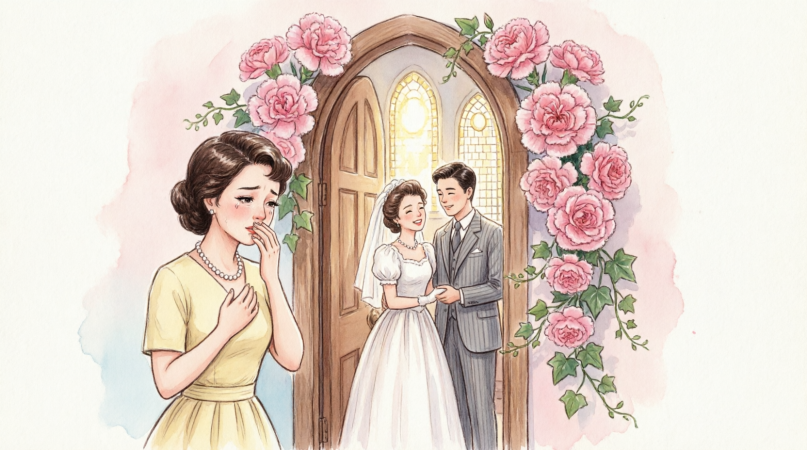
At the end of the lane stood a small white chapel.
I slowed before I reached the gate, every nerve in my body suddenly alive. Owen stepped inside without hesitation.
I crossed the street and stood just outside the open doors.
Candles glowed near the front. White folding chairs were arranged in neat rows. A few sprays of flowers had been tied to the aisle ends with satin ribbon. And standing at the front, wearing a short white dress and holding a bouquet as if she had every right in the world to be there, was my sister Brooke.
For a second I honestly could not understand what I was seeing.
Brooke looked nervous, but not confused. Owen walked directly to her side. He did not flinch. He did not look guilty. He moved like a man arriving exactly where he had intended to be all along.
Then Brooke said, in the casual tone of someone asking whether the caterer had remembered ice, “She still has no idea, right?”
Owen took her hand and lowered his voice. “Stop worrying.”
From the front row, my mother laughed.
It was not awkward laughter. Not panic. Not surprise. It was warm, bright, familiar, and cruel.
“She never sees what’s right in front of her,” she said.
My father stood near the aisle adjusting his cuff links, looking not shocked or embarrassed but composed, like he was proud to be included in something important.
They were all there.
My whole family.
My husband, my sister, my parents, and a tiny chapel arranged for some kind of ceremony that centered around my erasure.
I wish I could say I stormed in and shattered the moment. I wish I could say I threw the bouquet or screamed or demanded an explanation dramatic enough to stain all their perfect white clothes forever.
I did none of those things.
I took out my phone.
With hands that had gone strangely steady, I photographed the chapel doorway, the flowers, Brooke in white, Owen beside her, my parents seated inside. Then I stepped back, recorded twenty silent seconds of video, and walked away before anybody noticed me.
That decision changed everything.
By the time I reached the resort, the first wave of shock had hardened into something colder. I did not go back to our room. I went to the front desk and asked for somewhere private to make a legal call. The woman behind the counter must have seen something in my face because she handed me a key to a small business office without asking questions.
Inside that room, with a fake ficus in the corner and a printer humming softly against the wall, I called Julia Chen, a divorce attorney whose number a coworker had given me nearly eight months earlier after I admitted, over too much wine, that my marriage felt wrong in ways I could not prove.
She answered on the third ring.
I said, “I am in Key West. My husband is in a chapel with my sister. My parents are helping. I need to know exactly what I should do next.”
Julia did not gasp. She did not waste a second asking whether I was sure.
She asked three practical questions: Was the marital home jointly titled, whose name was on the main accounts, and could I leave safely without alerting him.
That was when all the boring things I had once been mocked for began saving me.
The house in Savannah had been mine before the marriage. I had inherited the down payment from my grandmother and kept the deed in my name. My salary funded most of our expenses because I was a senior contracts manager for a medical supplier and earned more than Owen, who called himself a consultant with the kind of vagueness that should have embarrassed me sooner. The main checking account was joint, but my savings and the house were separate.
Julia told me not to confront anyone in person.
“Document everything,” she said. “Leave. Preserve your peace. We can do the rest from home.”
So I did.
I returned to the room only once, when I knew Owen would still be gone. I packed my suitcase, my passport, my laptop, and the envelope where I kept account numbers and property records when traveling. Then I noticed his tablet on the dresser, still unlocked.
I should probably thank his arrogance for the next part.
An email notification had just come through. The subject line read: Ceremony Balance Received – Chapel by the Harbor.
I opened it.
There it was in clean black text. Client names: Owen Mercer and Brooke Talbot. Event type: private commitment ceremony. Floral package confirmed. Officiant requested. Music cue list attached.
There was no confusion left after that.
I forwarded the email to myself. Then another. And another. The bouquet invoice. The white dress alteration appointment. A message thread between Brooke and my mother discussing whether I would be easier to tell before or after the trip. A note from Owen saying it would be simpler once they got home and he could “handle the house issue.” The words did not even make sense to me at first because there was no house issue. There was only the house he clearly imagined was his.
I sent every piece of it to Julia.
Then I moved my flight up to that night and left Key West alone.
The next morning, sitting across from Julia in her Savannah office, I was so tired I felt hollowed out. But shock had not made me stupid. I signed what needed to be signed. We filed for divorce immediately. We filed a motion for temporary exclusive use of the house. After Owen began blowing up my phone with calls the moment he realized I was gone, Julia also drafted a petition for a temporary no-contact order if the harassment escalated.
It escalated within hours.
First came confusion. Where are you? Why did you leave? Are you okay?
Then came denial. It wasn’t what you think. Brooke was helping with something for your mother. You are overreacting.
Then came panic. Please call me before you do anything stupid.
And finally, when I still did not answer, anger.
My mother left a voicemail calling me dramatic. My father texted that families survived worse than this when people chose grace. Brooke wrote, unbelievably, that she had not planned to hurt me and that “these things happen when hearts change.”
I saved every message.
Then I called a locksmith.
By the time my family returned from Key West a week later, the house was secure, Owen’s personal belongings were boxed, cataloged, and placed in a storage unit Julia’s office had arranged. The garage code had been changed. The alarm had been reset. I had suspended the voluntary monthly transfers I had been sending to my parents for nearly two years to help with their condo after my father’s business failed. And I had placed a folder on the front door.
Inside it were four things.
A locksmith invoice.
The storage unit receipt.
The divorce papers stamped as filed.
And notice that all future communication must go through counsel.
I set Owen’s wedding ring on the welcome mat because I knew he would
understand the symbolism faster than he had ever understood me.
Then I watched through the doorbell camera from the upstairs hallway.
When their rideshare pulled up, all four of them came up the walk together. My mother was still tanned from the trip. Brooke was wearing my sunglasses. Owen had one hand on the handle of the suitcase I had helped him pack before we left for what I thought was a family vacation.
They saw the folder.
Owen opened it first.
Even through the camera, I watched the blood drain from his face. Brooke leaned over his shoulder, then jerked back. My mother’s mouth fell open. My father read the first page, then looked straight at the door like it might reopen the version of events he preferred.
Owen pounded once, hard.
I pressed the speaker.
“The woman you planned to marry in Key West can help you find somewhere to sleep,” I said.
None of them spoke for a full two seconds.
Then everyone spoke at once.
That day was ugly, but it was clarifying. No matter what they said through that camera, they could not make me unknow what I had seen or unread what I had forwarded to myself. Owen claimed the chapel was symbolic. Brooke said she and Owen had fallen in love “by accident,” as if accidents made vows gentler. My mother insisted they had delayed telling me only because they were worried I would be unstable. My father tried a quieter tactic, asking me not to destroy two families with legal overreaction.
Two families.
As if mine had not already been burned to the ground inside that chapel.
I did not open the door.
The weeks that followed became a war of paper, evidence, and unraveling pretenses.
Owen hired a lawyer and tried to take a superior position. He said there had been no legal wedding, so I was acting out of wounded pride rather than responding to actual wrongdoing. Julia responded by producing the emails, the floral invoices, the recorded messages, and a timeline showing he had used joint funds to pay deposits for Brooke’s dress, the chapel, and a weekend suite upgrade booked under both their names.
The most useful line came from Owen himself.
In one of the messages I had forwarded from his tablet, he told Brooke not to worry about me because once we got home, he would “push Leah out of the house fast.”
That line, presented beside the deed and closing documents proving the home had always been mine, destroyed any version of the story in which he was simply a confused man following his heart. He had not just betrayed me. He had made plans around dispossessing me.
Brooke tried to present herself as tragic. In mediation she cried and said no one chooses who they love. Julia, who possessed the kind of calm that makes liars itch, slid a printed copy of Brooke’s message across the table. The one where she told my mother I was dependable enough to survive it.
Brooke stopped crying after that.
My parents were worse.
They wanted forgiveness without truth. They wanted to call it complicated, painful, unfortunate, anything except deliberate. My mother said she had believed Owen and I were drifting apart. My father said Brooke finally seemed happy and he did not want to stand in the way of that. When I asked whether either of them had considered, even for a second, that I was their daughter and not an obstacle, neither answered.
That silence was the real ending of my relationship with them.
Legally, the divorce was not as long or as dramatic as Owen expected. Because the house was separate property and because the paper trail around the misused funds was so clean, his leverage collapsed early. He ended up with his clothes, his car, and a humiliating obligation to repay the money he had spent on the chapel deposits, Brooke’s trip expenses, and several charges he could not explain once scrutinized.
He did not get alimony. He did not get the house. He did not get to move his affair into the life I had built.
And Brooke did not get the story she had imagined.
For three months after the filing, she and Owen rented a furnished condo across town. People who knew us whispered. Some of them chose sides. Most simply enjoyed the spectacle from a safe distance. I heard through mutual acquaintances that Brooke hated how quickly everyday life stripped the fantasy out of what they had done. Owen became irritable. Brooke became suspicious. Two people who had bonded through secrecy discovered that daily sunlight was less flattering.
By month five, they were no longer together.
That detail did not heal me, but I would be lying if I said it brought no satisfaction.
My parents, meanwhile, learned what their version of family loyalty had actually cost them. Once I stopped subsidizing their condo and their insurance supplements, they had to sell the unit and move into a smaller place farther inland. My father sent one bitter email accusing me of punishing them financially over a personal matter. I wrote back exactly once.
I am not punishing you, I said. I am no longer protecting you from the consequences of what you chose.
After that, all communication went through Julia or not at all.
The divorce became final seven months after Key West.
On the morning the judge signed the order, I expected triumph. What I felt instead was something quieter and far more valuable: relief so deep it almost felt like grief. I drove home with the windows down and let the humid Savannah air fill the car. The house was waiting when I got there, still, clean, and undeniably mine.
There are practical things no one tells you about after betrayal. How many mugs one person actually needs. How strangely peaceful it is to eat toast over the sink without listening for someone else’s mood. How silence changes when it no longer means punishment.
I went to therapy. I replaced the mattress. I repainted the bedroom because I could not bear the old color anymore. I sold the ring and donated the money to a local legal aid fund for women leaving controlling relationships. I stopped apologizing for my instincts.
A year after Key West, my best friend Mara asked whether I wanted to take a weekend trip with her to the coast. I almost refused on reflex. Travel had become contaminated in my mind. But I went.
On the second evening we walked near the water at sunset, and for the first time in a long time, I realized I was not waiting for something terrible to step out from behind beauty and ruin it. The sky turned gold, then rose, then blue again at the edges. Couples laughed in the distance. Someone was getting married somewhere nearby because music drifted briefly over the dunes.
I listened to it without shaking.
That night, back at the hotel, my phone lit up with an email from my mother. It was longer than anything she had written since the divorce. She said families should not be destroyed over one mistake. She said Brooke was struggling, my father’s health was fragile, and surely enough time had passed for perspective.
I read it once.
Then I answered with the only true thing left to say.
It was never one mistake. It was a room full of choices.
I blocked the address after that.
I have not spoken to Brooke since mediation. I have not seen Owen since the final property handoff in Julia’s office, when he could not quite meet my eyes and kept fiddling with a tie he probably hoped made him look respectable. My parents are somewhere in Georgia, aging inside the life they chose without me.
And I am here.
In the house they thought would become theirs.
At the table where I now drink my coffee in complete peace.
Under a roof that no longer shelters performance, deception, or people who confuse my steadiness for weakness.
Key West did fix something in the end.
Not my marriage.
Not my family.
It fixed my last remaining habit of pretending betrayal was only misunderstanding with better lighting.
The day I walked away from that chapel, I thought my life had shattered.
The truth is, that was the day it finally stopped belonging to everyone else.
And that is where the story ends: with my name on the deed, the divorce signed and done, the locks changed, the numbers blocked, and no one left in my home except me and the peace they never thought I would choose over them.
THE END.