Duke let out a low whimper—a sound neither growl nor bark, halfway between pain and relief. For the first time in a long time, someone had spoken aloud what he couldn’t explain. Something inside him loosened. He was no longer alone in his pain.
That day marked the beginning of a quiet but powerful routine. Emma came to the shelter almost every day after school. Sometimes she brought a Braille book and read aloud. Other times she simply sat in front of the cage, talking about her day. She shared her fears, how at first she was terrified of crossing streets, tripping, falling, or being treated as fragile.
“He’s tired, you know?” she said, fingers tracing the fur she could now touch freely. “Everyone thinks you can’t do anything on your own. Maybe you understand that… They see you as dangerous, but you’re just hurt. They see me as weak, but I know I can be strong.”
Duke listened. His ears perked when he heard the cane tap at the entrance. His tail, motionless for months, twitched side to side. He stopped growling at volunteers when Emma approached. Sometimes he got so close to the bars that his whole body seemed to want to pass through and stand beside her.
Three weeks later, the change was undeniable. The director, who had promised not to risk anyone with Duke, noticed something he hadn’t seen in years: hope. In a quick meeting, while Duke rested his head against the cage, lulled by Emma’s voice, the man spoke to her mother.
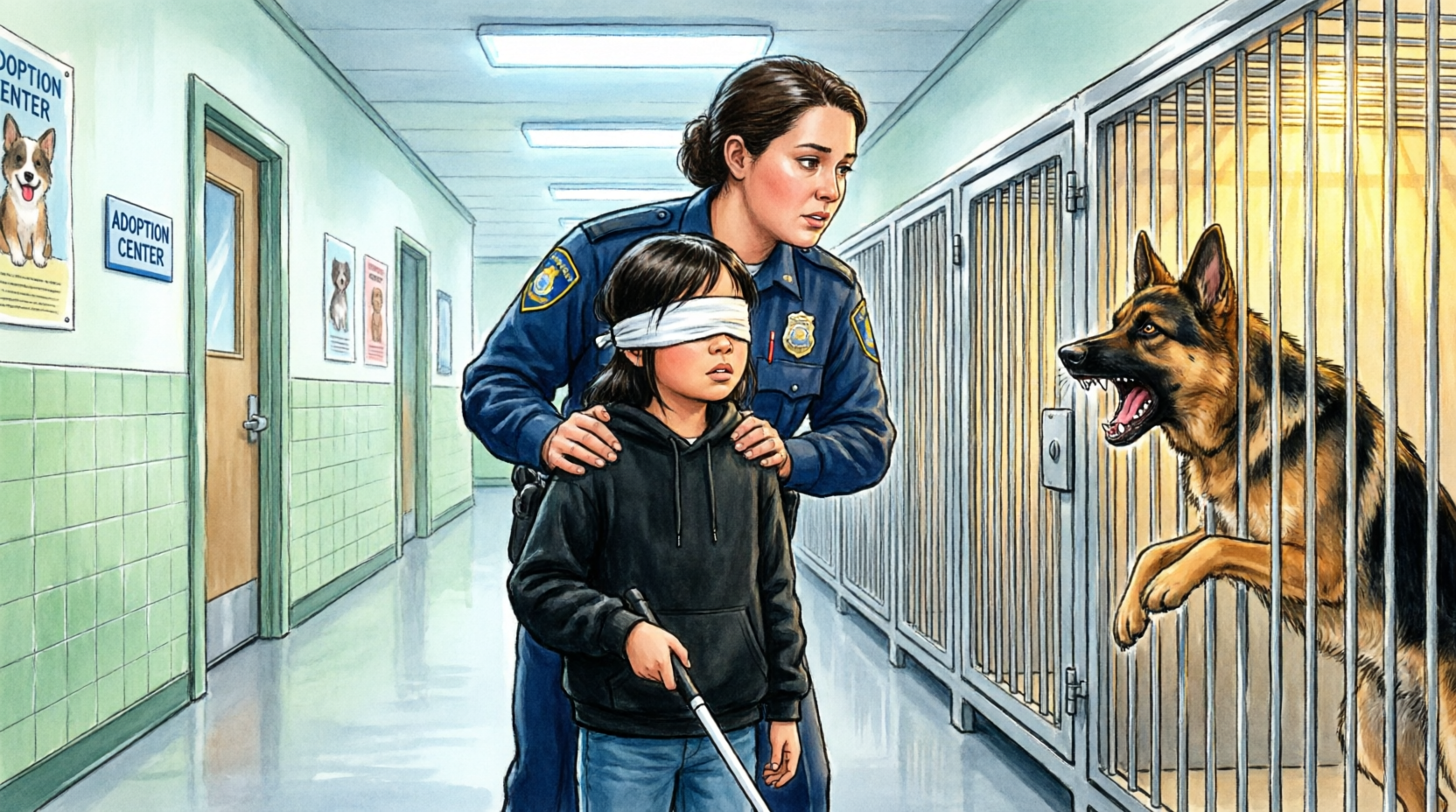
“I can’t explain exactly what’s going on,” he said. “But that dog… he’s not the same. He hasn’t tried to hurt anyone since Emma started visiting. And when she’s around, he’s a different animal.”
Her mother was torn between fear and awe. She had seen it with her own eyes—and felt it in her heart. Duke transformed in front of her daughter. The first time Emma touched him cautiously, he sniffed her and, as if sensing her importance to the girl, lay down beside her—watchful but calm.
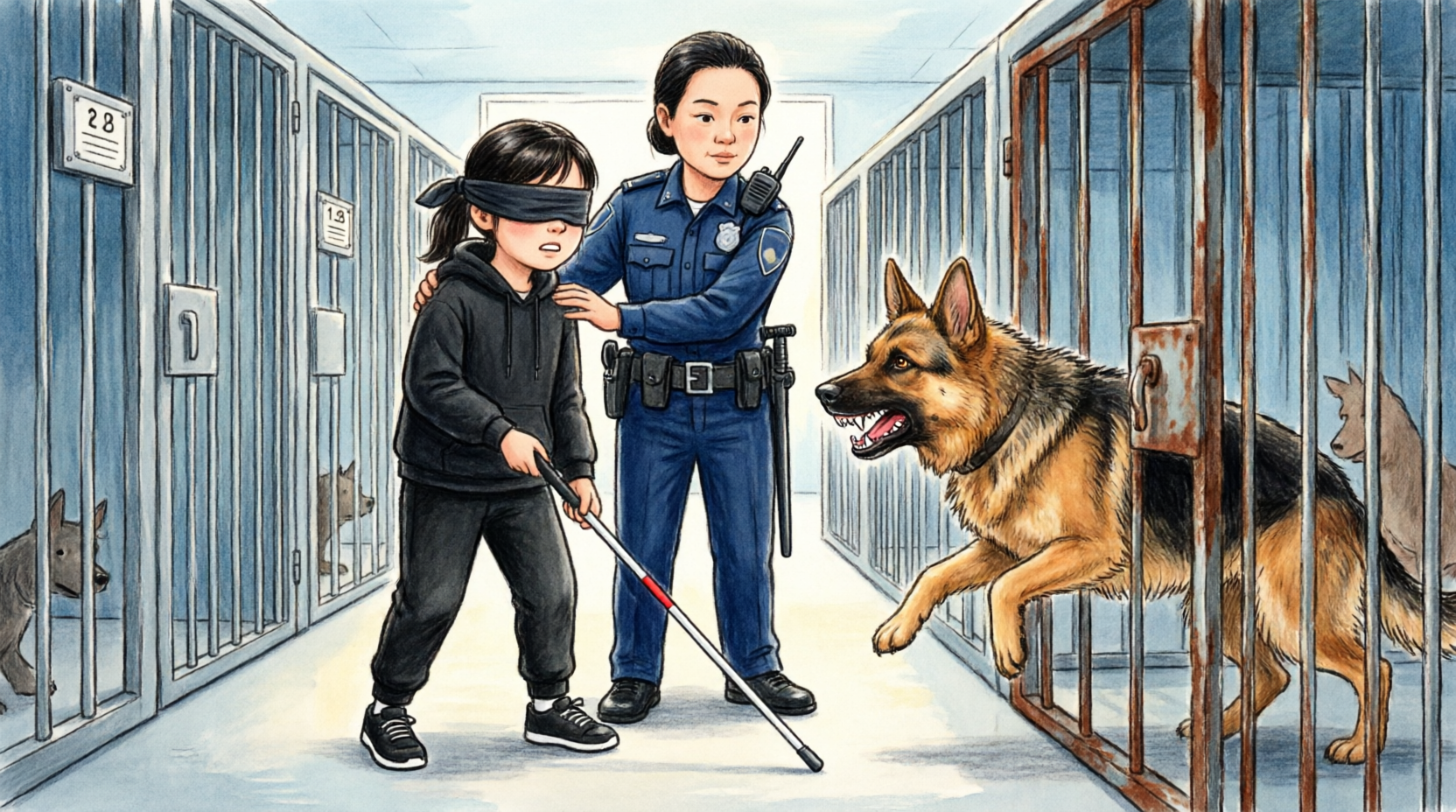
Finally, a decision was made. The cage door opened. Everyone held their breath. If anything went wrong, it would end there. But Duke didn’t run. He didn’t bare his teeth. He stepped forward slowly, sniffed the air, and, with a certainty no one had taught him, walked straight to Emma and sat by her chair.
“It seems she has already chosen,” whispered a volunteer, tears in her eyes.
They tested him on a short leash in the shelter and later in the yard, always with Emma nearby. Duke never took his eyes off her. When someone spoke loudly, he tensed—but when he heard her voice, he relaxed. When she tripped over a stone, he stepped forward, offering his side to lean on. It was as if he had found a new mission: not to protect an armed comrade, but to watch over a little girl he saw with his soul.
With training and patience, she gradually transformed him into her guide dog. The “most dangerous dog in the shelter” learned to stop at corners, guide her around obstacles, and stand firm when cars or bicycles passed by. At first, her mother walked behind them, heart pounding. But each day she grew more confident as she watched Duke become a wall between danger and her daughter.
One afternoon, that trust was put to the test. Emma walked with Duke along a busy street, horns blaring, engines roaring. At the crosswalk, the pedestrian light was red, but someone nearby said,
“You can cross now, no one’s coming.”
Emma stepped forward, guided by the movement of the crowd—but Duke didn’t move. He dug in, leash taut.
“Come on, Duke…” she whispered. The dog let out a low growl—not aggression, but alertness.
At that exact moment, a car sped around the corner, running the red light. The wind brushed past Emma. Pedestrians screamed. The leash held her firmly at the curb. Only then did she realize: if Duke had blindly obeyed, she would have been right in the middle of the road.
A woman approached, clearly shaken.
“Oh my God, your dog saved your life,” she said, her voice trembling.
Emma crouched down, wrapping her arms around Duke’s neck, holding him tight.
“I know,” she whispered into his fur. “Thanks, buddy.”
From that moment, the trust between them became no longer a promise—it became a certainty. He would be her eyes, and she would be the voice that restored faith in both of them. At night, when the world quieted and city noises faded to a distant murmur, Emma lay on her bed and Duke curled beside her, his head close to her hand. She stroked the fur that had once seemed untouchable, speaking softly, as if sharing a secret.
“You believe for me, Duke,” she told him, “and I’ll believe for both of us. When everyone thought I was a monster, I didn’t believe it. When everyone thought I was weak, you helped me prove them wrong.”
Duke closed his eyes, taking a deep breath, as if her words filled the emptiness left by the loss of his partner. He would never forget the past—but now he had a new present, a mission: to be the light in the darkness for a blind girl.
Over time, the neighborhood stopped seeing Duke as “the dangerous dog from the shelter.” Children approached, neighbors smiled as they passed. They knew he had been a police dog and something of his history—but what impressed them most was how he looked after Emma. He stood in front of her in crowds, remained steady when someone approached too quickly, and patiently guided her around tricky corners.
Once, during a school talk, the teacher asked Emma to share her story. She sat at the front of the class, Duke lying calmly at her feet.
“Everyone here knows I can’t see,” she began, smiling. “But few of you know that before Duke came along, I had stopped believing too. I was afraid of everything: falling, getting lost, being a burden. And this dog you see here, the one everyone thinks is strong and brave, was broken too. He had lost his companion, bitten others out of fear. Everyone thought he was dangerous, that nothing could be done.”
He bent down to stroke her ears.
“What no one understood was that all he needed was someone who didn’t look at him with fear. Someone who couldn’t see his scars, only his heart.”
A classmate raised a hand.
“And you were never afraid of him?”
Emma smiled.
“Of course I was scared,” she admitted. “I’m human. But I was more afraid he’d be left alone in that cage forever, thinking I was bad, when he was only sad. So he decided that if I could live without seeing, he could learn to trust again. And here we are.”
The teacher wiped a tear discreetly. Duke, as if he understood, rested his head on Emma’s leg. She whispered something he could barely hear:
“Sometimes you don’t need to see to know who you are. You just need love.”
From that day on, whenever someone doubted themselves, Emma told the story of how a “dangerous” dog became their eyes, and how a “weak” girl became the only one capable of seeing his heart. She explained that labels—blind, dangerous, broken, useless—were just words people used when afraid to look deeper.
Duke, once discarded as “unfit,” now walked the city in a harness that read “guide dog.” Many admired him, unaware he too had been afraid, on the verge of giving up. But Emma knew—and each night, before sleep, she repeated the promise she had made the first time she saw him through the bars:
—You see for me, and I will believe for you. I have no sight, but you have eyes. You had no faith, but now you have my heart.
In the end, Emma didn’t need her sight to find her way, nor did Duke need to return to the force to feel valued. They were enough for each other. Two souls the world had deemed broken, finding home in each other’s wounds, healed by something no one could measure or buy: the certainty that even when everyone has given you up for lost, someone can always appear, reach out, and say with a quiet smile:
“I’m not here to be afraid of you. I’m here to truly see you.”
END