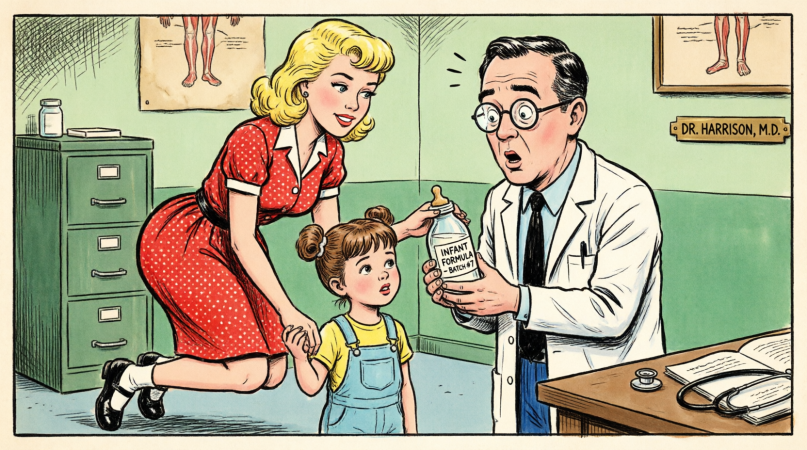
But as soon as he read the label, he changed.
He straightened up in his chair, looked up at me, and then looked at the jar again, this time with a seriousness that froze my bones.
“Who gave this to the girl?” he asked.
I didn’t like the way he said “this” at all.
“My mother-in-law,” I answered. Apparently, every day. I don’t know how many exactly. Emma told me that she no longer wanted to take “the pills that grandma gives her”.
The doctor clenched his jaw. He called a nurse and asked her to take Emma to weigh her, take her signs and do some urgent blood tests. My daughter clung to my pants.
—¿Mommy?
I bowed immediately.
“I’m going with you, sweetheart.
“You’re not going to be angry with grandma, are you?”
I felt something break inside me.
Not because she wasn’t angry.
But because my daughter was already protecting the person who had been sneaking medication into her.
“Right now I’m just going to take care of you,” I said, stroking her hair. That’s the only important thing.
When the nurse took her away for a moment to prick her finger, the doctor asked me to close the office door.
I did it with my hands shaking.
“That medicine is not a vitamin,” he said bluntly. It is an anxiolytic with a sedative effect. It is used in adults. In a four-year-old girl it can cause drowsiness, disorientation, irritability, respiratory problems if the dose is high… and even dependence if administered repeatedly.
I stared at him without fully understanding. Or perhaps understanding too much.
“Has my mother-in-law been drugging my daughter?”
He did not respond immediately. That scared me more than any words.
“I can’t say intention until I know the exact amount and time,” he said at last. But I can tell you that he should never have given it to him. Under no circumstances.
I had to sit down again.
All the scenes of the last few weeks came back at once, one after the other, fitting together like pieces of a nightmare that I had let in out of courtesy. Emma asleep on the sofa in the middle of the afternoon. Emma slower in the mornings. Emma saying that sometimes “her head tickled”. Diane smiling with that smugness of hers, saying that finally the girl was “calmer” and that I should thank the help of someone with experience.
Experience.
My God.
“I’m going to call my husband,” I murmured.
The doctor nodded.
“Do it. But first I need you to answer me something with total honesty: is your mother-in-law alone at home right now?
I thought of Diane in my kitchen, probably pouring herself tea, perhaps upset that she had taken me to Emma without explanation. I thought about the bathroom cabinet where he kept his medicines. I thought about my bag left halfway on the table.
“Yes.
“Then don’t go back alone with the child,” said the doctor. And don’t confront her before you have someone with you. This is no longer a family discussion. Depending on the results, it may be a legal situation.
The phrase fell on my chest like a stone.
Legal.
I called my husband, Daniel, with such clumsy hands that I misdialed twice. He answered the third tone.
“All right?” He asked, absent-minded, probably still in the office.
“Listen to me carefully and don’t interrupt me,” I said, and my own voice sounded unfamiliar. Your mother has been giving Emma an adult sedative medication every day. I’m at the pediatrician. I need you to come right now.
There was a brief silence. Then an incredulous laugh.
“What?” No. My mom would never do something like that. Surely you got confused—
“Daniel,” I cut him off. I have the bottle in my hand. With his name. And the doctor just told me that these are not vitamins. Come. Now.
I hung up before I could deny it any longer.
An hour later the preliminary results arrived. The doctor confirmed traces of the drug in Emma’s blood. Not a dangerous overdose, thank God. But there is repeated presence. Enough to explain his lethargy of the last few days.
When Daniel walked into the office, pale and out of breath, I knew from his face that he was no longer in defense mode. He saw the jar on the desk. He listened to the doctor. He looked at Emma asleep on the gurney with her stuffed rabbit under her arm. And he understood.
He sat down. He covered his face with both hands. He didn’t cry, but I watched him crumble in silence.
“We need to talk to her,” he said at last, his voice breaking.
The doctor slowly denied.
“They need to call the police or child protective services if they want to make a record. And, of course, immediately remove the minor from contact with the person who gave her this.
Daniel raised his head suddenly.
“Police?” It’s my mother.
“And she medicated her four-year-old daughter without consent or medical indication,” the doctor replied dryly. Call it what you want. The facts do not change.
We returned home at dusk, but not alone. Daniel’s sister, Michelle, came to us because, for some reason, he felt he would need someone else in his family to face his mother. I didn’t want any of them around. But I accepted because I wanted witnesses. I no longer trusted anything that could be said later behind closed doors.
Diane was in the living room, with a blanket over her legs and an open book she wasn’t reading. As soon as he saw us enter, he smiled with that irritating calm.
“Do you see?” So much drama for nothing. I knew Emma was just tired.
I put the jar on the coffee table.
His smile froze.
Michelle saw it and turned pale.
Daniel spoke first.
“Did you give this to Emma?”
It took Diane just a second to rearm.
—Of course not. Well… not like this. I gave it a little bit, sometimes. Less than half a crushed pill. To help her sleep. That girl is too nervous, too restless. You don’t know how to set limits.
I took a step towards it.
“You drugged my daughter.”
“Don’t exaggerate,” he replied, lifting his chin. In my time, everything was done for children to rest. He was helping. Besides, you always complain that he doesn’t let you finish anything in the house.
The slap went up my body, although I did not throw it. I understood something horrifying: I didn’t see it as a bad thing. I saw it as a valid method. As a right.
“Since when?” Daniel asked, and this time his voice did tremble.
Diane looked at him angrily, as if he, too, had suddenly become irrational.
“Two weeks, maybe three. Not every day. Only when she was very overcrowded or very responsive.
Emma, from the hallway, heard the last word and leaned out hugging her rabbit.
“Grandma said that if I drank it I was going to be pretty.
The silence was total.
Michelle began to cry dryly. Daniel went white. I went to Emma, picked her up and buried my face in her hair.
“Yes, my love. It’s over.”
Diane stood up with difficulty, irritated.
“Don’t look at me like that. I did it for this family. That girl needed order, and you,” she pointed out, “are too soft to admit it.
Then Daniel did something that I had never seen him do with his mother.
He raised his hand.
Not to hit her. To shut her up.
“Enough.”
Her voice was so hard that even Emma pressed tighter against me.
Diane blinked, offended.
“Are you talking to me like that for her?”
“I’m talking to you like that for my daughter,” he said. “Gather your things. Tonight.”
His mother let out a brief, incredulous laugh.
“You can’t kick me out. I’m recovering.
—To vas.
—Daniel—
“You’re leaving!” he roared, and now the whole house felt it.
I’d never heard it like that. Neither had I. Nor, by Diane’s face, did she either.
Michelle wiped away her tears and walked over.
“Mom, I’ll take you to my house. But you can’t stay here.
Diane looked at one and the other as if hoping someone would come to their senses. No one did.
“This is your fault,” she said, full of venom. “You always wanted to turn my son against me.
I didn’t answer.
Because it was no longer the time to win an argument. It was the time to protect my daughter.
The police arrived forty minutes later. They did not arrest Diane that night, but they took a statement, photographed the bottle, spoke with the pediatrician, and instructed us on how to proceed if we wanted to file formal charges. They also made a report for possible misadministration of medication to a minor.
When I finally saw her leave my house with her suitcase, leaning on Michelle and still muttering that it was all a modern exaggeration, I felt no immediate relief.
I felt trembling.
The kind that comes when the danger has passed and the body finally understands that it was closer than one thought.
That night I slept with Emma in my bed. At midnight she woke up, touched my cheek and whispered:
“Are they never going to give it to me again?”
I hugged her tightly.
“Never again, sweetheart. And if someone tries to give you something again without me knowing, you tell me right away. Even if it’s an adult. Even if I tell you it’s a secret. Yes?
He nodded very sleepily.
“I do tell you everything, Mommy.
And then I did cry. Quietly, so as not to scare her.
Two weeks later, Emma was the same again. More awake. More smiling. More intense, yes. Blessed intensity. The house ceased to have that strange air of forced nap and small submission.
Diane sent us messages. First furious. Then offended. Then pitiful. That she never meant to hurt. That children used to be raised better. That we treated her like a criminal. Daniel didn’t answer any. Neither did I.
The last I knew, Michelle got her an appointment with a psychiatrist, because even she had to admit that it wasn’t just “grandma’s help.”
Sometimes I think about how close I came to not finding out. About how easy it would have been to continue believing that Emma was more tired from growth, from heat, from a strange stage. It breaks me to imagine.
But then I remember something stronger.
The small hand pulling my arm.
The scared little voice saying that she didn’t want to take those pills anymore.
And I understand that my daughter was saved the instant she decided to trust me.