Part 1: The Warning That Was Never Meant to Happen
My life didn’t fall apart at home. It didn’t even start with a fight or a discovery. It started on the side of a highway, under flashing red and blue lights, with a warning that wasn’t meant for me—but changed everything anyway.
We had been driving south that afternoon, heading to my wife’s mother’s house like we had done dozens of times before. Nothing felt unusual. Nothing felt off. Lena kept one hand steady on the wheel, the other adjusting the radio as if she were choosing the perfect soundtrack for a completely ordinary day.
Then the siren came. Short. Sharp. Final. She slowed down immediately, signaling before pulling the car onto the shoulder like someone who had nothing to hide. “Probably speeding,” she said calmly, already reaching for her license. Seventy-eight in a sixty-five. Not great, but nothing serious. The kind of thing that gets a warning or maybe a ticket if the officer’s in a bad mood.
I didn’t think about it again. At least—not until the officer walked back to the car. At first, everything looked normal. He took her license, returned to his cruiser, and started typing. I watched him in the side mirror out of habit, the way you do when you’re waiting for something routine to finish.
Then something changed. It was subtle. The way he leaned closer to the screen. The way his posture straightened.
The way he didn’t come back right away. Too long. Long enough to feel wrong. When he finally stepped out of his cruiser, he didn’t walk to Lena’s side.
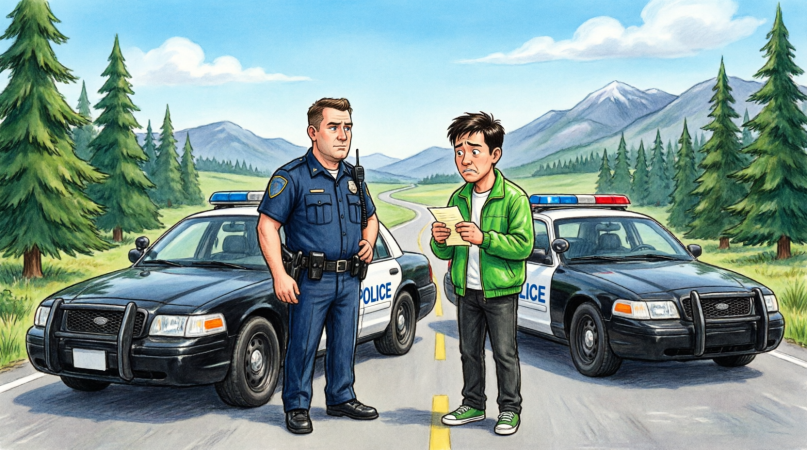
He walked to mine. He tapped on the window. “Sir, can you step out of the vehicle for a moment?” I glanced at Lena. She frowned slightly, confused, but didn’t question it. I stepped out. Heat from the asphalt rose through the soles of my shoes. Cars rushed past just a few feet away, loud and indifferent.
The officer led me behind the car—just far enough that she couldn’t hear us. Then he looked at me. Not casually. Not professionally. Directly. Like whatever he was about to say mattered more than the stop itself. “Listen to me carefully,” he said. His voice dropped—not softer, but tighter. “You should not go home tonight.” I blinked, trying to process the words. “What?”
“Go somewhere else,” he continued. “A hotel. A friend’s place. Anywhere she doesn’t know.” The sentence didn’t make sense. Not yet. “Why?” I asked. “What did you find?” For the first time, he hesitated. That was the moment fear actually set in. Because hesitation meant this wasn’t routine. “I can’t explain it here,” he said.
A pause.
Then, more quietly—
“But it’s bad.”
Very bad.
He slipped something into my hand.
A small folded piece of paper.
“Read it when you’re alone,” he said. “And be careful who you trust.”
Then just like that—
It ended.
He walked back to the car, handed Lena her license, gave a standard warning, and sent us on our way like nothing had happened.
No raised voices.
No tension anyone else could see.
Just another traffic stop on a busy road.
But something had already shifted.
I got back into the car.
Lena glanced at me.
“What was that about?”
“Nothing,” I said.
The word felt wrong the moment I said it.
She nodded, but her hands tightened slightly on the wheel. Her eyes flicked to the mirror more often than before.
The drive continued.
Normal on the surface.
But under it—
Something had already cracked open.
The note in my pocket felt heavier with every mile.
Not because I knew what it said.
But because somewhere deep down—
I already knew it wouldn’t be something I could ignore.
Part 2: The Sentence That Rewrote Everything
Dinner that night should have felt familiar.
That was the problem.
Everything looked exactly the way it always did.
Lena laughed at the right moments. Passed dishes across the table. Smiled when her mother told stories I had heard too many times to count. The plates clinked. Glasses touched. Conversation moved in comfortable loops.
If you had walked into that room, you would have seen a normal family evening.
But once doubt enters a marriage—
Nothing stays normal.
Not really.
Her laugh didn’t sound different.
It sounded… placed.
Measured.
Like something chosen at the right moment instead of something that just happened.
Her warmth wasn’t gone.
That would have been easier.
It was still there—
But now it looked intentional.
Practiced.
That was worse.
Because it meant it might never have been real.
I answered when spoken to.
Kept my face steady.
Played my part in a scene that had already started to come apart.
All the while, the note burned quietly in my pocket.
Waiting.
We went to bed early.
Guest room. Floral curtains. Mattress too soft in the wrong places.
She fell asleep quickly.
Or pretended to.
I waited.
Counted her breathing.
Watched the rise and fall of her shoulders until it settled into something steady enough to trust.
Then I got up.
Slowly.
Carefully.
And locked myself in the bathroom.
The light from my phone cut sharply through the dark.
I sat on the edge of the tub.
And unfolded the paper.
Seven words.
No explanation.
No context.
Just a sentence.
She isn’t who she says she is.
Under it—
A phone number.
And one word.
Detective.
I read it once.
Then again.
And again.
The meaning didn’t change.
But everything around it did.
Because once something like that enters your mind—
It doesn’t sit there quietly.
It starts moving.
Rearranging.
Connecting things you had already seen but never questioned.
I went back to bed.
Lay down beside her.
And stared into the dark.
Memory didn’t come back all at once.
It never does.
It comes in fragments.
Her job.
Always described in broad terms.
Marketing. Consulting. “Client work.”
Never specific enough to question.
Never clear enough to understand.
The travel.
Frequent.
Last-minute.
Always explained.
Never detailed.
The calls.
Taken in other rooms.
Doors half-closed.
Voice lowered—not dramatically, just enough.
The office I had never visited.
The coworkers I had never met.
No names.
No stories.
No company events.
No reason to ask—
Until now.
For years, I had labeled it something reasonable.
Privacy.
Independence.
The normal distance that comes with adult lives running in parallel.
But lying there in the dark—
It didn’t look like distance anymore.
It looked like design.
That realization didn’t break me.
Not immediately.
It did something else.
It removed the safety from everything I thought I understood.
The next morning, she left early.
“Client meeting,” she said.
Same tone.
Same rhythm.
Same normal.
I waited until her car disappeared from the driveway.
Then I picked up the phone.
And called the number.
Part 3: The Life I Was Never Meant to See
He answered on the first ring.
No greeting. No hesitation. Just a voice that sounded like it had been expecting this call long before I made it.
“Detective Carter.”
I gave my name. Explained, briefly, how I got the number.
There was a pause.
Short—but deliberate.
“Are you alone?”
“Yes.”
Another pause.
Then everything changed.
“Your wife has been under investigation for eight months,” he said.
The sentence didn’t land all at once.
It didn’t shock me immediately.
It settled.
Slowly.
Like something too large to process in a single moment.
“For what?” I asked.
“Financial operations tied to an organized network,” he replied. “Money movement. Shell companies. Laundering.”
Each word added weight.
Each one pushed the situation further away from anything I could explain.
“That’s not possible,” I said automatically.
It wasn’t denial.
It was reflex.
Because the alternative required rebuilding everything I thought I knew.
“There is no registered company under the name she gave you,” he continued. “We verified it. The job is a cover identity.”
The room felt smaller.
Not physically.
Structurally.
As if the space I had been standing in no longer had the same shape.
“You’re telling me my wife doesn’t exist the way I know her.”
“I’m telling you,” he said, “that the version you know was constructed for a purpose.”
A pause.
“Your marriage provided stability. Predictability. Clean records. No attention.”
Perfect cover.
The word wasn’t spoken.
It didn’t need to be.
I sat down slowly.
“Show me,” I said.
He didn’t argue.
Didn’t soften anything.
He just started listing facts.
Addresses.
Transactions.
Entities tied together through layers of ownership designed to obscure movement.
Money coming in—
Dirty.
Money going out—
Clean.
Timed.
Structured.
Controlled.
And at the center of it—
Her.
The woman I had lived with for years.
Not reacting.
Not improvising.
Operating.
Efficiently.
Quietly.
Professionally.
“That’s not the part you need to understand,” he said.
I frowned.
“Then what is?”
“She’s preparing to leave.”
That landed differently.
Sharper.
“How?”
“Parallel identities. Distributed assets. Exit positioning,” he said. “We’ve seen this pattern before. Once the exposure risk increases, they detach.”
Detach.
From the network.
From the location.
From anything that ties them down.
From me.
“She was building a way out,” I said.
“Yes.”
Not “might be.”
Not “possibly.”
Was.
The timeline rewrote itself instantly.
The distance.
The secrecy.
The small financial inconsistencies I never followed up on.
It wasn’t stress.
It wasn’t space.
It was preparation.
I leaned forward, elbows on the table, trying to keep my thoughts from scattering.
“So what happens now?”
He didn’t answer immediately.
Because this was the part where the choice mattered.
“You can step away,” he said. “We continue without you. Build the case independently.”
A pause.
“Or you help.”
I didn’t respond right away.
Because helping meant something very specific.
It meant going back into that house.
Sitting across from her.
Acting like nothing had changed.
While knowing exactly what she was.
It meant listening to conversations I wasn’t supposed to hear.
Watching behaviors I had never questioned.
And documenting everything.
It meant turning my life into evidence.
“You’d be working with us directly,” he continued. “Gathering access. Patterns. Devices. Communications.”
“And if I don’t?”
“We proceed anyway.”
Of course they would.
This didn’t depend on me.
But my involvement would change how it ended.
I looked around the room.
At the quiet.
At the ordinary objects that now felt disconnected from everything I thought they represented.
Then I thought about going back.
Sitting across from her.
Hearing her speak.
Knowing that every word was part of something else.
And realizing—
I had already been living inside that without knowing.
Now I just had the truth.
I exhaled slowly.
“I’ll help,” I said.
Not because I wanted revenge.
Not because I wanted answers.
But because once you understand the structure you’re inside—
You don’t pretend it’s still a home.
Part 4: Living With Someone Who Was Never Real
Going back into that house felt different the moment I stepped through the door.
Not because anything had changed—
But because now I knew it hadn’t.
The couch was still in the same place.
Her coat still hung by the entrance.
The faint smell of her perfume lingered in the air like it always did.
Everything looked exactly the same.
That was the problem.
Because nothing in that space was what I thought it was anymore.
She was in the kitchen when I walked in.
Barefoot.
Hair tied loosely.
Scrolling through her phone like any other evening.
She looked up and smiled.
“Hey,” she said. “You’re back early.”
Same tone.
Same rhythm.
Same woman I had built ten years around.
Only now—
I could see the edges.
“Yeah,” I replied. “Plans changed.”
That became the pattern.
For six weeks, I lived inside a performance.
Only this time—
I was aware of it.
The cameras came first.
Small. Hidden. Integrated into things that belonged in the room.
A clock.
A speaker.
A charging dock.
Nothing obvious.
Nothing intrusive.
Just enough to watch.
To record.
To confirm.
Then came the data.
Her laptop—accessed when she showered.
Her phone—mirrored when she slept.
Conversations—captured when she stepped into another room to take calls.
And every day—
The same realization deepened.
She wasn’t improvising.
She wasn’t nervous.
She wasn’t slipping.
She was operating.
Efficient.
Controlled.
Like someone who had done this long enough to trust the system she was inside.
At night, I kissed her goodnight.
Watched her close her eyes.
Listened to her breathing slow into sleep.
Then sat in the dark—
Reviewing recordings of her discussing money movement with people I had never heard of.
Amounts that didn’t make sense.
Accounts that didn’t exist—on paper.
And in those conversations—
I wasn’t her husband.
I was context.
A reference point.
A piece of the cover.
She referred to me once.
Not by name.
Just…
“stable.”
That word stayed with me longer than anything else.
Not because it was insulting.
Because it was accurate.
I had been stable.
Predictable.
Reliable.
Exactly what she needed me to be.
That was the role.
And I had played it perfectly.
The hardest part wasn’t the evidence.
It wasn’t the surveillance.
It wasn’t even the lies.
It was the intimacy.
The small things.
The way she reached for my hand without thinking.
The way she leaned against me on the couch.
The way she remembered details about my day.
Those things weren’t fake.
That’s what made it worse.
They were real behaviors—
Used inside something that wasn’t.
That contradiction is what breaks you.
Because it leaves you with a question you can’t answer:
Which part of this was ever true?
By the sixth week, the case was ready.
Reynolds didn’t celebrate when he told me.
He just said:
“We move Saturday morning.”
Multiple locations.
Coordinated entry.
No warning.
No mistakes.
My role was simple.
Leave the house.
Act normal.
Say nothing.
I told her I had an early tee time.
She was half asleep when I left.
Hair across the pillow.
Face soft.
Unaware.
Or pretending to be.
For a moment—
I almost stayed.
Not for her.
For the version of her I had believed in.
But that version didn’t exist.
And staying would only mean choosing the lie again.
So I left.
The call came just after nine.
“She’s in custody.”
No struggle.
No scene.
Just… over.
Seven other arrests across the region.
Devices seized.
Accounts frozen.
Network exposed.
I drove back later that day.
The house was quiet.
Exactly the same.
But empty in a way it had never been before.
The difference wasn’t her absence.
It was the removal of the illusion.
The couch wasn’t a shared space anymore.
The kitchen wasn’t a routine.
The photos on the wall weren’t memories.
They were props.
The divorce took months.
Legal process.
Financial tracing.
Separation of what was real from what wasn’t.
They cleared me completely.
Proved I had no knowledge.
No involvement.
That should have felt like relief.
It didn’t.
Because being innocent doesn’t erase the fact that you lived inside something false.
She pled guilty.
Twelve years.
No cooperation.
No explanation.
No closure.
I never visited.
Never wrote.
Because by then—
I understood something clearly.
Any answer she gave me would just be another version of control.
And I had already spent too long inside those.
People ask if I miss her.
They don’t mean her.
They mean the version of her that existed in my life.
The one who knew how I took my coffee.
Who remembered my sister’s birthday.
Who fell asleep with her hand on my chest.
I don’t know how to answer that.
Because you can only miss something that was real.
What I had—
Was something built to feel real.
That’s different.
And once you understand that difference—
You don’t go back.
You rebuild.
Carefully.
Without confusing comfort for truth.
Without mistaking time for trust.
Without assuming that what looks stable—
Actually is.
I lost ten years to someone who never shared them honestly.
But I kept everything that came after.
And this time—
It belongs to me.