I used to think birthdays turned dangerous in ordinary ways.A forgotten call. A forced smile. A dinner where everyone said they were happy for you while making sure the conversation never stayed on your life for long.
That was the kind of mess I expected from family. Petty things. Bruised feelings. The old familiar ache of being present and somehow peripheral.I did not know a birthday could end with my sister driving my face into a cake so hard that bone cracked.What I remember first is the frosting.
Cold, sweet, violently soft. A smear of vanilla buttercream across my mouth and nose, a heavy floral scent from the overdecorated roses on top, then the sudden sharp impact beneath all that softness, as if the world had hidden metal inside sugar. My vision burst blue and white. The room snapped sideways. Somewhere very close to my ear, somebody laughed.
Not somebody.
Rowan.
Her laughter had always been easy to recognize. Bright, quick, almost musical until you knew what sat underneath it. Then it changed. Then you heard the little blade in it.
I hit the floor hard enough to bite my tongue. My head rang. The ceiling lights above the private dining room blurred into long yellow streaks, and for a second I couldn’t tell if the warm wetness running down the side of my neck was icing, sweat, or blood.
“Jesus,” someone said.
Then another voice, already half-laughing, “It was just a joke.”
A joke.
That word floated above me while my body struggled to understand where up was.
People rushed in the way people always do when something has happened and they want credit for being concerned without the burden of changing anything. Chairs scraped back. My mother gasped my name, but there was irritation in it, not fear. Gerald, my mother’s husband, muttered something about napkins. One of Rowan’s friends bent toward me and then straightened again as if my disorientation had become awkward for everyone.
Rowan was still laughing.
Not hysterically. Not out of control. It was worse than that. It was measured. She had one hand over her mouth, shoulders shaking delicately, eyes shining. There was frosting on her fingers and a streak of red on the heel of one palm.
“My God, Avery,” she said, and if you only heard her words, you might have thought she was worried. “You fell so dramatically.”
I tried to sit up. The room heaved. Pain bloomed hot and strange at the base of my skull, spreading forward behind my eyes. Someone pressed a stack of paper napkins into my hand. Someone else set my purse beside me. No one looked especially alarmed. They looked inconvenienced. Embarrassed on my behalf. Eager for the unpleasantness to resolve itself quickly enough that they could return to drinks and candles and whatever version of my birthday they’d actually come to enjoy.
“It’s fine,” my mother, Marlene, was already saying to the room at large. “She startled easily. Rowan was just teasing.”
Just teasing.
The phrase settled over everything like a tablecloth pulled neatly across a stain.
The waiter hovered nearby, uncertain, glancing between me and the ruined cake on the stand. He looked young enough to still believe adults meant what they said. My mother smiled too brightly at him and said, “We’re okay, thank you. Family nonsense.”
Family nonsense.
Another phrase to make pain sound harmless.
I lifted my hand from my neck and stared at the smear there. White frosting streaked with pink. Then darker red.
My stomach turned.
Rowan finally crouched beside me, close enough that I could smell her perfume under the sugar and candle smoke. She tilted her head, studying me with that infuriating blend of mock-concern and private delight that had followed me all my life.
“You know,” she said softly, so softly no one else could hear, “you really do know how to ruin a mood.”
Then she stood and, louder, for everyone, “Can someone help her up?”
That was Rowan. Harm first, management second. She had always liked being present for both parts.
I let Gerald and one of my cousins pull me into a chair. My knees trembled. My mother dabbed at my hairline with a fresh napkin as if she were fixing mascara, not tending to an injury. The dining room was full of voices trying too hard to sound normal.
“Do you want ice?”
“It looks worse than it is.”
“You should see your face,” Rowan said, then laughed again like she hadn’t meant to say it out loud.
Everyone smiled uneasily. Nobody corrected her.
I looked at my reflection in the darkened restaurant window. Frosting was smeared across one cheek, tangled in my hair, caked along my collarbone. A thin line of blood traced from just behind my ear into the neckline of my dress.
I should have left immediately.
Instead, I did what I had always done.
I tried to understand the room I was in by the rules my family had trained into me. I searched their faces for the right emotion to borrow. If everyone else was treating it like a stupid accident, maybe that’s what it was. If no one looked horrified, maybe I was the one in danger of making too much of it.
That is what happens when you grow up in a house where your pain is constantly translated into overreaction. You stop trusting your first response. You stop trusting your body. You can be bleeding and still wonder whether you owe someone an apology for the mess.
I stayed another twenty minutes.
I sat through coffee I didn’t touch and a replacement dessert I couldn’t swallow. Rowan retold the moment twice, each time shaping it into something cuter, sillier, less violent. The second version included me “leaning forward too fast.” The third suggested I had lost my balance when everyone laughed.
My mother nodded along. “Avery’s always had terrible timing.”
And people smiled, relieved to have a story simple enough to live inside.
By the time I walked out to my car, the cold Seattle air felt like knives in my lungs. I stood in the parking lot with one hand on the door and waited for the nausea to pass. My head throbbed in pulses that synced with my heartbeat. When I closed my eyes, I still saw blue-white flashes.
Inside the car, I sat with both hands on the steering wheel and did nothing for a long minute.
My phone had three messages before I even turned on the engine.
Mom: Text when you get home so I know you’re not being dramatic about this.
Rowan: Hope you’re not concussed lol.
Rowan again, thirty seconds later: Seriously though don’t make me the villain. It was cake.
I stared at the screen until the words went fuzzy.
Then I drove home with the heater blasting and the window cracked open because the smell of frosting on my skin was making me sick.
All the way back to my apartment, I replayed the moment the way I had replayed so many moments with Rowan before it—looking for the version of events that would hurt least.
Maybe she hadn’t meant to push that hard.
Maybe the cake stand had slipped.
Maybe she really had thought it would be funny.
Maybe the flash in her eyes before she did it hadn’t been satisfaction. Maybe it had been mischief. Maybe what I thought I saw, what I had so often thought I saw over the years, was just my own exhaustion giving sharp edges to ordinary things.
By the time I unlocked my apartment door, part of me had almost managed to believe it.
That was my oldest skill. Not resilience. Not strength. Revision.
I had grown up learning how to swallow things.
Small hurts, sharp comments, humiliations dressed up as jokes. I came from a family where peace was not a feeling but a performance, and I had been cast early in the role of the daughter who kept it going. The steady one. The reasonable one. The one who didn’t need much.
“Avery’s strong,” my mother liked to say, usually in moments when I could have used actual care.
What she meant was: Avery can survive neglect, so let’s spend our energy elsewhere.
Elsewhere was always Rowan.
Rowan was born eighteen months after me, and from the day she arrived, people behaved as if she had not entered the family but electrified it. She was loud in the charming way some children are, reckless in the way adults call fearless when they enjoy the child doing it. She had huge dark eyes, a theatrical laugh, and a talent for taking up emotional space so completely that the rest of us became background without meaning to.
When Rowan cried, my mother’s whole body responded.
When Rowan sulked, dinner shifted.
When Rowan wanted attention, the house rearranged itself to provide it.
I remember being six and watching my mother kneel in front of Rowan to retie a shoe with the kind of tenderness I had to get sick to receive. I remember standing there holding my own untied laces, waiting.
I remember learning from that moment what the hierarchy was.
My mother, Marlene, loved us both, I’m sure she would say even now. She would probably believe it. But love and preference are not the same thing, and preference, when practiced daily, can shape a child more ruthlessly than open rejection ever could.
With Rowan, my mother lit up.
With me, she softened into courtesy.
It was as though Rowan activated some deeper, warmer version of her, and I got the remainder: the polite smile, the practical praise, the “good job, honey” offered while her attention leaned elsewhere.
Rowan noticed early too.
Children always do.
She learned the family weather patterns before she could spell her own name. She understood instinctively that if she laughed, people leaned in; if she cried, they soothed; if she accused, they believed; if she reframed, they followed.
And because some children test boundaries with curiosity while others test them with appetite, Rowan began small.
A shove into a coffee table that left a bruise on my thigh when I was ten.
A whisper of “clumsy” as I tripped on the front steps in middle school.
A habit of offering to carry my bag at family gatherings only for the contents to end up mysteriously spilled in doorways or across lawns, while she fussed theatrically over helping me pick everything up.
Once, when I was twelve, we were at my grandmother’s for Easter. I was carrying a tray of deviled eggs down the hall when Rowan passed too close and clipped my elbow. The tray flipped. Eggs everywhere. Yolk ground into the carpet. My mother turned at the crash and said my name in that tired, disappointed tone reserved for people who have failed by being inconvenient.
“It was an accident,” Rowan said immediately, wide-eyed and sweet. “Avery turns too fast.”
I remember standing there with mayonnaise on my sleeve thinking, I didn’t turn at all.
But by then Rowan was already kneeling helpfully, already the good sister cleaning up my mess.
That was her genius. She rarely left a moment empty long enough for the truth to settle.
If she hurt me, she hovered after.
If she embarrassed me, she laughed first.
If I protested, she looked stricken.
If I insisted, my mother sighed.
“Avery, don’t be dramatic.”
“Your sister loves you.”
“You know how Rowan is.”
Yes. That was the problem. I did know how Rowan was. I just wasn’t allowed to say it plainly.
The first time I remember being truly afraid of her, I was twelve.
That memory lived in me like a splinter for years, too small to remove, too painful to ignore if touched the wrong way.
It was Thanksgiving at my grandmother’s house—crowded, noisy, all the adults warm with wine and obligation. The upstairs landing was narrow, old wood polished smooth with age. I was carrying a stack of folded napkins down to the dining room because I had become, by then, the reliable child. The useful one. Rowan came up behind me fast, impatient, complaining that I was in the way.
Then a hand between my shoulder blades.
Not a brush. Not accidental contact. A push.
Hard enough that the world lurched and the stairs rushed at me.
I fell halfway down, catching myself badly, twisting my ankle, hitting my cheek on the banister. I remember the shock more than the pain. The clean disbelief. I turned from the bottom of the stairs and looked up.
Rowan was staring down at me.
Just for a second, before the performance began.
Then she gasped, hands flying to her mouth. “Oh my God, Avery!”
Adults rushed in. My mother was exasperated before she was alarmed. “What happened now?”
“I slipped,” I heard myself say.
Because Rowan was already descending toward me with tears in her eyes and panic on her face, and because even then I knew what the room wanted. It wanted an accident. It wanted restoration. It wanted nothing that would interrupt the holiday.
Later, when we were alone in the bathroom and my cheek was already turning purple under the damp washcloth, Rowan leaned against the sink and said, almost conversationally, “You make falling look so ugly.”
Then she smiled and asked if I wanted one of the good cookies before dinner.
That was Rowan too. Cruelty did not interrupt her appetite.
Our aunt Elise saw more than most people did.
Elise was my mother’s younger sister, and unlike Marlene, she had never mastered the art of pretending that tension was normal. She noticed too much. Felt too much. She was the kind of woman who apologized when stepping around a sleeping dog and cried at museum exhibits when no one else understood why.
Because she noticed, she also frightened my mother a little.
I didn’t understand that then. I only understood that Elise was the one adult who occasionally looked at me as if she suspected my version of events mattered.
She was there the Thanksgiving I fell down the stairs. I didn’t know until much later that she had been at the top landing when Rowan shoved me.
At twelve, all I knew was that Elise crouched beside me while everyone else debated whether I needed ice and asked, very softly, “Did somebody push you?”
I looked past her to my mother, already annoyed, already telling people not to fuss.
I shook my head.
Elise held my gaze one second longer than anyone else ever did.
Then she said, “Okay,” in the saddest tone I had ever heard.
That was how it went. The truth would rise, tentative and hopeful, and then see there was nowhere safe to land.
So it sank again.
I grew into the kind of girl people call mature when what they mean is self-erasing. I learned not to ask for much. I kept my room neat, my grades high, my emotions contained. My mother praised me for being easy. Gerald—who married my mother when I was fifteen and mastered passivity like it was a moral virtue—used words like capable and independent, often in contexts where those words meant he could ignore me without guilt.
Meanwhile Rowan took up more and more air.
She was beautiful in the obvious, high-voltage way that made teachers forgive lateness and strangers start conversations in grocery stores. She turned every recital, graduation, and family dinner into a small stage. She flirted with waiters, cried in perfect tears, and could retell a minor inconvenience with the dramatic gravity of a war memoir.
The house orbited her moods.
If she was happy, everything felt festive.
If she was disappointed, everyone scrambled.
If she was angry, my mother moved through rooms like a woman defusing a bomb.
And me? I fitted myself into the cracks.
By sixteen, I could tell the emotional temperature of a house from the sound Rowan’s footsteps made in the hallway. I knew what version of my mother would open the front door by whether Rowan had had a good day. I knew when to stay invisible and when invisibility itself might be interpreted as disloyalty.
People sometimes ask why I didn’t simply leave earlier, as if families are rooms you can walk out of once you notice the wallpaper is ugly. But families like mine do not operate through open force. They operate through distortion. You are loved, but always conditionally. Included, but unevenly. Protected, but only if the truth costs nothing.
You learn to doubt your own thresholds.
By the time I was grown, distance was the only survival strategy I trusted. I moved into a small Seattle apartment with good light and secondhand bookshelves. I built a life from routines that belonged only to me—coffee on the fire escape when it wasn’t raining, work that paid my bills, grocery trips where nobody commented on what I bought, evenings quiet enough to hear my own thoughts before someone else translated them.
I worked hard. I made enough. I built something modest and real.
My mother called it a phase for years.
Rowan called it “Avery’s monk era.”
But it was the first life that ever felt mine.
Still, Rowan had a gift for staying central even when I tried to step away. She texted at odd hours with insults disguised as concern. She dropped by family events with stories about me I didn’t remember telling her. She positioned herself as the sister who checked in, the generous one, the one always willing to “help Avery out,” even when the help came wrapped around control.
And because families train witnesses as carefully as they train victims, everyone around us kept interpreting the pattern in her favor.
Rowan is just intense.
She jokes like that.
She loves hard.
You know how close siblings are.
No, I wanted to say. You know how your version of closeness always leaves bruises on me.
But I had spent too many years being told I was sensitive, dramatic, humorless, cold. Those words collect. They start to function like gravity. Even when you know better, you feel them pulling.
There was one person outside Elise who made me feel seen in those years.
Great-aunt Eleanor.
She was my grandmother’s older sister, though by the time I was old enough to know her properly, she felt less like an aunt and more like a separate country from the rest of my family. She lived alone in a crooked Victorian house north of the city, the kind with stained-glass windows, an impossible number of staircases, and rooms that smelled faintly of cedar and old paper. The paint peeled. The porch leaned. Half the plumbing had opinions. It was glorious.
Eleanor loved things that took patience to restore.
Furniture with gouged legs.
Silver too tarnished to shine at first glance.
People who had been underestimated.
When I was young, she used to sit me on the back steps with a chipped mug of hot chocolate and ask what I thought about things no one else thought to ask me. Not how school was. What I thought. About a book. About a storm. About why some rooms felt different depending on who had last cried in them.
She spoke to me as if I had an interior life worth visiting.
I adored her for it.
As I got older, I started spending whole weekends helping her with the house. Sanding banisters. Cataloging old photographs. Learning how to strip wallpaper without tearing plaster. Rowan came once, declared it smelled like dust and dead people, and never came again.
Eleanor noticed everything and judged almost nothing. She never told me Rowan was cruel or my mother was unfair. She just made space where those facts could be felt without being denied.
“You don’t have to make yourself smaller to keep other people comfortable,” she told me once while we painted trim in the upstairs hall.
I laughed because the idea seemed so impractical.
“What else am I supposed to do?”
She looked at me over the rim of her glasses. “Start by noticing every time you do it.”
I thought about that line for years.
Eleanor died three years before my birthday.
A stroke, sudden and decisive, the kind of death that makes a house feel evacuated even when every object remains. I went to her funeral numb with grief. Rowan wore black silk and cried beautifully. My mother said all the right things in the right order. Gerald held doors.
After the service, we gathered at the Victorian house for coffee and casseroles and the exhausted rituals people perform around loss. I remember wandering upstairs because the first floor felt crowded with condolences, all of them touching nothing real. The back staircase there was narrow and steep. I was descending with one hand on the rail when Rowan came up behind me.
“Careful,” she said, in that tone she used when she meant the opposite.
Then a pressure at my side. A clip of hip and elbow. The world tipped.
I went down awkwardly, my ribs slamming against the banister before I caught myself two steps from the bottom. Pain flared so hot I saw stars.
“Avery!” Rowan cried instantly, dropping beside me. “Oh my God, you scared me.”
I remember not being able to breathe properly. I remember her hand rubbing my back for the benefit of onlookers. I remember my mother arriving and sounding tired before frightened.
“You have to slow down.”
I said I was fine. Of course I did.
At the time I told myself grief had made me clumsy. The bruise across my side faded in ugly yellows and greens. Breathing hurt for weeks. Rowan brought me soup one afternoon and joked that I should wear bubble wrap around stairs.
She had a way of making you feel ridiculous for still hurting from what she had done.
A month after Eleanor’s funeral, the will was read.
She left the Victorian house to me.
Not because she loved Rowan less, though Rowan would later insist that was exactly the point. She left it to me because I had loved the house with her. Because I knew where the floorboards squeaked and which windows stuck in winter and how to keep rain from pooling near the back steps. Because she trusted I would restore it instead of selling it to someone who thought history was only valuable once stripped and modernized.
My mother called it “unexpected.”
Gerald called it “a lot of responsibility.”
Rowan said very little in front of me.
But the silence around her felt hot.
That same week, Elise overheard Rowan on the phone in the laundry room at my mother’s house. I would not learn this until much later, sitting in a hospital gown with dried blood behind my ear, but Rowan said: “Accidents happen. If Avery looked less competent, somebody sensible could manage the place.”
At the time, Elise told no one.
She was afraid of my mother. Afraid of being cut off from the family entirely. Afraid, maybe, of what it would mean to say out loud that the girl everyone called difficult was actually dangerous.
Fear makes accomplices out of decent people more often than evil does.
I didn’t know any of that on the night of my thirty-sixth birthday.
I only knew that my head hurt in a way I couldn’t reason with.
I showered carefully, wincing when water hit the cut behind my ear. I scrubbed frosting from my hair and watched pink water circle the drain. I took ibuprofen. Then more. I turned off the lights and lay in bed with a pillow folded over my eyes.
Sleep came in torn scraps.
Each time I drifted off, I woke to a fresh stab of pain, a wave of nausea, or the sickening sensation that the room had tilted while I wasn’t looking. Around three in the morning I got up to drink water and nearly fell when the kitchen floor shifted under me. By dawn the headache had changed from pounding to something narrower and meaner, like a drill finding one exact point behind my skull and returning to it over and over.
Still, my first instinct was denial.
I told myself I was being dramatic.
I told myself it was dehydration.
I told myself bright lights always made headaches worse.
Then I touched the tender spot behind my ear and my fingertips came away sticky with dried blood.
That was the moment fear entered properly.
Not because blood always means catastrophe. Because I could suddenly feel the shape of the stories I had been telling myself, and all of them were flimsy.
I dressed slowly, one hand on the dresser when the room pitched. I considered calling my mother and discarded the thought before it fully formed. I could hear her already.
You don’t need an emergency room over a headache.
You bruise easily.
You always make things bigger when you’re emotional.
And Rowan—Rowan would laugh. Lightly. Easily. She would ask whether I planned to sue the pastry chef.
So I drove myself.
Seattle’s ER was already crowded by the time I arrived. Fluorescent lights hummed. A child cried somewhere behind the triage desk. A man with a wrapped hand paced near the vending machines. It all looked distressingly normal, which made me feel foolish until the nurse at intake saw me flinch from the overhead lights and frowned.
“How long ago was the injury?”
“Injury?” I repeated, as if that word belonged to somebody else.
She looked at the cut behind my ear, then back at me. “What happened?”
I opened my mouth, and for the first time I heard how strange the truth sounded.
“My sister shoved a birthday cake into my face.”
The nurse’s pen paused.
“Did you lose consciousness?”
“I don’t think so.”
“Nausea? Vomiting? Dizziness? Blurred vision?”
“Yes. Yes. Yes.”
She didn’t smile. Didn’t treat it like a joke. She just placed a wristband around my arm and said, “Let’s get you back.”
That was the first crack in the family script.
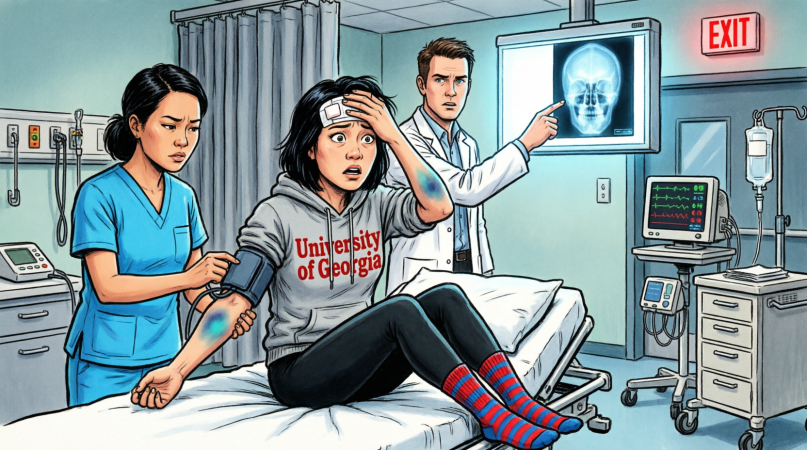
In the exam room, under the paper gown and the thin blanket that never quite warms you, I felt less like a person seeking help and more like evidence beginning to exist. Every question built a shape around the night before. When did it happen? Was alcohol involved? Did I fall after impact? Has this person hurt you before?
That last one sat between us longer than the others.
I said, “I’m not sure.”
It sounded pathetic even to me.
A doctor named Hanley came in twenty minutes later. He was in his late fifties, silver at the temples, with the kind of calm voice people spend years learning because panic helps no one. He asked me to follow his finger, squeeze his hands, smile, move my neck. Each motion made the pain at the base of my skull flare.
“We’re going to get some scans,” he said. “Just to be safe.”
Safe.
The word hit me strangely. Like something from a language I understood academically but had never fully spoken.
The CT room was cold enough to make my teeth ache. I lay still inside the machine and stared up at a square of ceiling tile while the equipment hummed around me. With nothing to do but wait, my mind returned to Rowan’s face.
Her grin before the push.
The split second after I hit the floor.
The way her laughter had not sounded surprised.
I had spent so many years revising her expressions for my own comfort. Misreading menace as mischief, contempt as impatience, satisfaction as coincidence. But pain has a clarifying effect. Excuses become more expensive when your body is the one paying for them.
When Dr. Hanley returned, he was carrying a stool.
That scared me more than the scan had.
Doctors don’t sit down for headaches they aren’t worried about.
He turned the monitor toward me and pointed to a faint pale line in the image of my skull.
“You have a hairline fracture,” he said.
For a second I thought I had misheard him. The sentence felt too large for the event that had caused it, or rather for the version of that event I had been trying to force into harmlessness.
“A fracture?”
“It’s not severe,” he said carefully, “but it’s real. And you have a concussion.”
I stared at the image as though clarity might somehow make it less true.
Then he clicked to another scan.
“This,” he said, touching a different place on the screen, “is an older injury. Left rib. It healed some time ago, but not cleanly enough that it would disappear on imaging.”
I swallowed. My mouth had gone dry.
“How old?”
“Based on the healing? Roughly three years.”
Three years.
The staircase after Eleanor’s funeral.
Rowan behind me.
The breath punched out of my lungs.
Her hand on my back afterward, public and soothing.
The room tilted harder than before, though maybe that was just memory.
Dr. Hanley watched my face with quiet concentration. He had likely seen this expression before—the one people wear when a medical fact collides with a truth they have spent years dodging.
“Ms. Dalton,” he said gently, “I need to ask you something directly. Has anyone in your family hurt you before?”
No one had ever asked me that without already implying the answer should be no.
I looked at him. Then at the scan. Then at my own hands, clenched white in the blanket.
“I…” My throat closed. “I don’t know what counts.”
He was silent for a moment.
Then he picked up the wall phone.
The call itself was brief, but every word changed the air in the room.
“I need to report a suspected assault with patterned injuries,” he said. “Adult female. Current skull fracture, prior unaddressed fracture, history suggests repeated harm.”
When he hung up, I still hadn’t moved.
Required.
Serious.
Patterned injuries.
These were not family words. These were not words that bent for peace. They were hard-edged, institutional, undeniable.
Dr. Hanley set the phone back in its cradle and met my eyes.
“Avery,” he said softly, “someone did this to you.”
I think part of me had always known.
Not in language.
In body.
In the way I braced around Rowan without meaning to.
In the way I stayed still when she moved quickly behind me.
In the way my stomach tightened every time she offered help.
But knowing in your nervous system and saying it out loud are not the same thing. One keeps you alive. The other rearranges your life.
A social worker came first. Then a detective.
Detective Carver introduced herself with a measured calm that made me trust her almost immediately. She was maybe in her forties, hair pulled back, plain dark suit, no dramatic gestures. She moved like someone who understood that truth comes easier when it isn’t cornered.
She pulled a chair to eye level with my bed and opened a small notebook.
“I’m here because of your injuries,” she said. “And because the details surrounding them raise concerns. I’m going to ask some questions. You can tell me if you need a break.”
My throat felt raw. “Okay.”
She began simply.
Who had been at the birthday dinner?
How much had Rowan had to drink?
Where exactly had she been standing?
Did I remember the angle of the table, the cake stand, the moment of impact?
Had there been previous injuries?
Had anyone discouraged me from seeking medical attention before?
Each question seemed to press on a different hidden bruise.
When she asked whether anyone had ever downplayed my need for medical care, I gave a short, humorless laugh that surprised both of us.
“My sister,” I said. “Every time.”
Detective Carver wrote that down.
“Did you believe her?”
That question undid me more than any other.
Did I believe her?
Or had I simply needed the world she offered to be true because the alternative was too ugly to hold?
I thought of Rowan pressing an ice pack to my side after the fall at Eleanor’s house, saying I didn’t need expensive X-rays over a bruise.
I thought of her rolling her eyes when I limped.
I thought of every incident after which she placed herself nearest to me, all helpfulness and witness management.
“It’s like…” I stopped and started again. “It’s like she always wanted to be the first person I turned to. And the last person I doubted.”
Carver’s expression changed slightly. Not surprise. Recognition.
“That happens,” she said.
Before she could ask more, the door flew open hard enough to hit the stopper with a crack.
My mother entered like weather.
“Avery Lynn Dalton, what on earth are you telling these people?”
She was wearing the same pearl earrings from dinner the night before, as if she had dressed for outrage before leaving the house. Gerald came in behind her looking pale and uncertain, hands half-raised in the universal posture of a man committed to doing nothing but wanting credit for being nearby.
My mother took in the room—the detective, the social worker, the chart clipped to the foot of my bed—and her face transformed. Not into fear for me. Into fury.
“All of this,” she said, gesturing at the monitors, the detective, my bandaged head, “over a birthday joke? Tell them. Tell them you’re confused. You bruise easily. You’ve always been sensitive.”
Sensitive.
Dramatic.
Confused.
Overreacting.
The old architecture of dismissal, assembled in seconds.
Detective Carver stood. “Mrs. Dalton, your daughter is speaking with me privately.”
Mom ignored her and looked straight at me.
“This is ridiculous, Avery. Rowan would never intentionally hurt you. You know how playful she is.”
My head was throbbing. My stomach was rolling. I should have been weaker in that moment than I had ever been.
Instead something settled inside me.
Maybe because the fracture on the screen was still fresh in my mind.
Maybe because Dr. Hanley had named what had happened without flinching.
Maybe because there is a point past which minimizing pain stops feeling like loyalty and starts feeling like self-erasure.
For the first time in my life, I did not shrink under my mother’s certainty.
“I’m not confused,” I said.
The room went still.
My mother blinked. It was such a small act of defiance, really—one sentence. But in our family, truth had always been permitted only if it reflected well on the right people. Refusing revision was its own kind of rebellion.
“Avery,” she said, voice sharpening, “don’t do this.”
I turned back to Detective Carver.
“I want to continue.”
The betrayal on my mother’s face would have ruined me once. That morning, it only clarified her.
Carver asked my mother and Gerald to step outside. My mother protested until the detective’s tone shifted into something official enough to leave no room for dramatics. Gerald touched Marlene’s elbow and murmured her name. She shook him off and left anyway, breathing hard through her nose, dignity fraying at the edges.
When the door closed again, the room seemed to exhale.
Carver sat back down.
“I’m going to be honest with you,” she said. “What you’ve described, along with the injuries Dr. Hanley identified, is highly concerning. We’ve already requested the security footage from the restaurant. We’ll also be speaking to everyone who was present. Right now my priority is understanding risk.”
Risk.
Again, a word from outside the family script.
“Do you feel safe going home?”
The question stunned me.
Not because I knew the answer. Because I had never once framed my family in those terms, and yet the moment she asked, my body gave its own response. A tightening in my chest. A hollow drop under my ribs. A tiredness so deep it felt ancient.
“I don’t know,” I said.
“That’s okay,” she replied. “An honest answer is useful.”
A soft knock came at the door before either of us could continue.
This time it was Elise.
She hovered in the doorway until Carver nodded permission for her to enter. Up close she looked exhausted, as if she had been carrying a secret in both hands for miles and could no longer feel her fingers.
“Avery,” she said, crossing the room in two quick steps. “I tried calling last night.”
I took her hand. It was cold.
“I know.”
She looked at Detective Carver. “Can I say something? I have information.”
Carver closed the notebook halfway. “Please.”
Elise sat carefully on the chair my mother had vacated, as if occupying it carried its own weight.
“I should have come sooner,” she said, and the shame in her voice made my throat tighten. “Years sooner.”
No one interrupted.
Elise drew a shaky breath.
“I’ve seen Rowan hurt Avery before.”
The sentence landed like glass breaking in another room—distant and immediate at once.
“When they were kids,” Elise went on, “it was small things. Or small enough that I told myself I might be imagining it. A trip. A shove disguised as horseplay. Avery always getting hurt when Rowan was right there. I didn’t know how to prove it, and Marlene…” She looked briefly toward the door. “Marlene was so committed to seeing Rowan as spirited instead of cruel.”
Her hands twisted together.
“Thanksgiving, when Avery was twelve? The stair fall? I was at the top landing. Rowan pushed her.”
My breath stopped.
Not because I didn’t know. Somewhere inside I had always known. But hearing the memory confirmed by another living person cracked something open in me that had been held shut by force for years.
Elise looked at me with eyes full of grief.
“I asked if she pushed you. You said no. I should have said what I saw anyway.”
I couldn’t speak.
She continued, voice rougher now, driven by the momentum of finally telling the truth.
“And three years ago, after Eleanor’s funeral…” She swallowed. “I overheard Rowan on the phone. She had just learned about the house. She was furious. She said—” Elise closed her eyes for a second. “She said accidents happen, and if Avery looked less competent, she’d be the one managing everything.”
Detective Carver stopped writing.
Even Dr. Hanley, who had reentered quietly at some point to check my chart, went still near the curtain.
Eleanor’s house.
Of course.
Suddenly a dozen moments rearranged themselves at once. Rowan asking leading questions about the estate paperwork. Rowan offering to “help” me with insurance. Rowan joking that old houses were wasted on people who didn’t know how to leverage assets. Rowan appearing at the Victorian unexpectedly, wandering through rooms as though taking inventory.
A chill moved through me that had nothing to do with the hospital.
Elise’s voice broke.
“I was afraid to say anything. Marlene would have cut me out. She always chooses Rowan. I told myself maybe I’d heard wrong, maybe it was anger talking, maybe if I waited there’d be a better moment.” Her eyes filled. “There never is, is there? There’s just more damage.”
Carver nodded once, gravely.
“No,” she said. “There usually isn’t.”
The detective asked Elise to repeat every detail. Times. Dates. Context. Where she had been standing on the stairs years ago. Which funeral guests had been nearby after Eleanor’s service. Whether Rowan knew she’d been overheard. Elise answered carefully, sometimes closing her eyes to retrieve a scene. With each answer, the shape of my life sharpened into something both horrifying and precise.
Not chaos.
Not bad luck.
Not sensitivity.
Pattern.
By the time the interview ended, I was exhausted down to the bone.
Carver stood. “We’ll keep you updated. For now, you should not be alone if possible. And you should avoid contact with your sister.”
I almost laughed at the absurdity of that instruction, not because it was wrong but because so many years of my life had been built around doing exactly the opposite—staying accessible, responsive, available for family events, present for the next minimization.
Elise touched my shoulder.
“I’ll stay with you.”
I nodded because I suddenly couldn’t imagine going back to my apartment alone with everything that had just been named.
The next two days passed in a blur of ice packs, prescription pain medication, paperwork, and the strange quiet that follows an earthquake before people begin counting what’s fallen.
Elise set up on my couch without ceremony, as if it were the most natural thing in the world to make tea in my kitchen and fold one of her sweaters over the arm of a chair. She did not hover, which was a kindness. She was simply there—solid, regretful, watchful in a way that felt protective instead of invasive.
I didn’t realize how tired I was of being alone with my thoughts until there was someone beside me who wasn’t trying to edit them.
We spoke in fragments.
About Eleanor’s house.
About childhood.
About all the ways fear teaches adults to confuse silence with neutrality.
At one point I asked the question I had been circling since the hospital.
“Why do you think she did it?”
Elise didn’t answer immediately.
“Because she could,” she said finally. “And because every time she did, someone made it easier for her to believe she’d get away with it.”
That was the simplest, ugliest truth of all.
My mother called six times the first day.
I let them all go to voicemail.
Her messages followed a predictable emotional arc—anger, woundedness, self-pity, attempted reason.
“Call me back right now.”
“You’re blowing this out of proportion.”
“I don’t know what story Elise is feeding you.”
“This family is being torn apart over misunderstandings.”
Not once did she ask whether I was afraid.
Not once did she ask how my head was.
Not once did she say, If Rowan hurt you, I need to know.
The absence was so complete it became its own answer.
Rowan texted only once.
You really went to the cops over cake? That’s honestly insane.
I stared at the message for a long time. What unnerved me most was not the cruelty. It was the tone. Light. Mildly inconvenienced. As if she were irritated by a parking ticket, not police attention.
Whatever fear I still had that maybe I was misreading her began dissolving then.
On the third day, Detective Carver called.
I sat on the couch with my blanket wrapped around my shoulders while Seattle rain tapped against the windows and Elise pretended not to listen from the kitchen.
“We reviewed the restaurant footage,” Carver said.
My hand tightened around the phone.
“And?”
Her pause was brief but deliberate.
“It was deliberate, Avery. Rowan picks up the cake, shifts her stance, and looks over her shoulder before she moves. She doesn’t just push your face downward. She angles it. When you fall, she smiles. It’s only a second, but it’s there before she starts pretending to panic.”
My stomach hollowed.
There is something uniquely terrible about having your most private suspicion confirmed by a camera. Because then the truth is no longer something you feel. It exists outside you. Visible. Portable. Playable frame by frame.
Carver continued.
“We also obtained a warrant for her phone based on the medical findings and witness statements.”
Something in her tone changed—less measured now, more grim.
“There are notes.”
“What kind of notes?”
“Dates that correspond with past incidents. Brief descriptions. Locations. Comments about your schedule, when you’d likely be alone, when you’d be distracted. There’s also a section labeled future.”
My breath caught.
Future.
Carver went on carefully, each word laid down like evidence on a table.
“Projected opportunities. Times you might be at the Victorian house alone. A reference to the back stairs there being unsafe. Comments about your headaches. One line says, ‘If she gets overwhelmed enough, Mom will insist I help with the house.’”
The room around me blurred.
Elise was beside me before I realized I’d made a sound.
This was beyond cruelty. Beyond sibling resentment. There was calculation in it, patient and cold, and somehow that was harder to absorb than the violence itself. Violence can be impulsive. This was architecture.
“We’re moving forward,” Carver said. “Given the pattern, the current injury, the witness statements, and the material on the phone, we have enough. I’d like you present at a family meeting Sunday evening. Rowan believes your mother is gathering everyone to smooth this over. We intend to arrest her there.”
“Why there?”
“Because she’s performed innocence for years with that family as her audience. This time they need to see something they can’t revise later.”
I thought of my mother’s face in the hospital. Her absolute confidence that this, too, could be reframed if she said the right words quickly enough.
“Yes,” I said. “I’ll be there.”
After I hung up, I sat very still.
Elise crouched in front of me. “What did she say?”
I told her.
When I finished, Elise pressed both hands over her mouth, eyes wet.
“Oh, Avery.”
That was all.
No explanation. No polishing. No attempt to draw meaning from pain before the pain had fully landed.
Just witness.
Sunday came with the slow inevitability of a storm you’ve tracked on radar and still cannot quite believe will hit your street.
Elise drove because I still wasn’t supposed to. The concussion had improved, but sudden movements made the world tilt, and fatigue came over me in waves sharp enough to feel physical. I watched familiar neighborhoods slide past the window and felt like I was being driven not toward my mother’s house but back through time.
The house looked exactly as it always had.
Brick walkway. Hydrangeas trimmed too hard. The porch light already on though dusk had barely settled. How many versions of the truth had been buried in that neat front yard? How many times had I walked through that door telling myself to stay calm, be reasonable, keep the peace?
Inside, the air smelled faintly of lemon polish and pot roast. My mother had always believed in cooking when she wanted the house to resemble safety.
Voices floated from the dining room.
Gerald first, murmuring too softly to make out.
Then my mother, clipped and anxious.
Then Rowan—laughing.