The envelope was cream-colored, crafted from a heavy, linen-weave stock—the kind of expensive paper people choose when they want their cruelty to appear elegant. My father held it between two manicured fingers, his posture as rigid as the white columns of the Ashcroft Hotel ballroom. Behind him, a wedding band played a soft, curated jazz melody that seemed to mock the tension thickening in the air. Around us, the sensory details of high-society Charleston blurred. Crystal glasses clinked like wind chimes against the backdrop of polite chatter. Somewhere near the towering champagne pyramid, a woman’s laughter rang out, sharp and artificial. And right there, in the epicenter of my sister’s reception with two hundred pairs of eyes watching and at least three professional cameras tracking my every breath, my father spoke the words that would haunt the silence of my nights for years to come. “This is from all of us,” he said. The room didn’t just go quiet; it settled into that peculiar, expectant stillness common in wealthy circles. It wasn’t a silence of respect, but one of bated breath—a room full of people inhaling, waiting for the entertainment of a public execution.
My sister, Emily, stood beside him. She was a vision in a satin gown that likely cost more than my first three years of military salary. Her lips curled into the faint, practiced smile of a victor before she caught herself, smoothing her expression back into one of concerned pity. She thought she knew how this scene ended. I could see the anticipation gleaming in her eyes. She expected me to crumble. She expected twenty-one years of humiliation, second-class status, and the crushing weight of their rejection to finally break me open in front of everyone she wanted to impress. Instead, I took the envelope with a hand that didn’t tremble. I opened it, my eyes tracking every cold, calculated word. Then, I folded the pages once, twice, slid them into my clutch, and I smiled.
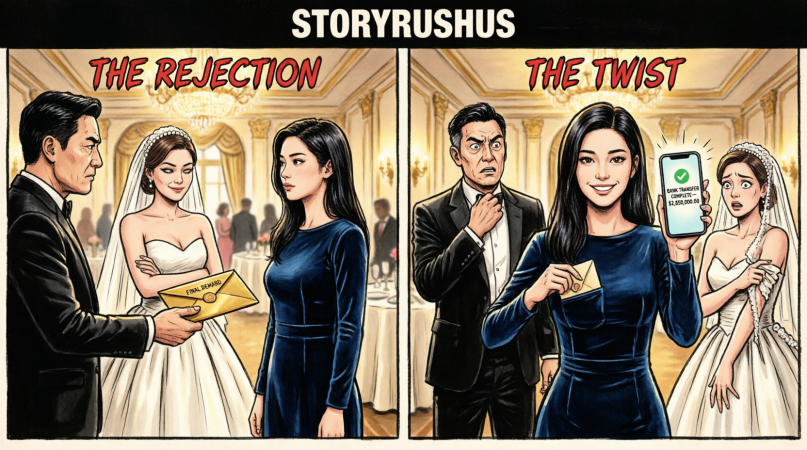
That smile was the first crack in their perfect evening. Nobody in that ballroom knew what I had spent the last six years preparing for. Not even my father. Especially not my father. As I looked into his suddenly uncertain eyes, I realized something that was almost funny: for the first time in my life, the Great Franklin Whitmore was afraid of me.
Chapter 1: The Ghost in Dress Blues
I had arrived in Charleston just three hours before the ceremony, the scent of salt and impending rain hanging heavy over the harbor. The sky was the color of a tarnished silver platter, matching the mood that always settled over me when I crossed the city limits.
The driver who picked me up from the airport kept stole glances at me through the rearview mirror. I knew why. I was wearing my Army Dress Blues. In the South, especially among the older generation, the uniform commands a specific kind of attention. My gold buttons were polished to a mirror shine, my ribbons—including the Bronze Star—were perfectly aligned, and my dark hair was pulled into a regulation bun so tight it felt like a physical anchor for my composure.
I’d spent over two decades in the Army learning how to carry myself as though I were bulletproof. By now, maintaining a stoic front felt more natural than breathing. But as the car pulled up to the Ashcroft Hotel, that old, familiar heaviness—the “Whitmore Weight”—settled into my lungs.
The hotel was a monument to old money. Massive chandeliers, marble floors polished to a treacherous gloss, and valets moving with the synchronization of a ballet troupe. It was exactly the kind of stage Emily required. As I stepped out of the car, I heard a whisper from a group of guests near the entrance.
“That must be the military sister.”
Not Rebecca. Not the eldest daughter. Not even a guest. Just a label. I offered a polite, hollow smile. If the Army had taught me anything, it was how to survive in rooms where you were tolerated but never truly wanted.
Inside, the ballroom smelled of thousand-dollar roses and expensive French perfume. I spotted my father near the bar almost immediately. At seventy, Franklin Whitmore still possessed the silver-haired, navy-tuxedoed elegance of a man who owned the ground he walked on. He hadn’t changed since the day my mother died fifteen years ago—the same cold, impenetrable posture.
For a fleeting second, I wondered if time had softened him. Then his eyes met mine. There was no pride, no “I’m glad you made it home.” Just a curt nod, as if I were a distant business associate who had arrived slightly behind schedule.
“You’re late,” he said as I approached.
I checked my watch out of habit. “The ceremony doesn’t start for forty minutes, Dad. I came straight from the airport.”
His gaze raked over my uniform, his lip thinning in distaste. “You really wore that?”
There it was. The immediate strike. I kept my voice as level as a horizon line. “It’s formal protocol for a commissioned officer at a black-tie event.”
“You could have worn a normal dress,” he countered. “Something… appropriate.”
I almost laughed. I had twenty-one years of service, two overseas deployments, and a chest full of commendations, yet in his mind, the most embarrassing thing about me was the fact that I served a cause greater than the Whitmore image.
“I think Mom would have liked it,” I said quietly.
The remark hit a nerve. His jaw tightened, the skin around his eyes crinkling with a flash of old rage. He still couldn’t handle the mention of her. Before he could retort, Emily appeared, a whirlwind of white satin and curated charm.
“Rebecca!” she exclaimed, her voice bright enough to alert the nearby cameraman. She air-kissed my cheek, careful to avoid actual contact. “You made it. Oh my god, everyone is talking about your… outfit.”
“It’s a uniform, Emily. Congratulations on the wedding.”
I noticed the cameraman lingering, aiming the lens directly at us. Emily noticed, too. Every move she made was a choreographed performance for the social pages.
“You’re at Table 14,” she added, her tone turning casually cruel.
I blinked. Table 14. I knew the layout of these events. Table 14 would be tucked behind a pillar near the kitchen doors, the furthest possible point from the wedding party. My father’s golf buddies were seated closer to the head table than his own daughter.
“Sounds good,” I replied, refusing to give her the satisfaction of a flinch.
Emily’s smile faltered. She wanted a scene. She wanted to see the “unstable” military sister hurt by the exclusion. “Well,” she said, smoothing her dress. “Try not to disappear before the cake this time.”
She was referring to five years ago, when I left Thanksgiving early. She hadn’t mentioned that she’d spent that entire dinner joking about how soldiers were just people with “government-funded trauma.” My father had laughed the loudest. They didn’t know that two weeks prior to that dinner, I had held the hand of a nineteen-year-old private as he took his last breath in a dusty field half a world away. Some things are too sacred to explain to people who only value the surface of things.
As Emily floated away to greet more “important” guests, the memories began to flood back like a rising tide. Emily getting a brand-new Mustang for her sixteenth birthday while I worked double shifts at a diner to buy my first pair of combat boots. Emily crying that her college apartment was “cramped” while I slept in a desert tent that smelled of diesel and desperation.
And then there was the money. Every time Dad’s business “hit a snag,” it was my phone that rang. I had emptied my savings accounts for their tuition, their hospital bills, their “emergencies.” I had lived on mess-hall food so I could wire thousands of dollars back to this city, only to be treated like an inconvenience once the checks cleared.
I walked toward the seating chart. My name was listed as Rebecca Whitman.
Not Whitmore. A “typo” that felt entirely too intentional. I stared at the card for a long moment, then I let out a soft, dry chuckle. At a certain point, humiliation stops being painful and simply becomes boring.
The trap is set, I thought, looking across the room at my sister. She just doesn’t realize she’s the one stepping into it.
Chapter 2: The Public Exile
The ceremony was a masterpiece of artifice. There were expensive floral arrangements, a string quartet, and Emily’s practiced tears as she exchanged vows with Daniel, a man who looked like he’d been plucked from a luxury watch advertisement. Daniel seemed nice enough, though he possessed the slightly dazed expression of someone who had realized too late that he was marrying into a hurricane.
By the time the reception dinner was served—a perfectly cooked filet mignon that tasted like ash in my mouth—I knew the “event” was approaching. You don’t spend years in military intelligence without learning how to read the room. I saw the whispered huddles between my father and Emily’s new husband. I saw the way my aunt and cousins avoided my table entirely.
Halfway through dessert, the music died down. My father stood, tapping a silver spoon against his crystal glass. The room fell into a hush.
“Before we continue the festivities,” he announced into the microphone, his voice echoing with patriarchial authority, “there is a family matter that must be addressed.”
He began walking toward Table 14. The cameras followed him like heat-seeking missiles. This was it. The climax of their production. He reached into his tuxedo jacket and pulled out that cream-colored envelope.
“This,” he said, loud enough for the back row to hear, “is from all of us.”
He handed it to me. He stood there, looming over me, waiting for the collapse. I could feel the heat of the spotlight on the back of my neck. I opened the envelope and pulled out three pages of single-spaced text. I didn’t skim. I read every line.
Rebecca, after years of disappointment, distance, and the embarrassment you have brought upon this family… we have decided it is healthier to formally separate ourselves from you. You are no longer considered part of this family. Do not contact us. We release you from your obligations, and we ask the same in return.
It was signed by my father, Emily, and a half-dozen other relatives who had happily cashed the checks I sent home over the years.
I looked up. Emily was watching from the head table, her hand gripping a glass of champagne, her face a mask of faux-sadness. She wanted me to run out of the room crying. She wanted the “difficult” daughter to prove her point by causing a scene.
“Thank you for finally putting it in writing,” I said. My voice was clear, amplified by the sudden silence of the room.
My father’s brow furrowed. “What?”
“I said thank you.” I stood up slowly, the medals on my chest clinking softly. “Honesty is so rare in this family. I appreciate the clarity.”
I looked over at Emily. “You wanted public honesty, didn’t you, Emily? You made sure the cameras were positioned perfectly for this moment.”
Emily’s smile wavered. She glanced at Daniel, who was looking increasingly horrified. “Rebecca, don’t do this,” she whispered, though her microphone was still live.
“Do what? Acknowledge the truth?” I took a slow sip of my water, then set the glass down with a deliberate thud. “I agree with the letter. Our loyalties do lie in different places. Mine are with the soldiers I served with. Yours… well, yours seem to be with my Social Security number.”
The air in the room vanished. My father’s face went from pale to a dangerous shade of crimson. “That is enough! Sit down, Rebecca!”
“No, Dad. You invited the audience. Let’s give them a show.” I reached into my clutch and pulled out a small, thin manila folder I’d kept tucked away. “Since we’re clearing the air, let’s talk about the loans.”
“What loans?” Daniel asked, his voice cracking the silence. He looked at Emily, then at my father.
“The loans my father took out in my name while I was deployed in Kandahar,” I said, my voice as cold as a winter morning in the mountains. “The ones he forged my signature on to pay for Emily’s ’emergencies’ while I was literally being shot at. The identity theft that nearly cost me my security clearance.”
“She’s lying!” Emily shouted, her voice shrill. “She’s unstable! We told you, Daniel, the war changed her!”
“I have the forensic handwriting reports, Emily,” I said, pulling a sheet from my folder. “And the bank transfer logs that show the money going directly into your bridal fund.”
The ballroom exploded into a cacophony of whispers. The “military sister” wasn’t breaking. She was attacking.
“I spent six years gathering this,” I continued, looking directly at my father. “I waited because I wanted to see if you’d ever stop. If you’d ever just… be a father. But then you handed me this letter.” I held up the cream-colored envelope. “And I realized you’ve finally given me exactly what I needed: a formal severance.”
“You think you can ruin this night?” my father hissed, stepping into my personal space. “You have nothing.”
“I have everything, Franklin. Including the copies I mailed to the Internal Revenue Service and the FBI this morning.”
As if on cue, the heavy oak doors at the back of the ballroom swung open. Two men in charcoal suits stepped inside. They didn’t have to say a word. The sheer, bureaucratic weight of their presence silenced the room.
My father turned, his face losing all color. The Great Franklin Whitmore looked, for the first time in his life, like a very small man trapped in a very large suit.
The game is over, I thought. But the real revelation hasn’t even happened yet.
Chapter 3: The Price of Silence
The next ten minutes were a blur of social collapse. The men in suits—special agents from the financial crimes division—approached my father with a terrifying, polite efficiency.
“Mr. Whitmore, we have some questions regarding several offshore accounts and the filing of fraudulent loan documents,” the older agent said.
The guests were no longer pretending to look away. They were recording. They were leaning in. This was the kind of scandal that didn’t just ruin a wedding; it erased a legacy.
Daniel, Emily’s new husband, stood up and walked away from the head table. Emily grabbed his arm, her eyes streaming with genuine tears now—the tears of a woman watching her golden life turn to lead. “Daniel, please! She’s doing this to hurt me!”
Daniel looked at her, and the expression on his face was one of pure, unadulterated realization. “The money for the house, Emily… the ‘inheritance’ from your aunt… was any of it real?”
Emily couldn’t answer. She just sobbed, her manicured hands clutching at his sleeve. He pulled away, not with anger, but with a hollow sort of disgust.
I didn’t stay to watch the rest. I had done what I came to do. I walked through the crowd, the sea of silk and tuxedos parting for my dress blues like I was a ghost they were afraid to touch. I reached the exit, the cool night air hitting my face, when my phone vibrated in my pocket.
It was my attorney, Michael. I stepped into the shadows of the hotel portico and answered.
“It’s done,” I said.
“Rebecca, wait,” Michael’s voice was urgent. “There’s something else. We just got the final disclosure from the private firm your mother used before she passed.”
My heart skipped. “My mother?”
“She knew, Rebecca. She knew what your father was doing even back then. She set up a secondary, blinded trust. It was locked behind a very specific ‘release trigger’ that your father couldn’t override.”
I leaned against a cold stone pillar. “What was the trigger, Michael?”
“A formal act of familial separation,” he replied. “The trust would only be released to you if your father or sister legally or formally disowned you. She was protecting you. She knew they would eventually try to cast you out, and she wanted to make sure that when they did, you’d never need them again.”
I closed my eyes. The rain began to fall in earnest now, a soft, cleansing drizzle. My mother, the woman who had died when I was barely a woman myself, had reached across fifteen years to shield me. The “exile letter” they thought was my death warrant was actually the key to my freedom.
“How much, Michael?”
“It’s not just the money, Rebecca. It’s the Greenleaf Estate in Georgia. The house she loved. It’s yours. All of it. The accounts are… substantial.”
I hung up the phone and looked back at the hotel. Through the glass doors, I saw my father being led toward a private room by the agents. I saw Emily sitting on the floor in her white dress, a broken doll in a room full of people who were already whispering about her downfall.
I felt a sudden, sharp pang of grief—not for them, but for the girl I used to be. The girl who had spent twenty years trying to earn the love of people who only saw her as a resource.
I turned away from the lights and walked into the rain. I didn’t need a car. I didn’t need a family. For the first time in my life, I was just Rebecca.
Chapter 4: The Lake of Quiet Truths
Six weeks later, the world was a different place.
The “Whitmore Wedding Scandal” had been the talk of the coast for nine days before the legal system truly took hold. My father’s business was liquidated to pay back the millions in fraudulent loans and back taxes. Emily’s marriage was annulled before the honeymoon phase could even begin. She had moved into a small apartment in the city, her social media accounts deleted, her “friends” nowhere to be found.
I, however, was in northern Georgia.
The Greenleaf Estate was a small, white-timbered house tucked against the edge of a mirror-still lake. It smelled of cedar, old books, and the kind of silence that doesn’t feel lonely. It was the only place I had ever felt truly safe as a child.
I sat on the porch, a cup of coffee in my hands, watching the autumn leaves drift onto the water. On the table beside me lay the final piece of the puzzle: a letter from my mother, written in her elegant, slanted handwriting, dated three months before her death.
My Dearest Rebecca, it began.
If you are reading this, it means you have finally stood your ground. I am so sorry I couldn’t stay to be your shield, but I knew the men and women you would become. I knew your father’s heart was hardening, and I knew Emily would follow his lead. I knew they would mistake your silence for weakness. Let them.
Freedom is expensive, my brave girl. It costs you your past. But I have made sure it doesn’t cost you your future. Use this house. Use these resources. Build a life where you are loved for who you are, not what you can provide. You were always my strongest soldier.
I wiped a stray tear from my cheek. I wasn’t the “military sister” anymore. I wasn’t the “difficult daughter.”
I looked out at the lake. The water was calm, reflecting the gold and crimson of the trees. The war was over. Not the one overseas, but the one that had started in that little house with the broken porch swing all those years ago.
I had lost a family, yes. But I had found myself. And in the end, that was the only victory that mattered.
If this story of resilience and justice stayed with you, please like and share this post. We believe that family should be a sanctuary, not a battlefield, and that the truth always finds its way to the light. Stay with us for more stories of courage and transformation.