My family dragged me to court, accusing me of being a fake veteran. “She never served in the military. She stole our family’s reputation. She made it all up,” my mother growled under oath. I didn’t react.
I just stared at the judge. She slowly rose from the bench. But when I lifted my shirt to reveal the wound on my shoulder, everyone was completely astonished.
A punishment they never expected…
My family dragged me to court like people drag trash to the curb, without looking back, convinced that my feelings didn’t matter.
The petition was filed by my mother, Linda Caldwell, and my older brother, Travis.
They claimed I was a “fraudulent veteran” who had lied about military service to steal sympathy and “the good name of the Caldwell family.” In our small Ohio town, reputation was currency, and my mother guarded hers like a vault.
I am Harper Caldwell. I’m thirty-four years old. I served eight years in the U.S. Army as a combat medic. I have a DD214, discharge papers, and the kind of mementos you don’t show off at barbecues.
But my family never wanted proof. They wanted a story that vindicated them.
After my father died, I cut off contact for a while.
My mother told people I’d “run away” and come back with made-up heroin stories. When I didn’t show up to parties, she said it was because I was “too embarrassed.” When I did show up, she’d touch the spot where my old unit patch used to be and laugh, “What branch are you pretending to be today?”
I didn’t confront her publicly.
Not because I couldn’t, but because the Army taught me that you don’t waste energy making a fuss when people are bleeding. I got my paramedic license, worked night shifts in a trauma ER, and kept my service private: medals in a shoebox, nightmares behind a clenched jaw.
Then my grandfather’s estate became the battleground. He’d left me his old house and a modest investment account, money he’d kept out of my mother’s reach. Two weeks after the will was read, the lawsuit arrived: fraud, defamation, “stolen value.” They wanted the court to label me a liar so the estate could be attacked as “undue influence.”
On the morning of the hearing, my mother walked into the courtroom as if it were her own. Travis followed, grinning, wearing a cheap camouflage jacket as a joke at my expense.
Three relatives I hadn’t spoken to in years sat behind them, ready to see me back down.
When the clerk called the case, my mother took the stand and swore to tell the truth. She looked straight at me and began, her voice sharp with practiced indignation.
“She never served in the military,” she snarled under oath. “She stole our family’s reputation. She made it all up. We have neighbors who can prove she was here the whole time.”
I didn’t flinch. I didn’t cry. I didn’t plead. I just stared at the judge, the Honorable Marissa Keane, and waited.
Judge Keane’s face remained unreadable as she listened, her pen moving in slow strokes. When my mother finished, the judge leaned forward.
“Miss Caldwell,” she said to me, “this is a serious charge. Do you have proof of service?”
“Yes, Your Honor,” I replied. “And I have something else.”
The courtroom stirred, a collective gasp. My mother’s mouth curved as if she had already won.
I stood up, took off my blazer, and reached for the hem of my shirt, right where the fabric met my left shoulder.
“Permission to show the court,” I said quietly.
Judge Keane nodded once. “Proceed.”
I lifted the fabric just enough to reveal the raised, pale scar etched on my shoulder, and the courtroom fell silent…
It wasn’t a smooth surgical line. It was jagged, ugly, and puckered—a starburst of white tissue against skin that had seen too much sun and too much dust. It was the kind of mark you don’t get from falling off a bike or slipping in a shower. It was shrapnel. From an IED outside Kandahar, during my third tour.
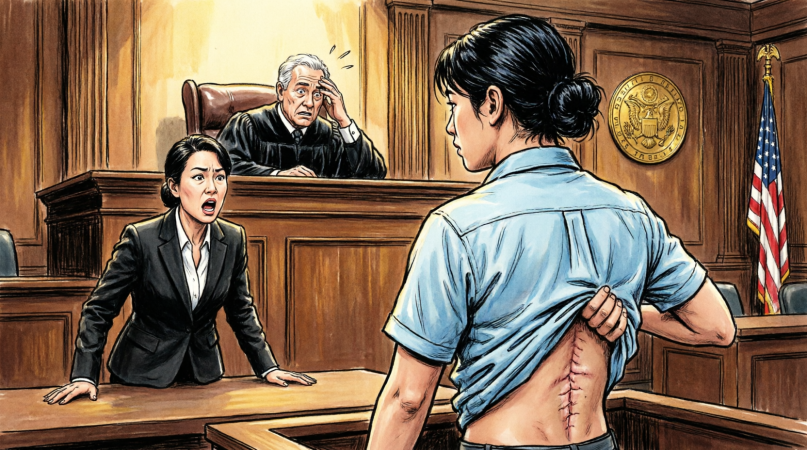
My mother’s eyes widened, but she didn’t look away. She looked at the scar like it was a stain she couldn’t scrub out.
“That… that could be anything,” she stammered, her voice losing its sharp edge. “People get hurt all the time.”
Travis shifted in his seat, the cheap camouflage jacket suddenly looking less like a joke and more like a costume. He stopped grinning.
I didn’t lower my shirt. I let them look. I let the whole room see the physical receipt of the years they claimed I’d wasted lying on a couch.
“Your Honor,” I said, my voice steady. “I have my DD214, my medical records from Walter Reed, and my Purple Heart citation in my bag. But I thought this might be more immediate.”
Judge Keane stood up fully now. She wasn’t just looking at me; she was looking through me, at the people sitting behind the plaintiff’s table. She walked down from the bench, something judges rarely do, and approached the barrier separating the gallery from the court.
“Mrs. Caldwell,” the judge said, her voice low but carrying to every corner of the room. “You swore an oath today. You told this court, under penalty of perjury, that your daughter fabricated her service.”
My mother swallowed hard. “I… I believed…”
“You believed what was convenient,” Judge Keane cut in. She turned to me. “Miss Caldwell, you may cover yourself. The court accepts your evidence as definitive.”
I pulled my shirt down and slipped my blazer back on. I felt exposed, not because of the scar, but because of the vulnerability of letting them see me hurt. But I stood straight. Posture perfect. Shoulders back. The way I was trained.
Judge Keane returned to her seat. She picked up a gavel, but she didn’t strike it yet. She looked at my mother and brother with a disdain that made the air feel cold.
“This court takes false claims of veteran status seriously,” the judge said. “But it takes malicious litigation based on lies even more seriously. You sought to strip your daughter of her inheritance by attacking her honor. You weaponized her service against her.”
She paused, letting the weight of her words settle.
“Case dismissed,” she said firmly. “The will stands as written. Miss Caldwell retains full ownership of the property and the assets.”
My mother opened her mouth to protest, but the judge raised a hand.
“Furthermore,” Judge Keane continued, “due to the frivolous nature of this suit and the demonstrable falsehoods presented under oath, I am ordering the plaintiffs to pay all of Miss Caldwell’s legal fees. Additionally, I am referring this matter to the county prosecutor for review of potential perjury charges.”
The color drained from Travis’s face. My mother gripped the edge of the table, her knuckles white.
“You… you can’t do that,” my mother whispered. “We’re family.”
Judge Keane picked up the gavel. “Family is exactly why this is so egregious. Court is adjourned.”
The bang of the gavel sounded like a gunshot.
I didn’t wait for them. I didn’t wait to see the panic set in as they realized the legal fees would likely cost more than the inheritance they were trying to steal. I walked out of the courtroom, into the hallway where the sunlight streamed through the high windows.
My lawyer, a quiet man named David who had served in the Navy, caught up to me near the exit.
“You okay?” he asked.
“I will be,” I said.
Outside, the air was crisp. I took a deep breath. For years, I had carried the weight of their disappointment like a rucksack full of stones. I had thought that if I just proved myself enough, if I just saved enough lives in the ER, if I just showed them the papers, they would finally see me.
But standing there, watching a squirrel scramble up an oak tree, I realized something. I didn’t need them to see me. I knew who I was. The scar on my shoulder wasn’t a wound anymore. It was a boundary.
My phone buzzed. A text from my mother. This isn’t over. You humiliated us.
I looked at the message. I thought about the judge’s warning about perjury. I thought about the bills they would be receiving in the mail next week.
I didn’t reply. I simply blocked the number.
A man walking past the courthouse steps stopped. He was older, wearing a hat with a unit insignia I recognized. He had been in the gallery. He stopped in front of me, took off his hat, and nodded.
“Thank you for your service,” he said.
It was simple. Automatic. But it landed differently this time.
“Thank you,” I said back.
I walked to my car. I didn’t feel like celebrating. I felt like exhaling. The house was mine. The money was mine. But more importantly, my story was mine. They couldn’t edit it anymore. They couldn’t shrink it to fit their narrative.
I drove back to the ER for my shift. There were sirens wailing in the distance, people hurting, people needing help. That was where I belonged. Not in a courtroom fighting for validation from people who were determined to deny me.
As I pulled into the hospital parking lot, I looked at my reflection in the rearview mirror. The eyes looking back weren’t the eyes of the little girl who begged for approval. They were the eyes of a soldier who had survived the blast.
My family wanted to drag me to court to prove I was a fake. Instead, they proved to the whole town that they were the ones without honor. And the punishment wasn’t just the money they lost. It was knowing that for the rest of their lives, everyone would know exactly what they tried to do.
I turned off the engine. I picked up my bag. I went inside to save lives.
Because that’s what I do. And no lawsuit, no lie, and no mother could ever take that away from me.