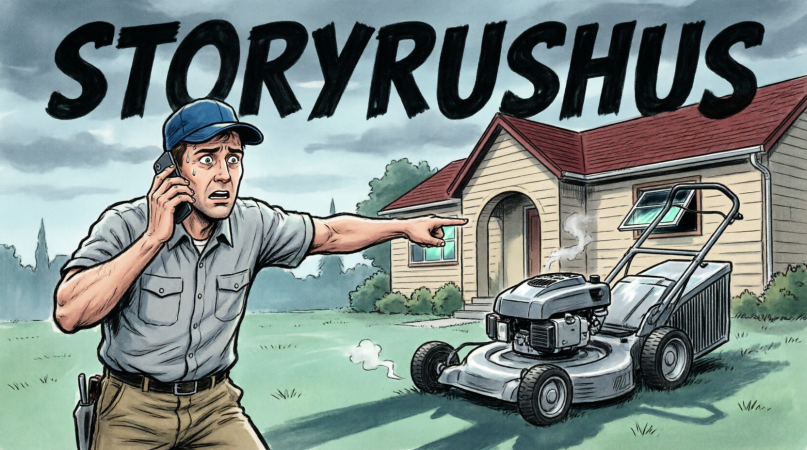
I hired a guy to mow the lawn while my daughter was out of town. About an hour later, my phone rang. His voice was low, almost shaking. “Sir… is anyone else supposed to be inside the house right now?” I froze. “What do you mean?” He paused, and for a second all I could hear was the mower idling in the background. Then he whispered, “I keep hearing someone crying… and it’s coming from the basement. That’s not a TV.”
The Crying Beneath Ashford Lane
I hired a guy to mow the lawn while my daughter was out of town. About an hour later, my phone rang. His voice was low, almost shaking. “Sir… is anyone else supposed to be inside the house right now?” I froze. “What do you mean?” He paused, and for a second all I could hear was the mower idling in the background. Then he whispered, “I keep hearing someone crying… and it’s coming from the basement. That’s not a TV.”
For a moment, the whole kitchen seemed to tilt around me.
My coffee sat untouched beside the sink, steam thinning into the morning light. Outside, the maple trees along Ashford Lane shifted in a soft wind, and the mower droned in uneven circles across the front yard. It was the kind of ordinary suburban morning I had trusted for years, the kind that made a man believe his life was finally quiet enough to stop hurting.
Gary Thompson stood near the basement window with one hand pressed to his ear and the other gripping his phone. I could see him from the kitchen, his ball cap pulled low, his work gloves tucked into the back pocket of his jeans. Gary had cut my grass every Tuesday for six years. He was practical, punctual, and not the type to make up strange sounds coming from someone’s house.
“Stay right there,” I told him.
My voice sounded calm. Thirty-two years flying commercial planes had trained that into me. When something went wrong at thirty-seven thousand feet, fear had to wait behind procedure. You checked the instruments. You confirmed the signal. You did not panic until panic became useful.
But as I set the mug down, my fingers felt numb.
The basement door was beside the pantry, painted the same white as the kitchen cabinets. I had walked through it thousands of times without thinking. Today, the knob felt cold in my palm.
I opened it and looked down the stairs.
Sixteen steps. Pine railing. Old carpet runner. A faint smell of dust, metal, and the lavender soap my oldest daughter Cassandra kept near her jewelry sink.
The house was supposed to be empty except for me.
Cassandra had left at seven that morning for a downtown client meeting. She had kissed my cheek, reminded me to take my vitamins, and walked out in a navy blazer with her leather portfolio under one arm. My Seattle flight was not until midafternoon. I had planned to pack, check the weather, and maybe call my friend Steven about golf.
Instead, I stood at the top of the basement stairs listening for someone who should not exist.
Halfway down, the house creaked around me. Old houses do that. Margaret used to say this one had moods. She had loved its wide porch, its narrow hallway, the kitchen window over the sink where sunlight fell across her herb pots. We bought it twenty-three years earlier, when Cassandra was nine and Felicia was four, back when both girls ran barefoot through the living room and left crayons in the sofa cushions.
Margaret had been gone ten years.
Felicia had been gone eight.
And Cassandra was all I had left.
At the bottom of the stairs, I stood still and listened.
Nothing.
Only the furnace humming behind its metal door and the faint electric buzz of the lights. The basement had once been a mess of storage bins, holiday wreaths, and Margaret’s old sewing boxes. Five years ago, Cassandra turned the far end into a jewelry studio. I had helped her paint the walls dove gray, install shelves, and mount track lighting above her workbench. She said the basement made her feel grounded, closer to the house, closer to her mother.
I opened the studio door.
Everything looked exactly as it always did.
Her long worktable stood in the center of the room, tools arranged in perfect order on a rolling mat. Pliers. Cutters. Tiny files. Silver wire coiled in glass jars. A velvet display tray held a row of pendants under the warm light. The pieces were beautiful, delicate vines and birds and small moons engraved with such precision that clients drove in from Chicago to buy them.
Cassandra had built a name for herself with that work. She called it grief transformed into beauty.
I had believed her.
Then I saw the glass.
It sat near the small sink in the corner, half full of water, condensation still clinging to the sides. I touched it with two fingers. Cold.
Cassandra had been gone almost an hour.
The faucet handle was damp. A folded hand towel hung crookedly over the sink, and the lavender scent in the room was too fresh to belong to last night.
I turned slowly.
The back wall looked normal at first. Same gray paint. Same neat line where the baseboard met the floor. But when the light hit it from the side, I noticed the texture. The paint there was smoother than the rest, almost too even, like a patch blended by someone who knew exactly how to hide repairs from a casual eye.
I walked to it and knocked.
The sound came back hollow.
Not the dense thud of foundation. Hollow.
“Mr. Hayes?”
I turned sharply.
Gary stood in the doorway at the foot of the stairs, his gloves twisted in both hands. His face had gone pale under the brim of his cap.
“I didn’t mean to come in without asking,” he said. “But you didn’t answer when I called down.”
“It’s all right.”
He glanced toward the back wall. “Did you hear anything?”
“No.”
He swallowed. “I know what I heard.”
I wanted to tell him sound carries strangely through old houses. I wanted to blame the vents, the neighbor’s television, a phone left playing somewhere. I wanted anything but the look on his face.
“What exactly did it sound like?” I asked.
“A woman crying,” he said quietly. “Not loud. Not like a movie. More like she was trying not to be heard.”
The words moved through me with a cold, slow precision.
Before I could answer, a car door shut outside.
Heels clicked above us.
Cassandra.
She appeared at the top of the stairs a moment later, framed by kitchen light. Her eyes moved from Gary to me to the open studio door. Surprise crossed her face, then vanished behind a smile so practiced it made my stomach tighten.
“Dad?” she said. “Gary? What’s going on?”
“Gary heard something from the basement windows,” I said.
Gary cleared his throat. “Crying, ma’am. I thought I should call.”
Cassandra laughed softly. Not too loud. Just enough to make the concern in the room seem slightly embarrassing. “Oh, goodness. That was probably my podcast. I worked late last night and had one of those emotional interview shows playing while I cleaned up. I must have left it on a timer.”
Gary’s shoulders eased. “That could be it.”
“It’s sweet of you to check,” she said, touching his arm briefly. “I’m sorry you got worried.”
“What brought you back?” I asked.
Her smile held, but something flickered behind it. “Forgot my presentation portfolio. Big commission. Red leather binder, shelf by the window.”
“I’ll grab it.”
The flicker sharpened.
“Dad, I can get it.”
“I’m already here.”
I walked into the studio, picked up the red leather portfolio, and handed it to her. Her fingers closed around it a little too quickly.
From the kitchen window, I watched her Audi back out of the driveway and roll down Ashford Lane as if nothing in the world had changed.
Gary returned to the mower.
I returned to the basement.
The studio looked different now because I was different.
The water glass was still cold. The soap scent was still fresh. The wall was still hollow. And Cassandra’s explanation, smooth as it had been, did not fit the room. She had always been good at making lies sound like hospitality. Good at softening edges until a person felt rude for noticing them.
I stood in front of that wall for a long time.
Then my phone buzzed.
Cassandra.
Thanks for covering, Dad. Love you.
Covering.
I stared at the word until it stopped looking like English.
I typed back, Love you too.
But I did not believe the message anymore.
That night, sleep came nowhere near me.
The bedroom ceiling above my face held the faint reflection of streetlight through the blinds. The clock changed from 11:47 to 12:30 to 1:15. Outside, the trees rustled along the street. In the old days, after a long rotation, that sound would have put me under in minutes. That night, it made the house feel awake.
At 2:15, I heard the basement stair creak.
Not the house settling. Not pipes. A footstep.
I sat up in bed.
Another creak came, softer this time, like someone putting weight on the side of the step that made less noise.
My first instinct was to call Cassandra’s name.
I did not.
Instead, I sat in the dark and hated myself for being afraid of my own daughter.
Margaret would have gone downstairs. Margaret would have known. She had always read our girls better than I could read a cockpit panel. When Cassandra was seven and lied about breaking the living room lamp, Margaret knew before the second sentence. When Felicia was sixteen and sneaked back through her bedroom window after midnight, Margaret was waiting in the kitchen with tea and disappointment.
Take care of our girls, Margaret had told me in the final weeks, her hand small and dry in mine. Promise me, Chris.
I promised.
God help me, I promised.
But in the dark, listening to the old house breathe around me, I had to wonder what kind of father needed a landscaper to hear his child crying beneath his feet.
Felicia had been nineteen when she disappeared.
March 15, eight years earlier. She had walked out after dinner with her keys in one hand and her phone in the other.
“Meeting Sophie for coffee,” she called from the hallway.
“Drive safe,” I said, barely looking up from my laptop. “You’ve got that design meeting tomorrow.”
“I know. Love you.”
“Love you too.”
Those were the last ordinary words I ever gave her.
By morning, her bed had not been slept in. Her phone went straight to voicemail. Her best friend Sophie had not seen her. The city records showed no card activity, no travel, no hospital admission. Cassandra cried beside me while we printed flyers. She called Felicia’s friends. She organized search posts online. She sat at the kitchen table with red eyes and said maybe Felicia needed space.
Maybe she took that New York opportunity early, Dad. You know Felicia. She hates goodbyes.
I had wanted to believe my daughter had left because leaving hurt less than imagining anything worse.
So I believed.
Over the years, small oddities had drifted past me like leaves in a flooded street. Grocery bills that doubled. Cassandra carrying trays downstairs after midnight. A muffled sound when I came home early from a trip. New drywall dust near the basement trash. Cassandra explaining each thing before I could fully ask.
Client events.
Late commissions.
New storage.
A private workspace.
Every answer reasonable. Every answer a brick in a wall I did not know I was helping build.
At three in the morning, I opened the notes app on my phone and began writing.
Tuesday, 7:34 a.m. Gary hears crying from basement.
Tuesday, 7:43 a.m. Cold water glass in studio.
Fresh paint on back wall.
Hollow sound behind wall.
Lavender soap recently used.
Three years ago, late basement sounds.
Two years ago, grocery bills increase.
One year ago, tray of food carried downstairs.
My hands shook as I typed.
Evidence first, emotion later.
It was something I had told young pilots for decades. When the sky goes wrong, you do not argue with fear. You collect facts.
By Thursday afternoon, I had enough fear to fill the house and not enough facts to survive it.
So I went through Cassandra’s papers.
She had left at noon for a gallery event downtown. I stood in the doorway of her home office, the room that used to be Margaret’s sewing room. Everything inside looked curated. Glass desk. White shelves. Design books arranged by color. A framed photo of Cassandra and me at her first gallery opening, her arm around my shoulder, both of us smiling like the past had not swallowed someone we loved.
The filing cabinet was not locked.
In the bottom drawer, I found an accordion folder labeled household grocery in Cassandra’s neat handwriting. Inside were receipts organized by month.
I spread them across the desk.
Target. Cub Foods. Costco. Amazon. Week after week. Canned soup. Rice. Pasta. Bottled water. Peanut butter. Multivitamins. Toothpaste. Shampoo. Sketch pads. Paperback novels. Women’s clothing, size small.
Cassandra wore a medium. Cassandra ate most dinners with clients. Cassandra did not read mysteries or use cheap sketch pencils. Cassandra had once told me drawing was “Felicia’s thing.”
Then I found the monthly personal items.
The same purchase, again and again.
I sat down hard.
Someone else was living in this house.
Someone who needed food that lasted, toiletries no guest ever saw, books to pass time, sketch pads to stay sane.
Someone small.
Someone like Felicia.
I photographed everything, hands trembling as I worked down the piles. When Cassandra’s car pulled into the driveway at 5:47, I had put every receipt back exactly where I found it and started dinner.
Chicken Marsala. Her favorite.
The kitchen smelled warm and safe. That made it worse.
Cassandra came in glowing. “Dad, you would not believe today. Three sales and Mrs. Peterson wants a custom anniversary piece.”
“That’s wonderful,” I said. “Tell me everything.”
She talked for twenty minutes. Clients, compliments, possible press coverage. I watched her face across the table and searched for the child I had taught to ride a bike, the little girl who cried when Margaret trimmed her bangs too short, the daughter who held my hand at Felicia’s memorial vigil even though there had been no body, no ending, no place to put our grief.
When she finally relaxed, I said, “You’ve been hosting clients here, right?”
Her fork paused for less than a second.
“Sometimes,” she said. “Why?”
“The grocery bills have gone up. I figured it was for private viewings.”
“Oh.” She smiled. “Yes, exactly. Wine, cheese, crackers. People expect an experience.”
“A lot of toiletries too.”
Her knuckles whitened around the fork.
“Dad,” she said lightly, “women come here. Emergencies happen. Good hospitality means being prepared.”
“Of course.”
We finished dinner like a normal father and daughter.
At nine, she kissed my cheek and went upstairs.
At nine-thirty, I went back to the basement.
The studio lights stayed off this time. I crossed the room with my phone flashlight angled low and placed my ear against the hollow wall.
At first, there was nothing.
Then I heard it.
Breathing.
Quick. Shallow. Terrified.
My chest closed.
“Felicia,” I whispered.
The breathing stopped.
For ten seconds, the whole world was silent.
“Felicia,” I whispered again. “If you can hear me—”
Above me, a floorboard creaked.
Cassandra’s bedroom door.
I stepped back from the wall, turned off the flashlight, and moved toward the stairs. Behind me, the breathing had started again, faster now, almost a sob trapped inside someone’s chest.
I wanted to tear the wall down with my hands.
Instead, I went upstairs and locked myself in my room.
The next day, Steven Harper called.
Steven was my oldest friend and the attorney who had helped Margaret and me set up the girls’ trusts. He was the kind of man who sounded calm even when delivering bad news, which was why the strain in his voice made me grip the phone harder.
“Chris,” he said. “You need to come to my office. It’s about Felicia’s trust.”
Twenty minutes later, I sat across from him on the twelfth floor of the IDS Tower, looking at bank statements spread across his desk.
“You remember Margaret’s insurance money,” Steven said. “Five hundred thousand set aside for Felicia. She was supposed to access it at twenty-one.”
“When she disappeared, I made Cassandra temporary trustee,” I said. “I thought it was safe.”
Steven slid a spreadsheet toward me.
“It wasn’t.”
The withdrawals began two weeks after Felicia vanished.
Fifty thousand dollars. Then another. Then another.
Debt repayment. Derek Hamilton.
The name took a moment to surface. Cassandra’s boyfriend from that time. Slick smile, expensive shoes, always looking over his shoulder as if trouble had his address.
“There’s more,” Steven said.
Payments to a contractor in Iowa. J. Morrison Construction. One hundred thousand dollars listed as home renovation.
My mouth went dry.
“We never renovated anything.”
“I checked city permits,” Steven said. “Nothing filed at your address.”
Other withdrawals followed. Food. supplies. operational expenses. Gallery startup. Investments under Cassandra’s name.
Margaret’s legacy had been drained piece by piece while I flew over cities, trusted my daughter, and slept above a room I had never known existed.
I told Steven everything. Gary. The glass. The wall. The breathing. The receipts.
He listened without interrupting. When I finished, his face had gone gray.
“Do not confront Cassandra alone,” he said.
“If Felicia is behind that wall—”
“Then Cassandra has kept control of this for eight years,” he said. “You cannot give her warning. You go home. You act normal. I’ll start tracing the money. We document everything.”
“Act normal,” I repeated.
He put copies of the statements into a folder and pushed it across the desk.
“Evidence first,” he said.
“Emotion later.”
I almost laughed when he used my own rule against me.
By Friday morning, the evidence came knocking.
Dorothy Green, my next-door neighbor, stood on my porch at 8:15 with a canvas tote pressed against her chest. Dorothy was seventy-two, widowed, and had been Margaret’s closest friend on the block. She used to bring casseroles after Margaret died and birthday cards for the girls long after they stopped expecting them.
That morning, she looked terrified.
“Mr. Hayes,” she said. “I should have told you years ago.”
I brought her inside.
She sat on the edge of the sofa and pulled three spiral notebooks from the tote. The covers were worn soft at the corners. Inside, every page was filled with dates, times, and careful handwriting.
March 15, 2017. 2:30 a.m. Cassandra exited basement with tray.
July 22, 2021. Heard faint crying from Hayes basement side. Lasted ten minutes.
October 3, 2023. Cassandra made three trips to basement carrying blankets, books, supplies.
My hands went cold as I turned page after page.
“I have insomnia,” Dorothy said, twisting a tissue between her fingers. “After Robert passed, I was up most nights. I saw things. Lights in your basement after midnight. Cassandra carrying bags. Sometimes dishes. Sometimes boxes.”
“You heard crying?”
Her eyes filled. “Yes.”
“Did you tell anyone?”
“I called once,” she whispered. “Years ago. Someone came by while you were away. Cassandra showed them the studio and explained she worked late. They left.”
Dorothy looked down at her lap.
“The next day, Cassandra came to my porch. She smiled the whole time. She said, ‘Mrs. Green, curiosity can disturb a peaceful neighborhood. I would hate for your life to become difficult over a misunderstanding.’ She never raised her voice. But I understood.”
I closed my eyes.
Dorothy pulled a USB drive from the tote.
“I installed a camera last year,” she said. “I know it was wrong to point it toward your house. But I needed to know if I was imagining things.”
We played the videos on my laptop.
Night vision footage.
Cassandra carrying black bags from the basement door. Cassandra standing in the yard at 12:35 a.m., looking up toward my bedroom window to see if the lights were off. A dark sedan pulling into my driveway near midnight, a thin man carrying a large box to the basement entrance while Cassandra waited.
“Do you know him?” Dorothy asked.
I stared at the man on the screen.
Derek Hamilton.
The pieces did not fall into place gently. They slammed.
When Dorothy left, I sat in my living room with her notebooks on the coffee table, Steven’s folder beside them, and Cassandra’s text glowing on my phone.
Morning, Dad. Client lunch until three. Love you.
Love.
The word had become impossible.
At 2:30 that afternoon, a message arrived on LinkedIn.
Riley Summers.
Felicia’s best friend from college.
Subject: About Felicia Hayes. I need to speak with you urgently.
Riley had called me every week the first year after Felicia vanished. Then less often. Then once, crying, to say she could not keep reopening the same wound. I never blamed her. Grief does not make people loyal in equal measurements. Sometimes it just makes them survive.
I called her.
She answered on the first ring.
“Mr. Hayes,” she said, breathless. “I found something.”
We met at Riverside Brew on Hennepin, in a back corner away from the windows. Riley looked older than I remembered, sharper, with dark curls pulled into a knot and a leather messenger bag full of papers.
She opened her tablet and pulled up Cassandra’s jewelry website.
“These aren’t Cassandra’s designs,” Riley said.
“What?”
“They’re Felicia’s.”
She showed me a pendant from Cassandra’s 2022 collection. Silver vines curled around a small oval center. Then she opened a scan of an old sketch from Felicia’s college portfolio.
The match was exact.
Not similar.
Exact.
The leaf spacing. The curve of the vine. The tiny break in the stem near the bottom.
Riley swiped again. Bracelet. Sketch. Ring. Sketch. Necklace. Sketch. Fifteen pieces. Fifteen stolen designs.
Then she zoomed in on the first pendant.
“Look here.”
At first, I saw only decoration. Then Riley traced the edge of one leaf with her fingertip, and a tiny hidden letter appeared in the negative space.
F.
“Felicia signed everything that way,” Riley whispered. “She told me once, ‘If people care enough to look, they’ll find me.’”
My daughter had been leaving her name in plain sight.
Fifteen times.
Fifteen quiet cries the world had almost missed.
“She’s alive,” Riley said, tears on her cheeks. “Isn’t she?”
I told her everything.
When I finished, Riley covered her mouth with both hands. “She’s in that house.”
“I think so.”
“What are you going to do?”
I looked at the hidden F on the screen.
“I’m bringing her home.”
That night, at 11:30, I went downstairs with a tape measure, flashlight, and Steven on speed dial.
This time, I did not move like a man investigating a sound.
I moved like a father who had wasted eight years and had no more room for fear.
The studio measured twenty-five feet from the door to the back wall. The exterior basement wall measured forty.
Fifteen feet missing.
On the left side of the studio, a tall bookshelf stood against the wall. It was filled with design books, metalwork manuals, and a few art history volumes placed too neatly to feel natural. I crouched and shone my flashlight along the bottom.
Caster wheels.
Locked with small metal pins.
Beside the left wheel, half hidden by the frame, was a keypad with a red LED light.
Four digits.
I tried Cassandra’s birth year.
Red.
Felicia’s.
Red.
Margaret’s death year.
Red.
Then my hand froze.
2016.
The year Felicia vanished.
I entered the digits.
The light turned green.
A soft click sounded inside the shelf. The pins released. I pulled, and the whole bookshelf rolled aside smoothly, revealing a narrow opening in the drywall.
Behind it stood a gray steel door.
A lock on the outside.
My breath caught so hard it hurt.
From the other side, I heard a soft, shallow inhale.
I pressed my forehead against the cold metal.
“Felicia.”
Silence.
Then a sound.
A tiny broken breath.
“Dad?”
My knees almost gave out.
“Baby,” I whispered. “Is that you?”
A sob came through the door, thin and shaking.
“Dad,” she cried. “You came.”
I reached for the lock.
Above me, footsteps moved across the kitchen.
Cassandra was awake.
For one terrible second, I stood between instinct and strategy. Every part of me wanted to open that door immediately, pull Felicia into my arms, and never let the house touch her again. But if Cassandra came down and found me there before help arrived, she would perform. She would lie. She would say I was confused, grieving, unstable. She had survived eight years by controlling the room.
I would not give her one more room.
“Felicia,” I whispered, voice shaking. “I’m calling for help right now. I am not leaving you. Do you hear me? I am not leaving.”
“Please,” she whispered. “Don’t go.”
“I’m right here.”
I called the emergency line from the basement, one hand flat against the door.
“My name is Christopher Hayes,” I said. “My daughter is alive inside a hidden room in my basement. She has been concealed there for years. I need responders at 2847 Ashford Lane immediately.”
The dispatcher kept me on the line.
Felicia cried quietly on the other side of the door.
I kept my palm pressed to the steel.
“I’m here,” I kept saying. “I’m here.”
The doorbell rang before the responders arrived.
I ran upstairs and looked through the peephole.
Derek Hamilton stood on my porch.
He was thinner than the man from Dorothy’s video, his face pale, his hair damp with sweat. He clutched a messenger bag like it contained something alive.
When I opened the door, he looked past me into the house.
“I heard you were asking questions,” he said. “Mr. Hayes, I need to tell you everything before they get here.”
In the living room, he collapsed into the armchair and pulled a USB drive from his bag.
“It was supposed to be one night,” he said, voice shaking. “Cassandra said it was a lesson. A scare. She said Felicia was leaving and she needed to understand consequences.”
“What did you do?”
He swallowed.
He described a staged roadside incident on Oakwood Avenue. A rented car. A prop shaped like a person. Red syrup from a costume store. A fake news article. A voice message made to sound like Sophie, Felicia’s friend, asking her to come help.
Felicia had driven there. She had panicked. Cassandra had appeared and convinced her she had caused something terrible. Derek had pretended to have official authority and told Felicia she could lose her future if anyone found out.
“My debts were bad,” Derek said, unable to meet my eyes. “Cassandra knew. She paid enough to keep me quiet, then kept paying just enough to keep me scared. She said if I told, I’d go down too.”
“You helped her lock my daughter away.”
His face crumpled. “Yes.”
The sirens were close now.
Derek pushed the USB drive toward me. “Messages. Transfers. Recordings. Her admitting there was no real incident. Her saying Felicia’s designs were too valuable to let go. I should have come sooner. I know that. I’m turning myself in tonight.”
I picked up the drive.
“You don’t get forgiveness from me tonight,” I said. “But you can still tell the truth.”
He nodded, tears spilling down his face. “Tell Felicia I’m sorry.”
The responders arrived moments later.
I led them downstairs with Derek behind us and Cassandra standing at the top of the basement steps in silk pajamas, her hair loose, her face suddenly bare of every polished layer.
“Dad,” she said. “What are you doing?”
For the first time in years, I did not answer to her tone.
A lead investigator named Linda Bennett followed me into the studio. She had sharp eyes and a voice steady enough to hold the room together. Two uniformed responders stood behind her. Another stayed near Cassandra.
Bennett looked at the rolled bookshelf, the keypad, the steel door.
“Open it,” she said softly.
The door swung inward.
The smell came first. Damp air. Disinfectant. Stale fabric. A room lived in without ever being allowed to breathe.
A narrow bed stood against one wall. A small desk sat under a lamp. Paper covered the desk. Pencils worn down to stubs. A tiny sink in the corner. A simple toilet behind a curtain. The walls were covered with drawings layered over drawings.
Birds.
Trees.
Open skies.
And one face, drawn again and again.
Mine.
On the bed, curled against the far wall, was a woman with long brown hair and pale skin, shielding her eyes from the sudden light.
She lowered her arm.
I knew her.
Eight years had carved her down, but it had not erased her.
“Felicia,” I said.
Her eyes found mine.
“Dad.”
I crossed the room and dropped to my knees beside her bed. When I wrapped my arms around her, she felt impossibly small. She clung to me with a strength that came from somewhere beyond muscle.
“I’m sorry,” I kept saying. “I’m so sorry. I’m so sorry.”
“You came,” she whispered into my shoulder. “I kept drawing you. I knew you would come.”
Behind us, Cassandra stood in the doorway, white as paper.
Felicia looked at her.
For a long moment, no one spoke.
Then Felicia asked the question that broke the last intact thing in the room.
“Why, Cassie?”
Cassandra’s mouth opened, but nothing came out.
By sunrise, Felicia was in the hospital.
Her condition was fragile but stable. The doctors spoke gently about malnutrition, muscle loss, vitamin deficiencies, long recovery, careful therapy. I heard the words and understood them only in pieces. All that mattered was her hand in mine.
She would not let go.
I did not want her to.
When she was ready, she told us about the night on Oakwood Avenue. The fake call. The road. The prop she believed was a person. Cassandra appearing like a savior and turning shock into obedience. Derek’s performance. The fake article Cassandra showed her the next morning about a man named Thomas Whitmore.
Bennett left the room to verify the name.
When she returned, her face had changed.
“There is a Thomas Whitmore,” she said gently. “He lives in Madison. He is alive.”
Felicia stared at her.
Bennett made the call in the room, on speaker.
A confused man answered.
No, he had never been involved in an accident on Oakwood Avenue. No, he had never lived in Minneapolis. Yes, he was alive and well.
Felicia made a sound I will hear for the rest of my life.
Not grief. Not relief.
The sound of a person learning the cage was built from a lie.
I held her as she sobbed.
“You didn’t hurt anyone,” I told her. “There was never anyone to hurt.”
“She let me believe it,” Felicia choked. “For eight years.”
“I know.”
“She let me think I deserved the room.”
I closed my eyes.
“No,” I said. “You deserved the sky.”
The investigation widened quickly, but I stayed focused on Felicia.
Evidence came in waves. The sale of her car two weeks after she disappeared, signed with a forged version of her name. Security footage from an Iowa dealership showing Cassandra in sunglasses and a cap, selling the white Corolla for cash. A contractor from Des Moines named Jake Morrison admitting he built the hidden room for Cassandra while I was away on a long flight rotation. He said she called it a climate-controlled private cellar. He said he should have asked more questions.
Everyone should have asked more questions.
Riley uncovered the hidden signatures in the jewelry designs and gave investigators Felicia’s old portfolios. An audio specialist reviewed old voicemail messages that had convinced all of us Felicia had left by choice. They sounded like her, but they were artificial. Constructed from old family videos and college clips. Cassandra had used Felicia’s voice to tell us not to look.
That revelation hurt in a different way.
For years, I had replayed one message when grief became unbearable.
Dad, I’m safe. I just need time. I’ll come home someday.
I had slept because of that message.
It had been a machine wearing my daughter’s voice.
Dorothy handed over eight years of notebooks and videos. Gary gave a statement about the crying. Steven traced the money. Derek confessed. The contractor cooperated. A man named Eddie, who had been sleeping near Oakwood Avenue the night of the staged incident, came forward after seeing the story. He had seen the prop, the rented car, Cassandra watching from the shadows. He had been too afraid and ashamed to speak then.
By the time Cassandra stood in her own gallery two weeks later, still pretending her life could be polished back into place, the case against her was no longer a suspicion.
It was a wall higher than the one she had built.
I was there when they came for her.
Cassandra Hayes Designs looked flawless that morning. White walls. Glass cases. Champagne. Soft music. A crowd of clients in expensive coats admiring pieces that had never truly belonged to Cassandra at all.
She stood at the center in a black dress, smiling as she explained the “personal grief inspiration” behind a silver vine pendant.
I saw the hidden F before she finished speaking.
Bennett entered first, followed by two officers from the public safety unit. The bell above the gallery door chimed like any other customer had arrived.
Then the room went quiet.
Cassandra turned. Her smile froze.
“Cassandra Hayes,” Bennett said, calm and clear. “You need to come with us.”
“There’s been a mistake,” Cassandra said.
Her eyes found me near the door.
For one second, she was not the confident artist or the careful daughter. She was a little girl caught with scissors in her hand and doll hair on the floor, already preparing tears before anyone asked why.
“Dad,” she said.
I walked toward her. The crowd parted.
“I know everything,” I said. “The room. The money. Derek. The voice messages. Felicia’s designs. The car. All of it.”
Her face crumpled. “You don’t understand.”
“No,” I said. “For eight years, I didn’t.”
“She was going to leave us,” Cassandra said, voice breaking. “She had New York. She had talent. She had everyone’s attention without even trying. After Mom died, this family was falling apart. I was trying to keep us together.”
“You kept your sister behind a locked door.”
“I fed her. I gave her supplies. I protected her.”
“You used her.”
“I needed her,” Cassandra whispered.
That was the truth, finally. Not love. Need.
The gallery had gone so silent I could hear someone’s bracelet shifting against a glass.
Cassandra’s eyes filled. “Please don’t hate me. I’m still your daughter.”
I looked at her, and for a moment I saw both children at once. The girl who used to sit on my shoulders during Fourth of July fireworks. The woman who had locked her sister away and sold her art as healing.
“You were my daughter,” I said, my voice unsteady. “But I don’t know who you are anymore.”
When they led her out, cameras flashed through the glass. Guests whispered. A woman began crying near the display case.
I walked to the pendant Cassandra had been presenting moments earlier. Silver vines curled delicately around the center. Hidden in a leaf was Felicia’s F.
She had been screaming from inside the beauty Cassandra sold.
And now everyone could see it.
One week after Felicia left the hospital, we did not return to life.
We began building one.
The house on Ashford Lane was no longer home. Felicia could not stand the basement. I could not stand the kitchen. Every wall held a question I should have asked earlier. We sold the house within months and moved into a fifth-floor apartment near the river, with wide windows and light that filled the rooms from morning until evening.
Felicia chose it.
“I need sky,” she said. “Always.”
She started therapy three times a week. Physical therapy came first, then trauma counseling, then art therapy. Her hair was cut short because she wanted nothing left that belonged to the room. She gained weight slowly. Some days she laughed. Some days she woke from nightmares and sat on the living room floor with every light on while I made tea at two in the morning.
Healing was not cinematic.
It was groceries. Appointments. New sheets. Slow walks along the river. Panic in elevators. Joy over a cup of coffee she could buy for herself. Tears in the cereal aisle because there were too many choices. Small victories no one would clap for but us.
One evening, she sat beside me on the couch wrapped in an oversized hoodie, holding a mug of peppermint tea.
“I want to tell you how I survived,” she said.
“You don’t have to.”
“I do.”
So I listened.
She told me about the first week, when she believed Cassandra was protecting her. How she cried until her throat hurt. How Cassandra sat outside the door and promised she was finding a lawyer. How days became weeks, then months, then the first year.
“That was when I understood,” Felicia said. “She was never letting me out.”
She told me about drawing my face from memory because she was afraid she would forget it. About tapping on the vent when she heard footsteps upstairs. About designing jewelry because Cassandra told her the money would help with legal fees she now knew never existed.
Then she told me about the bird.
“A sparrow fell through the vent once,” she said. “Its wing was hurt. I named her Hope.”
I swallowed.
“I fed her crumbs. Made a little splint from cloth. She got better. When I let her go through the vent, she came back two days later.” Felicia smiled faintly. “I think she was terrible at being free at first. Like me.”
“What happened to her?”
“She stopped coming one spring.” Felicia looked toward the window. “I told myself she had found a tree.”
I held her hand.
“The hidden F,” I said.
“That was for Riley,” Felicia said. “We used to sign our work in secret during college. I thought if anyone would see it, she would. I didn’t know if Cassandra was selling the designs. I only knew she kept asking for more. So I hid myself in every one.”
“And you drew me.”
“Every day at first,” she said. “Then whenever I was afraid I might forget what love looked like.”
That broke me more than any courtroom ever could.
When the trial came, Felicia chose to testify.
Cassandra sat at the defense table with her hair pulled back, face pale, hands folded in front of her. She looked smaller without the gallery lights, without the jewelry, without the story she had built around herself.
The courtroom listened as Felicia spoke.
She did not exaggerate. She did not perform. She told the truth in a voice so steady it made people cry harder than shouting would have.
“I believed I had ruined a life,” she said. “My sister used that belief to take mine.”
Derek testified. Dorothy testified. Riley testified. Steven explained the trust. Experts explained the forged documents and the false voice messages. The contractor admitted what he built. Eddie described the staged road scene from his broken window near Oakwood Avenue.
Piece by piece, Cassandra’s careful world came apart.
The jury did not take long.
Guilty on all major counts.
At sentencing, Cassandra stood and asked to speak.
“I know everyone thinks I’m cruel,” she said, voice trembling. “But I loved my sister. I was scared of losing my family. After Mom died, Felicia was going to leave. I thought if I could just keep her close for a little while—”
Felicia’s hand tightened around mine.
Judge Margaret Sullivan raised her eyes from the file.
“Ms. Hayes,” the judge said, “love does not require a locked door. Love does not steal a person’s voice, money, art, movement, and future. What you called protection was control. What you called family was possession.”
The sentence was long enough that Cassandra’s shoulders folded before the judge finished reading it.
When she was led past us, she stopped.
“Dad,” she whispered. “I’m sorry.”
I looked at her.
For months, I had imagined what I would say in that moment. Something sharp. Something final. Something that would give me back a fraction of the years Felicia lost.
But when the moment came, I had nothing left to give Cassandra. Not anger. Not comfort. Not absolution.
Only the truth.
“I hope someday you understand what you did,” I said.
Her face twisted, and she was led away.
Outside the courthouse, Felicia leaned against me in the sunlight.
“It doesn’t give me eight years back,” she said.
“No.”
“But she can’t take any more.”
I wrapped my arm around her shoulders.
“No,” I said. “She can’t.”
Six months later, I stood at the back of a crowded bookstore and watched my daughter speak to two hundred people.
Her hair was short and bright under the lights. She had gained weight, strength, and a kind of calm I did not know how to name. On the table beside her sat stacks of her memoir, The Hidden Room. The cover showed a sparrow flying out of a dark square into a pale blue sky.
Riley sat in the front row. So did Steven, Dorothy, and Gary. People who had become part of the chain that pulled Felicia back into the world.
Felicia stepped to the microphone.
“I spent eight years in a room without windows,” she said. “But this book is not only about what was taken from me. It is about what could not be taken. My imagination. My stubbornness. My ability to love the sky without seeing it.”
The room was silent.
“I used to think survival meant waiting to be rescued,” she continued. “Now I think survival can be smaller than that. Sometimes it is drawing one more picture. Drinking one more glass of water. Naming a wounded bird Hope. Hiding your initial in a leaf because some part of you still believes someone will look closely.”
Her eyes found mine.
“My father found me,” she said. “But before he did, I had to keep leaving pieces of myself where the world might someday notice.”
I cried in the back of the room and did not care who saw.
After the reading, we drove home to the apartment near the river. The city lights shimmered on the water below. Felicia changed into sweatpants, made tea, and curled into the corner of the couch. The apartment windows reflected both of us back at ourselves, changed but still here.
“You were incredible tonight,” I said.
She smiled. “I was terrified.”
“Couldn’t tell.”
“That’s because I inherited your pilot voice.”
I laughed, and the sound surprised me.
Later, she asked, “Do you think I’ll ever forgive Cassandra?”
I set my mug down.
“I don’t know,” I said. “And you don’t owe anyone an answer today.”
“Part of me still loves her.”
“That makes sense.”
“Part of me never wants to hear her name again.”
“That makes sense too.”
She leaned her head on my shoulder. “I don’t want what happened to be the only story people know about me.”
“It won’t be.”
The next week, Felicia opened Hope’s Wings, a nonprofit art studio for people rebuilding after trauma. No locked rooms. No hidden doors. Just tall windows, paint-stained tables, shelves of paper, jars of pencils, and a small framed sketch of a sparrow near the entrance.
Under the sketch, Felicia wrote one sentence.
Broken wings still remember the sky.
On opening day, Gary brought flowers. Dorothy brought cookies. Riley hung the first set of student drawings on the wall. Steven stood beside me with his hands in his pockets and pretended he was not emotional.
Felicia moved through the room slowly, greeting people, laughing softly, touching the back of a chair when she needed balance. She was not the girl who vanished at nineteen. She was not only the woman we found behind the wall.
She was becoming someone larger than both.
That night, after everyone left, I found her standing alone by the windows. The studio overlooked the river, and sunset spread orange across the glass.
“You okay?” I asked.
She nodded. “For the first time, I think I am.”
I stood beside her.
“I need to tell you something,” I said.
She looked at me.
“I did stop looking,” I whispered. “Not in my heart, maybe. But in the real ways. The calls. The questions. The pressure. I accepted the story because it hurt less than not knowing. And I am so sorry.”
Felicia did not answer right away.
Outside, a flock of birds crossed the river in a dark, shifting line.
Finally, she took my hand.
“I know,” she said.
The words were gentle, but they landed with weight.
“I was angry about that,” she continued. “For a while. In the room. At the hospital. During therapy. I still might be sometimes.”
“You have every right.”
“But I also know Cassandra worked very hard to make everyone stop looking. She stole my voice and used it to tell you to let me go.” Felicia turned to me. “I don’t forgive everything. Not yet. But I know you came when you finally heard me.”
My throat closed.
“That doesn’t erase eight years,” she said. “But it matters.”
I nodded because speaking was impossible.
She squeezed my hand.
“Let’s go home, Dad.”
Home.
Not Ashford Lane. Not the house with the hidden room. Not the place where trust had become a wall.
Home was the apartment with the windows. The tea on the counter. The bookshelf full of books Felicia chose herself. The extra bedroom Riley used when she stayed late. The little sparrow sketch by the door.
Home was not a building anymore.
Home was the truth, finally allowed to breathe.
Sometimes people ask me when I knew I had my daughter back.
They expect me to say it was the night the door opened. Or the day the sentence came down. Or the first time she stood in sunlight outside the hospital and closed her eyes like she was listening to the world forgive her.
But it was later than that.
It was a Tuesday morning almost a year after Gary’s phone call. I was making coffee in the apartment kitchen when Felicia walked in wearing paint-smeared jeans, her hair sticking up on one side, and said, “Dad, I’m stealing the last bagel.”
I looked at her, standing there in ordinary morning light, complaining about cream cheese, alive in the most beautifully normal way, and something inside me finally unclenched.
She was not a ghost in my memory.
She was not a missing poster.
She was not a hidden signature.
She was my daughter, reaching for breakfast.
I smiled and said, “Only if you leave me half.”
She rolled her eyes. “You’re retired. You can buy more bagels.”
And just like that, the room filled with laughter.
Not dramatic. Not perfect. Just real.
That was the payoff no courtroom could give me.
My daughter was free enough to be ordinary again.
And after everything we lost, ordinary felt like a miracle.