Nicholas leaned toward her, confused at first, then furious when he realized what was happening. “What did you do?” he hissed through gritted teeth.
Renee’s eyes went wide. “What did I do? You’re the one who told me to put more on!”
The emcee’s microphone was still live. And that sentence came out clearly.
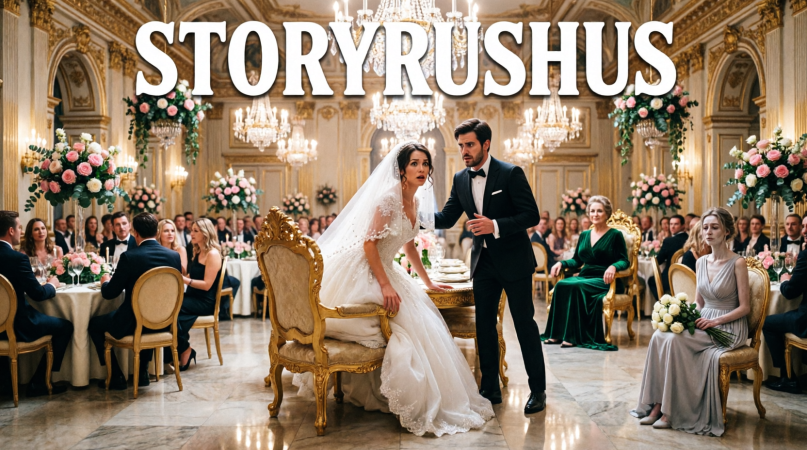
Entire. Cruel. It rolled through the ballroom like a wine glass shattering in slow motion. The applause died. The orchestra stopped playing. Two hundred people stood frozen, watching the bride glued to a chair, her white gown trapped by the same poison she had set for my wife.
Rosario squeezed my hand. “Bill… what’s happening?”
I didn’t answer her immediately. Because Nicholas was looking at me. No longer like a son, but like an accused man.
Renee pulled again, desperate. The lace tore with a dry, ripping sound. Several women covered their mouths. Someone let out a nervous laugh at a back table, but no one dared to follow it.
“Get me up, you idiot,” Renee hissed.
Nicholas tried to grab her arm. “Don’t make a scene.”
“I’m stuck!”
The microphone again. Everyone heard it again. Mrs. Amparo, Renee’s mother, stood up abruptly, her pearl necklace rattling against her chest. “What kind of filth is this?”
I stood up slowly. Not because I needed the drama, but because at my age, when your soul breaks, your body demands care.
“It’s the filth your daughter prepared for my wife.”
Rosario turned to me. “For me?” Her voice was small. Too small for a woman who, for forty years, had held my house together with hands of steel and a heart of gold.
Nicholas approached. “Dad, don’t start.”
I looked at him. And for the first time in his life, I didn’t see my little boy. I saw a man who had learned to use my last name as a shield and his mother’s tenderness as a doormat.
“I didn’t start this, Nicholas. I just swapped the place cards.”
A massive murmur filled the hall. Renee started to cry, but they weren’t tears of remorse. They were tears of shame. Of rage. From a woman who couldn’t stand that her own trap had been turned against her.
“He did it!” she screamed, pointing at me. “Mr. Aranda did this to me!”
I nodded. “Yes. I put your name in the seat where you put the glue.”
Rosario put a hand to her chest. “Glue?”
Nicholas took a step toward me. “Dad, shut up. There are guests here.”
“That is exactly why I’m going to speak.” I picked up the glass in front of me and set it back on the table. I didn’t want to toast. I wanted to remember.
“Thirty-five years ago, your mother sold her earrings to pay for your tuition at the private school you wanted so badly. Twenty-eight years ago, she went without eating meat for three months to buy your first computer. Twelve years ago, when you crashed while drunk and begged her not to tell me, it was she who paid to fix the other guy’s car.”
Nicholas turned pale. “That has nothing to do with this.”
“It has everything to do with this. Because the woman you wanted to see glued to a chair today—humiliated, wetting herself from fear, or lying on the floor—is the same woman who carried you when you had a fever and told me, ‘Don’t scold him, Bill, he’s just a little boy.’”
Rosario began to cry in silence. I looked at her, and I felt something snap inside me. She shouldn’t have found out like this. But monsters choose their own time to emerge. And sometimes, you can only decide whether you let them bite or whether you turn on the lights.
Mrs. Amparo rushed to Renee, pulling at the dress. “Get scissors! Get alcohol! Something!”
A waiter ran over. Renee tried to cover her face. “Mom, do something.”
Mrs. Amparo turned on me. “You are a savage! Ruining your own son’s wedding!”
“No, ma’am. Your daughter ruined it the moment she decided my wife was an aesthetic obstacle.” She opened her mouth but couldn’t find the words.
Then, a voice spoke up from among the guests. “I recorded it.”
Everyone turned. It was a young woman, Renee’s cousin, holding her phone up, her face pale. “I’m sorry, Renee… but since before the ceremony, you were saying that Rosario was going to be ‘a joke.’ I thought it was a cruel joke, but I recorded it because it gave me a bad feeling.”
Renee glared at her. “Danielle, put that down.”
“No.”
Nicholas shouted, “Put the phone down!”
That ended any doubt. An innocent man doesn’t shout at a witness. Danielle was shaking, but she kept the phone steady. “I also recorded when Nicholas said that after the wedding, you were going to convince Mr. Aranda to put the construction company in Renee’s name because ‘the old lady was very sick and he was going to be alone soon.’”
The room turned into a tomb. Rosario let go of my hand. Not quickly. Slowly. As if she had just touched something burning.
“Did you say that?” she asked.
Nicholas turned toward her. “Mom, no. It wasn’t like that.” But he didn’t dare get close. Renee’s chair, cemented to her own malice, was a border no one could cross without getting stained.
I pulled out my phone. “Ben.”
My driver appeared at the back, steady as always. “Yes, Mr. Aranda?”
“Bring the folder from the car.”
Nicholas looked at me with fear. Finally. Not fear of losing his mother. Not fear of having broken me. Fear of the paperwork. Spoiled children aren’t afraid of the pain they cause; they are afraid of the consequences that cost them.
Ben returned with a black folder. The same one my lawyer had handed me two days earlier, after months of doubts, suspicions, and silences I hadn’t wanted to face. I opened it on the head table.
“I came prepared for something else, Nicholas. Not for this. I intended to give you a wedding gift today.”
Renee stopped struggling. Nicholas swallowed hard. “Dad…”
“I intended to hand you the directorship of the company’s residential projects. I intended to sign over shares. I intended to secure your future.”
Rosario looked at me, confused. I lowered my voice. “I also intended to ask you, in front of everyone, to come back home to eat with your mother once a week. A silly old man’s wish, I suppose.”
Nicholas’s eyes filled with tears. But I no longer knew if I could believe them. I took out the first document. “This was the trust fund.”
I tore it in two. A gasp echoed through the room.
Nicholas took a step forward. “You can’t do that!”
I tore another sheet. “This was the appointment.”
“Dad!”
I tore the third. “And this was the authorization for you and your wife to occupy the summer house in the Hamptons for the first year of your marriage.”
Renee screamed from the chair: “Nick, do something!”
I looked at her. “He’s done quite enough.”
Mrs. Amparo began to cry. “My daughter made a mistake. A prank. Don’t destroy two families over a chair.”
Rosario lifted her head. Her tears were still falling, but her voice was firm. “It wasn’t just a chair.” Everyone went silent. My Rosario, in her sky-blue dress and wrinkled hands, stood up carefully. I tried to help her, but she gave me a gentle signal. She wanted to stand on her own. And she did.
“It wasn’t just a chair,” she repeated. “It was me. My hip. My body. My shame. My fear. You weren’t just trying to ruin a dress. You wanted to ruin me so my son would stop feeling guilty for despising me.”
Nicholas began to cry for real. Or so it seemed. “Mom, forgive me. I got carried away.”
Rosario looked at him the way you look at a door you painted, cared for, and defended, only to realize it’s been rotted through by termites from within. “I don’t know if I can.”
Those four words hurt him more than any blow. Renee, desperate, pulled hard. The dress tore from her hip to her thigh. Several people looked away. Not out of modesty, but out of discomfort at seeing justice so exposed. Two employees arrived with a special solvent. One of them, seeing the type of glue, shook his head. “This doesn’t come off easily. We have to cut part of the dress and peel it away carefully. If this had been an older person, it could have ripped the skin right off.”
Rosario closed her eyes. Nicholas covered his face. I felt nauseous. Because hearing it was one thing; hearing from a stranger how close my wife had come to being maimed by her own son was another.
At that moment, my lawyer entered. Ramiro. Gray-haired, serious, with the face of a man who is never late by accident. “Mr. Aranda,” he said, “I received your message.”
Nicholas lifted his head. “You called the lawyer, too?”
“Not before the wedding. After hearing what you were planning, yes.”
Ramiro stepped closer. “There is internal CCTV footage from the hotel. Security is already securing the material. There are also witnesses and clear intent to cause harm to a vulnerable person.”
Renee shrieked, “I’m not a criminal!”
Ramiro looked at her. “A judge will decide that, ma’am.”
“I’m not anyone’s wife yet!” she yelled.
And that sentence left Nicholas nailed to the floor. Not anyone’s wife yet. Not “we didn’t do anything.” Not “forgive me.” Not “what have I done?” The first thing she defended was the title. The last name. Entry into the Aranda family.
Rosario turned to our son. “Are you signed yet?”
Nicholas didn’t answer. Neither did Renee. Ramiro opened another folder. “The religious ceremony has already occurred. The civil ceremony was scheduled for after the reception, at 7:00 PM.”
I felt a relief so great it shamed me. My son wasn’t legally married to that woman. There was still a door. A small, damaged door, but a door nonetheless.
Nicholas looked at me. “Dad, please. Don’t do this. We’re all just upset. Renee made a mistake. I did, too. But we’re family.”
“Family?” I asked. “Three hours ago, you said your mother looked like old furniture.”
Rosario shuddered. Nicholas shook his head. “I wasn’t thinking.”
“No, you were thinking perfectly clearly. What you didn’t think about was that someone might hear you.”
He fell to his knees. In front of his mother. Not in front of me. “Mom, forgive me. I let myself get carried away. Renee was nervous. I didn’t want to…”
Rosario backed away. “Don’t use that woman to hide your mouth. The words came from you, Nicholas.”
Renee, with half her dress cut off and two employees trying to peel her away without tearing the upholstery, let out a bitter laugh. “How nice. Now it’s all my fault. He told me his mom was suffocating him. That you were faking being sicker to manipulate him. That his dad would leave him with nothing if he didn’t get married soon.”
Nicholas turned to her in horror. “Shut up.”
But Renee no longer wanted to sink alone. “No, honey. If I’m staying stuck, you’re staying with me.”
The whole room held its breath. Renee looked at me. “Do you want to know the truth, Mr. Aranda? Your son doesn’t love me. And I don’t love him. This was an agreement.”
Rosario put a hand to her mouth. I felt the blood pounding in my ears. “What agreement?”
Nicholas shouted, “Renee!”
She smiled with eyes full of running mascara. “Your dear Nick needed to get married before you changed your will. My mom needed me to enter a family with money before they took our house. We all won.”
Mrs. Amparo lunged at her. “Shut up, you idiot!” Too late. Ramiro was recording. Danielle was, too. And perhaps half the room.
I looked at my son. “Did you know about my will?”
Nicholas remained silent. Ramiro frowned. “Mr. Aranda, only three people knew the clause: you, me, and the notary.”
A cold sensation ran down my spine. Renee let out a broken laugh. “Oh, well, someone else knew. Because Nick had a copy.”
Nicholas turned pale in a way I had never seen. Ramiro approached him. “Where did you get that copy?”
My son didn’t answer. But his eyes searched for someone among the guests. A table at the back. Table twelve. There was my brother Esteban. My own younger brother. With his drink untouched, his suit impeccable, and the face of a man who had just watched a wall collapse that he himself had weakened.
I understood before Nicholas spoke. Esteban had worked with me for thirty years. Esteban knew my offices. Esteban knew where Ramiro kept copies when he came to sign documents. And Esteban, ever since I decided to leave the majority of my assets to Rosario while I was still alive rather than directly to Nicholas, had stopped visiting me on Sundays.
“Uncle Esteban,” Nicholas whispered.
The name was enough. My brother set his glass on the table. “Bill, don’t jump to conclusions.”
Rosario grabbed my arm. Now she was the one holding me up. I looked at Esteban. At Nicholas. At Renee stuck to her trap. At Mrs. Amparo feigning a faint. At the guests who no longer knew if they were at a wedding or a trial.
And I realized that the chair wasn’t an isolated prank. It was the tip of a rusted rebar poking out of the concrete. Underneath, there was a rotten structure. My family. My blood. My last name. All full of cracks.
Ramiro leaned toward me. “Mr. Aranda, we must leave here and secure your documents today.”
I nodded. But before moving, Rosario let go of my arm and walked toward Nicholas. Everyone thought she was going to hug him. I did, too. Because a mother always scares us with her capacity to forgive.
But Rosario just took off the fake pearl brooch she wore on her chest and placed it in our son’s hand. “I was going to give this to you when your first child was born,” she said. “It belonged to my mother. Today I give it to you so you remember that the only thing fake at this table wasn’t the pearls.”
Nicholas began to sob. Rosario returned to me. “Take me home, Bill.”
I took her arm. We passed Renee, who had been partially freed, leaving half her dress stuck to the chair like skin peeled from a lie.
As we reached the exit, Esteban caught up to me. “Brother, wait. You’re making a mistake.”
I stopped. “No, Esteban. The mistake was believing that blood doesn’t need a structural inspection.”
His face hardened. “You don’t know everything.”
“Then speak.”
He looked at Rosario. Then at Ramiro. Then at Nicholas, who was still on his knees. “Your will wasn’t the only thing I copied.”
Ramiro tensed. “What else do you have?”
Esteban smiled slightly. A sad, rotten smile. “The letter Dad left before he died.”
I felt the air leave the room. My father had died forty years ago. And he had never left a letter. Or so I was told. Esteban reached into his jacket and pulled out a yellowed envelope. My name was written on the front. Guillermo. In my father’s handwriting.
Rosario whispered, “Bill…”
Esteban held up the envelope. “If you destroy me today, you’re also going to destroy the story you were told about how you built your company… and about who really paid for that first plot of land.”
My hand closed over Rosario’s cane. The wedding no longer existed. The chair, the glue, the humiliation, and the torn dress had opened a much older door. And behind that door was my brother, holding a secret that had been sitting at our family table for forty years without anyone daring to bring it up.
That night, I left the ballroom with my wife alive, my son kneeling, and my family shattered; but when I opened my father’s envelope in the car, I understood that Renee hadn’t been the greatest betrayal of the day—only the most scandalous.
If you had been in my place, would you have forgiven Nicholas, or would you have let him carry his own malice forever? Tell me in the comments and follow the page, because what that letter said didn’t just change my inheritance… it also revealed why my father had hidden from me that Esteban wasn’t my brother by blood.
Part 3:
Esteban held the envelope as if it were a weapon.
And it was. Not the kind that fires lead, but the kind that shatters memories. For forty years, I had repeated the same story: that my father died leaving me nothing but an old truck, two tools, a debt, and a phrase: “Concrete doesn’t forgive the lazy.” With that, I built my construction company. With that, I raised my son. With that, I became tough when I had to be and humble when I could.
But inside that envelope was my name, written by the hand of a dead man. And the dead, when they speak late, do not come to comfort. They come to collect.
“Give it to me,” I said.
Esteban held the envelope a little higher. “Not here.”
I laughed—a dry sound that scraped my throat. “Are you worried about the audience now? Ten minutes ago, you were willing to watch my wife be humiliated in front of two hundred people.”
“I had nothing to do with the chair.”
“But you had everything to do with the rest.”
He didn’t answer. Rosario gripped my arm. Her hand was ice-cold. “Bill, let’s go.”
“Yes,” I said. “But with the envelope.”
Esteban pressed his lips together. Nicholas stood up from the floor. His face was swollen, his eyes red, his suit wrinkled. For a second, he looked like the little boy who would break a vase and hope his mother would say it was just the wind.
“Dad, listen to him,” he said. “Uncle didn’t want to hurt you.”
I looked at him. “And you?”
He looked down. That was all the answer I needed.
Ramiro stepped forward. “Mr. Esteban, if that document belongs to Mr. Aranda, you must hand it over. If it was stolen from private property or used to manipulate financial decisions, this could become much more complicated.”
Esteban smiled. “Always so righteous, Ramiro. It’s funny you weren’t quite so righteous when you helped Bill leave Nicholas out of the company.”
“I didn’t leave anyone out,” I replied. “Your nephew left himself out the moment he confused inheritance with divine right.”
Renee, half-covered by a borrowed tablecloth and her ruined dress, screamed from the back: “Well, of course he had to get married! You were going to leave everything to your wife!”
Rosario closed her eyes. Not out of weakness, but out of exhaustion—that ancient exhaustion of women who hear others discuss them as if they were land, bank accounts, or furniture.
“I am not war booty,” she said. Her voice wasn’t loud, but it cut through the room. Renee fell silent. Mrs. Amparo did, too.
Esteban looked me in the eyes. His confidence was falling off his face, layer by layer. He had expected to see me scared. He expected the word “Dad” to fold me, that the old letter would make me forget the chair, the glue, the humiliation, the betrayal. But a life in construction taught me one thing: when a column is cracked, you don’t cover it with paint. You break it open, inspect the rebar, and decide if it can hold or if it needs to be torn down.
“Last time,” I told him. “Give me the envelope.”
Esteban looked down at the paper. For an instant, I thought he would tear it. Ramiro thought so, too, and stepped forward. But the one who moved first was Danielle—Renee’s cousin, the girl with the phone. She approached, trembling, but with a courage I hadn’t seen in many grown men.
“Mr. Esteban,” she said, “it’s all recorded. If you tear it, that will be recorded, too.”
Esteban glared at her. “Shut up, girl.”
“No,” she replied, barely audible. “I’m tired of staying silent in this family.”
I didn’t know the girl, but in that moment, I respected her. There are people who are born into families full of noise and still manage to listen to their own conscience.
Esteban let out a bitter laugh and threw the envelope at my chest. I caught it. It weighed very little. It hurt a great deal. I didn’t open it. Not yet.
“Ramiro,” I said, “we’re leaving.”
“Mr. Aranda, it’s best if we leave through the side door. Security already has the camera footage and the list of witnesses.”
Nicholas tried to approach Rosario again. “Mom, please. Don’t go like this.”
Rosario looked at him. My wife could be as sweet as fresh bread, but that day, her tenderness had run out of sugar. “Like what, Nicholas?”
He couldn’t answer.
“With dignity? With my skin intact? Without giving you the chance to explain why you wanted to see me suffer?”
Nicholas wept. “I didn’t want you to suffer.”
Rosario shook her head slowly. “No, son. You wanted me to suffer a little bit. Just enough to be a joke. Just enough for me to know my place. But you forgot that I was the one who taught you to walk. I knew where my place was long before you learned how to stand.”
He crumbled. And I felt pity. Yes, pity. Because no matter how much a son dirties himself, you still remember the clean baby. But pity is not forgiveness. And that day, I learned that a father can also love from a distance so he doesn’t keep raising forty-year-old monsters.
We left the hall amid whispers. Nobody applauded. Nobody dared. At the side exit, Ben waited with the SUV. I opened the door for Rosario. She climbed in slowly. Ramiro sat in the front. I stayed outside for a moment, the envelope in my hand. From the main entrance, I could hear screaming: Renee yelling at her mother, Mrs. Amparo blaming Nicholas, Nicholas calling for me, Esteban demanding someone listen to him. All those people who had come to celebrate a wedding were now fighting not to drown in the truth.
I got in. “Home,” I said.
Nobody spoke during the drive. Rosario looked out the window. Her tears were no longer falling, but they were still there, stuck in her eyes like rain that can’t find a way out. I looked at the envelope. Guillermo. My father’s handwriting. Firm. Slanted to the right. As if he were still in a hurry.
We arrived home as dusk was falling. Ben tried to help Rosario, but she got out on her own. She was picking up the pieces of herself in silence, and every movement was a way of saying: I am still here.
We went inside. The house was intact. The sofas, the photos, the portrait of Nicholas as a child on the piano. Rosario stopped in front of that photo. He was six years old there. He was smiling, toothless, with a soccer medal around his neck. She reached out and touched the frame.
“I did something wrong,” she whispered.
I felt a pang. “No, Chayo.”
“Yes,” she said. “I did something wrong. Because my son was able to see his mother as an obstacle.”
I went to her. “Rosario, there are children who turn love into permission to destroy. That is not the fault of the one who loved.”
She looked at me. “And what if we pampered him too much?”
I thought of all the “let it go” moments. The “poor thing, he’s tired.” The times Nicholas broke something and we rushed to buy another. The doors we opened for him before he learned to knock. I didn’t want to lie to her.
“Maybe,” I said. “But pampering is not the same as teaching cruelty. He chose that.”
Rosario sat on the sofa. I sat across from her. Ramiro remained standing, respecting the silence. I placed the envelope on the coffee table. No one touched it for a full minute. Then, Rosario took a deep breath.
“Open it, Bill.”
My fingers shook as I broke the flap. Inside were three sheets: a letter, an old receipt, and a photograph. The photo fell out first. My father, young, hat in hand. Next to him was my mother. And behind them, a woman I recognized instantly by her eyes: Rosario’s mother, Aurelia. In the photo, my father was holding a folder. Aurelia had her hand on it, like someone handing over something important.
Rosario leaned in. “It’s my mom.” Her voice cracked.
I picked up the letter. My father’s handwriting hit me from the first line: “Guillermo, if you are reading this, it is because I didn’t have the guts to tell you while I was alive.”
I had to stop. Rosario took my hand. I continued.
My father explained that when I was twenty-two and dreaming of buying my first plot of land, he didn’t have a dime. The old truck wasn’t enough; the tools were pawned; the debt to the bank was about to take our house. Then, Aurelia appeared. She had savings—not much for the wealthy, but to her, it was her whole life: money from sewing, from sales, from years of saving coin by coin in cookie tins. She gave that money to my father on one condition: that it go to me and Rosario. Not to him. Not to Esteban. Not to the Aranda family. It was so I could start a business and Rosario wouldn’t go hungry.
My father accepted. He bought the land in his name because “it was simpler.” Then he handed it to me, claiming it was the fruit of his sacrifice. He never mentioned Aurelia. He never mentioned Rosario. He never mentioned that the first stone of my company had been paid for by the calloused hands of my mother-in-law.
I felt my chest fold. Construction Aranda. My pride. My history. My speech at every anniversary. It had all started with a woman I remembered serving me coffee in chipped cups. A woman who never asked for a plaque. Or a photo. Or an office with her name on it.
Rosario was weeping now, no longer hiding it. “My mom never told me.”
I kept reading. My father wrote that he regretted it. He wanted to fix it, but shame became a habit. Esteban had found the receipt one day and demanded part of the company, arguing that if the help had come into the family, he deserved a cut. My father refused. That was when Esteban’s resentment was born. Not because something was taken from him, but because he discovered that not everything I had came from the Aranda men. It came from a poor woman. A mother.
The last line made me close my eyes: “If you are a man, Guillermo, put the correct name where I put mine.”
I left the letter on the table. Nobody spoke. The silence was no longer that of a wedding; it was that of an open grave. Ramiro picked up the receipt carefully. “This has historical value, perhaps legal as well. But more than that, Mr. Aranda… it changes the entire narrative of your assets. Your mother-in-law provided the initial capital. If there are later records, we could document it.”
I looked at Rosario. My whole life, I had said, “my company.” She never corrected me. She never asked me for an accounting. She never said, “without my mother, you wouldn’t have started.” On the contrary. She would get up early when I had work. She would wait for me with dinner. She would help me pick out gifts for employees. She would listen to me brag about contracts. And she would smile.
My God. How many times does a woman stay silent not because she lacks the truth, but because she doesn’t want to take pride away from the man she loves?
I knelt before her. At my age, my knees protest. That day, I didn’t care. “Forgive me, Chayo.”
She shook her head. “You didn’t know.”
“But I enjoyed an incomplete history. And I never asked how much you had put into my dreams.”
She touched my face. “I put in my life, Bill. And I don’t regret it. But today, I no longer want my life to be invisible.”
I kissed her hand. “It won’t be.”
Ramiro cleared his throat. “Mr. Aranda, we must act before Esteban moves anything. If he had access to documents, he could have made copies—perhaps even made transactions.”
I stood up. The old man from the wedding had stayed behind. The man in my living room no longer wanted punishment out of anger. He wanted order.
“First thing tomorrow, we go to the office,” I said. “We will change access codes, review files, revoke powers of attorney, and call an extraordinary meeting.”
Ramiro nodded. “And Nicholas?”
I looked at the photo of my son on the piano. That child no longer existed. But I did. And I had to decide as a father and as the one responsible for everyone who depended on the firm.
“Nicholas is out of any decision, position, signature, benefit, or trust until he answers legally and truly seeks help. If he ever wants to return to my table, it won’t be because of blood. It will be because of his actions.”
Rosario closed her eyes. It hurt her. It hurt me, too. But there are pains that are like surgery.
Esteban called seventeen times that night. Nicholas, thirty-four. Renee sent a message from an unknown number: “All of this is going to sink you, too.”
I read it and deleted it. Not out of fear. Out of hygiene.
The next morning, I arrived at the firm with Rosario. I had never brought her to meetings. I used to say she’d get bored. The truth was, I had built a world where she appeared at parties, not in decisions. That world was over.
The employees were surprised to see her walk in with me. Some greeted her with affection. Others with that awkward courtesy of those who know something happened but don’t know how much to ask. In the boardroom were the directors, Ramiro, the accountant, the notary, and Esteban.
Yes, Esteban had arrived early. Sitting in my chair. My chair.
When I entered, he didn’t stand up. “How theatrical,” he said. “Bringing Rosario to elicit pity.”
Rosario stepped forward before I could. She set her purse on the table and looked at him. “Esteban, pity is stealing from the dead to pressure the living.”
Some looked down. Esteban turned red. “You don’t understand business.”
“I understand foundations,” she replied. “My mother paid for the first one.”
The room went still. Ramiro handed out copies of the letter, the receipt, and several documents we had found that morning: unauthorized access, copies taken from the notary’s files, emails forwarded to Esteban’s personal account. The accountant was sweating. “Mr. Aranda, there are transactions we need to review. Some invoices from suppliers linked to Mr. Esteban show inflated prices.”
Esteban slammed the table. “Lies!”
Ramiro looked at him. “Then you won’t have a problem with an audit.”
That was the moment my brother understood the envelope wasn’t his weapon. It was his confession. He stood up. “I helped you build this.”
“Yes,” I said. “And you were paid. Well. With a salary, minority shares, bonuses, trucks, trips, and patience. What you weren’t paid for was the right to rot my home from the inside.”
“Dad preferred me.”
It hurt to hear that. Not for me. For him. Forty years later, and he was still fighting a ghost.
“Then go and collect from his grave,” I told him. “Leave my wife alone.”
The notary formalized Esteban’s temporary removal from any operational access while the audit proceeded. Ramiro sought measures regarding the stolen documents. The accountant handed over backups. The directors signed non-disclosure agreements.
And then I did what I should have done long before. I stood before them all. “As of today, the moral founder of this company will be recognized by her name: Aurelia Méndez. Without her initial contribution, this place would not exist. And my wife, Rosario Méndez de Aranda, will be president of the new family heritage council.”
Rosario looked at me as if I had opened a window in a room where she had been breathing shallowly for decades.
“Bill…”
“No,” I said softly. “This isn’t a gift. It’s a correction.”
Three months later, the company inaugurated a scholarship for the children of employees: The Aurelia Méndez Scholarship. Rosario insisted that they study whatever they wanted: engineering, nursing, cooking, accounting, music. “Not everyone is born to build buildings,” she said. “Some build lives.”
On the inauguration day, she cut the ribbon. I stayed to the side, applauding. For the first time, I didn’t want to be in the center. I discovered that pride can also be felt watching the right person receive the light.
Nicholas wasn’t there. After the canceled wedding, he disappeared for two weeks. Then he appeared at the house in the middle of the night, drunk, crying in front of the gate. We didn’t let him in. Rosario cried behind the curtain. I did, too. But we didn’t open the door.
The next day, I sent him a message: “I love you. I am not going to rescue you from the consequences. When you are sober, when you want to repair without demanding forgiveness, call Ramiro.”
Months passed. He sold his car. Renee left him when she understood there would be no trust, no house in the Hamptons, no useful last name. Mrs. Amparo tried to sue the hall, the hotel, me, and even the chair manufacturer. It didn’t prosper. Danielle testified. Other videos appeared. Truth, when it loses its fear, multiplies.
Esteban fell deeper. The audit found small diversions at first, then large ones. Inflated suppliers. Rigged contracts. Favors. Signatures. I didn’t have him destroyed. It wasn’t necessary. His own ambition had left footprints in mud-covered boots.
One afternoon, he asked to see me. I accepted. Not at my house. On a bench outside the office. He arrived looking older. Or perhaps, for the first time, I saw him without the “loyal brother” costume.
“Are you going to send me to jail?” he asked.
“That doesn’t depend only on me.”
“We are blood.”
I looked at my hands. Hands of labor. Hands of contracts. Hands that had also signed without reading enough into people. “Blood is not concrete, Esteban. It doesn’t hold together what is rotten. Sometimes, it only stains.”
He laughed without humor. “Dad left everything to you.”
“No. Dad left me a lie. You used it. I believed it. Rosario paid for it.”
He didn’t say anything else. He left. I haven’t seen him since.
With Nicholas, it was different. Because a son never truly leaves for good. A year after that wedding, Ramiro called me. “Mr. Aranda, Nicholas came to see me.”
I went with Rosario. Nicholas was in the reception area. Thin. No beard. Simple shirt. No expensive watch. No “owner’s son” cologne. He stood up when he saw us. He didn’t run. He didn’t cry immediately. That made me listen.
“Mom,” he said. “Dad.”
Rosario squeezed my hand. He pulled out a sheet of paper. “I didn’t come to ask for money. Or a job. Or for you to drop anything. I came to deliver this.”
It was a letter. Not as old as my father’s, but just as heavy. Nicholas read it aloud. He asked for forgiveness. Not “if you felt bad.” Not “if I exaggerated.” Not “for what happened.” He asked for forgiveness for having despised his mother, for having planned to take advantage of me, for having allowed Renee to prepare a cruel humiliation, for having confused love with obligation and a last name with a permit.
Then he looked at Rosario. “I’m not asking you to hug me. I’m not asking you to trust me again. I just wanted to tell you that I’m in therapy, that I’m working at a hardware store for an acquaintance who doesn’t know who I was, and that for the first time in my life, I’m paying rent with my own money. It scares me. But I think I needed it.”
Rosario was weeping. I was, too. Nicholas left the letter on the table. “I’m going to keep coming to see Ramiro every month to report that I’m still on track. If one day you want to see me for ten minutes at a coffee shop, I’ll be there. If not, I will respect that, too.”
He turned around and left. Rosario didn’t stop him. But she didn’t tear up the letter, either. She kept it in her purse. That night, I saw her read it three times. She didn’t ask me what to do, because a mother knows that forgiveness, when it arrives, doesn’t obey orders. It arrives limping. Or it doesn’t arrive at all.
Six months later, we agreed to see him at a café. Ten minutes became fifteen. Then half an hour. He didn’t return to our house for a long time. And when he finally did return, he didn’t enter like an owner. He rang the bell. He waited. He brought flowers for Rosario and a toolbox for me.
“To fix the garden gate,” he said. “If you let me.”
I let him. We worked in silence. I explained how to hold the hinge. He listened. Without interrupting. Without saying “I already know.”
When we finished, Rosario brought out lemonade. We sat on the patio. It wasn’t a perfect scene. There was no music. No huge promises. Just three people around a table, learning not to use love as a weapon. Sometimes, that is more of a miracle than any wedding.
That hall closed months later for renovations. Not because of the scandal, although people said that. I drove past the place one morning and saw workers taking out old chairs. Perhaps that one was among them. The chair. The trap. The one that didn’t catch Rosario, but rather everyone who believed that humiliating an older woman was a joke. I thought about staying to watch. I didn’t. I kept driving.
Rosario was by my side. She was wearing a yellow dress. Her hair was pulled back. She no longer had the fake pearl brooch; Nicholas had returned it. Not as a claim, but in a small box. “I still don’t deserve it,” he had said. Rosario kept it. Not as a punishment. As a memory.
That Sunday, we inaugurated the Aurelia Méndez Foundation’s community dining hall. Rosario wanted it to be next to a project where the construction company was building low-income housing. She said you can’t build a wall if the people are hungry. There were children running everywhere. Many of them. Their shoes slapped against the new floor. Their laughter bounced off the freshly painted walls. Rosario watched them with a smile that lit up her years.
Nicholas arrived late, with boxes of fruit. Sweaty. No driver. No suit. He approached his mother. “Sorry, there was traffic.”
She looked at him. “The important thing is that you arrived carrying something that wasn’t an excuse.”
He smiled faintly. I did, too.
On the main wall, there was a plaque: “Aurelia Méndez. The first stone was hers.”
Rosario touched it with her fingers. “My mom would have said it wasn’t necessary.”
“That’s why it was necessary,” I replied.
She leaned her head on my shoulder. “Do you remember the wedding?”
I watched the children run. Nicholas handing out apples. Danielle, who had also come and was now studying law on a foundation scholarship. Ramiro talking to Ben. My wife standing—not as an ornament for anyone, but as the visible foundation of everything.
“Yes,” I said. “I remember.”
“Me too,” she whispered. “But it doesn’t hurt the same way anymore.”
I took her hand. “How does it hurt?”
She thought for a moment. “Like a scar. It doesn’t bleed anymore, but it reminds me where I learned not to let them sit me in a chair I didn’t choose again.”
I squeezed her hand. At that moment, a child ran into me and almost knocked over a pitcher of water.
“Sorry, sir!”
“Run carefully,” I told him. The boy ran off laughing. Rosario followed him with her gaze.
The children were running. And that time, no one stopped out of fear. The music played from an old speaker. There was enough food. The chairs were clean. No one was hiding glue under any of them. No one was talking about inheritances in hushed tones. No one needed to humiliate a woman to feel important.
And I understood, late but at last, that a family isn’t saved by keeping all its names at the same table. It is saved by removing the seats where lies, abuse, and greed sit. Sometimes a hole remains. Sometimes it hurts to see it. But then, someone arrives with fruit. Someone with an apology that doesn’t demand a hug. Someone with a plaque for a woman no one named. Someone with children who run.
And the hole stops looking like a loss. It starts to look like space. Space to breathe. To rebuild. To put the correct name on the first stone.
Rosario looked at me and smiled. “Let’s go eat, Bill. But this time, you serve.”
I laughed. “Yes, Madame President.”
I took two plates. I served her first. Not out of courtesy. Out of justice. And as I watched her receive her meal, her place, and her complete history, I knew that wedding hadn’t taken away a son, a brother, or a lie. It had given us back something much more difficult: the truth. And with the truth, even if it hurts, you can finally build.