I Finally Opened My Late Wife’s Safety Deposit Box, Expecting Her Papers. The Bank Manager Stopped Me And Said, “Someone Tried To Get In Before You.” I Asked Who. She Turned The Security Monitor Toward Me. What I Saw…
Part 1
I almost didn’t go.
Eight months is enough time for people to stop saying your wife’s name like it’s a fragile thing. Enough time for casseroles to stop showing up at your door. Enough time for the world to expect you to have moved on, like grief is a subscription you can cancel if you click the right button.
But the safety deposit box… that was still sitting there like an unopened wound.
Leah always called it her “grown-up drawer,” even though it wasn’t a drawer and it wasn’t in our house. “If the place ever burns down,” she’d say, tapping my chest with one finger, “I want you to have one corner of the world that’s still orderly.”
Our place didn’t burn down. Leah did.
Not literally. I’m not trying to be poetic. She died on a lake in November, the kind of gray morning where the sky and the water look like the same sheet of metal. The report said “accidental fuel leak,” and everyone nodded like accidents are tidy. I nodded too, because it was easier than trying to picture my wife—my careful, stubborn wife—making a mistake that big.
I stood in my kitchen that Tuesday with my keys in my hand, staring at the faded magnet on the fridge that said PIERCE ORCHARD: U-PICK SATURDAYS. The house smelled like coffee I’d forgotten to drink and the lemon dish soap Leah liked because it “didn’t smell like a hospital.”
My lawyer had called twice in the last week. Not nagging, exactly. But firm in that polite way that means he’s already decided what your life needs.
“The estate can’t be finalized until we inventory the box,” Darian Lowe had said. “I know it’s hard. But the paperwork is just going to stack up around you.”
So I went. I pulled on my coat, the one Leah hated because it made me look like “a tired English professor,” and drove into Maple Hollow with my jaw clenched the whole way.
The bank sat off Main Street, brick building, fake planter boxes, an American flag that snapped in the wind like it was mad about something. Inside it smelled like carpet shampoo and old paper. The air was warm in that slightly stale way that makes you think of waiting rooms.
A bell chimed when I walked in. Two tellers were helping customers, and a guy in a high school hoodie was depositing a handful of crumpled bills. Everything looked normal.
And then Gwen Dorsey looked up from behind the counter, and her whole face changed.
Gwen had been the branch manager as long as I could remember. She was the kind of woman who wore simple pearl earrings and could pronounce everyone’s last name correctly, even the ones with too many consonants. Leah used to bring her apple butter every Christmas.
Gwen didn’t smile at me like someone who hadn’t seen me in a while.
She smiled like someone who’d been holding their breath.
“Nolan,” she said, already stepping out from behind the counter. Her heels made small, quick clicks on the tile. “I’m glad you came in today.”
The words should’ve felt comforting. They didn’t. They landed wrong, like a chair you think is there but isn’t.
“I’m here for Leah’s box,” I said, because if I started talking about anything else I’d start shaking.
Gwen nodded, but she didn’t reach for forms. Instead she leaned slightly closer, her voice dropping. “Before we do that… can you come with me to my office for a minute?”
There were two people sitting in the little customer chairs, pretending not to listen while very obviously listening. I could feel their eyes flick to me and then away.
“What’s this about?” I asked.
Gwen’s hand hovered near my elbow, not touching, like she wasn’t sure I’d bolt.
“It’s important,” she said. “And I’d rather tell you privately.”
Her office smelled like peppermint gum and printer ink. A small diffuser on the bookshelf puffed out something floral that Leah would’ve hated. Gwen closed the door and sat behind her desk, folding her hands so tightly her knuckles went pale.
She looked at me for a long moment, like she was measuring the weight of what she was about to say.
“Nolan,” she began, “nine days ago someone came in and tried to access Leah’s safety deposit box.”
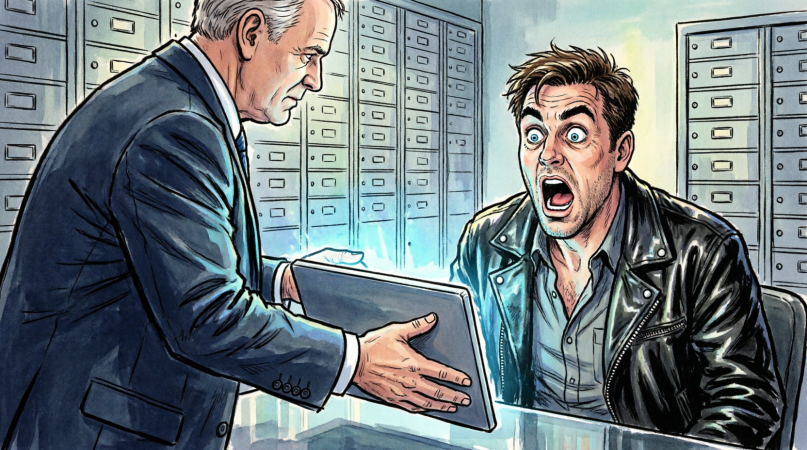
The room went thin around me. I heard the buzz of the fluorescent light above us, louder than it should’ve been.
“That’s not possible,” I said automatically. “It’s in my name now. I’m—” I swallowed. “I’m the executor.”
“They had paperwork,” Gwen said. “Copies. A letter claiming next-of-kin authorization. The notarization was… questionable. And they didn’t have the original death certificate.”
My throat tightened. “Who?”
Gwen didn’t answer right away. She turned her monitor slightly and clicked something. The security footage popped up, grainy and gray. A man stood at the vault window. Baseball cap pulled low. Hands jammed in the pockets of a jacket.
At first I couldn’t place him because my brain didn’t want to.
Then he shifted his weight—left foot forward, slight bounce like he was impatient—and his hand came out to tap the counter twice with his ring finger.
That was a habit I’d watched for forty years.
“Grant,” I said, and it came out like a cough.
My older brother.
Gwen’s eyes softened. “I’m sorry. We refused him. We told him only the executor could access it. He left without making a scene.”
I stared at the frozen image of Grant on the screen. The cap. The posture. The exact way he held his shoulders, like he was used to being listened to.
Grant had been around constantly since Leah died. Bringing over chili. Fixing a hinge. Sitting in my living room with sports on low volume like noise could fill the space she left.
Grant had hugged me at the funeral so hard my ribs hurt.
And nine days ago he’d tried to get into Leah’s safety deposit box.
“Did he say why?” I asked.
Gwen shook her head. “He said… he needed ‘something Leah left for the family.’” Her mouth tightened. “Nolan, I didn’t want to tell you over the phone. I didn’t want to scare you. But I’ve been watching the account activity closely. Nothing else has happened, but…”
“But he knew it existed,” I said.
She didn’t correct me.
My stomach turned, slow and sour. “Take me to it.”
Gwen hesitated. “Are you sure you want to do this today?”
I laughed once, short and humorless. “No. But I’m here.”
The vault room was colder than the rest of the bank, like the air conditioning had a grudge. Gwen led me down a narrow hallway and through a heavy door that clicked shut behind us. The sound echoed inside me.
She gave me the box on a tray and stepped back. “I’ll be right outside,” she said, and pulled the little privacy door mostly closed.
I sat in the tiny chair, the metal cold against my palms. My hands were steady, which felt wrong. Like my body hadn’t gotten the message yet.
The box opened with a soft scrape. Inside were the things I expected: our house deed, Leah’s passport, a velvet pouch with her grandmother’s cameo brooch, a folded copy of our marriage certificate.
Orderly. Leah.
Then, underneath, was an envelope.
Not addressed to “Nolan,” the way she wrote on my birthday cards. Not “Babe,” the way she scribbled on sticky notes stuck to the coffee maker.
My full name.
Nolan Pierce.
The kind of name you write when you need someone to pay attention.
My fingers went numb as I lifted it. The paper smelled faintly like Leah’s lavender hand cream. Or maybe that was my imagination, desperate for proof she’d been real.
Inside was a letter and a small brass key taped to the page, tagged with a storage-unit number.
I unfolded the first sheet. Leah’s handwriting was neat and slightly slanted, the way it always was when she was trying to stay calm.
The first line hit me like ice water:
If Grant has already tried to get into this box before you, then I’m out of time—and you are not safe.
My chest tightened hard, and I stared at the words until the ink blurred, one question pounding louder than my heartbeat: what did my brother want from my dead wife badly enough to fake his way into a bank vault?
Part 2
I drove home with the letter on the passenger seat like it might start talking on its own.
Outside, the orchards were still bare, branches black against a white March sky. The snow had melted into gritty piles along the gravel drive, and the wind smelled like thawing earth and last year’s apples rotting somewhere out back. Normally that smell meant spring was coming.
That day it just made me feel sick.
I didn’t go inside right away. I sat in my truck with the engine off, the cabin cooling fast, and read Leah’s first page again. Her pen strokes were steady, but I could see where she’d pressed harder on certain words, like she’d been holding back anger.
She started with small things. The kind of small things you ignore until they aren’t small anymore.
Nolan, I know you’re going to think I’m being paranoid. I thought so too at first.
She wrote about how Grant had insisted on “helping” with orchard paperwork after she died—how he’d offered to “handle the boring stuff” so I could grieve. She wrote about the envelope that arrived in January addressed to me from a private lender I’d never heard of, thanking me for my “timely payments.”
Leah said she’d opened it by mistake, thinking it was orchard mail.
It wasn’t a payment notice. It was a late notice.
She wrote: The loan is in your name. The signature isn’t yours.
My throat tightened. I’d never taken out a private loan. We’d been careful. Leah had been obsessive about debt, the way a lot of people are when they’ve grown up watching their parents juggle bills with fear.
She continued, and the words got sharper.
I pulled copies of the paperwork from the county office. Someone filed a lien against the south parcel—our best land. The one with the old well. The one the developers keep sniffing around.
My eyes flicked up instinctively, like I could see that parcel through my windshield. All I saw were rows of skeletal trees and the sagging fence line Leah always meant to replace.
Leah wrote about Cedar Run Development—how they’d been trying to buy land near the lake for years. She wrote that Grant had started meeting with one of their reps “for coffee” in town, and when she asked why, he’d smiled too wide and told her she worried too much.
Then she wrote a sentence that made my skin prickle.
I heard Grant say your name in the bank parking lot. Not recently. Back in October.
October. The month Leah died.
My hands tightened on the paper until it crinkled. In my mind I saw Grant at the funeral, his arm around my shoulders, his voice low: I’m here, little brother. I’ve got you.
Leah’s letter kept going, each paragraph like a step deeper into water.
She said she’d confronted Grant quietly in February, asked him about the lien, asked him about the lender. He’d laughed, she wrote. Actually laughed, like she’d told a joke.
He told me you’d agreed to let him “streamline” things. He told me you were tired. He told me if I loved you, I’d stop meddling.
My stomach rolled.
Leah wrote that she’d gone to Gwen at the bank and asked a hypothetical question about safety deposit box access. Gwen, bless her cautious heart, had told Leah the box was secure as long as only she and I were listed on it.
So Leah put this letter here. And she put something else here too, she said.
Not money. Not jewelry.
Proof.
The next page was where Leah’s handwriting changed slightly—smaller, tighter, like she was trying to fit panic into lines.
There is a flash drive in the storage unit key I taped here. Unit 14C at Maple Hollow Storage. The code is our anniversary. Don’t open it at home.
My pulse jumped. Don’t open it at home.
She continued: If anything happens to me, do not believe it’s just bad luck. And Nolan… I need you to understand something before you start blaming yourself or blaming the wrong person.
The phrase “the wrong person” sat there like a landmine.
I flipped to the third page.
Leah wrote about Cole.
Our son.
Twenty-six years old, a grin that could still disarm me, even when he was late and broke and full of excuses. He’d moved back into town a year ago after his “temporary” job in Chicago fell apart. He’d been helping at the orchard, mostly when he felt like it.
Leah loved him fiercely, but she’d also been the first to notice when something was off.
Cole has been spending time with Grant. More than he tells you. They’re careful about it. They think I don’t see.
My mouth went dry. Cole and Grant had always been close. Grant was the fun uncle—the one who bought fireworks and told stories that made Cole feel older than he was. I’d never thought to question it.
Leah wrote: Two weeks before the accident, I came down to the boathouse to get the life jackets. I heard voices. I didn’t go inside. I listened.
My breath caught. The boathouse. The lake.
Leah’s next line was messy, like she’d written it too fast.
I heard Grant say, “If Nolan won’t sell, we’ll make him.”
I stared at that sentence until my vision tunneled. Make him.
Leah wrote that she’d recorded what she could on her phone, but Grant noticed something, because the next day he showed up at the house unexpectedly with donuts and that same too-wide smile.
She wrote: He looked at me like he knew I knew.
The fourth page ended with instructions: call a number. A voicemail box. A place Leah said she’d hidden her last recording because she didn’t trust anything in the house anymore.
My fingers fumbled for my phone. The screen glowed too bright in the dim truck. I dialed the number, half expecting nothing, half expecting Leah’s voice to spill out like a ghost.
A beep. Then her voice—thin, shaky, unmistakably hers.
“Nolan,” she whispered. “If you’re hearing this… I’m sorry.”
I pressed the phone harder to my ear, like I could pull her back through it.
“I didn’t want to scare you,” Leah said. “But I need you to listen. I saw Cole at the boathouse with Grant tonight. I saw Cole hand him—” Her breath hitched. “A knife. Or something like a knife. I don’t know what they were doing, but Nolan, it felt wrong. It felt… planned.”
My skin went cold.
Leah’s voice dropped lower, a tremor running through it. “Please don’t confront them alone. Please don’t—”
A sound cut her off. A door? A footstep? Then Leah inhaled sharply.
“I think someone’s outside,” she whispered, and the recording ended.
I sat frozen in my truck, phone still pressed to my ear, the silence afterward roaring.
Then my screen lit up with an incoming call.
Grant.
My stomach clenched with sudden heat, and one question slammed into my head as I watched his name pulse on the screen: had he been listening too, and if he knew I’d opened the box… what was he coming to do about it?
Part 3
I didn’t answer.
I let Grant’s call ring out while my heart hammered like it was trying to get away from my ribs. When the ringing stopped, a text popped up almost immediately.
You home? Need to talk.
Need to talk. Like this was a casual check-in, like he hadn’t tried to snake his way into my dead wife’s safety deposit box with fake paperwork.
I walked into the house and locked the door behind me, a motion so automatic it scared me. The kitchen felt too quiet. The clock above the stove ticked with obnoxious confidence. Leah’s mug was still on the drying rack—blue ceramic with a chipped lip—because I couldn’t bring myself to put it away.
I set the letter on the table and stared at it like it might accuse me.
My goal, right then, was simple: keep breathing long enough to think.
The conflict was that grief and rage don’t care if you need to think. They just show up and start throwing furniture around inside you.
I called Darian Lowe.
He answered on the second ring, voice calm, like he’d been expecting me to finally crack open whatever box I’d been avoiding.
“I opened Leah’s safety deposit box,” I said.
A pause. “Okay.”
“Someone tried to access it nine days ago.”
Another pause, sharper. “Who?”
I swallowed. “Grant.”
Silence stretched. Darian didn’t fill it with comforting noise. He waited, and somehow that made it worse.
“I need you to come to my office,” he said finally. “Now. And Nolan—don’t tell anyone you’ve found anything. Not Grant. Not Cole. No one.”
“I already have Grant calling me,” I muttered.
“Don’t answer,” Darian said. “If he thinks you’re scared and confused, let him keep thinking that.”
I looked out the kitchen window. The orchard stretched behind the house, rows of trees like dark ribs. The wind shook the branches, tapping them together with a dry clatter.
“I can’t just sit here,” I said.
“I know,” Darian replied, softer. “But you also can’t get yourself killed trying to play detective.”
The word killed landed like a stone.
An hour later I was in Darian’s office, a squat building that smelled like old leather and lemon cleaner. He read Leah’s letter slowly, his jaw tightening as he went. When he got to the line about the lien, he leaned back and exhaled through his nose.
“This isn’t just family drama,” he said. “This is fraud. Potentially a lot more.”
I slid my phone across the desk and played Leah’s voicemail. Darian’s face didn’t change much—he was trained not to react—but I saw his fingers flex once against the armrest when Leah mentioned the knife.
When the recording ended, Darian didn’t speak right away. He stood, walked to his window, and stared out at the street like he needed a neutral view to organize his thoughts.
“You need someone who knows how to handle this,” he said finally. “Not your brother. Not your friends. Someone who can investigate without tipping them off.”
“Like who?” I asked.
Darian turned and opened a drawer. He pulled out a business card and slid it to me.
Monica Velez. Private Investigator.
“I used to work with her when she was with the state,” Darian said. “She left because she was tired of politics. She’s smart, she’s quiet, and she doesn’t scare easily.”
I stared at the card. My hands were steady again, which still felt wrong.
Darian continued, “Before you do anything else, we need to confirm the lien and the loan. We need copies. We need timelines. And Nolan… we need you to act normal.”
I laughed, but it came out brittle. “Normal is gone.”
“Act it anyway,” Darian said. “You run an orchard. You’re grieving. You’re overwhelmed. That’s believable. Use it.”
I left his office with a folder of instructions and Monica’s card burning a hole in my pocket. My goal shifted: collect proof without getting caught.
The conflict came fast.
When I pulled into the orchard lot, Cole’s truck was already there, parked crooked like he’d been in a hurry. He was near the loading shed, tossing empty crates around with unnecessary force. His hair stuck out from under a baseball cap, the same cap he wore in high school. The sight of it made my stomach tighten, remembering Leah’s whisper: I saw Cole hand him a knife.
Cole looked up when he saw me, and his expression flickered—something like guilt, gone too fast.
“Hey,” he called, wiping his hands on his jeans. “Where’ve you been? Grant stopped by earlier looking for you.”
My pulse jumped. “He did?”
“Yeah. Said he couldn’t get you on the phone.” Cole shrugged too hard. “He was all, you know, concerned. Wanted to make sure you were okay.”
Concerned. Sure.
I forced my voice into something casual. “I had errands.”
Cole stepped closer, squinting at me like he was reading tiny print. Leah used to say Cole could smell a lie like a dog smells bacon. I wondered where he got that.
“You okay?” he asked.
“Fine,” I said.
He nodded slowly, like he didn’t believe me, then glanced past my shoulder toward the house. “You go to the bank?”
My throat tightened. “Why would you ask that?”
Cole’s eyes flickered, just once. “Just… heard you had to do paperwork stuff. Estate things.”
I was about to answer when another truck rolled into the lot.
Grant’s.
White, shiny, always washed. Grant treated his vehicles the way some men treat their reputations: polish the outside, keep people from looking too close underneath.
He climbed out with a bright smile and a paper bag in his hand. Fried chicken, I realized, because even from twenty feet away I could smell the grease and pepper.
“Little brother,” Grant called, like we were in a commercial for family values. “Thought you might forget to eat.”
My goal in that moment was to not lunge at him.
The conflict was that every muscle in my body wanted to.
Grant stepped up and clapped a hand on my shoulder. His palm was warm through my coat, heavy. He looked me up and down like he was checking for cracks.
“You been dodging my calls,” he said lightly.
“Busy,” I replied.
Grant’s smile didn’t fade, but his eyes sharpened. “Busy with what?”
I forced a shrug. “Lawyer stuff.”
“Ah.” Grant nodded like that settled it, then angled his body slightly, blocking Cole’s view. “Gwen over at the bank says she saw you come in this morning.”
My stomach dropped.
Gwen hadn’t told him. She wouldn’t.
So how did he know?
Grant leaned closer, voice still friendly, eyes not. “You get what you needed?”
I could smell his aftershave—something sharp and expensive that didn’t belong in an orchard. My pulse thudded in my ears.
“I don’t know what you mean,” I said.
Grant’s smile widened just a fraction, like he enjoyed the dance. “Sure you don’t.”
He set the paper bag on the hood of my truck. “Eat,” he said. “We’ll talk later.”
Then he walked away like nothing had happened, leaving me with the smell of fried chicken and the sudden certainty that Grant had someone feeding him information from places he shouldn’t.
That night, when I got home, there was an envelope in my mailbox.
No stamp. No return address.
Inside was a single sheet of paper with Leah’s handwriting.
Except it wasn’t Leah’s handwriting.
It was close—too close—like someone had practiced it.
The message was three words long:
Leave the lake.
My hands went cold, and I stared at the fake letters until my vision blurred with fury and fear, one question clawing its way up my throat: if Grant could forge Leah’s handwriting, what else had he already forged—and how far would he go to stop me from finding out?
Part 4
Monica Velez showed up the next morning in boots that had seen real weather and a denim jacket that made her look like she belonged more in a mechanic’s shop than an investigator’s office.
She didn’t offer condolences. She didn’t soften her voice. I liked her immediately.
“Show me what you have,” she said, sitting at my kitchen table like it was her job to make my life uncomfortable.
I laid out Leah’s letter, the fake note, and the storage unit key. Monica read everything once without expression, then read it again slower. When she got to the voicemail transcript Darian had written out, she tapped the page twice with her finger.
“Knife,” she said. “Boathouse. Lake. And a lien on valuable land.” She leaned back. “That’s not a random mess. That’s motive.”
“My brother wouldn’t—” The words died in my mouth. I didn’t have the energy to defend him anymore.
Monica stood. “We’re going to the storage unit.”
My goal was clear: get whatever Leah hid before Grant or anyone else could.
The conflict: if they’d already tried to get into the bank box, they might already know about the unit.
Maple Hollow Storage sat behind a tire shop, all gray metal doors and gravel. The air smelled like rubber and wet cardboard. Monica parked where she could see the gate and watched the keypad camera for a long moment before we got out.
“Smile,” she said. “Like this is boring.”
My mouth felt stiff, but I forced something that could pass for normal from a distance.
Unit 14C groaned open, the roll-up door rattling like it didn’t want to reveal what was inside. Dust and old wood smell hit my face. Leah’s scent wasn’t here. This was purely storage: dry, stale, forgotten.
Inside were stacked plastic bins labeled in Leah’s neat handwriting—HOLIDAY, TAXES, ORCHARD—along with a small metal lockbox and an old duffel bag.
Monica held up a hand. “Before you touch anything,” she said, “look for signs someone’s been here.”
I scanned the floor. The dust wasn’t even. There were faint shoe prints near the back, crossing the concrete like pale smudges.
My chest tightened. “Someone’s been inside.”
Monica crouched, fingers hovering over the prints without touching. “Recent,” she murmured. “Not today. But not months ago either.”
The lockbox sat on a shelf. The key Leah left fit it perfectly, like she’d built the whole thing around that one click.
Inside: a flash drive, a folded set of documents, and a boat key on a float tag that read EEL RIVER MARINA.
The boat key made my stomach lurch. The lake.
Monica took the flash drive and slipped it into a small evidence bag. “Not here,” she reminded me.
The documents were copies of the lien paperwork, plus something worse: a loan agreement with my name printed in bold and a signature that looked like mine if you squinted and didn’t care about truth.
Leah had highlighted the notary stamp in yellow. Next to it she’d written: FAKE.
In the duffel bag was an old hoodie of Cole’s, the one Leah used to complain about because it smelled like smoke. And underneath it, wrapped in a towel, was Leah’s phone.
Not the one she’d used every day. An older one. A burner, I realized, my mouth going dry.
Monica lifted it carefully. “Smart woman,” she said.
The phone was dead, but Monica had a charger in her car like she’d expected this. Watching Leah’s old screen glow back to life felt like watching someone inhale after being underwater too long.
There were videos. Voice memos. Photos of paperwork. And one folder labeled simply: LAKE.
My fingers hovered over it, but Monica stopped me.
“Marina first,” she said. “We’re not watching anything you can’t unsee unless we’re somewhere safe.”
Eel River Marina sat on the far side of the lake, a cluster of docks and weathered wood buildings that smelled like fuel and algae. The wind off the water cut through my coat. The lake was calmer than I’d ever seen it in November, which felt like an insult.
A bell jingled when we stepped into the marina office. A man behind the counter looked up—late fifties, gray beard, hands stained with grease. His eyes landed on me and narrowed.
“You Nolan Pierce?” he asked.
I nodded.
His expression shifted—something like sadness and suspicion layered together. “Leah’s husband.”
My throat tightened. Hearing Leah’s name out loud in a place that smelled like gasoline made me dizzy.
“I’m Ray,” he said, wiping his hands on a rag that didn’t help. “Leah came by here a couple times. Asked weird questions.”
Monica stepped forward. “We’re trying to understand what happened,” she said calmly. “Leah left a key with a marina tag. She also mentioned she recorded something.”
Ray’s gaze flicked to the window, to the docks beyond. “Not here,” he muttered. Then he leaned closer, voice dropping. “You shouldn’t be asking about that in the open.”
My pulse jumped. “Why?”
Ray’s jaw tightened. “Because a couple weeks after she died, your brother came in here.” His eyes sharpened on me. “Grant Pierce. Real friendly. Asked me if Leah had been ‘acting strange.’ Asked if she’d left anything behind.”
The air seemed to thin again.
“What did you tell him?” I asked.
Ray’s mouth twisted. “Told him I didn’t know squat. Which was true.” He hesitated. “Mostly.”
Monica’s eyes didn’t blink. “Mostly?”
Ray reached under the counter and pulled out a small plastic case—like the kind you keep a memory card in. “Leah gave me this,” he said quietly. “Told me if anything happened to her, I was to give it to you. Not Grant. Not Cole. You.”
My heart thudded hard enough to hurt.
Ray slid it across the counter. “I didn’t know if you’d ever come. But seeing you now…” He shook his head once. “I’m sorry, man.”
My fingers closed around the plastic case. It was warm from being under the counter, like it had been hiding in someone else’s pocket.
I walked out to my truck and sat in the driver’s seat with the case in my hand, breathing in short, sharp pulls like I’d run too far. Monica watched me, waiting.
I opened the case.
Inside was a microSD card, tiny as a fingernail, heavy as a confession.
When I slid it into Leah’s old phone, the screen filled with the first frozen frame of a video: Grant leaning over the engine of Leah’s boat, a utility knife glinting in his hand—and behind him, holding a flashlight, someone wearing Cole’s baseball cap.
My stomach dropped with a sick, burning certainty, and one question ripped through me as the video began to play: if my son was there that night, what exactly did he help his uncle do to my wife?
Part 5
We watched the video in Monica’s car, parked two blocks from the marina like we were doing something illegal.
Maybe we were. Maybe truth always feels illegal when your family has been lying.
The video was shaky at first—Leah filming from somewhere hidden, the image half-blocked by dock posts. Wind hissed across the mic. The lake slapped against wood in a steady, indifferent rhythm.
Grant’s voice came through clear anyway, low and irritated. “Hold it steady,” he snapped.
The flashlight beam jittered, then steadied again.
A younger voice muttered something I couldn’t quite make out. Leah zoomed slightly, and the brim of Cole’s cap came into view.
My son.
My hands went numb.
Grant leaned closer to the engine and the blade flashed. A soft scrape. Then Grant said, almost casually, “Just nick it. Doesn’t have to look like a hack job.”
Cole’s voice—tight, uncertain—answered, “This is messed up.”
Grant scoffed. “You want out from under that loan or not?”
The word loan hit me like a punch. Leah had been right. The lien, the lender, the pressure—it wasn’t separate. It was all one rope tightening.
Cole said something else, quieter. “She’s gonna be on the boat too.”
Grant paused. Even on video I could feel the moment shift, like the air changed.
“She won’t be,” Grant said finally. “She’s too smart for that. She’ll be home nagging Nolan like always.”
Then he laughed, and I wanted to smash my phone into the dashboard.
The video ended abruptly—Leah must’ve moved or flinched—leaving only the hiss of wind and the lake’s dull slap.
Monica didn’t speak for a long moment. She let the silence hang, heavy and honest.
My goal was suddenly not proof anymore.
My goal was answers.
The conflict was that the answer I wanted and the answer I was getting were two different animals.
“I need to talk to Cole,” I said, voice rough.
Monica’s eyes sharpened. “Not alone.”
“I’m his father.”
“And he’s in something big enough that your brother tried to fake his way into a bank vault,” Monica said. “That changes the math.”
I stared out at the lake through the windshield, sunlight glittering on the water like it was mocking me. “He’s my kid.”
Monica’s voice softened a fraction. “Then let’s do this in a way that keeps you alive.”
Cole was at his apartment above the hardware store, a cramped place that smelled like old pizza and cheap detergent. He opened the door with a wary look that hardened when he saw Monica behind me.
“Who’s she?” he demanded.
“Someone helping me,” I said, stepping inside without waiting for permission. My heart was pounding so hard I could feel it in my teeth.
Cole’s goal was obvious: keep control of the situation.
Mine was to break it.
“Dad,” he said, forcing a laugh that didn’t reach his eyes. “What’s going on? Grant said you’ve been—”
“Don’t,” I snapped. The word came out sharper than I intended, and Cole flinched.
I pulled Leah’s old phone from my pocket. “Tell me about the boathouse.”
Cole’s face drained of color so fast it was almost impressive. “What boathouse?”
“The one at the lake,” I said. “The one you were at with Grant the night before Leah died.”
Cole’s mouth opened, then closed. He swallowed. His eyes darted to Monica, then back to me.
“I wasn’t—” he began.
I hit play.
Leah’s video filled the screen, Grant’s knife flashing, Cole’s cap unmistakable. Cole stared at it like it was a gun pointed at him.
“Dad,” he whispered.
My chest burned. “What did you do?”
Cole shook his head hard, hands lifting like he could physically push the question away. “I didn’t cut anything. I swear. I didn’t.”
“Then why were you there?” I demanded.
Cole’s breath came fast. “Grant told me the engine was messed up. He said Leah was gonna take it out and he didn’t want her stranded. He said it was… maintenance.”
“And you believed him,” I said, voice flat.
Cole’s eyes filled, and for a split second he looked like the kid who used to fall asleep in the back seat after baseball games. Then his face twisted with something uglier.
“I didn’t have a choice,” he snapped. “You don’t get it.”
Monica spoke for the first time, calm as a blade. “The loan. He threatened you with it.”
Cole’s shoulders sagged like someone cut the strings. “He said he’d ruin me,” Cole muttered. “He said he’d tell you everything. About the paperwork. About the money.”
“What paperwork?” I asked, though I already knew.
Cole looked at me with watery eyes. “He had me sign stuff,” he admitted. “Said it was orchard restructuring. Said it was to protect the family. And then when I found out it was a lien—when I found out it was your land—he said if I didn’t do what he asked, you’d find out and you’d hate me.”
My hands clenched. “So you helped him.”
Cole’s voice cracked. “I held a flashlight. That’s all I did. I didn’t know he was gonna—” He stopped, shaking, and his eyes went wild. “He told me Leah wouldn’t be on the boat.”
The room tilted slightly, the floor suddenly unreliable.
Leah had been on the boat.
Which meant either she chose to go anyway… or someone made sure she did.
Monica stepped closer. “Cole,” she said gently, “did you ever hear Grant talk about hurting her?”
Cole stared at the carpet. “He said she was a problem,” he whispered. “He said she was gonna ‘cost us everything.’”
Us.
I felt something inside me snap—not loud, not dramatic. Just a quiet, final break.
“I’m going to the police,” I said.
Cole’s head jerked up. “Dad, no—please—Grant will—”
“I don’t care what he’ll do,” I said, my voice shaking now with anger instead of fear. “He already did it.”
Monica touched my elbow. “Not local,” she murmured. “Grant knows people. We do this smart.”
My goal shifted again: trap Grant cleanly, with enough proof he couldn’t wriggle out.
The conflict was that my body wanted to storm into my brother’s house and set his life on fire with my bare hands.
Monica laid out a plan: a controlled meet, a wire, state investigators she still had contacts with. I nodded like I understood, like I was calm, while inside my grief was chewing through everything.
That evening, I agreed to meet Grant at a diner off Route 9—bright lights, greasy smell, the kind of place where conversations get swallowed by clinking forks.
Grant slid into the booth across from me like he owned the cushion. He smiled. “There he is,” he said warmly. “Thought you were gonna keep sulking forever.”
My jaw tightened. I forced my face into blank.
Grant leaned in, voice low. “We can make all this simple,” he said. “Sign the south parcel over to my LLC. We sell to Cedar Run. You get cash. Cole gets out clean. Everyone wins.”
Everyone.
I nodded slowly, like I was considering. “And Leah?” I asked softly.
Grant’s smile faltered for half a heartbeat. Then it returned, colder. “Leah’s gone,” he said. “Don’t make her into a martyr. She didn’t understand business.”
I tasted blood where I’d bitten my tongue.
I stood up without another word and walked out, my hands shaking so hard I could barely get my keys into the ignition.
Halfway home, my phone buzzed. A message from Monica: Tomorrow night. Boathouse. Wear the wire.
I stared at the screen through a film of sweat.
Then I pressed the brake pedal at the next stop sign—and it went straight to the floor.
The truck didn’t slow.
My stomach dropped into my boots as the intersection rushed toward me, heat flooding my chest with pure terror, one question screaming in my head: if Grant could cut my wife’s boat line, did he just cut my brakes too?
Part 6
The only reason I’m alive is because Leah taught me to overcorrect.
Years ago, I’d been driving our old pickup on a slick orchard road, and the back end started to fishtail. I panicked, jerked the wheel the wrong way, and Leah—calm as ever—had reached over and guided my hands.
“Don’t fight it,” she’d said. “Work with it.”
So when the brake pedal sank and the stop sign became a suggestion instead of a command, I didn’t freeze.
I yanked the wheel toward the gravel shoulder and aimed for the ditch like it was a lifeboat. The truck bounced hard, tires screaming, and then the whole world tilted as I dropped into soft mud.
The impact knocked the breath out of me. My head hit the window. For a second everything was white noise and pain.
Then I realized I was still breathing.
I sat there shaking, hands locked on the steering wheel, the smell of hot metal and wet earth filling the cab. My heart felt like it was trying to punch its way out.
When I finally climbed out, my legs nearly gave. I crouched by the front tire and stared under the truck.
A brake line dangled, sliced clean.
Not frayed. Not worn.
Cut.
I laughed once—short, ugly—because at that point, what else do you do? Cry? Scream? I’d already done both.
Monica arrived ten minutes later, headlights sweeping across the ditch like a searchlight. She got out fast, took one look at the line, and her face went flat.
“That’s deliberate,” she said.
“No kidding,” I muttered, wiping mud off my hands like it could wipe off what I’d just learned.
My goal, now, was survival long enough to finish what Leah started.
The conflict was obvious: someone wanted me quiet.
Monica didn’t waste time. She made calls, quick and clipped. By midnight, I was sitting in a bland motel room off the highway with a state investigator named Brent Halvorsen explaining how a wire worked, like this was a normal Tuesday activity for widowed orchard owners.
“You let him talk,” Brent said. “You don’t push too hard. You get him comfortable. You get him to admit what he did and why.”
My mouth tasted like pennies. “And if he doesn’t talk?”
Brent’s eyes were steady. “Then we keep building the case. But your brake line makes me think he’ll talk. He thinks you’re scared. He thinks you’ll fold.”
I thought of Grant’s smile in the diner, the way it tightened when I said Leah’s name.
“He’s wrong,” I said quietly.
The next evening, I drove a rental car to the boathouse with a tiny microphone taped under my shirt and a transmitter pressing against my ribs. The lake was dark, moonlight cutting a pale path over the water. The wind smelled like algae and cold stone.
Leah died out there.
Grant was already waiting inside the boathouse, the overhead light casting him in a harsh yellow glow. He leaned against a workbench like this was his kingdom. A toolbox sat open nearby. A knife glinted among the sockets.
My stomach twisted, but I kept my face blank.
Grant looked up and grinned. “There he is,” he said. “Thought you might bring company.”
“Just me,” I replied, stepping in.
He chuckled. “Good. I like family talks to stay in the family.”
My goal was to keep him talking. The conflict was that every word from his mouth felt like acid.
Grant gestured to a stool. “Sit.”
I sat.
He leaned forward. “You ready to do the smart thing?”
I swallowed. “You cut my brakes.”
Grant’s eyebrows lifted, mock surprise. “Did I?”
I stared at him. “I could’ve died.”
Grant shrugged, like death was a business expense. “You’re dramatic, Nolan.”
My hands clenched under the table. “Why?”
Grant sighed, like I was exhausting him. “Because you’re stubborn. Because you keep acting like this orchard is some sacred thing. It’s dirt and trees. It’s money sitting there waiting to be turned into real value.”
“Leah thought it was sacred,” I said softly, and my voice shook despite my best efforts.
Grant’s eyes hardened. “Leah was a problem.”
The words hit me like a slap. The mic under my shirt felt suddenly too small for the rage trying to spill out of me.
“She stuck her nose in things she didn’t understand,” Grant continued. “She made Cole nervous. She made you nervous. She was gonna blow the whole deal.”
“Deal,” I repeated, keeping my voice even. “With Cedar Run.”
Grant smiled. “Now you’re catching up.”
“And the boat?” I asked, forcing the question out without my voice breaking.
Grant’s gaze flicked toward the lake through the boathouse window. For a moment, something like annoyance crossed his face.
“I told Cole she wouldn’t be on it,” he muttered.
My blood went cold. “So you did something to it.”
Grant’s shoulders rose in a small shrug. “I nicked a line,” he said, almost bored. “Nothing dramatic. Just enough to cause trouble out there. Make her scared. Make you both back off.”
My chest tightened. “She died.”
Grant’s jaw clenched. “Accidents happen.”
I stared at him, my vision tunneling. “She wasn’t supposed to be on it.”
Grant leaned back, irritation flashing. “No. She wasn’t. She was supposed to be home. But she went anyway—because she was stubborn. Like you.”
My hands shook. I forced them still. The wire under my shirt felt like it was burning.
Grant leaned forward again, voice low, coaxing. “Look, Nolan. It’s done. No bringing her back. But you can still save what’s left. Sign the land over. Take the money. Let Cole walk. We bury this, and you get to keep your little grief shrine without the state crawling up our asses.”
Our.
The word tasted like poison.
I stood slowly. “You killed my wife,” I said, and my voice was calm in a way that surprised me.
Grant’s smile vanished. “Careful,” he warned. “You’re still breathing because I allow it.”
That was enough.
I stepped back toward the door and said, loudly and clearly, “I’m done.”
Brent and two troopers came through the side entrance so fast Grant barely had time to turn. The boathouse filled with shouted commands, boots on wood, the metallic click of handcuffs.
Grant’s eyes met mine over the chaos, and in them I saw something raw and ugly—rage, yes, but also shock. Like he’d truly believed I would fold.
As they hauled him out, Grant twisted his head toward me and hissed, “You’ll regret this. Cole will regret this.”
I didn’t flinch.
Cole did get arrested. For the loan paperwork. For lying. For being there that night, even if he didn’t hold the knife.
He called me from the county jail two days later, voice cracked. “Dad, please,” he said. “I’m sorry. I didn’t mean—”
“I know what you meant,” I replied, staring at Leah’s mug on the counter. “You meant to protect yourself.”
“Dad, I was scared.”
“So was your mother,” I said, and my throat tightened. “And she still did the right thing.”
Cole sobbed. I listened, silent, until he ran out of air.
Then I said, “I’ll make sure you have a lawyer. I’ll make sure you don’t starve. But don’t ask me for forgiveness. You don’t get to break someone and then want their arms around you.”
I hung up before he could answer.
Grant took a plea deal that still put him away for a long time. Cedar Run got hit with fraud charges. The lien was voided. The south parcel stayed ours.
But “ours” didn’t feel like family anymore.
I reorganized the orchard into a worker co-op by summer. The people who’d been sweating in those rows for years deserved better than being collateral in my brother’s greed. I kept a small cottage on the edge of the property, the one Leah always joked we’d retire in. I stopped sleeping in the big house, because the silence there was too sharp.
On Saturday mornings, I started going to a grief group in town, mostly because sitting alone was starting to feel like a slow death too. That’s where I met Tessa—a widowed nurse with tired eyes and a laugh that sounded like it surprised her.
We didn’t fall into some dramatic romance. We just… sat near each other. Talked about ordinary things. Shared coffee that tasted like burned hope and still drank it anyway.
One afternoon in early fall, I went back to the bank to close Leah’s safety deposit box for good. Gwen met me at the vault door, her face softer now, relief carved into the lines around her mouth.
“I’m sorry,” she whispered.
“I know,” I said, and I meant it—for her, for me, for Leah.
When I shut the lid for the last time, I felt something shift inside me. Not peace. Not yet. But a quieter kind of resolve.
Outside the bank, a kid on the sidewalk bit into a bright red apple, juice running down his wrist. The smell hit me—sweet, alive, unmistakable—and for the first time in months I didn’t just feel what I’d lost.
I felt what was still possible.
And as my phone buzzed with a simple text from Tessa—Coffee later?—my chest tightened with something unfamiliar and fragile, one question rising like a new sunrise: after everything my own blood did to me, could I ever let myself trust a future again?
Part 7
By late April the orchard had started to smell like somebody cracked open a bottle of honey and spilled it over everything.
The trees were in bloom, white and pink like they were trying to pretend nothing bad had ever happened here. Bees worked the blossoms with that steady, practical hum, and the air held a damp sweetness that stuck to my clothes. I should’ve felt grateful. Instead, I kept turning my head at every sound, like the wind could be footsteps.
I was in the packing shed, leaning over a clipboard, trying to pretend I cared about crate counts, when my phone vibrated.
Gwen Dorsey.
I almost didn’t answer. My body had learned to treat her number like a flare gun. But I picked up.
“Nolan,” she said, and her voice had that same tightness from the day she pulled me into her office. “I need you to come in.”
My stomach sank. “I already closed Leah’s box.”
“I know. This isn’t that.” She lowered her voice. “This is… another one.”
I stared at the rows of stacked crates, the dust motes floating in the sunbeam that cut through the open bay door. “Another safety deposit box?”
Gwen paused like she was choosing words that wouldn’t shatter me. “A small box was rented under Leah’s maiden name at our Franklin branch. It came up in an audit because someone attempted access last week using identification with your name.”
I felt heat creep up my neck. “That wasn’t me.”
“I know.” Gwen’s breath sounded shallow. “The ID looked real enough that the teller scanned it before she caught the inconsistency. We have footage. Nolan… whoever did this had your address, your birth date, and a signature that’s close.”
A bee bumped into the dusty window near my head, soft thud, then resumed its frantic work outside like nothing happened. I didn’t feel like I could move.
“What’s in the box?” I asked.
“We don’t know. We didn’t open it.” Gwen’s voice dropped even more. “But there’s something else. The person who tried to access it said a phrase. They said, ‘Leah told me Nolan would understand.’”
My throat tightened. Leah told me.
“Are you sure it wasn’t Grant?” I forced out.
“It wasn’t him.” Gwen sounded certain. “Different build. A woman.”
A woman. My mind immediately grabbed the nearest shape it could: Tessa’s tired eyes, her laugh at the grief group, the way she’d looked at me like she could see the parts of me I kept taped together. Then my logic kicked in. That was fear talking, hunting for someone new to accuse.
“I’ll be there,” I said.
I didn’t go home first. I didn’t want to walk through my front door and wonder if someone was inside. I drove straight to the bank, my hands clenched on the steering wheel so hard my fingers hurt.
Gwen met me in the lobby and didn’t bother with small talk. Up close, I could see she hadn’t slept. Her eyeliner was smudged like she’d rubbed at her eyes too much.
“I’m sorry,” she said as she led me toward her office. “I should’ve called sooner. The Franklin manager only looped me in yesterday.”
“Show me the footage,” I said.
Gwen pulled it up. Grainy, gray. A woman in a loose jacket and a baseball cap, shoulders slightly hunched. She stood at the counter with her hands folded, posture calm. Not panicked. Not sloppy.
And then, just for one second, she lifted her head and the camera caught the side of her face.
I couldn’t tell who it was. That was the worst part. Not knowing meant my imagination could fill in anybody.
“She had paperwork?” I asked.
“Copies again,” Gwen said. “A death certificate printout. A power-of-attorney document dated after Leah died.” Gwen’s mouth tightened. “Which is… impossible.”
My chest felt like it was full of sand. “So someone’s forging things in my name now.”
Gwen nodded once. “And I’m worried about you.”