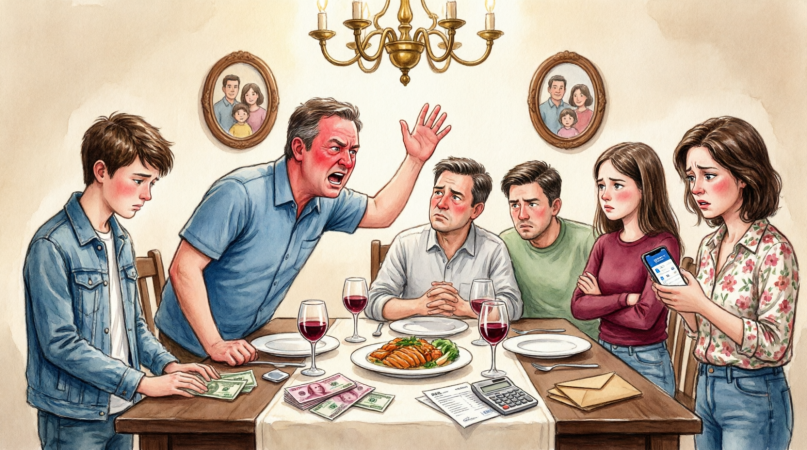
“My Dad Slammed His Fist On The Table And Said, ‘You Act Like This Family Owes You Something—But You’ve Never Earned Your Place Here!’ Then He Told Me To Get Out If I Wanted To Be So ‘Independent.’ So I Did. A Month Later, My Mom Called, Panicked: ‘Why Was The Mortgage Declined?’
I Just Replied, ‘Guess The One Who Never Earned Their Place Was Paying For Yours.’ Then I Watched The House Fall Apart—Just Like The Family Inside It. I used to believe my family was normal. Not the glossy, matching-sweaters-on-a-holiday-card kind of normal. More like the sitcom kind—messy, loud, a little dysfunctional, but safe.
The kind where people slam doors and say things they don’t mean, and by the end of the episode there’s a hug in the kitchen and someone cracks a joke and everything resets. Sitcoms don’t prepare you for the night your dad slams his fist on the dinner table and tells you you’ve never earned your place in the family. They don’t prepare you for what comes after, either—the silence, the paperwork, the way love can evaporate when money enters the room. They don’t prepare you for the moment you realize some people only love you when it’s convenient.
My name is Nolan Grayson. I’m twenty-four. I grew up in a small town where the speed limit is always thirty-five and the gossip travels faster than the mail. People wave at you at red lights. Cashiers ask about your mom. Teachers remember your last name even after you graduate. It’s the kind of place that feels like community until you learn it can also feel like surveillance. My parents, Alan and Marjorie, were the kind of couple people admired—or at least pretended to.
My dad was a contractor, the type of man who could build a house from scratch and then stand back and point at it like it proved something about him. He had strong hands, a loud laugh, and a pride that sat in his chest like a permanent badge. My mom was a real estate agent who somehow managed to make every conversation about her network. She never simply said “I met someone.” She said “I connected with someone.” She treated relationships like currency, and even as a kid I could feel it—the way she measured people by what they could offer. Together they had my older brother, Ethan, and me. Ethan was three years older.
Taller. Better-looking in that effortless way people with confidence carry themselves. Ethan had the kind of charm that made adults laugh at his jokes even when they weren’t funny. The golden boy. The one who could wreck the car and get a pat on the back because at least he’s honest about it. Meanwhile, if I forgot to take out the trash once, it was a week-long lecture about responsibility and gratitude. Growing up, it felt like living under two different sets of rules. Ethan’s mistakes were “learning experiences.” Mine were “disappointments.” If Ethan got a B in math, my dad said, “He’s got bigger talents.
He’s a visionary.” If I got a B, my dad said, “You’re lazy. Don’t waste your potential.” If Ethan lied about where he’d been, my mom sighed and said, “He’s just figuring himself out.” If I stayed quiet at dinner, she snapped, “Speak up. You’re so weird. Don’t embarrass us.” I learned early to keep my head down. Not because I didn’t have opinions. Because opinions in my house were expensive. You paid for them with lectures, punishments, and that special kind of contempt adults can deliver without raising their voices. So I worked. I worked in the quiet ways. I helped my dad in summers, hauling lumber, cleaning job sites, learning how to measure twice and cut once.
I did chores without being asked because it was easier to do them than to argue. I got good grades because it was the only currency I had that couldn’t be taken away. And even then, I was always second. When I was fourteen, I asked my dad for a laptop because I needed it for school. He laughed and said we didn’t have money for “toys.” Two weeks later, Ethan got a new gaming console because he’d “been through a lot” after breaking up with his girlfriend.
When I was sixteen, I got a scholarship offer for a summer program in finance. My mom barely looked up from her phone and said, “That’s nice.” That same day, Ethan announced he wanted to start a clothing brand and my parents spent the entire dinner brainstorming names and logos like they were launching an empire. By the time I was old enough to understand what favoritism was, I also understood something else: if I wanted stability, I couldn’t depend on them. So when I left for college, I didn’t ask for money. I paid for it myself—scholarships, part-time jobs, whatever it took.
My parents called it “wanting independence.” I called it survival. I got my degree in finance and landed a decent job right out of school. Not glamorous—no Wall Street skyscraper, no viral startup. But stable. It paid enough to rent a small apartment and keep up with my student loans. It gave me something I’d never had growing up: a sense of control. I visited home occasionally, usually on holidays, because that’s what you do. And every visit ended the same way. Some comment from my dad about how I thought I was better than everyone else because I “escaped.” Some jab from Ethan about how I “left the family behind.”
My mom smiling too brightly, introducing me to her friends as “the one who thinks he’s too busy for us.” I learned to laugh it off. To smile. To go back to my apartment where I could finally breathe. Then last summer, things shifted. My dad’s contracting business slowed down. The economy got weird. Clients delayed payments. Jobs fell through. The kind of instability my dad hated. And Ethan moved back home after his third failed startup attempt. Suddenly, I wasn’t just the independent one.
I was the one they started calling when bills got tight. It started small. My mom called and asked if I could “temporarily” help cover the electric bill. “It’s just for this month,” she said, voice sweet. “Your dad’s waiting on a check.” I sent the money. It wasn’t huge. It felt like helping. Then the next month it was car insurance. Then the month after that it was “just easier if you pay it directly.” By month three, my mom was calling every few days, checking in, asking questions that sounded caring until you realized they all led to a request. How’s work? (Pause.) So listen, about the water bill… How’s your health? (Pause.) We might need help with groceries. How’s the weather? (Pause.) Your dad’s stressed and money’s tight.
I knew what was happening. I was becoming their safety net. The same family that told me I was “too good for them” now needed me to keep their lights on. Still, I helped. Maybe out of guilt. Maybe out of some leftover hope that they’d see I wasn’t the selfish one they painted me to be. Maybe because my brain still believed that if I just did enough, I’d finally earn a place. Ethan, of course, acted like I was contributing to “the family fund.” He’d laugh and say, “Hey, you’re finally pulling your weight, little brother.” Pulling my weight. Like I hadn’t been pulling it my entire life. The resentment built slowly, like pressure behind a wall.
Then came the dinner. My mom’s birthday. She made me promise to come. She said it would mean a lot. She said Dad had been “calmer.” She said Ethan was “doing well.” I drove home with a knot in my stomach and a gift bag on the passenger seat. The house looked smaller than I remembered. Not because it had physically shrunk, but because it was filled with tension that clung to the air like smoke.
Ethan had just announced he was starting another business. A crypto consulting agency. My parents practically glowed with pride. My dad raised his glass to him, bragging about how Ethan never gives up. My mom clapped and said, “That’s my boy.” I forced a smile, but inside I was thinking about the rent and bills I’d quietly covered while Ethan blew through his savings chasing “big ideas.”
Halfway through dinner, my mom turned to me, all sweetness. “So, Nolan,” she asked, “are you finally saving for something real? Like a house?” I didn’t mean it as a jab. I answered honestly. “Yeah, actually,” I said. “I’ve been looking into getting one soon.” My dad’s smile froze. “A house?” he repeated, like I’d confessed to a crime. “On your own?” His voice had that edge, the one that always implied my success was suspicious.
“That’s ambitious,” he said. My mom chimed in, too quickly. “Well, maybe wait a bit until things settle with the market. Or you could get something closer to home. Help out more around here.” The way she said “help out” didn’t sound like a suggestion. It sounded like an expectation. I tried to keep my tone calm. “I think I’ve helped out plenty already,” I said. Ethan laughed. “Oh come on. Don’t act like you’re carrying the family, dude. You’re just doing your part.”
My dad nodded. “Exactly. Family means everyone contributes.” Something in me started to crack. I looked at them—my dad, my mom, Ethan—and realized they genuinely believed I owed them. Not gratitude. Not love. Money. My dad leaned forward. “You act like this family owes you something,” he said, voice sharpening, “but you’ve never earned your place here.” It hit harder than I expected. Maybe because I’d spent my whole life trying to earn that place. “What do you mean by that?”
I asked, and my voice came out quieter than I wanted. My dad slammed his fist on the table. The silverware jumped. My mom flinched. Ethan smirked, like he’d been waiting for this moment. “You think you’re better than us because you got a fancy degree and a job in the city,” my dad barked, “but when it comes down to it, this family carried you. We raised you. You wouldn’t have anything if it weren’t for us.” My mom didn’t defend me. She stared at her plate. Ethan’s smirk widened.