At 11:47 p.m., the house always smells like rubbing alcohol and old pine—like a cabin that tried to become a hospital and failed at both. I learned to live inside that smell. Six years ago, Bree and I were driving home from a late dinner on Commercial Street, the kind of night where the fog makes the streetlights look soft and forgiving. We argued about something stupid—whether we should move closer to her job, whether I should quit mine, whether we were allowed to want different things at the same time.
Then the world snapped. Headlights. A horn that didn’t belong to us. The sickening sideways slide and the crunch that sounded like someone folding a ladder. She never opened her eyes in the ambulance. They called it a coma. A “persistent vegetative state” once, in a hushed voice, like the words were heavier than the truth. The hospital wanted her moved to a long-term facility. “It’s safer,” they said. “It’s appropriate,” they said. As if love had a policy manual.
I brought her home anyway. In the mornings, I warmed a basin of water and washed her face like I was erasing six years of dust from her skin. I rubbed lotion into her hands until my thumbs ached. I brushed her hair and told myself that the softness meant she was still here. I talked while I worked—ordinary things, because that was how I kept from screaming. “The neighbor finally fixed that fence,” I’d say. “The one that leans like it’s tired of standing.” Sometimes, I read to her. Sometimes, I just sat in the armchair by her bed and listened to the oxygen concentrator hum and the faint, irritating click of the feeding pump.
That clicking became my metronome. If it stopped, my heart would stop with it. I kept a routine because routine was the only thing that didn’t argue back. The day nurse, Mrs. Powell, came from 9 a.m. to 3 p.m. She was sixty-ish, blunt, and smelled faintly of peppermint tea. She charted everything with the seriousness of an air-traffic controller. She’d watch me lift Bree’s arm, guide it through a sleeve, and she’d say, “Matthew, you’re going to ruin your back.” I’d say, “I’m already ruined,” and we’d both pretend it was a joke. At night, it was just me.
Or at least, that’s what I believed until three months ago, when small wrong things started stacking up like dishes I hadn’t washed. The first time, I noticed Bree’s sweater wasn’t the one I put her in. I distinctly remembered choosing the gray one with the tiny pearl buttons because it was cold and the heater in her room always ran a little behind. At midnight, when I went in to check her tube and adjust her blankets, she was wearing the blue cardigan. The one I hated because it snagged on her nails. I stood there, staring, my fingers hovering above her shoulder.
Maybe I misremembered. I was tired. That was the easiest answer. But then I saw the gray sweater folded in the hamper, perfectly squared, like someone had taken the time to make it look neat. I don’t fold like that. I shove things. I’m a shover. Bree used to fold like that. Bree used to make order out of everything. I told myself Mrs. Powell must’ve changed her before she left and forgot to mention it. The next day, I asked. “I didn’t,” she said, not looking up from her chart. “And I don’t go into that hamper, hon. That’s your territory.” The second time, it was the scent. Bree’s perfume—Santal and something smoky—had been sitting untouched on the dresser for years. The bottle was more symbol than object now.
I couldn’t bring myself to throw it away, but I also couldn’t bring myself to spray it because it felt like faking her presence. One night, I stepped into her room and smelled it. Not old perfume clinging to a scarf. Fresh. Like someone had just walked out of a department store. I leaned over Bree, close enough to feel my own breath bounce back off her cheek, and I tried to find the source.
Her hair smelled like her shampoo, nothing else. Her skin smelled like the oatmeal lotion I used. The perfume was in the air. My stomach tightened with a stupid, childish fear: a ghost. A presence. Bree’s spirit wandering because I’d trapped her here. Then I saw the bottle. The cap had been put back on crooked, just slightly, like the hand that did it wasn’t careful. I tightened it.
My fingers shook, and I hated that they did. The third time, I heard something. Not a voice, exactly. More like the soft scuff of shoes across the hallway runner at a time when the house should’ve been asleep. I snapped awake in the recliner by Bree’s bed, my neck kinked, the room dim except for the green glow of her monitor. The sound was gone. The house settled.
The old beams made their familiar pops. I told myself it was the radiator. The wind. My brain trying to fill silence with something it could fight. But after that night, I started checking doors. I started counting the knives in the block like I was auditioning for paranoia. And then came the smallest thing that ruined me: Bree’s fingernails. I trim them every Sunday because if I don’t, they catch on fabric when I move her, and sometimes they scratch her skin. I keep the little clippers in the top drawer of her nightstand.
One Sunday, I trimmed them and filed the edges until they were smooth. I remember because I nicked my own thumb and muttered a swear that would’ve made Bree laugh. On Tuesday night, her nails were shorter. Cleaner. Filed into a gentle curve like they’d been done with patience. I stared at her hands and felt my mouth go dry. Someone was touching my wife when I wasn’t there. The next day, I told Mrs. Powell I had to travel for a two-day training in Boston. It was a lie so clumsy it almost made me blush. “Boston?” she said, skeptical.
“Since when do you do trainings?” “Since my boss suddenly loves professional development,” I said, forcing a smile. Mrs. Powell narrowed her eyes, then shrugged. “Your sister said she’d stop by and check on things. Alyssa. She texted me this morning.” My sister. Alyssa had always been the loud one in our family. The kind of person who filled a room and didn’t ask permission.
She’d been showing up more lately with casseroles I didn’t ask for and advice I didn’t want. She’d stand in Bree’s doorway, arms crossed, and say, “You know, Matt, you can’t keep doing this forever.” I always answered the same way. “Watch me.” I packed a suitcase anyway, because lies work better with props. I kissed Bree’s forehead like I always did—her skin cool, her hair smelling like soap and time—and I told her, “I’ll be back Thursday.” Then I walked out like a normal husband. I drove two blocks away and parked behind the closed hardware store.
I turned off the engine and sat in the dark until my breath fogged the windshield. The town felt too quiet, like it was holding its own breath with me. At 12:08 a.m., I got out of my car and walked back through the shadows, staying off the streetlights, my heart banging like it wanted to crack my ribs open and climb out. I hated myself for what I was about to do. I hated myself more for needing to.
Our house has a side yard that runs narrow between the clapboard and the neighbor’s fence. The grass there never grows right. I slipped along it, shoes sinking into damp soil, the air smelling like salt and leaves. Bree’s bedroom window faces that side yard. The curtains are usually half-drawn, enough for privacy, enough for moonlight. Tonight, the curtains were wider than I left them.
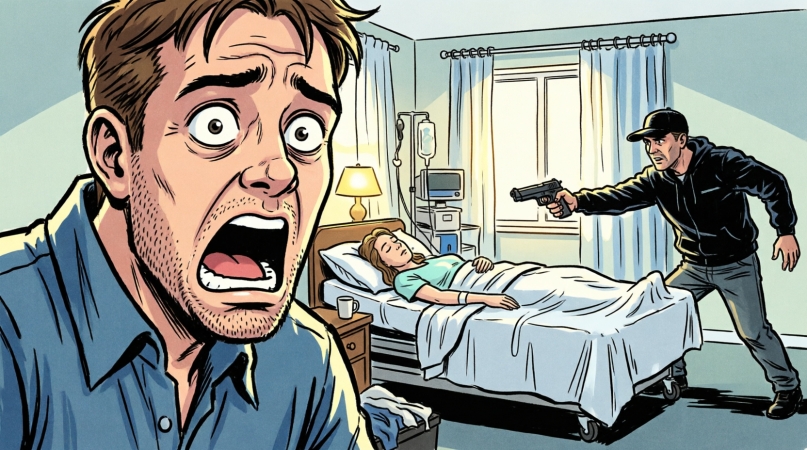
I crouched beneath the sill, my palms pressed into cold dirt, and slowly lifted my head. At first, I saw only the familiar scene: Bree in her bed, her face turned slightly toward the door, her hair spread on the pillow like dark ink. The monitor beside her blinked green. The little bedside lamp cast a warm circle of light. Then I saw movement. Someone stood beside her bed