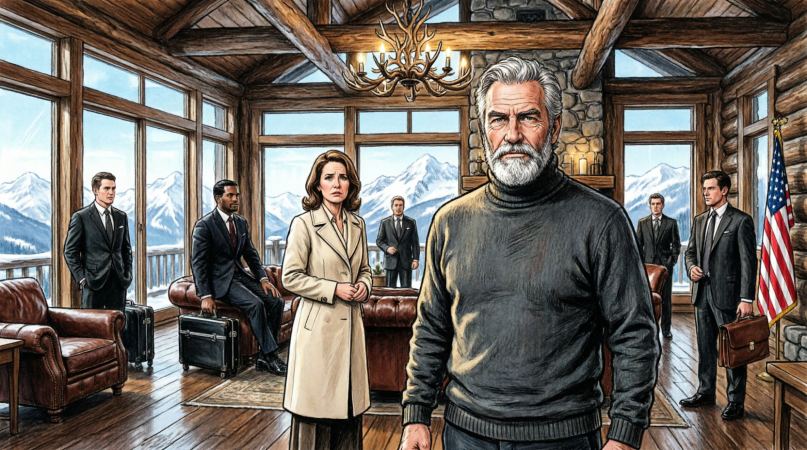
“We’re Taking Over!” My Greedy DIL Stormed My New Cabin In Aspen—Then She Saw What I’d Hidden
“WE HEARD YOU SCOOPED UP THAT FANCY CABIN IN ASPEN. WE’RE MOVING IN TO BURY THE HATCHET,” MY DAUGHTER-IN-LAW BARKED, SHOVING HER BAGS THROUGH MY DOOR LIKE SHE OWNED THE PLACE. I JUST SMIRKED AND LET THEM BARGE IN. BUT AS THEY STEPPED INTO THE GREAT ROOM, THEIR FACES DRAINED OF COLOR…
“We’re Taking Over!” My Greedy DIL Stormed My New Cabin In Aspen—Then She Saw What I’d Hidden
“We heard you bought this gorgeous cabin in Aspen. We’re moving in to leave all the grudges behind.”
My daughter-in-law barked that line while shoving her suitcases through my front door like she already owned the place. I just smiled and let them push past me. But the second they stepped into the great room and saw what was waiting for them, every drop of color drained out of their faces.
Before I go on, subscribe to the channel and write in the comments what time it is in your part of the world right now.
My name is Harold Winston. I’m sixty-eight years old, and I live in a mountain cabin outside Aspen, Colorado. For thirty-two years, I built something out of nothing. I started as a line cook in a greasy little diner in Denver and ended up owning four restaurants under my own name. Winston’s Grill. Maybe you’ve heard of it. I sold the whole chain three years ago for $3.8 million, which isn’t a bad finish for a boy who once washed dishes for minimum wage and thought a quiet Sunday off was luxury.
Now I spend my mornings fly-fishing on the Roaring Fork River and my evenings reading rare nineteenth-century cookbooks by the fire. Peaceful life. Quiet life. The kind of life a man earns after decades of twelve-hour shifts, burned hands, bad knees, and a thousand deals made across restaurant tables.
At least that was what I thought.
Let me tell you about my son.
Trenton is forty-one now. He works as a mid-level manager at an IT company in Aurora. Last I heard, he was making somewhere around seventy-eight thousand a year. Not that he tells me much anymore. That stopped years ago, right around the time he married Deborah.
Deborah Kelly—Deborah Winston now—is thirty-eight, does not work, and has never met a mirror she didn’t enjoy. She used to sell real estate before she decided being Trenton’s wife was a full-time profession. As far as I can tell, that profession mostly involves spending money they do not have, studying people the way a buyer studies square footage, and treating anyone she considers beneath her like an inconvenience.
That list, unfortunately, includes me.
I remember when Trenton was a boy. He used to run to the front door every time I came home from a shift, little sneakers slapping the hardwood, arms up, yelling, “Daddy, Daddy!”
He wanted to hear everything. What I cooked. Who came in. What funny thing happened in the kitchen. If a food critic showed up, he wanted the whole story. If a busboy dropped a tray, he wanted sound effects. He used to say he’d work in my kitchen one day. That boy had stars in his eyes.
I do not know exactly where that boy went.
The change was gradual at first. After the wedding, Trenton stopped calling every week. Then every month. Then it became holidays only. Then even the holidays grew thin, rushed, uncomfortable.
Christmas two years ago was the last time I saw them before everything went bad. I made a prime rib roast—my specialty—and while I was telling a story about a famous food critic who once tried to sneak into my kitchen through the back corridor, Deborah rolled her eyes so hard I thought they might stay there. She picked at her plate like it offended her, announced she was watching her carbs, and pushed the food away.
Trenton said nothing.
He just stared at his hands.
But the moment that truly opened my eyes happened about a year ago. I called Trenton one evening and he must have accidentally answered in his pocket because I heard voices before either of them realized the line was open.
“That old man is still hanging around,” Deborah said, her voice dripping with contempt and impatience.
Then came the line that sat in my chest like a stone.
“When is he going to leave us the money and stop being such a burden?”
I waited for my son to defend me. To say something. Anything.
Instead, after a beat, Trenton answered in a flat voice I barely recognized.
“Soon, probably. He’s not getting any younger.”
I hung up. Then I sat alone in my kitchen for an hour staring at the wall.
Thirty-two years building a legacy, and my own son was quietly waiting for me to die so he could cash it out.
That was when I started paying attention.
Really paying attention.
Four months ago, I got a curious phone call from an old acquaintance named Dr. Mitchell. We knew each other through the country club, and he asked if everything was all right with my health. I told him I was perfectly fine and asked why.
He hesitated. Then he told me a woman claiming to be my daughter-in-law had been asking him very specific questions about what it took in Colorado to have an elderly relative declared unable to manage his own affairs. She had asked about guardianship. About medical evaluations. About what kind of documentation the court would need.
I thanked him and hung up.
Then I made some calls of my own.
Which brings me to three days before the real showdown.
The doorbell rang at two in the afternoon. I wasn’t expecting anyone. Vivien, my neighbor, usually comes around through the back porch. Delivery men know to leave packages by the cedar bench. So I set down my coffee and walked to the front door.
Through the frosted glass I could see two figures. One taller, one shorter. Far too much luggage.
I opened the door.
“Dad!”
Deborah said it brightly—yes, she calls me Dad now, which is funny considering how she talks about me when she thinks I cannot hear—and then pushed past me before I could say a word. She dragged two massive suitcases behind her, their wheels scraping over my hardwood floors. Trenton came after her with three more bags and the kind of face guilty people wear when they want forgiveness before they’ve earned it.
“We heard you bought this gorgeous cabin in Aspen,” Deborah said, looking around with naked appraisal in her eyes. “We’re moving in. Time to put all those silly misunderstandings behind us, don’t you think?”
I kept my voice pleasant.
“Deborah. Trenton. What a surprise.”
“Isn’t it wonderful?” she said, already surveying the great room, the stone fireplace, the beams, the view. “Family reunited at last. We’ve just been so distant lately, and I said to Trenton, I said, we need to fix this. Family is everything.”
“Family is everything,” I repeated.
The words tasted like ash.
For just a second, Trenton finally met my eyes. I saw something there. Shame, maybe. Guilt. Then it vanished, and the blank look Deborah had trained into him slipped back over his face.
“It’s good to see you, Dad,” he said.
“Is it?”
Deborah laughed, brittle and high.
“Oh, Harold. Always with the jokes. Now, which room is ours? We’ve had such a long drive from Aurora.”
I smiled. A genuine one, which seemed to unsettle her more than anger would have.
“Of course. Let me help you with those bags.”
As they fumbled and bickered in the hallway, I slipped a hand into my pocket. My phone was right where I had put it. The moment I heard their car roll up my drive, I had started a recording.
The first three days of our family reunion were educational.
Deborah began redecorating my home before she had fully unpacked.
“These curtains look cheap, Dad. We should replace them.”
She ran her fingers along handwoven fabric I had bought from a local artisan in Snowmass Village.
“I know a great designer in Denver,” she went on. “She could really transform this place.”
Transform.
Interesting choice of word.
Transform my $2.3 million Aspen cabin into something stamped with her taste, her preferences, her invisible claim.
“I’ll think about it,” I said.
Then I went to make coffee.
Trenton was no use at all. He nodded at everything Deborah said like one of those dashboard dogs people used to stick in car windows.
“She’s right, Dad. The place could use some updates.”
He would not look at me when he said it.
I remembered a different Trenton. Twelve years old. Standing in my kitchen after closing time, carefully plating a practice dish on a white oval plate.
“Is this right, Dad?”
“Perfect,” I had told him.
That boy had opinions. Dreams. A spine.
Somewhere along the way, Deborah had filed him down until only compliance was left.
On the second day, I conducted a little experiment.
I left a stack of documents on the kitchen table—the latest property appraisal for the cabin. $2.3 million in black and white. Then I went to my study and watched through the crack in the door.
Deborah found them in less than twenty minutes.
She looked around first, of course. Then she pulled out her phone.
Click.
Click.
Click.
She photographed every page.
I almost felt sorry for her.
Almost.
She thought she was being clever. She had no idea she was dancing exactly where I wanted her.
That evening, I told them I was going for a drive.
“Fresh mountain air helps me think,” I said. “Might be gone a few hours.”
Deborah smiled all teeth.
“Take your time, Dad. We’ll hold down the fort.”
I didn’t go for a drive.
I went to Denver.
Marcus Reynolds’s office was on the fifteenth floor of a building off Court Place. He specialized in elder law, financial exploitation cases, estate disputes, and the quiet wars people wage when money mixes with blood.
I had found him through careful research, not through anyone I knew. When you’re preparing for battle, you do not want your general to have divided loyalties.
Marcus was in his mid-fifties, sharp-eyed, gray at the temples, and the kind of man who listened without interrupting because he was already sorting the weak facts from the useful ones.
“Mr. Winston,” he said, shaking my hand, “you said on the phone this was urgent.”
I told him everything.
The overheard call. Dr. Mitchell’s warning. Deborah’s questions about guardianship. The photographs of the appraisal. Their sudden arrival with luggage.
When I finished, Marcus leaned back in his chair.
“Colorado has strong protections for older adults,” he said. “But guardianship cases can get messy if someone is willing to lie aggressively enough. They’d need medical evidence that you’re unable to manage your own affairs.”
“Which doesn’t exist,” I said.
“That helps you,” he replied. “But we don’t wait around and hope the truth saves us. We document. We record. Colorado is a one-party consent state. You can legally record conversations you’re part of in your own home. And I think we bring in another set of eyes.”
He gave me a name.
Carla Summers.
Former detective. Private investigator. Very discreet.
We spent two hours building a preliminary defense plan. By the time I left, I had a list, a strategy, and something I had not felt since the phone call with Dr. Mitchell.
Control.
The drive back to Aspen was dark and winding. The mountains rose around me like witnesses. I thought about every hire I had made over the years, every supplier dispute, every landlord negotiation, every critic who ever came in convinced I would fail. I had built an empire because I understood one simple truth.
Problems do not solve themselves.
You act.
It was nearly eleven when I pulled into my driveway. The cabin was mostly dark, but a light glowed in my study.
I came in through the side door as quietly as I could.
The study door was open a crack.
Through it, I saw Deborah standing at my desk, phone in hand, photographing my financial papers. Bank statements. Investment summaries. The deed to the cabin.
She did not hear me behind her. She was smiling—just a small one, private and satisfied, the kind of smile people wear when they think they’re getting away with something.
I leaned against the frame and cleared my throat.
Deborah spun around so fast I thought she might drop the phone.
For one glorious second, I saw pure panic in her eyes.
Then the practiced smile slid back into place.
“Dad. You’re back early. I was just… I thought I heard something in here. Wanted to make sure everything was okay.”
“At eleven at night? In my private study? With your phone out?”
“I was checking the time,” she said lightly, slipping the phone into her pocket.
“Silly me. Good night.”
She brushed past me close enough that I could smell her perfume—something expensive, probably bought with money Trenton did not have.
I watched her go.
Then I sat at my desk and began to write.
Names. Dates. Times. What I had seen. What I suspected. What I knew.
The game had begun.
And unlike my daughter-in-law, I already knew exactly how I intended it to end.
Four days after they arrived, I invited them both into the great room.
“Family meeting,” I announced over breakfast. “Something important I need to discuss.”
Deborah’s eyes lit up instantly. She shot a quick glance at Trenton that practically said inheritance talk. They followed me into the great room and settled onto the leather sofa with expectant smiles stretched over hungry faces.
What they did not know was that I had been up since five arranging the room for effect.
Three chairs near the fireplace.
A thick manila folder on the coffee table stamped WINSTON CASE FILE in bold black letters.
And waiting in my study, ready to come in on cue, three people Deborah and Trenton had never met.
I remained standing by the window.
“Before we begin,” I said, “I’d like to introduce some colleagues who have been helping me with a few matters.”
I nodded toward the hallway.
Marcus Reynolds entered first, briefcase in hand.
Behind him came Nathan Price, the notary I had engaged specifically for that morning.
Then Carla Summers, short dark hair, watchful eyes, carrying a slim leather file.
I saw Deborah’s face change before anyone sat down.
The color went out of it so fast I thought she might faint.
Trenton looked as if someone had kicked all the air out of him.
“This is Marcus Reynolds, my attorney,” I said. “Nathan Price, licensed notary. And Carla Summers, a private investigator I’ve retained.”
Neither of them moved.
I gestured toward the couch.
“Sit down. We have a lot to discuss.”
Carla opened the file and slid out the first photograph.
It showed Deborah outside a medical building in Denver. The signage was clearly visible. Dr. Patricia Holbrook, psychiatry and geriatric mental health.
“Taken three weeks ago,” Carla said in a neutral voice. “Mrs. Winston visited this office twice and asked questions about the process for having an older family member evaluated for dementia.”
Deborah found her voice first.
“That’s an invasion of privacy. You can’t just follow people around taking pictures.”
Marcus did not even blink.
“In Colorado, there is no reasonable expectation of privacy in public spaces, Mrs. Winston. Photos taken from a public sidewalk are lawful.”
Carla laid down more papers.
“I also obtained records of online searches made from your home IP address. How to have someone declared unable to manage his own affairs in Colorado. Guardianship laws for elderly parents. How long does it take to become someone’s legal guardian.”
Trenton had gone pale.
“Dad, I can explain—”
“Can you?” I asked. “Because I would genuinely love to hear it.”
He swallowed hard.
“We were just worried about you being up here alone at your age. We wanted to make sure you were being taken care of.”
“By taking control of my finances? By having me declared unable to handle my own life?”
I kept my tone almost conversational.
Marcus stepped in.
“Concern is one thing. Attempting to manipulate the system to gain control of an older adult’s assets when you know that person is mentally sound is something very different.”
Deborah straightened in her seat.
To her credit, she recovered quickly.
“This is ridiculous. You’ve been spying on us. Recording conversations. That’s illegal. We’ll sue.”
Marcus clasped his hands.
“No, you won’t. Colorado is a one-party consent state. Mr. Winston has every right to record conversations in which he is a participant in his own home.”
Carla added another sheet.
“You also called Dr. Richard Mitchell four months ago and described Harold Winston as confused, forgetful, and increasingly unable to manage his affairs.”
I watched Deborah’s face cycle through shock, anger, fear, and then something colder.
Calculation.
She was regrouping, looking for an angle.
At last she said, “Fine. So we were exploring options. That isn’t illegal. We’re family. We have every right to be concerned about Harold’s well-being.”
Marcus nodded slightly.
“Concern is lawful. Fabricating a narrative of decline for financial gain is not.”
Trenton looked ill.
Deborah, however, was already shifting to the next move.
“We haven’t filed anything,” she said. “We haven’t taken legal action. This is all speculation.”
She was right, and she knew it.
So I gave them a choice.
“Pack your bags and leave by tomorrow morning,” I said. “Do that, and I will consider this matter closed. Stay, and I pursue every legal avenue available to me.”
Deborah rose slowly, smoothed her blouse, and looked at me with naked contempt.
“We’re not going anywhere, Harold. This is your son’s home too. He has every right to be here. We’re family whether you like it or not. And if you try to force us out, we’ll fight you in court. We’ll tell them you’re paranoid, unstable, hiring investigators to follow your own family. That doesn’t exactly sound like the behavior of a calm, rational man.”
Then she turned and walked out of the room with her head high.
After a moment’s hesitation, Trenton followed her.
Marcus looked at me.
“Well,” he said, “now we know what we’re dealing with.”
What followed was a master class in domestic warfare.
True to her word, Deborah did not leave.
She settled in harder.
When I asked Marcus about getting them out quickly, he told me Colorado law was a nuisance in this area.
They were not tenants, so normal eviction rules didn’t apply cleanly. But because I had initially allowed them inside, I could not simply call the county and have them removed like trespassers. There would be paperwork. Hearings. Time.
Possibly weeks.
Possibly months.
The thought of sharing my home with those two for months turned my stomach.
So I made their stay unpleasant in every lawful way available to me.
First, I canceled cable and internet.
“Budget cuts,” I said when Deborah stormed into the kitchen demanding to know why none of her shows would stream. “Fixed income. Need to be careful.”
She stared at me.
“Fixed income? You sold your restaurants for nearly four million dollars.”
“And I intend to make that money last,” I said, pouring coffee. “Unlike some people, I know how to manage it.”
The look on her face was almost worth the inconvenience to myself.
Next, I stopped buying groceries for the household.
My refrigerator, once stocked with quality produce, meats, butter, cream, and fresh herbs, now held only the things I personally intended to use, labeled and separated.
When Trenton awkwardly asked what the dinner plan was, I looked at him over the rim of my mug.
“You’re both adults. Forty-one and thirty-eight. I’m sure you’ll work it out.”
Deborah tried cooking for themselves.
Unfortunately, several kitchen appliances developed inconvenient moods.
The oven ran hot one day and lukewarm the next. The garbage disposal made dramatic grinding noises. The dishwasher leaked onto the floor. Nothing dangerous. I am not reckless. Just inconvenient enough to remind a guest that comfort is not a right.
“You should call a repairman,” Deborah snapped after ruining her third dinner.
“I will,” I said, turning a page in my book. “When I get around to it.”
Then came the roof.
I had been meaning to have part of it repaired anyway, and suddenly the timing became perfect. A contractor I knew from my restaurant days sent up a crew of six men who started promptly at seven every morning. Hammers. Power saws. Boots. Shouting.
For two straight weeks, the cabin vibrated with maintenance.
One morning Trenton came into the kitchen looking wrecked, dark circles under his eyes, shoulders bent.
“Sorry about the noise,” I said mildly. “But you know how it is. Have to maintain the property. Cabin will only be worth more once the roof is solid again. You’d want that, wouldn’t you? For when you eventually inherit it.”
He only stared at me and went silent.
While the cold war continued inside my cabin, Carla was working in the background.
She called one evening with information that made even me sit up straighter.
“I’ve been digging into Deborah’s recent activity,” she said. “She didn’t consult one psychiatrist about you. She consulted three. Over six months. Same story each time. Older relative, serious cognitive decline, memory issues, poor judgment with finances. She was trying to build a trail.”
“She was shopping for a diagnosis,” I said.
“Exactly. This wasn’t impulsive. It was methodical.”
I sat in my study after that call and looked out at the mountains while the sun went down in bands of gold and blue. Deborah had not improvised this scheme. She had built it carefully, brick by brick, thinking ahead. I almost respected the discipline. Almost.
Then, three days later, the official court packet arrived.
Thick envelope. Pitkin County seal. I knew what it was before I opened it.
Inside was a formal petition for emergency guardianship filed by Trenton and Deborah Winston on behalf of their allegedly incapacitated family member, Harold Winston.
Me.
The filing claimed serious concerns about cognitive decline, erratic behavior, and an inability to manage my financial affairs. It asked the court to appoint Trenton as my guardian with authority over my medical care, living arrangements, and finances.
I read it twice, slowly.
Then I set it down and looked out the window.
They had done it.
After the warning. After the evidence. After the chance I gave them to walk away clean.
They had decided to go all the way.
I called Marcus immediately.
“They filed,” I said.
There was a brief pause.
Then, to my surprise, he said, “Good.”
“Good?”
“Yes. Now they’ve committed themselves. Now we stop playing defense.”
Two days later, I was back in his Denver office with Marcus, Carla, and Nathan Price seated around a conference table.
“First things first,” Marcus said, spreading papers out. “We oppose their petition, and we go on offense. We document attempted exploitation, harassment, bad-faith filing, and we ask the court to remove them from your property. But to do this cleanly, I want independent medical evidence on the record. Full cognitive workup. No holes.”
Carla opened her laptop and turned it toward me.
“And there’s more,” she said.
The spreadsheet on the screen was red all over.
Credit-card debt: $31,000.
Auto loan arrears: about $12,000.
Personal loan from an online lender: $4,000 at a brutal rate.
Unpaid rent in Aurora. Two months behind.
Total outstanding mess: around $47,000.
I let out a slow breath.
“They’re drowning.”
“Yes,” Carla said. “This isn’t just greed. It’s desperation with greed sitting on top of it.”
Suddenly Deborah’s aggression made even more sense. They were not just trying to control my estate someday. They needed a life raft now.
The medical evaluation happened the following week at a Denver clinic Marcus trusted. Dr. Sandra Chen, a geriatric specialist with twenty years of experience, put me through four solid hours of memory tests, reasoning exercises, neurological checks, blood work, and scans.
When the results came back, she gave me a small professional smile.
“Mr. Winston, I wish half my patients were in your shape. Your cognitive scores are excellent. Memory intact. Judgment intact. No indication of dementia, Alzheimer’s, or any condition impairing your ability to manage your affairs.”
“Would you testify to that?” I asked.
“Gladly.”
That report became our shield.
Marcus filed our response the next day. He asked for denial of the guardianship petition, legal costs, and a court order requiring Trenton and Deborah to vacate the property.
Then Carla found something that changed the entire flavor of the case.
She called one evening and said, “It looks like this is not the first time Deborah has tried something like this.”
I told her to keep talking.
Before she married Trenton, Deborah had been quietly forced out of a real estate job after an elderly client filed a complaint. The woman’s name was Eleanor Vance. Seventy-four at the time. Widowed. Alone in a house in Littleton she’d owned for four decades.
Deborah had told her the house needed massive repairs. Foundation trouble. Roof trouble. Electrical trouble. She pushed the woman to sell fast and cheap to a buyer Deborah just happened to know.
“Let me guess,” I said. “A friend.”
“Cousin,” Carla replied. “The house was worth around four hundred thousand. Deborah tried to steer her into selling for two-fifty.”
The deal fell apart because Eleanor’s daughter got suspicious and hired an independent inspector, who found nothing wrong. Deborah’s firm buried the matter and let her go quietly to avoid publicity.
But the records still existed.
And Eleanor Vance was still alive.
Better than that, she was willing to testify.
So was a former colleague named Jennifer Marsh, who had heard Deborah describe Eleanor as an easy mark.
That was the moment I stopped seeing Deborah as merely rude, greedy, or vulgar.
She had a pattern.
And patterns are persuasive.
The tension inside the cabin finally exploded a few days later.
I was in the kitchen making lunch when Deborah stormed in red-faced and trembling.
“You’re trying to destroy me,” she shouted. “Digging up old lies, ancient history—”
I kept spreading mustard on my bread.
“That ancient history has a lot to say about who you are.”
“I was cleared. Nothing happened.”
“You were fired,” I said. “And an older woman almost lost a hundred and fifty thousand dollars because you thought she was easy. That happened.”
Deborah went white.
For the first time since she arrived, she did not look superior. She looked scared.
Then she screamed for Trenton.
He came in looking exhausted.
“What’s going on?”
“Your father is trying to ruin us.”
I looked at my son.
“Am I? Or am I telling the truth about your wife?”
Trenton stared between us, then said quietly, “Dad… can we talk? Just us.”
Deborah turned on him.
“What? No.”
He surprised both of us.
“Deborah, please.”
There it was.
A flicker of the old spine.
She stared at him, furious, then stormed out.
Trenton sat down and put his head in his hands.
“I’m sorry, Dad.”
“For what, specifically?”
He looked up with wet eyes.
“For the petition. For the years. For going along with all of it.”
“Did you know about Eleanor Vance?”
“No. I swear I didn’t.”
“But you knew what Deborah was planning with me.”
He nodded.
“I knew it was wrong. I just…”
“Couldn’t say no to her?”
He did not answer.
He did not need to.
I looked at him for a long moment.
“Knowing something is wrong and doing it anyway isn’t weakness, Trenton. It’s a choice. Every silence was a choice. Every time you stood next to her and let it happen was a choice.”
Tears ran down his face.
“I know.”
I said nothing else.
Because apologies, when they come that late, are not bridges.
They are only doorways.
And a person still has to decide whether to walk through.
Then the case escalated again.
One evening, my neighbor Vivien came over wrapped in a cashmere shawl and told me she had seen Deborah in town at the Rose Café with a polished man in a dark suit. Papers all over the table. Intense conversation. Court. Documents. Making it stick.
I called Carla.
Within forty-eight hours she had a name.
Randall Morgan.
Aurora attorney. Aggressive family representation. A man whose reputation in legal circles was described to me as colorful, which is always a polite word for trouble.
Then Carla called again with something even worse.
Morgan had filed a document with the court claiming to represent the interests of the Winston family estate.
Attached to that filing was a will.
My will.
A will supposedly signed by me three years earlier leaving everything—cabin, investments, savings—to Trenton.
I sat down very slowly when she told me.
“There is one problem with that,” I said.
“What’s that?”
“I never signed such a will.”
She went quiet.
“Are you certain?”
“Carla, I built four restaurants from the ground up. I’ve signed contracts, leases, licenses, permits, payroll records, vendor agreements, tax documents, and more checks than I care to count. I remember every important signature I’ve ever given. I did not sign a will leaving my entire estate to my son.”
If the court froze my assets based on that document, I could be financially tied up before we even got to the heart of the case.
But there was one beautiful fact about a forgery.
A good expert can smell one.
Marcus immediately hired a forensic document examiner named Dr. Patricia Webb, a woman who had testified in more than two hundred cases.
Meanwhile, I did something Deborah never anticipated.
I drafted a real will.
Nathan Price came to the cabin and notarized every page.
Ninety percent of my estate would go to a charitable foundation I established—the Winston Young Restaurateurs Fund—to help aspiring restaurant owners with talent and no capital get started the way I once had to. The remaining ten percent would go into a trust for Trenton, accessible only after he completed a financial literacy course and maintained stable employment for five consecutive years.
Nathan looked at me over the papers.
“You certain about these conditions?”
“Completely. If my son wants money connected to my name, he can earn the right to touch it.”
Three days before the hearing, Dr. Webb called with her findings.
“Mr. Winston, I’ve completed the analysis. The signature on the will Mr. Morgan submitted is not yours. The letter formation is inconsistent. Pen pressure is wrong. Baseline alignment is off. Whoever created this document was attempting to imitate your signature and made several classic mistakes.”
“You’re sure?”
“Completely. I would stake my reputation on it.”
I called Marcus.
He didn’t waste time.
“Good,” he said. “Now this stops being just a family dispute.”
The hearing took place on a gray morning with low clouds over the mountains.
I sat at the front table with Marcus. Across the aisle, Randall Morgan came in polished and smug, exactly as Vivien had described. Deborah followed him looking determined. Trenton looked like a man being dragged behind a truck he himself had climbed into.
Judge Katherine Holloway presided, silver-haired, sharp-eyed, and famous for disliking nonsense.
Morgan rose first.
“Your Honor, my client is concerned that Mr. Winston’s recent behavior suggests serious decline and that his estate should be protected pending resolution—”
Marcus stood.
“Before Mr. Morgan continues, Your Honor, we’d like to present evidence that undermines the entire petition.”
He handed up Dr. Webb’s report.
Judge Holloway read in silence for a long moment.
Morgan’s face changed as he turned the pages.
It was subtle at first.
Then not subtle at all.
“This report concludes the will you submitted is forged,” the judge said coolly.
Morgan tried to recover.
“Your Honor, we have not had adequate opportunity—”
“It was filed yesterday, Mr. Morgan. You might have reviewed it before walking into my courtroom.”
Silence.
Then Marcus spoke again.
“We are not merely asking that this petition be denied. We are asking that the matter be referred for criminal investigation. Submission of a forged document to the court is serious, and the broader conduct here includes attempted exploitation of an older adult.”
Deborah leaned forward so abruptly her chair scraped.
Morgan, without even turning fully toward her, said, “My client provided me with this document in good faith.”
And just like that, he tried to throw her overboard to save himself.
Deborah broke.
“That isn’t true,” she snapped. “You told me you could make it work—”
“Mrs. Winston, sit down,” Judge Holloway said sharply.
Deborah kept going.
“We’re family. I was just trying to protect my husband’s inheritance from a confused old—”
“Enough.”
The judge’s voice cracked through the courtroom like a ruler against a desk.
She called for county authorities to review the forged filing and noted her concern on the record.
The gavel came down.
That night I couldn’t sleep.
Around two in the morning, I heard soft footsteps in the hall. Then a knock on my bedroom door.
“Dad?”
It was Trenton.
We sat in the kitchen with coffee between us, the cabin silent around us except for the refrigerator hum.
He looked ten years older than he had a month earlier.
“I’m sorry,” he said.
“You keep saying that.”
“Because I mean it.”
He stared into his mug.
“I knew it was wrong from the beginning. The petition. The move. The pressure. Everything. But I kept going along with it because Deborah told me to, and because things were bad financially, and because I was ashamed to admit how bad.”
I studied him.
The boy who once wanted to plate food in my kitchen was still in there somewhere. Buried. Bent. But not entirely gone.
“You made choices, Trenton,” I said. “Don’t hide from that behind fear. You made choices.”
Tears slid down his face.
“I know.”
I let the silence sit there.
Then I said the only honest thing I had.
“I’m not forgiving you tonight. But the door isn’t locked forever. What happens next is up to you.”
The next morning Deborah was gone.
Her car was gone. Her wallet, purse, and phone were gone. But her suitcases still sat in the guest room.
She had run.
Within an hour, county deputies were on my porch taking statements. There was already enough on the table to justify a warrant: forged document, bad-faith court filing, attempted exploitation.
Trenton stood beside me while the deputy asked questions.
“Any idea where she might go?”
He swallowed.
“Her sister lives in Las Vegas. Monica.”
The deputy wrote it down.
After they left, Trenton sat at my kitchen table looking hollowed out.
“What happens now?”
“Depends on what she did, what can be proven, and whether she cooperates.”
“And me?”
“That depends on whether you finally tell the truth. All of it.”
He nodded immediately.
“I will.”
Carla tracked Deborah’s movements over the next several days through credit-card activity. Gas stations off Interstate 70. Then New Mexico. Then Nevada.
Exactly where Trenton said she’d go.
On the sixth day, Carla called.
“Nevada officers picked her up this morning. She was at her sister’s apartment. She put up a fight. They’re holding her pending extradition.”
I allowed myself a very small smile.
The net was closing.
While the paperwork moved, Marcus helped me finalize the foundation, the revised estate documents, and the next phase of the case. Deborah’s original hearing had now become part of a broader criminal matter. Randall Morgan, sensing danger, wanted distance from everything. The bar association, Carla told me, had started asking questions of its own.
Trenton stayed in the guest room through all of it, but the fire had gone out of him.
We barely spoke except when necessary.
Finally, one morning, he came into the kitchen with a packed duffel and said, “The car’s loaded.”
“Where will you go?”
“Back to Aurora. The apartment’s still there, barely. I worked something out with the landlord. I need a job. A real one. I need to fix the debt.”
I nodded.
He hesitated at the door.
“Is there any chance for us?”
I considered him carefully.
He was my son.
He was also a grown man who had nearly helped his wife steal my life.
Both things were true.
“The door isn’t closed,” I said. “But you earn your way back. Fix your own life first. The debt. The work. The self-respect. Come back in a year as a different man, and then we’ll talk.”
He nodded once.
“A year.”
At the door, he stopped and turned.
“Thank you for not giving up on me completely.”
Then he left.
Three days later, Deborah was formally arraigned in Pitkin County.
The charges reflected what the evidence could support: forgery, fraud on the court, and attempted exploitation of an older adult. She pleaded not guilty, but by then the sharpness was gone from her. She could no longer afford Randall Morgan, and her court-appointed attorney looked miserable from the start.
Bail was set higher than she could pay.
So she stayed in custody.
The trial began on a crisp autumn morning with the mountains blazing gold and copper outside the courthouse windows.
I sat in the gallery beside Marcus Reynolds.
Across the aisle, Deborah looked nothing like the polished woman who had rolled into my cabin with suitcases and entitlement. Her hair hung limp. Her face was pale and drawn. The expensive layers and bright confidence were gone, replaced by a plain gray suit and the eyes of someone realizing charm has a limited shelf life.
The prosecution built the case piece by piece.
First came Jennifer Marsh, Deborah’s former colleague, who testified that Deborah had once described Eleanor Vance as an easy mark and bragged that older people were easier to pressure because they were trusting.
Then came Eleanor Vance herself, now eighty and still sharp enough to cut glass. She told the jury how Deborah had tried to rush her into selling her home far below market value by inventing structural problems that did not exist.
Then Carla took the stand and laid out the timeline: the psychiatrist visits, the guardianship groundwork, the financial desperation, the sudden arrival in Aspen, the forged will, the flight to Nevada.
Then Dr. Patricia Webb explained, in careful detail, why the signature on the will was not mine.
And finally I testified.
I told the story clearly and without drama. The overheard phone call. Dr. Mitchell’s warning. The arrival. The recordings. The petition. The fake will. The truth of what they were trying to do.
Near the end, the prosecutor asked me a question I had not expected.
“Mr. Winston, what do you want people to understand from all of this?”
I looked across the room at Deborah.
She looked away first.
Then I answered.
“I want people to understand that getting older does not make us easy. Our years are not a weakness. They’re experience. We’ve seen more, survived more, and learned more than people often give us credit for. If my story helps even one older person recognize when affection is being used as a tool, then some good came out of all this.”
The closing arguments took most of the afternoon.
Deborah’s attorney tried to cast her as a woman who had made terrible mistakes under financial pressure. The prosecution framed it the way it truly was: pattern, planning, manipulation, fraud, and greed dressed up as family concern.
The jury deliberated less than three hours.
When they came back, I knew from their faces what was coming.
Guilty.
On all three counts.
Deborah’s face folded in on itself. For a second I thought she might collapse. Then something harder came over her—a kind of bitter resignation. She had gambled everything and lost.
The sentencing came two weeks later.
She did not get prison time, which surprised some people. Instead, the judge imposed four years of supervised probation, $15,000 in restitution to cover my legal costs, mandatory completion of a financial crimes rehabilitation program, and a permanent protective order keeping her away from me and my property.
It was not theatrical justice.
But it was justice.
As for Randall Morgan, the legal profession handled him in its own elegant way. The bar association opened an investigation into his conduct, and a few months later he surrendered his license rather than fight a full disciplinary proceeding he was unlikely to survive.
Trenton did exactly what he said he would.
I heard through Vivien—and later through Marcus, who heard through someone else—that he got a job at a neighborhood grill in Denver. Nothing glamorous. Dish station first. Some prep work. Some line help. The way I started, fifty years ago.
He did not call.
I did not ask him to.
But one day, the Winston Young Restaurateurs Fund received an anonymous donation.
Five hundred dollars.
No note.
No name.
I knew who it was.
The months passed.
Summer slipped into fall. Aspen leaves went gold against the slopes. I fished the Roaring Fork again. I read antique cookbooks by the fire. I had dinner with Vivien and her friends. I slept with the kind of peace that only returns once a threat is truly gone.
One morning I sat on my porch with a cup of coffee watching sunlight crawl across the peaks. The air was cold and clean, edged with the first promise of winter. A hawk circled above the valley. My phone buzzed.
A message from Vivien.
“Dinner at my place tonight. I’m making that salmon recipe you taught me.”
I smiled and texted back.
“Wouldn’t miss it.”
Then I set my phone down and looked out at the mountains.
My mountains.
My home.
My life.
Everything I built.
Everything I protected.
People think the story ends with the courtroom, or with Deborah’s face when she realized the fake will had buried her, or with the moment she walked into my cabin expecting to take over and instead found my lawyer, my notary, and my investigator waiting in the great room.
But that isn’t really where it ends.
It ends here.
With a man sitting on his porch in Aspen, coffee in hand, looking out over the life he fought to keep. With the knowledge that blood does not excuse betrayal. With the even quieter knowledge that survival is not enough—you also have to defend what you built.
THE END.