On a sweltering summer afternoon in downtown Chicago, forty floors above the relentless noise of traffic and sirens, Benjamin Carter leaned against the glass wall of the conference room and watched the city pulse below. His reflection stared back at him, crisp suit, loosened tie, eyes shadowed by exhaustion. To the world, he was a real estate titan, the founder of Carter Urban Developments, the man who had reshaped skylines across America. Inside, he felt like a man standing on the edge of a cliff.
In less than twenty minutes, a panel of investors would decide whether to strip him of everything he had built. The accusation of financial misconduct hovered over him like a storm cloud. He was innocent. He had proof. Signed contracts. Original audit records. Legal confirmations. All sealed in a black leather portfolio.
The portfolio he had lost.
He had dropped it rushing out of a taxi that morning. By the time he noticed, the vehicle was gone. He retraced his steps. Nothing. Without those documents, his lawyers had no defense. His empire would crumble. His reputation would dissolve. Prison was a possibility. The irony tasted bitter. He had climbed from nothing to everything, and now everything balanced on a folder that had vanished into a crowded city.
Executives gathered around the long table. Suits, tablets, murmured conversations, impatient glances. They expected answers. Benjamin had none.
He sat in the leather chair that cost more than most families earned in a year and tried to breathe. Ten minutes left. He searched his mind for excuses, distractions, any lie that might buy time. There was nothing. Truth without evidence meant nothing in this world.
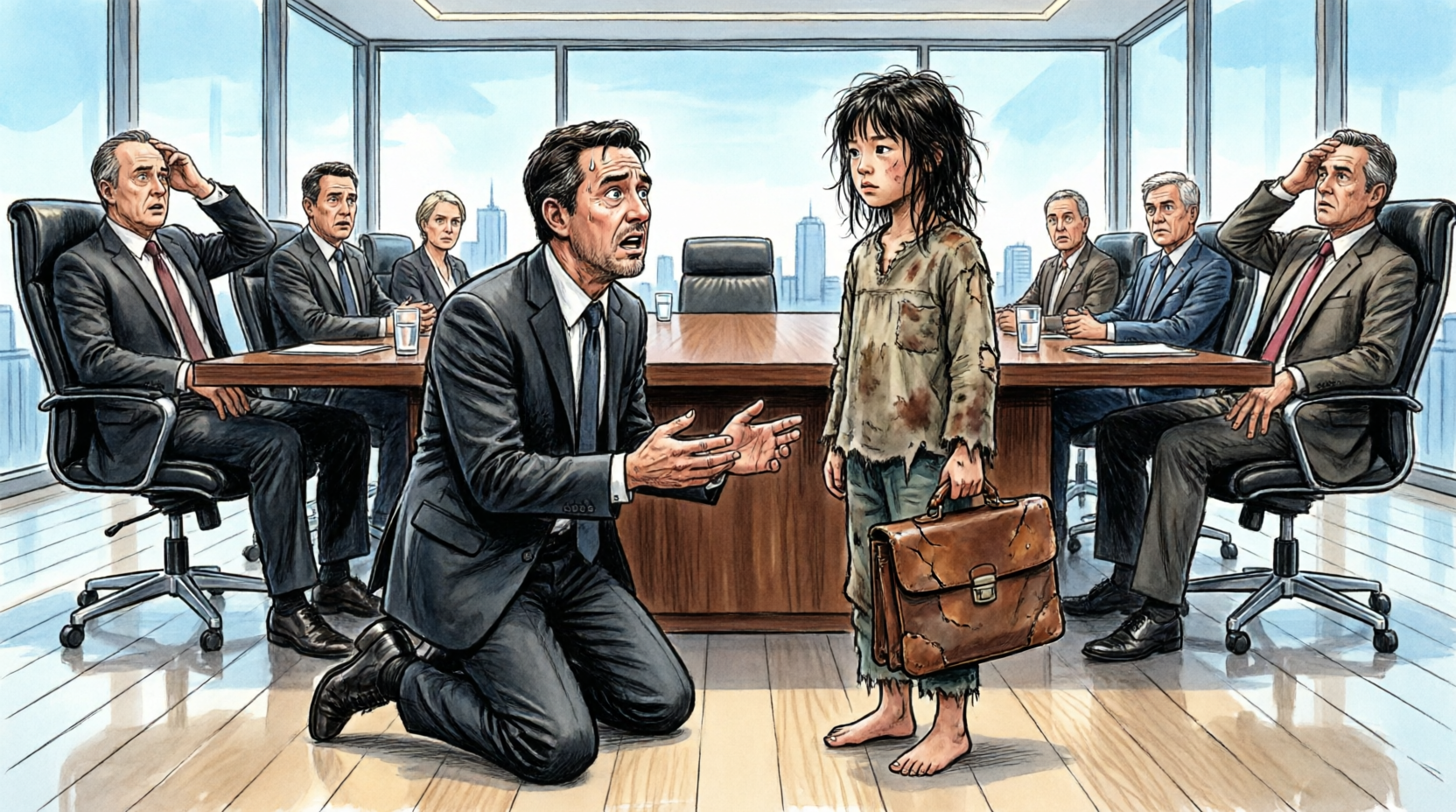
Then the door opened. Every head turned. In the doorway stood a little girl, no older than five. Bare feet blackened with street dust. A faded yellow dress torn at the hem. Hair tangled into wild knots. She clutched a black leather portfolio to her chest as though it were fragile glass.
Silence swallowed the room. Benjamin rose slowly, unsure if he was dreaming. His heart thudded so loudly he thought others might hear it.
“Who are you,” he asked, his voice hoarse.
The girl stepped forward. Her eyes were wide but steady.
“I saw you drop this on the street,” she said softly. “I ran to give it back, but you walked into the building too fast. I followed you.”
A stunned murmur rippled through the room. One lawyer removed his glasses. An executive leaned forward in disbelief. No one spoke.
Benjamin crossed the room in two strides and knelt in front of her. The powerful businessman, accustomed to towering over boardrooms, now looked up into the face of a child.
“How did you get inside,” he asked gently.
She shrugged. “I went into the elevator when nobody was watching. Nobody sees a poor kid.”
The words struck him harder than any accusation ever had. He reached for the portfolio, but the girl tightened her grip.
“I will give it back,” she said seriously. “But you must promise me something.”
Benjamin blinked. “What do you want,” he asked quietly. “Food, a safe place, school.”
The room held its breath.
The girl hesitated, then nodded once. “I want to not sleep outside anymore.”
Benjamin swallowed against the sudden pressure in his chest. “I promise,” he said. “You have my word.”
Only then did she hand over the portfolio. He opened it immediately. Every document was inside. Untouched. Perfect. His salvation lay in the hands of a child no one had noticed.
The meeting resumed minutes later. With the evidence presented, the accusations collapsed. Lawyers argued. Investors apologized. Contracts remained intact. His company stood secure.
Yet Benjamin barely heard any of it. Across the room, the girl sat on a couch, slowly eating crackers offered by a secretary. She chewed as though unsure when her next meal might come.
When the last executive left, Benjamin approached her.
“What is your name,” he asked.
“Sadie,” she replied.
“Do you have family, Sadie.”
She shook her head. “My mom left a long time ago. I sleep wherever I can.”
Benjamin closed his eyes. A memory of his own childhood surfaced. Nights in shelters. Hunger. Fear. A past he had buried beneath skyscrapers and contracts.
“No more,” he said. “You will not sleep outside again.”
That day changed both of their lives.
Benjamin took Sadie to dinner in a restaurant overlooking the river. She stared at the menu like it was written in another language. When the food arrived, she ate slowly at first, then faster, tears forming as she realized no one would take the plate away. He bought her clothes. New shoes. A warm jacket. She touched each item as if it were magic.
“Is it really mine,” she asked.
“Yes,” he said. “All yours.”
He hired a social worker named Diane Keller to handle the legal process. A teacher named Mrs. Thompson began tutoring Sadie every morning. Benjamin sold his lonely penthouse apartment and bought a house in a quiet neighborhood with a yard and sunlight and space for laughter.
One evening, Sadie sat on a swing he had installed in the backyard. Benjamin sat beside her.
“Why are you doing this,” she asked. “You do not even know me.”
He looked at her small hands gripping the chains. “Because you saved me,” he replied. “And now it is my turn to save you.”
She smiled, and something inside him finally felt whole.
Six months later, trouble arrived.
A rival businessman named Gregory Sloan walked into Benjamin’s office without knocking. His grin carried no warmth.
“I have interesting information,” Gregory said, settling into a chair as if he owned it.
Benjamin folded his arms. “Speak.”
Gregory leaned forward. “I discovered who Sadie’s mother was. A former accountant at your firm. Fired years ago for selling confidential data. Imagine the headlines. Billionaire adopts daughter of disgraced employee. People will say she was planted to steal your secrets.”
Benjamin’s jaw tightened. “You are lying.”
Gregory slid a birth record across the desk. “Forty percent of your company,” he said. “And I keep quiet.”
Benjamin’s vision blurred with anger. He imagined the press, the scandal, the damage to Sadie. Then he remembered her laughter in the yard, her whisper every night before bed.
“Goodnight, Dad.”
He slid the document back.
“You will get nothing,” Benjamin said. “Release whatever you want.”
Gregory stared, stunned. “You will regret this.”
Benjamin shook his head. “I have regretted many things. Loving my daughter will never be one of them.”
Gregory left, slamming the door. The story broke the following week. News anchors speculated. Comment sections filled with cruel theories. Benjamin sat beside Sadie and held her hand.
“People will say ugly things,” he told her. “But none of it changes who we are.”
Sadie nodded. “I trust you, Dad.”
Something remarkable happened. The public did not turn against him. They rallied. Messages poured in. Donations. Support. Offers to help homeless children. A movement began.
Benjamin founded the BrightSteps Initiative, a network of shelters for street children. Safe beds. Hot meals. Education. Within a year, multiple centers opened across the city. Sadie became the face of the project, standing beside him at events, speaking with a confidence that astonished everyone.
At eight years old, she stood on a stage in front of thousands.
“I was invisible,” she said. “People walked past me every day. Hungry, scared, cold. One day I returned something that was not mine. That one choice changed my life. My father saved me. Now we save others.”
Applause thundered. Benjamin wiped tears from his eyes. Years passed. Sadie grew into a brilliant young woman. She sat beside Benjamin in meetings, offering ideas sharper than many seasoned executives.
“What if we build housing not for profit,” she suggested one day. “Homes we give to families who have nothing.”
Benjamin studied her face. “Are you sure.”
She smiled. “Money is only useful when it helps people live.”
Carter Urban Developments launched a housing division dedicated to free homes for struggling families. Neighborhoods rose. Communities flourished. Benjamin’s reputation soared higher than ever, yet he valued none of it more than the nightly hug from the girl who had walked barefoot into his boardroom.
At twenty, Sadie graduated top of her class in architecture. Benjamin sat in the audience, pride filling his chest. When her name was called, she took the microphone.
“I dedicate this to my father,” she said. “He taught me that success is not measured by wealth, but by love.”
The audience stood in applause. Benjamin stood too, heart full. That night, over dinner, Sadie leaned forward.
“Dad, I have an idea,” she said. “Let us build entire communities designed for dignity and belonging. Not charity. Justice.”
Benjamin smiled, seeing in her the best parts of both their journeys.
“Then we build them together,” he said.
And they did. Thousands of children left the streets. Families found stability. Cities gained neighborhoods born from compassion instead of greed. Yet the greatest achievement of Benjamin Carter was never listed on a balance sheet. It was the voice he heard every night before the lights went out.
“I love you, Dad,” Sadie whispered.
And in those words, he knew that the day he lost a portfolio was the day he found a family, a purpose, and a heart he thought money had erased.
END.