At six the next morning, you stood outside your own front gate wearing a wool coat over yesterday’s anger, your hair pulled back, your jaw set so tight it hurt.
Beside you were two patrol officers, a locksmith adjusting his tool case on the sidewalk, and your attorney, Rebecca Sloan, who looked like she had been born already unimpressed by weak men.
She held a leather folder under one arm and a paper cup of black coffee in the other, as calm as if she were waiting for a brunch reservation instead of the legal demolition of your marriage. The street was still half asleep, washed in gray-blue dawn, and the bougainvillea on the wall of your house looked too bright for what was about to happen.
When the front door finally opened, your husband stepped out with the smugness of a man who thought he had won overnight.
That expression lasted maybe two seconds.
His eyes landed on the uniforms first, then the locksmith, then Rebecca, then you. And the arrogance drained out of his face so quickly it was almost beautiful. He looked past you as if maybe a camera crew would step out and tell him this was a prank, but no such miracle arrived.
“What is this?” he asked.
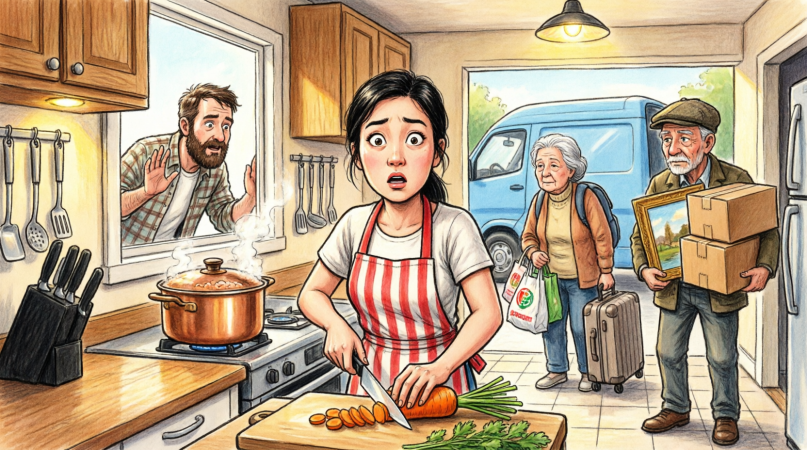
You almost laughed, but you had spent the night cooling your rage into something cleaner and more useful. You had learned long ago that anger alone could make a woman loud, but strategy could make her dangerous. So instead of shouting, you reached into your bag, pulled out a set of documents, and handed them to Officer Morales, who passed them to Iván.
“That,” you said, “is the beginning of your education.”
He looked down at the papers, confused at first, then paler with every page.
Rebecca spoke before he could recover. “These are the property records showing the home is solely owned by my client, purchased prior to marriage and protected under a valid separate-property agreement. These are also statements documenting your unlawful exclusion of the legal homeowner from her residence last night. You do not have the right to remove her, bar her entry, or admit long-term occupants without her permission.”
From the doorway behind him, your mother-in-law appeared in a robe and slippers, still wearing the face cream she slept in.
She squinted toward the gate, then gasped when she saw the officers. “Iván, what did this woman do?”
It was almost adorable.
Even then, even with dawn light spilling over her silk robe and a police cruiser parked right outside, Ofelia somehow believed you were the intruder. She believed reality was a costume she could rearrange if she complained loudly enough. You looked at her over the top of your sunglasses and felt a cold satisfaction settle into your bones.
“What I did,” you said, “was remember whose house this is.”
Tomás appeared next, one hand on the wall, his expression sour and bewildered.
He had the framed painting under his arm as if he was prepared to carry on with decorating through the apocalypse. Behind him, you could already see their shoes lined up by your entry table, their travel bags stacked by the stairs, your carefully chosen living room now contaminated by their presence like mold spreading across clean drywall. Something in your stomach hardened even more.
Officer Morales stepped forward. “Sir, ma’am, we’re here to keep the peace while the homeowner re-enters the property. There will be no obstruction, no threats, no destruction of property, and no removal of items without legal authorization.”
Ofelia let out a dramatic laugh. “Homeowner? She’s his wife.”
Rebecca smiled the way surgeons do before making the first cut. “And yet the deed remains wonderfully unmoved by marital theatrics.”
Iván finally found his voice.
“You called the police on me?” he asked, looking straight at you, as if that were somehow the betrayal in this story. “Over one argument?”
You took a step closer to the gate. “You locked me out of my own house in socks.”
“It was one night.”
“You invited your parents to move into my home without telling me, tried to dump a six-figure bill in my lap, and then physically removed me when I said no. Don’t shrink it now just because uniforms are standing here.”
That hit.
Not enough to produce shame. Men like Iván rarely got all the way to shame without a court order. But enough to make him glance sideways, enough to make him remember that the version of events he had rehearsed in his own head sounded ridiculous in open air. His mouth tightened. Ofelia placed one hand on his arm, as if steadying an emperor.
“Well,” she snapped, “if she wants to make a spectacle, then perhaps she should explain to everyone why she abandoned her husband’s parents.”
“Abandoned?” You smiled. “That’s rich, considering I met your moving truck with a soup pot on the stove.”
Rebecca murmured, “Keep going. Calm and factual.”
You nodded once.
That was the hardest part of the morning, not crying, not screaming, not telling Ofelia exactly what kind of parasite she was. The hardest part was staying calm enough to let the truth do the strangling for you. You unlocked your own gate with your own key and walked inside while the locksmith stood by in case the interior locks had been changed.
The moment you stepped onto the porch, Ofelia moved to block the doorway.
“You can’t just storm in here and humiliate us,” she said.
One of the officers sighed.
Rebecca stepped forward. “Ma’am, move.”
Ofelia did not move.
Officer Morales repeated it, more firmly. “Move aside.”
For one theatrical second, you thought she might actually refuse and get herself handcuffed before sunrise. But then Tomás touched her elbow and muttered something that sounded like caution, and she stepped back with a face like spoiled milk. You crossed the threshold of your own house and felt a rush so sharp it almost made you dizzy.
Nothing looked the same.
The air smelled like menthol ointment, old cologne, and the oily breakfast sausage Tomás must have cooked in your good skillet. Your cream throw pillows had been replaced with brown crocheted cushions from somewhere in the seventies.
A ceramic saint now stood on your entry console where your brass bowl used to be. Ofelia had draped one of her floral shawls over the back of your Danish lounge chair like the opening move in a hostile occupation.
You stood in the foyer, taking it in, and suddenly the insult of the lockout became only part of it.
This was never a temporary visit.
It was an invasion.
They had not arrived with panic or uncertainty or nowhere else to go. They had arrived with décor, prescriptions, framed art, and invoices, with the confidence of people who had already been promised your house, your money, and your submission. And your husband had let them believe it.
You turned slowly toward him.
“How long?” you asked.
He frowned. “How long what?”
“How long have you been planning to do this?”
He said nothing.
That silence was louder than anything he could have said.
You walked past him into the living room and saw further evidence everywhere. The drawers of your sideboard stood open. Your bar cabinet had been rearranged to make room for medication organizers.
A folded blanket lay on your sofa where Tomás had probably napped. In the corner near the window sat a cardboard box full of papers labeled IMPORTANT in Ofelia’s handwriting, as if she had already assigned herself a permanent office in the home you built before she was ever a factor in your life.
Rebecca opened her folder.
“My client is requesting immediate removal of unauthorized occupants and restoration of full possession of the property.”
Iván scoffed. “You can’t evict family in one morning.”
Rebecca flipped a page. “Actually, what we are dealing with right now is not a tenancy issue. They were admitted without the owner’s consent less than twenty-four hours ago, have no lease, no legal right of occupancy, and no established residency recognized by my client. Their belongings may be removed today under supervision, especially after the unlawful expulsion of the homeowner.”
Tomás lifted both hands. “Hold on. We sold our apartment.”
You looked at him. “That sounds like something you should have considered before turning up at my house with a painting.”
His face hardened, but not with the fury of a powerful man. More with the petty resentment of someone who had coasted on other people’s boundaries for years and could not believe one had finally held. Ofelia crossed her arms over her robe and stared at you as if your existence itself were bad manners.
“You’re destroying your marriage,” she said.
“No,” you answered. “Your son did that yesterday on the porch.”
That landed harder than anything else so far.
For a second, even Iván looked at the floor.
You could see the previous evening all over again if you let yourself. The cold tile under your socks. The shock in your chest when the deadbolt clicked from inside your own house. The hotel room you booked with shaking fingers and slept in fully dressed because you no longer trusted your life enough to rest properly. Around midnight, after the anger settled just enough for reason to breathe, you called Rebecca.
She answered on the second ring.
You had apologized first for the hour.
She had cut you off with one sentence. “Tell me exactly what happened.”
So you did.
Every detail. The surprise arrival. The sold apartment. The invoice. The shouted entitlement. The bag thrown onto the porch. The lock turning from the inside. By the time you finished, she was already emailing herself notes.
Then she told you to go downstairs to the business center in the hotel lobby and print the property deed, mortgage history, prenuptial annex, and the separate-property marriage agreement she had once insisted you keep digitized.
At the time, years ago, you had thought she was being dramatic.
At midnight, sitting barefoot in a hotel office chair, you sent her a silent apology through the universe.
Back in your living room, Officer Morales asked the practical question.
“Do you want them out now?”
You did not answer immediately.
Instead, you looked at the people in front of you and allowed yourself the luxury of one honest inventory. Iván, handsome in the lazy way that had once convinced you he was more substantial than he was, now stood wrinkled and defensive in the same clothes from the day before. Ofelia looked outraged, but behind the outrage there was calculation, like she was still deciding whether tears or threats would serve her best. Tomás looked embarrassed only by inconvenience, not by principle.
And that was when something colder than anger settled fully into place.
You were done hoping any of them would suddenly become decent.
“Yes,” you said. “Now.”
Ofelia let out a cry that sounded genuinely wounded. “Where are we supposed to go?”
“That,” Rebecca said, “is no longer her emergency.”
Iván spread his hands. “Daniela, let’s talk about this privately.”
You laughed.
Not loudly. Not hysterically. Just one short, disbelieving sound, because men always seemed to discover a passion for privacy the moment public consequences arrived. He had no interest in private discussion when he was stuffing your clothes into a travel bag and pushing you out the door. But now, with witnesses, legal documents, and his mother’s robe glowing in the dawn, suddenly he wanted nuance.
“There is nothing private left,” you said.
He lowered his voice anyway and stepped toward you. “Don’t do this in front of them.”
“You mean the police? Or your parents?”
“You know what I mean.”
“Yes,” you said. “I do. You want me to save your image while you destroy my life.”
Rebecca pretended to review her notes while very obviously enjoying every second.
The next hour became a theater of disassembly.
The officers stood by while Tomás and Iván hauled the suitcases back out to the truck. Ofelia complained in waves, switching tactics every ten minutes. First came offense, then guilt, then age, then family, then religion, then the familiar old script of how a “good wife” bends so the family doesn’t break.
You had heard variations of that music your entire life. It played at weddings, funerals, baby showers, dinner tables, on television, in whispers passed between aunts. A woman absorbs. A woman yields. A woman understands. A woman cleans the mess and calls it love.
Standing in your hallway while your mother-in-law removed her pill organizer from your console table, you felt the last thread of that programming snap.
When Tomás tried to carry out the framed painting and scrape the wall on the way, you said, “Be careful.”
He glared. “Now you care about the wall?”
“I always did. That’s why I paid for it.”
Ofelia turned around so fast her slippers squeaked on the floor. “There it is. Always the money. Everything with you is money.”
“No,” you said. “With me it is consent. You just only notice consent when it costs you something.”
That silenced her for perhaps the first time in recorded history.
You moved through the house room by room while they cleared their things.
The guest room, which you had designed in pale blues and warm woods so friends would feel welcome, now smelled like camphor rub and resentment. The hallway bathroom held new toothbrushes, someone’s denture cup, and a stack of towels you had bought in Lisbon and specifically asked no one to use because the embroidery snagged easily.
In the kitchen, Tomás had somehow managed to leave grease on your white tile backsplash in a single evening, a feat so efficient it would have been impressive in another context.
Rebecca followed you into the kitchen.
“You’re handling this well,” she said quietly.
“No, I’m handling it legally. The emotional part is a knife drawer.”
She nodded, as if that were entirely reasonable.
Then she pulled out another set of papers. “I drafted an emergency petition for exclusive occupancy, temporary no-harassment relief, and preservation of financial records. If he contests anything after this morning, we file before lunch.”
You looked at her. “You drafted all that before sunrise?”
She took a sip of coffee. “You married badly. I prepare thoroughly.”
For the first time since dawn, something inside you loosened enough to smile.
You had known Rebecca since college, back when she wore thrifted blazers and argued with professors in a voice so calm it made them more furious than if she shouted. When you got engaged to Iván, she was the only one who had pulled you aside and asked the one question no one else wanted to ask. Does he respect what you’ve built, or does he just enjoy standing inside it? At the time, you had called her cynical.
Now, watching your husband drag his father’s suitcase across the entry rug you imported from Oaxaca, you understood that cynicism was just realism with the sugar removed.
By eight fifteen, their things were mostly back in the truck.
By eight twenty, the neighbors were fully awake.
Curtains twitched all up and down the street. A dog barked from across the road. Mrs. Beltrán next door stepped onto her balcony in a pink robe and pretended to water a plant that had been dead for months. Your humiliation was public now, but strangely, it did not feel humiliating. That part had happened the night before in the dark. In daylight, with documents in order and witnesses at your side, it felt less like exposure and more like correction.
Iván stood near the truck while Ofelia argued with one of the officers about “respect for elders.”
You walked out onto the porch to face him one more time.
He turned when he heard the door open. For a heartbeat, there was something almost familiar in his face. Not the husband from the last year, with his irritation and entitlement, but the man you had once met at a mutual friend’s housewarming.
The man who laughed easily, asked questions, made you feel not smaller but seen. It would have been easier if that version had been entirely fake. But life rarely gives you villains in theater makeup. More often it gives you charm with weak foundations.
“How did we get here?” he asked.
You stared at him, amazed.
That question, from his mouth, after everything, almost qualified as art. You were the one locked out, ambushed, overruled, treated like a wallet with a wedding ring, and he was asking history itself how it had betrayed him.
For a second you considered listing every step, every compromise, every time he let Ofelia insult you and called it generational difference, every time he hinted you should “contribute more” because you had “less family pressure,” every time he treated your success as shared while treating your authority as optional.
Instead, you said the truest thing.
“You confused my love with permission.”
He flinched.
“You think this is about one bill,” he said.
“No. I think it’s about the fact that you all walked in here like I was the last person whose opinion mattered.”
His jaw tightened. “They’re my parents.”
“And this is my house.”
“They needed help.”
“Then you should have helped them. With your money. Your apartment. Your effort. Not my property and my paycheck and my silence.”
He looked over your shoulder toward the doorway, maybe hoping Rebecca or one of the officers would disappear so he could still win this by tone alone. Nobody disappeared. He lowered his voice.
“You’re making me choose between you and them.”
You shook your head slowly. “No. You already chose. Yesterday just made it visible.”
That one stayed with him.
You could tell by the way his mouth opened, then closed again. The awful thing about a clean truth is that it leaves nowhere to stand except inside it. He looked tired suddenly, not tragic-tired, just the tiredness of a man who had finally run out of ways to edit reality. Behind him, Ofelia called his name sharply, the way she always had when summoning him back into alignment.
He looked toward her.
And in that small reflex, you saw the whole marriage.
Not just the son he had been, but the husband he could never quite become.
By nine, they were gone.
The truck rolled down the street in a cough of exhaust and offended dignity, Tomás at the wheel, Ofelia rigid in the passenger seat, her saint statue in her lap like a prop from a melodrama. Iván followed in his own car after standing too long in the driveway as if waiting for you to break, to call him back, to soften the ending into one more extension of grace. You did not move.
Only when the last car turned the corner did you let yourself exhale.
The house fell into a silence so complete it rang.
You closed the front door and locked it, then locked it again just to hear the click. The officers left after confirming you were safe. The locksmith replaced the side door cylinder and rekeyed the deadbolt while Rebecca sat at your dining table and prepared the next stage of your war. When they were all gone, the house belonged only to you again, and somehow that felt less triumphant than eerie.
Like surviving a storm and hearing the roof still intact.
You walked slowly from room to room.
In the kitchen, the soup ingredients still sat where you had abandoned them the day before, carrots browned at the edges, cut squash drying on the board. In your bedroom, your closet door still hung open from where Iván had yanked out your bag.
On the bathroom counter lay the face serum you used every night before bed, uncapped and waiting, as if the world had assumed you’d be back in twenty minutes instead of after legal intervention and a marriage collapse.
You stood in your room and finally cried.
Not hard. Not loudly. Just enough for the body to discharge the poison it could not hold any longer.
When the phone rang an hour later, you almost didn’t answer.
It was your mother.
Rebecca must have guessed right when she said the neighborhood gossip line would outrun Wi-Fi. Your mother didn’t ask whether it was true. She asked, in that careful tone mothers use when they are already afraid of the answer, “Do you want me to come over?”
You looked around the bedroom at the half-open drawers, the disrupted air, the aftermath.
“No,” you said gently. “Not yet.”
She was quiet for a moment. “Are you safe?”
“Yes.”
“Are you alone?”
“Yes.”
Another pause. Then, softer, “That may be the safest you’ve been in a while.”
That nearly started the tears again.