The first thing people notice about our street is how quiet it is.
Not the uneasy kind of quiet, not the sort that makes you wonder what is happening behind drawn blinds or why a dog has stopped barking all at once. Ours is the clean, orderly quiet of a suburb just outside Columbus, Ohio, where people edge their lawns in straight lines, haul their recycling bins back in before dark, and wave across driveways without ever really knowing what goes on inside one another’s homes.
On Saturdays, you hear lawnmowers, basketballs thumping in distant cul-de-sacs, and little kids riding their bikes in patient circles while their parents stand on porches holding coffee in oversized travel mugs.
In the fall, American flags stir lightly against white siding. In the winter, the streets are lined with salt crust and glowing porch lights, and the whole neighborhood takes on that decent, respectable look people trust too easily.
It is the kind of place where people like to believe trouble belongs somewhere else.
Somewhere in the city. Somewhere on the evening news. Somewhere far from the mailboxes with little flowerbeds planted beneath them and the school pickup lines and the women who buy rotisserie chickens at Kroger on their way home.
I used to believe that too.
At fifty-six, I had built a life out of ordinary routines and the sort of quiet endurance that does not impress anyone until they have to live it themselves. My name is Margaret Collins, though nearly everybody calls me Maggie.
I have lived in the same two-story townhouse for almost twenty years, long enough to watch maple trees fatten and sidewalks crack and neighbors come and go. My husband, Daniel, died seven years ago after a fast, mean illness that left behind a stack of hospital bills, a mortgage I did not know how I would manage, and a silence so large in the house that for months I kept the television on just to feel less alone.
You learn strange skills after grief. How to carry grocery bags and sorrow at the same time. How to answer, “How are you doing?” with something polite enough to keep the conversation moving. How to stand at the sink at dusk and realize there is no one coming home but you, then dry your hands and keep going anyway.
For a long time, the house felt too big.
Then my son moved back in.
At first, it felt like a blessing, or close enough to one that I was willing to call it that. Ethan had just finished college with a degree in business administration and said he only needed a few months to get on his feet.
He said it in that easy, confident tone young people use when time still feels like a thing that belongs to them. A few months turned into half a year. Half a year stretched into nearly two. Temporary arrangements have a way of putting down roots when nobody insists on boundaries early enough.
I told myself it made sense. Rent had gone up everywhere. Groceries cost more than they used to. He was young, still finding his way, still building a life. That is the story mothers tell themselves when they want to believe patience is the same thing as wisdom.
Then he got married, and Lily moved in too.
That had happened six months before the night everything cracked open. Their apartment had raised the rent by four hundred dollars overnight, and suddenly moving into my townhouse again became, in Ethan’s words, “the smartest financial move for now.”
Lily was a freelance graphic designer who worked from her laptop, usually in the living room with her knees tucked under her and a blanket over her legs even in mild weather. She was not rude. That would have been simpler to understand.
She was polite in that distant, careful way that never quite warms into affection. She thanked me when I cooked, but rarely offered to help. She smiled often enough, but the smile never stayed. She was always scrolling, always answering emails, always somewhere slightly removed from the room she was in.
Still, I welcomed her.
Family helps family. That was the sentence I had built half my life around.
The evening Ethan hit me began like a hundred other evenings had. It was a Tuesday in late October, cool enough that the kitchen windows had fogged faintly from the stove, with the sky outside turning the soft bruised color it gets before full dark.
By six o’clock, the sun was filtering through the blinds in thin golden bands that striped the counter and the old ceramic fruit bowl I had owned since the nineties. The kitchen smelled of chicken broth, celery, onion, and black pepper.
I was making my mother’s chicken noodle soup, the kind of meal that belonged to damp weather and long days and people you loved enough to feed without asking whether they deserved it.
I remember standing at the stove, stirring the pot slowly, tasting the broth with a spoon, deciding it needed another minute. Maybe two. The noodles were just on the edge of done, still holding a little bite, and the carrots had softened without going mushy. It was comfort food, plain and familiar, the sort of meal that says home in a language most people do not even realize they know.
Behind me, the front door opened.
I did not have to turn around to know it was Ethan. I recognized him by the rhythm of his arrival. Heavy footsteps. A quick breath, halfway between a sigh and a grunt. The dry metallic sound of keys hitting the counter like a period at the end of a sentence.
“How was work?” I called.
“Long,” he answered.
That was all.
He worked at a logistics company downtown in a glass-and-brick building near the business district, the kind of place with fluorescent-lit conference rooms, coffee that always smelled burnt, and men in quarter-zips talking about targets and efficiency. The pay was good for someone his age, and on paper it looked like the sort of job a mother should be proud of.
But over the previous year I had watched something in him change. Not all at once. Never all at once. A shortening fuse. A sharper tone. Irritation where there used to be fatigue, and something uglier beneath the irritation that I kept pretending I was imagining because acknowledging it would have required action, and action would have required me to admit that love does not fix what people refuse to face.
He went upstairs to change, and a few minutes later Lily drifted into the kitchen doorway, phone in hand, her hair clipped up loosely as if she had spent the day half-dressed in concentration and was only now remembering the rest of the house existed.
“Soup smells good,” she said.
“Almost ready.”
She nodded, already looking back down at her screen.
There was a television murmuring in the living room. A weather update, I think. Something about colder temperatures coming in from the west. I set out bowls, spoons, napkins. I placed the salt shaker near Ethan’s spot without thinking much about it. Small habits become invisible in families. You do things so many times they stop feeling like choices.
When the soup was ready, I ladled it into bowls and brought them to the table. Steam lifted in soft ribbons. The noodles curled through the broth like pale little commas. Bright pieces of carrot floated near the surface, and the chopped parsley I’d added at the end gave the whole thing a fresh green finish. It looked exactly the way my mother’s soup had looked on sick days and snow days and evenings when money was tight but dinner still needed to feel like love.
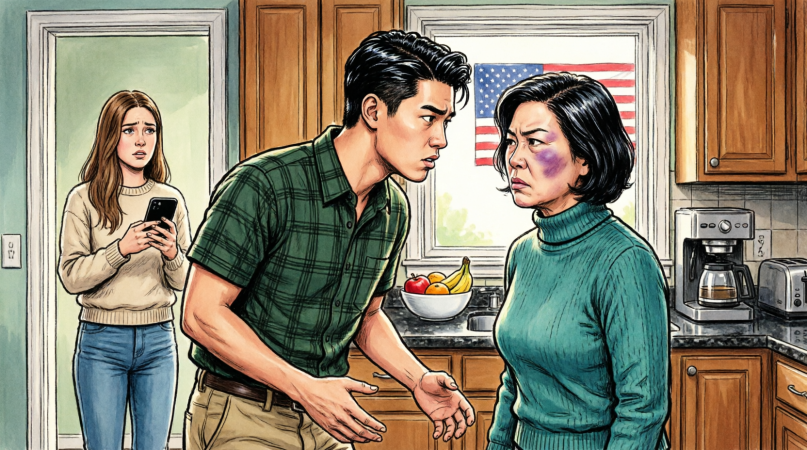
Ethan sat down first. Lily lingered in the doorway instead of joining us immediately, as if she had not decided whether she wanted to eat or simply witness the meal from a safe distance.
He picked up his spoon and took one bite.
Then his face changed.
It was subtle at first, just the tightening of his eyebrows and the way his upper lip barely lifted. The sort of expression most people would miss if they were not already trained by habit to read moods before words.
“Did you forget salt?” he asked.
It was not a real question. It had the tone of a complaint disguised as conversation, a trap hidden inside ordinary language.
I wiped my hands on a dish towel and kept my voice light.
“Oh, I can add some. Sometimes it’s easier to season after.”
I reached toward the table for the shaker.
That was when Ethan slammed his palm against the counter.
The sound cracked through the kitchen hard enough to rattle the bowls. His spoon clanged sharply against the side of the ceramic, and for a second the whole room seemed to flinch. Even the refrigerator’s hum felt louder after that.
Nobody moved.
Lily was still standing in the doorway with her phone glowing in her hand. She did not step forward. She did not say his name. She did not say mine.
Ethan’s jaw tightened.
“I work all day,” he said, each word cut clean and sharp. “The least you can do is make it right.”
Something in my chest pulled tight. Not fear exactly, not yet. More like the old instinct that makes you lower your voice when someone else raises theirs, as though gentleness can prevent what anger has already decided.
“I was going to add…”
I never finished.
Later, when I replayed it, the whole thing came back in pieces. A movement too fast for the mind to follow properly. A shift in air. A blur from the corner of my eye. Then the sound.
His hand struck my face flat and hard.
For a fraction of a second, I truly did not understand what had happened. There was only white noise in my head, a sudden ringing in my ear, and the sensation that the room had tilted a few degrees to the left.
My knees buckled. I caught the edge of the counter before I fell, fingers gripping the laminate so hard my hand ached afterward. Pain bloomed hot across my cheek. The kitchen, which had smelled comforting a moment earlier, now smelled too strong, too immediate. Broth. Celery. Garlic. Heat. It was as if every ordinary thing in the room had been turned up until it became unbearable.
I looked at him.
Ethan stared back at me with wide eyes.
Not horrified. Not truly sorry. Not yet.
He looked shocked in the cold, selfish way people sometimes do when they realize they have crossed a line they assumed would always hold. For one honest second, I think he saw himself clearly. Then whatever he felt hardened over. His face changed, sealing up. Anger folded around the moment like it meant to defend itself from consequence.
“Don’t make a big deal out of it,” he muttered.
He picked up his bowl and walked into the living room.
Just like that.
As if the thing that had happened was an inconvenience. As if I were the one being difficult for standing there with half my face burning.
Lily remained in the doorway another heartbeat longer. She lifted her eyes to my cheek. I saw recognition there. I saw that she knew exactly what had happened and exactly what it meant.
Then she looked back at her phone and followed him.
I wish I could tell you what I did next with the precision of someone giving testimony, but the truth is shock has a way of softening the edges of time. I remember standing at the counter with one hand still braced against it, breathing too quickly.
I remember the soup steaming quietly on the table like nothing had changed. I remember the television in the next room and the low murmur of voices from some ad for car insurance or local news. I remember thinking, in a weirdly calm and detached way, My son just hit me.
There are moments in life so wrong that the mind rejects them the first time through. It tries to file them under misunderstanding. Misfire. Accident. Anything but the truth.
I cleaned the kitchen because I did not know what else to do.
That sounds small, but anyone who has ever been blindsided inside their own home will understand it. Sometimes the body reaches for routine because routine is the last bridge left to normalcy. I cleared bowls. I poured leftover broth down the disposal. I washed the ladle.
I wiped the counter twice, then a third time because I had forgotten whether I’d already done it. I kept expecting Ethan to come back in and say something that would reset the world, even a bad something. An excuse. A half-apology. Another burst of anger. Anything that would prove he understood a line had been crossed.
Nothing came.
When I finally went upstairs, the house had gone into that false quiet that is worse than shouting. My cheek was throbbing. In the bathroom mirror, the skin had already flushed a deep red along the cheekbone and just below the eye.
I touched it carefully and hissed. I remember opening the freezer, taking out a bag of frozen peas because the ice packs were buried under old bread and a half-empty bag of corn, then lying on my bed with the peas wrapped in a dish towel against my face while the ceiling fan turned above me.
I did not cry right away.
That came later, in a few brief, angry bursts that felt almost insulting in their smallness. Mostly I stared at the ceiling and thought about Ethan at eight years old, kneeling in the yard because he had found a baby rabbit and was worried it looked lonely.
Ethan at twelve, crying over a bird that had flown into our front window. Ethan at sixteen, standing in a tuxedo at his junior prom looking embarrassed and handsome and so unmistakably still my boy.
A mother’s mind is cruel that way. When the person who hurts you is your child, memory starts offering evidence for the defense before you have even admitted there should be a trial.
Questions kept coming whether I wanted them or not. When had his temper changed from occasional frustration to something I now tiptoed around without admitting it? When had I started measuring my words so he would not snap?
When had the house rearranged itself around his moods? There had been slammed doors. Sharp comments. A glass once thrown into the sink hard enough to shatter. A meeting at work he had ranted about for forty minutes until I nodded through the whole thing because disagreeing felt dangerous. None of it had looked, in the moment, like a road leading here. But afterward, all of it did.
Love does not vanish the minute someone harms you.
That is what makes it so hard to speak honestly about family violence. People imagine hatred where there is usually confusion, grief, denial, loyalty, and shame all tangled together until you can barely tell which feeling belongs to which wound.
I loved my son that night. I was also afraid of him. I was furious with him. I was embarrassed for him. I was embarrassed for myself. I wanted him out of my house. I wanted him downstairs so I could demand an explanation. I wanted to believe he had lost control for one second and would never do it again. I wanted to believe all kinds of things that would have made me feel less helpless.
I slept maybe two hours.
By morning, the red had deepened into a swollen purplish ache under the skin. In daylight the bruise looked undeniable. I stood in the bathroom with a tube of concealer and an old compact mirror, dabbing makeup over it the way women of my generation were taught to repair appearances before feelings. It dulled the color but did nothing for the swelling. My face still looked wrong, slightly fuller on one side, as if something underneath had shifted.
At eight o’clock there was a knock on my door.
Before I could answer, Ethan opened it and stepped into the room. He was wearing his work shirt, sleeves buttoned, tie hanging loose around his neck. His hair was still damp from the shower. He smelled faintly of soap and shaving cream, and the ordinariness of that smell nearly made me sick. There was something obscene about how normal he looked.
“Lily’s mom is coming for lunch,” he said.
That was all at first, as if he were announcing the weather.
My stomach tightened.
“Oh.”
“Cover everything up and smile.”
He did not look directly at my cheek when he said it. He glanced at my shoulder instead, then at the floor, as though avoiding proof might reduce guilt.
I stared at him.
He turned and walked out before I could answer.
A minute later I heard the front door close, his car start in the driveway, then the familiar sound of it backing out and heading down the street. I stood in my bedroom, one hand still holding the concealer tube, and realized I was shaking.
At nearly the same hour, across downtown Columbus, Ethan walked into the office building where he worked and felt something uneasy moving through him that he could not name. He would tell me later, much later, that the whole elevator ride up had felt wrong, like the air had changed pressure.
The lobby smelled of coffee, printer toner, and rain tracked in on other people’s shoes. The receptionist said good morning. He answered automatically. His phone buzzed in his pocket with a message from his boss.
Come to my office when you arrive.
At the time he told himself it was probably about deadlines. A client issue. Maybe one of the shipments their team had been scrambling to untangle all week. He had been under pressure for months by then, missing small details, showing up irritable, snapping at coworkers in ways he later called stress and other people quietly called alarming. He had been telling himself everybody at work was on his back, that the company culture was toxic, that nobody appreciated how hard he was pushing.
It is amazing what a person can call pressure when they are trying to avoid calling it a problem in themselves.
He stepped off the elevator on the fifth floor and walked down the carpeted hallway toward Mr. Harris’s office. The door was already open. That detail unsettled him, though he would not have been able to say why.
He went in, expecting a routine reprimand, a talk about deliverables, maybe one of those false-calm managerial conversations where every sentence begins with “We just want to make sure you’re supported.”
Instead he stopped cold.
Mr. Harris was behind the desk.
He was not alone.
Beside him sat Denise Warner from HR, a woman in her forties with composed eyes and the kind of measured voice that always made people more nervous than shouting did. A folder lay open on the desk. Ethan would later remember that folder with almost painful clarity. Pale manila. A yellow sticky note. His own name printed across the tab in neat black letters.
Mr. Harris did not gesture to the chair.
He folded his hands and said, very quietly, “Ethan, we need to talk about what happened at home last night.”
For a moment Ethan genuinely thought he had misheard.
“What?”
Denise’s face did not harden, but it settled. “We received a report this morning.”
“A report of what?”
His mouth had already gone dry.
Mr. Harris leaned forward slightly. “A domestic incident connected to you.”
Ethan stared at them.
“Who called?”
“I can’t share that,” Denise said. “What we can say is that your name was mentioned, your address was mentioned, and the concern raised this morning was specific enough that we had to address it.”
He would tell me later that his first feeling was not remorse. It was panic. Not because he had suddenly grasped the full moral weight of what he had done, but because consequence had arrived faster than he thought it could. That is another ugly truth people do not like to say out loud. Accountability often begins with fear before it becomes understanding.
Mr. Harris continued, calm as ever. “You’ve also been under unusual stress at work. Missed deadlines. Raised voice in meetings. Tension with coworkers. None of that proves anything on its own, but taken together with what was reported this morning, it became something we couldn’t ignore.”
Ethan stared at the carpet.
His hands were trembling.
Denise spoke gently, but not softly enough to leave him a place to hide. “Did you hit someone, Ethan?”
The room held still around the question.
There are moments when silence is not indecision but collapse.
At last he closed his eyes and said, “My mom.”
Denise did not react the way people imagine HR reacts in movies. No dramatic intake of breath. No lecture. Just a small, almost weary stillness, the kind you see in people who have heard too many painful truths in office chairs and conference rooms.
The conversation lasted twenty minutes.
When it was over, Ethan walked out with a counseling program card in one hand and his access badge temporarily limited in the system. Administrative leave for a week. Mandatory participation in anger management and a workplace behavioral program. Failure to comply would put his job at risk.
He drove around downtown afterward because he did not know where else to go. He sat in a parking lot near the Scioto River with the heater running and looked at his own hands on the steering wheel. He kept hearing the sentence he had said in that office.
My mom.
Two small words can become a mirror when there is nowhere else left to look.
Back at the townhouse, I spent the morning moving from room to room in a kind of slow, stunned fog. Barbara, Lily’s mother, was expected at noon. She had been to the house only a handful of times before.
She was one of those women who managed to look assembled even in casual clothes, with clean nails, tasteful perfume, and a way of carrying herself that suggested she had been solving family messes quietly for years without asking anyone’s permission. We were not close, exactly, but I had always found her easier to speak with than Lily. She asked direct questions. She looked at people when they answered.
By eleven-thirty I had set the table, reheated the leftover soup, and placed the apple-cider candles Lily liked on the mantle even though I did not light them. Habit again. Performance. The bruise under the concealer had darkened. I could feel it pulling when I smiled, so I stopped trying.
When the doorbell rang at noon, I opened the door to find Barbara standing on the porch in a camel-colored coat, pearl earrings, and sensible low heels, holding a bakery box tied with red string.
“Margaret,” she said warmly. “I brought apple pie.”
The smell of pastry and cinnamon drifted out the second I opened the box for her in the kitchen. Ordinarily it would have made the house feel festive. That day it made me tired.
“Come in,” I said.
She stepped inside, looked around once with the efficient attention of a woman taking in the condition of a room and the people in it at the same time, then set the pie box on the counter.
“Where’s Ethan?” she asked.
“Work ran long.”
It was the easiest lie available, so I used it without thinking.
Barbara turned toward me fully then, and I watched her expression shift. She had probably come prepared for strained in-law small talk, maybe a few polite complaints about the housing market. Instead she saw the bruising beneath my makeup and the faint swelling I had failed to hide. Her eyes narrowed just slightly.
“Margaret,” she said, and there was no warmth in her voice now, only clarity. “Did he do that?”
I could have lied.
A thousand women before me had lied in kitchens and bathrooms and front porches because lying felt simpler than breaking the shape of a family in one sentence. I could have blamed a cabinet door. I could have said I slipped in the shower. I could have done what my own mother’s generation would almost certainly have done, which was protect the man who caused the injury and call it keeping peace.
Instead I set both hands flat on the counter to steady myself.
“Yes,” I said. “He hit me.”
Barbara held my gaze for a long second.
Then she nodded once, slow and deliberate.
“Okay,” she said. “Then we’re going to handle this like adults.”
There are sentences that feel like rescue even before you know what they will require.
She pulled out a chair and sat down. Not dramatically. Not in panic. As if what mattered now was not shock but sequence.
“Tell me exactly what happened.”
So I did.
I told her about the soup. The salt. The sound his hand made against my face. Lily standing there. Ethan telling me the next morning to cover it up and smile. As I spoke, Barbara did not interrupt except to ask for details that mattered. Time. Words used. Whether he had done anything like this before. Whether Lily had seen it directly. Whether I felt safe in the house that night.
When I finished, she leaned back and exhaled through her nose.
“I had a feeling something was off,” she said.
My heart gave a small, ugly turn. “What do you mean?”
She looked almost irritated with herself for not acting on the feeling sooner. “Lily has been minimizing things for months. Saying Ethan has been stressed. Saying he ‘gets loud’ but doesn’t mean anything by it. Little comments. Enough to make me pay attention, not enough to force her hand. I asked questions. She avoided them.”
I sat very still.
The world was already changing shape around me, becoming a place where what had happened was not an isolated burst of madness but part of a larger pattern other people had glimpsed from the edges.
Barbara rested one manicured hand over the other. “I need to call Lily.”
“She’s working.”
“She can work later.”
Barbara picked up her phone and stepped into the dining room. I heard only fragments of that conversation. Her voice low, controlled, then suddenly sharper. A silence. Another question. Then, “No, don’t do that. Listen to me carefully.”
When she came back, her mouth was set in a thin line.
“She knew,” Barbara said.
The sentence landed heavier than I expected, maybe because some part of me had still been trying to preserve Lily as merely passive rather than complicit. Barbara saw the shift in my face and softened a little.
“She didn’t know he would do it,” she added. “But this wasn’t the first time he lost his temper. She says he has punched walls, kicked a laundry basket across the room, screamed in the car. She told herself it was stress. She told herself marriage is hard. She told herself he would settle down once work got easier.” Barbara paused. “Women tell ourselves dangerous stories when we are afraid of what the truth will cost.”
We sat in my kitchen for nearly two hours. The soup went untouched. The apple pie stayed boxed on the counter like a prop from another version of the day. Barbara called Lily again and told her to leave the house for the afternoon and come stay with her.
She told me, with a firmness I had not known I needed, that Ethan was not to continue living in the townhouse as though nothing had happened. She asked whether I wanted police involved. I said I did not know. That answer embarrassed me, but she did not shame me for it. She simply nodded and said uncertainty was not the same thing as weakness.
“For today,” she said, “we make sure you are not dealing with this alone. Tomorrow, we decide the next piece.”
It is strange how quickly a person can begin breathing differently once someone else names reality out loud. Not better, exactly. But less like they are drowning in private.
By the end of the afternoon, Lily had gone to Barbara’s house. Ethan had called twice from some unknown place and left no voicemail. Barbara stayed until evening. Before she left, she wrote her number on a sticky note and pressed it into my hand even though I already had it.
“I know you have this,” she said. “Write it again anyway. Sometimes seeing a number on paper feels more real.”
Then she looked around the kitchen, at the table where the bowls still sat untouched, at the salt shaker between them, and back at me.
“You do not have to protect him from what he did,” she said. “Not from me. Not from Lily. Not from himself.”
After she left, I stood in the house alone and listened to the quiet settle differently than it had the night before. It was still painful. Still full of things broken and unnamed. But there was a new element in it now. Witness. The truth had left my body and entered the room. That changed everything.
Ethan did not come home that night.
He texted instead, a string of messages that began with Can we talk and ended with I didn’t mean it like that, which remains, to this day, one of the most absurd things anyone has ever said to me. He also wrote I was just angry and I’m sorry you got hurt, the kind of language people use when they want the wound to seem accidental, as if anger itself had hands and he had merely been in the vicinity.
I did not answer.
Instead, I locked my bedroom door for the first time in twenty years and sat on the edge of the bed while darkness gathered outside. Cars passed along the main road beyond our subdivision. A dog barked three houses over.
Somewhere a television flickered blue against curtains. All the ordinary sounds of an American neighborhood continuing exactly as planned while inside one townhouse a mother sat with a bruise under her eye and understood, with terrible clarity, that the life she had been calling difficult had become unsafe.
Three weeks later, Ethan was living in a motel off the highway near one of the strip malls on the north side, the kind with faded curtains, thin towels, and an ice machine that sounded like it was coughing itself to death.
But the distance between those two points, my kitchen and that motel room, was not clean or quick. It was made of hard conversations, legal caution, family pressure, and the long humiliating process of admitting to myself that my son could not remain under my roof simply because I still loved him.
Barbara helped force the issue. So did Lily, though from farther away. Ethan had argued, apologized, minimized, then apologized again. He had tried tears, exhaustion, self-pity, and the old practiced woundedness of a man asked to face his own behavior.
What finally moved him was not remorse, not at first. It was the fact that work had already begun holding him accountable, Lily had left, and Barbara had made it clear she would not smooth anything over for appearances.
There is a kind of strength older women develop when they have spent enough years watching people excuse what should have been named early. Between the two of us, and perhaps to his own surprise, Ethan discovered that his charm no longer worked as currency.
The day he moved his bags out, I stood in the doorway of the guest room and watched him pack in stiff silence. A duffel bag. A laundry basket. A stack of work shirts. The room looked smaller with the curtains open, less like a place where a temporary arrangement had stretched into dependency and more like what it actually was, a room in his mother’s house that he had mistaken for a place without consequences.
At one point he held up an old sweatshirt and said, “I can’t believe you’re really doing this.”
I looked at him and said, “You hit me.”
It was the first time I had said the full sentence directly to him without softening it, and it changed the air instantly. He lowered the sweatshirt. Something in his face collapsed inward for a second, like a structure finally admitting damage.
He finished packing without another word.
The first weeks after Ethan moved into the motel were quieter than the house had been in months, but not in any way I would call peaceful. Quiet after harm is complicated. It is relief and loneliness braided together until you cannot separate them.
The air in the townhouse felt lighter without his moods moving through it, without the heavy front-door slam at six-thirty or the muttered tension of his phone calls from the hallway, but every small sound still made me freeze.
A knock at the door. Footsteps outside. The creak of the stairs settling at night. Even the dry click of the thermostat turning on could pull me upright in bed before I remembered where I was and who was not in the house.
Trust, I learned, does not disappear all at once.
It erodes.
It thins slowly, like a favorite shirt worn through in the same place over years until one day your finger goes right through the fabric and you realize it has been fragile for a long time. Rebuilding it is even slower. There is no dramatic montage for that part. No one speech. No single apology. Just repetition, caution, and the stubborn daily work of deciding what safety looks like now that innocence is gone.
Ethan’s world, meanwhile, had narrowed dramatically. Before everything happened, his days had been crowded with the usual young-professional performance of busyness. Early alarms. Commutes downtown with coffee in the cup holder.
Meetings that ran late because nobody in middle management ever seemed capable of ending one on time. Gym sessions. Takeout dinners. Endless phone-checking, endless low-grade agitation. After the incident, his life collapsed into three fixed points. The motel. Counseling. Work, if he managed to keep it.
Mr. Harris extended his administrative leave by another week, then made it clear the extension was not mercy but procedure. Show us progress, he told him. That meant attendance records from counseling, written compliance with the company’s workplace conduct program, and visible behavioral change. Ethan hated the conditions at first. He said it felt humiliating. That was the word he used repeatedly. Humiliating.
When he told Dr. Grant that in their second session, she folded one leg over the other, made a note in her pad, and said, “Accountability often feels like humiliation to people who are not used to it.”
He had gone to anger counseling in the same spirit men sometimes go to the dentist when a tooth finally aches too badly to ignore. Not because they are committed to change, but because the alternative has become more expensive.
Dr. Sabrina Grant ran a practice in a low brick building west of downtown, one of those calm, tastefully neutral offices with framed landscape prints, soft lamps, and a bowl of hard candy on the reception table. She was in her early fifties, with steady eyes and the sort of composed patience that does not invite nonsense for long.
Ethan sat across from her on the second week of November with his arms folded, one ankle over his opposite knee, trying to perform a kind of defensive ease he did not actually feel.
“You think I’m some kind of monster,” he said.
Dr. Grant looked at him for a moment. “No.”
“That’s hard to believe.”
“I think you made a harmful decision. I think you have been building toward harmful decisions for some time. I think you learned some bad ways of handling frustration, then avoided confronting them because avoidance felt easier than shame. But no, I don’t find the word monster very clinically useful.”
He let out a short, humorless laugh. “That sounds like a polite way to say it.”
“If you were a monster,” she said, “you would not be sitting here asking what I think. You would be sitting here asking how to get everyone off your back.”
He did not answer.
She watched him long enough that the silence became work.
Then she said, “Tell me what happened from the moment you walked in the door that night.”
At first he told the story the way angry men often do, as if sequence might soften moral reality. Work was stressful. Traffic had been bad. He was behind on a project. His phone had been buzzing all afternoon. He came home exhausted. The soup tasted bland. He felt disrespected. The details piled up in front of him like excuses dressed in business casual.
Dr. Grant let him finish.
Then she said, “Your mother did not hit you.”
He stared at her.
“She did not insult you. She did not threaten you. She did not block your exit. She did not do anything that required self-protection. You chose to strike someone who was feeding you in her own kitchen.”
For the first time in the session, Ethan looked less defensive than stunned. Not because the idea was new, but because hearing his behavior described without the cushioning language of stress and frustration made it sound exactly as ugly as it was.
“I know,” he muttered.
“Do you?”
He did not answer that either.
Back at my townhouse, I was learning my own version of adjustment. Barbara, who had apparently decided she was not going to let either Lily or me muddle through this alone, began checking on me almost daily.
Some days it was a text. Some days coffee dropped off in a paper carrier from a café near her office. Once she came over with a legal pad and sat at my kitchen table while we listed practical questions I had been too overwhelmed to organize.
Did I want Ethan’s key returned immediately. Yes. Did I want to document the bruise with photographs, even if I was not sure I wanted to go to the police. Yes. Did I want a friend or relative staying over for a few nights. No, though I appreciated the offer. Did I need the locks changed.
That last question embarrassed me.
I looked down at my hands and said, “Do you think that’s necessary?”
Barbara did not answer quickly. She took care with people’s dignity, even when she disagreed with their instincts.
“I think doing it would help your nervous system understand this house belongs to you again.”
It was such a precise sentence that I nearly cried.
So I changed the locks.
A locksmith came on a gray Thursday afternoon wearing a company sweatshirt and work gloves, carrying a metal toolbox that knocked softly against his leg as he walked up the path.
He did not know why I wanted the locks changed. He did not ask. He just removed the old hardware, installed the new deadbolt, tested it twice, and handed me two fresh keys on a bright brass ring.
The click of that new lock the first time I turned it felt strangely intimate, like signing papers after a divorce or hearing a doctor say a diagnosis out loud. A tiny sound, but one with a whole life folded inside it.
Barbara was right. Something in me shifted.
Lily stayed with Barbara during those first weeks. I heard bits and pieces through her mother before I heard anything directly from Lily herself. She had told Barbara more than she had ever told me. About Ethan shouting in the car.
About his temper flaring over minor inconveniences, a lost charger, a parking ticket, a grocery item forgotten. About one night he punched the pantry door so hard the hinge cracked.
About how often she had told herself it was stress, work pressure, money strain, temporary immaturity, anything but what it actually was. She had not left because, in her own words to Barbara, he had never hit her.
That sentence stayed with me for days.
Not because it made sense, but because I recognized the logic of it. People move their moral boundaries a little at a time when fear is involved. We tell ourselves it could be worse.
We tell ourselves this is not technically the worst version. We call it patience, understanding, marriage, loyalty, grace. Then one day there is a bruise on someone’s face and the old language falls apart under the weight of fact.
About a month after the incident, Barbara persuaded me to go to counseling too.
“Family trauma does not politely confine itself to one person,” she said over coffee one Sunday. “It spreads through rooms. Through routines. Through sleep. Through memory.”
She was right, though I wanted her to be wrong. Part of me resisted the idea because counseling felt like one more place where I would have to say the words out loud. My son hit me. My son hit me. My son hit me. It seemed impossible that repeating it could help.
But one Thursday afternoon I found myself sitting in a soft blue armchair across from Dr. Leonard Hayes, an older therapist with silver hair, reading glasses he took on and off thoughtfully, and a voice so calm it made you want to fill the silence before he did.
His office smelled faintly of cedar and tea. There was a framed black-and-white photograph of Lake Erie in winter on one wall and a shelf full of books on grief, family systems, and trauma on the other.
He asked me how I was sleeping first.
“Badly.”
“How badly?”
“Lightly. I wake up to every little sound. Sometimes I hear his footsteps and then remember he isn’t there.”
Dr. Hayes nodded.
“And how are you feeling about your son right now?”
I looked at my hands.
“I love him.”
“That was not the question.”
The answer startled a laugh out of me, small and tired and unwilling. Then tears rose so fast behind it I had to look away.
“I’m angry,” I said.
“That makes sense.”
“I’m sad.”
“That also makes sense.”
I swallowed. “I miss him.”
He leaned back slightly, as though giving the truth room to stand between us. “Grief often arrives before people are actually gone.”
I stared at him.
“The son you thought you had,” he said gently, “the life in that house as you understood it, your sense of safety, your image of yourself as a mother who knew what was happening. You are grieving more than one thing.”
It is a particular kind of relief when someone names a pain you have been carrying in pieces. Not because the naming solves it, but because it stops you from thinking you are crazy for feeling five contradictory things before lunch.
“What scares you most?” he asked.
I thought about it for a long time.
Then I said, “Forgiving too quickly.”
That answer seemed to interest him.
“Tell me more.”
“I don’t want to become one of those women who says, ‘He didn’t mean it,’ just because saying that feels easier than facing what it means. But I also…” I pressed my lips together. “I also don’t want to lose my son forever.”
Dr. Hayes nodded slowly. “Then your work is not choosing between love and boundaries. It is learning how to hold both.”
It sounded so simple when he said it.
In practice, it was anything but.
December came early and hard that year, with a cold snap right after Thanksgiving that left the roads salted white and the sycamore branches black against the sky. I put a wreath on my front door because I had always put a wreath on my front door, but I did not hang the stockings.
The ritual felt too hopeful for where I was. Daniel’s old box of Christmas records stayed in the hall closet. I did not want music telling me things were merry when my nervous system was still bracing at shadows.
Ethan, meanwhile, was discovering that counseling, unlike apology, does not let a person rehearse only the version of themselves they prefer.
At first he went because he had to.
Then he kept going because, to his own surprise, he began seeing the architecture of his anger more clearly than he had ever wanted to. He had thought of himself as stressed, underappreciated, overloaded. Dr. Grant kept steering him toward a more humiliating and more useful vocabulary. Entitled. Reactive. Controlling. Defensive. Ashamed.
One afternoon she said, “When do you remember first learning that force made people stop doing things you disliked?”
He frowned. “I don’t know.”
“Try.”
He was quiet for so long she finally asked whether he wanted water.
Then he said, “My dad used to yell a lot.”
That got her attention, though not in the dramatic way television therapists pretend everything is an instant breakthrough. She did not pounce. She just asked the next right question.
“And what happened when he yelled?”
“My mom would get quiet.”
“Did it work?”
He looked irritated. “What do you mean?”
“I mean, did his volume change the room?”
“Yes.”
“Did people adjust themselves around his moods?”
“Yes.”
She made a note. “Children often mistake fear for influence. Then they grow up and call it communication.”
Ethan rubbed his palms against his jeans. “My dad never hit my mom.”
“That is not the standard we are measuring against.”
He did not like her much on days like that.
Which, she later told him, was usually a sign they were finally talking about something real.
By January, Lily finally spoke to me directly. She asked if she could come by. I said yes, though I spent the hour before she arrived pacing the kitchen and wiping down counters that did not need wiping. When she knocked, she stood on my porch in a wool coat the color of oatmeal, hair down, hands tucked inside her sleeves against the cold. She looked younger than usual, or maybe just less guarded.
“Hi,” she said.
“Hi.”
For a second we both remained there, held by the awkwardness of two women who had lived in the same house and missed each other completely.
I stepped aside. “Come in.”
She sat at the kitchen table while I made tea. The ordinary act of setting out mugs gave us something to do with our hands. Through the window, the backyard fence wore a thin line of old snow along the top rail.
“I’m sorry,” Lily said finally.
I turned toward her. “For what?”
She took a breath. “For standing there. For not saying anything. For minimizing things before that. For acting like stress explained everything.”
I sat down across from her.
Her eyes looked tired. Not from one bad week. From months.
“I kept thinking if I stayed calm enough, he’d calm down too,” she said. “I know how stupid that sounds.”
“It doesn’t sound stupid,” I said quietly. “It sounds familiar.”
That made her blink.
“I thought because he never touched me…” She stopped and looked away. “I thought there was still time before it became something serious.”
“It already was.”
“I know.” Her voice broke on the last word. “I know that now.”
We talked for almost two hours. Not gracefully. Not all in one emotional register. Some of it was painful. Some of it practical. Some of it was just finally saying what had been obvious in that house but never addressed.
She told me she had married Ethan because she loved the good parts of him, and because the bad parts came in flashes, isolated enough to feel deniable. He could be attentive. Funny. Capable of tenderness in small domestic ways.
Bringing home my favorite dark chocolate from the checkout lane without being asked. Fixing a wobbly cabinet hinge. Remembering birthdays. Calling from work to ask whether I needed anything from the store. That is another difficulty people rarely speak plainly about. Harmful people are often intermittently lovely. If they were monstrous all the time, almost no one would stay.
“What are you going to do?” I asked.
She wrapped both hands around her mug. “I don’t know yet.”
It was an honest answer, and I respected it more than false certainty.
Ethan spent Christmas alone in the motel.
I know that because he texted me a photo of the tiny artificial tree in the corner near the television and wrote, I deserve this. I stared at the screen a long time before setting the phone facedown and not responding.
Self-punishment can look a lot like accountability from a distance, but they are not the same thing. One centers the person harmed. The other still centers the one who did harm. Dr. Hayes would later help me understand that ignoring Ethan’s dramatic guilt was not cruelty. It was boundary maintenance.
In late January, Dr. Grant recommended a family session.
The suggestion sat heavily with me for several days before I agreed. Dr. Hayes, who had been careful not to push faster than my nervous system could tolerate, said, “You do not owe reconciliation. But structured truth-telling in a safe environment can be clarifying even if the outcome is distance.”
So we scheduled it.
The office waiting room smelled faintly of lemon cleaner and old carpet. Ethan arrived before I did. When I came in, he stood immediately. He looked thinner. Not transformed, not noble, just worn.
His hair needed a cut. There were shadows under his eyes. He had always been handsome in a broad-shouldered, earnest-looking way, and seeing him sit there like a chastened schoolboy almost activated the old reflex in me to comfort first and analyze later.
I did not let it.
“Hi, Mom,” he said.
“Hello, Ethan.”
We sat.
Across from us, Dr. Grant and Dr. Hayes had arranged the room with almost theatrical care. No desk between anyone. Chairs angled rather than directly opposed. A box of tissues placed within easy reach of all parties, not centered toward the person expected to cry. Small details, but meaningful ones.
“Thank you both for being here,” Dr. Hayes said.
“No yelling,” Dr. Grant added. “No interrupting. No rewriting the past to make it easier to sit with.”
Ethan nodded too quickly. “I’ll start.”
He turned toward me, and for a second I saw how tightly his hands were clasped, fingers interlocked so hard the knuckles had gone pale.
“I’m sorry,” he said.
I had heard those words before, by text and voicemail and once through a motel-room door I never opened. This time they sounded different. Less panicked. Less eager to secure immediate absolution.
“I know I’ve said it already,” he continued, “but I need you to hear it again. I understand now that it wasn’t about the soup. It wasn’t even about work. I was angry before I walked in the house. I was angry in general. At everything. And I…” He swallowed. “I took that into the room with the person who was safest to hurt because I assumed you’d still love me afterward.”
The sentence knocked something loose in me.
Dr. Hayes glanced at me but did not interrupt.
Ethan kept going. “That’s the ugliest part. Not just what I did, but that some part of me must have believed I could do it and still be held.”
Tears burned behind my eyes.
Dr. Grant asked, “Do you understand why that feels important to say?”
He nodded. “Because if I keep calling it a mistake, I can pretend it came from nowhere. It didn’t. I had been getting worse for a while.”
I did not realize I had been holding my breath until I let it go.
Dr. Hayes turned to me. “How does it feel hearing that?”
I stared at the carpet for a moment before answering. The pattern was a bland office blue-gray meant, I suppose, to soothe.
“Part of me wants to hug him,” I said.
Ethan’s face changed, hope and pain crossing it at once.
“But another part of me,” I continued, “wants to keep every door in my house locked for the rest of my life.”
Dr. Grant nodded. “Both reactions make sense.”
Ethan lowered his eyes. “I deserve that.”
Those words annoyed me unexpectedly.
I turned toward him more fully. “This is not about whether you deserve my fear. It is about the fact that I have it.”
He looked up.
“I am tired,” I said, and my voice shook. “I am tired of your feelings becoming the main event in rooms where I was the one hurt.”
The silence after that was different from the earlier ones. Not fragile. Productive.
Dr. Hayes let it hold for several seconds before asking Ethan a question that changed the tone of the room entirely.
“What would you do if your future child saw you hit someone?”
The question seemed to strike him below the ribs. He froze.
“What?”
“Answer it,” Dr. Hayes said.
Ethan stared at his hands. When he finally spoke, his voice was low. “I’d hate myself.”
“Why?”
“Because that’s not the kind of father I want to be.”
Dr. Grant leaned forward. “Then your work here is not only about repairing one relationship. It is about deciding who you become from this point forward when nobody is forcing your hand.”
For the first time all session, Ethan did not look wounded or defensive. He looked frightened in a more mature way, the kind of fear that comes from seeing the long shadow of your own choices.
We talked for almost ninety minutes that day. Not all of it went well. There were moments when Ethan slipped into self-pity and had to be redirected. Moments when I felt my body go cold and distant, as if part of me were leaving the room. Moments when both therapists slowed us down so drastically it felt absurd. “Say that again using fewer abstractions,” Dr. Grant told Ethan at one point. “Tell her what you did, not what you learned from doing it.” It was grueling. Necessary. Incomplete.
Afterward, Ethan walked me to my car.
The wind had a January bite to it, and the parking lot was edged with old gray snow that no longer looked festive, only stubborn. We stood beside my sedan in that awkward space between clinical honesty and real life.
“Thank you for coming,” he said.
“You’re welcome.”
He reached into his coat pocket and pulled out something small and rectangular. A baseball card in a clear plastic sleeve.
I looked at it and laughed softly in disbelief. “You kept these?”
It was one of his old cards, a worn Ken Griffey Jr. rookie he had once treated like holy material. When he was nine, he used to sit cross-legged on the living-room rug while I helped him organize them by team and year. Daniel had taught him the names. I had taught him patience. At least I had thought I had.
“You used to say patience builds value,” Ethan said.
I turned the card over in my fingers. “I remember.”
“I’ve been thinking about that.”
“About baseball cards?”
His mouth twitched, almost a smile. “About patience.”
The cold moved between us.
Then I handed the card back.
“Learning it at thirty is better than not learning it at all,” I said.
A week later, Lily called him after hearing from Barbara that the session had gone well enough to be called real. Their conversation, as he later described it, was careful and stripped of all the shortcuts they used to rely on.
“I heard about the family session,” she said.
“Your mom’s network remains terrifyingly efficient.”
That got a small laugh from her.
“How did it go?”
“Hard.”
“But useful?”
“Yeah.”
Silence followed, the sort that had once made him rush in to fill it.
This time he waited.
Finally she said, “I’m proud of you for going.”
The words surprised him.
“Does that mean you’re coming back?”
Another pause.
“I’m considering what rebuilding would even have to look like,” she said. “That’s not the same thing as yes.”
“Fair.”
“I don’t want promises,” she added. “I want patterns.”
That sentence would stay with him long after the call ended. I know because months later he repeated it to me almost word for word, as if it had entered him like a rule.
By early spring, the rhythms of our lives had changed enough to become recognizable. Ethan continued counseling. He returned to work under supervision and, to his credit, did not lose the job.
Mr. Harris watched him closely, and Denise from HR required monthly check-ins for a while. He hated the scrutiny, but he submitted to it. That mattered. Not because it made him admirable, but because it suggested he was beginning to understand that change is often boring from the inside. It is repetition. Structure. Not exciting remorse.
Lily did not move back into my townhouse. She and Ethan rented a small apartment closer to downtown once she decided she was willing to try living with him again under entirely new conditions. Separate savings. Ongoing counseling. Immediate departure if he ever became physically threatening again. She told him all this in language so calm it unsettled him more than anger would have.
“I’m not rebuilding a fantasy,” she said. “I’m building terms.”
He agreed to them.
For my part, I began allowing him back into my life in very narrow ways. Coffee first. Then short visits. Then, eventually, dinner once a week if I felt up to it. Every step was named. Nothing was assumed.Z
He did not have a key. He texted before coming over. He asked if it was a good night rather than announcing his arrival. They were small changes, but they re-taught the house something important. Access could be earned. Familiarity no longer outranked safety.
One rainy Thursday in March, he sat at my kitchen table nursing a mug of coffee with both hands while the gutters outside rattled with runoff.
“I’ve been thinking,” I told him.
“That’s usually dangerous,” he said, attempting a weak joke.
I did not smile.
He set the mug down.
“I need you to understand something clearly,” I said.
His posture straightened.
“I will always love you.”
Relief flickered across his face so fast it made me angry again.
“But love does not mean access,” I said.
The relief vanished.
“This house is safe now. And I will not allow anyone, family included, to make it unsafe again.”
He looked around the kitchen, at the yellow curtains over the window, the old clock by the refrigerator, the exact room where everything had happened.
“I understand,” he said quietly.
“I believe you are trying to change.”
“I am.”
“But trust is not a feeling you ask for. It’s a pattern you build.”
He nodded once. “I’ll wait.”
And to his credit, he did.
Six months passed before the next real test came.
That length of time matters. People love stories where redemption appears after one apology, one crying conversation, one symbolic gesture. Real change is much duller to watch and much more convincing because of it.
Six months meant new routines. Six months meant repetition. Six months meant therapy had started to feel less like punishment and more like structure. It meant the bruise on my face had vanished long before, but the memory had not.
It meant I could hear footsteps in my own house again without automatically bracing. It also meant there was finally enough ordinary life around the incident for something harder to emerge. Not forgetting. Not forgiveness in the easy sense. Something more practical. A life after certainty.
By then Ethan came over most Sundays for dinner, but never by assumption. He texted first.
Is tonight okay?
Sometimes I said yes. Sometimes I said not this week. Both answers were respected. That, more than any single statement he made in therapy, told me change had entered his habits and not just his language.
One Sunday in early spring, he arrived holding two reusable grocery bags.
“I thought I’d cook,” he said.
I looked from the bags to his face. “You?”
“I’ve been practicing.”
“Should I be concerned?”
He gave a small, sheepish smile. “Dr. Grant said I need more slow activities.”
“And cooking won over woodworking and stamp collecting?”
“It was either that or pottery, and I’m not emotionally prepared to make a bowl.”
I laughed before I could stop myself. Not a big laugh, just a startled one, but it softened something in the room.
“Come in,” I said.
He unpacked the groceries onto the counter with a concentration I had never seen him bring to domestic things before. Carrots. Celery. Egg noodles. Chicken thighs. Fresh parsley. A yellow onion. Good broth, not the cheapest brand. I stared at the ingredients and then at him.
“Chicken noodle soup?”
He nodded, suddenly less sure of himself. “Too much?”
I thought about the night that meal had split my life into before and after. Then I thought about the fact that healing often arrives disguised as a repetition that turns out differently.
“No,” I said. “Maybe exactly right.”
The kitchen felt strange with him working there, but not wrong. Careful. Intentional. He read the recipe twice before chopping anything. He kept the knife tucked properly. He measured the salt instead of guessing. There was humility in the slowness, and because it was real, it was almost unbearable to witness.
For a while the only sound was the tap of the knife on the cutting board and the gentle hiss when the onion hit the buttered pot. Rain pressed softly against the back windows. The neighborhood beyond them was a wash of damp gray roofs and bright spring grass.
“I used to think anger just happened,” Ethan said after a while.
I was standing at the stove, stirring broth into the pot.
“Now?”
“Now I know it builds. Pressure, I guess. Pride. Resentment. The feeling that everything is an attack.”
I glanced at him. “And?”
“And if you don’t deal with it honestly, it looks for the nearest weak place to burst through.”
That answer made me pause. Not because it was elegant, but because it sounded lived-in rather than rehearsed.
When the soup was done, he spooned some into a bowl and handed it to me with both hands.
I tasted it. Then I smiled despite myself.
“It needs salt.”
He froze.
I saw it happen in real time. The old charge. The old shame. The old memory. All of it moving through him at once.
Then he inhaled slowly, held it, exhaled, and reached for the shaker.
“How about now?” he asked after adding a pinch.
I tasted again.
“Perfect.”
For the first time in months, the kitchen felt not only safe but peaceful.
Two days later came the work test that would show whether the peace at my table meant anything beyond my house.
A major project at the logistics company had gone sideways. Shipment data had been misread, deadlines were sliding, and one of their larger clients was threatening to escalate. Mr. Harris called a meeting. The conference room was too warm, the coffee too stale, and the mood too brittle for civility to last.
Ethan sat through twenty minutes of rising tension before one of his coworkers, Greg, pointed across the table and said, “This is on you. You were supposed to double-check the numbers.”
Six months earlier, that accusation would have detonated something in him. He would have raised his voice, talked over the room, turned every criticism into attack and every attack into justification. He told me once that in those days anger used to feel clarifying, almost energizing, right up until the moment it blew up his life.
Now the old impulse rose, but so did something else. Practice.
Pause. Breathe. Assess.
Three dull, almost embarrassingly simple skills. Yet life-changing ones.
Ethan felt the heat climb his chest. He felt his jaw tighten. He saw, in a quick flash, his mother holding a bowl of soup and saying she could add some salt. The memory arrived not as guilt alone, but as warning.
“I reviewed the numbers,” he said, keeping his voice level. “If something got missed, we’ll fix it.”
Greg scoffed. “That’s not good enough.”
It was bait. Everybody in the room knew it.
Ethan’s fingers pressed briefly into the edge of the conference table. Then he let go.
“What would be useful right now,” he said, “is figuring out where the handoff failed.”
The room shifted. Not dramatically, but enough.
Mr. Harris noticed.
So did Denise, who was sitting in because this project had already been messy and she had a way of observing interpersonal weather even when nobody officially invited HR to the storm.
The meeting ended without shouting.
Afterward, Mr. Harris caught Ethan in the hallway by the windows overlooking the parking structure.
“Six months ago,” he said quietly, “that would have gone differently.”
Ethan gave a short nod. “Yeah.”
Mr. Harris clapped him once on the shoulder. “Good work.”
It was a small moment. That is what mattered. Real change is often proved in small moments no one photographs.
That night Lily called him.
“You sound tired,” she said.
“Long day.”
“Bad long or normal long?”
He gave a tired laugh. “Bad long.”
There was a pause. “Did you lose it?”
“No.”
Relief entered her silence before her voice did. “I’m proud of you.”
“I almost did.”
“But you didn’t.”
“No.”
Another pause followed. Not awkward. Thoughtful.
“Do you still think about that night?” she asked.
“All the time.”
“Me too.”
His voice softened. “I’m trying to make sure it never happens again.”
“I know,” she said. “That’s why I’m still here.”
That line mattered to him more than he admitted at the time.
A few weeks later, something happened none of us expected.
There was a knock on my door on a Wednesday evening just before six. I opened it expecting maybe a package or a neighbor. Instead Ethan stood there with Greg, the coworker from the meeting. Both men looked uncomfortable in entirely different ways.
“Mom,” Ethan said, “can we talk?”
I looked at Greg.
He lifted a hand in an awkward half-wave. “Hi. Sorry. This is weird.”
“That’s one word for it,” I said.
Still, I stepped aside and let them in.
We sat in the living room. The lamp by the window was on, and the room smelled faintly of lemon polish because I had dusted that afternoon. Greg perched on the edge of the sofa like someone at a job interview. Ethan remained standing for a second before finally sitting in the armchair across from him.
“I told Greg what happened,” Ethan said.
My stomach tightened. “You did?”
He nodded. “He’s been having issues with anger.”
Greg rubbed the back of his neck. “I yelled at my girlfriend last week. Nothing physical. But not okay either. And Ethan… well, he told me some of his story.”
I stayed quiet.
Greg looked at me with the careful respect of someone who knows he is in a room he has no right to demand anything from. “He said you were the reason he stopped pretending he was fine.”
I folded my hands in my lap.
“That’s not exactly flattering,” I said.
“No,” Greg admitted. “But it’s honest.”
We talked for almost an hour.
Not about Ethan only. Not even mainly. About how people excuse themselves in increments. About the silence around family behavior that everyone sees and nobody names. About the way shame makes people lie and the way fear makes everyone else help them. Greg asked me, very directly, how I had handled it when Ethan hurt me.
I told him the truth.
“I stopped protecting the wrong person.”
He sat with that.
“When someone hurts you,” I said, “silence almost always protects them more than it protects the one harmed.”
Greg nodded slowly.
“And boundaries matter,” I continued. “Love is not the same thing as permission.”
At that, Ethan looked down, not in woundedness this time but in recognition.
Greg asked, “So why didn’t you cut him off forever?”
I turned toward my son before answering.
“Because eventually he chose accountability,” I said. “Not guilt. Not excuses. Change.”
The room went quiet.
After they left, I sat for a while in the silence they had disturbed and then restored. It struck me that part of Ethan’s growth, if it was growth, involved being willing to place his own worst act inside another man’s lesson. Not theatrically. Not for praise. Simply as warning. There was something sober in that.
Later that evening Lily came over too. She had heard, through the same maternal telephone line that seemed to connect Barbara to all human developments within a thirty-mile radius, that Greg had been at my house.
We sat with tea in the living room.
“I heard you were offering wisdom to troubled men tonight,” she said.
I smiled. “God help them.”
She laughed, then looked toward the kitchen where Ethan was rinsing mugs. “You know what’s strange?”
“What?”
“Him being the one who tells someone else to get help.”
“Life is strange,” I said.
She turned her cup between her hands. “Do you think he’s really different now?”
I thought before answering. That was another thing trauma had changed in me. I no longer rushed to reassure.
“I think he is trying every day,” I said. “And I think that matters more than dramatic declarations.”
She nodded. “That’s how it feels to me too.”
That summer, Ethan and Lily moved into a small apartment closer to work. Not into my townhouse. That chapter was finished. The new place was on the third floor of a brick complex with narrow balconies, overwatered shrubs out front, and the sort of beige carpeting that all apartment managers seem to buy in bulk.
It was not glamorous. It was also theirs, which mattered. Our relationship grew steadier after that. Less entangled. More honest. He came by for dinner. He helped me carry mulch bags from the car one Saturday. He asked before giving opinions. Sometimes we talked about therapy. Sometimes about baseball. Sometimes about nothing at all.
Healing did not arrive all at once.
It arrived in increments so small they could have been mistaken for routine if you were not paying attention. A text before a visit. A quiet apology without demand for response. A disagreement that did not escalate. A mother realizing halfway through washing dishes that her shoulders had not been up around her ears all evening.
By autumn, the trees outside my townhouse had turned the color of rust and honey. Leaves drifted across the sidewalks in dry little swirls. The air carried that sharp Ohio chill that makes people reach for sweaters, soup, and excuses to stay indoors. Life had settled into something stable.
Not perfect.
But stable.
Sometimes stability is the most powerful kind of peace.
Then came the phone call.
It was a Thursday evening. I was folding towels in the den with the local news murmuring from the television when my phone buzzed on the side table. Ethan’s name lit up the screen.
“Mom?”
“Yes?”
“Can I come by tonight?”
There was something in his voice. Nerves, certainly. But something brighter beneath them.
“Of course,” I said.
A pause.
“I have news.”
That word still had weight in our family.
“Good news or bad?”
“Good,” he said quickly.
“Then come over.”
When he arrived, Lily was with him.
That alone made me smile. For months after deciding to try again, she had carried herself with understandable caution. Seeing them walk up the front path together with their shoulders almost touching felt like watching something fragile learn how to stand under its own weight.
Lily held a small bakery box in both hands.
“Peace offering,” she said.
“What kind?”
“Apple pie.”
I laughed. “Then you’re both welcome forever.”
We sat at the kitchen table, the same table where I had once served soup into waiting bowls and believed the worst thing I had to manage that evening was seasoning. The memory was still there, but it no longer owned the room.
Ethan looked like a man trying not to vibrate out of his own skin.
Lily smiled at him. “Just say it.”
He blew out a breath.
“We’re having a baby.”
For a moment the whole world seemed to go still around the sentence.
“A baby?”
Lily nodded. “Twelve weeks.”
My hand flew to my mouth before I even realized I was doing it. Tears rushed in so quickly I did not have time to resist them.
“Oh my goodness.”
I stood and hugged them both at once, catching Lily’s shoulder in one arm and the back of Ethan’s neck in the other. I could feel how tense he was even then.
“Good tears?” he asked when we sat again.
“The best kind,” I said.
But joy and fear often arrive together in families like ours.
Once the pie was cut and the first rush of excitement had passed, I saw Ethan’s face settle into something more serious. He kept rubbing his palms against his jeans under the table.
“What’s wrong?” I asked.
He looked down. “I’m scared.”
“That’s normal.”
He shook his head. “Not that kind of scared.”
Lily touched his arm lightly.
He looked at me then, fully. “What if I mess this up?”
The room went very still.
I knew exactly what he meant. Not diapers, sleeplessness, or daycare costs. He meant history. Pattern. Temper. The possibility that one terrible night could become a lineage if not interrupted all the way down.
I placed my hand over his.
“Ethan.”
He met my eyes.
“You already did the hardest part.”
“What’s that?”
“You faced what you did.”
He sat there listening like a boy again.
“People who refuse to change repeat themselves,” I said. “People who confront themselves have a chance to become different.”
Lily nodded. “You’ve been doing the work.”
He swallowed. “I just want to be a good father.”
“Then keep doing exactly what you’re doing,” I said. “Keep choosing humility before pride. Pause before reaction. Truth before comfort.”
A few weeks later, he asked me something I had known was coming eventually.
“Mom,” he said one evening on the back porch while dry leaves scraped along the fence line, “do you still think about that night?”
He did not have to specify which one.
“Yes,” I said.
He nodded. “So do I.”
The yard behind us was lit by the weak gold of the porch light. Somewhere in the distance a dog barked. A plane moved like a slow star across the dark.
“But you know what’s strange?” I said.
“What?”
“It doesn’t define you anymore.”
He looked genuinely startled.
“It doesn’t?”
“No.”
I leaned back in my chair. “You can’t erase it. Neither can I. But you didn’t spend the next year protecting it. You didn’t build your life around excuses. You let it accuse you. That matters.”
He stared at the deck boards.
“I wish I could take it back.”
“I know.”
“I’d give anything to erase that moment.”
“You can’t.”
He nodded once.
“But you can decide what comes after it,” I said.
That seemed to settle into him.
The pregnancy moved along smoothly. Lily, who had once seemed uncertain around domestic things, became almost comically organized about impending motherhood. There were lists. Calendars. Prenatal vitamins lined up in a kitchen cabinet.
Ethan accompanied her to every appointment he could. He read parenting books, highlighted passages, asked pediatricians questions with the tense determination of a man studying for a moral exam. He even signed up for a parenting class at the hospital.
One evening he came by holding a cardboard box.
“What’s that?” I asked.
He opened it on my kitchen table. Inside were his old baseball cards, each in a sleeve, some of them bent at the corners with age and handling.
“You kept them all these years,” I said.
“Yeah.”
He picked up the Ken Griffey Jr. rookie and smiled faintly.
“I want to pass these down someday.”
“Then you better be prepared for a child who puts sticky fingers on valuable things.”
He laughed. “I’m working on my patience.”
That line would have felt scripted once. Now it sounded true.
Eight months later, Lily went into labor.
Ethan called me at three in the morning, his voice half a shout and half a prayer.
“Mom, it’s happening.”
By the time I got to the hospital, he looked like a man who had forgotten blinking was a bodily function. He was pacing the waiting area in wrinkled clothes, hair disordered, eyes bright with terror and joy. The maternity floor smelled like antiseptic, coffee, and that faint powdered scent hospitals somehow all share no matter where you go.
“How is she?” I asked.
“Strong,” he said immediately. “Terrifyingly strong.”
That sounded like Lily.
Hours passed. Then a nurse stepped out with a smile.
“Grandma?”
My heart jumped into my throat. “Yes?”
“You can come meet your granddaughter.”
Inside the room, Lily looked exhausted and luminous in the way women sometimes do after dragging life into the world by force. Ethan stood beside the bed holding a tiny bundle wrapped in a pink blanket.
He looked up when I entered, and his eyes were full.
“Mom,” he said softly. “This is Emma.”
I moved closer slowly, because some moments deserve that kind of reverence. He placed the baby in my arms with the frightened care of a man handling both miracle and responsibility. Emma blinked up at the world with dark, unfocused eyes and a little rosebud mouth that seemed too delicate for the size of her own cry.
So small.
So new.
Ethan watched my face, not the baby’s, waiting.
“I want to do this right,” he said quietly.
I looked at him.
Not at the man from that terrible night only. Not at the son from the baseball-card years only. At the whole person standing there now, held together by remorse, effort, failure, repetition, and the long, unglamorous labor of change.
“You will,” I said.
And for the first time, I believed it without forcing myself to.
Weeks later, he came by the townhouse with Emma asleep in a carrier and Lily trailing behind with a diaper bag big enough to survive a weeklong evacuation. The house took on that particular energy babies bring with them, the low watchfulness of adults suddenly aware that everything loud or clumsy now matters.
I made soup.
Of course I did.
Some stories, if they are going to heal honestly, have to circle back through the place where they broke.
Ethan sat at the kitchen table and tasted it carefully.
He paused.
I raised an eyebrow. “Well?”
A smile spread slowly across his face.
“It needs salt.”
We both laughed.
He reached calmly for the shaker and added a pinch.
Then he looked over at Emma sleeping beside him in her carrier, one tiny fist tucked under her chin.
“You know,” he said, “it’s funny how something so small started everything.”
“The salt?”
He nodded.
I shook my head.
“No,” I said. “The lesson.”
He looked at me for a second, then down at his daughter, then back at the soup steaming between us.
And he smiled.
Love is not blind. I do not believe that anymore.
Love sees clearly or it becomes something weaker than love, something mushy and dangerous that confuses protection with permission. Real love sees harm and names it. It sees patterns and interrupts them. It allows consequences. It refuses to call fear respect. It does not rush to heal the person who caused the wound before tending to the one who carries it.
But love, when it is paired with truth, can also leave room for redemption.
Not cheap redemption. Not the kind built on one dramatic apology and a dozen people agreeing to move on because the holidays are coming and nobody wants tension at the table. I mean the other kind. The slow, stubborn kind.
The kind made of counseling appointments kept when the crisis has already faded. Workdays survived without explosions. Boundaries respected when no one is watching. A man deciding, again and again, that shame will not be allowed to turn back into anger simply because anger feels easier to carry.
Ethan did not become perfect.
None of us do.
But he became someone who could look directly at the ugliest thing he had done and keep looking long enough to change shape around the truth. He became someone who learned that respect is stronger than control. He became someone who understood that safety inside a family is not owed automatically. It is built, protected, and rebuilt if necessary, at great cost and with real humility.
And maybe that is what redemption actually looks like in ordinary American homes like mine. Not a miracle. Not a speech. Not a clean ending. Just people deciding that the thing handed down to them stops here, in this kitchen, at this table, with this bowl of soup, before a child sleeping in the next room grows old enough to inherit what should have died years ago.
I still think about that night sometimes when the house is quiet and the late light hits the counter a certain way. I still remember the sting, the disbelief, the humiliating urge to explain it away. Those memories do not vanish just because life moved forward. But they are no longer the whole story. They are one chapter in a much longer one, and maybe that matters more than I understood at the beginning.
Because families are not only tested by whether love survives pain.
They are tested by whether truth survives it too.
And I still wonder, even now, how many homes on streets as quiet as mine are carrying some version of this story behind tidy curtains and trimmed hedges, and how different those stories might become if one person, just one, decided to stop calling harm by gentler names.
If you’re still here, thank you. That means more than you know.